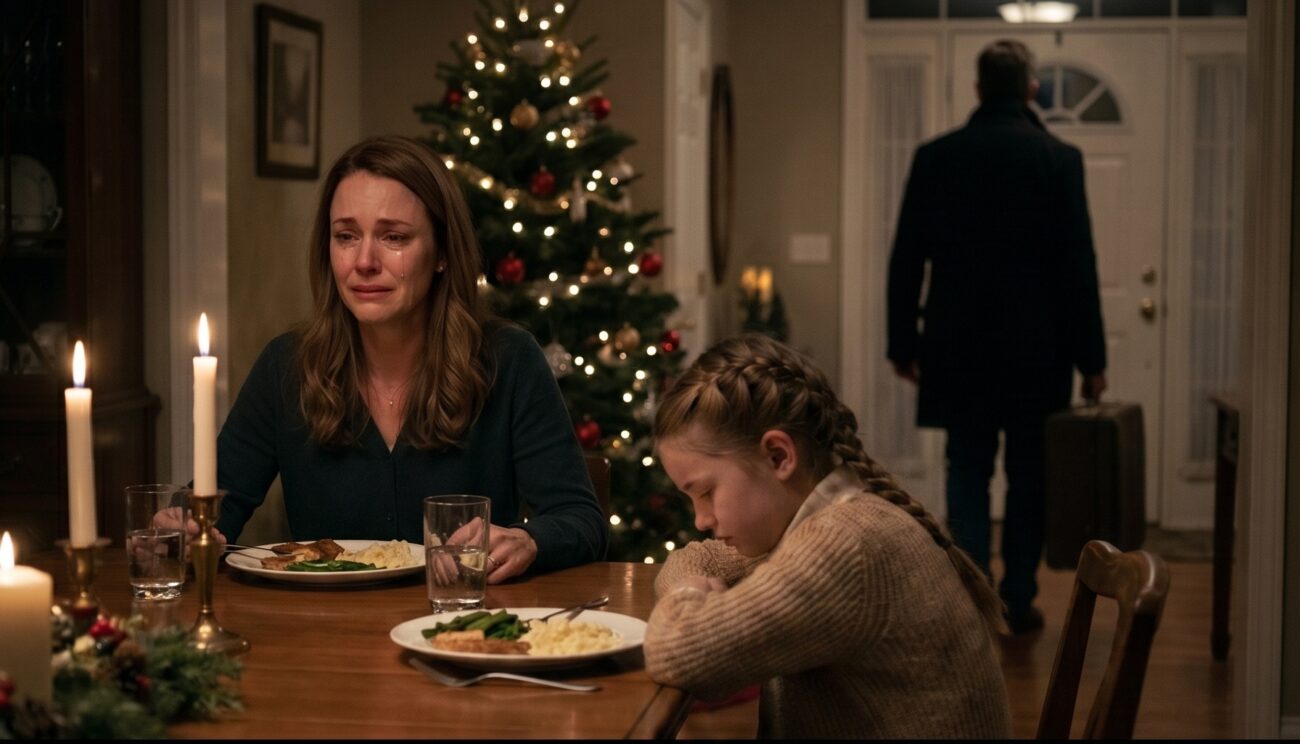
My Husband said it was an emergency work trip to Atlanta. At 9:43 PM, My Fitness Tracker Said He Was 6 Miles Away at a Marriott. I Put on My Coat and Drove There on Christmas Eve. A Blue Dot on My Phone Told Me My Marriage Was Over.
He said it was an emergency work trip to Atlanta. He said he’d call. He called for exactly one minute and forty-three seconds, said Merry Christmas, and hung up before I could finish a sentence. I sat with my wine and the feeling that something was wrong in a way I couldn’t name yet — and then I opened my fitness tracker app to find the device I’d left in his car. The blue dot wasn’t in Atlanta. It was at a Marriott in South End Charlotte. Six miles from the sugar cookies, six miles from our daughter asleep upstairs, six miles from seven years of a marriage I had just run out of reasons to believe in.
PART ONE: The Trip He Packed For
My husband told me he had to leave for an emergency business trip to Atlanta two days before Christmas. I believed him — not because I was naive, but because I had spent seven years building a marriage on the assumption that the person sleeping beside me was operating in good faith. That assumption is not stupidity. It is the basic architecture of a functioning partnership, and I refuse to be ashamed of it now.
He said the Atlanta office was dealing with a server migration that had gone sideways and that his team needed him on the ground. He said it with the particular brand of reluctant professionalism that I had always respected in him — the “I wish I didn’t have to, but someone has to” energy that made me admire his work ethic for seven years. He said he’d be back by the twenty-sixth, maybe the twenty-seventh. He said he was sorry about the timing.
I helped him pack. I folded his shirts the way he liked them — flat, sleeves tucked, stacked by color — and I put in the extra phone charger that always lived in the bathroom drawer, and I added the travel-sized ibuprofen because he got headaches on long drives and I knew this about him the way wives know things, the way you accumulate a person’s particular geography over years of daily proximity. I kissed him goodbye in the driveway at six-fifteen a.m. while it was still dark and our daughter Lily was still asleep upstairs.
“I’ll call you tonight,” he said. He kissed my forehead. He got in the car.
I went inside and made coffee and thought about how to make Christmas Eve feel whole for a seven-year-old with one parent, which is a manageable problem and one I was willing to solve.
Christmas Eve went the way Christmas Eves do when you are determined to make them good for a child. Lily and I made sugar cookies in the morning — the kind with the royal icing in the squeeze bottles that gets on everything and that I would be finding on the countertops until February. We watched The Polar Express in the afternoon, which Lily had seen eleven times and which she narrated quietly under her breath, not because she needed to follow the story but because she had memorized it and found comfort in the confirmation that the words were still right where she had left them.
We had tomato soup and grilled cheese for dinner, which was what Lily had requested when I asked what she wanted, because she is seven years old and has very clear priorities. I read her three chapters of her current book and then her Christmas Eve book — a tradition we had maintained since she was two — and I sat beside her bed until her breathing changed and she was gone, tucked under the quilt my mother had made her, the tree lights visible from the hallway through the crack in the door.
I went downstairs. I poured myself a glass of the Pinot Noir I had been saving for the holiday. I sat on the couch beside the lit tree, which had taken Lily and me forty-five minutes to decorate and which leaned slightly to the left in a way that I had decided was charming rather than a problem. I waited for Brett’s call.
He called at nine-fifteen. He said Merry Christmas. I said it back. I started to ask how the server situation was going, how the team was holding up, whether the hotel had decent room service — the ordinary questions of a wife maintaining connection across distance — and he cut me off. “I can’t talk, I have to go.” The call ended after one minute and forty-three seconds. I know because I looked at the call log afterward, the way you look at things when you are trying to understand why something felt wrong.
I sat with my wine and the lit tree and the quiet, specific wrongness of a conversation that had ended too fast. Not rushed — ended. Terminated. The particular abruptness of someone cutting a wire rather than setting something down carefully.
I am not sure what made me think of the fitness tracker. The mind does things in the margins of distress that the conscious self doesn’t always direct — small, lateral movements toward the truth. I had left the tracker in Brett’s car the previous week by accident. A Garmin vívoactive, a gift I had given myself the previous January when I started running again after years of meaning to. I had been looking for it for days. I had a vague memory of clipping it to the sun visor on the passenger side.
I opened the Garmin app on my phone more out of idle habit than real intention. The app showed the last synced location of the device — not real-time GPS, just the location where it had last connected to a paired device. Brett’s phone was paired. The app showed the last sync location.
The blue dot was not in Atlanta.
It was at a Marriott in South End Charlotte. I know the intersection — I have driven past that hotel a hundred times. Six miles from our house. Six miles. Not three hundred miles south on I-85, not somewhere in the vicinity of an Atlanta office park with a failing server migration. Six miles from the driveway where I had kissed him goodbye that morning in the dark.
I sat very still for a moment. The tree lights blinked in their slow, cheerful cycle — red, gold, green, white — completely indifferent to the fact that the person looking at them had just felt the floor shift under everything she thought she was standing on.
Then I put down my wine. I texted my neighbor, Dana, who had told me months ago to call her for anything, anytime, no explanation required. I put on my coat. I got my keys from the hook by the door. I drove to the hotel.
PART TWO: The Marriott in South End
The Marriott was decorated for the holiday — a wreath on the automatic doors, white lights around the lobby windows, a small artificial tree on the front desk counter with a gold star on top. The parking lot was half-full, quiet in the particular way of places where people are spending Christmas Eve away from home. The air smelled like cold pavement and, faintly, the pine of the lobby decorations coming through the sliding doors.
Brett’s car was in the third row of the parking lot. I saw it immediately — the navy Volvo XC60, the Northwestern alumni sticker on the rear window that he had been meaning to remove for two years. I parked three spaces away. I sat in my car for a moment. I was not crying. I want to be clear about that — not because crying would have been wrong, but because I want an accurate record of who I was that night, and who I was that night was someone who had moved past the emotional event and into the operational one with a speed that surprised even me.
I went to the front desk. A young woman in a hotel polo smiled at me with the professional warmth of someone working a holiday shift and trying to make it feel less like a holiday shift. I told her I was looking for my husband, Brett Calloway, and gave her his description. I told her I had a family emergency and needed to reach him directly. I told her I had been unable to reach him by phone.
She looked at her screen. I watched her face. There was a brief flicker — the micro-expression of someone processing a request they have processed in some version before and for which the hotel has unofficial protocol that is slightly different from official protocol. She said she wasn’t able to share guest room information, which I expected. She asked if I wanted to use the house phone to call his room.
I said yes.
She dialed. It rang four times. Then Brett answered, with the reflexive, half-asleep hello of someone who has not yet processed the situation they are in.
“Brett,” I said. “It’s me. I’m in the lobby.”
The silence that followed lasted approximately three seconds, which is a very long time to be silent when your wife is standing at the front desk of the hotel you told her you weren’t at.
“Claire—”
“I’ll wait here,” I said, and sat down in one of the chairs near the decorative tree with the gold star and waited.
He came down eleven minutes later, which was long enough that I had time to notice the details of the lobby — the pattern on the carpet, the music playing softly through the speakers (White Christmas, then Have Yourself a Merry Little Christmas), the way the Christmas lights outside the window made the parking lot look softer than it was. I noticed everything with the heightened, flat attention of a person in a kind of shock that has bypassed emotion and arrived directly at observation.
Brett looked the way people look when they have been caught not in the act but in the aftermath — not flushed, not frantic, but assembled too quickly, the seams of the story showing. He was wearing the Northwestern sweatshirt he always wore when he wasn’t performing any version of himself, and he had the specific stillness of a man who has had eleven minutes to decide what to say and has not been able to decide.
He sat down across from me.
He said my name.
I said, “How long?”
He looked at his hands. He said “Claire” again, which is not an answer to the question how long, and which told me that the answer was long enough that he couldn’t lead with it.
I said, “Who is upstairs?”
He looked up. “It’s not—”
“Don’t,” I said. The word was very quiet and completely final. “Don’t manage this right now. I am asking you a direct question and I am asking it once.”
Her name was Vanessa. She worked at his company’s Charlotte office — a different building from his, which I later understood was how he had justified to himself that it didn’t count as a workplace relationship. She was thirty-three years old. They had been seeing each other for fourteen months. Fourteen months. Lily had been six when it started. I had been the woman who folded his shirts and put in the extra phone charger and kissed him goodbye in the dark, for fourteen months, while this was happening.
I sat with that number for a moment.
Then I said, “I need you to go check out of this room tonight. You can stay at your parents’ in Ballantyne or you can stay here on your own card. But you are not coming home tonight, and you are not coming home tomorrow. Lily’s Christmas morning is not going to include this conversation.”
He started to speak.
“I am telling you what is going to happen,” I said. “Not asking.”
He nodded. He looked, for the first time in the conversation, like a man who understood that the person across from him had driven six miles on Christmas Eve and walked into a hotel lobby and sat by a decorated tree and was still, at this exact moment, more composed than he deserved.
I stood up. I drove home. I poured the rest of my wine. I sat by the tree until the lights on the timer went out at eleven, and I let myself cry for exactly as long as I needed to, and then I went to bed, and in the morning I got up and made Lily’s Christmas.
PART THREE: January
I did not tell anyone what had happened until after Christmas. Not my mother, not my best friend Priya, not Dana next door, who had watched Lily without asking a single question and who I knew would have come back in the morning with coffee and righteous fury in equal measure. I did not tell anyone because telling someone on Christmas made it a Christmas story, and I refused to give it that. It already had Lily’s sugar cookies and The Polar Express and the quilt from my mother. I was not going to add it to that list.
I told my mother on December 27th, after Lily went to bed, on the phone in the kitchen. She was quiet for a long time and then she said, “What do you need?” — which is the right question, and which is exactly what I would expect from a woman who had raised me on the understanding that the purpose of family is to answer that question before it is fully asked.
I told Priya on January 2nd, in her kitchen in Plaza Midwood, over the very good coffee she orders from a roaster in Asheville. Priya is a corporate attorney and one of the most precise thinkers I know, and her response was to ask three questions — how long, was I certain, and did I have documentation — before she said anything else. Then she said, “Okay. Here’s what we’re going to do.”
I retained a family law attorney on January 6th. Her name was Susan Okafor of Okafor & Bellamy on East Trade Street in uptown Charlotte, and she had been practicing family law in Mecklenburg County for twenty-two years. She was direct in the way that I needed her to be — not unkind, but without the softening that can make an attorney feel more like a therapist and less like someone who is going to help you navigate a legal process competently.
She asked about assets. I had brought a folder.
The folder was something I had started on December 27th, in the same calm, operational state that had carried me through the hotel lobby and the drive home and the wine by the tree. I am a project manager by profession — I run construction timelines for a commercial real estate firm, which means my primary skill set involves building comprehensive documentation, anticipating gaps, and keeping multiple complex tracks moving simultaneously without losing the thread of any of them. I had brought these skills to the folder the same way I brought them to everything else.
The folder contained: seven years of joint tax returns, account statements for our joint checking and savings accounts, documentation of the equity in our house, records of my contributions to Brett’s 401(k) during the three years he had been self-employed, documentation of the investment account we had opened together in 2021, and a printed copy of the fitness tracker app screenshot that showed the blue dot at the South End Marriott at nine-forty-three p.m. on December 24th.
I had also documented, in a simple numbered list, the evidence I had accumulated over the previous several months without fully understanding what I was accumulating: unexplained cash withdrawals that I had assumed were client entertainment expenses, a hotel charge on a business credit card statement from a Charlotte property that had no connection to any Atlanta client, three weekends marked as “conference” in his shared Google calendar for which I could find no conference registration or travel documentation when I looked.
I had not been looking for evidence. I had been managing the household finances the way I always managed them — thoroughly, systematically, with the attention of someone who simply does not leave details unaccounted for. The evidence had been there. I had filed it without understanding its shape. In January, the shape was clear.
Susan reviewed the folder with the focused attention of someone who has seen many folders and is assessing this one for completeness. When she finished, she looked at me over her reading glasses. “You came prepared,” she said.
“I manage projects,” I said.
She smiled briefly. “That’s going to help.”
PART FOUR: The Process
North Carolina is an equitable distribution state, which means marital assets are divided fairly — not necessarily equally, but in proportion to what each party contributed and what is equitable given the full picture of the marriage. Susan explained this on the first meeting and expanded on it in the weeks that followed as the discovery process began and the full picture of our shared financial life was mapped with the thoroughness that legal proceedings require.
What the discovery process found — in addition to what I already knew — was a secondary credit card Brett had opened in his own name eighteen months ago, which had been used for restaurant charges, hotel stays, and two weekend trips to Charleston that I had believed were fishing trips with his college roommate. The total charges over eighteen months were approximately $14,200. Susan’s team documented each one.
Brett had retained his own attorney — a family law practice in SouthPark that I recognized from a billboard on Park Road. He was, by his attorney’s initial posture in the early correspondence, anticipating a simpler proceeding than the one that was actually in front of him. Susan described his team’s initial approach as “optimistic in a way that will correct itself as the documentation is reviewed.” I appreciated her precision.
The house was the central asset. We had purchased it in 2018 for $380,000 in Dilworth, and the current appraisal came in at $620,000 — a reflection of the Charlotte market’s movement over those years. My down payment contribution had been $55,000, drawn from an inheritance I had received from my grandfather in 2017. Susan flagged this as separate property under North Carolina law — a pre-marital asset that had been traced clearly through the records.
Lily’s custody arrangement was the other central matter, and it was, in some ways, the harder one — not legally, because both Brett and I agreed from the beginning that we wanted joint legal custody and a parenting plan that prioritized her stability, but emotionally, because a parenting plan is the document in which a marriage’s ending is made most concrete. It is the piece of paper that tells a child, in the language of scheduled weekdays and holiday rotations, that her family is going to look different now, and that both of her parents are going to be present in that different shape whether or not they are in the same house.
Lily did not know what was happening yet. She knew that her father was “staying at Grandma and Grandpa’s for a while” because that was the age-appropriate truth I had offered, and she had accepted it with the particular resilience of a seven-year-old who is not yet old enough to ask the questions that have hard answers. I was working with a child therapist — a woman named Dr. Keisha Harmon in Myers Park who specialized in children of divorce — on how to have the full conversation at the right time, in the right way, with the right language.
I thought about Lily constantly during those months. Not with despair — I had made a deliberate decision in January that despair was not a mode I could afford, not because my feelings weren’t real but because Lily needed me functional and present, and those two requirements were incompatible with the kind of collapse that this situation arguably warranted. I thought about her the way I thought about every project I had ever managed: with the focused, forward-moving attention of someone who knows that the only direction available is through.
Brett and I had one significant conversation in February, at Susan’s office, with both attorneys present. It was not hostile. That was the detail that surprised people when I described it later — that two people in the middle of a divorce proceeding could sit across from each other and speak in measured, factual sentences about the practical architecture of ending a marriage. But I think hostility is, in many cases, a performance of injury, and I was not interested in performing anything. I was interested in getting to the other side of this with my daughter’s security intact and my own life in a shape I could build from.
Brett was, in that meeting, the best version of himself — the version I had married, the one that was competent and present and stripped of the particular vanity that had apparently made a fourteen-month lie seem manageable to him. He agreed to the parenting plan framework without significant negotiation. He agreed to the financial disclosure timeline. He looked, across that conference table, like a man who understood what he had done and was no longer trying to argue his way out of understanding it.
I did not feel warmth toward him in that meeting. I did not feel contempt, either. What I felt was the specific, clarifying blankness of someone who has finished grieving a thing before the proceedings that document its end have concluded — who has moved through the loss and arrived, still standing, on the other side of it.
The settlement was reached in April.
PART FIVE: The Other Side
The divorce was finalized on a Thursday afternoon in May, in a brief proceeding before a Mecklenburg County family court judge who reviewed the consent agreement, asked two questions, and signed the order. Susan called me from the courthouse. I was at my desk at work, in the middle of reviewing a construction timeline for a mixed-use development in NoDa, and I sat for a moment after the call with my hands flat on the desk and my eyes on the window and the Charlotte skyline in the spring light.
Then I went back to the timeline.
The house was mine. The settlement reflected my down payment contribution, the equity accrued during the marriage, and Susan’s thorough documentation of the marital assets and their sources. Brett received his share of the liquid marital accounts and his retirement portfolio, which had grown during a period when I had contributed both financially and operationally to the household that allowed him to invest in it. The $14,200 in undisclosed personal expenses was factored into the equitable distribution calculation in a way that Susan had anticipated from the first meeting.
I did not pursue alimony. I had my own income, my own career, and the specific pride of a woman who does not want to structure her future around monthly payments from someone she no longer trusts. What I wanted was a clean line — a settlement that reflected what was true and then closed, so that what came after could belong entirely to me.
Lily started seeing Dr. Harmon in March and had her first full conversation with both Brett and me together in April, in Dr. Harmon’s office, with the kind of age-appropriate honesty that seven-year-olds sometimes handle better than adults expect because they have not yet learned that things are supposed to be more complicated than they are. She cried. She asked if it was her fault, which Dr. Harmon had told us she would ask, and which Brett and I answered together with the only true answer: absolutely not, not even slightly, not for one second. She asked if she would still see her dad. We said yes. We said often. She asked if she could still have her room.
“That’s your room,” I told her. “It’s always going to be your room.”
She nodded, with the particular seriousness of a seven-year-old receiving important information, and then asked if we could get ice cream on the way home.
We got ice cream on the way home.
People ask me about the fitness tracker. It has become the detail of the story that people want to talk about — the blue dot on the app screen, the six miles, the Christmas tree in the Marriott lobby. I understand the appeal of it as a narrative hinge. It is, objectively, a very good detail. It is the kind of specific, mundane, accidental piece of truth that stories are usually built around — the thing that was not planned, not dramatic, not the product of investigation or confrontation, just a small piece of technology doing exactly what it was designed to do while a woman sat on a couch by a lit tree wondering why a phone call had ended too fast.
But I want to be clear about what the fitness tracker did and didn’t do. It showed me a location. It gave me a coordinate. What it could not give me — what nothing could give me — was the thing I actually needed, which was the moment of clarity that follows the removal of uncertainty. The fitness tracker ended the uncertainty. It handed me the truth in the form of a blue dot on a map, and what I did with the truth was drive six miles in a coat on Christmas Eve and sit in a hotel lobby and wait for my husband to come downstairs.
The clarity was mine. I made it from what I found.
It is October now. Charlotte in October is the best version of itself — the temperatures dropping into the sixties, the light going golden earlier in the afternoon, the trees in Dilworth turning the particular red and orange that makes the neighborhood look like it was designed for fall specifically. Lily started second grade in August. She is doing well, which is the thing I care about most and the thing I track with more attention than any construction timeline I have ever managed.
She spends alternating weeks with Brett and with me, in the parenting plan schedule that Dr. Harmon helped us design to minimize transitions during the school week. Brett has an apartment in South End — I know the general neighborhood, though not the specific building, which is exactly the right amount of information for me to have. He is, by Lily’s account, present and engaged on his weeks, which is what matters. I take Lily’s account seriously because she is the most reliable narrator of her own experience and because she has no incentive to tell me anything other than what is true.
I run in the mornings now. Five days a week, before Lily wakes up, along the greenway that runs through Freedom Park and down to the creek. My fitness tracker — the same Garmin, reclaimed from Brett’s car in January along with the travel charger and the ibuprofen — is clipped to my wrist, logging my miles, syncing to my own phone on my own account. I do not particularly find this symbolic. I find it practical. But I will acknowledge that there is a specific satisfaction in looking down at my wrist on a cold October morning on the greenway, with the park quiet and the creek running fast from the overnight rain, and seeing the green light pulse.
It was always mine. It just took a blue dot on a map for me to know I needed it back.
I am not going to tell you that the Christmas Eve in the Marriott lobby was the worst night of my life, because I am not sure that is true and I believe in precision. It was a night that changed the shape of my life in ways I am still learning to map. It was a night that ended something and, in the same motion, began something — a version of myself that is less forgiving of dishonesty, more fluent in her own legal rights, more certain of what she is willing to build and what she is not willing to carry.
I am thirty-eight years old. I am a project manager in Charlotte, North Carolina. I own a house in Dilworth with a tree that leans slightly to the left and a daughter who memorizes books she loves and asks for grilled cheese on Christmas Eve and will grow up in a home where the adults tell the truth even when it is expensive.
That last part is not a small thing. It is, in fact, the whole point.
