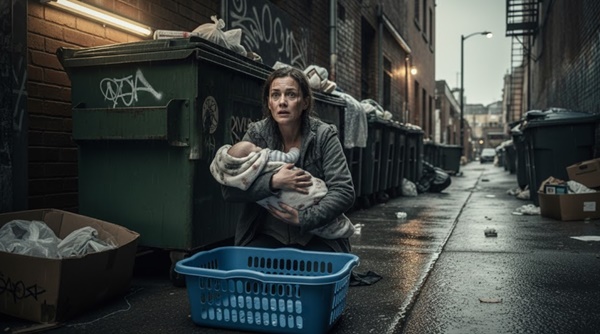
‘Crazy Trash Lady’ found him in a laundry basket behind a dumpster. 20 years later, he silenced them all…..
“You’re raising someone else’s child just to be left alone in the end.”
20 years later, the “crazy” woman got an answer that silenced the entire town.
In a small, forgotten town in the Rust Belt, where the fog clings to the rusted fences like a funeral shroud, lived Martha. At 65, her back was curved like a question mark, a physical map of a life spent hauling what others threw away.
Every morning at 5:00 AM, the rhythmic clink-clink of her rusty shopping cart echoed through the alleys. While the world slept, Martha was hunting for treasure: aluminum cans, discarded copper wires, and glass bottles. To the town, she was the “Can Lady.” To herself, she was just a woman trying to survive.
Martha lived in a trailer at the edge of the creek—a place that smelled of damp earth and loneliness. Life had taken everything from her. Her husband died in a construction accident decades ago. Her only son, Samuel, was lost to a fever when he was just three months old. Since then, Martha had become a ghost in her own life, speaking more to the stray cats than to people.
One Tuesday, the sky was a bruised purple, heavy with the threat of rain. As Martha reached into a dumpster behind a grocery store, the manager barked, “Move it along, Martha! You’re scaring off the customers with that smell!”
She mumbled an apology, pulling her thin coat tighter. Behind her, she heard the snickering of teenagers: “Look at her. No family, no life. Must have done something terrible to end up like that.”
She didn’t look back. She just gripped the handle of her cart harder.
But as she passed the old brick wall behind the town square, she heard it. A sound so faint, it was almost a trick of the wind. A whimper. A thin, fragile cry.
At first, she thought it was a kitten. But as she moved a pile of damp cardboard, her heart stopped.
There, tucked inside a cracked plastic laundry basket, was a newborn baby. He was wrapped in a threadbare flannel shirt. Taped to the side was a crumpled note, stained with tears: “Please. I can’t give him the life he deserves. Give him a chance.”
Martha stood frozen. The morning chill bit at her skin, but her eyes were burning with something else. She reached out with a trembling hand and touched his cheek. The baby’s tiny hand instinctively curled around her index finger. It was a grip of pure desperation.
Passersby began to gather. “Call Social Services,” someone said. “You can’t take him, Martha. You can barely feed yourself,” another added. “He’ll just grow up and leave you. Don’t be a fool.”
Martha didn’t hear them. Something in her frozen heart was thawing—like the first ray of sun after a brutal Michigan winter.
“You have no one… and I have no one left,” she whispered, her voice cracking for the first time in years. “How about we be ‘no one’ together?”
From that day on, the trailer by the creek changed. There was the sound of a baby’s cry, the glow of a dim lamp late at night, and a woman who finally found a reason to stay awake.
The neighbors called her “Crazy Martha.” They warned her: “Raising a stranger’s kid is a thankless job. He’ll leave the moment he tastes freedom.”
She would only smile, her eyes deep and peaceful. “Maybe he will. But for now, I get to hear someone call me ‘Mom.’ I’ve waited a lifetime for that sound.”
She named him Hope.
Hope grew up in the shadows of poverty. Dinner was often canned soup and day-old bread. His clothes were thrift-store finds, patched and re-patched. But Martha taught him a different kind of wealth.
“Character isn’t built in a mansion, honey,” she’d say, scrubbing his school spirit shirt until it was snowy white. “You can be poor in pocket, but never be poor in soul.”
Every night, she pushed her cart for miles to save for his school supplies. Her hands were cracked and calloused, bleeding in the winter cold, but she never let him see her wince.
Once, a bully at school taunted him: “Your mom is a trash picker! She smells like a landfill!” Hope didn’t swing a punch. He looked the boy in the eye and said, “My mom smells like the hard work it takes to keep me fed. What does yours smell like?”
Hope was brilliant. He studied by candlelight. When he was accepted into Johns Hopkins University with a full scholarship to study medicine, he collapsed into Martha’s arms, sobbing.
Martha just smiled, pressing a crumpled $20 bill into his hand—her entire “emergency” fund. “Go, son. I don’t need anything. Just live a life that matters.”
During his years in the city, Martha sent him letters. The handwriting was shaky, the grammar wasn’t perfect, but the love was undeniable. “I found a good haul of scrap today. Bought you that medical textbook you wanted.” He tried to send money back, but she always returned it with a note: “Keep it. I’m already rich.”
20 years later.
The old trailer was gone, replaced by a small, sturdy cottage Martha had managed to keep up. One afternoon, a sleek black car pulled into the gravel driveway. The neighbors gathered, whispering. “That’s Hope. Martha’s boy. He’s a big-shot surgeon now. Probably here to finally put her in a home.”
A man stepped out, dressed in a sharp suit. He didn’t look at the house; he looked for the woman.
When he saw Martha sitting on the porch, he didn’t just wave. He walked over and knelt in the dirt at her feet.
“Mom,” he said, his voice thick with emotion. “I’m home. And I’ve bought a place for us by the coast. You’ll never pick up another piece of scrap as long as you live.”
Martha looked at him, her eyes clouded with age but bright with pride. She ran her hand through his hair.
“I didn’t do much, son. You were the light God gave me to find my way out of the dark. Seeing you like this… that’s my heaven right here.”
The neighbors stood in silence. The ones who had called her “crazy” now wiped their eyes, looking down at their own feet in shame.
As they packed her things, Hope picked up the old, cracked plastic laundry basket she had kept all those years in the corner.
“Mom, let’s throw this out. I’ll buy you the best luggage money can buy.”
Martha smiled, her gaze drifting to the horizon where the sun was setting in a blaze of gold.
“Keep the fancy bags, honey… This old basket? It held my whole world when no one else would. It’s a reminder that sometimes, the things people throw away are the only things worth saving.”
As the car drove away, the sunset reflected off the creek. Somewhere in the distance, the sound of a child’s laughter echoed—as clear and bright as the hope found in a dumpster two decades ago.
If this story touched your heart, drop a “❤️” and share it. You never know who needs a reminder that kindness is never a waste of time.
