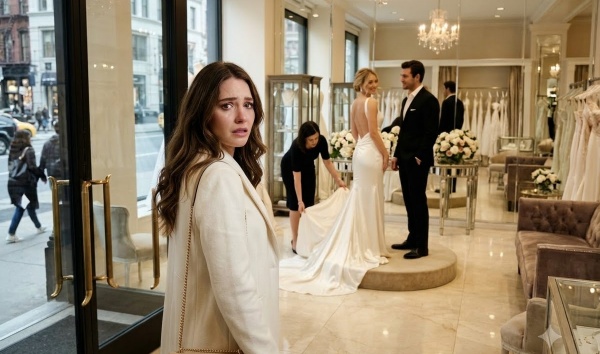
Three weeks before my wedding, I walked into a bridal boutique and found my cousin wearing My Wedding Veil. My fiancé stood in front of her, smiling as though she was the bride. They told me it wasn’t what it looked like, but an email waiting in my inbox revealed they had already changed more than I ever imagined. Before they could take the wedding I had spent almost a year building, I would make one decision they never expected.
Part 1: The Fitting Room
Three weeks before my wedding, I walked into the bridal boutique and found my cousin wearing my custom cathedral-length veil while my fiancé stood in front of her, looking at her like she was the woman he was about to marry. Before they could take the wedding I had spent almost a year building, I would make one decision they never expected. But the betrayal in that fitting room was only the beginning of what they had failed to understand.
The boutique sat on a quiet street in Savannah, Georgia, between a bakery and a store that sold handmade candles. I had been there so many times that the woman at the front desk recognized my car before I even opened the door. That afternoon, I was only supposed to pick up a garment bag and confirm the final alterations on my dress.
I had taken the day off from my job at a local accounting firm because my mother was coming in from Atlanta that evening. I wanted everything ready before she arrived, down to the welcome basket in her hotel room. She had been looking forward to the wedding for months, and I was determined to give her a weekend she would remember.
When I stepped inside, the front desk was empty. Somewhere in the back, someone laughed, and I recognized the sound immediately. It belonged to my cousin, Lauren.
I smiled at first. Lauren had been helping me with last-minute details, and I figured she had stopped by to pick up the bridesmaid dresses. Then I heard another voice, lower and familiar enough to make me stop.
“That’s exactly how I imagined it,” my fiancé said.
I followed their voices down the hallway, my keys still in my hand. The door to the largest fitting room was partly open, and through the gap I saw a long trail of ivory tulle spread across the carpet. Tiny pearls caught the afternoon light from the window.
My veil.
Lauren stood on the small platform in front of the mirror, wearing a simple white dress I had never seen before. Daniel was facing her, holding one edge of the veil between his fingers. He was smiling at her in a way that made my stomach drop before either of them noticed me.
For a second, I told myself there had to be an explanation. Maybe the boutique had needed someone close to my height to check the length. Maybe Daniel was helping with some ridiculous surprise.
Then Lauren looked at him and whispered, “Are you sure she won’t be here?”
My keys slipped from my hand and hit the hardwood floor.
Both of them turned. Lauren’s face drained of color, and Daniel dropped the veil as if it had burned him. Neither spoke while I picked up my keys.
“What are you doing?” I asked.
Daniel opened his mouth, but Lauren answered first. “Emma, this looks worse than it is.”
I stared at the veil. My grandmother’s lace had been carefully stitched along the edge, the same lace she had worn on her own wedding day in 1958. After she died, my mother gave it to me in a small blue box, and I had taken it to the boutique to have it incorporated into something new.
Lauren knew what it meant. She had been sitting beside me when the seamstress opened the box and told me she could make the lace part of the veil. She had cried with me that day and said Grandma would have loved seeing us together.
“Take it off,” I said.
“Emma, please let me explain.”
“Take it off.”
Her hands trembled as she reached for the comb, but it was caught in her hair. For one ugly moment, I was afraid she would tear the lace. The seamstress, Mrs. Alvarez, appeared in the doorway and gently stepped in to remove it.
She had a measuring tape around her neck and a look on her face I couldn’t read. She folded the veil over her arm, then carried it past me toward the workroom without saying a word. I was grateful she understood it was mine.
Daniel followed me into the hallway. “I didn’t know she was going to put it on,” he said. “I came here because she said she needed my opinion about something for the rehearsal dinner.”
“Then why were you holding my veil?”
He glanced back toward the fitting room. “She was upset. She wanted to see what it looked like, and Mrs. Alvarez stepped out for a minute.”
Lauren came out behind him, still wearing the white dress. It was knee-length, with little fabric-covered buttons down the front. She looked less like someone attending a rehearsal dinner than someone planning to stand at the front of a courthouse.
“I’m sorry,” she said. “I know I should have asked.”
“Why are you wearing white?”
“It’s just a dress, Emma.”
“For what?”
She looked at Daniel. He looked at the floor.
That was the moment I understood there was a question neither of them wanted to answer. I had known Lauren all my life and Daniel for four years. I knew the difference between two people caught doing something thoughtless and two people trying to decide how much of the truth to tell.
My phone buzzed in my purse. It was my mother, reminding me that her flight landed at six and asking whether I wanted her to bring the old family photo albums. I stared at her message while the two people in front of me waited for me to make this easier for them.
I didn’t.
“Are you having an affair?” I asked.
Daniel’s head snapped up. “No.”
Lauren said, “It’s complicated,” at exactly the same time.
The silence that followed was so complete I could hear a delivery truck backing up outside. Daniel reached for my hand, but I stepped away. I asked Lauren what she meant.
“We’ve been talking,” she said. “About how things have changed.”
“What things?”
“Between us.”
I looked at Daniel. His face had that careful, apologetic expression he wore when he had already decided what he wanted and was waiting for everyone else to catch up. I had seen it when he quit his job without telling me and when he bought a truck we had agreed we couldn’t afford.
“How long?” I asked.
He rubbed his forehead. “A few months.”
A few months. During those months, Lauren had helped me choose flowers and addressed invitations at my kitchen table. Daniel had tasted wedding cake beside me, kissed me in the parking lot afterward, and told me he couldn’t wait to be my husband.
I wanted to ask whether they had laughed about me afterward. I wanted to know if they had stood in my kitchen, eating the pasta I made for them, and exchanged looks while I talked about seating arrangements. But Mrs. Alvarez was waiting in the workroom with my grandmother’s lace, and I needed to get it home.
I asked her to pack the veil and my dress. Daniel tried to follow me, but I closed the workroom door behind me. Mrs. Alvarez didn’t ask questions; she simply wrapped the veil in tissue paper and placed it in its box.
When I came out, Lauren was back in her jeans. Daniel stood beside her, and for a moment neither of them looked like someone I had ever loved. They looked like strangers who had wandered into my life and started moving the furniture.
“I’ll come by tonight,” Daniel said.
“No,” I told him. “You won’t.”
He frowned. “We live together.”
“I know where we live. I’m telling you that I need tonight without you.”
He started to argue, then noticed Mrs. Alvarez watching from behind the counter. He lowered his voice and said he would stay at his brother’s house. Lauren kept her eyes on the floor as I walked past her.
In the parking lot, I placed the veil box on the passenger seat and sat behind the wheel without starting the car. I thought the worst part was finding them together. I thought the white dress and the look on Daniel’s face were the whole betrayal.
Then my phone buzzed again.
It was an email from our wedding venue, with a subject line that made me read it twice.
Updated event details for the wedding of Lauren Whitaker and Daniel Mercer.
Part 2: The Wedding They Had Planned
For several minutes, I sat in the boutique parking lot with the email open on my phone. The message contained an updated event summary, a new seating estimate, and a request to confirm the revised names on the welcome sign. At the bottom was a note from the venue coordinator: “Per your conversation with Daniel and Lauren, please review these changes.”
My name was nowhere in the event summary.
I called the coordinator, a woman named Beth who had worked with me for nearly a year. When she answered, I asked her why my cousin’s name had replaced mine. Her cheerful greeting vanished.
“Daniel told me the two of you had separated,” she said. “He said you were aware that Lauren would be taking over the event.”
I looked through the windshield at a couple walking past the bakery, sharing a paper bag of cookies. “And you believed him?”
“He said you were having a difficult time and didn’t want to discuss it. I should have called you directly, Emma. I’m sorry.”
I pulled up the original agreement on my phone while we spoke. My name was on the contract as the client, and the payments had come from my account and the joint account Daniel and I had opened for wedding expenses. I asked Beth not to make any further changes until I had a chance to review everything.
She agreed to pause the revisions, though she explained that any cancellation or change would still be governed by our contract. There were deadlines, deposits, and other vendors involved. She promised to email me a copy of the current agreement and a record of the requested changes.
Then she said something that made my hand tighten around the phone.
“Daniel mentioned Lauren might be wearing the family veil. He said you had offered it to her.”
I looked at the blue box beside me.
“No,” I said. “I didn’t.”
Beth was quiet for a moment. “I’m very sorry, Emma.”
After we hung up, I called my mother. She answered from the airport, where she was waiting at her gate with a cup of coffee. I had planned to tell her in person, but the words came out before I could find a gentler way.
“Mom, the wedding might be off.”
She didn’t ask about the deposits or the guests or the dress. She asked, “Are you safe?”
“Yes.”
“Are you alone?”
“Yes.”
“All right,” she said. “I’m getting on that plane.”
I drove home slowly, keeping both hands on the steering wheel. At every red light, I checked my phone and found another message from Daniel. The first asked me to call him; the next three said we needed to talk; the last one said I was making a scene.
I didn’t answer any of them.
Our house was a small rental with a front porch and a stubborn blue door. Daniel had moved in two years earlier, and we had spent most weekends making it feel like ours. There were framed photographs in the hallway, a bowl of lemons on the kitchen counter, and a calendar on the refrigerator with our wedding date circled in red.
I carried the dress inside and hung it in the guest-room closet. Then I put the veil box on the bed and sat beside it. I had just begun to cry when I noticed a stack of mail on the dresser.
Most of it was junk, but one envelope had the logo of the caterer we had hired. Inside was an invoice for a revised menu and a handwritten note thanking us for confirming the changes. The date on the invoice was ten days earlier.
Lauren had been eating lunch with me ten days earlier. We had sat at a café near my office while she complained about her boss and asked whether I was nervous about getting married. I remembered telling her I was nervous about the speech my father would never get to give.
My father had died four years before, after a sudden heart attack. He had been the kind of man who fixed neighbors’ porch steps without sending them a bill and called every Sunday, even when he had nothing to report. I had planned to leave an empty chair for him at the ceremony, with a photograph and a sprig of rosemary from his garden.
The revised seating chart attached to the caterer’s invoice showed no empty chair.
I called the florist next. She confirmed that Daniel had asked her to replace my father’s rosemary arrangement with more white roses. He had also asked whether the bouquet could be changed from garden roses and greenery to an arrangement Lauren had saved on a shared inspiration board.
The florist had not made the changes yet. She had found the request odd because I was the one who had handled nearly every conversation with her. She had planned to call me the following morning.
By then, I could no longer believe that what happened in the boutique had been a moment of weakness. Daniel and Lauren had been moving through my wedding plans, detail by detail, while I was still paying for them. They had treated my life like a room they could redecorate before I got home.
I opened the banking app on my phone. The joint wedding account held a little over $11,000 the last time I checked it. That afternoon, the balance was $2,436.
There had been three withdrawals over the previous two weeks. Two were transfers to an account I didn’t recognize; the third was a payment to a jewelry store. Daniel and I both had access to the joint account, so I couldn’t assume that every withdrawal was illegal, but I knew I hadn’t agreed to them.
My hands were shaking when I called the bank. The representative couldn’t discuss an account that wasn’t mine, and she couldn’t tell me where the transfers had gone. She did help me download statements and explained my options for protecting my individual accounts.
I changed the passwords on the accounts that belonged only to me and made sure the contact information was current. I also moved the money from my personal savings account to another account in my name, after checking with the bank about how to do it. I did not touch the remaining joint funds until I understood what I was allowed to do.
At five-thirty, Daniel called again. This time I answered because I needed him to hear me clearly.
“I saw the venue email,” I said. “And I saw the withdrawals.”
There was a pause. “I was going to explain.”
“When?”
“Tonight.”
“Before or after you changed the flowers?”
He sighed, and I could hear a television in the background. “Emma, we were trying to figure out a way to handle this without wasting everything that had already been paid for.”
“You put Lauren’s name on my wedding.”
“It wasn’t your wedding anymore if we weren’t getting married.”
That sentence landed harder than I expected. Not because it surprised me, but because he said it as if I had already agreed to a breakup no one had bothered to tell me about.
“You hadn’t even told me,” I said.
“I didn’t know how.”
“So you let me keep planning?”
“I didn’t want to hurt you.”
I looked at the calendar on the refrigerator. Yesterday, he had written “cake tasting deposit” in the square for Friday and drawn a little heart beside it. He had stood in this kitchen and watched me make a grocery list for the week my mother arrived.
“You should have been honest,” I said. “You don’t get to make decisions for me because you’re afraid of a difficult conversation.”
His voice sharpened. “You’re acting like Lauren and I planned some kind of crime.”
“I’m asking you what you did with our wedding money.”
“Some of it went toward bills. Some went toward the rings.”
“What rings?”
He didn’t answer.
I ended the call before he could offer another explanation. A minute later, Lauren texted me: He was going to tell you. Please don’t make your mom hate me before we can explain.
I read the message twice, then set my phone face down. The person Lauren feared disappointing was not the cousin whose wedding she had tried to take. It was my mother, who had welcomed her into our home for years.
At the airport, Mom came through the arrivals doors carrying a small suitcase and the old photo albums in a canvas tote. The moment she saw my face, she left the suitcase standing and wrapped her arms around me. I had been holding myself together for hours, and I finally let go.
We were halfway home when Daniel called her.
She put him on speaker because I asked her to. He sounded calm, almost reasonable, and said he and Lauren had made mistakes but wanted to “do the right thing now.” Then he made a request I had not expected.
“Could Emma give us until Sunday before she tells anyone?” he asked. “Lauren’s mother has a heart condition, and we don’t want her hearing it the wrong way.”
Mom glanced at me. “What do you mean, the wrong way?”
Daniel hesitated. “Lauren and I were going to tell the family together.”
“Tell them what?”
Another pause.
“That she’s pregnant.”
Part 3: The Choice
My mother pulled into the parking lot of a grocery store before either of us said anything. She turned off the engine and stared straight ahead, her hands resting on the wheel. I watched a woman load bags into the back of an SUV and wondered how the world could look so ordinary.
Daniel was still on speaker. He said Lauren had found out a few weeks earlier and that they were waiting until she had seen her doctor before telling anyone. I didn’t ask for dates or details; I had already heard enough to know the relationship was over.
Mom asked whether Lauren was all right. Daniel said she was. Then he returned to the thing he apparently considered most urgent.
“We don’t want to cancel everything,” he said. “The venue, the food, the guests coming into town. It could still be a wedding, just not the one we originally planned.”
I looked at my mother. She looked at me. Neither of us spoke.
“We’d reimburse Emma for what we can,” Daniel continued. “And we’d tell people in a way that protects her.”
“Protects me from what?” I asked.
“From embarrassment.”
I ended the call.
For the first time that day, I laughed. It wasn’t a happy sound, but it broke through the numbness long enough for me to understand exactly what he was offering. He wanted me to give up the wedding, the money, and the truth, and he wanted credit for sparing my feelings.
Mom reached across the console and took my hand. “You don’t have to decide anything tonight,” she said.
We ordered takeout and ate it at the kitchen table. Between calls from relatives and messages from Daniel, I showed her the contracts, invoices, and bank statements. She listened without interrupting, except to ask which accounts were in my name and whether I had copies of everything.
Around nine, my aunt Diane called. She was Lauren’s mother and my father’s younger sister, and for most of my life she had been the person I called when I needed a second opinion. She taught me to make biscuits, came to my college graduation, and once drove three hours to sit with me after a breakup.
I answered because I thought she might not know what had happened.
“Lauren told me,” she said.
I closed my eyes. “Then you know why the wedding is off.”
“I know things are a mess. But there’s a baby involved now, Emma.”
“I understand that.”
“Do you? Because Lauren is terrified, and Daniel says you’re threatening to cancel everything.”
“I asked the venue to pause changes until I can review the contract.”
“That money will be gone either way,” she said. “Wouldn’t it be better if something good came out of it?”
I looked across the table at my mother. She was sorting papers into neat piles: venue, caterer, florist, photographer. When she heard Diane’s voice grow louder through the phone, she stopped.
“Something good for whom?” I asked.
“For the family.”
“I’m family too.”
Diane sighed. “Honey, sometimes we have to put our pride aside.”
I wanted to remind her that she had called me every day after my father died. I wanted to ask whether she remembered holding my hand at the funeral while Lauren stood on my other side. Instead, I asked a question I had been avoiding.
“Did you know they were planning to use my wedding?”
She took too long to answer.
“I knew they were discussing options,” she said.
“How long?”
“About a week.”
A week. For a week, my aunt had known that her daughter and my fiancé were discussing how to replace me at my own wedding. During that same week, she had called to ask whether I wanted her famous peach cobbler at the rehearsal dinner.
I told her I needed to go. She began saying my name, but I ended the call and set the phone down. Mom reached for it when it rang again and silenced it for me.
The next morning, I met with a local attorney named Rachel Bennett. A friend from work had recommended her, and she agreed to see me after I explained that several contracts had deadlines approaching. I brought a folder full of documents and a notebook where I had written down every conversation I could remember.
Rachel listened while I described the venue changes, the joint account, and the payments I had made. She didn’t promise that I could recover everything, and she didn’t suggest that Daniel’s withdrawals automatically amounted to a crime. She said the contracts, account terms, and facts would matter, and that I should preserve records rather than make accusations I couldn’t support.
She also advised me to contact each vendor in writing, explain that the wedding was not proceeding as planned, and ask about my options under the agreements. If Daniel was a party to a contract, we would need to account for that. If a deposit was nonrefundable, a vendor might still offer a credit or another arrangement, but there was no guarantee.
It was not the dramatic answer I had imagined. There was no magic sentence that would undo what had happened or make every dollar reappear. There was only a list of practical steps, a box of tissues on Rachel’s desk, and the uncomfortable work of deciding what I wanted next.
“What would you like to do with the date?” Rachel asked.
I had been so focused on stopping Daniel and Lauren that I hadn’t considered the question. The venue was booked for a Saturday afternoon in December, and nearly a hundred people had already made travel plans. My father’s college roommate was flying in from Ohio, and my mother’s oldest friend had bought a dress she’d been showing everyone for weeks.
“I don’t know,” I said.
“That’s all right. Find out what the venue permits before you decide.”
When I got home, Mom was on the porch with two mugs of coffee. She handed me one and told me she had spoken to Beth. The venue could not promise a full refund, but Beth was willing to discuss converting the reservation into a different event, subject to a revised agreement and the other vendors’ availability.
I sat beside Mom on the porch swing. Across the street, a neighbor was wrestling a string of holiday lights into a boxwood bush. It was the kind of small, familiar scene that usually made me feel at home.
“I don’t want their wedding,” I said.
“Then don’t give it to them.”
“I don’t want mine either. Not anymore.”
Mom nodded. “That makes sense.”
I thought about my father’s empty chair and the people who had already made plans to come. I thought about how many times he had gathered friends and relatives around a table, even when there was no special occasion. After he died, everyone said we should get together more often, but the years had slipped by.
“What if we still have dinner?” I asked. “Not a wedding. Just dinner for the people who want to come.”
Mom smiled, but she didn’t rush me. “What would you want to celebrate?”
I watched the neighbor step back from the bush and inspect his crooked lights. “Dad always said a table shouldn’t need an excuse.”
My mother’s eyes filled. “He did say that.”
I called Beth that afternoon. We discussed the cost of changing the event, what deposits could be applied, and which details still needed written approval. I told her not to substitute Lauren’s name for mine or confirm any wedding plans with Daniel or Lauren while the contract was being reviewed.
Then I sent Daniel an email. I told him the wedding was canceled, that I would be communicating about shared financial matters in writing, and that I was exploring other permitted uses for the venue. I made no promise about money I didn’t know I could recover.
He called within minutes. When I didn’t answer, he sent a message.
You can’t seriously be doing this. People already know there’s a wedding that weekend.
I wrote back: They’ll know there isn’t one as soon as I tell them.
His next message arrived almost immediately.
Lauren told her friends to save the date. She’s already sent them pictures of the dress.
I stared at the screen. They had not merely imagined taking my place; they had started inviting people to watch it happen. I wondered how many of those friends thought I had quietly stepped aside.
Before I could respond, another message appeared.
There’s something else you need to know about the house.
Part 4: What Was Mine
Daniel’s message sent me straight to the folder where I kept our lease. We rented the house together, and both of our names were on the agreement. Whatever he meant, I knew I couldn’t simply declare it mine or expect him to disappear because I was angry.
When I called, he sounded relieved that I had finally answered. He told me he wanted to stay in the house after the wedding date and that Lauren would eventually move in. He had already spoken to the landlord about renewing the lease.
“You talked to him before you talked to me?” I asked.
“I wanted to know what our options were.”
“Our options?”
He corrected himself. “My options.”
I asked whether the landlord had agreed. Daniel said no paperwork had been signed, but he thought it would be simpler if I moved out. Lauren’s apartment lease was ending, and the house had a second bedroom.
I looked toward the hallway, where the framed photograph of my father still hung. Daniel had helped me choose the frame, then held the nail in place while I checked whether it was straight. I wondered if he had already decided which of my things would need to go.
“I’ll speak to the landlord myself,” I said.
Daniel’s voice softened. “Emma, I know this is painful, but we’re trying to build a family.”
“So was I.”
That afternoon, I called the landlord and explained that Daniel and I had separated. He confirmed Daniel had asked about renewing, but no new agreement had been made. We arranged a meeting to discuss the existing lease and possible options for both of us.
I didn’t want to stay in the house. I had loved the porch and the big kitchen window, but I no longer wanted to measure my days against the life I had expected to have there. Still, leaving would have to be handled properly, with an agreement about the lease and our belongings.
My friend Tasha came over that evening with boxes, packing tape, and a container of macaroni and cheese. She had been my roommate in college and knew that when I was overwhelmed, I either cleaned the kitchen or stopped eating. She put the food in front of me before she asked a single question.
After dinner, we walked through the house and made a list of what belonged to me. Tasha took photographs of the furniture I had purchased before Daniel moved in and helped me gather receipts I already had. We left his belongings alone and put shared items on a separate list to discuss later.
At the bottom of my dresser drawer, I found a birthday card Daniel had given me the year we got engaged. Inside, he had written that he loved the way I made people feel welcome. I sat on the floor with the card in my hand until Tasha found me.
“You can throw it away,” she said.
“I know.”
“You can keep it too.”
I put the card in a box marked decide later. It was a small relief to remember that I didn’t have to make every choice at once.
Two days later, I sent a message to our guests. I kept it short: the wedding would not take place, and anyone who had made travel arrangements should contact their airline or hotel about changes. I apologized for the inconvenience and said I would share more information about the dinner once the details were confirmed.
Some people responded with kindness. Others asked questions I wasn’t ready to answer. One of Daniel’s uncles wrote, “Are you sure?” as if I had accidentally canceled the wrong wedding.
Lauren posted a photograph that evening. It showed two coffee cups on a table and the caption: Sometimes life takes you somewhere unexpected. Choosing love isn’t always easy, but it’s always worth it.
She didn’t mention my name. She didn’t have to. Several relatives had already heard enough to recognize what she meant, and by morning, my phone was full of screenshots and opinions.
I drafted a response three times. In the first version, I described the fitting room. In the second, I listed every payment I had made. In the third, I addressed Lauren directly and told her exactly what I thought of her idea of love.
I didn’t post any of them. The people closest to me knew what had happened, and the rest didn’t need a public fight in their feeds. I saved the screenshots with the other records and put my phone away.
That afternoon, Aunt Diane came to the house without calling. Mom opened the door, and I heard them speaking quietly in the entryway. A moment later, Diane stepped into the kitchen carrying a bakery box.
“I brought your favorite,” she said.
It was pecan pie. She set it on the counter between us, and for a few seconds I could almost pretend she was visiting for the reason she usually did: to sit at my table and talk about everyone else.
“I shouldn’t have asked you to give them the wedding,” she said.
I had not expected an apology. “No, you shouldn’t have.”
She nodded, looking down at the box. “Lauren told me she was pregnant, and I panicked. I thought if I could make everything look settled, she’d be all right.”
“So you decided I should pay for it?”
“I told myself Daniel would pay you back.”
“Did you ask him how?”
She pressed her lips together. She hadn’t.
Diane began to cry, and I felt the old reflex to comfort her. I had spent much of my life smoothing over family arguments, translating one person’s hurt into words another person could accept. But that day I stayed where I was.
“I love Lauren,” she said. “She’s my daughter.”
“I know. I loved her too.”
Diane wiped her cheeks. “You still can.”
“Maybe someday. But loving her doesn’t mean I have to pretend this didn’t happen.”
She stayed for another half hour. We talked about the immediate family members who needed to hear the truth from us rather than through rumors. We agreed not to share details of Lauren’s pregnancy without her permission, but I made clear that I would not lie about why my wedding was canceled.
Before Diane left, she asked whether Lauren could call me. I told her no, not yet. I needed time to make decisions without Lauren asking me to relieve her guilt.
Later that week, Beth confirmed that the venue could host a family-and-friends dinner on the original date. The caterer agreed to apply the existing deposit to a revised menu, and the florist offered to make a smaller arrangement using the flowers already ordered. There were additional costs and some losses, but I reviewed the numbers and chose an event I could afford.
I called it a gathering, not a celebration of the breakup. Guests could come if they wanted, and anyone who preferred to change their plans was free to do so. I invited people because I wanted them at the table, not because I needed them to choose a side.
My father’s college roommate wrote back within an hour. Your dad once drove six hours to help me move a couch, he said. I can make it to dinner.
The photographer, who had known my father through a local volunteer group, asked whether I still wanted her there. I said yes, but only if she could photograph the evening as a family gathering. She promised no staged wedding poses and no pictures I didn’t want.
Then the jeweler called.
Daniel had listed my phone number on an order. A pair of rings was ready for pickup, and the store needed to confirm who would collect them. I told the caller the order was Daniel’s and that she should contact him directly.
After we hung up, I sat at my desk for a long time. I had seen the jewelry-store charge in our joint account, but hearing about the rings made the plan feel real in a new way. They had chosen symbols for a future together while I was still choosing napkins for ours.
That evening, Daniel emailed me a proposal for settling our shared expenses. He offered to repay part of the wedding costs over time, but the document included a condition: I would agree not to discuss the relationship with anyone outside our immediate families. I forwarded it to Rachel and did not sign.
Her reply came the next morning. She said we could review the financial proposal, but I should not feel pressured to accept a confidentiality condition simply because he had included one. Any agreement would need to be something I understood and was willing to sign.
I sent Daniel a short response: I’m willing to discuss a fair accounting of our shared expenses. I’m not agreeing to keep your relationship a secret.
He didn’t reply that day. For the first time since the boutique, his silence felt like room to breathe.
Then, three nights before the gathering, Lauren showed up at my door.
She was holding the blue box that had once contained my grandmother’s lace.
Part 5: A Table Without a Wedding
For a moment, I thought she had somehow gotten the veil back. My stomach tightened as I opened the door and saw the familiar faded ribbon around the box. Then I remembered that I had used a larger box to bring the veil home from the boutique.
Lauren held out the smaller one. “Your mom left this at my house after we looked through Grandma’s things last spring.”
I took it from her and opened the lid. Inside were two pearl hairpins, a folded handkerchief, and a photograph of my grandmother standing outside a church. I had forgotten the box existed.
“Thank you,” I said.
Lauren shifted her weight. The porch light caught the edge of her coat, and she looked tired in a way I had never seen before. For years, she had been the person in our family who knew how to walk into a room and make everyone laugh.
“Can I come in?”
I thought about saying no. I had every right to close the door, and she would still have returned the box. But there were questions I wanted to ask while I could look her in the face.
We sat at the kitchen table. The room looked different now that most of my things were packed; even the calendar had come down from the refrigerator. Lauren noticed the boxes stacked near the hallway but didn’t comment.
“I’m sorry,” she said. “I know those words don’t cover it.”
“No, they don’t.”
She nodded. “Daniel and I got close when he was helping me after my breakup. At first, I told myself we were just talking. Then it became something else, and every time I thought about telling you, I was afraid of what I’d lose.”
“You didn’t seem afraid of what I’d lose.”
She looked down at her hands. “I know.”
I asked her about the boutique. She said she had ordered the white dress online for a possible courthouse ceremony, before Daniel suggested they might use the wedding plans. She had brought it to Mrs. Alvarez for a small alteration and asked to try on the veil when she saw it hanging in the workroom.
“I wanted to see how it looked,” she said. “And I wanted to feel like Grandma was there.”
I stared at her. “You knew why I had that lace.”
“Yes.”
“You were there when Mom gave it to me.”
“I know.”
The simplest answer was also the hardest to hear. She had known what the veil meant, and she had wanted it anyway. Whatever story she had told herself about love or fate, she had still made a choice in that fitting room.
“Did Daniel know you were going to ask for it?” I said.
“He knew I wanted to. He said you might be willing to lend it to me once things settled down.”
I thought about the email from Beth and Daniel’s claim that I had already offered it. Things had not settled down; they had barely begun to fall apart. Yet he had spoken for me as though my answer was a detail he could fill in later.
Lauren wiped her eyes. “I didn’t come here to ask for it.”
“Why did you come?”
“Because I heard about the dinner. I thought maybe I could come and apologize to everyone in person.”
I let the question sit between us. Through the kitchen window, I could see the neighbor’s holiday lights glowing unevenly across the bush. I had started to love how crooked they were.
“No,” I said.
Lauren’s face crumpled. “Emma—”
“I’m not inviting Daniel either. The dinner is for people I can sit with comfortably, and I’m not there with you.”
“You’re going to make me miss Grandma’s side of the family.”
“I’m not making you miss them. You can call them, visit them, and build your own relationships with them. But you can’t come to an event I’m hosting and ask me to manage your apology.”
She cried then, quietly at first and then with her face in her hands. I got her a glass of water because she needed one, not because I was ready to forgive her. Both things could be true.
When she left, she thanked me for listening. I watched her walk to her car and waited until she drove away before closing the door. Then I carried the small blue box into the guest room and placed it beside the larger one.
On Saturday morning, Mom helped me take the veil out of its tissue paper. We spread it across the bed, and the pearls shimmered in the winter light. The lace was intact; Mrs. Alvarez had checked it carefully and repaired a loose stitch before packing it.
“You don’t have to do anything with it today,” Mom said.
“I know.”
But I had been thinking about the veil all week. For months, it had represented the day I thought I was going to have. I didn’t want my last memory of it to be Lauren standing in front of that mirror.
I took the handkerchief from the blue box and tucked it into my coat pocket. Then I folded the veil again, slowly and carefully, and returned it to its box. It could wait until I knew what it meant to me next.
The gathering began at five. The venue had removed the wedding arch, and the tables were set with candles, greenery, and the smaller arrangements the florist had prepared. Near the entrance, Beth placed a framed photograph of my father beside a sprig of rosemary.
There was no empty chair at the head of the room. Instead, there was a table with photographs and index cards where guests could write down a memory of someone they missed. Mom’s friend brought a picture of her sister, and my father’s college roommate added one of the two of them standing beside a terrible-looking dorm-room couch.
Some guests had canceled their trips, which I understood. Others came, and by the time dinner started, the room was filled with the sound of people catching up. A few approached me carefully, unsure whether to mention the wedding, but the awkwardness softened once we began eating.
Tasha stood beside me while I welcomed everyone. I had written a speech, then crossed out most of it that afternoon. In the end, I spoke without the page.
“This isn’t the evening any of us expected,” I said. “But I’m grateful you’re here. My dad believed that if you had people you loved and enough food to share, you had a reason to set the table.”
Mom reached for my hand. Across the room, Diane lowered her eyes, then raised her glass. She had asked if she could come, and I had said yes after she promised not to use the evening to argue on Lauren’s behalf.
We ate roast chicken, mashed potatoes, green beans, and warm rolls. The caterer served the dessert we had chosen for the wedding, though the cake had been redesigned without a bride and groom on top. My father’s roommate took a second slice and said Dad would have approved of any occasion that involved that much frosting.
After dinner, people began reading the memory cards aloud. One woman remembered my father helping her start her car in a grocery-store parking lot. Another recalled how he had shown up at her house with a toolbox after a storm, even though she had only mentioned the broken porch railing in passing.
I had planned a wedding that would honor him with one quiet chair. Instead, the room filled with stories I had never heard. I laughed hard enough to wipe tears from my face when his roommate described the couch and the disastrous attempt to carry it up three flights of stairs.
Toward the end of the evening, Diane approached me near the dessert table. She didn’t bring up Lauren or ask me to reconsider anything. She handed me a card with a memory written on it.
Your dad taught me to ride a bike, it said. He ran behind me for so long that I didn’t realize he had let go.
“I forgot about that until tonight,” she said.
I hugged her. It didn’t erase what she had done, and it didn’t mean our relationship was instantly repaired. But it was a beginning we could both be honest about.
Over the next few weeks, Daniel and I worked through the practical parts of separating. With help from Rachel and a written accounting, we reached an agreement about several shared expenses and arranged for the remaining questions to be resolved separately. I moved into a small apartment across town, and the landlord documented the change to the lease after everyone involved agreed to the terms.
Not everything came back. Some deposits were lost, and some of the money took time to recover. I stopped expecting a perfect ending to a situation that had never been fair.
Lauren sent me a message after the baby was born several months later. She included a photograph and wrote that she understood if I wasn’t ready to respond. I looked at the picture for a long time, then sent a brief note wishing them well.
That was all I could offer then. Maybe our relationship would change with time, and maybe it would never return to what it had been. I no longer believed that family meant pretending a wound hadn’t happened.
One Sunday that spring, I opened the blue box again. I took my grandmother’s photograph out and set it on the bookshelf in my new apartment. The veil stayed wrapped in tissue paper, safe for another day.
That afternoon, Mom came over, and Tasha arrived with a bag of groceries. We cooked too much food in my small kitchen, pulled a third chair up to the table, and ate until the sun went down. Nothing about the evening looked like the life I had planned a year earlier.
But when my mother laughed and Tasha reached for another roll, I thought of my father. He would have found an excuse to invite the neighbors, and he would have insisted there was enough for everyone. For the first time in months, the thought made me smile without hurting.
Daniel and Lauren had believed they understood what they were taking from me: a venue, a date, a dress, and a veil. They had failed to understand that none of those things was the heart of what I had been building. The people who truly loved me were still willing to gather, and I was still allowed to decide who sat at my table.
