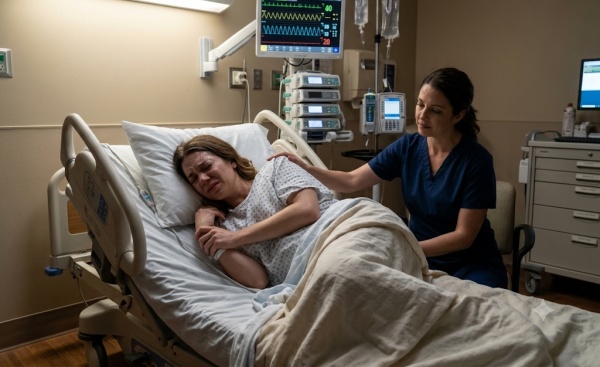
I was thirty-two weeks pregnant, hooked to monitors in a Chicago hospital, when my husband told me he had to leave for a business emergency. He said it was Chicago, but the photos on my phone showed palm trees, cocktails, and his hands around a woman who was not me. The worst part wasn’t just that he lied — it was that he came back expecting me to be too fragile to do anything about it. He was wrong, because the daughter I was fighting to keep safe became the reason I stopped protecting his secrets.
PART I — THE MONITORS AND THE LIE
I was thirty-two weeks pregnant, hooked to monitors in a Chicago hospital, when my husband told me he had to leave for a business emergency.
My name is Laurel Voss, and I need you to understand what hospital bed rest at thirty-two weeks actually means before I tell you the rest of this story. It means your body has decided that the ordinary rules of pregnancy no longer apply. It means you are connected to a fetal heart rate monitor that beeps with a rhythm you learn to read like a second language. It means the nurses come every four hours, the lights never go fully dark, and the particular loneliness of lying still while the world continues outside your window is the kind that settles into your bones differently than any other kind of lonely you have ever known.
It means you are completely dependent on the people who say they love you.
I had been admitted to Northwestern Memorial Hospital eleven days earlier after my OB, Dr. Priya Anand, detected signs of preterm labor at my routine thirty-week appointment. My cervix had shortened significantly, and after two days of monitoring at the clinic, she made the call that I needed inpatient care. I was placed on strict bed rest, given medications to slow contractions and support the baby’s lung development, and told that every day we kept her inside was a victory.
Her name was going to be Clara.
We had decided that in the second trimester, lying in bed together on a Sunday morning with name books spread across the comforter, and it was one of the last genuinely tender memories I had of my husband before everything changed.
His name was Marcus Voss.
We had been married for six years, living in Lincoln Park in a three-bedroom condo we had bought two years earlier with the optimism of people who believe the future is a place they are building together. Marcus was forty-one, a regional sales director for a medical device company, which meant he traveled frequently, managed a team across four Midwestern states, and had the particular skill set of someone whose entire career depended on making people feel comfortable and believed.
He was very good at his job.
I had not understood, until the end, how thoroughly that skill set had been applied at home.
The eleven days before he left had been hard but manageable.
Marcus visited every evening after work. He brought food I actually wanted to eat, sat beside the bed for two or three hours, watched television with me, held my hand during the harder monitoring sessions, and said the right things to Dr. Anand when she came by. He looked like a devoted husband. He looked like a man who understood that his wife was fighting to keep their daughter safe.
On the twelfth day, a Tuesday, he came in at six in the evening looking distracted.
I noticed immediately.
After six years of marriage, you learn a person’s textures. The way distraction sits differently on their face than tiredness. The way a prepared story creates a specific kind of stillness around the eyes.
“Everything okay?” I asked.
“Work thing,” he said.
He sat down but did not take my hand.
“What kind of work thing?”
“Quarterly numbers are off in the Detroit territory. Regional VP wants a team on the ground.”
“In Detroit?”
“Yeah.”
He said it easily.
He said it the way people say things they have practiced.
“How long?” I asked.
“Two days. Maybe three.”
I looked at him.
“Marcus, I’m on bed rest.”
“I know.” He reached for my hand then, which felt like a correction. “My mom can come stay. She’s been asking to help.”
His mother, Diane, lived in Naperville and had offered multiple times to come to the hospital. I had been managing without her because Marcus and I had been managing together, and because Diane and I had a relationship that was warm on the surface and careful underneath, the way relationships are when two women love the same man differently.
“When?” I asked.
“Tomorrow morning.”
I looked at the monitor.
Clara’s heartbeat moved across the screen in its steady green line.
“Okay,” I said.
He stayed another hour.
He kissed my forehead when he left.
He said he would call when he landed.
He did not call when he landed.
He texted at 10:47 p.m. that night: Landed safe. Crazy busy. Call you tomorrow.
I fell asleep watching the monitor and thinking that Detroit in November was cold and gray and I hoped he had packed his good coat.
The photos arrived the next morning at 9:15.
Not to me directly.
To my college roommate, Becca Hartwell, who had been following a food and travel account on Instagram that she knew I liked, and who had been tagged in a post by someone in our extended social circle who thought Becca would appreciate the aesthetic.
Becca called me at 9:22.
“Laurel,” she said, “I need you to stay calm.”
Those words.
Those specific words from someone who knows you well enough to lead with them.
“What happened?” I asked.
“I’m sending you a screenshot.”
My phone buzzed.
I opened the image.
It was an Instagram post from an account belonging to a woman named Jade Ellison. The post showed two photos side by side. In the first, a woman in a white bikini was standing on what was unmistakably a Miami Beach shoreline, the Art Deco hotels of South Beach visible in the background, the sky the particular saturated blue of Florida in November. In the second photo, she was sitting at an outdoor bar with a man whose face was turned slightly away from the camera but whose jawline, whose watch, whose left hand wrapped around a cocktail glass, were ones I had been looking at for six years.
Palm trees.
Cocktails.
His hands around a woman who was not me.
I stared at the screen for a long time.
The monitor beside me continued its steady beeping.
Clara’s heartbeat, reliable and strong, filling the hospital room with the sound of a life that did not yet know what her father was doing.
Becca was still on the line.
“Laurel?”
“I see it,” I said.
“I’m so sorry.”
“How many people have seen this?”
“The account is public. The post has about four hundred likes.”
Four hundred people.
Four hundred people had seen my husband on a Miami beach while I was hooked to monitors in a Chicago hospital fighting to keep our daughter alive.
“Okay,” I said.
“What do you need?”
“I need you to screenshot everything on that account and send it to me. Every photo. Every caption. Every tagged location.”
“Laurel—”
“Please, Becca.”
She did.
By ten o’clock, I had seventeen screenshots.
Marcus and Jade Ellison at a rooftop bar in Miami Beach. Marcus and Jade at what appeared to be a hotel pool. Marcus and Jade at a restaurant with a waterfront view. The timestamps on the posts covered Tuesday evening through Wednesday morning.
He had left my hospital room at seven Tuesday evening.
He had been on a beach by Tuesday night.
I put my phone face down on the blanket.
I looked at the ceiling.
I thought about the word fragile and what Marcus had expected when he came back.
He expected me to be too fragile to do anything about it.
He was wrong.
PART II — WHAT FRAGILE ACTUALLY LOOKS LIKE
I did not call Marcus immediately.
That surprised even me.
The version of myself I had imagined in a moment like this — the hypothetical, abstract version who had never actually been thirty-two weeks pregnant on hospital bed rest while her husband lied about Detroit — would have called immediately. Would have been crying, shaking, demanding answers through the phone while nurses came to check on elevated blood pressure readings.
Instead, I lay very still and thought.
Dr. Anand had told me in our first week that stress was one of the primary triggers for the contractions I was trying to suppress. She had been specific: elevated cortisol, emotional distress, physical agitation. She had told me that my job, my only job, was to stay calm and keep Clara inside as long as possible.
Every day we kept her inside was a victory.
I thought about that.
Then I thought about Marcus, on a beach in Miami, and I made a decision that I believe saved both my daughter’s life and my own future.
I decided to be strategic instead of reactive.
I called Becca back.
“I need a favor,” I said.
“Anything.”
“I need you to find out everything you can about Jade Ellison. Not invasively. Just what’s publicly available. Where she works, how she knows Marcus, how long this has been going on if you can tell.”
“You’re not going to call him?”
“Not yet.”
A pause.
“Laurel, are you okay?”
“I’m thirty-two weeks pregnant on hospital bed rest and my husband is in Miami with another woman,” I said. “I am not okay. But I am thinking clearly, which is more useful right now.”
Becca, who had known me for fifteen years and understood the difference between my falling apart and my pulling together, said, “I’ll call you back in an hour.”
Then I called my mother.
My mother, Sandra, lived in Evanston, twenty minutes from the hospital, and had been coming to see me every other day since my admission. She was sixty-four, recently retired from a career as a paralegal, and possessed of the particular combination of warmth and practicality that I had spent my whole life trying to inherit.
She answered on the second ring.
I told her what I had found.
She was quiet for exactly four seconds.
Then she said, “I’m coming now.”
“Mom, you don’t have to—”
“Laurel Anne Voss, I am coming now.”
She arrived forty minutes later with a tote bag containing a thermos of the chamomile tea she had been making me since I was a child, a container of cut fruit from the Whole Foods near her apartment, and the expression of a woman who had decided that her daughter would not face this alone.
She sat beside my bed and held my hand while I showed her the screenshots.
She looked at each one carefully.
She did not say anything dramatic.
She said, “Have you spoken to anyone about your legal options?”
That was my mother.
Not what a monster, not I always knew, not poor baby.
Legal options.
“Not yet,” I said.
“You should.”
“I’m on bed rest.”
“Phones work on bed rest.”
That was also my mother.
She stayed for three hours.
During that time, Becca called back with what she had found through public social media and professional networking sites. Jade Ellison was thirty-four years old, worked in marketing for a hospitality company based in Miami, and had been connected to Marcus on LinkedIn for approximately eighteen months. Her Instagram account showed a life of travel, rooftop bars, and beach weekends. She had posted about Miami consistently for the past three days.
Eighteen months.
I had been pregnant for eight of those months.
The math was not comforting.
Marcus called at two in the afternoon.
I answered.
“Hey,” he said. “How are you feeling?”
His voice was normal. Easy. The voice of a man who believed the story he had told was still standing.
“I’m okay,” I said. “How’s Detroit?”
“Cold,” he said. “Meetings ran long. Probably another day.”
“Okay.”
“How’s Clara?”
“Strong,” I said. “Her heartbeat has been steady.”
“Good.” A pause. “I miss you guys.”
I looked at the screenshot on my phone. His hand around a cocktail glass. Palm trees. The Art Deco skyline of South Beach.
“I miss you too,” I said.
I kept my voice completely even.
He said he would call that evening.
He did, at eight, and I answered and spoke to him for twenty minutes about the hospital food and a show I had been watching and a funny thing one of the night nurses had said. I was calm. I was present. I was the wife he expected to find waiting, fragile and grateful, when he returned.
After I hung up, my mother, who had stayed through dinner, looked at me.
“You didn’t tell him,” she said.
“No.”
“Why?”
I looked at the monitor.
“Because I need a few days,” I said. “And because he doesn’t know what I know yet. That’s the only advantage I have right now.”
My mother looked at me for a long moment.
“When did you get so strategic?”
“When I had no other choice.”
She squeezed my hand.
The next morning, I called the hospital’s patient advocate and asked if there was a social worker on staff who worked with patients in complicated personal situations. There was. Her name was Keisha Monroe, and she came to my room that afternoon with a quiet manner and a list of resources that included family law attorneys who did consultations by phone.
“I’m not sure I’m ready to file for divorce,” I told her.
“You don’t have to be,” she said. “But knowing your options is different from using them.”
That was the second time in two days someone had used the word options.
I was beginning to understand that options were what happened when you stopped being reactive and started being prepared.
Keisha gave me three names.
I called the first one that evening.
Her name was Renata Cruz, a family law attorney in Chicago with seventeen years of experience and a phone manner that was direct without being cold. I told her my situation in broad terms: pregnant, on bed rest, husband potentially having an affair, documented through social media, no confrontation yet.
She asked three questions.
Was I in a safe situation physically? Yes. Did I have documentation of the evidence? Yes. Was I a joint owner of our marital home and assets? Yes.
“Good,” she said. “Call me when you’re ready to move forward. And Laurel — don’t move any money, don’t access his accounts, and don’t confront him until we’ve spoken again.”
“I won’t.”
“One more thing.”
“Yes?”
“You’re doing the right thing by thinking before acting. Most people don’t.”
I hung up and lay in the dark hospital room listening to Clara’s heartbeat and thinking about the word most.
Most people don’t.
I was going to be the exception.
PART III — HE CAME BACK
Marcus came home on Friday.
Not to the hospital first.
To the condo.
He texted at noon to say his flight had landed and he was going home to shower and change before coming to see me. I read that text and thought about what it meant that a man returning from a supposed business trip needed to go home before seeing his hospitalized pregnant wife.
He arrived at the hospital at three.
He looked rested.
That was the detail that hit me hardest.
Not guilty. Not haggard. Not the face of a man who had spent three days managing a work crisis in a cold Midwestern city. He looked the way people look when they have spent three days in warm weather, eating well, sleeping in a good hotel.
He brought flowers.
Sunflowers, my favorite.
He kissed my forehead and sat beside the bed and asked about Clara and told me the Detroit meetings had been brutal but productive. He was fluent and detailed and completely convincing, the way people are when they have rehearsed a story long enough that it feels like memory.
I let him talk.
I asked questions.
I was interested, engaged, the wife he expected.
Inside, I was memorizing everything.
After an hour, his phone buzzed on the chair beside him. He glanced at it and turned it face down, which was a thing he had started doing about six months ago that I had noticed and filed away.
“Everything okay?” I asked.
“Work,” he said. “It can wait.”
I nodded.
We watched television for another hour.
When he left at six, he kissed me again and said he would be back tomorrow morning.
After he was gone, I opened my phone and looked at the screenshots one more time.
Then I opened my notes app and wrote down everything I had observed. The way he looked. The detail about going home first. The phone turned face down. The specific stories he had told about Detroit. The names of the colleagues he had mentioned.
Documentation.
Not for revenge.
For clarity.
My mother came the next morning before Marcus.
She sat beside my bed and I showed her my notes.
“You’ve been doing this all week?” she said.
“Since Tuesday.”
She looked at me.
“Laurel, I want to ask you something.”
“Okay.”
“What do you want?”
Not what are you going to do. Not what does he deserve. Not what does the law say.
What do you want.
I looked at the monitor.
“I want Clara to be born healthy,” I said. “I want to be in a position to take care of her properly. I want the truth on the table. And I want to make decisions from a position of information rather than shock.”
My mother nodded slowly.
“And Marcus?”
I thought about the sunflowers on the windowsill.
I thought about the Sunday morning with the name books.
I thought about his hand around a cocktail glass on a Miami beach while I lay in a hospital bed fighting to keep his daughter alive.
“I don’t know yet,” I said honestly. “But I know I’m not going to pretend.”
Marcus arrived at ten.
He was cheerful, present, attentive in the way he had been throughout my hospitalization. He talked to Dr. Anand when she came by, asked the right questions, held my hand during the afternoon monitoring session.
He was performing.
I could see it now with a clarity I had not had before Tuesday.
Not because he was a different person.
Because I was seeing him differently.
At four o’clock, when my mother had stepped out for coffee and Marcus was scrolling his phone beside my bed, I said, “How was Miami?”
The room changed.
Not dramatically.
The way a room changes when the temperature drops two degrees.
Marcus looked up from his phone.
His face did the thing I had been waiting to see: the micro-second of recalibration before the mask reassembled.
“What?”
“Miami,” I said. “How was it?”
“I was in Detroit, Laurel.”
“I know what you told me.”
He set his phone down.
“What is this?”
I reached for my own phone and turned the screen toward him.
The screenshot. Jade Ellison’s Instagram. His hand. The palm trees. The Art Deco skyline.
He looked at it for a long time.
I watched him calculate.
“That’s not what it looks like,” he said.
“What does it look like?”
“It was a client event. Jade works for one of our distribution partners. It was a company—”
“Marcus.”
He stopped.
“Don’t,” I said. “Please don’t do that.”
He looked at the monitor.
At Clara’s heartbeat moving across the screen.
Something in his face shifted.
Not remorse exactly.
The particular deflation of a man whose story has collapsed and who has not yet decided what to replace it with.
“How long have you known?” he asked.
“Since Wednesday morning.”
He closed his eyes.
“You’ve known for three days.”
“Yes.”
“And you didn’t say anything.”
“No.”
He looked at me.
“Why?”
I held his gaze.
“Because I needed to think,” I said. “And because I needed to make sure Clara was stable before I had this conversation. And because I was not going to let you come back here and manage me the way you manage everything else.”
His jaw tightened.
“I wasn’t going to manage you.”
“You brought sunflowers.”
He looked at the windowsill.
The sunflowers sat there in their vase, bright and oblivious.
“I always bring you sunflowers,” he said.
“I know,” I said. “That’s how I knew.”
PART IV — THE TRUTH ABOUT EIGHTEEN MONTHS
The conversation that followed was the longest and most important of our marriage.
Not because it was loud.
It was almost entirely quiet.
Marcus sat in the chair beside my bed and I lay against my pillows and we talked for two hours while the monitor beeped and the hospital moved around us and outside the window Chicago went about its gray November afternoon.
He told me the truth.
Not all at once.
In the way people tell the truth when they have been lying for a long time: in layers, each one revealed only when the previous layer was no longer defensible.
Jade Ellison had been a contact through work for eighteen months. It had started as professional, then personal, then something he could not categorize cleanly. He said he had not planned it. He said it had happened gradually. He said he had been going to end it before the baby came.
I had heard that sentence before, in other women’s stories.
I had never expected to hear it in mine.
“Were you with her when I went into preterm labor?” I asked.
He looked at his hands.
“I was on a call with her when you texted me from the clinic.”
I absorbed that.
“And you still came to the hospital.”
“Of course I came.”
“And then you went to Miami.”
“It was planned before—”
“Marcus.” I stopped him. “I’m not asking for a timeline. I’m asking you to understand what you did.”
He looked up.
“I was in a hospital bed,” I said. “Fighting to keep our daughter alive. Every day mattered. Every hour mattered. Dr. Anand told us that. You were there when she said it. And you left.”
He said nothing.
“You left and you lied about where you were going and you came back expecting me to be too fragile to notice or too scared to say anything.”
“I didn’t think—”
“You didn’t think I would find out.”
He exhaled.
“No,” he said quietly. “I didn’t.”
That honesty, at least, was real.
I told him I had spoken to an attorney.
His head came up.
“When?”
“Wednesday evening.”
He stared at me.
“You called a lawyer before you called me.”
“I called a lawyer instead of calling you,” I said. “Because calling you in that moment would have been about my feelings, and I needed to think about Clara first.”
He was quiet for a long time.
“What did she say?”
“She said I had options.”
He nodded slowly.
“Are you filing for divorce?”
I looked at him.
“I don’t know yet,” I said. “I’m thirty-two weeks pregnant on hospital bed rest. I am not making permanent decisions today. What I am doing is making sure that whatever I decide, I am not making it from a position of ignorance or fear.”
He leaned forward.
“Laurel, I want to fix this.”
“I know.”
“I’ll end it completely. I’ll do counseling. Whatever you need.”
I looked at the monitor.
Clara’s heartbeat.
Steady and strong.
“What I need right now,” I said, “is for you to be honest with me about one more thing.”
“Okay.”
“Is there anything else I don’t know?”
He was quiet for too long.
“Marcus.”
“There was a trip in August,” he said. “Nashville. I told you it was a conference.”
August.
I had been twenty weeks pregnant in August.
We had just found out she was a girl.
We had celebrated with dinner at our favorite restaurant in River North, and Marcus had cried a little, which I had found so unexpectedly tender that I had taken a photo of his face.
I had that photo on my phone.
I looked at the monitor instead.
“Anything else?”
“No.”
I believed him.
Not because I trusted him completely.
Because he looked like a man who had just put down something very heavy and was not capable of carrying more.
My mother came back with her coffee and read the room immediately.
She sat in the corner without speaking.
Marcus looked at her.
“Sandra,” he said.
My mother looked at him with the expression she reserved for situations that required restraint she was not entirely sure she had.
“Marcus,” she said.
One word.
It contained everything.
He left an hour later.
At the door, he turned.
“I’m sorry,” he said.
Not the managed apology of a man trying to minimize consequences.
Something rawer.
“I know,” I said.
After he was gone, my mother came and sat beside me.
She did not say anything for a while.
Then she said, “What do you need?”
“I need Clara to be okay,” I said. “I need to get through the next few weeks. And then I need to make some decisions.”
“You don’t have to decide anything right now.”
“I know.”
“But when you do decide—”
“I’ll call Renata.”
My mother nodded.
She stayed until nine.
That night, alone in the hospital room with the monitor and the city lights and Clara’s steady heartbeat, I thought about the word fragile. Marcus had expected me to be too fragile to act. He had calculated that my physical vulnerability would translate into emotional paralysis.
He had confused fragile with careful.
They are not the same thing.
Fragile breaks under pressure.
Careful waits for the right moment.
I had been waiting for the right moment since Wednesday morning.
It had not arrived yet.
But it was coming.
PART V — WHAT CLARA MADE POSSIBLE
Clara was born at thirty-six weeks and two days.
Not the emergency we had feared in those early weeks of bed rest, but not the full-term arrival we had hoped for either. She came on a Tuesday morning in December, four weeks after the Miami conversation, after Dr. Anand determined that the risks of continuing the pregnancy outweighed the benefits of waiting longer.
She weighed five pounds, four ounces.
She had Marcus’s dark hair and my stubborn chin and the most extraordinary expression of focused concentration I had ever seen on a face that small, as if she had arrived with opinions already formed and was simply waiting for the vocabulary to express them.
She was in the NICU for eleven days.
Those eleven days were the hardest of my life and also, strangely, some of the most clarifying. There is something about sitting beside an incubator, watching a tiny person work at the basic project of surviving, that strips away everything that is not essential. The noise of the marriage, the anger, the grief, the calculations — all of it receded in those eleven days into something simpler and more fundamental.
Clara needed me to be okay.
So I was going to be okay.
Marcus was present throughout.
He came every day. He learned to read her monitors. He held her during kangaroo care sessions with a tenderness that was real and that I did not know how to reconcile with everything else I knew about him. He was a man who loved his daughter genuinely and had betrayed his wife genuinely, and both of those things were true simultaneously, and I had to find a way to hold them both without letting either one distort my thinking.
That was the hardest part.
Not the anger.
The complexity.
On the eighth day in the NICU, Marcus’s mother, Diane, came to the hospital.
She had been giving us space, which I appreciated, but she had also been calling Marcus daily, and I suspected she knew more than she had said. She sat beside me at Clara’s incubator for a long time without speaking.
Then she said, “He told me.”
I looked at her.
“When?”
“Last week.” She paused. “He called me after you confronted him.”
“What did you say?”
She looked at Clara.
“I told him he had made the worst mistake of his life at the worst possible time,” she said. “And that whatever you decided, he had no right to make it harder for you.”
I had not expected that.
“Diane—”
“I am not here to ask you to forgive him,” she said quickly. “I am here because she is my granddaughter and you are her mother and I want you to know that whatever happens between you and Marcus, I am not going anywhere.”
I looked at Clara through the incubator glass.
Her chest rose and fell with the reliable rhythm of a fighter.
“Thank you,” I said.
Diane nodded once.
She stayed for an hour and then left quietly, the way she had come.
Clara came home on a Friday.
Our condo had been prepared with the careful thoroughness of two people who had channeled the energy of a fractured marriage into making sure their daughter’s homecoming was perfect. The nursery was ready. The equipment was set up. The refrigerator was stocked. Marcus had taken two weeks of paternity leave.
We existed in the same space with the careful politeness of people who had not yet decided what they were to each other.
Not hostile.
Not warm.
Honest, in a way we had not been in a long time.
Three weeks after Clara came home, I called Renata Cruz.
I told her I was ready to talk seriously.
She asked me what I wanted.
I told her I wanted a separation agreement that protected Clara’s financial future, established clear parenting arrangements, and gave both Marcus and me the space to determine whether the marriage was salvageable without the pressure of an immediate divorce filing.
“That’s a measured approach,” Renata said.
“I’ve had a lot of time to think.”
“Do you want to save the marriage?”
I looked at Clara, asleep in the bassinet beside my chair.
“I want to make a decision based on truth rather than fear or anger,” I said. “I’m not there yet.”
“That’s fair,” Renata said. “Let’s start with the separation agreement.”
Marcus agreed to the separation without contest.
I think he had expected me to file for divorce immediately, and the separation surprised him in a way that was not entirely comfortable. It required him to sit with uncertainty rather than resolution, which was harder for him than a clean break would have been.
That was not my intention.
But I understood it.
We went to couples counseling.
Not because I had decided to stay.
Because I had decided that I would not make a permanent decision about my marriage without having done the honest work of understanding what the marriage actually was, beneath the performance and the lies and the grief.
Our therapist, Dr. Angela Marsh, was a licensed marriage and family therapist in Lincoln Park with a direct manner and a complete absence of sentimentality. She did not tell us what to do. She asked questions that made us both uncomfortable and then sat with the discomfort rather than filling it.
In our third session, she asked Marcus why he had gone to Miami.
He said he had felt invisible.
I had expected defensiveness or deflection.
The honesty surprised me.
He said that the pregnancy had shifted everything between us, not wrongly, but completely, and that he had felt himself becoming peripheral in a story that was supposed to be shared. He said he knew that was not an excuse. He said it was an explanation, and that he understood the difference.
Dr. Marsh asked me what I heard in that.
I said I heard a man who had responded to feeling peripheral by making himself central in someone else’s story.
She nodded.
“And what do you do with that?” she asked.
“I don’t know yet,” I said.
“That’s honest,” she said.
Honesty, I was learning, was the beginning of everything.
Not the resolution.
The beginning.
By spring, Clara was three months old and had developed the habit of smiling at ceiling fans with an enthusiasm that suggested she found them genuinely hilarious. She slept in four-hour stretches, which felt like luxury after the NICU nights. She had Marcus’s dark hair and my stubborn chin and a personality that was already, unmistakably, entirely her own.
She was the reason I had stopped protecting Marcus’s secrets.
Not because I wanted to punish him.
Because she deserved a mother who modeled honesty.
Because she deserved to grow up watching a woman make decisions from a position of information rather than fear.
Because the daughter I had fought to keep safe in that hospital bed was worth more than the silence I had been keeping.
I had not yet decided whether to divorce Marcus.
That is the truth, and I will not pretend otherwise for the sake of a cleaner ending.
What I had decided was this: I would not stay out of fear. I would not leave out of anger. I would not make any permanent decision until I understood clearly what I was choosing and why.
Renata called me one afternoon in April to check in.
“How are you doing?” she asked.
“Better,” I said. “Clearer.”
“And Marcus?”
“Working on it,” I said. “Both of us.”
“The separation agreement is still in place?”
“Yes.”
“Do you want to extend it or move toward something more permanent?”
I looked out the window at the Lincoln Park street below, the trees beginning to bud in the particular tentative way of Chicago springs, as if the city is not quite sure it trusts the warmth yet.
“Give me another sixty days,” I said.
“Of course.”
After I hung up, I went to the nursery where Clara was awake in her crib, examining her own hands with the philosophical intensity she brought to most things. She looked up when I came in and smiled the way babies smile when they see the person who is their whole world.
I picked her up.
She grabbed my finger with her whole fist.
I thought about the hospital room. The monitor. The green line of her heartbeat. The Tuesday morning when I looked at a screenshot and decided to be strategic instead of reactive.
I thought about my mother arriving with chamomile tea.
I thought about Keisha Monroe and her list of resources.
I thought about Renata Cruz saying most people don’t.
I thought about Diane Ashford sitting beside me at the incubator saying I am not going anywhere.
I thought about Dr. Marsh asking what I heard and waiting, without filling the silence, for an honest answer.
None of those women had told me what to do.
They had each, in their own way, handed me something more useful.
The tools to decide for myself.
People ask me sometimes what I would tell a woman in my situation.
I tell them this:
Fragile is not the same as powerless.
Being in a hospital bed does not mean being without options.
The most important decisions of your life will rarely arrive at a convenient time, and waiting for a convenient time is how you end up making them from a position of shock instead of clarity.
Document what you see.
Call the attorney before you call him.
Let the people who love you show up with chamomile tea and fruit and the practical question of what you need.
And when the person who was supposed to protect you has failed at that job, remember that you have been protecting yourself all along.
You just did not know it yet.
Clara grabbed my finger tighter.
Outside, a Chicago spring was making its cautious, determined way into the world.
We watched it together from the nursery window.
The trees budded.
The city breathed.
And the daughter I had fought to keep safe looked at the world with the expression of someone who had already decided it was worth the effort.
She was right.
It was.
