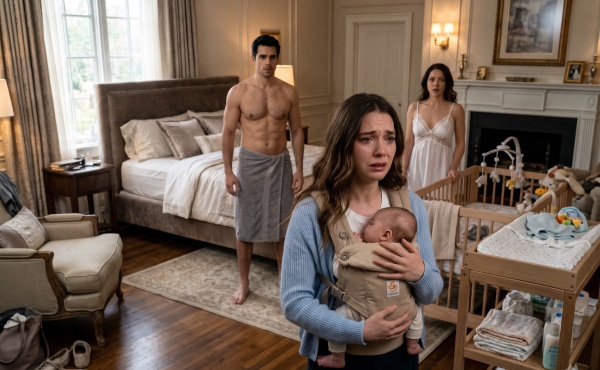
Five Days After Giving Birth, I Found My Husband’s Mistress in Our Bedroom Wearing the Robe He Gave Me for Our Anniversary
Five days after delivering my daughter, I came home to rest and found a woman I had never met standing at my dresser in my ivory silk anniversary robe, holding my perfume like it already belonged to her. She turned around, looked me in the eye, and said, “You must be Nora,” like I was the one who didn’t belong in my own bedroom. My husband thought he could explain his way out of eight months of lies, but he had forgotten about one document his own family had insisted we sign before the wedding. And the woman in my robe wasn’t even the most unexpected person I would find waiting in that house before the week was over.
PART I — FIVE DAYS
Five days after giving birth to my daughter, I found my husband’s mistress in our bedroom wearing the ivory silk robe he had given me for our third wedding anniversary.
My name is Nora Ashford, and I need you to understand what five days postpartum actually means before I tell you the rest of this story. It means your body is not yours yet. It means you are running on broken sleep measured in ninety-minute fragments, on hospital-grade ibuprofen, on the particular adrenaline of a new human being who needs you every hour. It means your emotions live approximately two millimeters beneath your skin, and the smallest things — a song on the radio, the smell of the baby’s head, a text from your mother — can split you open without warning.
It means you are the most vulnerable you will ever be as an adult.
And it means that what I walked into that afternoon in our Portland, Oregon home hit me with a force I was not physically or emotionally equipped to absorb.
Her name was Simone Vega.
I knew the name. I had known it for about six weeks, the way you know a thing you are not ready to fully believe. A name that appeared twice on Julian’s phone when he left it unlocked on the kitchen counter. A name attached to a contact listed only as “S” that he changed to “Simone V” when I asked, casually, who he had been texting. A name I had filed away in the part of my brain reserved for things I would deal with after the baby came, after the birth, after I had enough sleep to think clearly.
I had not yet had enough sleep to think clearly.
But there she was.
I had come home from my mother’s house earlier than expected. My mother, Carol, lived twenty minutes away in Lake Oswego and had been helping me with the baby since we left the hospital. That afternoon, she had offered to keep Lily for a few hours so I could rest at home alone, in my own bed, without the particular alertness that comes from being the only person responsible for a newborn.
I drove home thinking about sleep.
I parked in the driveway, noticed Julian’s car was there, assumed he had come home from work early to check on things, and let myself in through the side door with my key.
The house was quiet.
I climbed the stairs slowly, one hand on the rail, because my body was still negotiating with gravity after the delivery.
Our bedroom door was partially open.
I pushed it.
Simone Vega was standing at my dresser, looking at herself in the mirror, wearing my ivory silk robe. Her dark hair was loose. She was holding my perfume bottle, turning it in her hand the way you handle something that belongs to you. She did not hear me immediately because she had earbuds in, and for approximately three seconds I stood in the doorway of my own bedroom watching a stranger examine my belongings in my clothes.
Then she saw me in the mirror.
She did not scream.
She did not look ashamed.
She looked startled, then calculating, then something I can only describe as prepared.
She pulled out one earbud.
“You must be Nora,” she said.
Those four words.
The audacity of those four words.
Not I’m sorry. Not I can explain. Not even the decency of silence.
You must be Nora.
As if I were the guest.
I stood very still because my body had gone into a kind of shock that was separate from emotion. My hands were not shaking. My voice, when it came, was quieter than I expected.
“Take that off,” I said.
She looked down at the robe.
Then she looked back at me in the mirror.
“Julian said you wouldn’t be home until—”
“Take it off and get out of my bedroom.”
Something in my voice must have communicated that I was not negotiating, because she reached for the sash, untied it slowly, and let the robe fall from her shoulders onto the floor. She was dressed underneath. She picked up a jacket from the chair by the window, my chair, and walked past me toward the door.
She smelled like my perfume.
I stood very still until I heard her footsteps on the stairs.
Then I picked up the robe from the floor, walked to the bathroom, and put it in the trash can under the sink. I washed my hands. I looked at myself in the bathroom mirror for a long moment. My face was pale. My eyes were the eyes of a woman who had given birth five days ago and had just used the last of her reserves to stay upright in a moment that deserved to destroy her.
Then I heard Julian’s voice downstairs.
Low. Urgent. The voice he used when managing a situation.
I walked to the top of the stairs.
Julian was standing in the entryway with Simone, one hand on her arm, speaking quietly. He looked up when he heard me on the stairs. His face did the thing faces do when a person is caught between two disasters and cannot decide which direction to run.
“Nora,” he said.
“Get her out of the house,” I said.
“I can explain—”
“Julian.” My voice did not rise. “Get her out of the house. Then come upstairs.”
Simone looked at me once more.
I did not look at her.
I went back to the bedroom and sat on the edge of the bed and breathed.
Julian Ashford was thirty-eight years old, a commercial litigation attorney at a mid-sized firm in downtown Portland, and the man I had married four years ago after a two-year relationship that had felt, at the time, like the most honest thing I had ever chosen. He was smart, careful with words, good in rooms full of people, and possessed of the particular confidence of someone who had never been truly held accountable for anything.
I had loved that confidence once.
I understood it differently now.
He came upstairs seven minutes later.
I know it was seven minutes because I counted.
He stood in the doorway of our bedroom in his work clothes, tie loosened, looking at me with an expression that had clearly been assembled on the way up the stairs. Remorse. Regret. The posture of a man preparing to explain.
“How long?” I asked.
“Nora—”
“How long, Julian.”
He exhaled.
“Eight months.”
Eight months.
Lily was five days old.
Eight months ago, I was two months pregnant.
He had started this affair when I was two months pregnant with his child.
I looked at the wall above his head because looking at his face was not something I could do in that moment without losing the composure I needed.
“Is she pregnant?” I asked.
“No.”
“Are you certain?”
“Yes.”
“Does she know about the agreement?”
The silence that followed that question was different from the others.
Longer.
Heavier.
Julian’s expression changed.
“What agreement?” he said.
But his eyes said something else entirely.
PART II — THE AGREEMENT
I need to go back four years to explain the agreement, because without it, the rest of this story makes no sense.
When Julian and I got engaged, his family was thrilled in the particular way of families who have spent years curating their son’s future and are relieved to see it proceeding on schedule. The Ashfords were old Portland money, the kind built on timber and real estate and three generations of careful reinvestment. Julian’s father, Richard, was semi-retired but still formidable. His mother, Patricia, was the kind of woman who expressed love through control and called it devotion.
They liked me well enough.
But they did not love that I came without a financial safety net of my own.
I was a high school art teacher from a middle-class family in Eugene. I had student loans, a ten-year-old Honda, and a genuine passion for my work that the Ashfords found charming in the way people find charming things that they do not take seriously. I was not what they had imagined for Julian.
Three weeks before our wedding, Richard Ashford called me into his study.
He was polite. He was measured. He was the most frightening person I had ever sat across from in a leather chair.
He told me that the Ashford family had certain expectations regarding the protection of family assets in the event of a marriage dissolution. He told me that Julian stood to inherit a significant portion of the family trust, and that the trust’s terms required any spouse to sign a prenuptial agreement as a condition of Julian’s continued participation in the trust distributions.
He slid a document across the desk.
I read it carefully.
It was a prenuptial agreement, drafted by a family attorney, limiting my claim to marital assets in the event of divorce. It was not unusual in structure. What was unusual was a specific clause on page seven.
The clause stated that in the event Julian engaged in documented marital infidelity, the prenuptial agreement’s asset limitations would be voided, and I would be entitled to a negotiated settlement reflecting my contributions to the marriage and family, to be determined by a neutral arbitrator chosen by both parties.
I had stared at that clause for a long time.
Richard watched me read it.
“We are not a family that tolerates certain behaviors,” he said. “That clause exists because we mean it.”
I asked for two weeks to have my own attorney review the document.
Richard said of course.
My attorney, a woman named Diane Cho who practiced family law in Eugene, read every page and told me the infidelity clause was unusual but legally enforceable under Oregon law if properly documented. She told me to keep a copy somewhere Julian could not access.
I signed the agreement.
I kept a copy in a fireproof box at my mother’s house.
I had not thought about that box in four years.
Until I stood at the top of the stairs and asked Julian if Simone knew about the agreement.
Now, sitting on the edge of our bed while he stood in the doorway, I watched him decide how to handle the fact that I had just referenced the one document that changed everything about his position.
“The prenup doesn’t apply here,” he said finally.
“Why not?”
“Because nothing has been documented.”
I looked at him.
“I just walked into our bedroom and found your mistress wearing my robe.”
“That’s not documentation.”
The attorney in him had arrived.
I had expected it.
“Julian,” I said, “I need you to think very carefully about the next few things you say to me.”
He crossed his arms.
“I’m not trying to be adversarial.”
“You brought a woman into our home five days after I gave birth. You are past the point of managing tone.”
His jaw tightened.
“I made a mistake.”
“Eight months is not a mistake. Eight months is a decision made repeatedly.”
He sat down in the chair by the window.
My chair.
The same chair Simone had taken her jacket from twenty minutes ago.
I stood up from the bed because sitting felt too passive.
“I want you to leave tonight,” I said.
“This is my house.”
“This is our house, and I have a five-day-old daughter who does not need to be in an environment where her father is managing the logistics of his affair.”
“I’m not—”
“Julian.” I stopped. I breathed. “I am not doing this tonight. I am going to call my mother, I am going to get Lily, and I am going to come back here and sleep in my own bed. You are going to be somewhere else.”
He looked at me for a long moment.
Then he nodded once and stood.
At the door, he turned.
“The agreement was my father’s idea,” he said. “Not mine.”
“I know,” I said. “That’s why I kept a copy at my mother’s house instead of here.”
His face went still.
He left.
I called my mother.
Carol arrived forty-five minutes later with Lily asleep in the car seat, a casserole dish, and the expression of a woman who had suspected something was wrong for weeks and was furious at being right.
I told her everything while Lily slept in the bassinet beside the bed.
My mother sat in the chair by the window and listened without interrupting, which was not her natural state, which told me she understood the gravity.
When I finished, she said, “Where’s the copy of the agreement?”
“In your fireproof box.”
She nodded.
“I’ll get it tomorrow.”
“Mom—”
“Nora.” She looked at me. “You just told me your husband had a woman in this house five days after you gave birth. I am getting the document tomorrow.”
I did not argue.
I fed Lily, changed her, held her against my chest in the dark bedroom while the city outside went about its ordinary evening. She smelled like the specific sweetness of new babies, that clean impossible smell that makes the whole world feel both fragile and worth protecting.
I whispered to her that I was sorry.
Not for what Julian had done.
For the fact that her first week of life had included this.
Then I told her it would not define us.
I meant it.
PART III — THE WOMAN DOWNSTAIRS
I woke at 6:14 the next morning to Lily crying and sunlight coming through the curtains I had chosen for this room two years ago, cream linen that turned gold in the morning.
My mother had slept in the guest room and appeared in the doorway within seconds of Lily’s first sound, already dressed, already holding a glass of water for me. We operated in the efficient shorthand of mothers and daughters who have been through hard things together.
By eight o’clock, Lily was fed and sleeping again, my mother had made coffee and eggs, and I had called Diane Cho’s office in Eugene and left a message explaining that I needed to discuss the prenuptial agreement I had signed four years ago.
Diane called back by nine.
She remembered the agreement.
She remembered the infidelity clause.
She asked me to tell her what had happened, and I did, briefly and factually, the way I had learned to speak about it overnight: without emotion in my voice, because emotion was for later, and right now I needed to be precise.
Diane said she would review her file copy and call me back by end of day.
Then she said, “Nora, do you have any documentation of the infidelity? Anything beyond what you witnessed?”
“I walked into my bedroom and found her there.”
“That’s significant. Is there anyone who can corroborate?”
I thought.
“My mother arrived forty-five minutes after. The woman was already gone.”
“Any messages? Photographs? Anything on his phone or email?”
“I haven’t looked.”
“Don’t look without guidance,” she said. “Oregon has specific laws about accessing a spouse’s private communications. We need to do this correctly.”
“I understand.”
“Good. And Nora — don’t confront Julian about the agreement directly yet. Let me review the document first.”
I agreed and hung up.
My mother was watching me from across the kitchen table.
“She’s good?” Carol asked.
“She’s careful,” I said. “Which is better.”
At eleven o’clock, the doorbell rang.
My mother went to answer it because I was nursing Lily in the living room and moving quickly was not yet something my body did comfortably.
I heard the door open.
I heard my mother say, in a voice I had not heard her use in years, “What are you doing here?”
Then I heard a voice I recognized.
Patricia Ashford.
Julian’s mother.
I pulled Lily gently away, covered myself, and stood slowly. I walked to the entryway.
Patricia was standing on my front porch in a camel wool coat, her silver hair perfectly set, her posture the posture of a woman who had never once doubted her right to be wherever she was standing. She was seventy-one years old and looked sixty. She was carrying a small paper bag from a bakery I recognized as the expensive one near the Pearl District.
She looked at me.
Something crossed her face that was not quite guilt and not quite sympathy but lived somewhere between them.
“Nora,” she said.
“Patricia.”
“May I come in?”
My mother, behind me, made a sound.
I put my hand on Carol’s arm.
“Yes,” I said. “Come in.”
We sat in the living room. Patricia placed the bakery bag on the coffee table without explanation. She looked at Lily in my arms with an expression that was the most unguarded I had ever seen on her face.
“She’s beautiful,” Patricia said.
“Yes,” I said. “She is.”
A pause.
“Julian called me last night.”
“I assumed.”
“He told me what happened.”
“Which version?” I asked.
Patricia’s mouth pressed together briefly.
“His version,” she said. “Which I suspect is incomplete.”
That surprised me.
“Why are you here, Patricia?”
She folded her hands in her lap.
“Because Richard and I put that clause in the prenuptial agreement for a reason,” she said. “And because my son appears to have forgotten that we meant it.”
The room went very quiet.
My mother sat forward.
Patricia looked at me steadily.
“I am not here to defend Julian,” she said. “I am here because you have just had my granddaughter, and because whatever happens between you and my son, I will not allow this family to treat you the way Julian has treated you.”
I studied her face.
“You knew about Simone.”
It was not a question.
Patricia’s expression did not change, but something behind her eyes shifted.
“I suspected,” she said. “For approximately three months.”
“And you didn’t tell me.”
“No.”
“Why?”
She was quiet for a moment.
“Because I hoped I was wrong,” she said. “And because I am his mother, which means I am capable of a cowardice I am not proud of.”
That honesty cost her something.
I could see it.
“What do you want, Patricia?”
“I want you to call your attorney,” she said. “And I want you to know that Richard and I will not interfere with the agreement’s terms.”
“Julian said the agreement doesn’t apply.”
Patricia’s eyes went sharp.
“Julian is incorrect.”
She reached into her coat pocket and placed a business card on the coffee table beside the bakery bag.
“This is our family attorney,” she said. “Not Julian’s personal attorney. The family attorney who drafted the prenuptial agreement. He has been instructed to cooperate with your counsel.”
I looked at the card.
Then I looked at her.
“Why are you doing this?”
Patricia looked at Lily.
For a long moment, she simply looked at my daughter.
“Because she deserves better than what this family has already given her,” she said quietly.
I did not cry.
I was too tired and too stunned and too carefully holding myself together.
But something in my chest shifted.
Not forgiveness.
Not trust.
Something more complicated and more useful.
The recognition that in this house, in this situation, I had an unexpected ally.
After Patricia left, my mother sat beside me on the couch.
“Well,” Carol said.
“I know.”
“I did not see that coming.”
“Neither did I.”
Lily made a small sound in my arms, the particular sound of a baby deciding whether to wake or settle back into sleep. She settled. Her face went smooth and distant the way babies’ faces go when they return to wherever they come from in sleep.
I kissed her forehead.
“Okay,” I said quietly, to both of them and to myself.
“Okay.”
PART IV — WHAT JULIAN BUILT AND WHAT IT COST
Julian came to the house the next morning.
He called first, which was the first sign that something had shifted in his understanding of the situation. The Julian I had married did not call ahead for his own home. He arrived. He announced. He managed.
The Julian who called that morning asked if he could come by to talk.
I said yes, with my mother present.
He arrived at ten with coffee from the place I liked, which was either genuine consideration or strategic, and I no longer had the energy to determine which. He sat across from me at the kitchen table while my mother occupied herself loudly in the other room, which was her version of giving us privacy while remaining within earshot.
Julian looked like a man who had not slept.
Good.
“My mother called me,” he said.
“I assumed she would.”
“She told me she came here.”
“She did.”
He wrapped both hands around his coffee cup.
“She had no right to do that without telling me.”
“She had every right,” I said. “She’s a party to the prenuptial agreement. Her name is on it alongside your father’s.”
His jaw tightened.
“Nora, I want to work through this.”
“Work through what, specifically?”
“Our marriage.”
I looked at him.
“Julian, you had an eight-month affair with a woman you brought into our home while I was postpartum. I want you to tell me, concretely, what working through that looks like.”
He leaned forward.
“Counseling. Transparency. I’ll end things with Simone completely—”
“You haven’t ended them yet?”
He stopped.
“I told her it was over.”
“When?”
“Yesterday.”
“After I found her in our bedroom.”
“Yes.”
I let that sit.
“And before that?”
He looked at the table.
“I was going to end it before the baby came. I kept—”
“Julian.”
He stopped.
“I don’t want your explanation right now,” I said. “I want you to understand something. The agreement your parents put in place is not a technicality. It is not something I am using as a weapon. It is a document that exists because your family anticipated this possibility and decided it mattered.”
“My parents were being controlling—”
“Your parents were being honest about your family’s history.”
That landed.
I had not meant to say it quite that directly.
But I had known, in the four years of our marriage, that Julian was not the first Ashford man to stray. Richard had his own history, managed quietly and expensively over decades. Patricia had stayed. Patricia had built her life around staying. And somewhere in the architecture of that choice, she had decided that her granddaughter would not inherit the same silence.
Julian looked at me for a long time.
“What do you want?” he asked.
“Right now? I want to focus on Lily. I want to heal. I want to sleep more than three hours at a stretch.”
“And the agreement?”
“My attorney is reviewing it.”
“Diane Cho?”
“Yes.”
He nodded slowly.
“She’s good.”
“I know.”
A pause.
“Are you filing for divorce?”
I looked at him.
“I don’t know yet,” I said honestly. “I am not making permanent decisions five days — now six days — after giving birth. What I am doing is making sure that whatever I decide, I am protected.”
He nodded.
He looked, for the first time since I had known him, genuinely uncertain.
Not the performed uncertainty of a man managing a situation.
Actual uncertainty.
The look of someone who had believed his own story for so long that being outside it felt like standing in a foreign country without a map.
“I’m sorry,” he said.
I believed him.
In the same way I had believed Elliot’s apology in a story I once read, in the limited and self-focused way of people who are sorry the consequences have arrived.
“I know,” I said.
He left an hour later.
Diane called that afternoon.
She had reviewed the agreement and confirmed that the infidelity clause was intact and enforceable. She explained that under Oregon law, the clause would require documentation of the infidelity, but that my direct witness testimony combined with corroborating circumstances was a strong foundation.
“Patricia Ashford’s cooperation is significant,” Diane said.
“She gave me the family attorney’s card.”
“I know. He called me this morning.”
I sat down.
“Already?”
“Patricia Ashford moves quickly when she decides to move,” Diane said, and I heard something like professional admiration in her voice. “His name is Warren Gill. He has been the Ashford family attorney for twenty-two years. He confirmed that the prenuptial agreement is valid, that the infidelity clause applies, and that the family will not contest it.”
“Julian said it doesn’t apply.”
“Julian’s personal attorney may argue that. But Julian’s personal attorney is not the attorney who drafted the agreement, and the family is not backing Julian’s position.”
I pressed my hand flat on the kitchen counter.
“What does the clause actually entitle me to?”
Diane explained carefully.
The clause voided the prenuptial agreement’s asset limitations and entitled me to a negotiated settlement through neutral arbitration. The settlement would consider my contributions to the marriage, the length of the relationship, the presence of a child, and other relevant factors. It did not guarantee a specific number, but it removed the ceiling the prenup had placed on my claims.
“What does that mean practically?” I asked.
“It means you are no longer limited to the modest provisions in the original agreement,” Diane said. “You are entitled to an equitable share of marital assets, which in a marriage involving Ashford family trust distributions is considerably more substantial.”
I thought about the ten-year-old Honda I had driven to my engagement.
The student loans I had paid off with my teacher’s salary.
The four years I had spent building a life inside a family that had always kept one hand on the door.
“Diane,” I said, “I need you to understand something. I am not doing this for money.”
“I know.”
“I am doing this because my daughter deserves a foundation.”
“I know that too,” she said. “And the law agrees with you.”
That night, after Lily was asleep and my mother had gone to the guest room, I sat in the kitchen in the dark for a long time. Not crying. Not planning. Just being still in the house that was mine and not mine, that held the life I had built and the life that had been built around me without my knowledge.
I thought about Simone Vega.
I had not thought about her much since the first day, which surprised me. She had been the initial shock, the face of the betrayal, the woman in my robe. But she was not the center of the story. She was a symptom.
The center of the story was a man who had decided that the people who loved him were resources to be managed rather than people to be honest with.
His wife.
His parents.
His daughter, before she was even born.
I thought about Patricia, sitting in my living room with a bakery bag and the most honest thing she had said to me in four years of knowing her.
She deserves better than what this family has already given her.
I looked at the baby monitor on the counter, the small screen showing Lily asleep in her bassinet, her chest rising and falling with the reliable rhythm of new life.
“Yeah,” I said quietly to the empty kitchen.
“She does.”
PART V — WHAT WE BUILD AFTER
The arbitration process took four months.
I will not pretend those four months were clean or simple or that I moved through them with the composed grace of a woman in a movie. There were nights when I cried so hard I had to muffle it with a pillow so Lily wouldn’t hear. There were mornings when I woke up and had to remind myself, before my feet hit the floor, why getting up mattered.
There were also afternoons when Lily smiled for the first time, and the whole architecture of grief rearranged itself around something more important.
Julian retained his own attorney, a partner at a different firm, which was professionally appropriate and personally painful in the way that watching someone you loved become an opposing party always is. His attorney raised arguments. Diane answered them. Warren Gill, the Ashford family attorney, provided documentation that supported the agreement’s validity.
Patricia attended one arbitration session.
She was not required to.
She came anyway.
She sat on my side of the room, which was not technically a side because arbitration is not a courtroom, but which everyone in the room understood the meaning of. Julian looked at his mother once, and she looked back at him with the expression of a woman who loved her son and had decided that love did not mean protection from consequences.
That was the hardest thing I watched in those four months.
Not for me.
For Julian.
Because whatever he had done, whatever choices had brought us to that room, he was also a man watching his mother choose truth over him, and that particular pain is real regardless of who caused it.
The arbitration resulted in a settlement.
I will not share the specific number because it involves the Ashford family trust and there are confidentiality provisions I intend to honor. What I will say is that Lily’s future is secure. Her education, her healthcare, her foundation — these things are protected in ways that do not depend on Julian’s continued goodwill or the fluctuations of his career.
That was what I needed.
Not revenge.
Not the satisfaction of a number that punished him.
A floor beneath my daughter’s life that no one could pull out from under her.
Diane called me the day after the settlement was signed.
“How do you feel?” she asked.
“Tired,” I said. “And okay.”
“That’s about right.”
Julian and I filed for divorce three weeks after the arbitration concluded. Oregon has a residency requirement and a waiting period, and the process moved at the pace of legal processes, which is to say slowly and with a great deal of paperwork. We used a mediator for the parenting plan because Diane and I both believed that Lily deserved parents who could be in the same room without attorneys present, at least eventually.
Julian was not a bad father.
That was the complicated truth I had to hold alongside everything else.
He showed up for Lily. He was present at her two-month checkup. He called when he said he would call. He learned to swaddle her correctly and sent me a photo once, at two in the morning, of Lily asleep on his chest with the caption: I understand now what I risked.
I did not respond to that message.
But I kept it.
Not as evidence.
As a record of the man he was trying to become.
Simone Vega left Portland approximately six weeks after everything became known. I heard this from a mutual acquaintance and did not seek further information. Her choices were her own and her consequences were her own, and I had spent enough energy on her presence in my marriage without extending it into her absence.
Patricia and I developed something I had not anticipated.
A relationship.
Not mother and daughter-in-law, because that was over.
Something more honest than that had ever been.
She came to see Lily every other Sunday. She brought the expensive bakery pastries and sat at my kitchen table and talked to me like a person rather than an accessory to her son’s life. She told me once, unprompted, that she had stayed in her own marriage through things she should not have stayed through, and that she had spent thirty years telling herself it was for the family.
“Was it?” I asked.
She looked at her coffee.
“It was for me,” she said. “Because leaving felt like admitting I had been wrong to stay so long.”
I understood that more than I wanted to.
“Do you regret staying?” I asked.
“I regret the years I spent making it look easy,” she said. “The staying I can live with. The pretending cost me more.”
That sentence stayed with me for weeks.
The pretending cost me more.
I thought about all the ways I had pretended in the last year of my marriage. Pretended not to notice the second phone. Pretended the distance between Julian and me was temporary. Pretended that having a baby would reset something that had already broken. Pretended that a name appearing twice on an unlocked phone was nothing worth examining.
I had been protecting a story that was already over.
That was the grief beneath the grief.
Not just the marriage.
The months I had spent maintaining a version of it that was no longer real.
By spring, I had returned to teaching.
Part-time at first, because Lily was still small and I was still rebuilding, and because my school’s administration had been more understanding than I deserved to hope for. I taught two sections of sophomore art and one elective in photography, and I stood in front of teenagers who were learning to see the world through a frame and thought about how much I had needed to learn the same thing.
Seeing clearly is a skill.
It requires practice.
It requires the willingness to look at things that are uncomfortable and not immediately look away.
My students were better at it than I had been.
I told them that once, obliquely, during a lesson about perspective.
“The frame doesn’t lie,” I said. “But we choose what to include.”
A girl in the front row raised her hand.
“What about what you leave out?”
“That’s the most important choice,” I said.
She wrote it down.
I thought about Julian, and Simone, and Patricia, and the ivory silk robe in the trash can under the bathroom sink.
I thought about the fireproof box at my mother’s house.
I thought about the woman I had been six days postpartum, standing in a doorway, choosing not to collapse.
I had left a lot out of the story I told myself during my marriage.
I was done doing that.
One evening in May, I was sitting on the back porch of the house — my house now, in the settlement — watching Lily on a blanket in the grass. She was four months old and had recently discovered her own hands, which she regarded with the profound philosophical interest of someone encountering a new and remarkable fact about the universe.
My mother was inside making dinner.
The evening was warm, the kind of Portland spring evening that makes you forgive the city for its winters.
My phone buzzed.
A text from Julian.
She laughed today when I made a face at her. I wanted you to know.
I looked at the message.
Then I looked at Lily, who was currently attempting to eat her own fist with the focused determination of someone who believes effort will eventually solve the problem.
I typed back: She laughs at everything. She’s very generous.
He replied with a single emoji.
A small yellow sun.
It was not forgiveness.
It was not reconciliation.
It was two people who had made a child together, trying to find the language of what comes after the story they thought they were living.
I put the phone down and watched my daughter discover the grass.
She touched a blade of it with one finger, pulled her hand back, then reached out again.
Testing the world.
Deciding it was worth touching.
I thought about the ivory robe.
I thought about the fireproof box.
I thought about Patricia in my living room with a bakery bag and the most honest sentence she had ever said to me.
I thought about Diane Cho, who had told me four years ago to keep a copy somewhere Julian could not access, and who had never once said I told you so.
I thought about the woman I had been on the stairs, five days postpartum, with nothing left but the decision to stay upright.
She had been enough.
More than enough.
People ask me sometimes what I would tell a woman in that situation.
I tell them this:
The document you sign before the marriage is not pessimism.
It is the acknowledgment that love is real and human beings are fallible and the law exists to protect people when those two facts collide.
Read everything.
Keep copies.
Find an attorney who is careful rather than dramatic.
And when you are standing in a doorway, five days postpartum, looking at something that should destroy you, remember that the most powerful thing you can do is stay exactly where you are and speak in a quiet voice.
Not because quiet is weak.
Because quiet is controlled.
And controlled is how you protect your daughter.
Lily rolled onto her side in the grass and looked up at the sky with an expression of complete astonishment, as if the existence of clouds were the most extraordinary thing she had encountered in her four months of life.
Maybe it was.
I lay down beside her on the blanket.
We looked at the sky together.
The clouds moved.
The evening held.
And the woman in my robe was the last thing on my mind.
