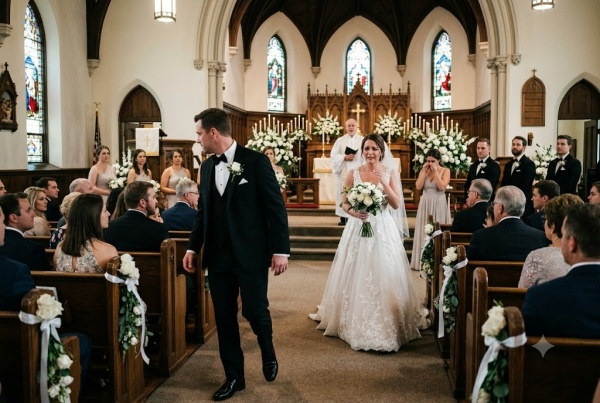
Fifteen Years After He Left Me at the Altar, I Walked Into His Boardroom With the Sons He Never Knew Existed…
Grayson Vale thought the woman he abandoned in a wedding dress had disappeared quietly from his life. Fifteen years later, I stepped into his Boston boardroom with two teenage boys who had his eyes, his jawline, and no idea whether they wanted to forgive him. The room went silent the moment he looked at them and understood what his family had hidden. But my sons were not the most dangerous thing I brought to that table — the sealed envelope in my portfolio was.
PART I — THE BOARDROOM IN BOSTON
Fifteen years after Grayson Vale left me standing at the altar, I walked into his Boston boardroom with the sons he never knew existed.
The room was on the thirty-sixth floor of Vale Meridian Capital, a private investment firm overlooking Boston Harbor, all glass walls, polished walnut, and the kind of silence money teaches people to maintain. Twelve executives sat around the table in dark suits, pretending not to stare when the receptionist opened the door and announced my name.
“Ms. Evelyn Hart is here for the 9:00 meeting.”
Grayson looked up from the head of the table.
For one full second, he did not recognize me.
I was no longer the twenty-six-year-old woman he had left in a silk wedding dress at St. Cecilia Parish in the Back Bay. I was forty-one now, wearing a navy suit, low heels, and the calm expression of a woman who had learned long ago not to tremble in rooms built to intimidate her.
Then recognition hit him.
His face changed so quickly that several people at the table noticed.
“Evelyn,” he said.
My name sounded strange in his mouth after fifteen years.
I stepped farther into the room.
Behind me stood two boys, both fifteen, both taller than I wanted to admit, both trying very hard to look like they did not care. Lucas stood on my left, jaw tight, hands shoved into the pockets of his gray coat. Noah stood on my right, quieter, studying everything with the careful eyes of a boy who noticed too much and said too little.
They were twins.
My sons.
His sons.
Grayson’s eyes moved from me to them.
At first, he looked annoyed, as if he thought I had interrupted a meeting with some inappropriate personal display. Then he looked at Lucas. Then Noah. Then back to Lucas again.
The color drained from his face.
Because my sons had his eyes.
His jawline.
His height.
And the exact same small crease between their brows when they were trying not to react.
The boardroom went completely silent.
One of the executives shifted in his chair. Someone’s pen rolled gently across the table and stopped near a crystal water glass. Outside the windows, a gray January morning hung over Boston, cold and sharp, as if the entire city had paused to listen.
Grayson stood slowly.
“Evelyn,” he said again, but this time his voice was different.
Not surprised.
Afraid.
I placed my leather portfolio on the table.
“I appreciate you making time for this meeting.”
His eyes were still on the boys.
“Who are they?”
Lucas gave a short laugh under his breath.
Noah looked at the floor.
I kept my voice steady.
“These are my sons. Lucas and Noah Hart.”
Grayson swallowed.
“They’re…”
He could not finish.
I did not help him.
That was something I had learned over the years: men like Grayson were comfortable asking questions only when they controlled the answers. He had walked away from me once without giving me any explanation that made sense. Now he could stand in silence and feel the weight of unfinished sentences.
His general counsel, a woman in her fifties with silver-rimmed glasses, leaned slightly forward.
“Ms. Hart, perhaps this matter should be handled privately.”
“It should have been handled privately fifteen years ago,” I said. “Unfortunately, your client’s family made that impossible.”
Grayson’s head snapped toward me.
“My family?”
I opened the portfolio but did not remove the envelope yet.
“Yes,” I said. “Your family.”
His younger brother, Bennett Vale, sat halfway down the table. I recognized him instantly despite the years. He had been twenty-four the last time I saw him, handsome, restless, and already carrying the entitlement of someone who expected consequences to be optional. Now he was nearly forty, still handsome, but sharper around the edges.
Bennett’s face went pale before Grayson’s did.
That told me I had come to the right room.
Lucas noticed too.
My son did not miss much.
“Mom,” he said quietly.
“I know,” I replied.
Grayson looked from me to Bennett.
“What is she talking about?”
Bennett leaned back in his chair.
“I have no idea.”
The lie was too quick.
Noah finally lifted his eyes.
“You do,” he said.
His voice was not loud, but it landed in the room like a gavel.
Several executives looked at him.
Grayson stared as if hearing his own teenage voice coming from a stranger’s mouth.
I took a breath.
I had imagined this moment for years, though never quite like this. In my imagination, I was colder. More elegant. Less aware of my sons breathing beside me. But reality is never as clean as the rehearsals we build in the dark.
“I didn’t come here to create a scene,” I said. “I came because Vale Meridian is preparing to acquire Hartwell Biologics, and I was asked to attend as outside counsel for the founder’s family trust.”
Grayson blinked.
“You’re the attorney?”
“I am.”
That surprised him almost as much as the boys did.
Good.
Fifteen years ago, when he left me, I was a nonprofit grant coordinator with student loans and a half-finished plan to go to law school. His family had always treated my ambitions like hobbies. They assumed losing him would shrink me.
Instead, it made me precise.
I had gone to law school at Boston College, worked litigation at a mid-sized firm, moved into fiduciary and corporate disputes, and spent the last six years handling complex trust matters for high-net-worth families who underestimated quiet women at their own risk.
That was why I was there.
At least officially.
Unofficially, I was there because the sealed envelope in my portfolio contained the truth about why Grayson never arrived at our wedding.
And the truth about who had made sure he never knew he had sons.
Grayson’s voice dropped.
“Evelyn, we need to talk.”
“Yes,” I said. “We do.”
He glanced at the executives.
“Everyone out.”
His general counsel hesitated.
“Grayson—”
“Out.”
The room emptied slowly.
Bennett stood too, but I lifted one hand.
“Not you.”
He looked at me.
Then at Grayson.
Then he sat back down.
The door closed behind the last executive.
Only four of us remained at the table.
Me.
Grayson.
Bennett.
And the two boys standing beside the woman their father had once abandoned in a wedding dress.
I pulled out the sealed envelope and placed it on the table between us.
Grayson stared at it.
“What is that?”
“The reason I’m here.”
Bennett’s jaw tightened.
I saw it.
Grayson saw it too.
For the first time that morning, he looked not at me, not at the boys, but at his brother.
And something old began to crack.
PART II — THE DAY HE DIDN’T COME
Fifteen years earlier, I stood in the bridal suite of St. Cecilia Parish wearing a dress my mother had altered by hand.
It was late September, bright and cool, one of those Boston afternoons that feels like the city has decided to forgive summer for leaving. My bridesmaids were laughing too loudly because everyone was nervous and pretending not to be. My mother kept touching my veil, smoothing the lace with fingers that trembled whenever she thought I wasn’t looking.
I was twenty-six.
I loved Grayson Vale with the kind of certainty that makes young women brave and foolish in equal measure.
He was thirty-one, already successful, already complicated, already carrying the burden of being the eldest son of Charles Vale, a real estate and private equity patriarch whose approval had the warmth of a bank vault. Grayson was not soft, but he was kind in private. He noticed details. He remembered my coffee order. He once drove from Boston to Providence at midnight because I had mentioned, jokingly, that I missed the bakery near my old apartment.
He made me feel chosen.
That is a dangerous feeling when you are young.
Our engagement had not been welcomed by his family.
Charles Vale thought I was unsuitable. His wife, Margaret, was colder but less direct, which somehow made her worse. Bennett joked often that Grayson was “marrying for character instead of strategy,” as if that were charming instead of insulting.
Grayson defended me at first.
Then less.
Then privately.
Then not where it mattered.
Still, I believed love would be enough.
At 2:10 p.m., the ceremony was supposed to begin.
At 2:25, my maid of honor, Sarah, came into the bridal suite with her face drained of color.
“Evelyn,” she said softly.
I knew before she spoke.
Everyone knows.
There is a particular silence that forms when a groom is late and no one wants to name the obvious.
“Where is he?” I asked.
Sarah looked at my mother.
My mother sat down.
“Where is Grayson?”
Sarah’s eyes filled.
“He’s not coming.”
The sentence was so absurd that I laughed.
Not because it was funny.
Because my mind refused to accept it as information.
“What do you mean he’s not coming?”
Sarah held out her phone.
There was a message.
Not from Grayson.
From Bennett.
Gray can’t do this. I’m sorry. Don’t make it harder than it has to be.
That was all.
No call.
No explanation.
No final conversation.
Just a message from his brother, as if my life were an appointment he needed to cancel.
I remember walking down the hall anyway.
I remember seeing guests standing in clusters, whispering under the stained-glass windows. I remember Margaret Vale looking at me not with pity, but with relief. I remember Charles Vale turning away before I could reach him.
I remember stepping into the sanctuary and seeing the empty space where Grayson should have been.
That image lived inside me for years.
The empty space.
People think heartbreak is dramatic.
Sometimes it is quiet.
Sometimes it is an aisle full of flowers that suddenly look expensive and stupid.
My father wanted to confront the Vales immediately, but my mother stopped him because there were cameras outside. The Boston society pages had cared about the wedding because Grayson was a Vale and because people like spectacle more than compassion. By sunset, the story had already begun moving through phones, dinner tables, and private clubs.
The official explanation arrived two days later.
Grayson had suffered “serious personal doubts” and needed time away from public attention.
Unofficially, people said I had been too ambitious.
Too emotional.
Too eager to marry money.
Some said there had been another woman.
Some said I had trapped him.
None of them knew the only thing that mattered.
Neither did I.
Three weeks after the wedding that never happened, I found out I was pregnant.
Twins.
I was still living in the apartment Grayson and I had planned to leave after the honeymoon. Half my things were packed. His were gone. The wedding dress hung in a garment bag on the back of my bedroom door like a ghost with a zipper.
I called him.
The number was disconnected.
I emailed him.
No reply.
I went to his office.
Security told me he was unavailable.
I went to his family home in Brookline.
Margaret Vale opened the door.
She looked at me with the controlled discomfort of a woman seeing a mess she had hoped someone else would remove.
“I need to speak to Grayson,” I said.
“He isn’t here.”
“I’m pregnant.”
Her face changed.
Only for a second.
Then it became stone.
“That is unfortunate.”
I stared at her.
“Unfortunate?”
“Evelyn, I suggest you think carefully before making claims that will be difficult to prove and damaging to everyone involved.”
“I’m not making claims. I’m telling you your son—”
“My son made his choice.”
“No, he disappeared.”
“He ended the engagement.”
“He didn’t even tell me himself.”
Margaret’s mouth tightened.
“Sometimes silence is the kindest answer.”
That sentence should have warned me.
But I was twenty-six, pregnant, humiliated, and still foolish enough to believe that the truth would matter once spoken clearly.
“I need him to know,” I said.
“He knows enough.”
Then she closed the door.
A week later, I received a letter from a law firm representing the Vale family.
It accused me, in careful language, of attempting to extort financial support through an unverified pregnancy claim. It warned that any public statement linking Grayson Vale to my pregnancy would result in legal action. It offered a one-time payment of $250,000 in exchange for a confidentiality agreement and a release of claims.
I tore it in half.
Then I taped it back together because even then, some part of me understood evidence mattered.
I did not take the money.
I moved to Worcester with my mother for the rest of the pregnancy.
My father died of a stroke two months before the boys were born. I still wonder whether the stress helped kill him, and though no doctor would say that, grief does not require a medical certificate to make accusations.
Lucas and Noah were born in June.
They were early but healthy.
Lucas screamed the moment he entered the world. Noah opened his eyes and looked offended by the lighting. I held them against my chest and understood, with a force that nearly broke me, that my life had not ended at the altar.
It had split open.
And inside the wreckage were two reasons to keep breathing.
PART III — THE YEARS I BUILT WITHOUT HIM
Raising twins as a single mother is not a poetic experience.
It is bottles and bills.
Laundry and panic.
Fever at 3:00 a.m.
Daycare waitlists.
Car seats you install wrong twice before a firefighter shows you how.
It is learning to carry two babies at once because neither cares that you only have two arms.
I worked part-time at first, then full-time, then studied at night for the LSAT while the boys slept in thrift-store cribs beside my desk. My mother helped until she could not, then I paid for help I could barely afford. I sold the last jewelry Grayson had given me to cover my first law school deposit.
I never told the boys their father was dead.
That would have been easier.
I told them the truth in pieces their age could hold.
When they were four and asked why other kids had dads at preschool pickup, I said, “Your father and I were not together when you were born.”
When they were eight and asked whether he knew about them, I said, “I tried to tell him, but the adults around him made it very difficult.”
When they were twelve and old enough to hear more, I told them he left before the wedding, and that I did not know whether he received my messages.
Lucas was furious immediately.
Noah went quiet for three days.
That was how they handled pain.
Lucas threw it outward.
Noah folded it into questions.
“Did he want us?” Lucas asked once, sitting on the kitchen counter in our apartment in Cambridge, eating cereal straight from the box.
“I don’t know,” I said.
“That’s not an answer.”
“It’s the only honest one.”
Noah asked a different question later that night.
“Do we look like him?”
I had been washing dishes.
I turned off the water.
“Yes,” I said.
He nodded as if filing that away somewhere private.
“Do you hate him?”
I thought about it.
“No.”
Lucas, from the hallway, said, “I do.”
I dried my hands.
“You don’t know him.”
“Exactly.”
I did not force forgiveness on my sons.
I also did not feed them bitterness.
Children deserve truth, but they should not be made into containers for adult revenge. That is a line many wounded parents cross without meaning to. I was determined not to.
Still, they felt what absence does.
Every Father’s Day.
Every school form.
Every time a coach asked whether “your dad can help out.”
Every time someone said, “You boys look just like someone I used to know,” then realized too late whose face they were seeing.
I built a life.
Not a glamorous one.
A real one.
I graduated from law school at thirty-two with two seven-year-olds in the audience, both wearing clip-on ties and eating contraband Skittles my mother smuggled in her purse. I passed the Massachusetts bar on the first try. I joined a law firm in Boston and worked harder than anyone because I had no fallback plan and two boys who needed braces, laptops, winter coats, field trip money, and eventually college funds.
By forty, I was a partner.
My specialty became trust litigation and family-controlled businesses.
That was not an accident.
I had learned firsthand how wealth turns family secrets into legal strategy.
Over the years, I heard things about Grayson.
He became CEO after his father had a stroke.
He expanded Vale Meridian into healthcare acquisitions and biotech infrastructure.
He never married.
That last detail always reached me through other people in the form of gossip disguised as curiosity.
“Did you know Grayson Vale is still single?”
As if that meant something.
As if loneliness were restitution.
It was not.
A man can remain unmarried for many reasons.
Regret is only one of them.
I saw him once from across a hotel ballroom at a charity event for Mass General. He was speaking with donors beneath a chandelier, older, broader, more controlled than the man I remembered. For one terrifying moment, I thought he would turn and see me.
He didn’t.
I left before dessert.
The boys were thirteen then.
They were at home building a science project involving baking soda, vinegar, and a level of confidence that threatened our kitchen ceiling. I remember standing outside the hotel in the cold, realizing that the sight of Grayson still had the power to rearrange my heartbeat.
I hated that.
Not because I wanted him back.
Because I wanted to be free of the physical memory of him.
Then, at the beginning of the boys’ sophomore year, Hartwell Biologics became my client.
Hartwell was a family-owned medical device company based in Cambridge, founded by a brilliant woman named Dr. Anne Hartwell, who had recently passed away. Her heirs were preparing to sell the company, and Vale Meridian Capital was the leading bidder.
I almost declined the case when I saw the name.
Then I reviewed the trust documents and realized something.
The deal structure required scrutiny.
Vale Meridian’s offer undervalued certain patent holdings by tens of millions of dollars. More importantly, a side letter proposed transferring a minority innovation fund into a separate entity controlled by Bennett Vale.
Bennett.
That name again.
Fifteen years later, he was still near the money.
Still near the door.
Still close enough to shape outcomes while Grayson took the public responsibility.
I began digging.
Not into the wedding.
Into the deal.
But sometimes the past and present are rooms connected by a hallway you did not know existed.
A month into due diligence, an anonymous package arrived at my office.
No return address.
Inside was an old flash drive, a photocopy of a canceled cashier’s check, and a handwritten note.
He was told you left with money. Ask Bennett about the letter.
My hands went cold.
The cashier’s check was dated three days after the failed wedding.
Amount: $250,000.
Payable to Evelyn Hart.
Except I had never received it.
Never endorsed it.
Never deposited it.
The signature on the back was not mine.
The flash drive contained scanned documents: internal Vale family correspondence, a draft nondisclosure agreement, and a letter addressed to Grayson, supposedly from me.
I read the letter in my office with the door locked.
It said I had decided not to marry him.
That I could not live inside his family’s expectations.
That I had accepted a financial settlement and wanted no further contact.
It was written in a style that almost sounded like me if you did not know me well.
Grayson might have believed it.
Especially if the person handing it to him was his brother.
Especially if he was already being told I had humiliated him.
Especially if pride did the rest.
The envelope I brought to the boardroom contained copies of everything.
The forged check.
The fake letter.
The old law firm threat.
The investigator’s affidavit comparing signatures.
And one more thing.
A recent DNA report.
Not court-ordered yet.
Voluntary.
The boys had agreed to submit samples after we discussed what confronting Grayson might mean. I had a legal contact obtain an indirect familial comparison using a publicly available sample from a close Vale relative who had uploaded genealogical data years earlier. It was not the final legal standard we would need, but it established what I had always known.
Lucas and Noah were Grayson’s sons.
The dangerous thing inside that sealed envelope was not just paternity.
It was motive.
Forgery.
Fraud.
And fifteen years of a family’s lie sitting quietly beneath a billion-dollar firm’s polished table.
PART IV — THE ENVELOPE
Grayson did not touch the envelope at first.
He looked at it as if it might detonate.
Bennett shifted in his chair.
“You should have counsel present before opening anything,” Bennett said.
Grayson turned toward him.
“Why?”
“Because this is obviously some kind of ambush.”
Lucas stepped forward.
“You mean like leaving someone at a wedding?”
“Lucas,” I said softly.
He stopped, but his face was burning.
Grayson looked at him.
The expression on his face nearly undid me.
It was not simple guilt.
It was recognition without permission.
Like seeing a photograph of yourself taken in another life.
“I didn’t know,” he said.
Lucas laughed once.
“Convenient.”
Noah did not speak.
He simply watched Grayson with a guarded expression that hurt more than Lucas’s anger.
Grayson looked back at me.
“Open it,” I said.
He reached for the envelope.
His hands were steady until he broke the seal.
Then they weren’t.
He read the fake letter first.
I knew the moment he recognized it.
His shoulders locked.
“This,” he said slowly, “is the letter I was given.”
Bennett stood.
“Gray—”
“Sit down.”
Bennett did not sit.
Grayson looked at him with a kind of coldness I had never seen before.
“Sit. Down.”
Bennett sat.
Grayson read the letter again, then the check copy, then the affidavit. He turned each page carefully, as if speed might make the truth worse. When he reached the law firm letter sent to me, his mouth tightened.
“I never authorized this.”
“I assumed you hadn’t,” I said.
He looked up.
“You assumed?”
“I hoped.”
That hurt him.
Good.
Hope should hurt when it arrives fifteen years late.
He turned to Bennett.
“What did you do?”
Bennett spread his hands.
“This is ancient history.”
The phrase hit the room like a slap.
Lucas moved so fast I had to catch his sleeve.
“Ancient history?” he snapped. “That’s our whole life.”
Bennett looked at him with irritation.
“Young man, you have no idea what was happening then.”
“I know you stole my father from me.”
The room went silent.
Even Bennett looked briefly shaken.
Grayson’s face folded inward.
“Noah,” I said quietly.
Noah had gone pale.
He stood very still, eyes fixed on the table.
“Do you need to step out?”
He shook his head.
“I want to hear it.”
So did I.
For fifteen years, I had lived with fragments.
Now I wanted the whole ugly shape.
Grayson pointed to the fake letter.
“You gave me this.”
Bennett exhaled sharply.
“Dad did.”
“Dad was recovering from surgery that week.”
“He approved it before.”
“Approved what?”
Bennett looked toward the windows, jaw working.
“Damage control.”
Grayson stared at him.
“Damage control?”
“You were about to marry someone who would have had claims on family assets, board visibility, trust access—”
“I was about to marry the woman I loved.”
“You were about to make a sentimental mistake.”
Grayson stood.
The chair rolled back and struck the wall.
Lucas flinched, then pretended he hadn’t.
Bennett continued, maybe because once a lie begins collapsing, some people try to hold it up by adding arrogance.
“Dad thought she would weaken you. Mom agreed. I handled the logistics.”
“The logistics,” Grayson repeated.
His voice was terrifyingly quiet.
“You mean the forged letter?”
Bennett looked away.
“I didn’t forge it.”
“Who did?”
Silence.
“Bennett.”
“A consultant.”
I almost laughed.
The wealthy have such delicate vocabulary for ugly things.
A consultant.
A fixer.
A family adviser.
Never a liar until someone poorer does it.
Grayson picked up the check copy.
“And this?”
“That was supposed to settle matters.”
“I never received it,” I said.
Bennett glanced at me.
“No. Apparently someone did.”
His carelessness told me he had never considered the money the real issue.
To him, $250,000 had been a tool.
To me, it had been an accusation.
To my sons, it had been part of the wall between them and their father.
Grayson’s voice broke.
“You told me she took it.”
Bennett did not answer.
“You told me she left me for money.”
“I told you what you needed to hear.”
Grayson stepped back as if his brother had physically shoved him.
I saw the young groom inside him then.
Not the billionaire investor.
Not the boardroom force.
The man who had believed he had been abandoned because that was easier than fighting a family that had trained him since birth to obey the word legacy.
He looked at me.
“I came to the church.”
My breath stopped.
“What?”
His eyes were wet.
“I came. Late. Bennett told me you had left. He showed me the letter in the car. He said you had taken a settlement and gone.”
The room tilted.
I gripped the table.
“No.”
“Yes.”
“No,” I said again, but softer.
Because if he had come, if he had been somewhere within reach, if we had both been in the same city under the same sky with lies being carried between us like knives—
I had to sit down.
Noah moved closer to me.
Lucas stared at Grayson.
“You were there?”
Grayson looked at him.
“In the parking lot behind the church. I never went inside.”
“Why not?” Lucas demanded.
Grayson wiped one hand over his face.
“Because I was thirty-one and proud and devastated and stupid enough to believe my family over the woman I loved.”
That was the first honest thing he had said.
It did not fix anything.
But the room changed after it.
Bennett stood again.
“This is emotional nonsense. Even if mistakes were made, the statute of limitations on whatever fantasy claim she thinks she has is long gone.”
My attorney’s instincts surfaced.
“Not necessarily.”
Bennett’s eyes narrowed.
I removed the final document from my portfolio.
“This is where your current problem begins.”
Grayson looked exhausted.
“What is that?”
“A memorandum regarding the Hartwell Biologics acquisition. It details a proposed side transaction that would route certain innovation assets into a Delaware LLC controlled by Bennett.”
Bennett went still.
I slid the memo across the table.
“This was presented as part of the deal package. It undervalues assets belonging to my client’s trust beneficiaries and benefits an insider without adequate disclosure.”
Grayson picked up the memo.
His face changed again.
This time, it was not personal shock.
It was professional fury.
“You put this in the Hartwell deal?”
Bennett said nothing.
Grayson looked at him.
“After everything, you’re still doing it.”
Still.
That word mattered.
Because this was no longer only about a wedding fifteen years ago.
This was a pattern.
The Vales did not make mistakes.
They made structures.
Structures to remove inconvenient women.
Structures to move money.
Structures to protect the family name from the truth.
But I was not the woman in the wedding dress anymore.
I was the attorney at the table.
And I had brought receipts.
“I’m advising the Hartwell trust to reject the current offer,” I said. “Unless all side arrangements involving Bennett are withdrawn and independently reviewed.”
Grayson looked at me.
“Done.”
Bennett turned sharply.
“You can’t make that call alone.”
Grayson’s eyes never left mine.
“I can.”
Then he looked at Bennett.
“And you are suspended from all deal activity effective immediately pending internal review.”
Bennett laughed.
“You’re going to blow up a billion-dollar family over her?”
Grayson looked at the boys.
Then at me.
“No,” he said. “You did that fifteen years ago.”
PART V — WHAT FIFTEEN YEARS CANNOT RETURN
After the meeting, Grayson asked to speak with the boys.
I said no.
Not because I wanted to punish him, but because my sons were not evidence to be examined after a corporate dispute. They were people. Angry, confused, curious people who had just learned that the father they thought abandoned them may have been manipulated, but had still chosen pride over pursuit.
That is complicated even for adults.
For fifteen-year-old boys, it is a storm.
We left Vale Meridian through a private elevator.
No reporters.
No dramatic hallway scene.
Just the three of us descending thirty-six floors in silence while Boston moved below us.
Lucas spoke first when we reached the parking garage.
“So he didn’t know.”
“He says he didn’t.”
“You believe him?”
I took a breath.
“I believe he was lied to.”
“That’s not what I asked.”
I looked at my son.
“I don’t know yet.”
Noah hugged his arms around himself.
“He looked like us.”
Lucas scoffed.
“We look like him.”
Noah shook his head.
“That’s not the same.”
I drove them home to Cambridge.
We did not go back to school that day. Some days are too large for algebra. I made grilled cheese and tomato soup because when boys are too old to be comforted like children but too young to be left alone with adult pain, food is sometimes the bridge.
Lucas ate angrily.
Noah barely ate at all.
That evening, Grayson emailed me.
Not called.
Not demanded.
Emailed.
That mattered.
Evelyn, I will follow whatever process you decide is appropriate. I would like to establish legal paternity if the boys are willing. I would like to answer their questions when and if they want that. I know I have no right to ask for forgiveness. I am asking only for the chance to tell the truth now, even though I failed to find it then. — Grayson
I read it three times.
Then I showed the boys.
Lucas said, “No.”
Noah said, “Maybe.”
That became our starting point.
Legal paternity was established three months later through proper testing in Massachusetts. The results said what their faces had said from the beginning. Grayson Vale was the biological father of Lucas and Noah Hart.
He did not ask them to change their last name.
That would have ended things before they began.
He did not offer money as if it could replace time.
He did establish education trusts for both boys, backdated support through a negotiated agreement, and a separate fund for future counseling, medical needs, and college expenses. I accepted those terms not for myself, but because children have rights independent of adult pride.
Grayson also wrote each boy a letter.
Lucas refused to open his for six weeks.
Noah opened his the same night and cried in the bathroom with the shower running so his brother would not hear.
The first meeting between Grayson and the boys happened at a small conference room in my attorney’s office. Neutral territory. No family mansion. No corporate tower. No boardroom table.
Just four chairs.
A pitcher of water.
A box of tissues nobody wanted to acknowledge.
Grayson arrived alone.
He wore no tie.
That surprised me.
Lucas noticed.
“Trying to look normal?” he asked.
“Trying not to look like I’m here for a quarterly earnings call,” Grayson said.
Noah almost smiled.
Almost.
The meeting was awkward.
Painfully so.
Grayson told them about the day at the church, the letter, the parking lot, his decision not to go inside. He did not make excuses. He did not say, “I was young,” though he had been younger. He did not say, “I was manipulated,” though he had been.
He said, “I should have walked into the church and asked your mother directly. I didn’t. That failure is mine.”
Lucas stared at him for a long time.
Then he said, “Do you know my birthday?”
Grayson closed his eyes.
“June 14.”
“Our middle names?”
“Lucas Daniel Hart. Noah Samuel Hart.”
“Our school?”
“Cambridge Rindge and Latin.”
Noah looked up.
“How do you know that?”
“Your mother’s attorney provided limited background after the paternity results. I asked what I was allowed to know.”
Lucas leaned back.
“So now you’re interested.”
“Yes,” Grayson said. “And I know that is fifteen years too late.”
The room was quiet.
Then Noah asked the question I had feared most.
“Did you ever look for her?”
Grayson looked at me.
Then at him.
“No.”
Noah’s face changed.
“Why?”
Grayson swallowed.
“Because I believed she had chosen to leave, and I was too proud to risk finding out I was wrong.”
Lucas stood.
“I’m done.”
He walked out.
I followed him into the hallway.
He leaned against the wall, breathing hard.
“He should have looked,” he said.
“I know.”
“He should have found us.”
“I know.”
“I hate him.”
I touched his shoulder.
He did not pull away.
“You can hate him today,” I said. “You don’t have to decide forever right now.”
His eyes filled, and he looked furious about it.
“I wanted him to have a better reason.”
That broke my heart.
Because so had I.
Over the next year, the relationship moved in uneven steps.
Noah met Grayson for coffee first. Then for a Celtics game. Then for a walk along the Charles River where they talked for two hours about rowing, books, and why both of them hated olives. Lucas refused every invitation until Grayson started sending short emails with no pressure attached.
Not gifts.
Not speeches.
Just small truths.
I heard your team won Friday. Congratulations.
Your mom said you’re studying American history. If you ever want primary sources from the Vale archive, they’re yours. No obligation.
I know you don’t want to see me. I respect that. I’m still here.
Lucas ignored twelve messages.
He answered the thirteenth.
Stop saying “no obligation.” It’s annoying.
Grayson replied:
Noted. I’ll find a less annoying phrase.
That was the beginning.
Not forgiveness.
But contact.
Bennett left Vale Meridian six months after the boardroom meeting.
The official statement cited “strategic differences.”
The internal review found enough misconduct around the Hartwell transaction to force his exit, though the family buried much of the older history in private settlements. I did not love that. But I had learned that justice in wealthy families often arrives wearing a suit and carrying nondisclosure provisions.
Still, he lost access.
That mattered.
Charles Vale died the following winter.
Margaret sent me a letter after his funeral.
Not an apology.
A letter.
She wrote that she had done what she believed necessary to protect her son’s future. She wrote that she regretted “certain outcomes.” She never used the words forgive me. Some people would rather choke on pride than speak plainly.
I did not answer.
Not every door needs reopening.
Two years after I walked into that boardroom, Lucas and Noah turned seventeen.
Grayson came to their birthday dinner at our house.
That sentence would have sounded impossible once.
He brought a cake from Mike’s Pastry because Noah loved cannoli filling and Lucas pretended not to but ate the most. He stood awkwardly in my kitchen holding paper plates while the boys argued about who got the corner piece. He looked less like a billionaire there and more like a man trying not to drop a cake knife.
After dinner, Lucas asked him to help fix a loose chain on his bike.
Grayson followed him to the garage.
I watched from the window.
They stood side by side under the yellow garage light, heads bent over the bike. Lucas said something. Grayson laughed. Lucas did not smile, but he did not walk away either.
Noah came to stand beside me.
“You okay?” he asked.
I looked at him.
“When did you become the adult?”
“Probably when you started making that face.”
“What face?”
“The one where you’re happy and sad at the same time.”
I laughed softly.
“I didn’t know I had a face for that.”
“You do.”
He leaned against my shoulder for half a second, too old for it and not too old at all.
“Do you forgive him?” he asked.
I watched Grayson and Lucas in the garage.
“I don’t know if forgiveness is one thing,” I said. “I think sometimes it’s a series of choices.”
“Like what?”
“Like telling the truth. Letting people be accountable. Not keeping yourself trapped in the worst day.”
Noah nodded.
“Do you still love him?”
That question went into me quietly.
I had asked myself versions of it for years and hated every answer because none of them were clean.
“I loved who I thought he was,” I said. “I’m still learning who he is now.”
Noah accepted that.
Teenagers can sometimes handle honesty better than adults.
Grayson and I never became the people we were supposed to be at twenty-six and thirty-one.
That life was gone.
No apology could return the wedding day. No DNA test could give him first steps, first words, school plays, emergency room visits, bedtime stories, or the years when I sat alone in parent-teacher conferences while teachers said, “Your boys are remarkable,” and I smiled like I wasn’t exhausted enough to cry in the car.
Fifteen years cannot be refunded.
But it can be witnessed.
That is what Grayson learned to do.
He showed up.
Quietly.
Consistently.
Without demanding gratitude for doing what should have been done all along.
He attended games and sat in the back. He helped with college applications but did not push Ivy League dreams onto boys who already had enough Vale weight on their shoulders. He told them about his childhood, the good and the damaging parts. He let them be angry.
That may have been the most important thing.
He let them be angry without punishing them for it.
The summer before they left for college, the four of us walked along the Boston Harborwalk after dinner. The city lights shimmered on the water. A ferry horn sounded in the distance. Lucas and Noah walked ahead, arguing about playlists for the drive to visit campuses.
Grayson walked beside me.
“I thought about that boardroom today,” he said.
“So did I.”
“I was terrified.”
“You looked it.”
He smiled faintly.
“I used to think fear meant something had to be controlled.”
“And now?”
“Now I think fear usually means something has to be faced.”
We stopped near the railing.
The boys were laughing ahead of us.
For a moment, I saw them at birth, tiny and red-faced under hospital lights. Then at five, covered in sidewalk chalk. Then at ten, missing teeth and asking questions I could barely answer. Then at fifteen, standing in a boardroom with their father’s eyes and no idea whether they wanted him.
Now they were nearly grown.
Grayson looked at them with grief and wonder.
“Thank you,” he said.
“For what?”
“For raising them into people who could still recognize truth when it finally arrived.”
I looked at the water.
“I didn’t do it so you could thank me.”
“I know.”
That was new too.
Once, Grayson would have heard rejection in that sentence.
Now he heard the boundary.
He respected it.
The sealed envelope that I brought to his boardroom still exists.
It sits in a fireproof box in my office, along with the forged letter, the check copy, the legal threats, the DNA report, and the first birthday cards Grayson ever wrote to the boys. Sometimes clients ask why I am so careful with documents. I tell them paper remembers what powerful people prefer to forget.
That usually ends the question.
People want to know whether Grayson and I got back together.
The honest answer is complicated.
We did not remarry.
We did not resume the old love as if it had been preserved under glass.
But we became something real.
Friends, eventually.
Co-parents, imperfectly but faithfully.
Two people standing on opposite sides of a life that should have been shared from the beginning, doing our best not to waste the years still available.
There were moments when I wondered what would have happened if he had walked into the church that day.
If he had ignored Bennett.
If he had found me before the boys were born.
If pride had not been louder than love.
But those questions are rooms without doors.
You can visit them, but you cannot live there.
On the morning Lucas and Noah left for college, Grayson came early to help load the car. Lucas was going to Northeastern for engineering. Noah was heading to Tufts for political science, which surprised no one because he had been cross-examining everyone since age six.
The boys hugged me first.
Then, awkwardly, they hugged Grayson.
Lucas pulled back and said, “Don’t make a big thing of it.”
Grayson nodded, eyes bright.
“I wouldn’t dare.”
Noah hugged him longer.
Then they got into the car, shouted last-minute reminders neither of them intended to follow, and drove away into a September morning that looked painfully like the one I had once mistaken for the beginning of my married life.
I stood on the curb.
Grayson stood beside me.
For once, neither of us spoke.
The car turned the corner and disappeared.
My sons were gone into the world.
Not fatherless.
Not untouched by pain.
But loved.
Truthfully.
Finally.
Grayson exhaled shakily.
“I missed so much.”
I looked at him.
“Yes.”
“I’ll always be sorry.”
“I know.”
“Does it ever stop hurting?”
I watched the empty street.
“No,” I said. “But it changes shape.”
He nodded.
The silence between us was not empty anymore.
It held history.
Loss.
Accountability.
And something like peace.
Fifteen years after Grayson Vale left me at the altar, I walked into his boardroom with the sons he never knew existed. He thought he was facing a woman from his past. He did not understand that I had brought the past, the present, and the future with me.
The room went silent when he saw their faces.
But my sons were not the most dangerous thing I brought to that table.
The sealed envelope was.
Because inside it was the truth.
And the truth has a way of waiting until the people who buried it are finally sitting in the same room where it can be opened.
