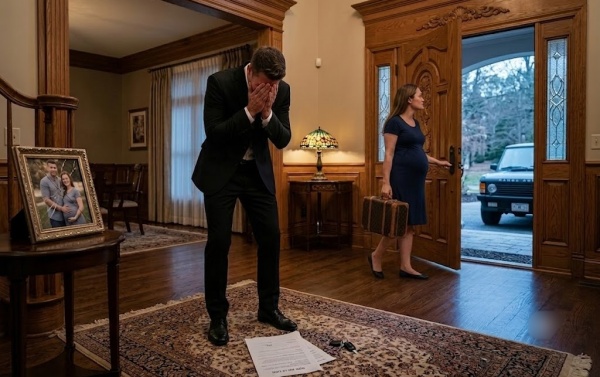
My Wife Whispered, “I Saw You in the Bedroom With Her,” and Then Disappeared — Three Years Later, I Found Twins She Never Told Me About
I thought the worst moment of my life was watching my wife leave after catching me in the bedroom with another woman. She left without screaming, without begging, and without telling me where she was going. Three years later, I saw her again at a children’s literacy event with two little kids who had my eyes and my smile. That’s when I realized the life I had destroyed had moved on without me—and I had lost far more than just my marriage.
Part 1: The Night She Left
The worst moment of my life did not come with shouting.
It came with a whisper.
My wife stood in the doorway of our bedroom, one hand resting against the frame, her face so still I almost convinced myself she had not understood what she had seen. Behind me, Vanessa Cole was scrambling for her blouse, crying under her breath, saying my name like I could still fix something.
But there was nothing left to fix.
My wife, Grace Whitmore, looked at me with eyes I had once believed would always soften when they found mine.
Then she said, very quietly, “I saw you in the bedroom with her.”
That was all.
No slap.
No broken lamp.
No dramatic speech.
No demand for details.
Just one sentence, spoken in a voice so calm it felt like the end of oxygen.
“Grace,” I said.
It came out like a prayer from a man who had never earned one.
She looked past me at the bed, at Vanessa, at the room we had painted together two summers earlier, the room where we had whispered about children, retirement, beach houses, and growing old in a way only young married people are arrogant enough to imagine as guaranteed.
Then she turned and walked down the hallway.
I followed her, barefoot, shirt unbuttoned, shame moving through me too late to be useful.
“Grace, wait. Please. Let me explain.”
She stopped at the top of the stairs.
That was the last chance life gave me to be honest quickly.
I wasted it.
“It wasn’t what it looked like,” I said.
She laughed once.
Not because anything was funny.
Because my lie was so small compared to what she had just watched die.
“It was exactly what it looked like, Daniel.”
My name is Daniel Whitmore.
At the time, I was thirty-four years old, an account director at a marketing firm in Raleigh, North Carolina, and the kind of man who thought being tired, flattered, and emotionally careless counted as a tragic excuse. Grace was thirty-two, a public school reading specialist who worked with kids who had dyslexia, speech delays, trauma histories, and all the invisible struggles adults like me rarely notice until someone patient points them out.
We had been married for six years.
Together for nine.
We owned a modest brick house in Cary, with a Japanese maple in the front yard, a screened porch Grace loved, and a mortgage we paid from two checking accounts and one shared belief that we were building something decent.
That night, I destroyed it in our bedroom.
Vanessa was not a stranger.
That would have been easier for Grace, I think, though not less painful.
Vanessa worked with me. She was sharp, charming, divorced, and good at making admiration feel like rescue. She laughed at my jokes when Grace was too exhausted from school meetings to pretend I was interesting. She told me I was talented when clients were difficult and my boss was impossible.
That is not an excuse.
It is the route.
People like to imagine betrayal begins with a bed.
It does not.
It begins with the text you do not mention.
The lunch you call work.
The complaint about your spouse you should have taken to your spouse.
The moment another person learns to comfort the version of you that your marriage is supposedly failing to appreciate.
By the time Vanessa came to my house that Thursday evening, I had already betrayed Grace a hundred quiet ways.
Grace was supposed to be at a district literacy conference in Durham overnight. Her principal had arranged hotel rooms for the staff, and Grace had packed a tote bag full of folders, a paperback novel, and the lavender sleep spray she used when hotels made her anxious.
I knew she was gone.
That knowledge became permission in the ugliest part of my mind.
Vanessa came over after dinner.
I told myself we were only going to talk.
Men who say “only talk” usually already know they are lying.
Around 8:40 p.m., Grace came home.
I learned later the conference hotel had a plumbing issue and several rooms were canceled. Grace had texted me, but my phone was downstairs in the kitchen, face down beside a half-empty glass of bourbon. She called once. I did not answer.
So she drove home.
The house was dark except for our bedroom.
When she reached the doorway, she saw enough.
Maybe everything.
I do not know exactly how long she stood there before I noticed her. That question kept me awake for years. Was it one second? Five? Did she see my hands? My face? Did she hear Vanessa whisper?
I hope not.
I fear yes.
After I gave that insulting sentence — “It wasn’t what it looked like” — Grace walked downstairs.
I followed her.
She picked up her purse from the entryway bench, the same one where she used to leave grocery lists and library books. Her overnight bag was still in the trunk of her car. She did not pack anything. She did not take clothes, photo albums, jewelry, or the ceramic mug with a chipped handle she used every morning.
She took only her purse and her car keys.
“Please,” I said. “Don’t leave like this.”
She turned at the front door.
There were tears on her face now, but she was not sobbing.
That made it worse.
Sobbing would have suggested something inside her still expected me to respond like a husband.
This was grief after expectation.
“I loved you,” she said.
“Grace, I love you.”
“No,” she whispered. “You loved being loved by me.”
Then she opened the door and stepped into the humid North Carolina night.
I stood frozen as her headlights swept across the front windows and disappeared down the street.
Vanessa came downstairs five minutes later, fully dressed, mascara smudged, holding her heels.
“I’m so sorry,” she said.
I looked at her.
For the first time that night, I saw her clearly.
Not as desire.
Not as escape.
As consequence.
“Leave,” I said.
She flinched.
“Daniel—”
“Get out.”
She left through the same door Grace had used, and the sound of it closing behind her felt like a verdict.
I called Grace twenty-seven times that night.
No answer.
I texted until the messages turned from desperate to pathetic.
Please come home.
We need to talk.
I made a terrible mistake.
I love you.
Tell me where you are.
Around 2:13 a.m., one message finally showed as read.
She did not reply.
The next morning, I called her school.
They said she had taken personal leave.
I called her mother in Wilmington.
No answer.
I drove to her best friend Maddie’s apartment in Raleigh. Maddie opened the door just wide enough for me to see one angry eye and a sliver of living room.
“She’s not here,” Maddie said.
“Do you know where she is?”
“Yes.”
“Please tell me.”
“No.”
“Maddie, I need to know she’s safe.”
“She needed to know her marriage was safe. We’re all disappointed.”
Then she shut the door.
Two days later, an attorney called me.
Her name was Rachel Stein, a family law attorney based in Wake County.
She informed me that Grace had retained counsel, that I was not to contact Grace directly, and that any communication regarding the house, finances, or separation should go through her office.
Separation.
The word hit harder than I expected.
I had imagined Grace crying somewhere, then returning, then yelling, then making demands, then perhaps forgiving me after enough humiliation, counseling, and promises. That fantasy lasted less than forty-eight hours. Grace did not return to perform pain for me.
She moved.
Quickly.
Legally.
Silently.
I did not know then that she was also carrying two children.
Our children.
Twins.
At the time she left, Grace was seven weeks pregnant.
She had not told me yet.
According to what I learned much later, she had found out three days before the conference. She had bought a tiny pair of white socks and a card that said, Our next chapter starts now. She planned to tell me that weekend over breakfast on the screened porch.
Instead, she came home early and found me in our bed with another woman.
I have imagined that moment from her side more times than I can count.
The positive test in her suitcase.
The hope in her chest.
The bedroom light under the door.
The sound of another woman laughing.
I did not just break my wife’s heart that night.
I changed the first memory she would ever have of carrying our children.
That is a kind of cruelty I cannot undo.
Part 2: The Silence She Built
The legal separation moved forward with a discipline I did not deserve.
Grace did not ask for dramatic revenge. She did not post about me online. She did not call my mother and scream. She did not expose Vanessa at work, though she could have ruined both of us with one email and a handful of screenshots.
She simply disappeared from my daily life and let attorneys speak where love used to.
In North Carolina, spouses must live separate and apart for at least one year before filing for absolute divorce. I learned that from my own attorney, Peter Langford, who explained it in a conference room while I stared at the grain of the table like it might open and swallow me.
“Is there any chance of reconciliation?” Peter asked.
“Yes,” I said immediately.
He looked at me with practiced neutrality.
“Has your wife indicated that?”
“No.”
“Then we proceed carefully.”
Carefully became the word that governed the next year.
Careful emails.
Careful financial disclosures.
Careful division of bank accounts.
Careful discussion of the house.
Careful avoidance of any language that might sound like harassment when what I wanted to do was drive across the state and beg.
Grace moved somewhere near the coast at first, though I did not know where. Later I learned she stayed with her aunt outside Wilmington during the early pregnancy, then took a job with a nonprofit literacy program in Greensboro after the twins were born. She rebuilt her life in layers, quietly, while I lived inside the wreckage I had made.
I remained in our house for six months.
That was a mistake.
Every room accused me.
The kitchen where Grace labeled spice jars in her neat handwriting.
The screened porch where she read on Sunday mornings.
The guest room she had once wanted to turn into a nursery.
The bedroom I could not enter without feeling sick.
I slept on the couch until my back hurt and my mother came over one Saturday, found me unshaven and hollow-eyed, and said, “Daniel, this is not penance. It is furniture.”
My mother loved Grace.
That made everything worse.
She had met Vanessa once at a company holiday party and later told me, “That woman looks at married men like doors she wants to test.”
I told her she was being judgmental.
Mothers are often inconveniently accurate.
When I finally confessed what happened, my mother did not cry.
She sat at my kitchen table with her hands folded and looked at me like I had become someone she would still love but no longer defend.
“Did you bring that woman into your home?” she asked.
“Yes.”
“Into your bedroom?”
I nodded.
She closed her eyes.
“Your father would be ashamed of you.”
My father had been dead for five years.
That sentence found bone.
“I know,” I said.
“No, Daniel. You feel sorry for yourself. That is not the same as knowing.”
She was right.
For months, I performed remorse mostly as suffering.
I stopped going out.
I quit drinking for a while.
I avoided Vanessa at work until she transferred to the company’s Atlanta office. She sent me one long email about how she never meant to destroy my marriage and hoped someday I could forgive both of us.
I deleted it.
The truth was, Vanessa had not destroyed my marriage.
I had used her as the tool.
By the time the divorce became final, Grace and I had communicated directly only once.
It was through a video mediation session about the sale of the house.
I saw her face on a screen after eleven months of silence and nearly forgot how to breathe.
She looked different.
Her hair was shorter, just above her shoulders. Her face was thinner. She wore a navy blouse and no necklace. The absence of her wedding ring was so obvious to me that I stared at her left hand until my attorney nudged me under the table.
Grace did not look sad.
That hurt more than if she had.
She looked resolved.
The mediator discussed the house, retirement accounts, joint debt, and personal property. Grace spoke clearly, politely, and only when necessary. I agreed to nearly everything because the idea of fighting her over furniture after what I had done felt obscene.
At one point, the mediator asked about the guest room bookshelves.
Grace said, “He can keep them.”
I opened my mouth before I thought.
“You loved those shelves.”
For the first time, she looked directly at me.
“Yes,” she said. “I loved a lot of things in that house.”
Then she looked back at the mediator.
That was the only personal sentence she gave me.
After the divorce finalized, I expected relief.
Instead, I felt the strange emptiness of consequences becoming official.
The court did not create the end. It merely recorded what I had done.
I sold the house.
A young couple bought it.
The wife was pregnant.
I signed the closing documents and then sat in my car in the parking lot for forty minutes, gripping the steering wheel and feeling like life had developed a cruel sense of staging.
I moved into an apartment near North Hills in Raleigh.
One bedroom.
White walls.
No memories.
That was the point.
For the next two years, I became functional.
Not healed.
Functional.
I went to work, changed companies, started therapy, and answered questions about my divorce with sanitized sentences.
“We grew apart.”
“It was my fault.”
“I made choices I regret.”
All true, none complete.
Therapy was the first place I said the ugliest version out loud.
“I cheated on my wife in our bed, and she walked in.”
My therapist, Dr. Elaine Porter, did not flinch.
“What do you feel when you say that?”
“Disgust.”
“At her? At Vanessa? At yourself?”
“Myself.”
“And underneath that?”
I hated that question.
Therapists are miners.
They keep digging under the emotion you brought them because they suspect the original crime is buried deeper.
Under disgust was shame.
Under shame was grief.
Under grief was something more humiliating: entitlement.
I had believed, without ever saying it, that Grace’s love was permanent enough to absorb my weakness. I had believed my unhappiness mattered more urgently than her dignity. I had believed one night could be separated from the life surrounding it.
I had believed wrong.
For two years, I learned to stop turning remorse into a plea.
That was difficult.
Remorse wants something.
Forgiveness.
Access.
A second chance.
A restored self-image.
Real accountability does not ask the injured person to become the instrument of your recovery.
So I stayed away.
I did not contact Grace on birthdays.
I did not send flowers.
I did not write long letters.
I did not show up where I thought she might be.
I checked her social media once, saw nothing public, and never checked again because even silent surveillance felt like another violation.
I thought that was the best I could do.
I thought leaving her alone was my final act of love.
I did not know there were two small people in Greensboro learning to walk with my eyes, my smile, and Grace’s stubborn chin.
Part 3: The Literacy Event
I found out about the twins at a children’s literacy fundraiser in Greensboro.
I was there because my company had become a sponsor for ReadForward NC, a nonprofit that provided books, tutoring, and family literacy programs across the state. One of our executives had backed out at the last minute, and my boss asked me to attend the Saturday event, shake hands, stand near the banner, and represent the firm.
I almost said no.
Greensboro was not emotionally significant to me then.
It was just a city ninety minutes west of Raleigh with good restaurants, old textile money, and the kind of downtown trying hard to become charming again. I drove there on a bright April morning, wearing a gray suit and the expression of a man prepared to make polite conversation about sponsorship packages.
The event was held at the Greensboro Cultural Center.
There were balloons, folding tables, stacks of children’s books, local authors signing copies, teachers carrying tote bags, parents with strollers, and kids sitting cross-legged on colorful rugs while volunteers read aloud. It was exactly the kind of event Grace would have loved.
That thought struck me before I saw her.
Of course it did.
For years, every room with books and children had carried her ghost.
I was standing near a table of early reader books when I heard a laugh.
Not Grace’s laugh.
A child’s laugh.
High, delighted, uncontrollable.
I turned.
Two little kids were running toward a display of stuffed animals shaped like book characters. A boy and a girl, maybe two and a half. Dark hair. Bright eyes. Matching green sneakers. The boy was slightly ahead, fearless. The girl followed with a picture book clutched to her chest like treasure.
Something in my body recognized them before my mind understood why.
The boy turned, grinning at a woman behind him.
“Mommy, look!”
Then Grace stepped into view.
The world narrowed.
She wore a cream cardigan over a blue dress, her hair pulled back loosely, a conference badge hanging from a lanyard around her neck. She was holding two small jackets and a canvas tote full of books. She looked tired in the way parents of toddlers look tired, which is to say permanently interrupted and somehow luminous.
For three seconds, I could not move.
Then the little girl looked directly at me.
Her eyes were mine.
Not similar.
Mine.
Hazel with a darker ring around the iris, the Whitmore eyes my grandmother used to call storm-colored.
The boy had them too.
And his smile.
God help me, his smile was mine from every childhood photo my mother kept in shoeboxes.
Grace saw me a second later.
Her face changed, but only slightly.
A tightening around the mouth.
A small stillness.
Then she recovered because she was Grace, and Grace had once taught a room of restless second graders while a fire alarm malfunctioned for eight straight minutes.
“Daniel,” she said.
Not Danny.
Not Dan.
Daniel.
The name of a man she used to love but no longer invited closer.
“Grace.”
The children reached her legs.
The boy looked up at me with open curiosity.
“Who’s that?”
Grace took a breath.
“This is Mr. Whitmore.”
Mr. Whitmore.
I felt the words enter me like glass.
The little girl hugged Grace’s knee.
The boy said, “Like our last name?”
My lungs stopped.
Grace closed her eyes for half a second.
Then she crouched between them.
“Yes, sweetheart,” she said softly. “Like part of your last name.”
I took one step back.
Part of your last name.
Not Ramirez.
Not Bennett.
Whitmore.
My knees went weak, and I gripped the edge of the book table hard enough to bend a flyer.
“Grace,” I whispered.
She stood.
“Not here.”
Her voice was quiet, controlled, and absolute.
I nodded because the alternative was falling apart in front of two toddlers and a room full of teachers.
A woman with silver hair approached.
“Grace, the panel starts in fifteen minutes.”
Grace smiled professionally.
“Thank you, Linda. I’ll be right there.”
The boy tugged her cardigan.
“Mommy, can I get the dragon book?”
“Yes. One book each.”
The girl held up hers.
“I got mine.”
Grace touched her hair.
“I see that, Lucy.”
Lucy.
The boy bounced.
“I’m getting dragon.”
Grace said, “Okay, Noah.”
Noah.
Lucy and Noah.
My children had names.
My children had voices.
My children had green sneakers and preferences and one book each.
I stood there like a man discovering a city had been built where he believed there was only empty land.
Grace looked at me.
Her eyes had tears in them now, though none fell.
“I have to work,” she said. “If you want to talk, give me your number. I’ll contact you.”
“I still have the same number.”
“I don’t.”
Of course she didn’t.
I gave it to her on the back of a program with hands that shook so badly the pen scratched through the paper.
She took it, folded it once, and put it in her tote.
Then she held out her hands to the children.
“Come on, babies. We need to wash up before story time.”
Babies.
My babies.
Noah looked back at me and waved.
“Bye, Mr. Whitmore.”
I managed to lift my hand.
Lucy did not wave.
She watched me as if she knew I was important but had not been given the words yet.
Then they were gone.
I left the event fifteen minutes later.
My boss called twice, probably wondering where the sponsor representative had vanished. I sat in my car in the parking deck with both hands over my mouth, trying not to make a sound because the sound would not stop once it started.
Twins.
Grace had been pregnant when she left.
She had carried them alone.
Given birth without me.
Named them.
Raised them.
Held them through fevers, first steps, teething, nightmares, daycare transitions, and every ordinary miracle I had forfeited before knowing it existed.
But there was another truth moving beneath the grief.
She had not told me.
I hated myself for thinking it, but I did.
How could she not tell me?
How could I have children for three years and not know?
Then memory answered with brutal efficiency.
Our bedroom.
Vanessa’s blouse.
Grace’s whisper.
My lie.
“It wasn’t what it looked like.”
I leaned forward until my forehead touched the steering wheel.
Whatever anger I felt had nowhere honorable to stand.
Part 4: The Truth She Carried Alone
Grace called me four days later.
I had not slept much.
I had told no one except my therapist, who said, “Before you decide what you deserve, focus on what the children need.” It was the kind of sentence that made me angry because it was right.
When Grace’s name appeared on my phone — Unknown Caller, technically, but I knew — my hand went cold.
“Hello?”
“It’s Grace.”
“I know.”
Silence.
Then she said, “Can you meet Friday at 10 a.m.? There’s a coffee shop near LeBauer Park. Public place. No kids.”
“Yes.”
“Daniel.”
“Anything. Yes.”
“I’m not promising anything.”
“I know.”
“I mean it.”
“I know.”
Friday came slowly.
I arrived twenty minutes early and chose a table outside where the spring air could keep me from suffocating. Grace arrived exactly on time. She wore jeans, a white blouse, and no makeup except mascara. She looked like the woman I had married and a stranger with better boundaries.
I stood.
She did not hug me.
Of course not.
We sat.
For a while, neither of us touched the coffee.
Finally, I said, “Are they mine?”
Her face tightened.
“Yes.”
The answer nearly split me open.
“I didn’t know you were pregnant.”
“I know.”
“When did you find out?”
“Three days before I came home early.”
I closed my eyes.
“Grace.”
“Don’t.”
I opened them.
She was looking at me with an expression I had no right to resent.
“I had bought you a card,” she said. “Little socks. I was going to tell you that weekend.”
My throat closed.
“Why didn’t you tell me later?”
Her hand tightened around the paper cup.
“Because I was afraid.”
That stopped every selfish argument forming inside me.
Afraid.
Not angry.
Not vindictive.
Afraid.
“Of me?”
“Of who you had become. Of how unstable I felt. Of being pregnant with twins and tied to a man who could bring another woman into our bed and then tell me it wasn’t what it looked like.”
I looked down.
“I deserved that.”
“This is not about what you deserved. That’s the problem. Back then, everything became about your regret, your calls, your messages, your need to explain. I could barely breathe. I couldn’t make my body safe and manage your collapse too.”
She was right.
After she left, I had flooded her phone with my panic and called it love.
“I told my attorney,” Grace continued. “I told my doctor. I told Maddie. I told my aunt. Everyone had opinions.”
“What did your attorney say?”
“That legally, withholding information about children from a biological father could create problems later, especially around custody and support. She advised me to disclose eventually. But at the time, there were no children born yet, only a pregnancy I was terrified of losing.”
“Did you consider—”
I stopped.
She looked at me sharply.
“Consider what?”
“Telling me before they were born.”
“Yes.”
“And?”
“I wrote the email six times.”
She looked away toward the park.
“I deleted it six times.”
I deserved every deleted draft.
“They were born early,” she said.
“How early?”
“Thirty-four weeks.”
I inhaled sharply.
“Were they okay?”
“NICU for nine days. Feeding support. Lucy had some breathing trouble at first. Noah was tiny but angry at everyone, which the nurses took as a good sign.”
A laugh and sob collided in my chest.
Grace’s eyes softened for half a second, then she looked down.
“My aunt was there. Maddie came. My mother flew in from Arizona. I was not alone.”
But I should have been there.
Not as a reward.
As responsibility.
“I missed it,” I whispered.
“Yes.”
“I missed everything.”
“Yes.”
She did not cushion it.
I respected her for that.
It still hurt.
“I put your name on the birth certificate,” she said.
My head lifted.
“You did?”
“Yes. Full legal names are Noah James Whitmore-Hayes and Lucy Anne Whitmore-Hayes.”
Hayes was Grace’s maiden name.
“Why?”
“Because the truth matters. Even when people fail it.”
I looked at her, tears blurring my vision.
She continued.
“I did not ask for child support. I had help. I had a job. I was angry, and I was scared, and maybe part of me wanted one thing in my life that you could not break.”
That sentence hurt because it was honest enough to include her own imperfection.
“I’m sorry,” she said.
I stared at her.
“No. Grace, don’t apologize to me.”
“I’m not apologizing for protecting myself. I’m acknowledging the children have a right to know where they come from. I should have found a way sooner.”
I wanted to say yes.
I wanted to say she should have.
I wanted to hold that small piece of grievance like evidence I was not the only one who had done harm.
But fatherhood entered the conversation before ego could.
“What do they know about me?”
“That you exist. That families look different. That they have a biological father named Daniel who lives in Raleigh.”
“Do they ask?”
“Sometimes.”
“What do you say?”
“That grown-up stories are complicated, but they are loved.”
I put my face in my hands.
Grace waited.
When I looked up, she was crying silently.
“Do you want me in their lives?” I asked.
She took a long breath.
“I want what is best for them.”
“That’s not the same answer.”
“No. It’s the only answer I trust.”
I nodded.
“Okay.”
“If this happens, it happens slowly. With a child therapist’s guidance. No sudden ‘Daddy’ reveal. No gifts trying to buy attachment. No showing up at my apartment. No contacting their preschool. No social media posts. No involving your mother before we have a plan.”
“Yes.”
“I mean it, Daniel.”
“Yes.”
“And you need an attorney. So do I. Not because I want war, but because custody, support, medical decisions, and parenting time need to be done correctly.”
“I understand.”
She looked almost surprised.
Three years earlier, I would have argued.
I would have said attorneys made things hostile.
I would have asked why we couldn’t handle it ourselves, meaning why couldn’t she trust me before I earned trust.
Now I understood that legal structure is not always a weapon.
Sometimes it is scaffolding around a fragile thing.
“I’ll do whatever is appropriate,” I said. “Child support, back support if ordered, insurance, college savings, therapy, anything.”
Grace studied me.
“This is not about paying your way into forgiveness.”
“I know.”
“Do you?”
I met her eyes.
“I’m trying to.”
That was the most honest answer I had.
We talked for two hours.
Not about reconciliation.
Not about love.
About Noah’s peanut allergy.
Lucy’s speech therapy.
Their preschool schedule.
Their favorite books.
Their sleep habits.
Noah hated socks but loved dinosaurs.
Lucy lined up crayons by color and corrected adults who skipped pages.
They both loved banana pancakes.
They had never had soda.
Grace was strict about bedtime.
Noah climbed everything.
Lucy hated loud hand dryers.
Every fact was a gift and a punishment.
I had to learn my children as if studying a language I should have been speaking from birth.
Before Grace left, she handed me a folder.
Inside were copies of their birth certificates, pediatrician information, allergy forms, and a printed list titled:
Things to Know Before Meeting Noah and Lucy
I touched the page.
Grace stood.
“I’ll contact a child therapist Monday.”
“Thank you.”
She nodded.
Then she paused.
“There is one more thing.”
I looked up.
“If you disappear after meeting them, it will hurt them more than never meeting you.”
“I won’t.”
“You don’t know that yet.”
“Yes, I do.”
“No,” she said gently. “You know what you feel today. Prove what you choose over time.”
Then she walked away.
That became the sentence I built fatherhood on.
Part 5: Learning to Become Their Father
I met Noah and Lucy as “Daniel” in a child therapist’s playroom.
The therapist, Dr. Melissa Grant, specialized in reunification, early childhood attachment, and family transitions. She was kind but firm, and before I met the twins, she met with me twice alone and once with Grace.
“Your goal is not to be recognized as their father immediately,” Dr. Grant said.
“What is the goal?”
“To become a safe adult they enjoy seeing.”
That humbled me more than any courtroom could have.
A safe adult.
Not Dad.
Not father.
Not family.
Safe adult.
The first visit lasted forty-five minutes.
Noah entered first, holding a plastic dinosaur by the tail. Lucy stayed half behind Grace, clutching a stuffed rabbit. Grace sat on the couch, close enough for them to return to her whenever they needed.
I sat on the floor because Dr. Grant told me not to loom.
“Hi, Noah. Hi, Lucy. I’m Daniel.”
Noah narrowed his eyes.
“Mr. Whitmore?”
“Yes.”
He pointed the dinosaur at me.
“Do you like T. rex?”
“I do.”
“Do you know they have tiny arms?”
“I’ve heard that.”
He looked disappointed.
“You’re supposed to say they’re still scary.”
I nodded solemnly.
“They’re still very scary.”
That earned me a small smile.
Lucy watched me for ten minutes before speaking.
Then she held up her rabbit.
“This is Poppy.”
“Hi, Poppy.”
She frowned.
“She can’t talk.”
“Right. Sorry.”
Grace looked down, hiding a smile.
That smile nearly ended me.
Not because it was for me.
Because it reminded me of the life where we might have shared these moments daily.
After the visit, I cried in my car.
Not loudly.
Not dramatically.
Just tears I could not stop.
I cried because Noah had my smile.
I cried because Lucy corrected me like Grace.
I cried because they were real in a way regret had never been.
The legal process began soon after.
There was no explosive custody battle.
Grace did not try to erase me once I agreed to move carefully. I did not try to punish her for the years I had missed. Our attorneys worked through parentage acknowledgment, child support, health insurance, parenting time, decision-making, and a gradual reunification plan.
I paid support.
Current and retroactive amounts were calculated through legal guidance and negotiation, based on income, expenses, insurance, and childcare. Writing the first check did not make me noble. It made me late.
I added them to my health insurance where appropriate.
I opened 529 college savings accounts with Grace’s knowledge.
I attended parenting classes.
I kept going to therapy.
I learned how to install car seats correctly after failing three times and being gently humiliated by a firefighter at a community safety check.
I bought children’s plates, outlet covers, picture books, allergy-safe snacks, and a first aid kit large enough to serve a summer camp.
My apartment changed.
Slowly.
A basket of toys in the living room.
Step stools in the bathroom.
Two small toothbrushes.
A dinosaur night-light.
A pink cup Lucy declared “acceptable.”
The first time they visited my apartment, Grace stayed for the full hour.
The second time, she stepped into the hallway for ten minutes.
The third time, she sat in her car downstairs while I read Dragons Love Tacos three times and Noah yelled “again” before I finished.
Trust came in increments.
For the children.
For Grace.
For me.
My mother learned about the twins after Grace and I had a plan.
She sat at my kitchen table holding their photos and sobbed so hard I had to get her water.
“Daniel,” she whispered. “You have babies.”
“I know.”
“Why didn’t she tell us?”
I looked at her.
“Mom.”
She closed her eyes.
“I know.”
Grace allowed my mother to meet them after two months, at a park in Greensboro. My mother brought two small books, no candy, and cried only in the bathroom. I loved her for that restraint.
Noah called her “Miss Linda” at first.
Lucy called her “the grandma lady.”
My mother accepted both titles like royal honors.
The first time Noah called me Daddy, it was an accident.
We were at a children’s museum, building towers with foam blocks. Grace was nearby helping Lucy with a magnetic wall. Noah’s tower collapsed, and he shouted, “Daddy, help!”
The word froze the room for me.
He did not notice.
Children give miracles casually because they do not yet know adults may spend years starving for them.
I helped rebuild the tower with hands that shook.
Grace heard.
She looked at me.
Then looked away quickly.
Later, in the parking lot, she said, “Don’t make a big deal of it with him.”
“I won’t.”
Then, after a pause, she added, “But I know it mattered.”
I nodded.
“It did.”
Lucy took longer.
She was watchful.
She loved puzzles, hated surprises, and studied adults like she was collecting evidence. For months, I was Daniel to her, even after Noah switched mostly to Daddy. I did not correct her. Dr. Grant had warned me never to demand a title.
One evening, after a supervised dinner at Grace’s townhouse, Lucy brought me a book and climbed onto the couch beside me.
“Read.”
So I read.
Halfway through, she leaned against my arm.
Not much.
Just enough.
When I finished, she said, “You can be Daddy Daniel.”
I swallowed.
“I’d like that.”
She nodded, as if approving a contract.
“Okay.”
Grace turned toward the kitchen window.
I saw her wipe her cheek.
We did not become a couple again.
People always ask that.
They hear secret twins, betrayal, reunion, and assume life must resolve into remarriage if enough remorse is applied.
Life is not a movie.
Grace had built a life without me because I forced her to.
She had become stronger in ways that did not require my return. She had friends, work, routines, a church community, and two children who trusted her as the center of their universe. My regret did not entitle me to move back into the house of her peace.
I did apologize.
Many times.
But not constantly, because apologies can become another form of asking for attention.
The most important apology happened one year after I found them.
Grace and I were sitting on a bench outside the preschool after a parent meeting. Noah and Lucy were inside finishing an art project. Spring rain tapped softly against the awning.
“I need to say something,” I told her.
She looked tired.
“Okay.”
“I used to think the worst thing I did was cheat.”
Her face remained still.
“It wasn’t.”
I took a breath.
“The worst thing was believing your love would be there no matter how carelessly I treated it. The affair was the act. But the entitlement came before it. I see that now.”
Grace looked down at her hands.
“I needed to hear that years ago.”
“I know.”
“I don’t know what to do with it now.”
“You don’t have to do anything.”
She looked at me then.
That seemed to matter more than the apology.
“I’m not saying it so you forgive me,” I said. “I’m saying it because it’s true, and because I don’t want to be that man near our children.”
Her eyes filled.
“Our children,” she repeated softly.
“Yes.”
For a long moment, rain was the only sound.
Then she said, “I forgive parts of you. Not all at once. Not everything. But parts.”
I nodded, unable to speak.
That was more grace than I deserved.
Appropriate, given her name.
Three years have passed since the literacy event.
Noah and Lucy are six now.
They have lost baby teeth, started kindergarten, learned to ride scooters, and developed strong opinions about pizza toppings. Noah wants to be a paleontologist, a firefighter, and possibly a pirate. Lucy wants to be a veterinarian but only for animals “with manners.”
I live in Greensboro now.
I transferred offices, then eventually changed jobs so I could be within fifteen minutes of their school. Grace did not ask me to do that. In fact, she warned me not to make a dramatic move and then resent anyone for it. I told her drama fades; proximity matters.
We co-parent.
Not perfectly.
But honestly.
We use a shared calendar. We split medical costs. We attend parent-teacher conferences together. We sit on opposite sides of school auditoriums and still exchange tissues when Lucy sings too loudly and Noah waves with both hands.
Sometimes Grace laughs at something I say.
Sometimes I still go home and grieve afterward.
Both can be true.
Grace is dating someone now.
His name is Aaron Miller, a pediatric physical therapist with kind eyes and a quiet manner. The first time I met him, every primitive part of me wanted to dislike him. Then Noah climbed onto his back like a jungle gym and Lucy asked him to open applesauce, and he did both with patience.
So I shook his hand.
Hard, but not too hard.
Later, Grace said, “Thank you for being decent.”
I said, “I’m learning.”
She smiled.
“I know.”
That smile was not an invitation.
It was acknowledgment.
I have learned not to confuse the two.
Sometimes, late at night, I still think about the other version of our lives.
The one where Grace came home from that conference, found me alone, and handed me the card with the tiny socks. The one where we cried on the screened porch and painted the guest room yellow. The one where I held her hand during the ultrasound and gasped when the doctor said there were two heartbeats.
That life existed for one second as possibility.
Then I killed it.
There is no poetic way around that.
But my children are not a punishment.
They are not a second chance at marriage.
They are not proof I suffered enough to be rewarded.
They are Noah and Lucy — two whole people who deserved a father from the beginning and got one late because I was selfish, and because their mother was brave enough to protect them until she could decide whether my presence would help more than hurt.
I used to say Grace kept them from me.
I do not say that anymore.
Grace kept them safe.
There is a difference.
And if I spend the rest of my life proving that safe does not have to mean away from me, that will still be less than what I owe.
The worst moment of my life was watching my wife leave after catching me in the bedroom with another woman.
But the most humbling moment came three years later, when a little boy with my smile waved at me in a room full of children’s books and called me Mr. Whitmore, while his sister stared at me with my own eyes.
That was when I understood the life I ruined had not stopped.
It had gone on.
It had learned to walk, talk, laugh, read bedtime stories, and call someone else home.
I missed the first steps.
The first words.
The first birthdays.
The first fevers.
The first time they said Mama.
I missed more than my marriage.
I missed the beginning of my children’s lives.
Now I show up for what remains.
Every school pickup.
Every dentist appointment.
Every bedtime I am given.
Every small hand reaching for mine in a parking lot.
Every chance to become, through repetition and humility, what biology alone did not make me.
Their father.
