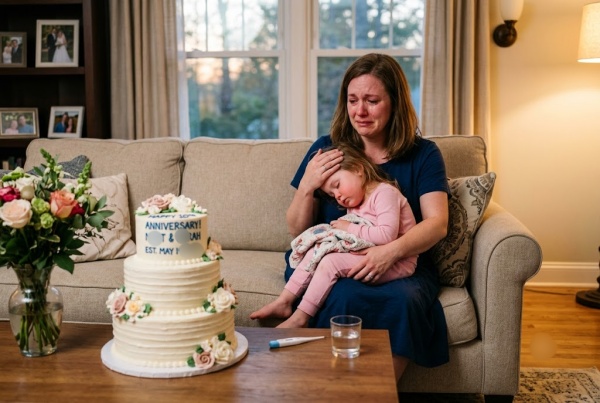
On our anniversary night, My Husband Abandoned His Wife and Sick Baby for His Mistress. He chose a diamond gala, a room full of wealthy strangers, and the woman he had been hiding from me. He told people I had gone home because ordinary women like me did not belong in that class. I stayed silent, holding our feverish daughter and watching the livestream from the nursery.
Part 1: The Night He Chose Her
My husband left me at home with our sick baby on our fourth wedding anniversary. He stood in our bedroom doorway in a black tuxedo, adjusting his cuff links while our six-month-old daughter coughed against my shoulder. I was wearing an old gray sweatshirt with baby formula on the sleeve, my hair tied up with a rubber band I had found on the bathroom counter. Ethan looked at me like I was part of the furniture he had outgrown.
“Are you really going?” I asked.
He did not answer right away. He checked himself in the mirror, smoothed the front of his jacket, and tilted his chin as if preparing for a photograph. Downstairs, a car waited in the driveway, headlights spilling through the curtains. Our daughter, Lily, whimpered softly, her small body warm with fever.
“It’s not just a party, Clara,” he said. “It’s my family’s biggest event of the year.”
I looked down at Lily’s flushed cheeks. “She has a 101.8 fever.”
“You already called the pediatric nurse,” he said. “They told you what to do.”
“They told me to watch her closely,” I said. “They told me if her breathing gets worse, I need to take her in.”
Ethan sighed like I was deliberately inconveniencing him. “Then watch her.”
That was marriage to Ethan Whitaker by then. My fear was drama. My exhaustion was weakness. My request for help was an attack on his freedom. He could turn any responsibility into my personality flaw if he spoke with enough confidence.
It was our wedding anniversary, but there were no flowers on the counter. No card. No dinner reservation. The only reason I knew he remembered the date was because he had casually mentioned it that morning while searching for his diamond cuff links.
“Funny timing,” he had said. “Four years married, and tonight my family finally gets back on top.”
The Whitakers loved phrases like that. Back on top. Legacy. Class. Bloodline. They came from old Atlanta money that had become thinner with each generation, though they still spoke as if their last name could purchase oxygen. Ethan’s grandfather had once owned part of a jewelry importing business, and the family never stopped talking about diamonds even after they quietly sold most of what remained.
That night’s event was called the Whitaker Diamond Heritage Gala. It was being held at the Harrington Building in Buckhead, one of Atlanta’s most beautiful private event spaces, with marble floors, brass elevators, and a rooftop terrace overlooking the city. Ethan’s mother had spent months making sure every wealthy person within a thirty-mile radius knew the Whitakers were presenting “a historic private diamond collection” to potential investors.
What she did not know was that the building was mine.
The collection was mine too.
And the investment company deciding whether Ethan’s future would survive the next fiscal quarter belonged to my family.
Ethan did not know any of that because Ethan had stopped seeing me long before he left the house that night. He saw the woman folding laundry, disinfecting bottles, scheduling pediatric appointments, and stretching grocery runs between nursing sessions. He saw the wife who traded silk dresses for washable cotton and the woman who no longer had the energy to attend dinners where his mother corrected my pronunciation of French designers.
He saw ordinary.
That was his favorite insult.
The first time he called me ordinary, he disguised it as affection. “You’re not like the women I grew up around,” he told me when we were dating. “You’re real.” Back then, I thought he meant grounded. I did not understand that to Ethan, real meant useful until impressive came along.
Impressive came in the form of Vanessa Reed.
She was a private events consultant with sleek auburn hair, a closet full of cream-colored suits, and the kind of laugh that always arrived half a second after Ethan spoke. His mother hired her to help coordinate the gala, but Vanessa quickly became more than a consultant. She became the woman Ethan texted from the driveway, the woman whose perfume lingered on his jacket, the woman whose name made him lock his phone face down.
He denied it at first.
Then he got tired of denying it.
“She understands this world,” he told me one night while I was washing pump parts at the kitchen sink. “You don’t.”
I had looked at him through the reflection in the dark window. “This world?”
“My family’s world,” he said. “High-level donors, investors, legacy clients. People who matter.”
I remember turning off the faucet slowly. Lily was three months old then, asleep in the bassinet beside the breakfast table. I was healing from childbirth, sleeping in two-hour fragments, and still trying to believe my husband was simply stressed. Ethan looked at me like I had become an employee who was no longer meeting expectations.
“And I don’t matter?” I asked.
He rubbed his forehead. “Don’t twist my words.”
Men like Ethan never twist their own words. They simply hand them to you sharp and blame you for bleeding.
That anniversary night, Vanessa texted him while he stood in front of me. I saw her name light up his phone. He angled the screen away, but not fast enough.
“Is she going with you?” I asked.
He slipped the phone into his pocket. “Vanessa is working the event.”
“Wearing what?” I asked quietly.
His eyes hardened. “Don’t embarrass yourself.”
There it was. The warning he had been giving me for months. Do not make a scene. Do not ask questions. Do not remind him that he had a wife and a baby when he wanted to perform as a free man among wealthy strangers.
Lily coughed again, and I shifted her against my chest. Her tiny fingers curled into my sweatshirt. Ethan glanced at her, then at his watch.
“I’ll be back late,” he said.
“Ethan,” I said, “please don’t go.”
For one second, I thought something human moved across his face. Maybe guilt. Maybe memory. Maybe the ghost of the man who once cried when Lily was born and whispered, “She’s perfect,” like he had discovered proof of God.
Then his expression closed.
“I can’t miss this because you’re overwhelmed,” he said.
He walked out.
I heard his shoes on the stairs. I heard the front door open, then close. A minute later, the car pulled away from the curb, taking my husband to a gala where he would arrive with his mistress while I sat in the nursery counting our daughter’s breaths.
At 8:17 p.m., Vanessa posted the first photo.
Ethan stood beside her beneath a crystal chandelier, one hand resting at the small of her back. The caption read: “Honored to celebrate legacy, brilliance, and the future of true luxury.”
I did not cry.
Not then.
I simply saved the photo, kissed Lily’s warm forehead, and whispered, “Your father has no idea what he just walked into.”
Part 2: The Ordinary Wife
I was not born into the kind of wealth people imagine from television. There were no gold gates, no staff lined up in hallways, no childhood ponies named after European cities. My father, Grant Mercer, built Mercer North Capital from a rented office in Charlotte, North Carolina, after spending twelve years managing risk for other men who liked his mind but not his name. By the time I was sixteen, he had become one of the quietest billionaires in the Southeast.
Quiet was the rule in our family.
My mother drove a Volvo station wagon until the odometer passed 190,000 miles. My father wore the same brown leather belt for twenty years. We lived well, but never loudly. He believed the fastest way to lose judgment was to become impressed with yourself.
So when I met Ethan at a museum fundraiser in Savannah, I introduced myself as Clara Mercer and nothing more. I was working under a different public-facing role at one of our family’s nonprofit arts foundations. Ethan told me he admired how “normal” I seemed compared to the women in his social circle. I should have noticed how much he needed that comparison.
He was charming then.
He opened doors, remembered my coffee order, and drove three hours just to bring soup when I had the flu. He told me he hated pretentious people, even though he wore privilege like cologne. He said he wanted a life with substance. He said he was tired of women who cared only about money.
I believed him because I wanted to be loved for myself.
That is the strange curse of growing up around money. People think wealth makes you suspicious of everyone, and maybe it does. But it also makes you desperate for one person who sees you without calculating what stands behind you. Ethan looked at my simple dresses, my used Jeep, and my job title at a nonprofit, and I thought he saw Clara.
In truth, he saw a woman he could feel superior to.
His family never liked me.
Eleanor Whitaker, Ethan’s mother, was polite in the way expensive knives are polished. She smiled without warmth and called me “sweet girl” even after I turned thirty. At our engagement dinner, she asked whether my parents were “comfortable” or “still working.” When I said my father worked in investment management, she nodded as if he might handle retirement accounts at a strip mall.
Ethan laughed it off.
“She’s just old-school,” he said. “Don’t take it personally.”
But old-school became the family excuse for every insult. His sister Paige asked if I needed help picking “appropriate gowns” for Whitaker events. His uncle joked that I must be shocked by real champagne. At Thanksgiving, Eleanor seated me near the kitchen entrance and told guests I had “such a practical background.”
I did not correct them.
Partly because my father had taught me that people reveal themselves more honestly when they think they have nothing to gain. Partly because I loved Ethan and did not want to embarrass him. Mostly because I believed kindness would eventually teach them what status could not.
I was wrong.
After our wedding, Ethan changed slowly enough that I kept making excuses. He began spending more time with his family, more time discussing “positioning,” more time trying to turn the Whitaker name back into something banks and investors respected. He had joined a boutique luxury investment firm that specialized in jewelry, hospitality, and high-end retail acquisitions. He wanted to be known as the man who revived his family’s legacy.
At first, I supported him.
I reviewed his investor decks late at night, tightening language and catching inconsistencies. I introduced him, carefully and indirectly, to people who could help without revealing how connected my family was. I encouraged him when deals fell through. I reminded him that reputation takes years to rebuild and seconds to damage.
Then Lily came.
Pregnancy was difficult for me. I developed high blood pressure in my third trimester and spent the last month on modified bed rest. Ethan was attentive for exactly eleven days, then irritated for the rest. He said he loved me, but he missed “the version of us that had momentum.”
Momentum.
That was what he called dinners, networking, travel, and being seen. My swollen ankles, doctor appointments, and nursery preparations were interruptions. He did not say that directly, but marriage teaches you to hear what people avoid saying.
After Lily was born, I struggled. She had reflux, recurring respiratory infections, and nights where she cried so hard her little body shook. I became a woman measured in ounces, temperatures, and minutes of sleep. Ethan became a guest star in our house, appearing for photos and disappearing for hard parts.
He loved holding Lily when she was clean, calm, and dressed in tiny outfits his mother bought from boutiques. He did not love walking the hallway at 3:00 a.m. while she screamed. He did not love sanitizing bottles, calling insurance, or changing crib sheets after she spit up for the third time before dawn. He called me “better at that stuff,” as if exhaustion were a talent.
Vanessa entered our lives when Lily was four months old.
Eleanor introduced her as the woman who could make the Diamond Heritage Gala “feel relevant again.” Vanessa understood lighting, press placement, donor psychology, and how to flatter wealthy men while making their wives feel invisible. She had been divorced once, engaged twice, and professionally described herself as “a luxury narrative strategist.”
Ethan was fascinated.
He began staying out late under the excuse of gala planning. He came home smelling like her perfume, something floral and sharp. When I asked why event meetings needed to run until midnight, he said I did not understand high-level execution.
I was nursing Lily when he said that.
I remember looking down at our daughter and thinking there was no higher-level execution than keeping another human being alive with your own body while someone else complained about seating charts.
The affair became obvious by accident.
A florist called the house to confirm delivery of white orchids to Vanessa’s condo. The card message read, “You make the future feel possible. —E.” Ethan said it was a professional thank-you. When I asked why a professional thank-you cost $685, he told me I was becoming small-minded.
Small-minded.
Ordinary.
Overwhelmed.
Homesick.
Those became his words for me.
Two weeks before the gala, Ethan told me his mother did not think I should attend. Lily’s health was too unpredictable, he said. My “energy” was wrong. The event required confidence, not postpartum anxiety.
I asked whether Vanessa would be there.
He looked away.
That was answer enough.
What Ethan did not know was that my father’s company, Mercer North Capital, had quietly acquired the Harrington Building through a preservation fund three years earlier. He did not know the diamond collection being displayed that night had been assembled by my grandmother, Ruth Mercer, who had spent forty years acquiring rare stones and donating millions to jewelry arts education. He did not know the Whitaker family had been invited to present alongside that collection only because I had asked my father to consider giving Ethan’s firm a chance.
I had done that before things fell apart.
I had believed my husband deserved opportunity.
By the time he left me on our anniversary with our sick baby, the opportunity was no longer a gift. It was a test.
And Ethan was failing it in public.
Part 3: The Diamond Party
At 9:05 p.m., Lily’s fever dropped to 100.4 after medicine and a lukewarm bath. She slept against my chest in the rocking chair, her breathing still raspy but steadier. I should have slept too, but Vanessa kept posting.
The gala looked exactly like Eleanor had dreamed. Champagne towers rose beside white floral arrangements. Women in silk gowns posed under the Harrington Building’s grand staircase. Men in tuxedos lifted crystal glasses while pretending not to check who else was watching.
Then came the photo that changed everything.
Ethan and Vanessa stood beside the central display case, where my grandmother’s blue-white diamond necklace rested on black velvet beneath museum-grade glass. Vanessa’s hand was looped through Ethan’s arm. Eleanor stood on his other side, smiling like she had finally arranged the family portrait she wanted.
The caption came from a society photographer.
“Ethan Whitaker and Vanessa Reed representing the future of the Whitaker legacy at tonight’s exclusive Diamond Heritage Gala.”
Representing the future.
I stared at those words until they stopped hurting and started clarifying.
At 9:22, my phone rang.
It was my father.
“Clara,” he said, “are you watching this?”
My father never wasted words, which meant he was angrier than his voice revealed.
“I’ve seen enough,” I said.
“Lily?”
“Sleeping. Fever’s down.”
“Do you want me to pull the program?”
I closed my eyes.
That was the easiest path. One call from Grant Mercer could have ended the night. The announcer could skip my name, the investment presentation could be postponed, and Ethan could continue believing he had walked into a room where he belonged while I sat forgotten at home.
But I was tired of protecting him from the truth.
“No,” I said. “Let it continue.”
My father was silent for a moment. “Are you sure?”
“Yes.”
“Then you need to know something,” he said. “Ethan’s firm is pitching for a capital partnership tonight. They believe the Whitaker family connection gives them leverage.”
I almost laughed.
Of course they did.
Ethan had spent months talking about how important the gala was, how his future depended on impressing certain investors, how one successful night could place him in a leadership track at his firm. He had never mentioned Mercer North Capital by name because he did not know it was involved. He only knew a private capital group would be assessing the evening.
That private capital group was my family.
“What happens if they fail?” I asked.
“They lose the partnership,” my father said. “Possibly more, depending on what they represented.”
I looked down at Lily’s sleeping face.
“She left her mark all over the public photos,” I said quietly. “He brought her as if she belonged there.”
My father exhaled. “I know.”
“And he told me not to embarrass myself.”
The silence that followed was colder than anger.
Finally, my father said, “Your mother is already on her way to the venue.”
I sat up carefully, trying not to wake Lily. “Mom?”
“She was attending late because of the donor remarks,” he said. “She saw the photos.”
That meant trouble.
My mother, Vivian Mercer, was soft-spoken, elegant, and almost impossible to provoke. She believed dignity was not something other people could take unless you handed it over. But she also believed there was a difference between forgiveness and allowing someone to publicly degrade your child.
“What is she going to do?” I asked.
“She said she is going to smile,” my father replied.
That was worse than shouting.
At 10:00 p.m., the gala moved into its formal program. I watched through a private livestream link sent to major donors and collection stakeholders. The ballroom lights dimmed, and a host stepped onto the small stage beneath the gold-leaf ceiling.
“Ladies and gentlemen,” he said, “welcome to the Whitaker Diamond Heritage Gala, hosted in partnership with the Harrington Preservation Trust and Mercer North Capital.”
The camera cut briefly to Ethan.
He applauded politely.
No recognition crossed his face.
Vanessa leaned in and whispered something. He smiled at her with the soft attention he had stopped giving me months ago. Eleanor sat beside them, posture perfect, diamonds at her throat, pride shining from her like polished silver.
The host began with remarks about legacy, craftsmanship, and responsible investment in historic luxury assets. He thanked the Whitaker family for their participation and mentioned their long history in the jewelry trade. Eleanor’s smile widened.
Then he said, “Of course, tonight would not be possible without the Mercer family, whose stewardship of the Harrington Building and the Ruth Mercer Collection made this evening’s exhibition a reality.”
Ethan stopped clapping.
Only for a second.
But I saw it.
The host continued. “The Ruth Mercer Collection includes several privately held stones rarely displayed outside museum partnerships, including the Azalea Blue, the Maribel Pair, and the 18.6-carat Whitestone Diamond currently featured in our central case.”
Vanessa’s smile flickered.
Eleanor turned her head slightly toward Ethan.
The camera was not focused on them, but they were visible at the edge of the frame. Ethan’s expression shifted from polite interest to calculation. I could almost see him searching his memory for the name Mercer and landing, finally, on mine.
Clara Mercer.
His wife.
The ordinary woman at home with the baby.
The host kept speaking. “We are especially honored tonight by the presence of Vivian Mercer, chair of the Mercer Arts Foundation, and by remote participation from Clara Mercer Whitaker, granddaughter of Ruth Mercer and current managing trustee of the collection.”
The room applauded.
Ethan did not move.
Vanessa’s hand slipped from his arm.
I sat in the nursery, Lily warm against my chest, watching my husband discover in real time that the building, the collection, and the investment company judging his future were tied to the wife he had abandoned on their anniversary.
Then the host smiled.
“And now,” he said, “we would like to share a brief message from Clara.”
My recorded video appeared on the screen behind him.
I had filmed it two days earlier, before Ethan made his final choice, before Vanessa’s photos, before our daughter’s fever. In the video, I wore a simple navy dress and pearl earrings that belonged to my grandmother. I looked rested because the recording had been done during Lily’s afternoon nap, under good lighting, with makeup hiding what motherhood and heartbreak had taken from my face.
“Good evening,” video-me said. “I’m sorry I can’t be with you in person tonight. My daughter needs me at home, and family must always come before presentation.”
The room went very still.
I had not meant the line as a weapon when I recorded it.
But truth has timing of its own.
Part 4: The Wife He No Longer Saw
In the video, I spoke about my grandmother Ruth. I described how she had grown up in Augusta, Georgia, during a time when women were often told to admire beautiful things rather than own them. She became fascinated by gemstones not because they represented status, but because they survived pressure. “A diamond,” she used to say, “is not made by being admired. It is made by enduring what would crush softer things.”
I saw several women in the ballroom nod.
Ethan stared at the screen as if I had become a stranger.
I continued speaking from the recording. “The Ruth Mercer Collection is not simply a display of wealth. It is a record of patience, stewardship, and responsibility. Every stone entrusted to our family carries a history, and every partnership we enter must reflect integrity worthy of that history.”
Integrity.
That word landed in the room like a glass breaking.
The camera cut to the audience. Ethan looked pale. Eleanor’s lips pressed into a line so thin they nearly disappeared. Vanessa looked down at her lap, where her phone glowed with notifications.
Then the host returned to the podium. “Thank you, Clara. We are grateful for your leadership and for your commitment to preserving this collection for future generations.”
Leadership.
Commitment.
Preserving.
Words Ethan had used all year to describe himself were suddenly being applied to me in a room where he had brought another woman as his future.
My mother took the stage next.
Vivian Mercer was wearing a black gown with a square neckline and no necklace, which made every diamond in the room look like it was trying too hard. She thanked the guests, the preservation team, the security staff, and the curators. She did not mention Ethan at first.
Then she turned slightly toward the Whitaker table.
“Our family believes that luxury without character is merely decoration,” she said. “And decoration, however sparkling, should never be confused with worth.”
The applause was polite but uncertain.
People sensed a knife under the velvet.
My mother continued. “As we consider future partnerships connected to this building, this collection, and the capital structures surrounding them, we will look beyond names, appearances, and claims of legacy. We will look for judgment. We will look for honesty. We will look for people who understand that what is entrusted to them must not be used carelessly.”
Ethan’s face had gone rigid.
Beside him, Vanessa shifted in her chair.
That was when Eleanor made her mistake.
She stood before my mother had fully left the stage and approached the podium with the bright, brittle smile of a woman trying to regain control of a room. The host looked surprised, but Eleanor was a Whitaker, and Whitakers had been walking into spaces uninvited for generations. She took the microphone gently, as if politeness could cover panic.
“Vivian, what a beautiful reminder,” she said. “And may I add how grateful the Whitaker family is to be connected, however recently, to the Mercer family through our dear Clara.”
Dear Clara.
At home, in the nursery, I almost laughed.
Eleanor had not called me dear in four years.
She continued, “Clara would have loved to join us tonight, but as many young mothers know, emotions and homesickness can sometimes keep us from participating fully in public life.”
My spine went cold.
Homesickness.
There it was.
The lie Ethan had apparently given them. Not that I was home with our sick baby. Not that I was caring for the child he had left behind. I was homesick, emotional, ordinary, unable to handle the class of people in the room.
Eleanor smiled at the audience. “She is a sweet girl, and we are hopeful she will grow more comfortable with the responsibilities that come with this level of society.”
My mother turned around.
Slowly.
The room seemed to inhale.
Before she could respond, the host stepped back toward the microphone. But my mother raised one hand lightly, and he stopped. She approached Eleanor with a calm so perfect it frightened even me through the screen.
“Eleanor,” my mother said, her voice warm enough to be dangerous, “Clara is not absent because she is homesick.”
Eleanor’s smile trembled.
“She is absent,” my mother continued, “because her infant daughter is ill, and Clara chose to remain home to care for her child.”
The room shifted.
A few heads turned toward Ethan.
My mother did not look at him yet. That was the brilliance of it. She let the audience do it first. Social consequences are sometimes most powerful when they arrive quietly.
Eleanor tried to recover. “Of course, of course. I only meant—”
“I’m sure you did,” my mother said.
Four words.
Enough to end the sentence and the excuse.
Then my mother turned to the audience. “Since Clara is not here to correct the record herself, I will do so briefly. She is not merely connected to the Mercer family through marriage. She is Grant and Vivian Mercer’s daughter. She is Ruth Mercer’s granddaughter. She is managing trustee of the collection displayed here tonight.”
Ethan looked like someone had removed the floor beneath him.
My mother continued. “She also serves on the advisory committee for the Harrington Preservation Trust, which owns this building. And she holds a voting interest in the Mercer North Capital partnership evaluating several opportunities connected to tonight’s event.”
Vanessa stood up.
Not dramatically.
Not confidently.
She simply stood as if her body had decided the chair was no longer safe.
Ethan reached for her wrist, but she pulled away. The camera did not focus on them fully, but enough guests were turning now that the livestream caught the movement. The woman he had brought to make me feel replaceable was suddenly trying not to be photographed beside him.
My phone buzzed.
Ethan.
I declined the call.
He called again.
I declined again.
Then a text appeared.
“Clara, we need to talk. Now.”
I looked at Lily sleeping in my arms.
“No,” I whispered.
We did not need to talk now. He had spent months talking over me, around me, and through me. He had used words like ordinary and emotional and homesick until he convinced himself they were facts. Now facts had finally taken the microphone.
The program continued, but the mood had changed. The gala was no longer a celebration of Whitaker legacy. It had become a public correction. Guests whispered behind champagne glasses. Phones lit up beneath tables. The wealthiest people in the room had come expecting diamonds and discovered a marriage cracking open under chandelier light.
At 10:48 p.m., my father texted me.
“Partnership review suspended.”
I stared at the message for a long time.
Suspended did not mean canceled. My father was too disciplined to make emotional business decisions in the middle of a ballroom scandal. But it meant Ethan’s firm would have to answer questions. It meant the capital partnership he had treated as guaranteed was now uncertain. It meant the future he had chosen over his family had stopped applauding.
At 11:05, Vanessa left the gala.
At 11:12, Ethan texted again.
“She embarrassed my mother.”
I read the sentence twice.
Not “How is Lily?”
Not “I’m sorry I left.”
Not “I should not have lied about you.”
His concern was still the performance. The room. The appearance. His mother’s embarrassment. Even now, with everything exposed, Ethan’s first instinct was to defend the image and blame the person who cracked it.
I saved the message.
Then I turned off my phone.
Part 5: What Diamonds Remember
Ethan came home at 1:36 a.m. He entered quietly, but not quietly enough. I heard the garage door, the alarm beep, the slow footsteps through the kitchen. I was sitting in the living room with Lily asleep in the bassinet beside me, a thermometer and medicine syringe on the coffee table.
He stopped when he saw me.
His tuxedo was wrinkled. His bow tie hung loose around his neck. Without the ballroom, the champagne, and Vanessa’s hand on his arm, he looked less like a man of legacy and more like a man who had misplaced the story he wanted to tell.
“How is she?” he asked.
It was the right question.
Hours too late.
“Her fever is down,” I said.
He nodded, rubbing his face. “Good.”
Silence filled the room between us. Not the peaceful kind. The kind full of every sentence we had avoided until avoidance became impossible.
Finally, he said, “You should have told me.”
I looked at him. “Told you what?”
“Who you were.”
I almost admired the arrogance of it. Not loved me better. Not respected me more. Not stayed home with our sick child. His grievance was that I had not provided him with a more accurate valuation of his wife.
“I did tell you who I was,” I said. “You weren’t interested.”
“That’s not fair.”
“No,” I said softly. “Leaving me here on our anniversary with Lily while you took Vanessa to a gala was not fair. Letting your mother tell people I was homesick was not fair. Telling yourself I didn’t belong in that room was not fair.”
His jaw tightened at Vanessa’s name. “She was working.”
“She left before dessert,” I said. “That’s an unusual work schedule.”
He looked away.
For months, I had begged for honesty as if it were water and he were the only person holding a glass. That night, I realized I had been asking the wrong question. It was not whether Ethan could tell the truth. It was whether he valued anyone enough to stop lying.
He sat on the edge of the armchair across from me. “My firm is in trouble.”
“I know.”
“My mother is humiliated.”
“I know.”
“People are saying things.”
“I’m sure they are.”
He looked up, frustration flashing. “Do you even care?”
That question would have broken me once.
I had cared so much that I ignored small insults to preserve family peace. I cared through pregnancy, postpartum pain, lonely nights, and dinners where his mother treated me like hired help who had wandered into the dining room. I cared while he chased approval from people who would turn on him the moment his shine dulled.
“I care about Lily,” I said. “I care about myself. I care about the truth. But I’m done caring more about your reputation than you care about our family.”
He flinched.
Good.
Not because I wanted to hurt him, but because some words should finally land.
The next morning, I called an attorney. Not my father’s attorney, not a Mercer North lawyer, but a family law attorney named Rachel Kim who had been recommended by a friend from college. I needed someone whose job was not to protect the Mercer name or manage corporate fallout. I needed someone whose job was to protect me and my daughter.
Rachel listened carefully.
She asked about Lily’s health, Ethan’s affair, our finances, the house, and whether I felt safe. I told her I was not afraid he would hurt me physically. I was afraid he would turn everything into a story where he was the victim and I was the cold, secretive wife who ruined him.
Rachel said, “Then we document facts and avoid performing for his story.”
That became my rule.
I did not post about the gala. I did not leak photos. I did not call Vanessa names, though plenty of strangers online eventually did without my help. I did not try to ruin Ethan’s career. I simply stopped protecting him from the consequences of his choices.
The partnership review with Mercer North Capital did not proceed. The official reason was “concerns regarding judgment, disclosure, and reputational alignment.” Ethan’s firm removed him from the proposal team within a week. By the end of the month, he was placed on leave pending an internal review of representations he had made during the process.
Eleanor called me once.
She began with, “Clara, I think there has been a misunderstanding.”
I said, “There has been.”
She exhaled in relief.
Then I continued, “You misunderstood my silence as permission.”
She had no answer for that.
Vanessa sent one email through her business account, claiming she had believed Ethan and I were “emotionally separated.” Maybe that was true. Maybe Ethan told her what he needed her to believe. But Vanessa had still stood beside him in photos, allowed herself to be framed as his future, and participated in a public lie about why I was absent.
I did not respond.
Some people want forgiveness before they have fully understood the harm. I was not responsible for speeding up her growth.
Ethan moved into a furnished apartment near Midtown while Rachel and I worked through the separation. He asked to come back twice, both times after professional setbacks rather than personal reflection. The first time, he said we should not “throw away a family over one mistake.” The second time, he said Lily deserved both parents under one roof.
I told him Lily deserved a home where respect was not conditional.
He began attending pediatric appointments after that, perhaps because he wanted documentation of his involvement. I did not mock him for it. If image made him show up, Lily still benefited from him showing up. But I no longer confused participation with transformation.
Months passed.
The divorce filing became public enough for society people to whisper but not dramatic enough for headlines. Rachel negotiated temporary support, parenting time, and household arrangements. My father stayed out of it unless I asked. My mother came over every Tuesday with soup, fresh flowers, and the kind of silence that lets a person rest.
Lily grew stronger.
Her breathing improved as winter turned into spring. She learned to sit, then crawl, then pull herself up on the edge of the coffee table with fierce determination. Every milestone felt like a small sunrise. While Ethan worried about lost invitations, I watched our daughter discover her own hands.
On what would have been our fifth anniversary, I took Lily to Piedmont Park. The Atlanta air was warm, the dogwoods were blooming, and families spread picnic blankets beneath the trees. I wore jeans, sneakers, and a white T-shirt with a tiny smear of applesauce near the hem. No diamonds. No gala. No audience.
My father met us there with lemonade and a paper bag of sandwiches from a deli he had loved since before he was rich. He pushed Lily’s stroller along the path while I walked beside him. For a while, neither of us spoke.
Then he said, “Do you regret not telling him sooner?”
I watched Lily kick her feet under the stroller blanket.
“No,” I said. “If he needed a balance sheet to respect me, he never respected me.”
My father smiled sadly. “Your grandmother would have liked that answer.”
I thought of Ruth Mercer’s diamonds under glass. Stones formed under pressure, cut carefully, valued publicly, but only after surviving darkness nobody applauded. People admired their brilliance without understanding what made them strong. Maybe women are often treated the same way.
Ethan had wanted sparkle without pressure.
He wanted a wife who made him look good, a baby who smiled on command, a mistress who made him feel powerful, and a family name that opened doors without asking what kind of man walked through them. He wanted legacy as decoration. But legacy is not a chandelier, a diamond case, or a last name printed on an invitation.
Legacy is what remains when the room stops clapping.
The final divorce took nearly a year. I received what was fair, protected Lily’s stability, and kept the Harrington Building and Ruth Mercer Collection completely separate from the marital estate, as they had always been. Ethan kept insisting to people that I had “hidden everything.” I let him say it.
The people who mattered knew the difference between privacy and deception.
One evening after the divorce was finalized, I returned to the Harrington Building for a small museum education event. No gala, no champagne towers, no society photographer waiting for the perfect angle. Just students, teachers, curators, and a display about geology, craft, and history.
A young girl stood in front of the Whitestone Diamond and asked why it was so bright.
The curator explained pressure, carbon, cutting, and light. The girl listened carefully, then said, “So it had to go through a lot before it looked like that?”
The curator smiled. “Exactly.”
I stood at the back of the room holding Lily on my hip, and for the first time in a long while, I felt no need to prove anything.
Ethan had left me at home on our anniversary because he thought I was the small part of his life. The tired wife. The ordinary woman. The one who did not belong in rooms where wealthy people discussed legacy and power.
But that night, when the announcer called my name, he learned the truth in front of everyone he had tried to impress.
The building was mine.
The collection was mine.
The investment company deciding his future belonged to the family he had dismissed.
And the wife he no longer saw had never been ordinary.
She had simply been waiting to see whether the man who promised to love her could recognize worth without a spotlight shining on it.
