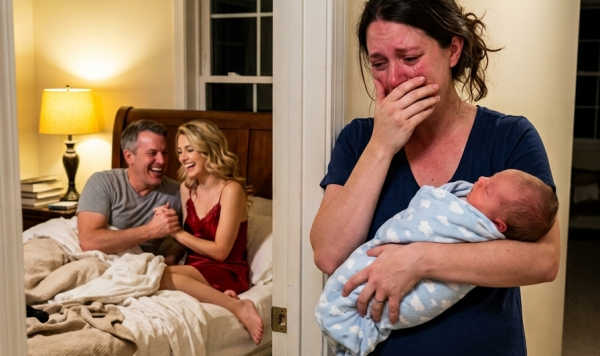
She was my best friend, but she was in bed with my husband… Lauren wasn’t just my best friend; she was the woman I trusted with my home, my secrets, and my newborn son. Then, less than two months later, she was sleeping beside my husband while he demanded ownership of the business my late father had helped me protect…
Part 1: The Woman Who Held My Hand
My best friend held my hand while I gave birth to my son.
That is the part people struggle to understand when I tell them what happened later. They want betrayal to arrive wearing warning signs, red lipstick, and a guilty look across the dinner table. But sometimes betrayal wears hospital scrubs over a sweater, wipes sweat from your forehead, and whispers, “You’re doing amazing, honey. I’m right here.”
Her name was Lauren Bell.
We had been best friends since sophomore year at the University of North Carolina, back when we both lived in the same dorm and thought boxed wine, ramen noodles, and crying over unavailable men counted as a balanced lifestyle. Lauren was loud where I was quiet, fearless where I was careful, and charming in a way that made strangers tell her secrets in grocery store lines.
I loved her like a sister.
Maybe that was my first mistake.
My name is Hannah Whitaker-Miles, and by thirty-six, I had built the kind of life I once prayed for in my twenties. I owned a small but growing bakery-café business in Raleigh called Whitaker & Rye, with three locations, forty-two employees, and cinnamon rolls that had been written up twice in Southern Living. I had a husband named Ryan, a baby on the way, and a best friend who knew every password, every fear, and every soft place in me.
Ryan and I had been married for six years.
He was handsome in an easy, North Carolina way: sandy hair, blue eyes, a good smile, and the kind of relaxed confidence that made people assume he was more capable than he sometimes was. He worked in commercial insurance, though he liked to tell people he was “in risk management,” which sounded more impressive at fundraisers. He was not a bad man when I married him.
Or maybe he was.
Maybe some people are only good when life requires very little from them.
When I got pregnant, Ryan acted thrilled at first. He posted the sonogram on Instagram before I had even told my aunt in Charlotte. He bought tiny Carolina Panthers onesies, called the baby “my little quarterback,” and told every bartender, client, and neighbor that he was finally going to be a dad.
But pregnancy changed my body faster than his patience could grow.
By the seventh month, my feet swelled so badly I could not wear anything except sneakers. I had heartburn that made sleep impossible, back pain that turned every step into a negotiation, and a business that still needed me even when my blood pressure climbed. Ryan began staying late at work more often.
Lauren filled the spaces he left.
She drove me to appointments when Ryan had “client dinners.” She brought groceries, painted the nursery wall a soft sage green, and assembled the crib while Ryan watched a golf tournament downstairs. She knew which prenatal vitamins made me nauseous and which pillow helped my hips at night.
I remember thinking, Thank God for her.
Eight weeks before my due date, she joked that she was basically the baby’s second parent.
“You better put me in the will,” she said, laughing as she folded tiny white onesies on my couch.
Ryan looked up from his phone.
“Honestly, she’s more useful than I am,” he said.
We all laughed.
I wish I had noticed that Lauren looked pleased.
My son, Noah, arrived two weeks early on a rainy Thursday night in March.
Labor was long, messy, and nothing like the peaceful birth videos I had watched at 2 a.m. My mother lived in Florida and could not get a flight until the next morning. Ryan drove me to WakeMed in a panic but spent half the time texting someone from work, stepping into the hallway whenever his phone buzzed.
Lauren never left my side.
She tied my hair back when I threw up. She argued with a nurse when my epidural took too long. She held one of my legs during delivery because Ryan looked like he might faint and the doctor said, “Someone needs to help right now.”
At 3:17 a.m., Noah Miles entered the world screaming.
He weighed six pounds, eight ounces, with a furious little face and a head full of dark hair. When the nurse placed him on my chest, my whole life rearranged itself around his tiny body. I cried so hard I could barely see him.
Ryan cried too.
Lauren stood beside us, sobbing openly.
“He’s perfect,” she whispered. “Hannah, he’s perfect.”
She kissed my forehead.
Then she took a picture of the three of us, Ryan leaning over me, Noah on my chest, my face swollen and exhausted and happier than I had ever been. Later, that photo would hurt to look at because Lauren’s hand was visible in the corner, resting on Ryan’s shoulder.
At the time, I thought it was love.
Family love.
The kind you choose.
When we brought Noah home, Lauren practically moved in.
She said it was temporary, just until I healed and adjusted. She slept on our pullout sofa, made coffee every morning, washed bottles, ordered DoorDash, and answered emails from the bakery when I was too sleep-deprived to remember my own name. I thanked her a hundred times.
Ryan thanked her too.
Too often.
At first, I blamed hormones for the sharp little feeling I got whenever they laughed together in the kitchen. I told myself I was tired, insecure, overwhelmed. Postpartum makes everything feel raw, and I did not want to be the kind of woman who suspected her best friend just because her husband suddenly seemed more alive around her.
So I ignored the signs.
The way Ryan started showering before “running errands.”
The way Lauren began wearing perfume around the house.
The way conversations stopped when I entered the room holding my newborn son against my chest.
At six weeks postpartum, I found Lauren’s earring on the floor of the guest bathroom.
It was a small gold hoop with a pearl charm, exactly her style. That should have meant nothing. She was staying with us, after all. But the guest bathroom was not where she showered.
Ryan used that bathroom after his morning runs.
I held the earring in my palm for almost a minute, then placed it on the counter and told myself I was being ridiculous.
Two weeks later, I woke up at 2:11 a.m. because Noah was fussing.
The bassinet beside my bed was empty.
For one terrifying second, I forgot Ryan had taken him downstairs so I could sleep for three hours. I threw on my robe and hurried toward the stairs, my body still sore, my incision from an emergency C-section pulling with every step. Halfway down, I heard voices.
Ryan and Lauren.
Whispering.
I stopped.
“I can’t keep pretending,” Lauren said.
Ryan replied, “Just give me time.”
“She trusts me,” Lauren whispered. “Do you know how awful that feels?”
There was a pause.
Then Ryan said, “Hannah will be fine. She has the business. She has money. She always lands on her feet.”
My hand gripped the banister.
Lauren’s voice shook. “And Noah?”
“He’s my son,” Ryan said. “I’m not leaving him. I’ll ask for shared custody.”
Shared custody.
The words sliced through me.
Not because I wanted to keep Noah from his father. I did not. But there is a difference between a father who wants to raise his child and a man arranging custody before his wife even knows she has been abandoned.
I walked down the rest of the stairs.
They were sitting on the couch, too close, Noah asleep in Ryan’s arms. Lauren’s face went white when she saw me. Ryan stood too fast, waking the baby.
Noah started crying.
For a moment, all three adults stood frozen while the smallest person in the room told the truth with his lungs.
I walked over and took my son from Ryan’s arms.
Neither of them stopped me.
“Hannah,” Lauren whispered.
I looked at her.
She had been in the delivery room.
She had cried when my son was born.
She had promised she would always be my family.
I wanted to scream. I wanted to throw every bottle, every burp cloth, every lie back into their faces. Instead, I held Noah against my chest and said the only thing I could say without falling apart.
“Get out.”
Ryan blinked. “This is my house too.”
I looked at Lauren.
“I was talking to her.”
Lauren burst into tears, but she still left.
Ryan did not follow her that night.
He slept in the guest room.
Two days later, he moved into her apartment.
Eight weeks after she held my hand in the delivery room, my best friend was living with my husband.
And that was only the beginning of what they tried to take.
Part 2: The Business I Built While He Watched
Whitaker & Rye did not begin as a business plan.
It began as grief.
My father, Thomas Whitaker, died when I was twenty-nine, three months after doctors found pancreatic cancer that had already traveled too far. He had owned a small hardware store in Durham for thirty-two years, the kind of place where contractors drank bad coffee at the counter and my dad knew which widows needed help carrying mulch to the car. He was not rich, but he was steady.
Steady people often leave the biggest empty spaces.
After he died, I could not sleep.
So I baked.
At first, it was banana bread because it reminded me of him. Then biscuits. Then sourdough. Then pies I delivered to neighbors because grief had filled my freezer faster than I could empty my heart.
One Saturday, a woman from church asked if she could pay me to make cinnamon rolls for her daughter’s baby shower.
I said no.
She insisted.
That was my first order.
Six months later, I was selling baked goods at a farmers market every weekend. I still worked full-time as a marketing coordinator then, waking at 3:30 a.m. to bake before work and answering customer messages during lunch. My apartment smelled constantly of butter, yeast, and hope.
Ryan came into my life after the business had already started.
We met at a Raleigh food festival where I had a booth under a white tent and a line fifteen people long. He bought a cheddar-chive biscuit, took one bite, and said, “If you’re single, I’m about to become very interested in baked goods.” It was cheesy, but he was charming enough to get away with it.
I laughed.
That was the beginning.
When we married two years later, Whitaker & Rye was still small: one rented kitchen, three part-time employees, and a dream I protected like a newborn. Ryan liked telling people he believed in me before anyone else did, which sounded romantic if you did not know the numbers. In truth, my father’s life insurance helped me secure the first storefront.
Ryan contributed encouragement.
Encouragement is not nothing.
But it is not ownership.
My father had taught me that difference.
Before Ryan and I married, Dad was already gone, but his voice still lived in my head. He had once told me, “Sweetheart, love people with your whole heart, but sign papers with your whole brain.” At twenty-nine, I thought that sounded cynical.
At thirty-six, I understood it was a blessing.
Because of my father, I had a prenup.
Ryan hated it.
He did not say that at first. He smiled in the attorney’s office, held my hand, and said he understood that the bakery was built before marriage. But later, after two glasses of bourbon at home, he said, “It feels like you’re planning for us to fail.”
“No,” I said. “It feels like I’m protecting something my father helped me build.”
“I’m your husband.”
“You will be,” I said gently. “And I love you. But the business is separate.”
He went quiet.
That should have warned me.
The prenup protected Whitaker & Rye as my separate property, including growth tied to the original business assets, trademarks, recipes, and any reinvestment from business profits kept separate from marital accounts. At the time, I barely understood how important that language would become. My attorney, Angela Price, insisted on every clause.
“She’s strict,” Ryan said afterward.
“She’s good,” I replied.
He kissed my forehead.
“I hope we never need it.”
So did I.
For years, Ryan seemed content standing beside the business without being inside it. He liked the perks: free coffee, community recognition, invitations to restaurant events, people calling us “a power couple.” But he did not wake at 4 a.m. to handle a broken oven before the morning rush.
He did not negotiate flour contracts.
He did not sit with a crying employee whose mother needed surgery.
He did not take out the second location loan using only my business credit, my collateral, and my sleepless nights.
Still, after Noah was born and the affair came out, Ryan suddenly remembered the business differently.
According to him, Whitaker & Rye had grown during the marriage, and therefore half of that growth belonged to him. He claimed he had supported me emotionally, attended events, and helped build the brand through “marital partnership.” His attorney used words like equitable distribution and business valuation.
My attorney used different words.
Separate property.
Premarital asset.
Operating agreement.
Traceable funds.
Prenuptial contract.
When Ryan officially filed for divorce, I was ten weeks postpartum.
My body still hurt. I was leaking through nursing pads, sleeping in ninety-minute stretches, and crying in the shower so Noah would not hear me. The idea of going to court while my best friend slept beside my husband in her downtown apartment felt like something designed to break me.
Then came the second betrayal.
Ryan requested temporary access to business financial records and claimed I was intentionally undervaluing Whitaker & Rye. He also requested that marital funds allegedly contributed to the business be reimbursed. He wanted half of the increase in value from the date of marriage.
Half.
Of the business I built from nothing.
Of my father’s final encouragement.
Of every early morning and late-night payroll panic.
Of the thing that had kept me alive after losing him.
When Angela read the filing, her face did not change much. She was a family law attorney in her fifties with silver-streaked hair, sharp glasses, and the calm expression of someone who had watched hundreds of people underestimate women. She turned one page, then another.
“He’s reaching,” she said.
“Can he win?”
“He can make it expensive.”
That was not comforting.
I sat across from her in a conference room with Noah asleep in a carrier beside my chair. He made tiny squeaking noises in his sleep, unaware that adults were trying to turn his mother’s life into columns on a spreadsheet. My C-section scar ached under the waistband of my leggings.
“I don’t know if I can do this,” I whispered.
Angela looked up.
“You can.”
“You don’t know that.”
“I know you have excellent documents.”
I almost laughed.
Excellent documents.
Not courage.
Not strength.
Documents.
At that point, documents sounded like paper towels against a flood.
Then Angela leaned back and said, “There’s something else I need to ask you. Did your father leave you any sealed estate materials related to the business?”
I frowned.
“What?”
“Your business formation file references a supplemental letter from Thomas Whitaker to be held with the company records. Do you know what that is?”
I shook my head.
“No. I mean, Dad left me letters. Some recipes. His pocket watch. But I don’t remember anything legal besides the life insurance and store sale proceeds.”
Angela’s eyes narrowed thoughtfully.
“Who handled his estate?”
“A lawyer in Durham. Mr. Caldwell. He retired years ago.”
“Find him,” she said.
“Why?”
“Because your father may have left more protection than you realize.”
That night, after Noah finally fell asleep, I sat on the floor of my bedroom surrounded by old boxes.
Ryan had not taken much when he left. Expensive watches, golf clubs, suits, a framed photo of him shaking hands with the mayor at one of my café openings. He left behind wedding albums, baby shower cards, and a drawer full of Father’s Day cards he had never read twice.
I pushed past all of it.
In the back of my closet, behind a box of maternity clothes, I found a plastic storage bin labeled DAD in black marker. Inside were things I could not touch for years without crying: his flannel shirt, a hardware store name tag, handwritten recipe notes, an old photo of us fishing at Jordan Lake.
At the bottom was a sealed envelope.
My name was written on the front in my father’s blocky handwriting.
Hannah Rose.
Not Hannah Miles.
Hannah Rose Whitaker.
My hands shook as I opened it.
Inside was a letter, a copy of an operating agreement amendment, and a note from Mr. Caldwell dated seven years earlier.
I read the first line of my father’s letter and started sobbing so hard I woke the baby.
My sweet girl,
If you are reading this because someone is trying to take what you built, then I need you to remember something before you read anything else.
You are not greedy for protecting the life your own hands made.
You are not selfish for keeping your name on your work.
And you are not alone just because I am gone.
Part 3: My Father’s Final Gift
My father had always been more careful than people realized.
To customers, Thomas Whitaker was the friendly hardware store owner who remembered birthdays and gave teenagers summer jobs. To me, he was the man who balanced accounts at the kitchen table every Sunday night and kept every receipt in labeled folders. He trusted people, but not lazily.
His final gift was not money.
It was protection.
Years before I married Ryan, when Whitaker & Rye was still just a farmers market table and a rented commercial kitchen, my father had insisted I form an LLC properly. I thought it was unnecessary. He said dreams deserved paperwork.
So we met with Mr. Caldwell, the old estate attorney who had handled my grandparents’ wills.
I remembered signing documents.
I did not remember all of them.
Apparently, my father did.
The papers in the envelope included an amendment to the original operating agreement of Whitaker & Rye LLC. It stated that the founding assets of the company—including recipes developed before marriage, brand name, trademarks, startup capital traceable to Thomas Whitaker’s estate proceeds, and ownership interest held by me—were to remain separate property. It also established that no spouse, partner, or outside party could claim management rights or ownership interest without a signed transfer approved by me and recorded in the company records.
Ryan had never signed such a transfer.
Because I had never offered one.
There was also a clause about appreciation.
That was the part Angela later called “beautiful.”
If the company grew through reinvested business revenue, owner labor, brand goodwill, protected intellectual property, or traceable premarital assets, that growth remained tied to the separate business interest unless marital funds were clearly documented as capital contributions. Household support, attendance at events, general encouragement, or spouse status did not create ownership.
My father had known the language of people who show up later and claim the harvest.
He had built a fence before I even saw the field.
The letter explained why.
Hannah,
One day you may marry someone who loves you well, and if so, I hope you never need this. But I have watched too many good women confuse partnership with surrender.
If a man builds beside you, honor him.
If a man stands behind you while you build, thank him.
But if a man simply watches you build and later asks for half the roof, remember who poured the foundation.
I pressed the letter to my chest and cried.
Not because I hated Ryan in that moment.
Because I missed my father so badly it felt physical.
He had been dead seven years, and still he had reached across time to put one hand between me and the cliff.
The next morning, I called Angela before the bakery opened.
“I found something,” I said.
Within an hour, I was in her office with Noah strapped to my chest in a baby wrap and my father’s papers in a folder. Angela read silently. Her eyebrows lifted once. Then she read the documents again, slower.
Finally, she looked at me.
“Hannah,” she said, “your father was a very smart man.”
I burst into tears.
Angela handed me a tissue and pretended not to notice how ugly my crying was.
“This does not mean Ryan’s claim disappears automatically,” she explained. “North Carolina equitable distribution can still examine marital contributions, active appreciation, and financial tracing. But this gives us a strong foundation. Combined with the prenup, clean business records, and separate accounts, his demand for half looks much weaker.”
“How much weaker?”
She smiled slightly.
“Let’s just say he may regret being aggressive.”
For the first time in weeks, I felt my lungs open.
But relief did not erase grief.
That afternoon, I took Noah to the flagship café on Hillsborough Street. I had not been there much since the birth, and walking in felt strange, like entering a life I used to know. The smell of espresso, brown sugar, and fresh bread wrapped around me.
My employees looked up.
Some smiled carefully.
Some looked worried.
They knew enough.
In a small business, pain travels faster than official announcements. They knew Ryan had left. They knew Lauren was involved. They knew I was fighting for the business because payroll, rent, health insurance, and their jobs depended on whether I could stay standing.
Maya, my general manager, came around the counter and hugged me gently.
“Careful,” I said. “I’m still held together with stitches and caffeine.”
She laughed, then cried.
“We’ve got you,” she whispered.
I almost fell apart again.
In the back office, I found a yellow sticky note on my computer.
Take your time. We handled the morning rush. Also, someone burned one tray of scones, but we are blaming capitalism.
It was signed by the staff.
For weeks, I had felt like Ryan and Lauren had taken my family.
Standing there, with my son asleep against my chest and my employees keeping the ovens warm, I remembered family can be larger than betrayal.
But Lauren knew that too.
That was why what she did next hurt so much.
Three days before the temporary hearing, Lauren texted me for the first time since leaving my house.
Can we talk? I miss you.
I stared at the message until the screen dimmed.
Then another came.
I know you hate me, but Ryan says you’re trying to destroy him. This isn’t fair.
Fair.
The word almost made me laugh.
I handed the phone to Angela during our next meeting.
“Do I answer?”
“No,” she said immediately. “Not emotionally and not directly. If she has relevant information, she can speak through counsel.”
“She was my best friend.”
Angela’s face softened.
“I know.”
“She held my baby.”
“I know.”
“She knows everything about me.”
Angela leaned forward.
“Then don’t give her anything else.”
That advice saved me.
Because Lauren had always known how to reach me. She knew guilt worked faster on me than anger. She knew I hated being misunderstood. She knew I had a habit of explaining myself to people who had already decided to use the explanation against me.
So I did not answer.
Instead, Angela’s office sent a formal communication instructing Lauren not to contact me directly about the divorce, custody, or business matters.
Lauren responded with a long email.
It was exactly what I would have expected if I had not been so devastated.
She said she and Ryan had “fallen in love unexpectedly.” She said she never meant to hurt me. She said she loved Noah and hoped one day she could be part of his life. She said Ryan deserved a fair share because he had “sacrificed” while I built the company.
Sacrificed.
Ryan had gone on golf weekends while I handled holiday catering orders.
Ryan had complained about flour dust in my car.
Ryan had accepted applause at ribbon-cuttings and called it support.
Then Lauren wrote one sentence that told me everything.
You have always had more than me, Hannah. Maybe this is the first time you’ll understand what it feels like to lose something.
I read that line three times.
Then I stopped crying.
Because finally, I saw the truth.
Lauren had not only wanted Ryan.
She had wanted my life to shrink.
Part 4: The Courtroom
The temporary hearing took place on a gray Tuesday morning in downtown Raleigh.
I wore a navy dress that still felt too tight across my postpartum body and flat shoes because heels were no longer part of my healing plan. Noah stayed with Maya at the café office, just a few blocks away, because I could not bear the thought of bringing him into a courthouse before he could even hold up his own head. My breasts ached halfway through the morning, and I kept checking the clock like my body was testifying too.
Ryan arrived with Lauren.
That was his choice.
A spectacularly stupid one.
She wore a cream coat, curled hair, and the expression of a woman trying to look supportive without appearing guilty. She sat behind him with her hands folded in her lap, as if this were a business seminar and not the legal aftermath of sleeping with her best friend’s husband.
I did not look at her for long.
I had learned that healing sometimes begins with refusing to give the betrayer a stage.
Ryan looked confident at first. He wore a charcoal suit I had bought him for our anniversary two years earlier. He smiled at his attorney, checked his watch, and avoided my eyes.
He thought I was tired.
He was right.
He thought tired meant weak.
He was wrong.
The judge began with temporary custody and support.
Angela did not try to keep Noah away from Ryan. That mattered. She said I supported a healthy father-child relationship but requested a gradual parenting schedule because Noah was eight weeks old, nursing, and had spent nearly all caregiving time with me since birth.
Ryan’s attorney argued that fathers had equal rights.
Angela agreed.
Then she calmly asked Ryan to identify the pediatrician’s name.
He hesitated.
The courtroom went quiet.
He guessed wrong.
My heart hurt, not because I wanted him embarrassed, but because Noah deserved better than a father who knew how to demand rights but not the name of the doctor checking his son’s weight gain.
Angela asked about feeding schedules.
Ryan did not know.
Diaper brand?
Wrong.
Reflux medication dosage?
He looked at me.
I looked down.
The judge granted Ryan short, frequent visitation at first, increasing over time as Noah grew, with specific instructions about feeding, communication, and safe sleep. It was fair. It was child-focused. It was not the punishment Ryan expected me to seek.
That seemed to annoy him.
Then came the business.
Ryan’s attorney stood and began describing Whitaker & Rye as a marital success story. He said Ryan had supported me through long hours, helped host events, and contributed to the household while the business expanded. He argued that the company’s growth during marriage should be valued and divided.
I sat still.
My hands shook under the table.
Angela stood slowly.
She started with the prenup.
Then the LLC records.
Then the bank statements showing separate accounts.
Then the trademark filings.
Then the operating agreement.
Then my father’s amendment.
Ryan’s attorney objected to something procedural.
The judge allowed Angela to continue.
She handed over certified copies, each page organized in a binder thicker than a cookbook. She explained that Whitaker & Rye was formed before the marriage using premarital funds and estate proceeds traceable to Thomas Whitaker. She explained that Ryan had never received membership interest, never signed capital contribution documents, never held management authority, and never made documented investments into the company.
Then she read part of my father’s clause aloud.
General spousal support, attendance at promotional events, social encouragement, or informal assistance shall not create ownership, membership, management rights, or transferable interest in Whitaker & Rye LLC.
Ryan’s face changed.
Lauren’s did too.
For the first time, they looked less like lovers facing an unfair world and more like people who had discovered the door they planned to kick open was made of steel.
Ryan whispered to his attorney.
His attorney whispered back.
The judge asked several questions about marital funds, growth, valuation, and whether Ryan might have a limited reimbursement claim if specific marital assets had been invested. Angela answered carefully. She did not overstate. She did not gloat.
That made her more terrifying.
Finally, Ryan’s attorney said, “Your Honor, Mr. Miles believed he was part of the business’s growth as Mrs. Miles’s husband.”
The judge looked at him over her glasses.
“Belief is not the same as documentation.”
I closed my eyes.
Somewhere, I hoped my father could hear that.
The court did not decide final equitable distribution that day. That would come later. But the judge denied Ryan’s request for temporary control, temporary payments from business accounts, or any immediate division of Whitaker & Rye assets. She ordered both sides to preserve records and set a schedule for valuation and discovery.
Ryan did not get half.
He did not get control.
He did not get to walk out of my marriage with my best friend and my father’s legacy tucked under his arm.
When we stepped into the hallway afterward, Lauren approached me.
Angela immediately moved closer.
“Hannah,” Lauren said, her voice trembling.
I turned.
For a second, I saw the girl from college. The one who shared her umbrella with me in a thunderstorm. The one who slept on my dorm floor after my first real breakup. The one who stood beside me when my father died and told me I would never be alone.
Then I saw the woman who had held my newborn and moved in with his father weeks later.
“What?” I asked.
Her eyes filled with tears.
“I never thought it would go this far.”
I looked at her.
That sentence again.
The anthem of people who light matches and act shocked when houses burn.
“You moved in with my husband,” I said quietly.
She flinched.
“You knew I was recovering. You knew I was nursing every two hours. You knew I trusted you in my home, with my child, with my grief, with everything.”
“I’m sorry.”
I believed she was.
I also knew her sorrow did not rebuild anything.
“You don’t get to be sorry because the consequences got real,” I said.
Ryan came up behind her.
“Don’t talk to her like that.”
I laughed then.
Not loudly.
Just enough.
Ryan frowned. “What?”
I looked at him, this man I had once loved, this man who thought defending Lauren in a courthouse hallway made him noble.
“You never defended me that fast.”
His face went red.
Angela touched my elbow.
“That’s enough,” she said gently.
She was right.
Not because they deserved mercy.
Because I deserved peace.
I walked away without looking back.
Outside, Raleigh traffic moved through the wet streets. The air smelled like rain and exhaust and coffee from a cart near the courthouse steps. I stood under the awning and took the first full breath I had taken in weeks.
Angela stood beside me.
“You did well,” she said.
“I didn’t do anything.”
“You survived the morning without giving them the version of you they hoped to provoke.”
That was something.
Maybe even everything.
My phone buzzed.
A photo from Maya.
Noah was asleep in the café office, wrapped in a blue blanket, one tiny hand curled under his chin. The caption said: Boss Baby approved payroll.
I laughed through tears.
Then I whispered, “Thank you, Dad.”
Part 5: What Was Saved
Ryan and Lauren did not last.
People always ask that first, though it is never the most important part. They want to know if the cheaters got their punishment, if love built on betrayal collapsed, if karma came wearing perfect timing. The answer is yes, but not dramatically enough for television.
It happened slowly.
Stress does what secrecy cannot.
Ryan moved into Lauren’s apartment thinking he was stepping into freedom. Instead, he found bills, legal fees, a newborn visitation schedule, and a girlfriend who had imagined romance would feel more glamorous than sharing a divorced man with court orders and diaper bags. Lauren discovered that winning someone else’s husband does not make him better at being a partner.
He still left dishes in the sink.
He still came home late.
He still became defensive when questioned.
And now Lauren knew he was capable of lying to a woman who trusted him completely.
That knowledge sat between them like a third person.
Three months after the hearing, Lauren texted me again.
I know you won’t respond, but I’m sorry. I think I ruined my life too.
I did not answer.
Not because I hated her.
Because some apologies are not meant to become conversations.
By the time Noah was six months old, Ryan and Lauren had broken up. I heard it from no one dramatic. Not through Facebook, not from a mutual friend whispering with satisfaction. I heard it because Ryan arrived late for visitation with red eyes and no overnight bag, and when I asked if he was still living at Lauren’s, he said, “No.”
That was all.
I did not smile.
I did not celebrate.
I simply handed him Noah’s diaper bag and said, “His bottles are labeled.”
That was the new me.
Less interested in punishment.
More interested in peace.
The divorce took fourteen months.
Ryan fought over the business until the cost of fighting became larger than the fantasy of winning. A forensic accountant reviewed the records, traced the funds, examined the prenup, and confirmed what my father had made sure would be clear: Whitaker & Rye was mine. There were small marital reimbursement issues for a few mixed expenses, and I paid what was fair.
Fair did not frighten me.
Theft did.
Ryan did not get half of the business. He did not get management rights. He did not get a payout that would have forced layoffs or closed a location. He left the marriage with his personal accounts, his vehicle, part of the marital home equity, and a child support obligation based on his income.
He also left with the knowledge that he had mistaken my kindness for poor preparation.
That may have been the most expensive mistake of all.
The final court date was in late spring, one year after Noah’s birth.
I wore a cream blazer, black pants, and the necklace my father gave me when I opened the first bakery location. Noah was with my mother, who had moved back from Florida temporarily because she said retirement was boring and her grandson needed someone to teach him “proper beach etiquette.” I suspected she mostly wanted to make sure I ate dinner.
Ryan looked older that day.
So did I.
Divorce ages people in strange ways. Not just because of stress, but because illusions are heavy, and once they fall off, your face has to learn its real shape again.
After the judge signed the final order, Ryan approached me outside the courtroom.
This time, he was alone.
“I’m sorry,” he said.
I looked at him for a long moment.
For over a year, I had imagined that apology. In some versions, I cried. In others, I told him exactly how deeply he had wounded me. In the angriest version, I said something sharp enough to leave a mark.
But when the moment came, I was tired of carrying knives.
“I hope you become the kind of father Noah deserves,” I said.
His eyes filled.
“I want to.”
“Then do that.”
He nodded.
“And Hannah?”
I waited.
“I never should have come after the business.”
That, more than the affair, almost broke my composure.
Because Whitaker & Rye had never been just money to me. It was my father’s last belief in me made visible. It was my name on a sign, my recipes in glass cases, my employees’ paychecks, my grief turned into something warm enough to feed strangers.
“I know,” I said.
Then I walked away.
The first thing I did after the divorce was final was not dramatic.
I did not throw a party.
I did not post a quote about betrayal.
I did not change my hair, buy a sports car, or take a beach vacation where I stood in white linen looking reborn.
I went to the bakery.
The afternoon rush had just started. Students were lined up for iced lattes, two nurses were sharing a lemon bar, and an older man in a Duke sweatshirt was arguing cheerfully with Maya about whether our biscuits were better than his grandmother’s. The world inside smelled like butter and coffee and survival.
When I walked in, the staff clapped.
I covered my face and cried.
Maya put a cinnamon roll in front of me and said, “On the house, boss.”
“It is literally my house,” I said through tears.
“Then payroll can deduct it from your feelings.”
I laughed so hard I had to sit down.
Later that evening, after we closed, I brought Noah into the empty café. He was too young to understand, round-cheeked and sleepy, wearing tiny socks with foxes on them. I carried him to the wall near the register where the original framed menu from my farmers market booth still hung.
Under it was a picture of my father.
He stood behind that first little table, smiling awkwardly, holding a tray of cinnamon rolls like he had baked them himself. He had not. But he had carried every box, fixed my tent when wind nearly took it, and told every customer, “My daughter made these. Best in the state.”
I touched the frame.
“He saved us,” I whispered to Noah.
But that was not fully true.
My father saved the business on paper.
The rest, I had to save by standing up.
Life after betrayal did not become easy.
That is another lie people tell in stories because clean endings feel better. Healing was not a straight line. Some nights, I still woke up angry. Some mornings, I missed the version of Ryan I thought I married. Some days, seeing mothers with sisters or best friends helping with babies made me ache in a place Lauren used to occupy.
Trust became difficult.
Not impossible.
Just expensive.
I learned to stop giving it away like free samples.
Ryan became a more consistent father over time. Not perfect. Not instantly transformed. But better. He learned Noah’s nap schedule, showed up for pediatric appointments, and stopped treating fatherhood like something to be negotiated around inconvenience.
I did not forgive him all at once.
I am not sure forgiveness works that way.
I simply stopped letting his failures rent space in my chest.
Lauren moved to Charlotte for a new job in event planning. A mutual college friend told me she had started over and was “working on herself.” I wished her no harm. But I did not wish her access to me either.
Some doors close because hatred locks them.
Others close because wisdom does.
Two years after the divorce, Whitaker & Rye opened its fourth location in Cary.
At the grand opening, my mother held Noah while I cut the ribbon. He was two by then, with sticky fingers, wild curls, and a deep suspicion of vegetables. When the crowd clapped, he clapped too, mostly because everyone else was doing it.
A reporter from a local magazine asked me what inspired the expansion.
I looked at the sign above the door.
Whitaker & Rye.
My father’s name.
My work.
My future.
“Family,” I said.
The reporter smiled, probably expecting me to talk about legacy in a polished way.
So I did.
But not the way she expected.
“Family is not always who stays,” I said. “Sometimes family is the person who protects you before you even know you’ll need protection. Sometimes it’s the employees who keep the ovens on when your life falls apart. Sometimes it’s the baby in your arms reminding you that you don’t get to give up.”
My mother cried.
Maya pretended she had flour in her eye.
That night, after everyone left, I found a small envelope tucked under the register.
For one wild second, I thought of Lauren.
But it was from Ryan.
Hannah,
I know today is important. I also know I don’t deserve to be part of it. But I wanted to say congratulations. I understand now that the business was never mine to claim. I’m sorry I tried to take what your father helped you protect.
Ryan
I read it twice.
Then I folded it and put it in a drawer.
Not because I wanted to keep a piece of him.
Because sometimes evidence of accountability matters too.
Years later, Noah would ask about his grandfather.
He would ask because children ask everything eventually, usually from the back seat when you are trying to merge onto I-40. I would tell him Thomas Whitaker was kind, stubborn, terrible at singing, and convinced every problem could be improved with a good toolbox and a better biscuit.
“Did he know me?” Noah asked once.
My throat tightened.
“No, baby. He died before you were born.”
Noah looked out the window for a moment.
“Then how did he save us?”
I glanced at him in the rearview mirror.
He was five then, holding a toy dinosaur and wearing one shoe because childhood is mysterious.
“What do you mean?”
“You said Grandpa saved us.”
I smiled sadly.
“He helped protect Mommy’s bakery. A long time ago, before you were even a dream.”
Noah considered this.
“So he was like a superhero lawyer?”
I laughed.
“Something like that.”
That night, after Noah fell asleep, I pulled out my father’s letter again.
The paper had softened at the folds. I had read it so many times that some lines felt memorized in my bones. But the ending still made me cry.
If someone good loves you, let them stand beside you.
If someone selfish tries to take from you, let the truth stand between you.
And if I am not there to say it, hear me now:
You were never too much.
You were never alone.
And nothing built from your courage belongs to the person who tried to break it.
Love,
Dad
I sat at my kitchen table, the same table where I had once signed bakery invoices with a newborn sleeping nearby and divorce papers waiting in a folder. The house was quiet. Noah’s baby monitor hummed softly. Outside, summer rain tapped against the windows.
I thought about Lauren holding my hand in the delivery room.
I thought about Ryan demanding half of the business.
I thought about walking into court with milk stains on my dress, stitches under my clothes, and grief so heavy I could barely breathe.
Then I thought about my father.
About his careful hands.
His labeled folders.
His belief that love and protection could exist in the same sentence.
People say betrayal takes everything.
It can.
For a while, it took my sleep, my appetite, my confidence, and my ability to trust the sound of a friend’s voice. It took the future I thought my son would have, with both parents under one roof and a woman I called Aunt Lauren at his birthday parties.
But it did not take everything.
It did not take my son.
It did not take my name.
It did not take the business I built from flour, grief, courage, and my father’s last gift.
And it did not take the part of me that finally learned a hard, holy truth:
Being betrayed by people you loved does not mean you were foolish to love them.
It means they were foolish to lose you.
So when people ask how I survived my best friend stealing my husband after I had his baby, I tell them the truth.
I survived because my father protected my future.
I survived because my attorney knew how to use that protection.
I survived because my employees held the line when I could barely stand.
I survived because my son needed a mother who understood that heartbreak is not the same as defeat.
And most of all, I survived because the life Ryan and Lauren tried to take from me was never theirs in the first place.
It had my father’s name on it.
And mine.
