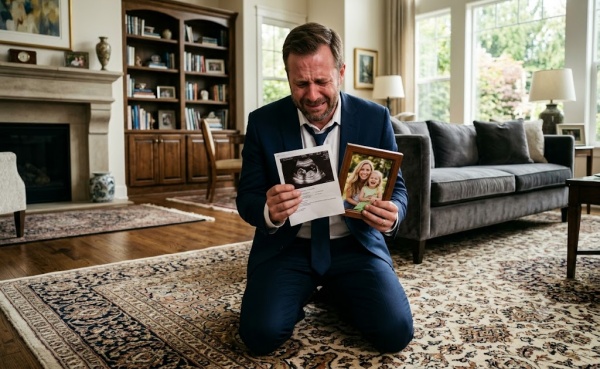
When my mistress showed me the ultrasound, I thought I was looking at the son I had always wanted. Within weeks, I divorced my wife, broke my daughter’s heart, and married the woman who promised me a new future. But on the morning of her prenatal appointment, she refused to walk inside the clinic—and what she confessed in the parking lot destroyed the life I had sacrificed everything for.
Part 1: The Picture That Made Me Leave
When my mistress showed me the ultrasound, I did not hesitate.
That is the part I hate admitting now. I wish I could say I asked questions, took a breath, or thought about my wife and daughter waiting for me at home in Marietta, Georgia. I wish I could say I was confused, pressured, or trapped.
But I was not trapped.
I was selfish.
Her name was Vanessa Cole, and she was twenty-eight years old, with glossy brown hair, green eyes, and the kind of laugh that made a foolish man believe he was younger than he was. I was forty-one, married for fourteen years, and old enough to know that attention from a younger woman was not the same thing as love. But knowing better and doing better are two very different things.
My wife, Sarah, was the woman who had built my real life.
She had been with me when I drove a used Honda Civic with a broken passenger-side window and ate peanut butter sandwiches for dinner because I was trying to get my contracting business off the ground. She answered phones for Miller Custom Homes before we could afford an office manager. She painted sample boards, met clients, kept receipts, and learned enough about permits to save me from three expensive mistakes.
When people congratulated me for becoming successful, I smiled like I had done it alone.
Sarah never corrected them.
That was one of the many things I took for granted.
We had a twelve-year-old daughter named Lily. She had Sarah’s brown eyes, my stubborn chin, and a talent for making sarcastic comments that were funnier than anything I could say. She played soccer, hated mushrooms, and still asked me to check under her bed for monsters when thunderstorms rolled through Cobb County.
I had everything most men claim they want.
A loyal wife.
A healthy child.
A good business.
A house with white shutters, a backyard grill, and a golden retriever named Scout who slept like he paid the mortgage.
And I threw it away because Vanessa handed me a black-and-white picture and told me it was my son.
We were in a hotel room near Buckhead when she showed it to me. I remember the room too clearly: cream-colored curtains, a king-size bed with too many pillows, a bottle of sparkling water sweating on the nightstand. Outside the window, Atlanta traffic moved along Peachtree Road like the whole city had somewhere better to be.
Vanessa sat on the edge of the bed, wearing one of my dress shirts.
She looked nervous.
At the time, I thought that meant she was vulnerable.
Now I know it meant she was performing.
“I need to show you something,” she said.
I was buttoning my shirt, already rehearsing the lie I would tell Sarah about why my late client meeting had run past midnight. I looked at Vanessa through the mirror and sighed like she was interrupting something important. That was the kind of man I had become.
“What is it?”
She reached into her purse and pulled out an envelope.
Inside was an ultrasound photo.
I stared at it.
There was a small shape on the image, blurry and grainy, the kind of picture only expectant parents pretend to fully understand. In the corner were printed details I did not read carefully enough. A date. A clinic name. A patient ID.
Vanessa’s hand trembled as she touched her stomach.
“I’m pregnant, Mark.”
My name sounded different in her mouth then.
Important.
Chosen.
Alive.
I should have asked how far along she was. I should have asked whether she had seen a doctor. I should have asked if she was sure, if the dates made sense, if we needed to talk calmly before making decisions that would destroy three lives.
Instead, I asked the question that exposed me.
“Is it a boy?”
Her eyes filled with tears.
A beautiful, perfect tear slipped down her cheek.
“Yes,” she whispered. “They said it looks like a boy.”
I believed her because I wanted to.
Sarah and I had wanted another child for years. After Lily was born, Sarah had two miscarriages. The second one nearly broke her. She folded tiny baby clothes into a box, put it in the attic, and never spoke of it again.
I held her while she cried back then.
At least, I did at first.
Over time, her grief became inconvenient to me. I wanted her to heal on my schedule. I wanted her to be cheerful at dinner, attractive at parties, supportive at work, and grateful for a life I acted like I had given her.
When she could not do all of that perfectly, I decided she had changed.
I did not consider that maybe I had become cruel.
Vanessa knew about the miscarriages.
I had told her during one of those self-pitying conversations cheating men use to make betrayal sound like loneliness. I told her Sarah had become distant. I told her I loved my daughter but wanted a son. I told her things a decent husband should have said to a therapist, not another woman in a hotel bar.
Vanessa listened.
Then she learned exactly where to place the knife.
“I know this is complicated,” she said, pressing the ultrasound into my hand. “But I can’t raise him alone.”
Him.
That word did something terrible to me.
It reached into the hollow part of my ego and filled it with fantasy. A son. A second chance. A little boy who would carry my name, wear tiny Braves jerseys, follow me around construction sites, and become proof that my life was still expanding.
I did not think about Sarah folding baby clothes in the attic.
I did not think about Lily waiting for me to come home.
I did not think about the wedding vows I had made in front of God, family, and a hundred people in a church outside Savannah.
I thought about myself.
“I’ll handle it,” I said.
Vanessa looked up at me like I had just rescued her.
I liked that feeling.
That was my first punishment, though I did not know it yet.
The next morning, I told Sarah I wanted a divorce.
She was standing in our kitchen, packing Lily’s lunch. It was 7:15 a.m., and sunlight was coming through the window over the sink. She had her hair in a messy bun and wore an old University of Georgia sweatshirt with a coffee stain on one sleeve.
She looked ordinary.
That made what I did even worse.
“I can’t keep doing this,” I said.
She paused with a sandwich knife in her hand.
“Doing what?”
“This marriage.”
She stared at me for a long moment.
Then she set the knife down carefully.
“Is there someone else?”
I had prepared many lines on the drive home.
We grew apart.
I still care about you.
This is best for everyone.
But when Sarah asked that question, something in my face betrayed me before my mouth could lie.
Her eyes closed briefly.
“Oh,” she whispered.
Just that.
Oh.
No screaming.
No plate thrown against the wall.
No dramatic collapse.
She opened her eyes again and asked, “Who is she?”
I said Vanessa’s name.
Sarah nodded once, as if some final math problem had solved itself.
Then she asked, “Does Lily know?”
I felt irritated that she brought our daughter into it so quickly.
That irritation should have disgusted me.
It did not.
“Not yet,” I said.
Sarah looked toward the hallway, where Lily’s backpack sat by the door with a soccer ball keychain hanging from the zipper.
“You don’t get to tell her today before school,” she said.
“Sarah—”
“No.” Her voice stayed calm, but something hard moved underneath it. “You don’t get to destroy her morning because you couldn’t keep your promises.”
I should have felt shame.
Instead, I felt defensive.
That is what weak men do when they are wrong.
They protect themselves from guilt by becoming angry.
Within a week, I had moved into a furnished apartment near Midtown. Within two weeks, Sarah had hired an attorney. Within thirty-five days, after I pressured, pushed, and paid more than I wanted just to hurry the process, the divorce was finalized uncontested under Georgia’s waiting period.
I told myself Sarah made it easy because she was cold.
The truth was worse.
She made it clean because she was done begging a man who had already left.
Vanessa and I married three weeks later at the Fulton County courthouse.
She wore a white satin dress and held a small bouquet of pink roses. I wore a navy suit and a smile that looked confident in the photos. We posted nothing online, but word spread anyway.
People always pretend scandal travels slowly.
It does not.
It runs.
Sarah heard from someone at church. Lily heard from a classmate whose mother had seen us leaving the courthouse. My daughter called me that night, crying so hard I could barely understand her.
“Dad,” she said, “is it true?”
I sat on the edge of Vanessa’s bed, staring at the floor.
“Yes.”
“You married her?”
I swallowed.
“Yes.”
There was silence.
Then my twelve-year-old daughter said something I will carry for the rest of my life.
“You didn’t even wait until I stopped being sad.”
I had no answer.
Because she was right.
Part 2: The Life I Thought I Had Won
At first, life with Vanessa felt like proof.
Proof that I had made the brave choice. Proof that I was not just a middle-aged husband trapped in routine. Proof that love could begin again with candlelit dinners, late mornings, and a woman who looked at me like I was still impressive.
She moved into the Midtown apartment immediately.
She said the place was temporary until we found “our real home,” but she had no trouble filling it with her things. Designer candles appeared on the coffee table. A mirrored vanity arrived from West Elm. Three enormous boxes from Nordstrom showed up one Friday while I was at work.
When I asked about money, she touched her stomach.
“Stress isn’t good for the baby,” she said.
So I stopped asking.
That became our pattern.
Whenever I questioned anything, she placed one hand over the baby I believed was growing inside her. It could be a restaurant bill, a missed doctor’s detail, or the fact that she refused to let me speak directly to her OB-GYN. The answer was always the same.
“You don’t trust me?”
I knew that sentence.
I had used it on Sarah for years.
Now it was being used on me.
At night, Vanessa talked about names.
Preston.
Beau.
Grayson.
She liked names that sounded like they belonged on monogrammed blankets and private-school applications. I liked the name Thomas, after my father, but Vanessa wrinkled her nose and said it sounded “too old.”
“It’s a family name,” I said.
“So is trauma,” she replied.
I laughed because she did.
Looking back, I can see how often I mistook cruelty for wit.
Vanessa wanted a bigger place before the baby came. She wanted something in Buckhead, preferably with a nursery, a gym, and “security.” I told her I was still paying the mortgage on the Marietta house because Sarah and Lily lived there.
Her face changed.
“Why are you still paying for her life?”
“She’s raising my daughter.”
“She’s also your ex-wife.”
The word ex-wife sounded different when Vanessa said it.
Like Sarah had stopped being a person and become an expense.
I should have defended Sarah then. Not as my wife, because I had destroyed that. But as Lily’s mother. As the woman who had spent fourteen years helping me become the kind of man Vanessa wanted to marry.
Instead, I said, “It’s temporary.”
I told myself I was keeping the peace.
In reality, I was teaching Vanessa that I would betray anyone if pressure was applied correctly.
My business started suffering within two months.
Miller Custom Homes had always depended on reputation. In suburban Atlanta, people wanted to know not only whether you built good houses, but whether you returned calls, treated subcontractors fairly, and showed up when you said you would. Sarah had been the invisible system that made me look dependable.
After she left, I noticed all the things she had done.
Invoices sat unpaid because I forgot to approve them.
Clients complained that no one followed up on selections.
A supplier called asking why our account was past due.
My office manager, Trina, finally stood in my doorway with a stack of folders and said, “Mark, we need Sarah’s process documented or we’re going to keep bleeding.”
I snapped at her.
“Sarah didn’t run this company.”
Trina looked at me for a long second.
“No,” she said. “She kept it from running off a cliff.”
I nearly fired her.
I should have thanked her.
At home, Vanessa was becoming more demanding and less careful.
She stopped pretending to like simple things. She hated takeout unless it came from somewhere expensive. She complained about my truck, my schedule, my daughter’s visits, my “emotional baggage,” and the fact that my divorce settlement had left me with less liquid cash than she expected.
One Saturday, Lily came over for her scheduled weekend.
I had prepared for it like a man preparing for an inspection. I bought her favorite cereal, washed the guest room sheets, and picked up a new soccer ball because I did not know what else to do. I thought if I gave her enough nice things, she might stop looking at me like I had become a stranger.
Vanessa stayed in the bedroom until noon.
When she finally came out, she wore a silk robe and acted surprised to see Lily sitting at the kitchen island.
“Oh,” she said. “I forgot this was your weekend.”
Lily looked at me.
I hated the embarrassment in her eyes.
“This is still my daughter’s home when she’s here,” I said.
Vanessa smiled tightly.
“Of course.”
But later, when Lily went to the bathroom, Vanessa whispered, “She makes me uncomfortable.”
“She’s twelve.”
“She judges me.”
“She’s twelve,” I repeated.
Vanessa’s eyes filled with tears.
“You always take her side.”
The old me—the man I used to be before vanity rotted my judgment—would have said, “She is my child. I will always protect her.” But the man I had become was tired, cornered, and desperate to believe his new marriage was worth the damage.
So I told Lily we might cut the weekend short because Vanessa was not feeling well.
My daughter nodded.
She did not argue.
That was worse.
When I drove her back to Sarah’s house, Lily stared out the passenger window the whole way. We passed the Chick-fil-A where we used to stop after soccer games and the park where I had taught her to ride a bike. She did not ask to stop.
At Sarah’s driveway, she unbuckled her seat belt.
“I don’t want to come next weekend,” she said.
My chest tightened.
“Lily—”
“She doesn’t want me there.”
“That’s not true.”
Lily turned toward me with tears shining in her eyes.
“Dad, please don’t lie to me too.”
Then she got out of the truck and walked into the house.
Sarah stood on the porch.
She did not yell.
She did not look smug.
She simply opened the door for our daughter and looked at me with the kind of disappointment that does not need volume.
I drove away angry.
Not because they had wronged me.
Because their pain made it harder for me to enjoy what I had chosen.
Vanessa’s prenatal appointment was scheduled for the following Wednesday at 9:30 a.m.
She had delayed it twice, claiming morning sickness, then a scheduling conflict, then anxiety. I offered to call the clinic and reschedule myself, but she snapped that I was controlling. So I backed off.
The night before the appointment, she sat on the couch, scrolling through her phone.
“You’re coming tomorrow, right?” she asked.
“Of course.”
She looked at me strangely.
For the first time, I saw fear without performance.
“Whatever happens,” she said, “you love me, right?”
I laughed softly.
“What does that mean?”
“It means promise me you won’t leave.”
I should have felt tenderness.
Instead, I felt a cold thread of unease.
“Vanessa,” I said, “what’s going on?”
She put her phone down.
“Nothing. Just hormones.”
That word should have reassured me.
It did not.
I barely slept that night.
At 8:45 the next morning, as we drove toward the women’s health clinic in Sandy Springs, Vanessa kept twisting her wedding ring around her finger. Traffic on GA-400 was heavy, the sky pale and bright above the windshield. She stared straight ahead, silent.
I reached for her hand.
She pulled away.
“Vanessa.”
She closed her eyes.
Then she said the sentence that made my blood run cold.
“Mark, we can’t go inside.”
Part 3: The Lie in the Parking Lot
I parked near the back of the clinic lot.
For several seconds, neither of us moved.
Mothers walked through the sliding glass doors holding folders, water bottles, and the hands of nervous husbands. A woman in a Braves cap laughed as her partner took a photo of her beside the clinic sign. Life was happening all around us, ordinary and hopeful.
Inside my truck, the air felt too thin.
“What do you mean we can’t go inside?” I asked.
Vanessa stared at her lap.
“Please don’t yell.”
That was when I knew.
Before she said it, before the words took shape, some part of me already understood that the life I had destroyed everything for was standing on nothing.
“Vanessa,” I said carefully, “are you pregnant?”
She began to cry.
Not the pretty tears from the hotel room.
Ugly tears.
Real ones.
“I was going to tell you.”
My hands went numb on the steering wheel.
“Are you pregnant?”
She covered her face.
“No.”
The word did not sound loud.
It sounded final.
I sat there, staring through the windshield at the clinic doors, unable to move. A man walked past our truck carrying a diaper bag and a bouquet of sunflowers. The sight of those flowers nearly made me sick.
“No,” I repeated.
“I thought maybe I was,” she sobbed. “I was late, and I panicked, and then you were talking about going back to Sarah, and I—”
“I was not going back to Sarah.”
“You were thinking about it.”
I turned toward her slowly.
“So you showed me an ultrasound?”
She flinched.
“It wasn’t supposed to go this far.”
“Whose was it?”
She cried harder.
“Vanessa.”
“My cousin’s.”
The parking lot blurred.
The ultrasound.
The baby boy.
The reason I filed for divorce.
The reason my daughter cried into the phone.
The reason Sarah had stood in our kitchen and quietly lost the last piece of trust she had in me.
A cousin’s ultrasound.
“You said it was a boy.”
“I said it looked like a boy.”
“You let me marry you.”
“You wanted to.”
That sentence hit me like a slap.
Because it was true.
She had lied, but I had rushed toward the lie with both hands open.
“You told me you couldn’t raise him alone,” I said.
“I was scared.”
“Of what?”
She wiped her face, mascara smearing under her eyes.
“That you’d leave me.”
I laughed once.
A dead, hollow sound.
“So you made me leave my family first?”
She looked at me then, angry through tears.
“You were already cheating on your wife. Don’t act like I invented your betrayal.”
That was the cruelest thing she could have said.
Because it was true too.
I opened the truck door and stepped out.
The August heat hit me hard. Georgia summers have a way of wrapping around your lungs and making every breath feel borrowed. I walked a few steps away, bent forward, and tried not to throw up on the asphalt.
Behind me, Vanessa got out.
“Mark, please.”
I turned around.
For a moment, I saw her clearly.
Not as the woman who made me feel young. Not as the mother of a son who never existed. Not as my escape from a marriage I had been too cowardly to repair.
Just a frightened woman who had gambled with other people’s lives and expected love to cover the debt.
“Was any of it real?” I asked.
She hugged herself.
“I love you.”
“No,” I said. “You needed me.”
Her face twisted.
“And you needed me too.”
Yes.
That was the part that destroyed whatever was left of my soul.
She was not the only liar in that parking lot.
I had lied to Sarah for months. I had lied to Lily. I had lied to my employees, my friends, my parents, my church, and myself. Vanessa had created the final lie, but I had built a whole house for it to live in.
My phone buzzed.
It was Sarah.
For one insane second, I thought the universe had given me a door back.
I answered too quickly.
“Sarah?”
Her voice was calm but distant.
“Lily’s school counselor called. She had a panic attack during first period.”
The world stopped.
“What?”
“She couldn’t breathe. They thought she was sick at first, but she told them she didn’t want to go to your apartment this weekend.”
I turned away from Vanessa.
“Is she okay?”
“She’s with me now.”
“Can I talk to her?”
There was a pause.
“No.”
The word cut deeper than anger would have.
“Sarah, please.”
“Mark, she needs stability. Not another emotional performance from you.”
I closed my eyes.
“I’m sorry.”
“I’m not the person you need to say that to today.”
The line went quiet for a moment.
Then she added, “But don’t call her right now. If you care about her, give her peace.”
If you care about her.
Not because you are her father.
Not because you have rights.
If.
I had earned that if.
Sarah ended the call.
Vanessa stood behind me, crying softly.
I looked at my phone, then at the clinic, then at the woman I had married for a child who never existed.
“There’s no way back,” I whispered.
Vanessa stepped closer.
“We can still have a life.”
I turned to her.
“What life?”
She looked wounded, as if I had betrayed her.
Maybe I had.
Maybe betrayal was all we knew how to give each other.
I drove her home in silence.
Not to our apartment.
Her apartment.
The one I had helped pay for before I destroyed my marriage.
She packed a small bag while I stood in the doorway. Neither of us knew what to say because the fantasy had required the baby, and without him there was nothing left strong enough to hold us together.
Before she left, she looked at me with red eyes.
“I didn’t think you’d actually divorce her that fast,” she said.
That sentence followed me for years.
Because beneath it was the truth I most wanted to deny.
Vanessa had lied.
But I had chosen speed.
I had chosen cruelty.
I had chosen to throw away a marriage before verifying the one thing I claimed made leaving necessary.
I had not been tricked into being heartless.
I had been given permission to show what was already there.
Part 4: The Door That Wouldn’t Open
I drove to Sarah’s house that afternoon.
I still thought of it as my house then, though my name on the mortgage did not make it feel like home anymore. The white shutters looked the same. Scout barked once from inside, then stopped. The porch swing moved slightly in the heat.
I knocked.
Sarah opened the door but did not step aside.
She wore jeans, a gray T-shirt, and no makeup. Her eyes looked tired. Not weak, not dramatic, just tired in the way people look when they have been forced to carry grief and groceries at the same time.
“Mark,” she said.
Hearing my name in her voice hurt.
Not because it was tender.
Because it was not.
“Can we talk?”
She looked past me toward the driveway.
“Where is Vanessa?”
“Gone.”
Sarah’s expression did not change.
“What does that mean?”
I swallowed.
“She lied. There was no baby.”
For the first time, emotion moved across Sarah’s face.
Not shock.
Pain.
Not for me.
For herself.
For Lily.
For the baby clothes in the attic.
For all the years she had spent mourning children who never came while I left her for a pretend son.
She gripped the edge of the door.
“You left us for a lie?”
My throat tightened.
“Yes.”
She looked away for a moment.
When she looked back, her eyes were wet but cold.
“No, Mark. You left us for yourself. The lie just gave you an excuse.”
I wanted to argue.
I wanted to say Vanessa manipulated me, that I was confused, that I thought I was doing the right thing for an innocent child. But Sarah’s words landed too cleanly to deny.
She was right.
“Can I see Lily?” I asked.
“No.”
“Sarah, please.”
“She is upstairs sleeping. She cried herself sick at school today because she thinks going to your apartment means sitting in a room with a woman who hates her.”
“She won’t be there.”
“That does not fix what happened.”
“I know.”
“No,” Sarah said. “I don’t think you do.”
Behind her, I saw the hallway where Lily’s school photos hung in frames. Kindergarten with missing teeth. Third grade with uneven bangs. Fifth grade with braces. A whole childhood I had treated as guaranteed.
“I want to make it right,” I said.
Sarah laughed softly.
It was the saddest sound I had ever heard.
“Mark, some things don’t become right again just because the man who broke them finally feels bad.”
I looked down.
“I’ll do anything.”
“Good,” she said. “Then start by leaving before Lily wakes up and sees you on the porch.”
The door closed.
Not slammed.
Closed.
That was worse.
A slammed door is anger.
A closed door is a boundary.
I stood there for almost a minute, staring at the white paint inches from my face. Then I walked back to my truck like a man leaving a funeral where he was not welcome to mourn.
The legal consequences began the next week.
Sarah’s attorney filed a motion to modify the custody arrangement. The original divorce decree had given me every other weekend and one weeknight dinner. After Lily’s panic attack and the instability in my new marriage, Sarah requested that visitation be adjusted temporarily based on Lily’s emotional well-being.
My attorney told me not to panic.
I panicked anyway.
“Can she do that?” I asked.
“She can request it,” he said. “And given the circumstances, the court may take the child’s well-being seriously.”
“I’m her father.”
“Yes,” he said. “But being a parent is not a magic phrase that erases recent behavior.”
Recent behavior.
That was a polite way to describe detonating my daughter’s life.
My business continued to decline.
Clients who had loved Sarah stopped calling. Two subcontractors quit after delayed payments. Trina resigned, leaving a note on my desk that said she hoped I found “professional and personal accountability.”
I used to hate phrases like that.
Now they seemed to be everywhere.
Vanessa filed for annulment first.
Fraud, her attorney claimed.
I laughed so hard when I heard that I scared myself.
Fraud.
She lied about a pregnancy, and somehow we were both accusing each other of deception. My attorney said the marriage could likely be dissolved quickly given the circumstances, but there would still be financial mess because I had mingled expenses, signed a short apartment lease, and made promises in text messages no grown man should make without counsel.
Sarah heard about the annulment from someone in town.
Of course she did.
Marietta may look suburban, but gossip moves through it like wildfire through dry grass. Church groups, school pickup lines, soccer sidelines, neighborhood Facebook pages—everyone knew a careful version of my humiliation before the month ended.
People were not cruel to my face.
That was almost worse.
They were polite.
A man at Home Depot who used to ask about my business simply nodded and walked away. A mother from Lily’s soccer team saw me in Publix and turned down another aisle. My own sister called me and said, “I love you, but I don’t know how to defend you, so don’t ask me to.”
I did not ask.
I had no defense.
The first time I saw Lily after everything came out, it was in a therapist’s office.
The room had soft chairs, a basket of fidget toys, and a framed poster that said feelings are visitors. I thought that was stupid until my daughter walked in and I realized shame had moved into my chest like it owned the place.
Lily sat beside Sarah, not me.
That hurt.
It was supposed to.
The therapist, Dr. Nolan, asked Lily if she wanted to speak first.
Lily looked at me.
Her face was pale.
“Was there really no baby?”
I closed my eyes.
“No.”
Her chin trembled.
“So you left Mom and me for nothing?”
The truth was worse than nothing.
I left them for ego, fantasy, and cowardice.
But she was twelve.
So I said, “I made a terrible mistake.”
Lily’s voice rose.
“No. A mistake is forgetting my cleats. You chose her.”
The room went still.
I nodded because there was nothing else I could do.
“You’re right.”
She looked surprised.
Maybe she expected me to argue.
I would have, once.
“I chose wrong,” I said. “I hurt you and your mom. I can’t make that disappear. I can only tell you I’m sorry and accept what you need from me now.”
Tears ran down her cheeks.
“What if I don’t want to see you for a while?”
My chest cracked open.
Sarah looked at the floor.
The therapist watched me carefully.
Every selfish part of me wanted to say, “But I’m your dad.” Every frightened part wanted to beg. Every arrogant part wanted to insist on my legal rights.
Instead, I thought about Sarah’s porch.
A closed door is a boundary.
“If that’s what you need,” I said, forcing the words out, “I will respect it.”
Lily cried harder then.
Not because I fixed anything.
Because for once, I did not make my pain her responsibility.
That was the first decent thing I had done in months.
It did not earn me forgiveness.
It only stopped me from taking more.
Part 5: No Way Back
People say there is no way back like it is always a punishment.
Sometimes it is also a mercy.
There was no way back to my marriage with Sarah. That door had closed before Vanessa’s lie came out. It had closed in every hotel room, every late-night text, every dismissive comment, every moment I made my wife feel like an obstacle to my happiness.
But there was also no way back to being the man who believed he could betray people and still control how they reacted.
That man died slowly.
Not nobly.
Not beautifully.
He died through court dates, therapy bills, quiet weekends, business losses, and the sight of his daughter walking into a counseling office without looking at him.
The annulment from Vanessa was finalized within months.
I did not see her again after the last legal meeting. She sat across from me in a conference room in downtown Atlanta, wearing a beige blazer and the same green eyes that had once made me feel chosen. This time, she looked exhausted.
Her attorney spoke for her.
Mine spoke for me.
There was no romance left in the room.
Just paperwork.
At the end, Vanessa looked at me and said, “I really did love you, you know.”
I believed that she believed it.
That was not the same thing.
“I loved who I got to be around you,” I said.
She looked down.
“Me too.”
That was our entire truth.
We did not love each other enough to be honest. We loved the versions of ourselves reflected back during the lie. Once the lie disappeared, so did the people we thought we were.
My business never fully recovered.
Miller Custom Homes survived, but smaller. I sold my truck, let go of the new office space, and moved into a two-bedroom rental near Smyrna. Trina did not come back, but she sent me a list of systems Sarah had created years earlier and wrote, “Use these if you’re serious about fixing the company.”
I used them.
Every spreadsheet felt like a confession.
Sarah’s name was everywhere in the old files.
Vendor notes.
Client preferences.
Permit timelines.
Warranty follow-ups.
She had built the quiet architecture of my success, and I had called it support instead of partnership because partnership would have required respect.
I wrote her a letter once.
Not to win her back.
By then, I knew better.
I wrote because apology should not always arrive with expectation attached.
Sarah,
I have said “I’m sorry” before, but I don’t think I understood what I was apologizing for. I am sorry for the affair, but also for the years before it when I made you carry the weight of our life while I took credit for standing tall.
I am sorry for leaving you for a lie, but more than that, I am sorry for making our marriage a place where a lie could become more attractive to me than the truth. I am sorry for hurting Lily and then expecting access to her pain because I am her father.
You do not owe me forgiveness. You do not owe me comfort. I only want you to know that I finally understand the damage was not caused by one ultrasound. It was caused by me.
Mark
I mailed it.
She did not respond.
That was her right.
Months later, Lily agreed to short visits again.
At first, we met at a park near Sarah’s house. One hour. Then two. No Vanessa, no apartment, no pretending. Just a father and daughter walking under pine trees while both tried to understand what could still exist after trust had been broken.
She talked about school.
I listened.
She talked about soccer.
I listened.
She told me she had made honor roll, and I almost said, “I’m proud of you,” but stopped myself because pride from me felt too easy. Instead, I said, “You worked hard for that.”
She glanced at me.
Then she nodded.
It was a tiny moment.
But tiny moments were all I deserved.
One afternoon, about a year after the lie, Lily asked me the question I had feared.
“Did you want a son more than you wanted me?”
I stopped walking.
The park was full of ordinary life around us. A kid learning to ride a bike. A couple pushing a stroller. Someone grilling hot dogs under a pavilion. The normal world has a cruel way of continuing while your heart is being examined.
“No,” I said.
She looked skeptical.
I deserved that.
“I wanted a version of myself that made me feel important,” I continued. “Vanessa used the idea of a son to reach that selfish part of me. But that part was already there. It was never because you weren’t enough.”
Lily’s eyes filled.
“You made it feel that way.”
“I know.”
We sat on a bench.
For a long time, neither of us spoke.
Then she said, “I don’t forgive you yet.”
I nodded.
“Okay.”
“But I don’t hate you today.”
I cried after I dropped her off.
Not in front of her.
That was another thing I was learning.
A parent can feel pain without making the child hold it.
Sarah eventually remarried.
His name was Ben. He taught history at a high school and coached girls’ track. He drove an old Subaru, wore glasses, and looked at Sarah like she was a person rather than a role. The first time I saw him at Lily’s soccer game, jealousy rose in me so fast I nearly choked on it.
Then I watched him hand Sarah a bottle of water without being asked.
Such a small thing.
Such a damning thing.
I had once bought Sarah diamond earrings for our anniversary and then missed dinner because of Vanessa. Ben brought her water and stood beside her in the sun. At that point in my life, I finally understood which gesture mattered more.
Lily liked him.
That hurt too.
But it also comforted me because my daughter deserved men in her life who showed up without needing applause.
Years passed.
I became a better father than I had been, though not as good as I might have been if I had not shattered the first version of our family. Lily grew taller, stronger, funnier. She chose a college in North Carolina and made me promise not to cry at drop-off.
I cried in the hotel parking lot afterward.
Sarah saw me before she and Ben drove away.
For a second, we just looked at each other across the asphalt.
Then she gave me a small nod.
Not forgiveness.
Not friendship exactly.
Recognition.
We had both survived the man I used to be.
The ultrasound photo stayed in my desk drawer for years.
I know that sounds strange.
People asked why I did not throw it away. The answer is not simple. At first, I kept it because I wanted to hate Vanessa. Later, I kept it because I needed to remember that a lie only worked because I wanted it to.
Eventually, I took it out one night and really looked at the details.
The date was wrong.
The clinic name was in Alabama, not Georgia.
The patient number had been partly cut off.
All the signs had been there.
I had ignored them because the picture told me a story I preferred over the life I already had.
That is the most dangerous kind of lie.
Not the one that fools you completely.
The one that gives you permission to fool yourself.
I finally burned the photo in a small metal firepit behind my rental house. Not dramatically. No music, no whiskey, no speech. Just a middle-aged man in a folding chair watching a piece of paper curl into ash.
When it was gone, I did not feel free.
I felt responsible.
That was better.
Now, when people ask why my first marriage ended, I tell them the truth if they are close enough to deserve it.
I cheated.
I believed a lie because it benefited me.
I abandoned my wife and daughter.
And by the time I realized what I had sacrificed, there was no way back.
Some people expect me to say Vanessa destroyed my family.
She did not.
She handed me a match.
I was the one who knew the house was full of people and lit it anyway.
Sarah rebuilt.
Lily healed in her own time.
I learned to live with the fact that some consequences are not temporary. You do not get every room back. You do not get every holiday back. You do not get to become the hero of a story where you were the storm.
But you can stop being the storm.
That is what I try to do now.
I show up.
I tell the truth.
I read documents before signing them, but more importantly, I read the faces of the people I love before assuming they will stay no matter what I do.
And every year on Lily’s birthday, I remember the hospital room where Sarah handed me our daughter for the first time. I remember how tiny Lily felt in my arms. I remember thinking I would never hurt anything so precious.
Then I remember that hurting someone does not always begin with hatred.
Sometimes it begins with entitlement.
With boredom.
With self-pity.
With a man convincing himself he deserves more than the life that already loves him.
Vanessa’s lie destroyed the fantasy.
But my choices destroyed the family.
That is the truth I live with.
I sacrificed everything for a son who never existed.
And in doing so, I nearly lost the daughter who did.
