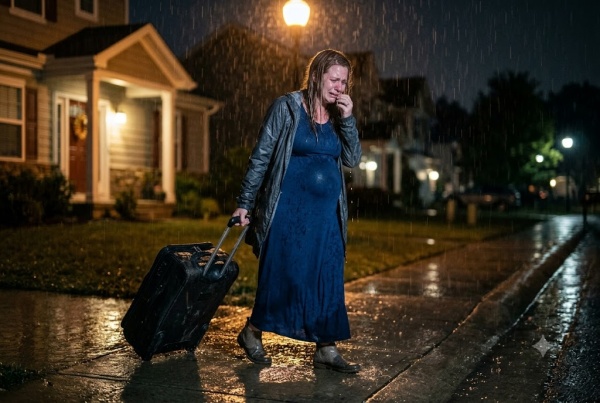
My Husband stood in our Bellevue kitchen and accused me of carrying another man’s child, while his pregnant mistress waited at the door with a suitcase. I left in the freezing Seattle rain with almost nothing but the truth. The next day….
Part 1 — The Test in the Rain
The first thing my husband did when he saw the positive pregnancy test was laugh.
Not the warm, surprised laugh I had imagined during all those months I stood barefoot in our Bellevue bathroom, praying over little plastic sticks like they were lottery tickets. Not the nervous laugh of a man overwhelmed by joy, fear, or disbelief. It was a cold laugh, sharp enough to make the kitchen lights feel brighter.
“That’s not my child,” Ethan said.
I stood by the island with one hand resting against the edge of the marble countertop, the other hand trembling around the sleeve of my sweater. Outside, Seattle rain hit the tall windows in silver sheets, the kind of January rain that seemed less like weather and more like punishment. I had driven home from my doctor’s appointment through traffic on I-90, rehearsing how I would tell him, thinking maybe good news could soften the distance that had grown between us.
“What?” I whispered.
Ethan picked up the pregnancy test from the counter using two fingers, like it was dirty. His eyes moved from the little blue plus sign to my face, and for one second I saw something flash there. Not shock. Not confusion. Anger.
“I said it’s not mine.”
The room tilted slightly. “Ethan, we’ve been trying for almost two years.”
He smiled, but there was no kindness in it. “You’ve been trying.”
I heard the words, but my mind rejected them at first. Sometimes a sentence is too cruel to enter the body all at once. It waits outside the door until your heart opens it by mistake.
“What are you talking about?” I asked.
He walked to the back door, opened it, and stepped out onto the covered patio. The freezing rain blew sideways across the yard, turning the lawn dark and glossy. Before I understood what he was doing, he threw the pregnancy test into the rain.
It landed near the stone steps, bounced once, and disappeared into the wet grass.
I stared at the place where it had fallen. That tiny plastic test had held the first proof that something I had prayed for might finally be real. And he had thrown it away like trash.
Ethan turned back to me. “I had a vasectomy.”
For a moment, I thought I had misheard him.
The refrigerator hummed. Rain struck the windows. Somewhere upstairs, the heating system clicked on. Everything normal continued around the most abnormal sentence of my life.
“You what?” I said.
“I had a vasectomy,” he repeated. “Eight months ago.”
My hand moved to my stomach before I could stop it. There was nothing to feel yet, nothing visible, no rounded proof of life. Just me, my breath, and the sudden knowledge that my marriage had contained a locked room I never knew existed.
“You told me you were still going to the fertility appointments,” I said.
“I went to one.”
“You told me your tests were normal.”
“They were.”
“You let me take injections. You let me cry every month. You let me think my body was failing.”
His expression hardened. “Don’t make this dramatic.”
That was Ethan’s favorite sentence whenever my pain became inconvenient. Don’t make this dramatic. Don’t be emotional. Don’t turn everything into a fight. He said those things in the calm tone of a man who believed volume determined guilt.
I stepped closer to the island because my knees felt weak. “Why would you do that?”
“Because I didn’t want kids anymore.”
The word anymore hit me worse than if he had said never. It meant there had been a decision, a change, a private vote in a marriage where I never got a ballot.
“We bought this house because of the school district,” I said. “You picked the nursery room.”
“I changed my mind.”
“And you didn’t think your wife deserved to know?”
He looked away toward the rain. “I knew how you’d react.”
The cruelty of that almost made me laugh. He had lied because he knew the truth would hurt me, and somehow that made the lie my fault.
“Ethan,” I said slowly, “I have never been with anyone else.”
His face twisted. “Don’t insult me.”
“I’m telling you the truth.”
“You’re pregnant, Lily. I had a vasectomy. So unless you want to explain a medical miracle, there’s only one answer.”
The baby. Our baby. My baby. Not even six weeks along, barely a heartbeat waiting to be heard, and already being turned into an accusation.
I reached for my phone on the counter. “I’m calling Dr. Patel. We can ask about failure rates, testing, anything—”
Ethan snatched the phone before I could unlock it.
“Give it back,” I said.
“You’re not calling anyone until you tell me who he is.”
“There is no one.”
“Then why are you panicking?”
“Because you’re scaring me.”
He stared at me, breathing hard. For a second, I thought he might throw the phone too. Instead, he slammed it against the edge of the island.
The screen cracked with a sound I still remember.
I flinched, not because he touched me, but because something in the room had crossed a line. Ethan looked down at the broken phone, then at me. His face shifted, and for one second he seemed startled by himself.
Then the mask came back.
“Pack a bag,” he said.
I blinked. “What?”
“You heard me.”
“This is my home.”
“It’s my house.”
That was not true, not exactly. The Bellevue house had been purchased after our marriage, with joint funds, though Ethan’s company bonuses had covered most of the down payment. I had handled renovations, mortgage paperwork, contractors, insurance, utilities, landscaping, and every small domestic detail he considered beneath him. But legal truth and emotional truth are very different things when you are standing in your kitchen with a broken phone and rain outside.
“I’m not leaving,” I said.
He walked past me toward the hallway. “Then I’ll call someone to remove you.”
The sentence chilled me more than the rain. Ethan was careful. He rarely raised his voice in front of other people. At work, he was charming, energetic, the founder of a fast-growing logistics software company that had been featured in local business magazines. At charity dinners, he placed his hand lightly on my back and introduced me as “the woman who kept him grounded.”
But at home, in private, grounding had become another word for being stepped on.
I watched him climb the stairs toward our bedroom. The bedroom I had painted warm gray because he hated beige. The bedroom where I had folded his laundry, hidden fertility medication in the mini fridge, and cried quietly into a pillow when he said he was too tired to try again.
I found the house phone in the office and called my sister.
Maddie answered on the third ring. “Hey, stranger.”
“Maddie,” I said, and my voice broke.
She changed instantly. “Where are you?”
“Home.”
“What happened?”
“I’m pregnant.”
There was a pause, then a sharp intake of breath. “Lily—”
“Ethan says it’s not his.”
The silence that followed was not confusion. My sister had never liked Ethan, but she had loved me enough to be careful with her warnings.
“I’m coming,” she said.
“He broke my phone.”
“Get your purse. Get your coat. Do not argue with him.”
“Maddie, he says he had a vasectomy.”
“Lily,” she said firmly, “listen to me. Get out of that house.”
Before I could answer, the front door opened.
I turned and saw a woman step inside with a rolling suitcase and a camel-colored wool coat soaked dark at the shoulders. She had glossy black hair, expensive boots, and one hand resting protectively over a visibly pregnant belly.
I knew her.
Not well. But I knew her.
Sienna Blake. Ethan’s head of client strategy. The woman he said was “brilliant but exhausting.” The woman whose late-night calls he always took in another room. The woman I once invited to Thanksgiving because she had “no family nearby,” only for her to spend the evening laughing too loudly at Ethan’s jokes while barely touching the sweet potatoes I made from my mother’s recipe.
She looked at me, then at the broken phone on the floor.
“Oh,” she said softly. “You’re still here.”
Still.
That one word told me more than any confession could have.
Ethan came down the stairs carrying my overnight bag. Not gently. Not with care. He dropped it near the front door.
Sienna stepped closer to him, and he put a hand on her back. A practiced hand. A familiar hand.
My sister’s voice crackled from the house phone still pressed to my ear. “Lily? Lily, answer me.”
I looked at Ethan. “She’s pregnant?”
His jaw tightened. “Yes.”
Sienna lifted her chin. “Twenty-four weeks.”
Twenty-four weeks.
I counted backward automatically, because women in broken marriages become accountants of betrayal. Twenty-four weeks ago, Ethan had been in San Francisco for a three-day investor meeting. He had sent me a photo of the Bay Bridge at sunset and written, “Wish you were here.”
I looked from her stomach to mine.
“You brought her here?” I asked.
Ethan did not deny it. “This situation has been difficult for everyone.”
I laughed then. It came out small and cracked, but it was still a laugh. “You mean for you?”
Sienna’s expression softened into something that tried to look like pity. “Lily, I know this is painful, but Ethan and I are building a life together. The sooner you accept that, the easier this will be.”
There are moments in life when rage would be easier than clarity. Rage burns fast. Clarity stays.
I looked around the entryway — the framed black-and-white print of Pike Place Market I bought at a street fair, the runner rug I chose after Ethan said he didn’t care, the ceramic bowl where he dropped his keys every night. I had spent years turning that house into a home. He had spent months turning it into a stage for my replacement.
Maddie was still on the phone. “Lily, talk to me.”
I swallowed. “I’m leaving.”
“Good. I’m ten minutes away.”
Ethan pushed my coat toward me. “Take the bag.”
I looked at it, then at him. “You packed for me?”
“You can come back later for the rest.”
“With your permission?”
His eyes narrowed. “Don’t start.”
I put on my coat. My hands shook so badly I could barely button it. Sienna watched me with the quiet confidence of a woman who thought she had moved into the winning side of a story.
At the door, I turned back. “Ethan, you emptied the joint account, didn’t you?”
He didn’t answer quickly enough.
I had checked our banking app that morning before the appointment. There had been just over $43,000 in the account, money from my salary, his draws, and the emergency fund I had insisted we keep. Now I knew why he had been in the office with the door closed before I left for the clinic.
“You did,” I said.
“It’s temporary,” he replied. “Until we sort out the situation.”
The situation. That was what he called a pregnant wife in the rain.
I stepped outside. The cold hit my face so hard it took my breath away. My positive pregnancy test lay somewhere in the wet grass, invisible now under the darkening sky.
Behind me, Ethan shut the door.
Not slammed. Closed.
That was worse somehow.
By the time Maddie’s Subaru pulled into the driveway, I was standing under the bare branches of the Japanese maple I had planted our second spring in the house. My hair was soaked. My broken phone was in my coat pocket. My overnight bag sat beside me on the stone path like evidence of a life packed by someone else.
Maddie jumped out and ran to me.
When she hugged me, I finally cried.
Not loudly. Not dramatically. Just enough for the rain to hide it.
Part 2 — The Family He Thought I Didn’t Have
Maddie lived in West Seattle in a small blue house with a view of the water if you stood on the back steps and leaned left. She was a nurse, divorced, practical, and impossible to intimidate. When she got me inside, she wrapped me in a blanket, took my wet clothes, and made peppermint tea I couldn’t drink because my stomach was twisting too hard.
“First,” she said, placing a notepad on the table, “you are safe.”
I nodded.
“Second, you are not calling him.”
“I don’t have a working phone.”
“Good. That helps.”
Despite everything, I almost smiled.
Maddie sat across from me, her face pale with anger. “Did he touch you?”
“No.”
“He broke your phone?”
“Yes.”
“Did he threaten you?”
I hesitated.
“Lily.”
“He said he’d call someone to remove me if I didn’t leave.”
She wrote that down. “And the account?”
“He emptied it.”
“How much?”
“About forty-three thousand.”
Maddie closed her eyes for a second. “I’m going to say something, and I need you to hear me. This is not a marriage problem anymore. This is a legal problem.”
I stared at the steam rising from the mug. “He had a vasectomy.”
“So he says.”
“You think he lied?”
“I think Ethan lies when breathing would be less convenient.”
Maddie had always been direct. It was one of the reasons Ethan disliked her. He called her “intense,” which was what men like him called women who could identify a bad smell before finding the source.
I slept badly that night in Maddie’s guest room under a quilt our grandmother made. Every time rain tapped the window, I was back in the Bellevue kitchen watching Ethan throw the test outside. I dreamed of searching the wet grass for it while Sienna stood in my doorway wearing my slippers.
At 6:15 a.m., I woke with one hand on my stomach.
Pregnant.
The word felt impossible and fragile. I had wanted this baby for so long that joy and fear were tangled beyond separating. I did not know what Ethan had done, what he had lied about, or what the truth of his vasectomy was, but I knew what I had not done.
I had not betrayed him.
At 8:00 a.m., Maddie drove me to a clinic to confirm the pregnancy and document my condition. The doctor was kind and careful, asking if I felt safe at home. That question almost broke me more than Ethan’s accusation because it was asked so gently, as though the world already knew women sometimes arrived carrying more than medical concerns.
Afterward, Maddie took me to buy a replacement phone. I called the bank, froze what I could, and requested statements. Then I called an attorney.
Her name was Rachel Kim, and her office was in downtown Seattle, not far from the courthouse. She had silver-threaded black hair, calm eyes, and a voice that made panic feel inefficient. Maddie sat beside me while I told the story from the positive test to Sienna in the entryway.
Rachel did not interrupt. She took notes, asked precise questions, and never once made me feel foolish for having loved my husband.
When I finished, she leaned back slightly. “We need to move quickly but carefully.”
“Can he just empty the account?” I asked.
“That depends on several factors, but courts generally do not look kindly on one spouse draining marital funds to disadvantage the other. We will document it.”
“What about the house?”
“Also marital property, based on what you’ve told me.”
“He said it was his.”
“People say many things when they’re trying to scare someone.”
I breathed for the first time in what felt like hours.
Rachel continued. “Do you have access to financial records? Company records? Emails?”
“Some. I handled personal bills, household accounts, insurance. Ethan handled the company.”
“What does his company do?”
“Cloud logistics software. Routing, warehouse automation, freight optimization. He started it four years ago.”
“Name?”
“Northline Systems.”
Rachel’s pen stopped.
I looked at her. “What?”
“Northline Systems,” she repeated. “Is your husband Ethan Mercer?”
“Yes.”
She looked at Maddie, then back at me. “I need to ask a strange question. Are you related to Harold Whitaker?”
My throat tightened.
Harold Whitaker was my great-uncle. Not the kind people usually mention in conversation, because his life had always felt separate from ours. He was my grandmother’s younger brother, a quiet man who made money in commercial lending and lived in Tacoma in a house full of nautical paintings. He had no children, sent birthday cards with checks inside, and called me “kiddo” until I was thirty-two.
“He died last month,” I said.
“I’m sorry,” Rachel said. “Did he leave you anything?”
“A letter,” I said. “Maybe some trust paperwork. I haven’t dealt with it yet.”
Maddie stared at me. “Lily.”
“I’ve been overwhelmed.”
Rachel was very still. “Do you know the name of his lending company?”
“Whitaker Capital.”
The room changed.
Rachel placed her pen down carefully. “Lily, I cannot confirm anything without documents, but I have seen Whitaker Capital appear in business filings. If Northline Systems has private debt financing through that lender, your great-uncle’s estate may matter significantly.”
I blinked. “What are you saying?”
“I’m saying your husband’s company may owe money to a lender you may have inherited an interest in.”
Maddie whispered, “Oh my God.”
I thought of Ethan standing in our kitchen, telling me I had no home, no money, no truth. I thought of Sienna holding her pregnant belly in my entryway, saying they were building a life together. And somewhere beneath the shock, a small, steady flame appeared.
“I have a box from Uncle Harold’s attorney,” I said. “It’s in my car.”
Maddie looked at me. “You left estate documents in your car?”
“I thought it was mostly sentimental stuff.”
Rachel stood. “Let’s open it.”
The box was in Maddie’s back seat, still sealed with brown packing tape. Inside were folders, a letter, contact information for Harold’s estate attorney, and a binder labeled “Whitaker Capital — Successor Control Documents.” My hands went cold when I saw my name printed on the first page.
Lillian Mercer.
Not Mrs. Ethan Mercer.
Lillian.
Rachel reviewed the documents slowly. Maddie paced near the window. I sat frozen, listening to the rain tapping against the office glass.
Finally, Rachel looked up.
“You appear to have inherited controlling interest in Whitaker Capital’s voting trust,” she said. “There will be formal steps, but based on this, you are the designated successor trustee.”
“What does that mean?”
“It means you may control decisions related to the lender, including certain enforcement actions, restructuring decisions, and access to loan records.”
“And Northline?”
Rachel turned a page. “Northline Systems is listed here as a borrower.”
The name stared back at me from the paper.
Northline Systems, Inc.
Senior Secured Credit Facility.
Outstanding principal: $3,800,000.
Three point eight million dollars.
Ethan had told me the company was “cash-flow tight” but stable. He had told investors the debt was routine growth financing. He had told me not to worry because I “didn’t understand startup finance.”
Apparently, my dead great-uncle understood it very well.
“What happens now?” I asked.
Rachel’s expression became careful. “Now we coordinate with the estate attorney. We preserve records. We do not make emotional decisions. We do not threaten your husband with business consequences in a personal dispute.”
“I wasn’t going to.”
“I believe you,” she said. “But I need to say it clearly. The fact that you may have legal control over a lender does not mean we use it recklessly. We follow the documents and the law.”
That made me trust her more.
By late afternoon, Rachel had spoken with Harold’s estate attorney, a man named Thomas Greer, who confirmed that Harold had named me successor trustee because, in his words, “Lily was the only one in the family who sent handwritten thank-you notes and asked how I was doing before asking about money.”
I cried when Thomas told me that.
Grief came strangely. I had been too consumed by my marriage to properly mourn Uncle Harold. Now he was gone, and somehow he had left me a locked door with a key inside.
Thomas also confirmed something else: Whitaker Capital had been reviewing Northline Systems for months.
“There were concerns,” he said over speakerphone.
“What kind of concerns?” Rachel asked.
“Reporting inconsistencies. Delayed financial statements. Unexplained transfers. Potential covenant breaches.”
The words sounded technical, but Rachel’s posture sharpened.
“Were these documented?” she asked.
“Yes.”
“Where are the records now?”
“In secure storage and digital archive. Harold ordered duplicates sent to outside counsel before he passed.”
I closed my eyes.
Records Ethan thought he had buried.
Already moving.
By the time I left Rachel’s office, the sky over Seattle was dark and low, and the wet pavement reflected headlights like melted gold. My life was still shattered. I was still pregnant, displaced, scared, and grieving a marriage that may have never been what I believed.
But I was no longer empty-handed.
That night, Ethan emailed my new address.
I don’t know what story you’re telling people, but you need to stop. Sienna is under stress, and I won’t let you create chaos. I’ll give you one week to collect your things. After that, I’m changing the locks.
I read it twice.
Then I forwarded it to Rachel.
For the first time since the kitchen, I did not answer him myself.
Part 3 — The Records in the Dark
The next day, Rachel filed for emergency temporary orders. The language was clean, formal, and far calmer than the events it described. It addressed the pregnancy, the removal from the home, the broken phone, the emptied account, the marital property, and Ethan’s attempts to control access to my belongings.
I hated seeing my life turned into paragraphs.
But Rachel told me something I held onto: “A good legal document does not need to scream. It needs to be accurate.”
Meanwhile, Thomas Greer arranged a secure call about Whitaker Capital. I joined from Maddie’s dining table with a borrowed laptop, wrapped in her old University of Washington hoodie. On the screen were Thomas, Rachel, an accountant named Julian Price, and a corporate attorney named Nora Feld.
They spoke carefully because every role mattered. I was Ethan’s wife. I was also, pending final estate formalities, the successor with authority over the lender that had extended millions to his company. Those two facts could not be tangled recklessly.
Nora explained it plainly. “You must act in the best interest of the trust and lender, not out of personal anger.”
“I understand.”
“If Northline is in default, the lender has rights. If records show fraud or misrepresentation, there may be legal obligations to escalate.”
“I understand.”
Julian shared the first set of findings. Northline had missed reporting deadlines. Some expenses were categorized strangely. Vendor payments had gone to entities that did not match ordinary business operations. A consulting agreement had been issued to a company registered to someone named Sienna Blake.
Maddie, who was pretending not to listen from the kitchen, froze.
Rachel looked at me. “Is that the same Sienna?”
“Yes.”
Julian continued. “There are also transfers from Northline to personal accounts, but we need more documentation.”
“How much?” Nora asked.
“Preliminary review suggests several hundred thousand dollars over eighteen months.”
The room went silent around me.
I thought about our joint account, drained of $43,000. I thought about Ethan complaining when I bought a $280 crib during a sale because “we needed to be careful.” I thought about Sienna stepping into my house with a suitcase and the calm confidence of someone whose bills were being paid by a man using money he may not have had the right to spend.
“What happens to the records?” I asked.
Nora answered. “If there are material concerns, we preserve everything and may seek court intervention related to the loan. Separately, your family law attorney may use lawful financial discovery in your divorce.”
“And Ethan?”
No one answered immediately.
Then Rachel said, “He will be notified through proper channels.”
Proper channels. That phrase became an anchor. Not revenge. Not chaos. Proper channels.
That afternoon, Ethan called from an unknown number.
I almost didn’t answer, but Rachel had told me not to engage unless necessary and to keep records of any direct contact. Maddie sat beside me and hit record after stating the date and time, following Washington’s consent rules as Rachel had explained them. Since I told Ethan the call was being documented if he wanted to continue, he could choose whether to speak.
“This call is being documented,” I said. “If you want to discuss legal matters, contact my attorney.”
He was quiet for half a second. “You got a lawyer?”
“Yes.”
“You’re unbelievable.”
“I’m ending the call.”
“Wait,” he snapped. “Did you contact Whitaker Capital?”
My pulse jumped.
“What?”
“Don’t play stupid, Lily.”
I looked at Maddie. Her eyes widened.
Ethan continued, voice low and tense. “I got a notice that Harold’s estate is reviewing Northline’s credit file. That has nothing to do with you.”
I swallowed. “You should speak with your company counsel.”
“This is my business.”
“And I’m not discussing it with you.”
“You have no idea what you’re touching.”
There it was. Not guilt. Not apology. Fear.
“I’m hanging up now,” I said.
“If you interfere with my company, you’ll regret it.”
Maddie reached for the phone, but I lifted one hand. My voice stayed steady somehow. “Do not threaten me again. Contact my attorney.”
I ended the call.
Then I ran to the bathroom and threw up.
Pregnancy, fear, and betrayal do not politely take turns. They arrive together, crowding the body until even breathing feels like work. Maddie sat on the bathroom floor with me, rubbing my back the way our mother used to when we were kids with the flu.
“He sounded scared,” she said.
“He sounded angry.”
“Same thing, sometimes.”
The hearing for temporary orders happened two days later in King County Superior Court. I wore the only dress Maddie had that fit loosely enough over my still-flat stomach, paired with boots because Seattle sidewalks were wet and unforgiving. Ethan arrived with his attorney, looking polished in a navy suit.
Sienna was not with him.
I was grateful for that, though part of me wondered if she was back in my house, opening my kitchen cabinets, touching the mugs I bought in Portland, sleeping in the bed where I had once whispered baby names to a man who was already planning a different family.
In court, Ethan’s attorney tried to frame the situation as a marital misunderstanding intensified by pregnancy hormones and emotional distress. I felt Rachel’s posture change beside me. She did not interrupt, but I sensed her patience narrowing.
When it was our turn, Rachel presented the facts calmly. The confirmed pregnancy. Ethan’s admission of a concealed vasectomy. The destruction of my phone. The drained joint account. His demand that I leave the marital home. The presence of his pregnant partner in the home that same night.
She did not embellish. She did not need to.
The judge asked Ethan’s attorney whether the joint account had been emptied.
His attorney said, “Funds were moved for safekeeping.”
The judge looked over her glasses. “Safekeeping from whom?”
Ethan’s attorney paused.
Rachel requested temporary access to marital funds, preservation of assets, exclusive use arrangements or access protocols for the home, and restrictions preventing either party from disposing of property or harassing the other. She also requested that communication go through counsel except for urgent matters.
The judge granted much of it.
Not everything. Court is not television. No one gasped, no one confessed, and no dramatic music rose when the judge spoke. But when we walked out, I had legal protection, temporary financial relief, and a date for the next hearing.
Ethan caught up with me near the hallway.
Rachel stepped slightly in front of me. “Counsel only, Mr. Mercer.”
He ignored her and looked at me. “You’re destroying me.”
I felt something inside me go quiet.
“No,” I said. “I’m documenting what you did.”
His face tightened. “You think Harold’s little loan makes you powerful?”
Rachel said, “Do not discuss business matters with my client.”
But Ethan was past caution. “That loan can be refinanced.”
“Then refinance it,” I said softly.
For the first time, he looked uncertain.
Because we both knew he would have done that already if he could.
That evening, Thomas called. The lender’s review had uncovered more than late reports. Northline had submitted financial statements that did not match bank activity. Certain documents appeared altered. Some internal emails suggested Ethan knew the company was in breach of loan covenants while continuing to represent otherwise.
“These records are being prepared for court submission,” Thomas said.
“What court?” I asked.
“Commercial matter first. Potentially more, depending on findings.”
I sat on Maddie’s couch, staring at the rain-dark window.
By the following night, exactly as Rachel had predicted, Ethan received formal notice that Whitaker Capital was seeking judicial oversight regarding Northline’s debt and records. The documents were filed properly, supported by evidence, and handled by attorneys who did not care about Ethan’s charm.
At 9:38 p.m., he sent one text from a number I had not blocked yet.
What did you do?
I did not respond.
At 9:41 p.m., another message arrived.
Lily, call me. Please.
Please.
The word looked strange coming from him.
I remembered the pregnancy test in the freezing rain. The broken phone. The empty account. Sienna’s suitcase in my entryway. His voice saying, “That’s not my child.”
Then I forwarded the messages to Rachel and turned off the phone.
For the first time in a week, I slept four straight hours.
Part 4 — The Truth About the Vasectomy
Two weeks later, I heard my baby’s heartbeat.
It was fast, steady, and impossibly strong, filling the exam room like a tiny galloping horse. I cried before I realized I was crying. Maddie cried too, then pretended she was checking her sleeve for lint.
Dr. Patel smiled. “There it is.”
I placed both hands over my stomach. “Hi,” I whispered.
In that moment, Ethan’s accusation lost some of its power. Not all of it. Cruel words do not disappear just because truth exists. But the heartbeat gave me something no accusation could touch.
A life was growing.
Mine to protect.
Rachel’s office received Ethan’s medical records through discovery weeks later. I was sitting across from her when she opened the file. She read silently, and her expression shifted in a way that made my skin prickle.
“What?” I asked.
She looked up. “He did have a vasectomy.”
My stomach dropped.
“But,” she continued, “there is no confirmed post-procedure clearance in the records provided.”
“What does that mean?”
“It means there is documentation of the procedure, but not documentation proving sterility afterward. Many doctors require follow-up testing before considering it effective.”
I stared at her.
“He lied,” Maddie said beside me.
Rachel held up a hand. “We need to be precise. He may have misunderstood, ignored follow-up instructions, or represented certainty he did not medically have.”
“That’s a polite way to say he used it as a weapon,” Maddie muttered.
Rachel did not disagree.
Then came the second document. An email from Ethan’s patient portal, sent months before, reminding him to schedule a follow-up analysis. Another reminder. Then a note indicating no sample received.
He had known.
Maybe he did not know the vasectomy failed. Maybe he believed the odds were low enough to accuse me safely. But he absolutely knew he had not completed the confirmation process.
The baby could be his.
And based on my life, my marriage, and my body, there was no other possibility.
Rachel leaned forward. “If paternity becomes an issue, it can be addressed legally and medically at the appropriate time. For now, the important fact is that his statement that a vasectomy proved the child was not his was not supported by his own records.”
I laughed once, but there was no humor in it.
He had thrown my pregnancy test into the rain over a conclusion his own doctor had never confirmed.
That same week, Sienna appeared in the story again.
Not at my door. Not directly. She posted online.
It was a soft, glowing maternity photo taken in the living room of my Bellevue house. My living room. The one with the stone fireplace I had saved to remodel, the white curtains I had hemmed myself when the custom ones were too expensive, the shelves where my books had been replaced with neutral vases.
Her caption read: “Building a peaceful home with the love of my life.”
People commented with hearts.
I stared at the photo for exactly twenty seconds. Then I sent it to Rachel.
“Can I be angry?” I asked Maddie.
“You can be furious.”
“Can I comment?”
“No.”
“I hate growth.”
“Growth hates you too, but here we are.”
I almost smiled.
Rachel handled it through counsel. Not because Sienna was forbidden from existing in a house Ethan currently occupied, but because marital property, personal belongings, public statements, and harassment boundaries mattered. The post disappeared by morning.
Then, unexpectedly, Sienna called me.
I did not answer. She left a voicemail.
Her voice was different without an audience. Less smooth. More strained.
“Lily, this is Sienna. I know you probably hate me, but Ethan isn’t telling me everything. He said the divorce was basically over before we got involved. He said you knew he didn’t want children. He said the house was his. Now there are lawyers calling, and Northline’s board is asking questions, and I’m pregnant and scared. I just… I need to know what’s true.”
I played it twice.
Maddie stood in the kitchen, arms crossed. “Do not feel sorry for her.”
“I don’t.”
But that was not entirely true.
I did not forgive Sienna. She had walked into my home with a suitcase. She had looked at me and said she was building a life with my husband. She had participated in my humiliation.
But I also recognized the sound of a woman realizing she may have been sold a version of reality designed for her compliance.
Rachel advised me not to contact Sienna directly. Instead, Sienna’s voicemail was documented. Her attorney eventually reached out. That was when more truth surfaced.
Ethan had told Sienna his marriage was “legally finished.” He had told her I refused to accept it because I wanted money. He had told her the Bellevue house belonged to him separately. He had told her his vasectomy meant my pregnancy, if real, was proof of an affair.
He had lied in every direction.
People like Ethan do not live double lives. They live custom lives, tailored separately for everyone they need to control.
Northline began to collapse publicly in quiet business language. Investors expressed concern. The board placed Ethan on administrative leave pending review. Whitaker Capital sought enforcement rights under the loan agreement. A judge ordered preservation of records.
No one dragged him out of an office. No one shouted in a dramatic conference room. Consequences, I learned, often arrive wearing gray suits and carrying binders.
Ethan called me again the night after the board meeting.
This time, Rachel allowed a limited call with attorneys aware, because Ethan claimed he wanted to discuss personal property and temporary arrangements. The call was recorded with proper notice.
He sounded exhausted.
“Lily,” he said, “I made mistakes.”
I closed my eyes. Mistakes were forgetting milk, missing an exit, sending an email to the wrong Sarah. What Ethan had done required planning.
“I’m listening,” I said.
“I panicked when I saw the test.”
“Why?”
“Because I thought… after the vasectomy…”
“You knew you never completed the follow-up.”
Silence.
“Ethan.”
“I didn’t think it mattered.”
“Then why did you say it proved anything?”
He exhaled shakily. “Because I needed it to.”
There it was. The closest thing to truth I had heard from him in months.
He needed me guilty so he could be innocent.
He needed my baby to belong to someone else so he could move Sienna into our house without looking like a man who had abandoned his pregnant wife. He needed the story clean. Wife unfaithful. Husband betrayed. New partner comforting him through tragedy.
It would have worked on some people.
Maybe even on me, if he had broken me fast enough.
“I want a paternity test when legally appropriate,” he said.
“You’ll get one through the proper process.”
“I know the baby might be mine.”
The sentence landed like a stone dropped into deep water.
“You knew that before you kicked me out,” I said.
He did not answer.
I looked down at my stomach. The baby was too small to move in a way I could feel, but I imagined them there anyway, floating in darkness, unaware that adults were arguing over truth like it was property.
“Ethan,” I said, “you did not just doubt me. You punished me for something you knew might not be true.”
His voice cracked. “I’m sorry.”
I had wanted those words for weeks. Maybe for years.
But when they came, they were too small to carry what he had done.
“I hope someday you understand the difference between regret and responsibility,” I said.
Then I ended the call.
Part 5 — The House with the Lights On
The paternity test, completed after the baby was born through the proper legal process, confirmed what I already knew.
Ethan was the father.
By then, my son was three weeks old, small and warm and furious whenever anyone took too long with a bottle. I named him Noah, because after the flood of that year, I wanted a name that meant survival without sounding like a battle cry.
When Rachel called with the result, I was sitting in Maddie’s living room, burping Noah over my shoulder while rain softened the windows.
“It confirms paternity,” she said.
I looked down at his tiny ear, the soft curve of it, the dark hair against his head.
“I know,” I whispered.
But knowing and having the world formally acknowledge it are different things. The document did not make Noah more mine. It did not make Ethan less cruel. But it closed one door he had tried to leave open.
Ethan did not ask to come over that day. His attorney contacted Rachel about visitation arrangements, child support, and revised temporary orders. That was the difference between panic and consequence: panic calls from blocked numbers; consequence schedules through counsel.
Northline did not survive in its original form. The company entered restructuring after the lender review exposed serious financial mismanagement. Ethan resigned before he could be removed. News articles used phrases like “leadership transition,” “debt pressure,” and “internal review,” which sounded much cleaner than the truth.
Whitaker Capital recovered part of the debt through restructuring. The trust remained intact. Thomas told me Uncle Harold would have been proud, not because I had power, but because I had used it properly.
That mattered to me.
I did not destroy Ethan’s company. Ethan did that with decisions made long before I understood the loan documents. I did not chase revenge. I preserved records, followed legal advice, and refused to be frightened into silence.
The divorce finalized the following summer.
By then, I had moved into a small rental in Kirkland with good light, safe locks, and a landlord who fixed the dishwasher within two days. It was not the Bellevue house. It did not have the stone fireplace, the wide kitchen island, or the nursery I had imagined.
But it had peace.
Noah’s crib stood by the window in a room painted pale green. Maddie helped me assemble it while swearing at the instructions. My friends brought secondhand baby clothes, freezer meals, diapers, and stories of their own lives falling apart and rebuilding in ways nobody saw coming.
The Bellevue house was sold as part of the settlement.
I went back once before closing to collect the last of my things. Rachel arranged the visit. Ethan was not there. Sienna was gone too.
I never learned exactly when she left him, only that she did. Her attorney sent one formal statement clarifying that she would not participate in false claims about me or my child. Months later, I heard through someone else that she had moved back to Portland to be near her family before giving birth.
I wished her child well.
That surprised people when I said it, but it was true. Children do not choose the stories they are born into. Adults do.
The house felt different empty. Without furniture, it echoed. My footsteps sounded too loud on the hardwood floors I had once polished before holiday parties.
In the kitchen, I stood near the island where Ethan had broken my phone. The marble edge still had a tiny chip. I touched it with one finger and waited for the old fear to rise.
It didn’t.
Only sadness came. Then relief.
Outside, the Japanese maple was bare, its thin branches black against a gray sky. Somewhere in the wet grass, months ago, a positive pregnancy test had landed like a discarded secret. I had searched for it later in my mind many times, imagining myself picking it up, washing it clean, proving it had mattered.
But standing there, I realized I did not need it anymore.
Noah existed.
Truth existed.
I existed.
On my way out, I found one box in the hall closet labeled “Lily — misc.” Inside were old picture frames, two scarves, a cookbook, and the tiny pair of yellow baby socks I had bought before everything happened. I had hidden them in the closet, saving them for the day I would surprise Ethan with a gift bag and a positive test.
I held them in my palm for a long time.
Then I put them in my purse.
The final court hearing was brief. Ethan looked older. Not dramatically ruined, not humbled in a way that would satisfy strangers, just smaller somehow. He had lost the company title, the house, a great deal of money, and the story he tried to tell about me.
When he saw Noah in the carrier beside me, his face changed.
For a second, I saw grief.
Maybe he loved our son. Maybe he loved the idea of redemption. Maybe he loved anything that might make him feel like the man he used to pretend to be.
I no longer tried to solve him.
The parenting plan was structured, supervised at first, then gradual if he complied. Child support was ordered. Communication remained through a co-parenting app. The court did not care about dramatic speeches. It cared about stability, documentation, and the best interest of the child.
Afterward, Ethan approached carefully with his attorney nearby.
“Lily,” he said.
Rachel looked at me. I nodded once.
Ethan swallowed. “I know I can’t fix what I did.”
“No,” I said. “You can’t.”
“I want to be better for him.”
“Then be consistent.”
He looked down. “And for what it’s worth… I know you didn’t betray me.”
For what it’s worth.
Once, I would have needed that sentence like oxygen. Now it was only a late receipt for something I had already paid for in full.
“I knew that the whole time,” I said.
Then I left.
Outside the courthouse, Seattle was doing what Seattle does best: raining lightly while pretending not to. Maddie waited by the curb with coffee and a grin.
“Well?” she asked.
“It’s done.”
She hugged me carefully around the baby carrier. “How do you feel?”
I looked at Noah, sleeping against my chest, his tiny mouth open.
“Tired,” I said. “Free. Still angry sometimes.”
“Sounds healthy.”
I laughed.
Months later, on Noah’s first birthday, I took him to Kerry Park at sunset. The city spread below us — the Space Needle, downtown towers, Elliott Bay, ferries moving like little white stitches across the water. Mount Rainier appeared faintly in the distance, pale and enormous, like something too steady to be real.
Noah clapped at a dog walking by.
I sat on a bench, holding a cupcake in a paper bag and thinking about the woman I had been that night in Bellevue. Soaked in rain. Phone broken. Bank account emptied. Husband accusing her. Another pregnant woman standing in her doorway like a replacement already delivered.
I wished I could go back and tell her what I know now.
I would tell her: You are not as alone as he wants you to feel.
I would tell her: The truth does not stop being true because someone with a louder voice denies it.
I would tell her: Do not waste your strength proving your pain to people invested in misunderstanding it.
And I would tell her: Sometimes the thing that looks like the end of your home is the beginning of your life.
The next morning, I received a forwarded envelope from Thomas Greer. Inside was a final personal letter from Uncle Harold, one that had been held until the trust transition was complete.
Kiddo,
If you are reading this, I am gone, and you are probably wondering why I left you with more responsibility than warning. The answer is simple: I watched how you treated people when you thought nobody important was watching.
Money is not character. It only reveals it faster.
Use good judgment. Trust documents more than charm. And never let anyone convince you that kindness means surrender.
— Harold
I read the letter three times.
Then I placed it in a frame on my desk.
That evening, after Noah fell asleep, I stood in my small kitchen washing bottles. Rain tapped softly against the window. The apartment smelled like baby lotion, dish soap, and the chicken soup Maddie had dropped off earlier.
My life was not glamorous. It was not easy. Some days I was still afraid of legal emails. Some nights I cried from exhaustion. Some mornings I missed the idea of the marriage I thought I had, even though I no longer missed the man.
Healing was not a straight line. It was a kitchen light left on. It was a bank account in my own name. It was a baby breathing softly in the next room. It was learning to sleep without waiting for footsteps on the stairs.
A year after Ethan threw my pregnancy test into the freezing rain, I bought another one.
Not because I needed it.
Because I wanted to reclaim the memory.
I stood in my bathroom, unwrapped the empty test from its box, and held it for a moment. Then I threw it away myself.
Not into the rain. Not in anger.
Just into the trash, where plastic belonged.
My son laughed from his bouncer in the hallway, delighted by absolutely nothing, the way babies are. I washed my hands, picked him up, and kissed his warm cheek.
Ethan had said, “That’s not my child.”
He had been wrong about the baby.
Wrong about the money.
Wrong about the house.
Wrong about the records.
But most of all, he had been wrong about me.
He thought if he broke my phone, I would lose my voice. He thought if he emptied the account, I would lose my options. He thought if he brought another woman into my home, I would lose my place in the story.
Instead, I found the people who loved me, the documents he feared, the law he underestimated, and the strength I had been quietly building for years.
The freezing rain did not wash me away.
It showed me exactly what needed to be cleaned from my life.
