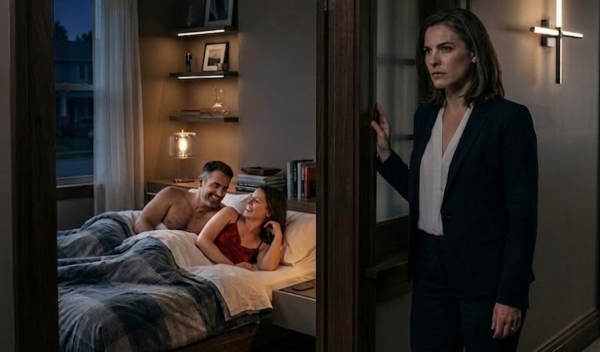
One summer night, I heard my husband tell another woman exactly how he planned to use me, my parents, and everything we had built. He wanted two more years to take what was never his. I only needed one night to start taking my life back.
Part 1
My husband didn’t know I was standing close enough to hear every word. He was on the back patio at my parents’ Fourth of July party, half-hidden behind the hydrangea bushes my mother had planted the summer I got married. The fireworks had already started over the lake, and everyone else was out front with paper plates, plastic cups, and kids running barefoot through the grass.
I had only stepped outside because I was looking for the extra sparklers. My sister’s twins were begging for them, and my mom swore she had left another box in the garage. Instead, I heard my husband’s voice, low and laughing, the kind of laugh he used when he wanted someone to think he was charming.
At first, I thought he was talking to one of his college friends. Then I heard a woman’s voice, soft and teasing, asking him how much longer he was going to “play the loyal husband.” My hand froze on the screen door, and for one foolish second, my brain refused to understand what my ears had already heard.
“Two years,” Mark said. “Maybe less if her dad gets tired enough to sign everything over.”
I remember the smell of charcoal smoke drifting across the yard. I remember the sticky condensation on the lemonade glass in my hand. Most of all, I remember how strangely calm the world looked while my life cracked open right in front of me.
The woman laughed. “And Emily has no idea?”
“No,” he said. “She thinks I’m building a future with her. Honestly, I’m using her, her family, the company, all of it. Once I’m positioned right, I walk away with what I’m owed.”
What he was “owed.” That was the phrase that turned my heartbreak into something colder. Not rage, not yet, but a clean, sharp clarity that moved through me like ice water.
I stood there in my white linen dress, the one he had complimented before we left the house. I stood there with my wedding ring catching the reflection of red and blue fireworks. I stood there listening to my husband explain to another woman how he planned to bleed my family dry and leave me when the timing was profitable.
The woman asked if he felt bad. Mark made a small sound, like the question was almost cute. “Emily will survive. Women like her always do. She’ll cry, her parents will throw money at the problem, and I’ll finally get a life that isn’t stuck in their shadow.”
I almost stepped outside then. I almost threw the lemonade in his face and screamed loud enough for the whole neighborhood to hear. But something stopped me, something older and wiser than my humiliation.
My father had spent thirty-eight years building Callahan Home Supply from a rented warehouse in Worcester into six stores across Massachusetts and New Hampshire. My mother had done the books at our kitchen table before I was old enough to understand why she used a calculator with such angry precision. That company had paid for employees’ kids to go to college, helped families through medical emergencies, and kept our name respected in towns where people still remembered your first bad check.
Mark knew that. He had known exactly where to aim.
I backed away slowly before either of them saw me. My legs felt hollow, but I made it to the garage, found the sparklers, and stood in the dark beside my father’s old snowblower while I tried to breathe. Somewhere outside, people cheered as another firework burst over the lake.
When I returned to the front yard, my niece ran toward me with chocolate on her chin. “Aunt Em, you found them!” she shouted. I smiled so naturally it scared me.
Mark came around the side of the house ten minutes later. He kissed my temple in front of everyone and asked if I was okay, because apparently my face had gone pale. I looked up at the man I had slept beside for nine years and said, “I’m fine. Just tired.”
He believed me. That was the first mistake he made.
My mother handed him a paper plate with a cheeseburger, potato salad, and corn on the cob. My father slapped him on the shoulder and asked about the new vendor contracts. Mark smiled like a son, like a partner, like a man who had not just confessed to planning the quiet destruction of everyone feeding him dinner.
I watched him from across the yard. I watched the way he leaned in when my father spoke, careful and respectful, the way he laughed at my mother’s stories. I watched his eyes flick toward his phone every few minutes.
I knew her name without needing to ask. Vanessa. His “consultant” from the Denver expansion project, the woman who always seemed to call during dinner and text during Sunday breakfast.
For months, I had told myself I was being insecure. I told myself marriage had seasons, and maybe we were in a difficult one. I told myself Mark was stressed because my father had begun talking about retirement and succession planning.
Now I knew the truth. Mark wasn’t stressed because he feared losing us. He was stressed because he wanted to calculate the cleanest way to take us with him when he left.
That night, after we drove home to our quiet colonial house outside Concord, he showered and climbed into bed like nothing had happened. He smelled like cedar soap and smoke from my parents’ firepit. He reached for me under the comforter, and I turned away before his hand touched my waist.
“Headache?” he asked.
“Long day,” I whispered.
He sighed, already bored with my answer, and rolled over. Within minutes, he was asleep.
I lay beside him in the dark and stared at the ceiling fan turning slowly above us. Nine years of marriage replayed itself in fragments: our first apartment in Cambridge, the honeymoon in Maine, the miscarriage we barely survived talking about, the nights we stayed up making plans on the back of grocery receipts. Every memory now had a shadow behind it.
At 1:13 a.m., I got out of bed. I put on sweatpants, tied my hair back, and walked downstairs without turning on the lights. My phone was in my hand, my laptop was under my arm, and for the first time all night, I knew exactly what I was going to do.
Mark wanted two more years. I only needed one night to start taking my life back.
Part 2
The first thing I did was not dramatic. I did not smash his phone, empty his closet onto the lawn, or post anything online. I made coffee, opened my laptop at the kitchen island, and wrote down everything I had heard while it was still sharp enough to cut.
I wrote the date, the time, the location, and the exact words I could remember. I described where I had been standing and where Mark had been standing. I included Vanessa’s voice, his reference to my father signing everything over, and the phrase that would not stop echoing in my head: “using her, her family, the company, all of it.”
My hands shook only once. It happened when I typed, “My marriage ended at approximately 9:42 p.m.” Seeing it in writing made it feel official, like a death certificate. I closed my eyes, counted to ten, and kept going.
Then I opened our shared financial folder. Not his private email, not his phone, not anything I had no legal right to access. Just the household records we both used, the tax documents we had uploaded together, the bank statements from accounts with both our names on them.
For years, Mark had teased me for being too organized. “You and your folders,” he would say whenever I saved receipts or scanned insurance papers. That night, every careful habit became a little piece of armor.
I downloaded copies of our mortgage statements, retirement account summaries, joint credit card bills, and tax returns. I noted every large transfer from the past eighteen months. I made a list of accounts I knew existed and a separate list of the ones I suddenly suspected existed.
At 2:04 a.m., I found the first thing that made my stomach drop. A consulting invoice from a company called V. Lane Strategy Group for $18,500. The description was vague: “Market positioning and regional partnership advisory.”
Vanessa Lane. I stared at the name until the letters blurred. Mark had approved the payment from Callahan Home Supply’s expansion budget, and my father had likely signed off because Mark told him it was legitimate.
I found three more invoices. $12,000. $21,750. $9,400. All approved by Mark, all billed through projects he supervised, all described in polished language that meant absolutely nothing.
I did not know yet whether they were illegal, unethical, or just ugly. I only knew my husband had been paying his mistress through my family’s company while smiling at my parents over grilled hamburgers. The humiliation was so complete it became almost weightless.
At 2:47 a.m., I emailed my personal attorney. Her name was Dana Reed, and I had hired her years earlier to review a property agreement when Mark and I bought our house. I had not spoken to her in almost four years, but I still had her card in my desk drawer.
The subject line was simple: “Urgent marital and business matter.” In the email, I kept my language factual. I wrote that I had overheard my husband discussing plans to use my family and company assets for personal gain, that I had concerns about financial misconduct, and that I needed legal guidance before confronting him.
Then I did something that felt harder than sending the email. I wrote one to my father.
I did not tell him everything. My dad was sixty-seven, stubborn, proud, and recovering from a mild heart scare that had finally convinced him to work fewer Saturdays. If I called him in tears at three in the morning, he would drive over in his pajamas and maybe do something he regretted.
So I wrote: “Dad, please do not sign any new ownership, vendor, or succession documents involving Mark until we talk. I know this sounds alarming, but I need you to trust me. I’m safe. I’ll explain in the morning.”
I stared at the message for a full minute before sending it. My finger hovered over the screen as if one tap could destroy what little peace my family had left. Then I sent it, because peace built on a lie was only another kind of trap.
My mother used to say that panic makes people loud, but fear makes them quiet. That night, I was very quiet. I moved through the house like a careful stranger, gathering copies of insurance cards, passports, birth certificates, and the small velvet box that held my grandmother’s earrings.
Not because I thought Mark would hurt me. He had never raised a hand to me, and I will not pretend otherwise. But I had just discovered that the person sleeping upstairs was comfortable using love as camouflage, and that was enough to make me cautious.
At 3:35 a.m., I opened the safe in my office closet. The code was my mother’s birthday, because Mark had always said he did not want to deal with “my document museum.” Inside were the house deed, old car titles, savings bonds from my grandparents, and a sealed envelope from my father.
The envelope contained a letter he had given me after my miscarriage. I had never opened it. On the front, in his square handwriting, he had written, “For when you forget who you are.”
I sat on the closet floor and finally opened it.
“Emmy,” it began, because only my father still called me that. “You come from women who rebuilt after fires, after funerals, after men who thought kindness was weakness. If life ever makes you feel small, remember that your name was never borrowed from anyone.”
I pressed the letter against my mouth and cried for the first time. Not loudly, not beautifully, not like women do in movies. I cried like a person trying not to wake the man who had become the reason for her tears.
By 4:10 a.m., the sky outside had turned the dull blue of early morning. I had a folder on my laptop labeled “Personal Records,” another labeled “Business Concerns,” and a third labeled “Do Not Touch Until Dana Reviews.” I had not made a plan for revenge, but I had made something better: a plan for protection.
At 4:22, Mark’s phone buzzed upstairs. I heard the faint vibration through the ceiling. A moment later, I heard him get out of bed.
I closed my laptop and placed it in my tote bag.
He came downstairs wearing boxers and the confused face of a man who expected the house to obey his schedule. “Em?” he said from the doorway. “Why are you awake?”
I turned slowly from the kitchen sink, where I had been rinsing my coffee mug. “Couldn’t sleep.”
He rubbed his eyes. “You okay?”
There it was again. The question he asked not because he cared about the answer, but because he trusted my answer would be convenient. I looked at him, at the husband who needed two more years, and gave him the same gift he had given me all night.
A lie.
“I’m fine,” I said. “Go back to bed.”
Part 3
By 8:00 a.m., my father had called six times. I answered only after I was parked outside Dana Reed’s office in downtown Concord with my tote bag on the passenger seat. The morning sun was already hot, and the sidewalk smelled faintly of wet pavement and coffee from the café next door.
“Emily Anne Callahan,” my father said, which meant he was scared. “What the hell is going on?”
“I’m meeting with an attorney in fifteen minutes,” I said. “I need you to listen before you react.”
There was a long silence. My father was a man who could negotiate a warehouse lease during a snowstorm and fire a supplier without raising his voice, but he had never learned how to be calm when one of his daughters was hurt. Finally, he said, “Are you safe?”
“Yes.”
“Did he hit you?”
“No.”
“Then tell me why I’m not signing anything.”
I told him enough. Not everything, not the details that would make him picture his son-in-law laughing with another woman behind the hydrangeas. I told him Mark had admitted to using the family and waiting for control, and that I had found suspicious invoices tied to Vanessa Lane.
My father made a sound I had never heard from him before. It was not anger exactly. It was the sound of a man realizing he had welcomed a thief to Thanksgiving and given him the good chair.
“Do not confront him,” I said quickly. “Please. I need this handled properly.”
“I want him out of my company by lunch.”
“I know,” I said. “But if you do that without a review, he’ll make himself look like the victim. Let the attorney and accountant look first.”
My father breathed hard through his nose. “Your mother is going to know something is wrong.”
“Tell her I’m handling it.”
He gave a bitter laugh. “That will make her more worried.”
“She raised me,” I said. “She knows I mean it.”
Inside Dana’s office, everything smelled like paper, lemon polish, and expensive calm. She listened without interrupting, taking notes on a yellow legal pad while I spoke. Her face gave away nothing until I mentioned Vanessa’s invoices.
Then her pen stopped.
“Do you have copies?” she asked.
“Yes.”
“Good. We’re going to keep this clean, lawful, and documented. You are not going to access anything you do not have permission to access, you are not going to threaten anyone, and you are not going to post about this online.”
“I wasn’t planning to.”
“You’d be surprised how many smart people lose leverage because they want applause before they want protection.”
That sentence stayed with me. Before that morning, I might have wanted everyone to know what Mark had done. I might have wanted his parents, our neighbors, and every person at Callahan Home Supply to look at him differently.
But Dana was right. Public shame was loud, temporary, and unpredictable. Documentation was quiet, slow, and powerful.
She explained the basics in plain English. Massachusetts divided marital property equitably, not always equally. The house, retirement accounts, and business-related compensation would need review, especially because Mark’s role in my family’s company complicated everything.
“What about my parents’ business?” I asked.
“That depends on ownership, contracts, compensation, and whether any company funds were misused,” Dana said. “Your father needs separate counsel for the business. You need divorce counsel for yourself. The interests overlap, but they are not identical.”
I nodded like I understood. Mostly, I felt as if I had walked into a class halfway through the semester and the final exam was my life. Still, every sentence gave shape to the fog.
Dana asked if we had children. I said no, and the word landed heavily between us. For years, that answer had carried grief; now, for the first time, it carried relief too, and I hated myself a little for feeling it.
“You’re allowed to be relieved,” Dana said quietly, as if she had read my face. “It doesn’t mean you didn’t want what you wanted. It means this situation is hard enough without a custody fight.”
I looked down at my wedding ring. It was a simple oval diamond with a thin gold band, chosen because Mark had said he liked how “unflashy” it was. At the time, I thought that meant he valued humility.
Now I wondered if he had simply known my family would pay for everything else.
By noon, Dana had given me a list of next steps. Open a separate bank account for my paycheck. Redirect my direct deposit. Do not remove large amounts from joint accounts without legal advice. Do not alert Mark to the business review until the attorneys were ready.
When I walked out of her office, my phone showed twelve missed calls from Mark. The texts began sweet and became irritated.
“Where are you?”
“Are you seriously ignoring me?”
“Emily, I have meetings today.”
“Did you take the Honda?”
That last one almost made me laugh. Not “Are you okay?” Not “I’m worried.” He wanted to know why the car he preferred for errands was not in the driveway.
I drove to my parents’ house instead of going home. My mother opened the front door before I knocked. She was still wearing her gardening gloves, and her eyes searched my face with the ruthless tenderness only a mother has.
“Oh, honey,” she said.
That was all it took. I folded into her like I was eight years old again, like I had scraped my knee on the driveway, like the worst thing in the world was still something she could fix with a Band-Aid and a Popsicle.
My father stood behind her, one hand on the banister. He looked older than he had the night before. When I pulled away from my mother, he stepped forward and hugged me so carefully it hurt.
“I’m sorry,” he said into my hair.
“You didn’t do this.”
“I trusted him.”
“So did I.”
We sat at the kitchen table where my mother had once done payroll by hand. I gave them the cleaner version first: the overheard conversation, the timeline, Dana’s advice. Then I showed them the invoices.
My mother put on her reading glasses and went very still. People underestimated her because she baked pies for every school fundraiser and sent handwritten birthday cards. They forgot she had balanced the company’s books during years when one bad winter could have ruined us.
“This is not how we code outside consulting,” she said.
My father looked at her. “You’re sure?”
“I created the system, Patrick.”
The room went silent.
For the first time since I had heard Mark’s voice on the patio, I was not alone with the truth. It sat on the table between the three of us, ugly and undeniable. My mother reached over and placed her hand over mine.
“What do you want to do?” she asked.
I expected to say I did not know. I expected to collapse under the size of the question. Instead, I heard myself answer clearly.
“I want him out of my house, out of my family’s business, and out of my life. And I want to do it in a way he cannot twist.”
My father nodded once. My mother squeezed my hand. Outside, a lawn mower started somewhere down the street, ordinary and loud in the summer heat.
For the rest of the day, my family moved like a storm with manners. My father called the company attorney. My mother called the external accountant who had handled audits for twenty years. I sat at the table and forwarded documents only when Dana told me to.
At 5:30 p.m., Mark texted again.
“Dinner? Or are you still being weird?”
I stared at the message until my reflection appeared on the black screen. The woman looking back at me had tired eyes, messy hair, and no makeup. She also had a plan.
I typed, “I’ll be home tonight. We need to talk.”
Then I deleted it.
Dana had told me not to warn him. My mother had told me not to go home alone if I was emotionally overwhelmed. My father had told me several things that were not useful and involved a shovel, so we ignored those.
In the end, I wrote only, “Staying with my parents tonight. I’ll contact you tomorrow.”
His reply came in seconds.
“What did you tell them?”
And there it was. Not confusion. Not concern. Fear.
I set the phone face down on the table and smiled for the first time all day.
Part 4
Mark arrived at my parents’ house at 7:12 p.m. He did not call first, because Mark believed doors opened for him when he was charming enough. He pulled into the driveway in his black Audi, got out wearing the navy polo my mother had bought him for Christmas, and walked up the front steps as if he were coming for dessert.
My father opened the door before Mark could ring the bell.
They stood facing each other through the screen. Mark smiled, but it was the wrong smile, too smooth and too early. My father did not move.
“Patrick,” Mark said. “Is Emily here? I think there’s been some kind of misunderstanding.”
My father’s voice was calm. “You need to leave.”
Mark blinked. “Excuse me?”
“You heard me.”
From the dining room, I could see only part of Mark’s face, but I saw enough. The charm slipped for half a second, and underneath it was irritation, sharp and entitled. Then he found the smile again.
“I don’t know what she told you, but this is between me and my wife.”
My mother stepped into the hallway. She had changed from gardening clothes into beige slacks and a white blouse, which somehow made her more intimidating. “Not when company funds may be involved.”
Mark’s eyes shifted. It was quick, but I saw it. He had expected tears, maybe shouting, maybe me making accusations he could dismiss as emotional.
He had not expected my mother with reading glasses on a chain around her neck and the accountant already scheduled for 8:00 a.m.
“Company funds?” he repeated. “That’s ridiculous.”
“Then you’ll be glad to cooperate with the review,” my mother said.
Mark looked past them and found me standing in the dining room. For a moment, the whole house seemed to hold its breath. He stared at me like I had betrayed him by refusing to remain useful.
“Emily,” he said softly. “Can we talk?”
That voice had once worked on me. It was the voice from hospital waiting rooms, from apologies after forgotten anniversaries, from mornings when he promised stress was the reason he had become distant. I had mistaken softness for sincerity because I wanted our marriage to survive.
Now I heard the calculation beneath it.
“You can speak with my attorney,” I said.
His face changed again. “Your attorney?”
“Yes.”
He laughed once, but there was no humor in it. “So that’s what this is? You run to Mommy and Daddy and a lawyer because you overheard something out of context?”
My father’s hand tightened on the doorframe.
I stepped closer before he could speak. “Out of context would be forgetting to take out the trash. Out of context would be venting after a bad day. You told another woman you were using me and my family while waiting to walk away with more than you deserved.”
The air went still.
Mark’s mouth opened, then closed. For the first time, he did not have an immediate answer. That tiny silence gave me more confirmation than any confession could have.
“You misunderstood,” he said finally.
“No,” I said. “I understood you perfectly.”
He lowered his voice. “You’re upset. I get it. But you need to think carefully before you burn down your whole life over one conversation.”
There it was, the threat disguised as advice. The old Emily might have trembled. The new one simply noticed it, filed it away, and let it pass.
“My life isn’t burning down,” I said. “I’m clearing smoke.”
Mark’s expression hardened. “You know I have rights.”
“Yes,” I said. “And so do I.”
My mother stepped forward. “This conversation is over.”
For a second, I thought Mark might push past them. Not violently, not dramatically, but in that privileged way he had of assuming resistance was temporary. Then he looked at my father, looked at my mother, looked back at me, and understood that the door would not open.
He stepped back.
“You’re making a mistake,” he said.
“No,” I replied. “I made one nine years ago. I’m correcting it.”
He left with the kind of controlled anger that makes a car door sound louder than it should. We watched through the front window as his taillights disappeared down the street. My mother exhaled slowly.
My father turned to me. “You okay?”
“No,” I said. “But I’m proud of myself.”
That night, I slept in my childhood bedroom under a faded quilt my grandmother had made. The room still had a bookshelf full of paperbacks, a softball trophy from tenth grade, and glow-in-the-dark stars stuck to the ceiling. I had spent years thinking that room belonged to a younger version of me, but lying there, I realized she had been waiting.
My phone buzzed until midnight. Mark sent apologies, accusations, memories, and finally silence. Vanessa called once from a Colorado number, and I let it go to voicemail.
The voicemail was only seven seconds long. She breathed, then hung up. Somehow that was worse than if she had spoken.
In the morning, the review began. The accountant found improper vendor classification within two hours. By lunch, the company attorney had advised my father to suspend Mark’s authority pending investigation.
Nobody accused him publicly. Nobody sent a company-wide email full of drama. Mark simply arrived at the office and found his access limited, his meetings reassigned, and a formal notice waiting for him.
He called me twenty-three times.
I answered none of them.
By Friday, Dana filed the initial divorce paperwork. I had known the word “divorce” for years, of course, but seeing it attached to my name felt surreal. It was both an ending and a door.
Mark’s attorney responded quickly. Suddenly, my husband wanted to reconcile. Suddenly, he was “devastated by the breakdown of communication.” Suddenly, he claimed he had been under stress, drinking too much at the party, and speaking “recklessly” to someone who had manipulated him.
I read the statement twice. Then I handed it back to Dana. “He forgot to mention the invoices.”
Dana smiled faintly. “They often do.”
The following weeks were not clean or cinematic. There were forms, deadlines, bank statements, legal fees, sleepless nights, and moments when grief ambushed me in grocery store aisles. I cried once in front of a display of peaches because Mark used to buy too many every July and let them rot on the counter.
Healing, I learned, is not a straight road with inspirational music playing in the background. Sometimes it is brushing your teeth at 6:30 a.m. because your attorney has a call at seven. Sometimes it is eating toast because your mother put it in front of you and told you she was not raising a ghost.
The business review uncovered enough irregularities to end Mark’s employment for cause. The details became part of a confidential legal process, not neighborhood gossip. My father wanted a dramatic public statement, but my mother, Dana, and the company attorney all said the same thing: protect the company first.
So we did.
Mark moved into a corporate apartment near Waltham and told mutual friends that my family had “turned on him.” Some believed him, at least at first. People like simple stories, and “rich wife’s family destroys hardworking husband” was simpler than the truth.
I lost friends I thought would ask more questions. I gained support from people I barely knew. The owner of the coffee shop near my office started adding an extra shot of espresso to my latte and pretending it was a mistake.
One afternoon, three weeks after the party, I found a box on my parents’ porch. Inside were framed photos from my wedding, my favorite blue sweater, and a sticky note in Mark’s handwriting. “This doesn’t have to be ugly.”
I laughed when I read it. Not because it was funny, but because it was such a perfect summary of him. He had made it ugly in secret and only objected when I stopped hiding the mess.
I put the photos in the garage. I kept the sweater. I threw away the note.
Part 5
Six months later, I stood in the empty storefront of Callahan Home Supply’s newest location in Portsmouth, New Hampshire. The floors were unfinished, the walls smelled like fresh paint, and rolls of contractor paper covered the front windows. Outside, the winter wind came off the river hard enough to make the glass hum.
My father stood beside me with a clipboard. My mother stood near the checkout area, arguing with an electrician about outlet placement. For the first time in years, I was not watching the family business from the edge of someone else’s ambition.
I had taken a leave from my marketing job in Boston and come into the company full-time. Not because I wanted to prove anything to Mark, though at first maybe I did. I came because my family had built something worth protecting, and I was tired of acting like loyalty made me less capable.
The divorce was not final yet, but the shape of my future had become visible. The house would be sold. The joint accounts would be divided according to the law. The business claims would be handled separately, carefully, and without giving Mark the dramatic stage he wanted.
He still sent messages sometimes through his attorney that sounded almost human. He regretted things. He missed me. He hoped we could remember the good years.
Maybe some of that was true. Maybe even selfish people miss the comfort of being loved. But missing me was not the same as respecting me, and regret was not the same as repair.
Vanessa disappeared from the story faster than I expected. I heard from a mutual acquaintance that she had moved on to another contract in Arizona and claimed she had “no idea Mark was so complicated.” That made me laugh for almost a full minute.
Complicated. It was a generous word for a man who had mistaken access for ownership.
In February, Dana called to tell me Mark wanted mediation. “He’s more realistic now,” she said. “That doesn’t mean generous. It means realistic.”
“Good,” I said.
“Are you ready?”
I looked around the Portsmouth store, where sunlight fell through dusty windows onto stacks of lumber samples. My mother was still correcting the electrician. My father was pretending not to be tired.
“Yes,” I said. “I am.”
Mediation took place in a conference room with bad coffee and a view of a parking garage. Mark arrived in a gray suit I had bought him for a company banquet two years earlier. He looked thinner, sharper, and somehow smaller without my family around him.
For a few seconds, I saw the man I had loved. Not clearly, not enough to change anything, but enough to mourn him one last time. The old Mark had brought me soup when I had the flu, danced with me in our kitchen, and cried with me after the miscarriage.
Then I remembered the patio. I remembered his laugh in the dark. I remembered that love, if it had existed, had not stopped him from planning my ruin.
He tried to speak to me before the lawyers began. “Emily,” he said. “I never wanted it to go this far.”
I looked at him calmly. “You wanted two more years.”
His face drained of color.
That was when he knew. Not suspected, not feared, but knew that I had heard every word. Until that moment, he had been fighting shadows, wondering how much I knew and how much I could prove.
I gave him the truth like a receipt.
He looked down at the table. “I was angry. I said things I didn’t mean.”
“No,” I said. “You said things you didn’t expect me to hear.”
After that, mediation became easier. Not kind, not pleasant, but easier. The fantasy version of Mark, the one who could explain anything away, finally had to sit quietly while reality took notes.
We settled months later. I did not get everything, and neither did he. That is how the law works sometimes: not like justice in a movie, but like adults measuring damage with calculators and signatures.
Still, I got enough. Enough to leave the marriage cleanly. Enough to protect what belonged to my family. Enough to begin again without carrying his debts, his lies, or his version of me.
The day the divorce was finalized, I drove alone to the lake where my parents had hosted that Fourth of July party. It was early spring, too cold for swimmers, and the picnic tables were still chained near the parking lot. The hydrangeas were bare sticks waiting for warmer weather.
I stood near the patio and listened to the wind move through the trees. For a moment, I could almost hear the echo of Mark’s voice from that night. The memory still hurt, but it no longer owned me.
My mother had asked if I wanted to sell the house after everything. I said no. Bad things had happened there, but so had birthday parties, baby showers, snow days, and summer dinners that lasted until mosquitoes chased us inside.
A place does not become cursed because someone lies in it. Sometimes it becomes sacred because you survive there.
That summer, exactly one year after the night I overheard him, we opened the Portsmouth store. My father cut the ribbon, but he made me stand beside him. My mother cried and blamed allergies, even though there were no flowers nearby.
Employees from all six stores came. Customers wandered through the aisles carrying paint samples and bags of mulch. A little boy knocked over a display of tape measures, and everyone laughed as if the sound itself could bless the building.
Near noon, my father tapped a spoon against a paper cup and made a speech. He thanked the staff, the contractors, the families, and the customers who had believed in Callahan Home Supply. Then he looked at me.
“And I want to thank my daughter Emily,” he said, his voice rough. “For reminding us that a family business is not protected by contracts alone. It is protected by people who know its worth.”
Everyone clapped. I looked down because I did not trust my face. My mother reached for my hand and held it under the folding table.
Later, after the crowd thinned, I walked through the aisles alone. The shelves were full of ordinary things: nails, hinges, garden gloves, light bulbs, paint rollers. Things people bought when they were building, repairing, improving, trying again.
That was when I realized my life had become one of those ordinary things too. Not a tragedy. Not a scandal. A repair.
I still had lonely nights. I still woke sometimes expecting to hear Mark’s keys in the door. I still caught myself measuring new people against old wounds and had to remind myself that caution was allowed, but fear was not a home.
But I was no longer waiting for someone else to decide my future. I had my own bank account, my own apartment near the harbor, my grandmother’s earrings in a dish by my bed, and my father’s letter framed on my desk. “Your name was never borrowed from anyone.”
One evening in August, I stayed late at the Portsmouth store to finish a display near the front entrance. The sun was setting orange over the parking lot, and the air smelled like sawdust and rain. My phone buzzed with an unknown number.
For a second, my body remembered panic. Then I let it ring.
Whoever it was left no voicemail.
I smiled, turned the phone face down, and went back to arranging paint samples. There were colors with names like Harbor Mist, Maple Cream, Storm Cloud, and New Dawn. I picked up New Dawn and laughed softly at how obvious life could be when it wanted to make a point.
A year earlier, I had stood in the dark and heard my husband tell another woman I was nothing but a bridge to the life he deserved. He thought patience would make him powerful. He thought my love made me blind.
He was wrong.
My marriage ended in one moment, but my life did not. My plan began quietly, with coffee at the kitchen island, documents saved in folders, and one email sent before sunrise. It began with the decision not to burn everything down just because he had handed me a match.
Mark needed two more years to take what was not his.
I needed one night to remember what was mine.
