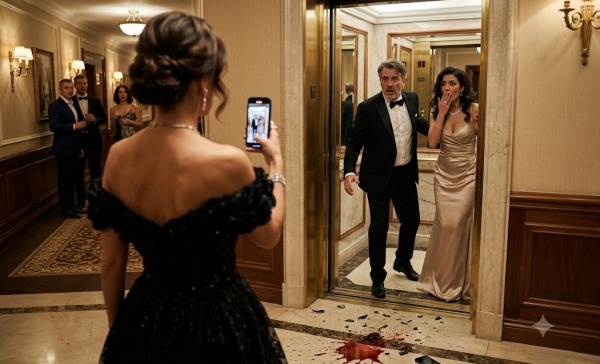
At 7:12 p.m., my husband texted me, “I’m working late. Don’t wait up.” Twenty minutes later. Then I Saw Him Kissing My Best Friend in a Hotel Lobby
I was standing in a downtown Chicago hotel lobby when the elevator doors opened—and there he was, holding my best friend like I was already erased from his life. They smiled as if they had gotten away with everything. What they didn’t know was that I had already taken three photos, and my next phone call would change all three of our lives forever.
Part 1: The Text Message
“I’m working late tonight. Don’t wait up.”
That was the text my husband, Mark, sent me at 7:12 p.m. on a Thursday evening in Chicago. It was short, casual, and so familiar that six months earlier, I probably would have believed it without thinking twice.
But that night, I was standing in the marble lobby of the Fairmont building on North Michigan Avenue, holding my phone in one hand and a cup of coffee in the other. And twenty minutes after Mark told me he was “working late,” the elevator doors opened.
There he was.
My husband.
Kissing my best friend.
Her name was Brooke Ellis, and for eleven years, she had been the person I called when my life fell apart. She had stood beside me at my wedding in a pale blue bridesmaid dress, crying harder than my mother as I walked down the aisle. She had held my hand through two miscarriages, brought soup when I had the flu, and once slept on my couch for a week because she said she couldn’t stand the thought of me being alone.
And now she was wrapped around my husband like she had been waiting years to claim him.
Mark’s hand was at her lower back. Brooke’s fingers were in his hair. They kissed like they were in a movie, like the lobby was empty, like the whole world had stepped aside so they could enjoy their victory.
Then they pulled apart.
And smiled.
Not embarrassed smiles. Not guilty smiles. Not the startled faces of people caught doing something terrible.
They smiled like they had won.
I stood behind a tall arrangement of white orchids near the concierge desk, half-hidden by the shadows and the evening crowd. My heart was beating so hard I could feel it in my throat. My knees went soft, but my hands stayed steady.
That surprised me.
I had always imagined that if I ever caught Mark cheating, I would scream. I thought I would throw something, maybe slap him, maybe collapse into a sobbing mess right there on the floor.
But I did none of that.
Instead, I lifted my phone.
Click.
First photo.
Mark’s face was turned just enough for the camera to catch his profile. Brooke’s hand rested on his chest, her diamond bracelet sparkling under the lobby lights.
Click.
Second photo.
They were laughing now. Brooke leaned close and whispered something in his ear. Mark tilted his head back, smiling in that lazy, confident way I used to love.
Click.
Third photo.
This one was perfect.
Mark had his arm around her waist, and Brooke was holding up a key card. Behind them, the brass sign near the elevator clearly showed the name of the building. The timestamp on my phone glowed at the top of the screen.
7:32 p.m.
Twenty minutes after “I’m working late.”
I did not cry.
Not yet.
I stepped backward behind the orchids, turned toward the glass doors, and walked out into the July heat with my coffee untouched and my marriage burning quietly behind me.
Outside, Michigan Avenue was loud and alive. Cars honked, tourists laughed, and a street musician played a soft version of “Stand by Me” on a saxophone near the corner.
The song almost made me laugh.
Almost.
I crossed the sidewalk, stopped beside a black SUV parked at the curb, and opened my contacts. My finger hovered over my mother’s name first, then my sister’s, then Mark’s.
But I did not call any of them.
Instead, I called Diane.
Diane Abrams was not my friend. She was not family. She was not the kind of woman who hugged you before asking questions.
She was my attorney.
And when she answered on the second ring, I said, “Diane, it happened exactly where you said it would.”
There was a pause.
Then Diane’s calm voice came through the phone.
“Did you get photos?”
I looked back through the glass doors. Mark and Brooke were gone now, swallowed by the elevator that would take them up to a private suite he had promised me was being used for a client meeting.
“Yes,” I said. “Three.”
“Good,” Diane replied. “Then do exactly what we discussed. Do not confront them. Do not text him. Do not call Brooke. Go home, pack one bag, and meet me at my office in forty minutes.”
My fingers tightened around the phone.
“Diane,” I whispered, “I thought I was ready for this.”
Her voice softened, just slightly.
“No one is ever ready to see the people they trusted most betray them. But you were ready enough to protect yourself.”
I closed my eyes as a warm wind moved through the city street.
“What happens now?” I asked.
Diane’s answer was quiet, precise, and colder than anything I could have imagined.
“Now,” she said, “we make sure they don’t get the ending they planned.”
Part 2: The Marriage Everyone Envied
Before that night, people used to say Mark and I were lucky.
We looked like the kind of couple that made sense. Mark was charming, tall, successful, and easy to like. I was organized, practical, and good at making everything around him look stable.
We had a three-bedroom condo in Lincoln Park with white kitchen cabinets, a small balcony, and a mortgage that made my stomach hurt every first of the month. We hosted Thanksgiving for both families. We took matching Christmas photos with our golden retriever, Scout, wearing a red bow around his collar.
On Facebook, we looked happy.
That is the thing about happy-looking people. Sometimes the picture is not a lie, exactly. Sometimes it is just a moment stolen from a much larger truth.
Mark and I had been married for eight years. We met at a friend’s backyard barbecue in Evanston when I was twenty-nine and he was thirty-two. He made me laugh within five minutes by pretending to know the difference between every craft beer in the cooler.
He was working in commercial real estate then, full of ambition and big talk. He wanted his own firm someday. He wanted a house on the lake, two kids, and a wife who believed in him when no one else did.
I believed in him.
That was my first mistake.
My second mistake was believing that being loyal meant being silent.
In the early years, Mark was sweet in a restless way. He brought me coffee in bed on Sundays. He left sticky notes on the bathroom mirror. He called me “Em” like my name was a secret only he knew how to say correctly.
When my father died, Mark handled the funeral arrangements because I could barely stand. He sat beside me in the front row, holding my hand while the pastor talked about love, family, and the things people leave behind.
My father left me money.
Not billionaire money. Not mansion-on-the-coast money. But enough to matter.
He had owned two dry-cleaning shops on the South Side for thirty years, and he lived simply. After my mother passed, he sold one shop, rented out the other building, and invested carefully. When he died, I inherited around $640,000, plus a small commercial property worth more than I understood at the time.
Mark cried with me when the lawyer read the will.
Then, six months later, he started talking about “our future” in a different tone.
He wanted to use part of my inheritance to expand his real estate business. He said it would be temporary, just seed money. He said my father would have wanted me to build something meaningful instead of letting the money sit in an account.
That line worked because it sounded like love.
I invested $220,000.
Mark promised everything would be documented properly, and it was. At least at first.
His company, Whitaker Urban Development, began with two small renovation projects and one office space in River North. I handled bookkeeping because I had worked as an operations manager for a nonprofit for years and I was good with details.
Mark handled clients, networking, dinners, handshakes, and charm.
He was very good at charm.
By our fifth anniversary, the business had grown enough for him to hire staff. By our sixth, he was on local business panels, shaking hands with aldermen, and talking about “revitalizing neighborhoods” like he had invented the concept himself.
By our seventh, he had started coming home late.
At first, I did not worry. Real estate was demanding. Clients called at odd hours, contractors missed deadlines, and city permits moved at the speed of cold syrup.
Then his phone started turning face down.
Then Brooke started asking too many careful questions.
“How are you and Mark?” she would say over wine on my couch. “Like really?”
I thought she was being protective.
I told her about the late nights. I told her about the distance. I told her that sometimes I felt like Mark looked through me instead of at me.
Brooke listened with soft eyes and touched my arm.
“Oh, Em,” she said. “You deserve to feel wanted.”
At the time, I thought she meant by my husband.
Now I know she was studying the cracks in my marriage like a burglar studying windows.
Brooke had been in my life since college. We met at Northwestern during freshman orientation, both of us lost near the library and pretending not to be. She was bold where I was cautious, glamorous where I was simple, and fearless in a way that made people either admire her or forgive her.
She had a talent for becoming necessary.
When I planned my wedding, she handled the florist meltdown. When I doubted my dress, she cried and said I looked timeless. When I miscarried the first time, she showed up with pajamas, ice cream, and a playlist called “Men Are Useless But We Love Them.”
She knew everything about me.
My passwords when I forgot them. My fears about never becoming a mother. My guilt over my father’s money. My doubts about Mark.
Especially my doubts about Mark.
That is what made the betrayal feel less like a knife and more like surgery without anesthesia. It was not just that she took my husband. It was that she had used my pain as a map.
Three months before the elevator, I found the first receipt.
It was folded inside Mark’s suit jacket, tucked behind a dry-cleaning tag. Dinner for two at a steakhouse in the West Loop. Two filets, one bottle of Napa Cabernet, one flourless chocolate cake, and two espresso martinis.
Total: $486.72.
Paid with the company credit card.
When I asked him about it, he barely looked up from his laptop.
“Client dinner,” he said.
“Which client?”
He sighed like I was a child asking why the sky was blue.
“Emma, I don’t interrogate you about every lunch receipt.”
That was new.
Mark had always been defensive when stressed, but lately his defensiveness had grown teeth. He accused me of being paranoid. He said I was “creating tension.” He said if I did not trust him, maybe I should ask myself why.
So I did.
I asked myself why.
And the answer was simple.
Because he was lying.
The second receipt was for flowers.
Not the mixed bouquet from Trader Joe’s he sometimes brought home after a fight. These were long-stemmed white roses from a boutique florist downtown. $312.
I did not receive roses.
The third clue was Brooke’s perfume.
It was expensive, sharp, and floral, the kind of scent that entered a room before she did. One Friday morning, I found it on Mark’s shirt collar when I picked it up from the floor near the hamper.
I stood there in our bedroom with the shirt in my hands, and my body went cold before my mind caught up.
That was when I called Diane.
I had met Diane Abrams two years earlier at a fundraiser. She was a family-law attorney in her late fifties with silver hair, red glasses, and the calmest voice I had ever heard. She had represented half the wealthy women in Chicago and scared the other half into prenuptial agreements.
Mark and I did not have a prenup.
At the time, I thought that meant romance.
Diane thought it meant poor planning.
When I sat in her office for the first time, I expected her to tell me to follow him, hack his phone, or set some trap like people did in movies. She did not.
“Do not break the law to prove someone else is dishonest,” she told me. “Do not access accounts that are not yours. Do not record private conversations if you do not understand consent laws. Do not threaten, do not stalk, do not post accusations online.”
I remember blinking at her.
“So what do I do?”
“You document what you can lawfully access,” she said. “Financial records you are authorized to see. Statements connected to shared accounts. Public behavior. Communications sent to you. And you make no emotional moves until your legal position is secure.”
That was how I learned my marriage had become a chessboard.
And I had been playing checkers with a man who had already moved half the pieces.
For the next six weeks, Diane and a forensic accountant reviewed what I could legally provide. Company statements, bank transfers, tax documents, vendor invoices, and contracts bearing my signature.
What they found was worse than cheating.
Mark had moved money.
Not all at once. Not in a way that would alarm a casual observer. He shifted small amounts from the business into vendor accounts, consulting fees, and “client hospitality expenses.”
Some of those vendors did not appear to exist.
One consulting company was registered to a P.O. box in Indiana. Another had a mailing address tied to a short-term rental. A third, Diane discovered, had been incorporated three months earlier by someone named Brooke L. Ellis.
My best friend.
The woman who cried at my wedding.
The woman who knew exactly how much of my father’s money had gone into Mark’s business.
The woman who knew I still wore my father’s old Timex watch when I missed him.
“She is not just having an affair with your husband,” Diane told me. “She appears to be helping him remove money from a company you partially funded.”
I felt the room tilt.
“How much?”
Diane glanced at the forensic accountant, a quiet man named Paul who wore navy suits and never smiled.
“So far,” Paul said, “we can identify approximately $118,000 in questionable transfers.”
I could not breathe.
That was the moment grief turned into something else.
Not rage. Rage burns too hot. This was colder, steadier, and more useful.
Diane slid a folder toward me.
“Emma,” she said, “I need you to listen carefully. If Mark realizes we know before we are ready, he may move faster. He may try to pressure you into signing something. He may try to drain accounts, sell assets, or frame the transfers as ordinary business expenses.”
“He already wants me to sign something,” I whispered.
Diane’s eyes sharpened.
“What?”
“A restructuring agreement. He said investors want cleaner ownership before they put in more money.”
Paul closed his laptop halfway.
Diane leaned back in her chair.
“Did you sign it?”
“No.”
“Good,” she said. “Do not sign anything.”
That was when Diane told me to wait.
For what, I asked.
For proof that connected the affair, the money, and the plan.
The Fairmont building gave us that proof.
Mark had booked a private suite there under the company account for what he described in an email as a “client strategy meeting.” The charge was scheduled for Thursday evening. He told me he would be working late.
Diane suspected Brooke would be there.
I did not want her to be right.
But at 7:32 p.m., the elevator doors opened.
And there they were.
Part 3: The Phone Call
Diane’s office was on the thirty-first floor of a building near the Chicago River. By the time I arrived, the sky had turned deep blue and the city lights were beginning to shimmer on the water.
I had packed one overnight bag like she told me. Jeans, two sweaters, toiletries, my father’s watch, and the folder of documents I had hidden in the back of the linen closet. I also brought Scout’s leash, because whatever happened next, my dog was not staying in that condo with Mark.
Diane opened her office door before I knocked.
She looked at my face and did not ask if I was okay.
Smart woman.
“Come in,” she said.
Paul was already there with his laptop open. Another attorney, a younger man named Theo, sat at the conference table with a stack of papers clipped and ready. A security consultant named Marisol stood near the window, speaking softly into her phone.
I stopped in the doorway.
“You were all waiting?”
Diane gestured to a chair.
“We were preparing.”
That word did something strange to me. Preparing. It made me feel less like a woman whose life had just exploded and more like someone walking into a storm shelter already stocked with water, batteries, and blankets.
I sat down and opened my phone.
My hands shook when I sent the three photos to Diane. Seeing them again made my stomach twist. There was Mark’s mouth on Brooke’s, Mark’s hand on Brooke’s waist, Brooke’s smile shining like stolen jewelry.
Diane studied each picture carefully.
“No confrontation?” she asked.
“No.”
“No messages sent to either of them?”
“No.”
“No posts online?”
I almost laughed.
“No, Diane. I did not live-stream my trauma.”
“Good,” she said. “You would be surprised.”
Paul turned his laptop toward us.
“While you were on your way, another charge hit the company card,” he said. “Room service. Champagne, strawberries, and a seafood platter.”
I stared at him.
“How much?”
“Four hundred and twelve dollars.”
Something inside me cracked, but not in the way I expected. I did not cry. I did not yell. I simply imagined my father standing behind the counter of his dry-cleaning shop at 6:00 a.m., pressing shirts until his shoulders ached, saving dollar by dollar.
And Mark had used money from the company I helped build to buy champagne for the woman helping him steal from me.
Diane folded her hands.
“Emma, the phone call you made to me was the correct one. Now I need your permission to make several calls on your behalf.”
“To who?”
“First, to the bank to freeze nonessential movement on accounts where we have authority. Second, to the registered agent for the company to preserve records. Third, to a process server.”
My throat tightened.
“A process server?”
Diane nodded.
“We prepared emergency filings this afternoon based on the financial evidence. The photos strengthen the timeline and motive. If the judge grants temporary orders tomorrow morning, Mark will be restricted from moving marital assets or company funds without notice.”
“And tonight?”
“Tonight,” Diane said, “we serve him with notice of the civil complaint related to the business transfers and your divorce petition.”
I stared at her.
“At the hotel?”
“At the suite,” Theo said quietly.
The room went still.
For the first time all evening, I felt something almost like fear.
“What if he gets angry?”
“That is why you will not be there,” Diane said. “The process server is licensed. Building security will be present. We are not creating a scene. We are delivering legal documents.”
I looked out at the river. Boats moved slowly below, their lights sliding through the dark like floating candles.
Part of me wanted to say no.
Not because Mark did not deserve it. Not because Brooke deserved mercy. But because once those papers were served, my old life would officially end.
There is a strange moment when you realize pain is familiar enough to feel safer than freedom. I had lived inside suspicion for so long that the thought of certainty terrified me.
Diane seemed to understand.
“Emma,” she said, “you can choose dignity without choosing silence. You can choose the legal route without choosing weakness. But if you wait, they may use the weekend to move money or pressure you.”
That last word hit me.
Pressure.
Mark had been pressuring me for two weeks to sign the restructuring agreement. He said it was urgent. He said I was holding him back. He said my lack of trust was embarrassing.
And Brooke had called me that very morning.
“Maybe you should just sign it,” she said gently. “Mark’s under so much stress. Sometimes men need to feel believed in.”
Men.
Not husbands. Not partners. Men.
I remembered her voice, syrupy and concerned, and suddenly my hesitation disappeared.
“Do it,” I said.
Diane picked up her phone.
The next thirty minutes passed in fragments.
Paul emailed documents to a secure address. Theo highlighted signature pages. Marisol confirmed that Scout could be picked up from my condo by a pet transport service Diane trusted, because Mark’s name was also on the property and she did not want me walking back into a confrontation.
Then Diane made the call that turned Mark and Brooke’s celebration into the worst night of their lives.
It was not a dramatic call.
That was the strangest part.
There was no shouting. No threats. No promise of revenge.
Diane simply called the hotel’s legal liaison, identified herself, explained that a licensed process server needed access to serve court documents to a guest in a suite booked under a business account, and provided the appropriate paperwork. She requested that hotel security accompany the server to avoid disturbance.
Then she called the process server.
“Mr. Whitaker is in Suite 2418,” she said. “You have confirmation from the front desk. Serve both packets. If Ms. Ellis is present, serve her as well.”
My head snapped up.
“Brooke too?”
Diane covered the receiver.
“She is named in the civil complaint.”
I sank back into my chair.
Of course she was.
Brooke did not just betray me emotionally. Her company had received money. Her signature appeared on invoices. Her name was not in my life by accident anymore.
It was in the evidence.
At 8:46 p.m., Mark called me.
His name lit up my phone.
For eight years, that name had meant home. Dinner. Sunday mornings. Arguments over thermostat settings. Grocery lists. Mortgage payments. The person I expected to grow old beside.
Now it looked like a warning label.
Diane glanced at the screen.
“Do not answer.”
I let it ring.
At 8:47, he called again.
At 8:48, Brooke called.
That one made me laugh softly, and everyone in the room looked at me.
“Sorry,” I said. “It’s just funny. She never calls twice unless there’s gossip.”
The phone buzzed again.
A text from Mark appeared.
Emma, call me NOW.
Then another.
What the hell did you do?
Then Brooke.
Em, this is not what you think. Please answer.
I stared at the message.
Not what I think.
Those five words should be banned from every cheater’s vocabulary. They never mean “you misunderstood.” They mean “I need time to replace the truth with a version that helps me.”
Diane held out her hand.
“May I?”
I gave her the phone.
She read the messages, took screenshots, and placed the phone facedown.
“Do not respond tonight.”
“But what if he goes to the condo?”
“He may,” Marisol said. “That is why Scout is already being picked up, and why you are staying at a hotel under your own name with security notified not to disclose your room.”
I looked at Diane.
“You planned everything.”
“I planned possibilities,” she said. “You chose the path when you called me.”
At 9:03 p.m., the process server called Theo.
Theo put the call on speaker.
“Service completed,” the man said. “Both parties present. Mr. Whitaker initially refused to accept documents, but they were placed at his feet after identity confirmation. Ms. Ellis accepted hers and began crying. Hotel security witnessed. No physical incident.”
Both parties present.
I closed my eyes.
It was done.
For the first time that night, tears filled my eyes. Not loud tears. Not dramatic ones. Just hot, quiet tears that slipped down my face before I could stop them.
Diane handed me a tissue.
“I know this hurts,” she said.
I nodded, but the truth was more complicated than that.
It did hurt.
But beneath the hurt, there was relief.
Because for months, Mark had made me feel crazy. Brooke had made me feel needy. Together, they had built a little room of lies and locked me inside it.
Tonight, the door opened.
And the people trapped in the room were not me anymore.
Part 4: The Story They Tried to Tell
Mark came home at 1:17 a.m.
I know because the doorbell camera recorded him standing outside our condo, sweating through his white dress shirt, hair messy, tie gone. He jabbed at the keypad three times before remembering the code had not changed.
He could enter. It was still legally his home.
But I was not there.
Scout was not there either.
That seemed to upset him more than my absence. On the footage, he opened the door, called my name, then called the dog’s name twice. When no one answered, he walked back into the hallway and stared directly at the camera.
“Emma,” he said, like the camera was my face. “You need to stop this right now.”
I watched the footage the next morning in Diane’s office while drinking burnt coffee from a paper cup.
Diane watched it once and said, “That is useful.”
Everything was useful to Diane.
Pain was evidence. Panic was evidence. Silence was strategy.
By 10:00 a.m., a Cook County judge had granted temporary financial restraints. Mark could not move money from business or marital accounts except for ordinary expenses. Records had to be preserved. Certain documents had to be produced.
By noon, Mark’s attorney contacted Diane.
By 12:30, Mark’s mother called me.
I almost answered.
I loved Elaine. She was a retired elementary school teacher from Naperville who made pumpkin bread every fall and still sent birthday cards with five-dollar bills tucked inside as a joke. She had always treated me like a daughter.
But Diane advised me to let all calls go through attorneys for now.
So I let it ring.
Then came the messages.
Elaine: Honey, Mark says there has been a misunderstanding. Please don’t make any big decisions while angry.
Mark’s sister: I don’t know what happened, but destroying his reputation won’t help anyone.
Brooke: I’m so sorry. Please let me explain. Mark told me you two were basically separated.
That one nearly made me throw my phone.
Basically separated?
We had eaten dinner together three nights earlier. I had washed his gym clothes on Sunday. He had kissed my forehead Wednesday morning and asked if I could pick up oat milk from Whole Foods.
Apparently, in Mark’s world, “basically separated” meant your wife still paid the electric bill.
Diane told me not to respond.
So I wrote everything I wanted to say in a notebook instead.
I wrote until my hand cramped.
I wrote about Brooke sitting beside me in the hospital after my second miscarriage, telling me that motherhood came in many forms and I was still whole. I wrote about Mark holding my father’s watch after the funeral and promising he would always protect what my dad left behind.
I wrote about the first time I noticed Mark flinch when I touched his shoulder.
I wrote about how lonely it felt to be married to someone who came home every night but was never really there.
Then I closed the notebook.
Grief, I learned, needs somewhere to go. If you do not give it a legal pad, it may choose your mouth at the worst possible time.
The story Mark tried to tell was simple.
He and Brooke had “developed feelings.” The marriage had been “emotionally over” for a long time. The financial transfers were “legitimate consulting fees.” I was “hurt and overreacting.”
It was almost elegant, really.
If you removed the secret hotel suite, the fake invoices, the company credit card, the restructuring agreement, and the photos, Mark’s version sounded very reasonable.
Unfortunately for him, Diane did not remove those things.
At the first settlement meeting, Mark looked worse than I expected. He had always been polished, the kind of man who owned pocket squares and knew which restaurants had valet parking. But that morning, his suit was wrinkled, his eyes were red, and his confidence had a crack running through it.
Brooke was not there. Her attorney attended separately by video.
I sat beside Diane in a navy dress I had bought for my father’s funeral years earlier. It felt strange to wear it again, but also appropriate. Another kind of death had occurred.
Mark looked at me when I entered the conference room.
“Emma,” he said softly.
For one dangerous second, I remembered the old Mark. The barbecue Mark. The man with the craft beer joke and the warm hand at the small of my back.
Then I remembered the elevator.
I sat down without answering.
His attorney, a gray-haired man named Russell, began with the usual phrases. Difficult time. Emotions running high. Everyone wants to avoid unnecessary damage. Best resolved privately.
Diane let him talk.
Then she opened her folder.
“We agree this should be resolved efficiently,” she said. “Our client is prepared to discuss divorce terms, business valuation, reimbursement of misappropriated funds, attorney’s fees, and a confidentiality structure that does not require Ms. Whitaker to lie.”
Russell cleared his throat.
“My client disputes any characterization of misappropriation.”
Diane slid one sheet across the table.
“That is Invoice 1047 from Ellis Strategic Consulting. It billed $18,000 for market research on a project in Bronzeville. The project did not exist.”
Mark shifted in his chair.
Diane slid another sheet.
“That is a hotel charge booked as client hospitality. No client attended. Ms. Ellis did.”
Another sheet.
“That is a wire transfer to a vendor whose registered address matches a short-term rental Ms. Ellis leased in April.”
Another.
“That is the restructuring agreement Mr. Whitaker asked my client to sign, which would have reduced her documented interest in the business three days after the final transfer to Ms. Ellis’s entity.”
Russell stopped clearing his throat.
Mark stared at the table.
Diane’s voice remained calm.
“We have more.”
The room went silent.
I looked at Mark then. Really looked at him. For months, I had imagined that when the truth came out, he would break down. He would apologize. He would confess that he had lost himself and beg me to remember the man he used to be.
But Mark did not look sorry.
He looked cornered.
There is a difference.
Finally, he raised his head.
“Emma,” he said, “I made mistakes.”
Diane touched my arm lightly under the table, a reminder not to speak impulsively.
But I had prepared one sentence.
Only one.
“You didn’t make mistakes, Mark. You made plans.”
His face changed.
Just for a second, the charm fell away completely, and I saw the anger underneath. It had always been there, I think, hiding behind smiles and expensive cologne.
Russell asked for a break.
During the break, I went to the restroom and locked myself in a stall. My hands shook so badly I had to grip the purse hook on the door.
Then my phone buzzed.
A message from Brooke.
I know you hate me, but I loved him. I still do. I never meant to hurt you like this.
I stared at the words.
I never meant to hurt you like this.
Like this.
Not “I never meant to hurt you.”
Just not like this.
That was Brooke in one sentence. She was sorry about the consequences, not the choices. Sorry the stage lights came on before she finished the performance.
I did not respond.
When I returned to the conference room, Diane had received new information. Brooke’s attorney wanted to discuss cooperation. Apparently, after being served in a hotel robe beside another woman’s husband, Brooke had discovered that Mark had not been fully honest with her either.
That almost made me smile.
Almost.
According to Brooke’s attorney, Mark had promised her that once I signed the restructuring agreement, he would file for divorce and start a new life with her. He told her I was unstable. He said the company was his, that I had “helped a little” with startup money, and that my ownership interest was just paperwork.
He had lied to both of us.
But that did not make Brooke innocent.
She had seen invoices. She had formed the consulting company. She had accepted transfers. She had smiled in that elevator like my humiliation was a prize.
By late afternoon, the tone of the meeting had changed.
Russell no longer spoke about misunderstandings. He spoke about “global resolution.” Brooke’s attorney spoke about “mitigating exposure.” Diane spoke about numbers.
The numbers were brutal.
Repayment of questionable transfers. Buyout of my business interest at a valuation Mark hated. Reimbursement of certain legal and accounting fees. Sale of the condo unless Mark refinanced within ninety days. Preservation of my father’s commercial property as separate property.
And divorce.
Clean, documented, enforceable divorce.
Mark resisted the business valuation most of all.
“You’re trying to ruin me,” he snapped.
I looked at him across the table.
“No,” I said. “I’m finally refusing to finance you.”
That was the last sentence I said to him in that room.
By evening, nothing was signed yet, but the shape of the ending had appeared. Not justice in the movie sense. No thunderclap. No dramatic arrest. No crowd cheering while the villain was dragged away.
Real life is quieter.
Real life is attorneys arguing over commas while your heart sits in your chest like broken glass.
But when I walked out of the building that night, the air felt different.
For the first time in months, I was not wondering where Mark was.
I did not care.
Part 5: The Life I Did Not Know I Was Allowed to Choose
The divorce took nine months.
People think the hardest part of divorce is losing the person. Sometimes it is not. Sometimes the hardest part is losing the story you told yourself so you could stay.
I had told myself Mark was stressed.
I had told myself Brooke was loyal.
I had told myself good wives were patient, good friends were forgiving, and good women did not make scenes.
But there is a difference between grace and self-erasure.
I learned that slowly.
I moved into a small apartment in Oak Park with Scout and a secondhand dining table I found on Facebook Marketplace for $90. The apartment had creaky floors, bad water pressure, and sunlight that poured through the bedroom windows every morning like a blessing.
For the first few weeks, I slept terribly.
I would wake at 3:00 a.m. reaching for a husband who was no longer there, then remember everything at once. The elevator. The photos. Brooke’s bracelet. Mark’s text.
“I’m working late.”
Four words that became a doorway between the woman I had been and the woman I was becoming.
I went to therapy on Tuesdays. I walked Scout twice a day. I ate too much takeout from the Thai place around the corner and cried once in the cereal aisle at Trader Joe’s because I could not remember whether I liked granola or had only bought it because Mark did.
Healing was not beautiful at first.
It was laundry. Paperwork. Password changes. New health insurance forms. Explaining to the dentist that my emergency contact needed to be updated.
It was realizing how many little pieces of my life had his name attached.
It was also discovering how many pieces did not.
I started wearing my father’s watch every day. I took over management of his old commercial property and hired a local broker to lease it to a woman opening a bakery. Her name was Marisol too, which felt like a small coincidence from the universe.
The first time I met her, she brought me a box of lemon bars and said, “Your dad’s building has good bones.”
I cried in my car afterward.
Not because I was sad.
Because someone had said something kind about something my father built, and for once, no one was trying to take it from me.
Mark’s business survived, but not in the way he wanted. He had to sell two projects, take out loans, and give up the glossy expansion plan he had bragged about at fundraisers. His reputation did not collapse publicly, but people in certain circles stopped inviting him to speak on panels.
Chicago is a big city until it is not.
Brooke moved to Arizona six months after the settlement.
I heard that from a mutual acquaintance who whispered it like gossip at a baby shower. Apparently, she told people she needed a fresh start in Scottsdale. She deleted most of her social media and rebranded herself as a “business growth consultant,” which was almost funny if I did not think about it too long.
She sent me one letter.
An actual handwritten letter on cream stationery, because Brooke always knew how to make even an apology look curated.
I did not read it immediately.
For three days, it sat on my kitchen counter beside the coffee maker. Scout sniffed it once and decided it was not food.
Finally, on a rainy Sunday afternoon, I opened it.
Brooke wrote that she missed me. She wrote that she had been selfish, insecure, and convinced that Mark understood her in a way no one else did. She wrote that she knew there was no excuse for what she had done, but she hoped someday I would remember the good years.
The good years.
That phrase hurt more than I expected.
Because there had been good years. That was the inconvenient truth. Brooke had made me laugh until my stomach hurt. She had known my coffee order. She had once driven forty-five minutes in a snowstorm because I texted, “I can’t stop crying.”
Betrayal does not erase every good memory.
It poisons the road back to them.
At the end of the letter, she wrote, I hope you can forgive me, not for me, but for yourself.
I folded the letter carefully and put it back in the envelope.
Then I placed it in a box with old wedding photos, Mark’s anniversary cards, and the pale blue scarf Brooke had given me the winter after my father died.
I did not forgive her that day.
I also did not hate her with the same energy anymore.
That felt like progress.
As for Mark, he tried several times to speak to me “as two people who once loved each other.” Diane advised boundaries until everything was finalized. After the divorce decree was entered, I agreed to one phone call.
I do not know why.
Maybe curiosity. Maybe closure. Maybe the dangerous human need to hear the person who broke you admit that they knew exactly what they were doing.
He called on a Sunday evening.
I was sitting on my balcony with Scout’s head on my knee and a glass of iced tea sweating on the small metal table beside me.
“Hi, Em,” he said.
I closed my eyes.
No one called me that anymore.
“Hello, Mark.”
He sighed like the sound itself was rehearsed.
“I’ve wanted to say I’m sorry.”
I watched a couple walk down the sidewalk below, their toddler wobbling between them in tiny sneakers.
“For cheating?” I asked. “For lying? For the money? For trying to get me to sign away my interest in the company? You’ll need to be specific.”
Silence.
Then he said, “I was unhappy.”
There it was.
The oldest excuse in the world.
I almost laughed, but I was too tired.
“So was I,” I said. “I didn’t steal from you.”
He inhaled sharply.
“I didn’t think of it that way.”
“I know.”
That was the problem.
Mark had never thought of it from any angle except his own.
He told me he had felt trapped. He told me Brooke made him feel admired. He told me the business pressure had been unbearable. He told me he had convinced himself that once everything was reorganized, he would make it right.
Make it right.
People love that phrase after they have made something wrong on purpose.
I listened without interrupting. Not because he deserved it, but because I wanted to hear the shape of his regret. I wanted to know if it had grown beyond inconvenience.
It had not.
Finally, he said, “Do you ever miss me?”
I looked down at Scout, who was asleep with one ear flipped inside out.
“I miss who I thought you were,” I said. “But I don’t think that person ever existed.”
His voice changed then.
Softened.
“Emma—”
“No,” I said. “I’m not saying it to hurt you. I’m saying it because it’s true.”
We sat in silence for a moment.
Then I said the thing I had practiced in therapy but never thought I would be brave enough to speak aloud.
“You were not my whole life, Mark. You were just the part of it that taught me how much of myself I was willing to abandon to be loved.”
He did not answer.
So I ended the call.
No slammed phone. No final insult. No cinematic speech.
Just my thumb touching the red button and the evening continuing around me.
One year after the elevator, I returned to Michigan Avenue.
Not to the Fairmont building. I had no desire to stand in that lobby again like a ghost haunting her own humiliation.
I went to a rooftop restaurant a few blocks away for my forty-first birthday. My sister flew in from Denver, Diane came for one drink and left before dessert, and three friends from my new book club brought me a ridiculous cake shaped like a stack of romance novels.
I wore a green dress and my father’s watch.
At sunset, the sky turned pink over the lake, and the city looked almost gentle.
My sister raised her glass.
“To Emma,” she said. “Who survived a man with too much hair gel and not enough morals.”
Everyone laughed.
I laughed too.
Really laughed.
Not the brittle laugh I used during the divorce when people asked how I was holding up. Not the polite laugh I used when someone said, “Everything happens for a reason,” and I had to resist throwing bread at them.
This laugh came from somewhere clean.
Later that night, after everyone left, I stood near the rooftop railing and looked down at the lights of the city.
My phone buzzed.
For one frozen second, my body remembered.
The text. The elevator. The photos.
But it was only a message from my sister.
Made it back to the hotel. Love you. Proud of you.
I smiled and typed back, Love you too.
Then I opened my photo gallery.
I had not looked at the three elevator photos in months. Diane had copies. The legal case was over. I did not need them anymore.
Still, my finger hovered over the folder.
When I opened it, the images looked smaller than I remembered.
There was Mark, kissing Brooke.
There was Brooke, smiling.
There they were, convinced they had won.
I studied the third photo the longest. The key card in Brooke’s hand. Mark’s arm around her waist. The lobby sign behind them.
For a long time, that photo had been proof of my worst night.
But standing under the Chicago sky one year later, I saw something else.
It was proof of the moment I stopped being fooled.
It was proof that I had trusted my instincts.
It was proof that when the elevator doors opened, my life did not end.
The lie did.
I selected all three photos.
For a moment, my thumb paused over the trash icon.
Then I deleted them.
Not because what they did no longer mattered. It mattered. It changed me. It cost me sleep, money, trust, and a version of the future I had once held with both hands.
But I did not want my healing tied forever to their faces.
The phone asked if I wanted to permanently delete the images.
I looked out at the lake.
Then I tapped yes.
The next morning, I woke early and walked Scout through the neighborhood. The air smelled like rain and cut grass. A little boy on a scooter asked if he could pet my dog, and Scout acted like he had been waiting all his life for that exact honor.
I bought coffee from the corner shop and sat outside with a notebook.
For months, my therapist had asked me to write about what I wanted next. I always hated the question. It felt too big, too cheerful, too soon.
But that morning, I wrote one sentence.
I want a life that does not require me to shrink in order to keep someone else comfortable.
Then I wrote another.
I want love that does not ask me to ignore my own eyes.
Then another.
I want to believe that peace can be exciting too.
A woman at the next table laughed into her phone. A delivery truck rumbled past. Somewhere nearby, church bells rang ten o’clock.
Nothing dramatic happened.
No one burst through the door begging forgiveness. No secret villain was exposed. No crowd gathered to applaud my survival.
It was just an ordinary American Sunday morning in July.
And somehow, after everything, ordinary felt like a miracle.
People always want to know if I regret making that phone call.
The answer is no.
I regret trusting Mark with parts of me he never deserved. I regret telling Brooke secrets she later used as weapons. I regret confusing loyalty with endurance.
But I do not regret the call.
Because that call did not ruin their lives.
Their choices did that.
That call saved mine.
And if there is one thing I would tell the woman standing behind the orchids that night, holding her phone while her heart broke silently in a hotel lobby, it would be this:
Take the photos.
Make the call.
Then walk away before they teach you to mistake betrayal for love.
