My Husband Chose His Mother’s Charity Gala Over Our Son’s Emergency—Then the Doctor Asked Me for Consent
My six-year-old son was lying in a hospital bed, pale and barely speaking, while my husband kept telling me not to “overreact.” His mother was at a charity gala, laughing in silk and diamonds, as if our child’s emergency was just bad timing. Then the doctor pulled me into the hallway and said, “We needed consent hours ago.” That was the moment I realized I wasn’t just fighting for my son’s life—I was fighting to escape the family that had been abandoning us for years.
Part 1: The Night Everything Changed
“My son will be fine. His grandmother already promised she’ll take care of everything.”
My husband said that without even looking at me.
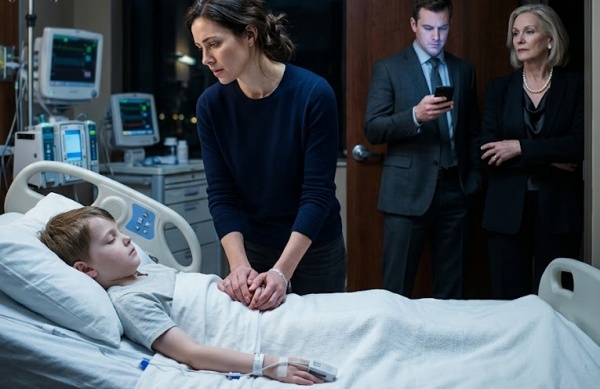
He stood near the foot of our six-year-old son’s hospital bed, one hand in the pocket of his expensive navy coat, his phone glowing in the other. The screen reflected against his face while our child lay pale beneath white sheets, an IV taped to his tiny hand, a monitor beeping softly beside him.
Those words cut deeper than exhaustion.
For two nights, I had lived inside that hospital room. I had slept sitting up in a stiff plastic chair, with my hand resting near my son’s ankle because I needed to feel that he was still warm. I had listened to nurses whisper, machines beep, carts roll past the door, and doctors speak in careful tones that made my stomach drop.
My son, Ethan, was only six.
Six years old, with a missing front tooth, a backpack full of dinosaur stickers, and a habit of asking for pancakes every Saturday morning. Six years old, and that night he looked so small that I kept wondering how a child who filled our whole house with noise could suddenly become so quiet.
And yet, no one from his father’s family had come.
Not his grandmother.
Not his aunt.
Not even a call from the relatives who posted smiling pictures with him every Thanksgiving, every Christmas, every birthday party where they made sure everyone knew they were “family first.”
Earlier that morning, I had sent my mother-in-law, Diane, a message.
Ethan’s condition is getting worse. The doctors think he may need surgery. Please tell Mark to answer his phone if you’re with him.
She didn’t respond for almost three hours.
When she finally did, her reply was so short I stared at it for a full minute, wondering if I had read it wrong.
I’m busy at a charity gathering. You handle it. You’re his mother anyway.
As if that made it optional.
As if love was a shift schedule.
As if I had been asking her to pick up dry cleaning instead of telling her that her grandson was lying in a hospital bed.
When my husband, Mark, finally returned my calls, his voice sounded irritated before I even finished speaking.
“Where are you?” I asked.
“At Mom’s fundraiser,” he said. “Why?”
“Why?” I repeated, gripping the phone so hard my fingers hurt. “Mark, Ethan’s fever spiked again. They moved him to pediatric emergency observation. The doctor said we may be looking at complications.”
He sighed.
Not worried.
Not shocked.
Just annoyed.
“Lauren, you always panic. He gets stomach bugs. Kids get sick.”
“This isn’t a stomach bug,” I said. “They’re talking about possible surgery.”
There was a pause, and I could hear music in the background. Laughter. Glasses clinking. A woman’s voice calling Mark’s name like he was at a party, because he was.
Then he said the word I had grown to hate.
“Don’t be dramatic.”
Dramatic.
Overreacting.
Too emotional.
Those were the labels Mark and his mother had placed on me for years whenever I noticed something they wanted ignored. If I questioned a late bill, I was anxious. If I asked why Mark had emptied part of our savings, I was controlling. If I said Diane was interfering in our marriage, I was ungrateful.
And now, when our son was sick enough for a surgeon to be called, I was “dramatic.”
I looked down at Ethan. His lashes rested against his cheeks, damp with fever. His lips moved slightly, and for one hopeful second, I thought he was waking up.
But he only whispered, “Mommy,” and drifted back under.
That was when something inside me hardened.
Not loudly.
Not all at once.
Just a quiet click, like a lock turning.
Hours later, a doctor named Dr. Ramirez called me into the corridor. She was calm, but her eyes were serious, and doctors’ eyes had become the only thing I trusted in that building.
“Mrs. Bennett,” she said, “we need consent to proceed with emergency treatment. We’ve been monitoring him, but the latest scan changes the timeline.”
I felt the air leave my lungs.
“Is he going to be okay?”
“We’re going to do everything we can,” she said. “But delays could be dangerous.”
My hands shook so badly that the pen tapped against the clipboard.
“Do you need Mark?” I asked, though I already knew I shouldn’t have.
“You are his mother,” she said gently. “You have authority to consent. We did try to reach your husband earlier because staff were told he wanted to speak with the surgeon before any procedure, but we cannot wait any longer.”
Staff were told.
I went still.
“Who told them that?”
Dr. Ramirez hesitated just long enough for me to understand.
“Your husband called the nurses’ station around 5:40 p.m.,” she said. “He said no major decisions should be made until his mother arrived.”
For a moment, the hallway blurred.
The vending machine.
The blue chairs.
The hand sanitizer dispenser.
The framed poster about childhood asthma.
Everything ordinary suddenly looked impossible.
“My mother-in-law?” I asked.
“Yes,” Dr. Ramirez said carefully. “He indicated she was helping coordinate family decisions.”
I almost laughed.
Not because it was funny, but because the alternative was screaming.
Diane, who had refused to come.
Diane, who was at a charity gala thirty miles away in downtown Dallas, posing for photos in silk and pearls while my son was burning with fever.
Diane, who had no legal authority over my child.
Diane, who thought motherhood was a job she could assign to someone beneath her.
I signed.
Without hesitation.
Without waiting for anyone else.
When they wheeled Ethan away, I walked beside him until the nurse told me I couldn’t go any farther. His small hand slipped out of mine, and the double doors closed between us.
I stood there alone.
No husband.
No family.
No one holding me up.
But I did not fall.
Because that was the moment I realized I had been alone for much longer than one hospital night.
I had been alone in my marriage for years.
I just hadn’t admitted it yet.
Part 2: The Grand Entrance
Mark arrived after midnight.
He did not run in.
He did not look like a father whose child had been taken into emergency surgery.
He walked through the hospital doors with his coat over one arm, his tie loosened, and the faint smell of alcohol following him like a confession. Behind him came Diane, my mother-in-law, still dressed as if she had stepped out of a magazine spread about wealthy women pretending to care about other people.
Her silver hair was pinned perfectly.
Her makeup hadn’t smudged.
A diamond bracelet flashed under the fluorescent lights every time she moved her hand.
She looked around the pediatric surgical waiting area with mild distaste, as if the hospital chairs had personally offended her.
“There you are,” she said to me, not “How is Ethan?” Not “I’m sorry.” Not “What happened?”
Just, “There you are.”
I had been sitting with a paper cup of burnt coffee between my hands. I hadn’t taken a sip. I had only held it because I needed something warm to touch.
Mark glanced at the closed surgical doors.
“Is he still back there?”
“Yes,” I said.
He frowned. “Why didn’t you wait?”
For a second, I thought I had misheard him.
“Wait?”
“For us,” he said, lowering his voice as if I had embarrassed him. “Mom and I were on our way.”
“You were at a fundraiser,” I said. “And you told the hospital not to proceed until your mother arrived.”
Diane lifted one perfectly shaped eyebrow.
“Don’t make it sound so dramatic, Lauren.”
There it was again.
That word.
The family shield.
Dramatic.
Diane sat down across from me, crossing one leg over the other. She looked composed, almost bored, while I still had dried tears on my face and Ethan’s favorite blue hoodie folded in my lap.
“I told Mark that important decisions shouldn’t be made emotionally,” she said. “You’ve always had trouble staying calm.”
I stared at her.
“My child needed emergency treatment.”
“Our child,” Mark corrected.
The word hit me like a slap.
Our child.
From the man who had ignored twelve calls.
From the man who had smelled like wine in a hospital waiting room.
From the man who needed his mother’s permission before acting like a father.
I leaned forward.
“Then why weren’t you here?”
Mark’s jaw tightened.
“Because Mom had a major donor event. Do you have any idea how important tonight was for her foundation?”
I looked at Diane.
She gave a tiny smile, the kind she used at country club luncheons when someone mispronounced a French wine.
“It was a pediatric wellness charity event,” she said.
The words were so absurd I couldn’t respond at first.
“You were at a children’s health fundraiser,” I said slowly, “while your grandson was in the hospital?”
Diane’s expression cooled.
“Don’t twist this.”
“I’m not twisting anything.”
“You’ve always resented my community work,” she said. “Some of us think beyond our own household.”
My hands clenched around the coffee cup until the lid bent.
“Ethan is six.”
“And he has doctors,” she replied. “Good ones, I assume, considering the insurance my son provides.”
The insurance my son provides.
Not Mark.
Not Ethan’s father.
Her son.
Always hers first.
My husband sat beside her, not me.
That was the part I remember most clearly.
Not the words.
Not the smell of alcohol.
Not Diane’s glittering bracelet.
I remember that when there were three seats in a row, Mark chose the chair next to his mother.
Then Diane waved her hand lightly, as if dismissing a waiter.
“Anyway, don’t worry. If anything happens, his mother will handle it.”
I froze.
“What did you say?”
She smiled faintly.
“Relax. You’re his mother. That’s your job.”
My husband nodded like it was obvious.
“Mom is right. You’re the one who should stay here. She has important connections. I’ll cover the bills.”
I looked at both of them.
One celebrating.
One agreeing.
Both abandoning responsibility with the ease of people who believed consequences never belonged to them.
For years, I had let them define reality for me.
Diane called herself “traditional,” but somehow tradition only meant I cooked, cleaned, apologized, hosted, soothed, sacrificed, and stayed quiet. Mark called himself “the provider,” but somehow providing meant using money as a leash.
He paid the mortgage, so I should be grateful.
His name was on the main checking account, so I should ask before spending.
His mother helped with the down payment on our house, so she had the right to enter without knocking, criticize my parenting, and rearrange my kitchen cabinets while smiling.
But what neither of them knew was that I had started preparing months earlier.
Quietly.
Carefully.
Not because I wanted war.
Because I wanted proof.
It began when Mark missed Ethan’s kindergarten winter concert after promising he would be there. I had watched my son scan the audience, his paper snowflake hat slipping over one eye, while every other child waved at someone.
When Ethan saw only me, he smiled anyway.
That smile broke my heart.
That night, Mark came home late and said he had been helping Diane with “foundation paperwork.” Later, I found a photo online of him at a private dinner downtown, smiling with a glass of bourbon in his hand.
I didn’t confront him.
Not then.
I started saving screenshots.
Bank transfers.
Missed appointments.
Text messages from Diane telling me I was too soft, too anxious, too “middle class” in my approach to parenting.
I kept a folder in my email called Receipts.
Then I made another folder called Ethan.
Doctor’s notes.
School emails.
Therapy recommendations Mark refused to attend.
Every time Mark forgot a pickup, every time Diane undermined a medical decision, every time I was told to be quiet because “the Bennetts handle things privately,” I documented it.
I had also opened my own checking account at a credit union twenty minutes away.
At first, I put in small amounts.
Twenty dollars from grocery cash.
Fifty from selling old baby gear online.
Then, after I returned to part-time remote bookkeeping work, I put every paycheck there.
I told myself it was emergency money.
That night, under the hospital lights, I finally understood what emergency meant.
At 1:13 a.m., Dr. Ramirez came back through the surgical doors.
I stood so quickly the coffee spilled onto my jeans.
“He’s stable,” she said.
For one second, my knees almost gave out.
Stable.
The word was a miracle.
“He’s in recovery now,” she continued. “The next twenty-four hours are important, but the procedure went well.”
I covered my mouth, and a sob escaped before I could stop it.
Mark exhaled loudly, as if he had been personally inconvenienced by the suspense.
Diane stood and adjusted her shawl.
“Well,” she said, “that’s good. We should all get some rest.”
I turned to her slowly.
“We?”
She blinked.
“Yes. Mark can take me home, and you can stay here with Ethan. Call us if something changes.”
Mark didn’t object.
He didn’t say, “No, Mom, I’m staying with my son.”
He didn’t say, “Lauren hasn’t slept.”
He didn’t say anything.
That was the moment the last soft part of me toward him disappeared.
Not because I stopped loving the man I married.
Because I finally accepted that the man I married might never have existed.
Part 3: What I Found in the Folder
Ethan woke up the next afternoon.
His voice was weak, but he asked for apple juice.
I cried over apple juice.
The nurse smiled kindly and told me that parents often cried over small things after long nights. I didn’t explain that it wasn’t small to me. Hearing Ethan ask for anything meant he was still here.
Mark came by at lunchtime with a paper bag from a sandwich shop.
He stayed for twenty-three minutes.
I know because I watched the clock.
He kissed Ethan on the forehead, took a picture of himself holding our son’s hand, and posted it online with the caption: Hardest night of our lives. Thankful for family, faith, and great doctors.
Family.
Faith.
Doctors.
Not one word about the mother who had signed the forms.
Not one word about being absent.
Within minutes, comments appeared.
Praying for your family, Mark.
You’re such a strong dad.
Diane must be so worried. Sending love to all of you.
Diane shared the post.
She added: Our precious Ethan is a fighter. Thank you to everyone who supported last night’s children’s health gala. Life reminds us why our work matters.
I stared at that sentence until the letters blurred.
She used my son’s hospital bed as a caption for her charity brand.
I almost replied.
My thumb hovered over the screen.
Then I stopped.
Because public anger would make me look exactly like what they had always called me.
Dramatic.
Emotional.
Unstable.
So I did what I had learned to do.
I saved the post.
Screenshot.
Date.
Time.
Folder.
Mark came back into the room while I was putting my phone away.
“You saw Mom’s post?” he asked.
“Yes.”
“Good. She’s getting a lot of support. That foundation matters to her.”
I looked at him.
“Ethan almost needed treatment delayed because of her.”
He rolled his eyes.
“Please don’t start.”
Something about his tone made me cold.
Not angry.
Cold.
“Mark, why did you tell the nurses not to proceed until Diane got there?”
“Because Mom understands medical systems better than you do.”
“She sells luxury real estate,” I said.
“She knows people.”
“She has no legal authority over Ethan.”
His face tightened.
“She’s his grandmother.”
“She is not his parent.”
The room went quiet.
Ethan shifted slightly in his sleep, and both of us lowered our voices.
Mark leaned closer.
“You need to be careful,” he said.
It was soft.
Almost calm.
But I heard the threat beneath it.
“Careful about what?”
“About making this into something it isn’t.”
I studied his face.
For the first time, I saw not just weakness, but calculation.
“You mean something that makes you look bad,” I said.
His eyes hardened.
“I mean something that could affect your situation.”
“My situation?”
He glanced toward the hallway, then back at me.
“You work part-time. The house is in both our names, but Mom put in the down payment. Most of the accounts are mine. If you make this ugly, Lauren, you won’t win.”
There it was.
The truth, said plainly at last.
Not concern.
Not partnership.
Control.
I kept my voice even.
“Win what?”
He smiled without warmth.
“Don’t play dumb.”
I wanted to throw the sandwich bag at him. I wanted to scream so loudly that every nurse on the floor would hear what kind of father he was. I wanted to tell him that the woman he thought was trapped had already been building a door.
Instead, I said, “You should leave.”
His eyebrows rose.
“This is my son’s room.”
“And he needs rest.”
Mark looked at me for a long moment.
Then he stepped closer and whispered, “My mother warned me you’d try something like this.”
I didn’t answer.
He left.
The door clicked shut behind him, and the room seemed to breathe again.
That evening, after Ethan fell asleep and the nurses dimmed the lights, I opened my laptop. Hospital Wi-Fi was slow, but it worked. I logged into the cloud folder where I had saved everything.
The folder had grown larger than I realized.
There were bank statements showing transfers from our joint account to Diane’s “foundation consulting fund.”
There were emails from Ethan’s school where I had been the only parent responding to teacher concerns.
There were appointment records showing I had attended every pediatric visit alone.
There were texts from Mark canceling pickups because Diane “needed him,” “had a dinner,” “was stressed,” or “couldn’t be alone.”
There was one voicemail from Diane I had saved three months earlier.
Her voice played quietly through my earbuds.
“Lauren, you need to remember your place. Mark comes from a family with standards. If you ever try to embarrass us, we have resources you don’t.”
At the time, I had cried after hearing it.
That night, I smiled.
Because resources were useful.
But proof was better.
The next morning, I called a family law attorney named Rachel Stein.
I had spoken to her once before during a free consultation. Back then, I told myself I was only gathering information. I wasn’t ready. I didn’t want to break up my family.
Now, sitting beside my son’s hospital bed, I understood something I should have understood earlier.
A family was not protected by pretending it wasn’t broken.
Rachel answered on the second ring.
“Lauren,” she said. “Is everything okay?”
“No,” I said. “But I’m ready.”
She was quiet for a moment.
“Tell me what happened.”
So I did.
I told her about the hospital.
About the delayed consent.
About Mark involving Diane.
About the threats.
About the accounts.
About the posts.
About Ethan.
Rachel listened without interrupting, except to ask precise questions.
Was there a police report? No.
Was Ethan safe now? Yes.
Did the hospital document the consent timeline? I believed so.
Did Mark have a history of missing medical decisions? Yes, and I had records.
Did Diane ever provide childcare? Occasionally, but never consistently.
Did she have legal guardianship? Absolutely not.
“Okay,” Rachel said at last. “First, I’m glad your son is stable. Second, you need to request copies of the hospital records when appropriate, including consent forms and notes related to communications. Third, don’t argue with Mark or Diane over text unless necessary. Keep everything calm and factual.”
“I can do that,” I said.
“Good. And Lauren?”
“Yes?”
“If you believe Mark may try to take Ethan or pressure you at the hospital, tell the staff. Hospitals deal with family conflict more often than people realize.”
I looked at Ethan sleeping under a blanket covered in cartoon rockets.
My voice dropped.
“Do you think he would?”
Rachel didn’t answer quickly.
“That depends on what he thinks he’s losing.”
After we hung up, I sat very still.
Then I did one more thing.
I walked to the nurses’ station and asked to speak privately with the charge nurse.
My voice did not shake.
I told her that only I was to make medical decisions unless Mark was physically present and appropriate, and that Ethan’s grandmother had no authority to speak on his behalf. I asked that any unusual calls or requests be documented.
The nurse nodded with the calm of someone who had seen every version of family crisis.
“We’ll note it,” she said.
For the first time in three days, I felt a little less alone.
Part 4: Diane’s Mistake
Diane came back that afternoon with flowers.
Not child-friendly balloons.
Not Ethan’s favorite stuffed dinosaur.
Flowers.
White lilies in a glass vase so heavy she made a nurse carry it in.
She entered the room smiling, but her eyes went straight to me.
“Lauren,” she said brightly. “You look exhausted.”
“I am.”
“Well,” she said, placing a hand over her chest, “that’s motherhood.”
Ethan was awake, watching cartoons with the volume low. When he saw her, he gave a weak smile.
“Hi, Grandma.”
Diane softened immediately, but only in the way she did when someone was watching.
“My sweet boy,” she said, bending to kiss the air near his forehead. “You gave us quite a scare.”
Ethan blinked.
“Were you here?”
The question landed in the room like a dropped glass.
Diane’s smile flickered.
“Of course I came as soon as I could.”
Ethan looked at me, confused.
I said nothing.
Children deserve truth, but not adult battles at their bedside.
Diane noticed my silence and turned cold again.
“Mark is downstairs parking,” she said.
“He was here earlier,” I replied.
“Yes, well, he’s been under enormous stress.”
I almost laughed.
Instead, I adjusted Ethan’s blanket.
Diane stepped closer and lowered her voice.
“You and I need to talk.”
“Not here.”
“Fine. Hallway.”
I followed her out because I didn’t want Ethan hearing whatever performance she had prepared.
The moment we reached the corridor, Diane’s face changed.
Gone was the charity smile.
Gone was the concerned grandmother.
What remained was the woman who had ruled my marriage from the beginning, one guilt trip at a time.
“You’re creating problems,” she said.
“No, Diane. I’m responding to them.”
“You embarrassed Mark.”
“He embarrassed himself.”
Her mouth tightened.
“You have no idea what you’re doing.”
“I know exactly what I’m doing.”
She took a step closer.
“Let me make this simple. If you try to paint my son as negligent, we will respond. Mark has income. Stability. Family support. You have a part-time job and a tendency toward emotional outbursts.”
There it was again.
The script.
The one they had been writing for years.
Lauren is unstable.
Lauren overreacts.
Lauren can’t cope.
Lauren should be managed.
I looked at Diane’s pearl earrings, her tailored cream coat, the woman who had built an entire identity around being admired in public and feared in private.
Then I said, “You left a voicemail telling me to remember my place.”
Her expression barely changed, but I saw it.
A flash of alarm.
“I don’t know what you’re talking about.”
“I saved it.”
Her nostrils flared.
“You record private conversations?”
“You left a voicemail.”
“That was taken out of context.”
“You haven’t heard which one.”
For the first time since I met her, Diane had no immediate response.
Then Mark appeared at the end of the hall.
“Mom?” he said. “Everything okay?”
Diane turned instantly, her face wounded.
“Your wife is threatening me.”
I stared at her.
Of course.
That was her gift.
She could throw the knife and cry because the room noticed blood.
Mark strode toward me.
“What did you say to her?”
“I told her I saved her voicemail.”
His face changed.
Not much.
But enough.
“What voicemail?”
“The one where she said your family has resources I don’t if I ever embarrass you.”
Diane laughed lightly.
“Oh, please. I was trying to help you understand how serious marriage is.”
“No,” I said. “You were trying to scare me.”
Mark lowered his voice.
“Lauren, stop.”
“No.”
The word came out so cleanly that all three of us seemed surprised by it.
No.
A complete sentence.
A locked door.
A new beginning.
Mark looked around the hallway, embarrassed that a nurse at the desk might hear.
“We’ll discuss this at home.”
“I’m not going home with you tonight.”
His eyes narrowed.
“Excuse me?”
“I’m staying here until Ethan is discharged. After that, Ethan and I are going somewhere safe while we figure out next steps.”
Diane’s face hardened.
“You are not taking my grandson anywhere.”
I turned to her.
“He is not your son.”
Silence.
A nurse glanced up.
Mark saw her looking and forced a smile, but his jaw was tight.
“Lauren,” he said quietly, “you need to think very carefully.”
“I have.”
“You can’t just leave.”
“I can.”
“With what money?”
There it was again.
The leash.
But this time, I didn’t flinch.
“With mine.”
Mark stared at me.
Diane did too.
And I realized they truly had no idea.
No idea about the account.
No idea about the attorney.
No idea about the folder.
No idea that the woman they had dismissed as emotional had become very, very organized.
Before either of them could speak, Dr. Ramirez approached.
“Mrs. Bennett?” she said.
I turned.
“Yes?”
“We’re going to keep Ethan one more night for observation, but he’s improving.”
Relief warmed through me.
“Thank you.”
Dr. Ramirez glanced at Mark and Diane, then back to me.
“Also, our social work team can speak with you if you need support arranging discharge plans or family communication.”
Diane stiffened.
Mark’s face reddened.
I understood immediately.
The hospital had noted enough.
Maybe not everything.
But enough.
“I would appreciate that,” I said.
Diane let out a sharp little laugh.
“A social worker? Really, Lauren? Are you trying to make us look like criminals?”
“No,” I said.
I looked at Mark.
Then at her.
“You did that yourselves.”
The next morning, while Ethan ate Jell-O and complained that the hospital TV didn’t have enough channels, Diane made her biggest mistake.
She posted again.
This time, she uploaded a photo from the gala. She stood onstage beneath gold lights, holding a microphone, smiling beside a banner for her foundation.
The caption read:
Even during a private family medical scare, we stayed committed to helping children across Texas. True service means showing up when it matters most.
Showing up.
When it matters most.
I stared at the words.
Then I opened the comments.
People praised her strength.
Her sacrifice.
Her grace.
I didn’t comment.
But someone else did.
A woman named Melissa Grant.
I recognized the name. She was a nurse from Ethan’s school district, a mother I had met twice at birthday parties. Her comment was simple.
Praying for Ethan. But as a mom, I hope the people closest to him were actually at the hospital when he needed them.
Within ten minutes, the comment had twenty likes.
Within thirty, it had replies.
By noon, Diane deleted the post.
By one, Mark called me from the parking garage.
“What did you do?” he snapped.
“I’m in Ethan’s room.”
“Don’t lie to me. Mom is getting messages.”
“I didn’t post anything.”
“You must have told people.”
“I told the doctors the truth. I told my attorney the truth. I haven’t told Facebook anything.”
He went quiet.
“Attorney?”
I closed my eyes.
There it was.
The word had landed.
“Yes.”
His voice dropped.
“Lauren.”
I looked at Ethan, who was carefully lining up green Jell-O cubes like building blocks.
“I’m not discussing this while our son is in the hospital.”
“You think you can take him from me?”
“I think Ethan deserves a safe, responsible parent making decisions for him.”
“I’m his father.”
“Then start acting like it.”
He hung up.
My hands shook afterward, but not from fear.
From release.
For years, I had been terrified of what would happen if I finally said the truth out loud.
Now I knew.
The world did not end.
The ceiling did not collapse.
Mark got angry.
Diane panicked.
And I kept breathing.
Part 5: The Day I Chose My Son and Myself
Ethan was discharged two days later.
The hospital sent us home with instructions, prescriptions, follow-up appointments, and a stuffed bear from the pediatric floor. Ethan named the bear Captain Waffles, because he said any bear who survived a hospital deserved breakfast.
I laughed for the first time in almost a week.
Not a big laugh.
Not a happy ending kind of laugh.
But enough to remind me that joy had not disappeared.
It had just been buried under fear.
Mark was waiting near the discharge area when the nurse wheeled Ethan out.
He looked tired now.
Not hospital-tired.
Damage-control tired.
His shirt was wrinkled, his hair uncombed, and for once his phone was not in his hand.
Diane stood beside him, wearing sunglasses indoors.
“Where do you think you’re going?” Mark asked.
The nurse paused.
I kept my hand on Ethan’s shoulder.
“To my sister’s house in Plano.”
Mark’s face hardened.
“We agreed you’d come home.”
“No,” I said. “You assumed.”
Diane stepped forward.
“This is ridiculous. Ethan needs his home.”
“Ethan needs peace,” I said.
Mark looked at the nurse, then back at me.
“We’ll talk outside.”
“We can talk through attorneys.”
His eyes flashed.
“You’re really doing this here?”
I looked at him, and I felt strangely calm.
Maybe because the worst night of my life had already happened.
Maybe because once you sit beside your child’s hospital bed and realize the people who should stand with you are debating optics, money, and convenience, something inside you becomes impossible to manipulate.
“I’m doing this because of here,” I said.
Mark swallowed.
For a second, I saw something like fear in his eyes.
Not fear of losing Ethan.
Fear of losing control.
Diane leaned toward me and whispered, “You will regret humiliating this family.”
I smiled faintly.
“No, Diane. I regret protecting it for so long.”
My sister, Claire, pulled up outside in her minivan. She jumped out before the car fully settled into park and hurried toward us, eyes red, arms open.
Ethan brightened.
“Aunt Claire!”
“Hey, buddy,” she said, bending down gently. “Captain Waffles coming too?”
Ethan nodded seriously.
“He’s part of the family now.”
Claire looked at me over his head.
I nodded.
She understood.
We loaded Ethan carefully into the back seat, buckled him in, and placed Captain Waffles beside him. Mark stood a few feet away, watching like a man who had never imagined a door could close while he was still standing in front of it.
Before I got into the car, he said, “Lauren, wait.”
I turned.
His voice softened.
“We can fix this.”
I had waited years to hear those words.
I had imagined them during lonely dinners, after cold arguments, after every time he chose Diane’s approval over our marriage. I had imagined him saying he was sorry, saying he understood, saying he would change.
But standing there in the hospital pickup lane, I finally understood that “we can fix this” meant something different to him.
It meant: come back before people find out.
It meant: stop making this difficult.
It meant: let things return to the way they were.
So I asked him one question.
“When Dr. Ramirez said delays could be dangerous, where were you?”
His mouth opened.
No answer came.
That was answer enough.
I got into Claire’s car.
As we pulled away, Ethan asked from the back seat, “Is Daddy mad?”
I turned around as much as the seat belt allowed.
“Daddy has big feelings right now,” I said carefully. “But that is not your job to fix.”
Ethan thought about that.
“Are you mad?”
I looked out the window at the Dallas skyline fading behind us.
“I’m sad,” I said. “And tired. But I’m also very glad you’re okay.”
He held Captain Waffles tighter.
“Me too.”
At Claire’s house, she had made up the guest room with fresh sheets and placed a small lamp shaped like a moon on the dresser. Her husband, Rob, had bought groceries, including the apple juice Ethan liked and the dinosaur-shaped chicken nuggets he had been begging for.
No one told me I was dramatic.
No one asked why I hadn’t handled things better.
No one made me defend needing help.
Claire hugged me in the hallway after Ethan fell asleep.
For the first time, I let myself collapse.
Not physically.
Emotionally.
I cried into my sister’s shoulder until there was nothing graceful left in me. She didn’t tell me to calm down. She didn’t tell me to be strong. She just held me and said, “You’re safe here.”
The next weeks were not easy.
I won’t pretend they were.
There were attorney meetings, court filings, temporary custody discussions, financial disclosures, and messages from people who suddenly wanted “both sides.” Diane tried to repair her image with careful posts about family privacy and prayer. Mark sent long texts at midnight, swinging between apologies and accusations.
Rachel told me not to respond emotionally.
So I didn’t.
When Mark wrote, You’re destroying this family, I replied, Please send all custody-related communication through the parenting app once it is set up.
When Diane wrote, You are hurting Ethan by keeping him from us, I did not answer at all.
When Mark wrote, Mom is devastated, I looked at Ethan coloring at Claire’s kitchen table and finally understood that Diane’s devastation was not my emergency.
The court did not magically fix everything overnight.
That is not how real life works.
But facts mattered.
Hospital records mattered.
Texts mattered.
Voicemails mattered.
Patterns mattered.
The judge did not take kindly to a grandmother being treated as a decision-maker over a legal parent. The judge also did not appreciate Mark’s casual attitude toward medical consent, especially when the records showed staff had been given confusing instructions during a critical window.
Mark received parenting time.
I did not try to erase him from Ethan’s life.
But medical decision-making was clearly defined, communication had to go through approved channels, and Diane was not allowed to interfere or present herself as a guardian. Pickups had rules. Appointments had documentation. Emergencies had protocols.
For the first time, there were boundaries with consequences.
Diane hated that.
Mark hated it too.
But Ethan did better.
Children feel tension even when adults whisper.
They feel when a house is built on eggshells.
At Claire’s, then later in a small two-bedroom apartment I rented near Ethan’s school, my son began sleeping through the night again. He laughed more. He asked questions. He taped a picture of Captain Waffles to the refrigerator and declared our apartment “the waffle headquarters.”
It wasn’t the house I had tried so hard to protect.
It didn’t have granite countertops or a formal dining room or Diane’s approved furniture.
But it had peace.
It had pancakes on Saturday mornings.
It had a mother who no longer apologized for noticing pain.
Three months after the hospital, I saw Diane at Ethan’s school fall festival.
She stood near the pumpkin-decorating table, wearing a camel-colored coat and the same expression she used when she wanted the world to admire her suffering. Mark stood beside her, holding two cups of cider.
Ethan saw them and ran over.
I stayed back.
That was the hardest part of healing: allowing Ethan to love people who had hurt me, while still protecting him from their worst parts.
Mark knelt and hugged him.
Diane touched his hair and smiled tightly.
For a moment, we looked like any complicated American family at a school event, standing beneath paper leaves and string lights while children ran around with painted faces.
Then Diane looked at me.
Her smile disappeared.
I expected anger.
Instead, she looked smaller than before.
Maybe she had always been small, and I had only mistaken control for power.
She walked toward me.
“Lauren,” she said.
I braced myself.
But her voice was lower than usual.
“I hope you understand that I only ever wanted what was best for my family.”
I looked at Ethan, laughing as Mark helped him choose a pumpkin.
Then I looked back at her.
“No,” I said gently. “You wanted what made you feel important.”
Her face tightened.
But she did not deny it.
“I won’t apologize for loving my son,” she said.
“You don’t have to,” I replied. “But you should apologize for teaching him that love means choosing you over everyone else.”
For once, Diane had no sharp answer.
She turned and walked back toward Mark.
I stood there with my hands in my jacket pockets, the cool Texas evening settling around me, and realized I was not shaking.
Not anymore.
Later that night, after the festival, Ethan and I drove home under a sky full of stars. He was in the back seat, half-asleep, with a tiny painted pumpkin in his lap.
“Mom?” he murmured.
“Yes, baby?”
“Are we okay now?”
The question squeezed my heart.
I looked at him in the rearview mirror.
“We’re getting there,” I said.
He nodded, satisfied with that.
I thought about the woman I had been in that hospital hallway, gripping a pen with trembling hands while everyone else treated my fear like an inconvenience. I thought about the mother who signed because waiting could have cost too much. I thought about how close I had come to losing my son, and how much I had lost before that night without admitting it.
A marriage.
An illusion.
A place in a family that had never truly made room for me.
But I had not lost everything.
I still had Ethan.
I had my voice.
I had proof.
I had peace beginning to grow in places fear used to live.
When we got home, Ethan asked for pancakes even though it was almost bedtime.
“Nice try,” I said, smiling as I unlocked the apartment door. “Saturday morning.”
He grinned sleepily.
“Captain Waffles says Friday night pancakes are legal.”
I laughed.
Real laughter this time.
“Captain Waffles needs a lawyer.”
Inside, the apartment was warm and quiet. Not perfect. Not fancy. Not the life I had once tried so desperately to keep together.
But it was ours.
And that night, after I tucked Ethan into bed, I stood in the doorway and watched him sleep.
His breathing was steady.
His cheeks had color again.
The blue hospital bracelet was gone, but I had kept it in a small box with the documents, not because I wanted to remember the fear, but because I needed to remember the truth.
That was the night I stopped begging people to care.
That was the night I stopped confusing money with safety.
That was the night I learned that being “just his mother” was not an insult.
It was the reason he survived.
And if Mark and Diane believed I had been alone when I signed those papers, they were wrong.
I had every sleepless night behind me.
Every ignored warning.
Every quiet sacrifice.
Every piece of proof.
Every ounce of love a mother carries when no one else shows up.
They thought I was weak because I cried.
They thought I was powerless because I stayed quiet.
They thought I would choose appearances over my own child.
But standing in that hospital corridor, with my son’s life on the other side of two swinging doors, I finally understood something they never had.
A mother who has nothing left to lose is not dramatic.
She is dangerous to every lie that kept her trapped.
