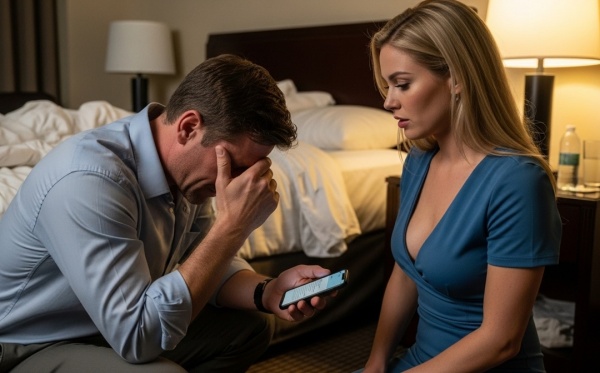
She Gave Me 80 Chances to Be a Father on Christmas Eve. I Missed Every Single One. By Morning, I Had No Son, No Wife, and No One Left to Blame But Myself.
There are mistakes you can apologize for, explain away, and slowly rebuild from. And then there are the ones that rewrite who you are permanently — the ones that live in your chest like a stone you can’t put down. I used to think I was a good man who made bad choices. On December 25th, at 7:02 AM, standing in a hospital hallway smelling like someone else’s perfume, I found out which one was actually true.
PART ONE: THE MORNING AFTER
7:00 AM, December 25th — Chicago, Illinois.
The heavy bells of St. Jude’s Cathedral rolled across the frosty morning air, deep and resonant, announcing the arrival of Christmas Day to a city still bundled under a thick quilt of gray clouds. Michigan Avenue below was nearly deserted — a ghost town of tinsel-wrapped lampposts and salt-stained sidewalks, the remnants of last night’s holiday foot traffic already swept into the gutters by the wind chill. Inside suite 1408 of the Waldorf Astoria on North Michigan Avenue, however, the world was sealed off behind blackout curtains and the stale warmth of a room that had seen too much of someone else’s bad decisions.
The air inside smelled of expensive perfume — Chanel No. 5, he’d been told — and the sweet-sour ghost of uncorked Moët that had gone flat in crystal flutes on the nightstand. A half-eaten plate of room service sat cold on the mahogany desk: filet mignon, lobster bisque, a basket of untouched dinner rolls. Someone had ordered the $180 prix fixe menu and barely touched it, too busy feeling important to actually eat.
Mike Callahan, forty-three years old, senior partner at Callahan & Reid Corporate Law, groaned as he stretched across the king-sized bed. His back ached in the way it always did when he slept somewhere unfamiliar, on a mattress that was too soft and a pillow that was too high. He rubbed his eyes and stared at the ornate plaster ceiling, the same vague smirk settling onto his face that his colleagues sometimes described as “confidence” and his wife had once called “the look you get when you think you’ve gotten away with something.”
Beside him, Chloe — twenty-six years old, a “marketing consultant” he’d met at a rooftop mixer in River North four months ago — was still fast asleep, her hair splayed across the pillow like she was posing for a magazine shoot. Mike had told himself, as he always did, that this was just stress relief. That a man in his position, billing 80 hours a week, managing seven-figure mergers, deserved an outlet. That Sarah — dependable, loyal, exhausted Sarah — would never understand the pressure he was under. He’d told himself a lot of things over the past year.
He reached for his iPhone 15 Pro on the nightstand. He had powered it off at 7:58 PM the previous night, right as he was pulling into the hotel parking garage. No distractions tonight, he’d thought. Tonight is mine. He’d rehearsed the excuse on the drive over: emergency partners’ meeting, multi-million dollar acquisition at risk of collapsing, senior counsel required on-site. Sarah had heard variations of this story so many times she’d stopped asking for details. He counted on that.
“She probably called a couple times and gave up,” he thought, pressing the power button on the side of the phone. “I’ll say the meeting ran until 2 AM, my phone died, I crashed at the office. She always buys it. She always does.”
The Apple logo appeared, white and clean against the black screen.
Then the phone came alive.
It didn’t just buzz — it convulsed. It shook so hard in his hand that he nearly dropped it, the vibration motor running continuously like a trapped animal. The lock screen lit up, and notifications began stacking on top of each other so fast that the display stuttered, the UI freezing for a full five seconds before it caught up with itself. Voicemails. Texts. Missed calls. All from the same contact.
Sarah.
Mike sat up straight. His heart rate spiked before his brain had even fully processed what he was looking at. The missed call counter in the top left corner of the screen glowed red, the way emergency alerts do. The number stopped him cold.
80 Missed Calls.
Eighty. He read it twice. His first thought — his shameful, selfish first thought — was logistical: Had she figured it out? His second thought, arriving half a second later like a freight train, was far worse: Something happened.
His mouth went dry. He swiped into his messages with fingers that had suddenly gone stiff. A long scroll of texts from Sarah loaded in chronological order, and he read them standing up without realizing he’d stood, the phone held in both hands like a man reading his own verdict.
10:15 PM: “Mike, pick up. It’s an emergency. Please.”
10:32 PM: “There’s been an accident. We’re in the ambulance. I need you. Mike, WHERE ARE YOU??”
10:58 PM: “Leo is in surgery prep. They need your signature on the consent forms. Mike I am BEGGING you, please pick up your phone.”
11:10 PM: “He needs a blood transfusion. You’re the only match. The doctors are asking about you. Please.”
1:45 AM: “They say he’s losing too much blood. I am here alone. I can’t do this by myself. Please, Mike. Please.”
And then the last message, sent at 3:12 AM. Seven words. No punctuation except a period at the end, because what else was there to say.
“Mike… our son… he’s gone.”
The phone hit the carpet before Mike realized he’d dropped it. His legs didn’t work the way they were supposed to. He grabbed the edge of the nightstand to keep from going down, knocking the champagne flutes to the floor, where they shattered without him registering the sound. Leo. Four years old. Twenty-eight pounds. Obsessed with dinosaurs and the Chicago Bears and Cocomelon, even though Mike always told Sarah he was getting too old for that show. Leo, who called him “Daddy-O” because he’d heard it in a cartoon and thought it was the funniest thing in the world.
Chloe stirred at the sound of the breaking glass. “Hey,” she murmured, pulling the duvet up. “Where are you going so fast? It’s Christmas.”
Mike didn’t answer. He was already pulling on his pants with one hand, searching for his keys with the other, moving through the suite with the frantic, clumsy energy of a man whose body had understood something his mind was still refusing to accept. He couldn’t find one of his dress shoes. He left without it.
PART TWO: THE DRIVE TO NORTHWESTERN
He floored the Audi Q7 out of the Waldorf’s parking garage and onto the empty streets of downtown Chicago, running the first red light before he’d even consciously decided to. The city was still and beautiful in the way that only happens at 7 AM on Christmas morning — a light dusting of fresh snow over the older, dirty snow, the streetlights still on, the holiday window displays glowing with no one there to see them. Under different circumstances, it would have looked like a postcard. Right now it looked like a nightmare he couldn’t wake up from.
Northwestern Memorial Hospital was eleven minutes away in normal traffic. At this hour, on this day, with the city essentially closed, Mike made it in six. He ran three more lights. His hands were shaking on the steering wheel, and he kept saying Leo’s name out loud, the way you do when you’re trying to make a thing real by speaking it, or trying to make it unreal by the same method.
As he drove, the memories of the previous evening came at him in flashes — sharp, out of order, like footage from a damaged tape. At 6:30 PM, Leo had been sprinting laps around the living room of their Naperville home in his little Santa-print pajamas, the ones with the feet in them, the ones that were almost too small now because he’d grown three inches since last Christmas. He had grabbed Mike’s hand with both of his and pulled with everything he had. “Daddy! You PROMISED! You said we’d go see the BIG tree at Millennium Park! You pinky promised, Daddy!”
Mike had pried his hand loose, faking a grimace as he pretended to check an urgent email on his phone — an email that did not exist. He’d looked at Sarah with the expression he’d perfected over a decade of marriage, the one that communicated I’m so sorry, this is out of my hands. He’d said, “Honey, the senior partners just called an emergency session. There’s a major merger deal that’s leaking to a competitor. If I’m not there, the firm loses a $40 million client. I have to go.” He paused, adding the detail that always closed the deal: “I’m so sorry. I’ll make it up to you guys, I promise.”
Sarah had looked at him for a moment — just a beat too long — and Mike had felt a flicker of something, a fear that this time she could see through it. But then her face had settled into the familiar, tired acceptance that he had come to rely on, the expression of a woman who had been disappointed so many times that disappointment had become her default setting. “Go,” she’d said quietly. “Do what you have to do. I’ll take Leo to see the lights so he isn’t sad.” She’d turned away before he could respond, and Leo had taken her hand instead of his, and the last thing Mike had seen as he walked to his car was his son’s small face in the front window, watching him go.
He had driven directly to the Waldorf. He’d had a steak at the restaurant in the lobby, two glasses of Scotch, ordered room service around nine, and powered his phone off because he hadn’t wanted to feel guilty every time Sarah’s name lit up the screen.
At 9:00 PM — while he was signing the room service receipt and deciding whether to order a second bottle — Sarah and Leo had been three miles away on Lake Shore Drive. The SUV in front of them had stopped short due to traffic. The driver behind them, a 28-year-old with a blood alcohol level of .19, had not. The impact had pushed their 2022 Honda Pilot thirty feet into the intersection. Leo, in his car seat in the back row, had taken the worst of it.
Mike pulled into the hospital’s emergency entrance so fast he left tire marks on the wet asphalt. He didn’t look for parking. He left the Audi idling at the curb with the hazard lights on — someone else’s problem — and ran through the automatic doors into the ER.
PART THREE: THE HALLWAY
The emergency department of Northwestern Memorial on Christmas morning was quieter than the average Tuesday, but it was never truly quiet. Nurses moved between curtained bays with the focused efficiency of people who had long ago made peace with the fact that human suffering does not observe holidays. Monitors beeped. A child cried somewhere behind a curtain. A PA system announced something in a calm, uninflected voice.
Mike burst through the inner doors, one shoe on, collar open, reeking of last night’s Scotch and a stranger’s perfume. “My son,” he said to the triage nurse at the front desk — a broad-shouldered woman in her fifties with short gray hair and the expression of someone who had seen everything. “Leo Miller — Leo Callahan — my son, four years old, he was in an accident. Where is he?”
The nurse looked at him. Really looked at him — at his disheveled shirt, the faint red smear on the collar that he hadn’t noticed yet, the glassy, panicked eyes of a man who clearly had not slept in a bed meant for sleeping. Her face did not express sympathy. It expressed something much cooler than that. She pointed down a long corridor toward a set of double doors marked INTENSIVE CARE UNIT — AUTHORIZED PERSONNEL ONLY.
Mike didn’t thank her. He ran.
In the waiting area outside the ICU, tucked into a row of plastic chairs under fluorescent lights that gave everything a sickly yellow tint, sat the people who loved his family more than he had proven to love them. His own mother, Patricia Callahan, seventy-one years old, who had driven in from Evanston the moment she got the call. His father-in-law, Don Hartley, sixty-seven, a retired firefighter with hands like dinner plates and a face like weathered oak. His mother-in-law, Renee Hartley, who was clutching a rosary in her lap and staring at the floor. And Sarah’s younger sister, Amy, who had flown in from Columbus overnight and still had her carry-on luggage at her feet.
They all saw him at the same moment. The room changed in temperature.
Patricia Callahan stood up. She was a small woman, five-foot-two, with white hair she wore pulled back in a bun, and she had never in Mike’s memory raised her voice or her hand at anyone. She crossed the waiting room with the slow deliberateness of someone who had made a decision and wasn’t going to rush it. She stopped twelve inches in front of him. And then, without a word, she drew back her right hand and slapped him across the face hard enough that the crack of it echoed off the linoleum floors and the drop-ceiling tiles and the sterile white walls. A passing orderly flinched. Nobody in the family moved.
Mike stood there, hand pressed to his burning cheek, and looked at his mother. “Mom,” he started, his voice coming out smaller than he intended. “Mom, is Leo… is he okay? What happened? Is he—”
“How dare you,” his mother said. Not loud. Low and steady and absolutely devastated. “How dare you walk in here, looking like that, smelling like that, after what this family has been through tonight.” Her voice broke once on the word “family” and then re-solidified. “That child is in a coma, Michael. The doctors don’t know if he’ll wake up. They had to get a court order to perform the surgery because you weren’t here to sign the consent forms. Sarah sat in that hallway and watched them wheel her son into an OR without a signature from his father, because his father was unreachable.”
“I—” Mike swallowed. “I was at the office. There was an emergency—”
Don Hartley rose from his chair. He was not a man who moved quickly, but when he did, people paid attention. “We called your firm,” he said, his voice flat and even. “The security desk answered. They told us the building has been on holiday lockdown since four o’clock yesterday afternoon.” He stepped closer. Mike took an involuntary step backward. “Look at yourself. Look at your collar.”
Mike’s hand moved to his neck before he could stop it. His fingers found the waxy, red crescent — Chloe’s lipstick, “Cherry Red,” the color she’d been wearing when she kissed him goodbye in the elevator. It was still there. A mark. A brand. A confession that needed no words.
He sank. Not in the metaphorical sense — his legs actually gave out, and he went down onto the cold linoleum in his thousand-dollar trousers, and he sat there among the feet of the people he had failed, and he could not look at any of them. The shame was a physical weight. It pressed on his chest like a hand. It was a different quality of shame than embarrassment — deeper, blacker, the kind that doesn’t pass.
PART FOUR: WHAT SARAH SAID
The ICU door opened.
Sarah Callahan, thirty-eight years old, who had been a high school English teacher before she’d taken time off to raise Leo, who made the best chicken tikka masala Mike had ever eaten, who ran a half-marathon every spring and coached Leo’s Saturday morning soccer clinic, who still left funny little notes in Mike’s coat pockets even after everything — Sarah walked out of the ICU and into the waiting area.
In twelve hours, she had aged in the way that only catastrophic grief ages a person. The change was not in wrinkles or gray hairs; it was in the eyes. They were sunken and still. Her hair, usually blow-dried and neat, was pulled back with what appeared to be a hospital-issued rubber band. She was still wearing the white wool sweater she’d put on for their Christmas Eve outing with Leo — an outing that was supposed to end with hot chocolate and the big tree at Millennium Park and Leo falling asleep in the backseat on the drive home. The sweater was stained. Dark, rust-brown patches, dried into the fibers at the left sleeve and along the hem. It took Mike a moment to understand what he was looking at. When he did, he felt sick.
He lurched to his feet. “Sarah—” He reached for her hand. “Sarah, baby, I’m so sorry, I made a mistake, I can explain everything—”
She stepped back. Not with anger — anger would have been easier. Her movement was the reflex of a person moving away from something they no longer recognize as belonging to them, the way you step around a stranger on a sidewalk. Her gaze found him, held him, and it was empty of everything he had ever counted on: the love, the frustration, even the disappointment. It was a void. It was the most frightening thing he had ever seen on a human face.
She reached into the front pocket of her jeans and produced a folded document, the kind of thick, formal paper that comes from a lawyer’s office. She held it out to him.
“What is this?” Mike’s voice shook in a way it hadn’t since he was a boy.
“Divorce papers,” Sarah said. Her voice was steady in the way a wire goes taut before it snaps. “My attorney drafted them three months ago. I’ve been carrying them in my bag since October, hoping I would never need them. I brought myself to the point of filing twice and pulled back both times.” She paused. “I’m not pulling back this time.”
“Sarah, please listen to me. Just let me explain—”
“I want to tell you something,” she said, cutting him off with the authority of a woman who had made her decision somewhere around the forty-third unanswered call. “Last night, while I was in that ambulance holding our son’s hand, while his blood pressure was dropping and the paramedics were telling me to keep talking to him — I called you. I called you because you are his father and because I needed you. I called you every three minutes from 10:15 until my phone battery died the first time. Amy brought me a charger and I started again.” Her eyes stayed level on his. “Eighty times, Mike. With every single ring, I told myself there was an explanation. I told myself you were in a tunnel. I told myself your phone had died and you were looking for a charger. I gave you eighty chances to be his father. Eighty chances to be a man.”
Mike opened his mouth. Nothing came.
“When they were prepping him for surgery,” Sarah continued, “he woke up for about forty-five seconds. He was frightened and in pain and he didn’t fully understand what was happening. He looked around the room and the first thing he said—” Her voice finally fractured, just slightly, along a single fault line. She pressed on. “The first thing he said was, ‘Is Daddy here?'”
Mike’s chest caved. “Sarah—”
“The nurses looked at me. The anesthesiologist looked at me. They all looked at me, Mike, and they were waiting for me to answer my four-year-old son.” She exhaled once, slowly. “I told him Daddy was dead. I told him Daddy wasn’t coming.”
“How could you say that to him?” The words came out before he could stop them — defensive, reflexive, and immediately wrong.
Sarah tilted her head, and something moved through her expression, a brief, terrible clarity. “Because it’s the truth. The husband and father named Mike Callahan died last night somewhere between 7:58 PM, when you powered off your phone, and 7:02 AM, when you finally turned it back on. The person standing in front of me right now is a stranger wearing his clothes.” She pushed the papers against his chest. “Sign them whenever your attorney tells you to. And then I need you to leave this hospital. If you don’t leave on your own, I will ask security to escort you out, and I will not feel embarrassed about it.”
She turned. She walked back to the ICU door. She pressed the handle and pushed it open.
“Sarah.” Mike’s voice broke completely. “Please.”
She looked at him one final time over her shoulder. It wasn’t a look of hatred. That would have been survivable. It was the look of someone who has closed a book and placed it back on the shelf. “Take care of yourself, Mike,” she said. Then she walked back into the room where their son was fighting for his life, and the heavy door swung shut with a soft, definitive click, and he was alone.
PART FIVE: WHAT REMAINS
Mike sat in the waiting room for two hours after Sarah left. No one spoke to him. His mother gathered her coat, squeezed her daughter-in-law’s arm when Sarah briefly came out to get coffee, and left without acknowledging him. Don Hartley passed him once on the way to the men’s room and looked directly through him, the way you look through an object that isn’t worth registering. Amy stared at her phone.
He sat with the folded divorce papers in his lap and his phone in his hand, the lock screen showing the last text in the thread. Mike… our son… he’s gone. She hadn’t meant what he’d feared when he first read it. Leo was alive — in a medically induced coma, with a traumatic brain injury and two broken ribs, but alive. The doctors had told Sarah, when he managed to catch a nurse for a status update, that the next 72 hours would be critical. They didn’t know about lasting damage yet. They wouldn’t for a while.
He’s gone meant something else. It meant the version of his son who fell asleep on Mike’s chest during football games and yelled “Daddy-O!” from across parking lots and brought him crayon drawings of dinosaurs wearing ties — that version had spent Christmas Eve bleeding in a trauma bay without his father present, and would wake up, if he woke up, in a world where the people around him were careful not to say Daddy’s name. Mike had been erased from the story. Not in the dramatic way of a custody fight or a restraining order, not yet — but in the quiet, prior way of a man who simply wasn’t there when it counted, and so ceased to be real to the people who needed him most.
He thought about the Waldorf. About the room service filet he’d barely touched. About Chloe’s laugh and the way he’d felt sophisticated and uncomplicated in her presence, unburdened by the weight of being someone’s husband and father. He’d chosen that. Chosen it deliberately, powered off the phone to protect it, guarded it with his most practiced lie. He’d looked at Leo’s face in the window as he walked to his car and made a calculation — a quick, cruel, unconscious calculation that his evening mattered more than his son’s Christmas — and driven away.
He did not weep in the waiting room. He was too hollowed out for that. Weeping requires some residue of self-pity, some flicker of the belief that you deserve relief, and Mike had nothing left that would support that claim. He just sat there, in a plastic chair in a hospital waiting room on Christmas morning, holding a document that formalized the end of the life he had built and then willfully burned down, listening to the distant sound of a television in a family lounge somewhere down the hall playing a holiday movie soundtrack that felt like a personal insult.
The drive back to the city was long and slow. The morning traffic had picked up as Chicagoans began their Christmas routines — church services letting out, families in their cars, the occasional last-minute gas station run. A light snow had started to fall again, the kind that looks clean and beautiful until you drive through it. The radio in the Audi played Christmas carols on the station he’d preset years ago because Leo liked hearing “Rudolph” in the car. Mike drove with the radio off.
He found himself parked outside the Naperville house — their house, the one he’d signed the mortgage on, the one with the basketball hoop in the driveway and Leo’s bike parked at an angle against the garage door, still wearing the training wheels he’d been begging to have taken off. The windows were dark. The Christmas lights on the porch were off, though they were usually set to a timer; someone — Sarah, probably, or her sister — must have turned them off manually. There was a wreath on the front door that Leo had helped make in his preschool class, lopsided and held together with too much glue, with a small photo of Leo’s class in the center.
Mike sat in the car for a long time. He was not sure what he had expected to find here. Not forgiveness — he was not delusional enough to expect that, not now. Maybe some physical proof of what he was losing, some tangible version of the math: on one side, whatever the last year with Chloe had given him; on the other, this. The wreath. The bike. The training wheels.
The math did not require a calculator.
In the weeks that followed, Leo came out of the coma on December 28th — three days after Christmas. His doctors reported no permanent cognitive damage, though he would need months of physical therapy for his left arm and close monitoring for the following year. When he was finally stable enough to have visitors beyond immediate family, he asked for his mom, his Grandpa Don, and a stuffed brontosaurus named Gerald. He did not ask for his father. Whether this was because of what Sarah had told him in the surgical suite or simply because, at four years old, his father had already become someone more absent than present in his daily experience of the world — Mike would spend a long time thinking about that.
The divorce was finalized the following September. Sarah and Leo moved to a two-bedroom condo in Lincoln Square, closer to her sister. Mike got supervised visitation on alternate weekends, contingent on a no-contact condition regarding his personal conduct — a condition the family court judge had ordered based on the testimony of the night of December 24th. He was required to complete a counseling program, which he did, though he was never entirely sure whether he was doing it for himself or for the optics of the custody arrangement.
He never saw Chloe again after that Christmas morning. She’d texted him once, a few days later: “Heard you had a rough Christmas. Hope everything’s okay.” He’d never responded. There wasn’t much to say.
On Leo’s fifth birthday in March, Mike mailed a card to the Lincoln Square address with a gift card for Leo’s favorite bookstore. He did not know if the card was given to Leo or thrown away, and he did not ask. He drove past Millennium Park once in February, on a night when the city was quiet and cold, and sat on a bench and looked at the big reflective Cloud Gate sculpture that Leo had called “the giant jellybean” every time they’d talked about going there. He had promised, on a pinky swear, that they would go together and see the jellybean at Christmastime. He sat there for forty-five minutes in the dark and the cold, and then he went home.
People talk about rock bottom as though it’s a specific place, a clear and definitive floor beneath which things cannot go. The truth is more complex. Rock bottom, for most people, is not a place you hit all at once — it’s a place you’ve been building toward, brick by brick, every small choice and every rationalization and every moment when you looked at the person who loved you and thought I can get away with this one more time. The floor was there long before Christmas Eve. It had been under construction for years.
I’m not writing this for sympathy. I’m writing it because somewhere out there, there’s a version of me — maybe a version of you, reading this — who is parked in a hotel garage right now, rehearsing an excuse, about to power off a phone. And if this story makes that person hesitate, even for a single second, then Leo’s worst Christmas was not entirely without purpose.
The bells of St. Jude’s Cathedral ring every morning at seven. I hear them sometimes, on the quiet days. They still sound like Christmas to me. They also sound like a warning I heard too late.
Is one night of temporary pleasure ever worth a lifetime of love? Drop your thoughts in the comments — and if this story moved you, share it. Someone you know might need to read it today.
