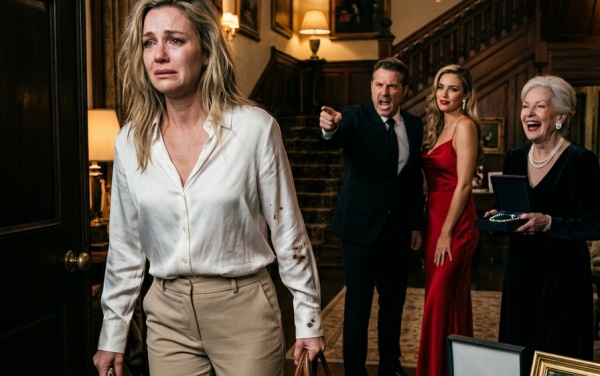
My Husband Slapped Me in Front of His Mistress at a Fancy Art Gallery. He thought raising his hand would silence me. He thought I was the kind of woman who would straighten her dress, lower her eyes, and go home quietly — because that’s what I had always done, isn’t it?
What RJ Whitmore didn’t know, standing there in that Scottsdale gallery with his mistress two feet away and sixty witnesses around him, was that he had just made the most expensive mistake of his life. And I had the receipts to prove exactly how expensive.
PART ONE: THE WOMAN BEHIND THE CURTAIN
Scottsdale, Arizona. A Tuesday afternoon in October.
The Whitmore estate sat at the end of a private cul-de-sac in the Silverleaf community — a gated enclave in North Scottsdale where the minimum lot size was an acre and the neighbors were either retired CEOs or professional athletes who hadn’t figured out what to do with themselves yet. The house itself was 8,400 square feet of travertine floors, vaulted ceilings, and a backyard that featured a negative-edge pool, a detached casita, and a putting green that my father-in-law, Richard Whitmore Sr., had installed specifically so he could avoid talking to people at his own parties. It was, by every external measure, a monument to success. What almost no one knew was that for the past three years, it had also been a monument to my spreadsheets.
My name is Claire Whitmore — née Claire Oduya — and for seven years I had been married to Richard Whitmore Jr., known professionally as “RJ,” a commercial real estate developer with a firm jaw, a great handshake, and an instinct for spending money that significantly outpaced his instinct for making it. When we met at a charity gala in Dallas in 2017, he was charming and broad-shouldered and talked about his family’s real estate portfolio with the casual confidence of someone who had never once had to worry about a number. I was thirty-one, a licensed CPA with a master’s in finance from UT Austin and seven years at a Big Four accounting firm behind me. I thought I was walking into a partnership. I didn’t fully understand, until much later, that I was walking into a rescue operation.
I had grown up in a two-bedroom apartment in South Austin with my mother, a Nigerian immigrant who worked double shifts as a registered nurse and believed with her whole heart that a woman’s education was the one thing no man could ever take from her. She had put that belief into me like a structural beam, and I had built everything on top of it. By the time I married RJ, I was a senior tax partner earning $280,000 a year, with a solid investment portfolio and a methodical approach to financial planning that my colleagues described, with no small amount of affection, as “borderline obsessive.” What can I say — I liked knowing where every dollar was, where it came from, and where it was going.
The problem was that RJ did not share this philosophy. RJ operated on vibes. On relationships. On the deep-seated belief that things always worked out for men like him because things always had. His grandfather had built the original Whitmore portfolio in the 1970s — commercial properties in Phoenix and Tucson that had appreciated beautifully for decades. His father had grown it conservatively. RJ had come in as the third-generation heir and proceeded to over-leverage it spectacularly. By 2021, two years into our marriage, I had quietly discovered that the Whitmore family’s crown jewel — the Scottsdale estate — was six months from foreclosure. RJ had taken out a $3.2 million private equity loan against the property to fund a resort development in Sedona that had stalled in permitting hell. He had told no one. Not his parents. Not his brother. Not me, his own wife.
I found out the way I found most things in our marriage: by doing the books myself. RJ handled the “big picture” and had a business manager named Gary who was, I eventually realized, slightly too willing to tell RJ what he wanted to hear. I had asked, gently and then less gently, to review the family trust documents as part of our estate planning. When RJ finally handed them over, I sat down with them at the kitchen table on a Wednesday evening with a glass of Sauvignon Blanc and found, buried in a secondary lien filed in Maricopa County, the full extent of the disaster. I finished the wine. Then I opened my laptop and started building a plan.
Over the next eighteen months, I negotiated the Sedona project out of permitting through a connection I had at the Arizona Department of Real Estate, brought in a boutique hospitality firm to co-develop and absorb the construction risk, restructured the private equity loan at a lower rate through a lender I’d worked with at the firm, and quietly injected $410,000 of my own money into the family trust as a bridge loan — interest-free — to cover the gap while the restructuring was finalized. I told RJ I had “handled some things.” He nodded, said “You’re the best, babe,” and went to play golf at Troon North with clients. His parents thanked him at Christmas dinner for his “steady leadership through a challenging market cycle.” I smiled and passed the sweet potato casserole.
I want to be clear: I did not do this for recognition. I did it because I loved my husband, because I respected his family, and because I genuinely believed that a marriage was a team, and good teams played their positions without keeping score. I was the detail person. RJ was the face. I could live with that. What I could not live with — what I did not yet know I would eventually have to confront — was what RJ was doing in the time I was saving his family’s legacy.
PART TWO: THE TEXT I WASN’T SUPPOSED TO SEE
It started, as these things so often do, with a phone left face-up on the wrong surface.
RJ had come home from a “client dinner” smelling like a steakhouse and wearing the slightly too-relaxed expression of a man who had convinced himself he was a good actor. This was not unusual. What was unusual was that he’d set his phone down on the kitchen island before going upstairs to change, and when I walked past it on my way to the refrigerator, the screen lit up with a preview notification before auto-locking. I wasn’t trying to see it. I saw it anyway. The contact name at the top read “Jess 🌸” and the message preview read: “Tonight was perfect. You always know exactly how to make me feel like the only woman in the world 😘.”
I stood at the refrigerator for a long moment with my hand on the door handle. The cold air came out and hit me and I didn’t feel it. My brain went quiet and clinical the way it does when I’m looking at a balance sheet that doesn’t add up — just clear, empty processing space where emotion will eventually arrive once the data has been fully assessed. I poured myself a glass of water. I went upstairs. I got into bed and I lay there in the dark and I listened to my husband take a shower and I thought about the Maricopa County lien and the $410,000 and the eighteen months I had spent rebuilding something he had never even fully understood he was losing.
I did not confront him that night. That is not how I operate. A woman who has spent her career in tax law understands instinctively that you do not move until you have documentation. Over the following six weeks, I gathered it quietly and completely. I hired a licensed private investigator named Sandra, a fifty-two-year-old former Maricopa County sheriff’s deputy who charged $175 an hour and communicated exclusively in bullet points. Sandra delivered a report on a Thursday morning that was twenty-three pages long, included timestamped photographs, hotel receipts, and a billing record showing that RJ had been paying for a furnished apartment in Old Town Scottsdale under a shell LLC — an LLC that, as it happened, was funded through the family trust. My trust. The one I had personally saved from foreclosure.
Her name was Jessica Harmon. Twenty-nine years old, a former model who had pivoted to “lifestyle influencing” and had 340,000 followers on Instagram. She posted sunsets and green smoothies and the occasional photo of a restaurant interior captioned “obsessed with this vibe✨” — the kind of life that looked aspirational until you understood whose credit card was funding it. I had no particular feeling about her as a person. She hadn’t made a vow to me. He had.
I retained a divorce attorney named Katherine Webb — a woman in her late fifties who had practiced family law in Scottsdale for twenty-six years and was known in the legal community for being, as one colleague put it, “methodical in a way that tends to make opposing counsel quietly nervous.” I met with Katherine for two hours on a Friday afternoon. I showed her everything. She read it carefully, asked me six very specific questions, and then said: “We’re going to be very patient and very thorough, and when we’re finished, the outcome is going to reflect the reality of your contributions to this marriage.” I liked her immediately.
For eight more weeks, I did nothing visible. I went to the gym. I attended RJ’s client dinners. I smiled at his parents on Sunday. I prepared his family trust’s quarterly financial report with the same care I always brought to it, because I am a professional and because, frankly, I was not finished doing what needed to be done before I was done. I transferred my personal bridge loan into a formal, legally documented promissory note — something Katherine had advised — and filed it correctly with the county. Every cent I was owed was now on paper. I updated the family trust beneficiary designations in the areas that were mine to control. I had a very productive few weeks.
PART THREE: THE NIGHT AT THE GALLERY
The confrontation I had been preparing for did not happen the way I had planned. Life rarely cooperates with plans.
It was a Friday evening in January, the kind of cool Arizona desert evening where the sky goes orange and then purple in the space of twenty minutes and the air smells faintly of creosote. RJ had told me he was attending an “investor preview” at a contemporary art gallery in Old Town Scottsdale — a private event for a real estate development project that one of his partners was presenting. He said it would be “boring and industry-focused” and suggested I skip it. He had never, in seven years of marriage, suggested I skip an industry event. I am useful at industry events. He knew this. The suggestion itself was a data point.
I wore the navy Armani sheath dress I’d bought in Chicago the previous spring, the one RJ had once said made me look “intimidating in a good way.” I drove myself. I arrived at the gallery on Marshall Way at 7:15 PM and walked in alone.
The gallery was the kind of space that tries very hard to feel effortlessly cool — exposed concrete, track lighting, overpriced wine in thin-stemmed glasses, abstract paintings that each cost more than a year of in-state college tuition. There were perhaps sixty people in attendance. I spotted RJ’s business partner Greg near the catering table and made my way toward him, scanning the room. I found RJ near the back, beside a large canvas of red and black geometric shapes, holding a glass of white wine and laughing at something the person next to him had just said.
The person next to him was Jessica Harmon.
She was wearing a green wrap dress and chandelier earrings and the easy, unguarded smile of a woman who did not know she was being watched by anyone who mattered. RJ’s hand was at the small of her back, the fingers slightly spread — the proprietary, comfortable touch of a man at ease with where his hand was and who he was standing next to. In a room full of people he knew professionally, he was standing next to his mistress with his hand on her back and no apparent awareness of risk. That told me something important about how much he thought he had to fear.
I crossed the room. I was not hurrying. I was not shaking. I felt, if anything, very calm — the same clarity I feel when I’m walking into a difficult client meeting with a file I’ve prepared thoroughly. RJ saw me when I was about fifteen feet away. The color left his face so quickly it was almost interesting to observe from a clinical standpoint. Jessica, following his gaze, turned and looked at me. She had good instincts; her smile dropped immediately.
“Claire.” RJ’s voice came out smaller than usual. “I didn’t — you said you weren’t coming—”
“I didn’t say that,” I said pleasantly. “You suggested I skip it. That’s different.”
There was a silence of approximately four seconds — which, in a social situation, is a surprisingly long time. Jessica took a small step backward. RJ’s jaw worked. And then, in the way that cornered and frightened men sometimes do something catastrophically stupid in the desperate hope that aggression will reset the situation — RJ looked at me with something ugly moving across his face, and he said, loudly enough for the people immediately around us to hear: “You need to lower your voice.”
“I haven’t raised it,” I said.
What happened next, I believe, he will regret for the rest of his life. He raised his right hand and brought it across my left cheek. Not hard enough to knock me down. Hard enough to make a sound. Hard enough to turn heads. Hard enough that the woman standing to my left — a stranger in a black blazer — gasped audibly. Hard enough that Greg, his own business partner, said “RJ—what the—” and stepped forward. Hard enough that a gallery employee near the door reached immediately for his phone.
I stood very still. The sting spread across my cheek and into my jaw and up to my ear. I looked at my husband. He looked back at me, and I watched him understand, in real time, the full magnitude of what he had just done — not just to me, but to himself, in a room full of professional contacts and witnesses and at least one person who was already filming on a phone.
I touched my cheek once, lightly, with two fingers. Then I turned to the woman in the black blazer who had gasped and said, quietly, “Would you be willing to write your name and contact information on something for me?” She said yes without hesitating. She had kind eyes. She found a business card in her clutch and handed it to me.
I thanked her. I thanked Greg. I picked up a glass of sparkling water from a passing tray. And I walked out.
PART FOUR: THE UNRAVELING
Within seventy-two hours of the gallery, RJ had called me forty-one times. I answered none of them. I had gone directly from the gallery to a hotel downtown — the Phoenician, because I had always wanted to stay there and this seemed as reasonable an occasion as any — and I had checked in with a rolling carry-on I’d packed two weeks earlier in preparation for exactly this kind of exit. Katherine Webb had told me, when we first met, to have a bag ready. I had taken that advice literally and seriously.
The calls from RJ gave way, by Saturday morning, to calls from his mother, Ellen Whitmore — a small, patrician woman who wore Lily Pulitzer in every season and had never in my experience raised her voice above a certain well-modulated level of disappointment. Ellen was not calling to ask if I was okay. Ellen was calling because RJ had gone home and told his parents a version of events that I can only describe as creative, and Ellen had questions. I let her calls go to voicemail. I read the transcripts. They were instructive.
By Monday, Katherine had filed for divorce in Maricopa County Superior Court and simultaneously filed a civil complaint for domestic battery arising from the gallery incident. The police report had already been filed Saturday morning — I had gone directly from the hotel to the Scottsdale Police Department at 8:00 AM, still in my Armani dress, still with the slight bruising on my left cheek, and given a full statement. The officer who took my report had done so with careful professionalism. Three other witnesses from the gallery had already provided independent statements, including the woman in the black blazer, whose name was Dr. Patricia Solis, an orthopedic surgeon from Tempe, who turned out to be one of the most precise and useful witnesses Katherine had ever worked with.
The financial disclosures that Katherine’s team filed in the divorce proceedings were extensive. My promissory note for $410,000 — properly recorded, legally airtight — was front and center. The documentation of the shell LLC RJ had used to fund Jessica’s apartment, sourced from the family trust, was included. The property restructuring records, the refinancing I had negotiated, the Sedona development rescue — all of it was laid out, timestamped, and attributed correctly for the first time. RJ’s attorney — a man named Phillip who had an expensive haircut and the slightly overwhelmed expression of someone who had not anticipated the volume of paper coming his way — requested two continuances in the first three weeks.
RJ’s parents found out the full truth on a Wednesday evening when Katherine’s disclosure package arrived at their attorney’s office. Richard Sr. called me directly — not RJ’s phone, mine — at 8:47 PM. He was quiet for a long moment when I answered. Then he said, “Claire, I owe you an apology.” He was one of those men who doesn’t say things he doesn’t mean, and so I believed him. I told him I appreciated the call. I told him the estate was not in any danger from my claims — I was not interested in the Whitmore family home. I was interested in what was mine. He said he understood. He said he was sorry. He said he was going to have a conversation with his son. I told him, gently, that some conversations were probably overdue.
The video from the gallery — filmed by another guest on an iPhone, capturing the moment of the slap in a medium wide shot that was unfortunately very clear — appeared on a local Arizona lifestyle blog by Wednesday of the following week. It had approximately 400,000 views within 48 hours. RJ’s Instagram comments became something I could have predicted if I’d had time to think about it. His professional network contracted noticeably. Two of his commercial real estate clients called Greg directly to ask about project continuity, without mentioning RJ by name. Greg, to his credit, called me instead of RJ.
PART FIVE: WHAT I BUILT ON THE OTHER SIDE
The divorce was finalized eight months later, in September.
Katherine did exactly what she’d promised: methodical, thorough, and reflective of reality. I received the full repayment of my $410,000 promissory note, plus legally established interest. I received a settlement that represented my equitable share of the marital assets — including a formal accounting of my financial contributions to the Whitmore family trust that had, for the first time, been explicitly named and valued in a legal document. I did not take the estate. I had never wanted the estate. I wanted what was mine, properly credited and returned with the acknowledgment that it had existed. I got that.
The civil battery case settled out of court four months after filing. The terms are confidential. What I can say is that Katherine was pleased with the outcome and that Dr. Patricia Solis sent me a handwritten note afterward that said, “I’m glad I was there that night.” I kept the note.
I moved into a two-bedroom condo in the Arcadia neighborhood of Phoenix — a bright, airy place with concrete floors and a small terrace that I planted with rosemary and bougainvillea. I paid for it outright, which was a feeling I can only describe as physical. Standing in an empty room that is entirely, cleanly, legally your own is a particular kind of peace that I hadn’t realized I was missing until I felt it. I stood in the living room with a coffee in my hand on the first morning and just listened to the quiet.
I had lunch with Ellen Whitmore three months after the divorce was final. She had asked; I had agreed, because I am not a person who holds grudges when they are unproductive, and because I had always genuinely liked her, apart from everything else. She apologized again, more fully this time, in the way that people do when they’ve had months to sit with something and understand it more completely. She told me she’d had no idea about the financial situation. She told me she was grateful. She told me RJ was in therapy and had moved to Dallas. I nodded and ate my salad and told her I genuinely hoped he found his way. I meant it. You can be done with someone and still hope they become a better person. Those two things are not in conflict.
My mother flew in from Austin that October to see the new condo. She brought a bottle of Nigerian palm wine she’d been saving for a special occasion and couldn’t tell me what the occasion had originally been intended for, which made us both laugh. We sat on my terrace in the warm Phoenix evening and she looked at the bougainvillea I’d planted and said, in the particular tone she uses when she is being serious by being indirect: “You know what the difference is between a woman who survives and a woman who builds?” I waited. “The woman who survives thanks God it’s over. The woman who builds doesn’t wait for it to be over before she starts.” She poured the palm wine. “You started building a long time ago, ọmọ mi. Now you can see it.”
I went back to work full-time — not at a firm this time, but at a financial consulting practice I had quietly begun registering six months before the divorce was finalized. My first three clients were women I knew professionally who had spent years in marriages similar to mine: smart, competent, financially literate women who had subordinated their expertise to someone else’s ego and were now, at various stages of reckoning, trying to understand what was theirs and what to do with it. I understood that terrain. I had surveyed it from the inside.
The practice has grown in the two years since. I have eleven clients now, a small team, and a reputation in the Phoenix legal and financial community for doing exactly the kind of quiet, meticulous work that people only fully understand the value of in retrospect. I have been asked, more than once, if I am angry about what happened — about the years I spent propping up a structure that didn’t acknowledge I was holding it, about the hand across my cheek in a room full of witnesses, about the woman who got the green wrap dress and the Instagram sunsets and the furnished apartment in Old Town while I got the balance sheets and the county filings and the Saturday mornings at the kitchen table with a glass of wine and a set of documents that made my stomach drop.
Here is my honest answer: I am not angry. Anger is a weather system that passes through you and costs you energy and leaves everything damp. What I feel is something quieter and more permanent — a clarity about what I am worth and a complete absence of confusion about who deserves my time. My mother gave me my education. I built my competence. I made my choices, including some that I would make differently now. But at the end of it, on a terrace in Arcadia with bougainvillea and palm wine and my mother’s voice in the evening air — I had something RJ Whitmore would spend the rest of his life unable to buy.
I had built something that was entirely mine.
The night my husband raised his hand to me, he thought he was asserting control over a situation that was already out of control. What he didn’t understand — what men like him almost never understand until it’s over — is that you cannot slap the foundation out from under a house and expect the house to keep standing. You can only discover, too late, that the house was never really yours to begin with.
To every woman reading this who is doing the invisible work, keeping the quiet books, holding the weight that no one else will acknowledge: I see you. Document everything. Know your worth to the cent. And when the time comes — and you will know when it comes — be ready.
The view from the other side is worth it.
