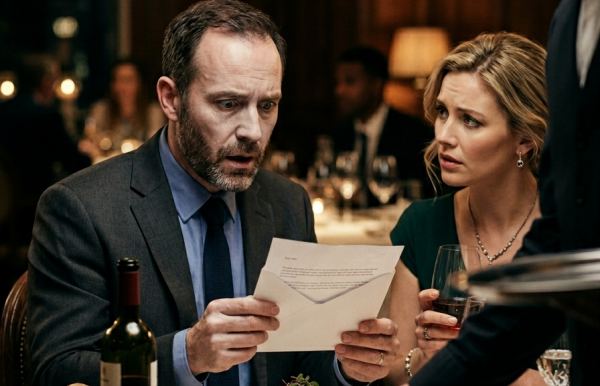
The Waiter Handed My Husband an Envelope During Dinner With His Mistress—And His Face Went Pale When He Opened It… At first, my husband looked annoyed when the “waiter” interrupted his romantic dinner. Then he opened the envelope and realized it wasn’t a menu, a bill, or a mistake. It was the divorce papers
Part 1: The Anniversary Dinner I Wasn’t Invited To
The first thing I noticed was the reservation.
Not the lipstick on his collar, not a perfume smell on his shirt, not some mysterious text lighting up his phone at midnight. Those things came later, in pieces, like crumbs leading through a dark house. But the first real crack in my marriage was a dinner reservation for two at a restaurant my husband told me he could never get into.
It was called Marlowe & Finch, a rooftop steakhouse in downtown Chicago where the cheapest entrée was more than I usually spent on groceries for two days. Evan had taken me there once, six years earlier, for our tenth wedding anniversary. I still remembered the view of the river, the tiny candles on the tables, and the way he had held my hand and told me he would marry me all over again.
That memory had stayed with me like a photograph in a drawer.
So when I saw the confirmation email on our shared tablet, I froze.
“Reservation confirmed: Marlowe & Finch. Party of two. Saturday, June 14. 7:30 p.m.”
June 14 was not just any Saturday. It was our sixteenth wedding anniversary.
For a few seconds, I actually smiled.
I thought, stupidly, beautifully, that he had planned a surprise. Evan had been distant for months, always on his phone, always tired, always irritated by the smallest things I said. I thought maybe this was his way of fixing something without admitting it had broken.
I imagined a dress. I imagined him waiting downstairs with flowers. I imagined sitting across from him under soft lights, pretending we were not two exhausted people who had spent the last year speaking more about bills than dreams.
Then I saw the note attached to the reservation.
“Window table if available. Celebrating one year together.”
One year together.
Not sixteen.
One.
My hands went numb.
The tablet sat on the kitchen island between a stack of mail and my daughter’s college brochures. Our daughter, Lily, was upstairs studying for finals, humming along to music through her earbuds. The dishwasher hummed in the background, and the neighbor’s dog barked twice, then stopped.
The ordinary sounds of my life continued while my marriage split open in silence.
At first, I told myself there had to be an explanation. Maybe it was for a client. Evan worked in commercial real estate, and client dinners were not unusual. Maybe his assistant had written the note incorrectly. Maybe the reservation was not even his.
But the confirmation had gone to his email.
And it was made with his Amex.
The same Amex he had told me we needed to “keep under control” when I asked if we could replace our aging washing machine.
I did not confront him that night. That surprised me. I had always imagined that if I ever caught my husband cheating, I would become the kind of woman who threw clothes onto the lawn and screamed until the whole block knew his name.
Instead, I became quiet.
Not calm. Quiet.
There is a difference.
When Evan came home at 9:15 p.m., he kissed the air beside my cheek and tossed his keys into the ceramic bowl by the door. He was wearing his navy suit, the one I used to say made him look like he belonged on a magazine cover. Now he just looked like a man who had gotten very comfortable lying in expensive fabric.
“Long day?” I asked.
“You have no idea,” he said, loosening his tie.
I watched him walk to the refrigerator and take out the leftover chicken Alfredo I had made the night before. He ate straight from the container while scrolling on his phone. The man had a rooftop anniversary dinner scheduled with another woman, but at home he stood barefoot in our kitchen eating leftovers I cooked for him.
That was when I understood something ugly.
He did not think he was choosing between two women. He thought he was entitled to both lives.
The wife at home. The woman at dinner. The clean shirts, the mortgage, the daughter, the public image, the secret romance. He had arranged his betrayal like furniture and assumed I would never walk into the wrong room.
“Any plans Saturday?” I asked.
He did not look up from his phone.
“Saturday?”
“June 14.”
His thumb stopped moving for half a second. Then it continued.
“I might have a client dinner.”
A client dinner.
I nodded slowly. “On our anniversary?”
He sighed, like I was already becoming inconvenient.
“Claire, don’t start. I told you work has been insane.”
“I didn’t start anything.”
He looked at me then, his eyes tired and impatient. “We can celebrate another night.”
Another night.
Sixteen years of marriage had been moved like a dentist appointment.
I wanted to ask her name. I wanted to say, “Is one year together more important than sixteen years married?” I wanted to shove the tablet across the counter and watch him try to explain the words glowing on the screen.
But something stopped me.
Maybe it was Lily upstairs. Maybe it was pride. Maybe it was the sudden realization that if I confronted him too soon, all I would get was a better liar.
So I smiled.
It felt strange on my face.
“Of course,” I said. “Another night.”
He looked relieved, which made me hate him a little.
That night, I lay awake beside him and listened to him breathe. Evan slept easily, like a man with no guilt. His phone was on the nightstand, face down, charging.
I turned my head and studied him in the dark.
This was the man I had married at twenty-eight in a small church outside Naperville. The man who cried when Lily was born. The man who once drove through a snowstorm to bring me soup when I had the flu before we were even engaged.
And this was also the man planning an anniversary dinner with someone else.
People like to say, “You never really know someone.” I do not think that is exactly true. I think sometimes you know someone very well, and then they decide to become someone else when you are not looking.
The next morning, after Evan left for work, I checked the reservation again.
Still there.
Then I did something I had never done in sixteen years of marriage.
I searched his email.
I am not proud of that. I am not going to pretend I felt noble. I felt scared, humiliated, and a little sick. But I also knew that whatever he was doing had already entered my home, my finances, and my marriage.
I found her name in less than ten minutes.
Melanie.
Melanie Reed.
There were hotel confirmations in Milwaukee. Flower delivery receipts. A necklace from a jewelry store on Michigan Avenue. Two plane tickets to Denver for a “conference” he had told me was canceled.
The oldest email I found was from eleven months earlier.
“Last night was perfect. I hate that we have to keep pretending.”
Her reply was underneath.
“We won’t have to pretend forever.”
I stared at that line for so long my vision blurred.
Forever.
That was supposed to be my word.
I closed the laptop when I heard Lily coming down the stairs.
“Mom?” she called. “Are you okay?”
I wiped my face so fast I scratched my cheek.
“Yes, honey,” I said. “Just allergies.”
It was June in Illinois. Allergies were believable.
Heartbreak was not something I was ready to explain before breakfast.
Lily poured cereal and talked about her English final, her friend Madison’s graduation party, and whether we could visit Northwestern again before applications opened. I nodded in all the right places. I laughed when she said her teacher wore socks with tiny Shakespeare faces on them.
My daughter was standing in front of me, seventeen years old, bright and nervous and almost grown. She had no idea that her father was quietly pulling threads out of the life we had built around her.
That was when my sadness hardened into something else.
Not revenge.
A plan.
By noon, I had called a divorce attorney.
Her name was Rebecca Shaw, and she had an office on the seventeenth floor of a building where everyone seemed to walk with purpose. She wore a cream blazer, no wedding ring, and the expression of a woman who had watched hundreds of people discover that love and legal paperwork are two very different things.
I told her everything.
The reservation. The emails. The charges. The anniversary dinner.
She listened without interrupting, except to ask dates, amounts, and whether I felt physically safe at home.
“Yes,” I said. “He’s not violent.”
“Good,” she replied. “Then do not make this dramatic at home. Do not threaten him. Do not post about him. Do not contact the other woman. Document everything. Protect your accounts. And let me handle the filing.”
I nodded, though my hands were shaking.
“Can he be served at the restaurant?” I asked.
Rebecca looked at me over her glasses.
“In Illinois, a process server can serve someone in a public place, as long as it’s done legally and safely. But I want to be clear, Claire. This is not a movie stunt. No public humiliation. No scene. No harassment.”
“I don’t want a scene,” I said.
And I meant it.
Mostly.
“I just want him to receive the truth at the same table where he planned to celebrate a lie.”
Rebecca studied me for a moment. Then she said, “That can be arranged properly.”
The next few days were the strangest of my life.
I cooked dinner. I did laundry. I helped Lily review her college essay. I slept beside Evan while knowing that a petition for dissolution of marriage was being prepared with my name on it.
He kept lying casually, like breathing.
On Thursday, he told me his client dinner Saturday might run late.
On Friday, he said he might stay at a hotel downtown because he had an early meeting Sunday.
On Saturday morning, he kissed my forehead while I was loading the dishwasher and said, “We’ll do something for our anniversary next weekend, okay?”
I looked at him and wondered how a person could speak so gently while cutting someone open.
“Sure,” I said. “Next weekend.”
He left at 6:40 p.m. wearing the charcoal suit I had paid to have tailored for him last Christmas.
He smelled like cedarwood cologne.
He did not bring a gift.
But he did bring his wedding ring.
I watched from the upstairs window as he backed out of the driveway and drove toward the city. For one minute, I let myself cry. Then I wiped my face, changed into jeans and a black sweater, and drove to my sister’s house.
Lily was spending the night there, supposedly because I had a migraine.
My sister, Anna, opened the door and looked at me like she wanted to break something on my behalf.
“Is it done?” she asked.
“Not yet.”
She pulled me inside and hugged me hard.
At 7:29 p.m., my phone buzzed.
Rebecca.
“Server is in position. Manager is aware. No details disclosed to restaurant staff beyond lawful service.”
I read the message twice.
Then I sat down at my sister’s kitchen table, folded my hands together, and waited for my husband’s anniversary dinner to begin.
Part 2: The Waiter With the Envelope
Evan always loved a window table.
He said it made dinner feel important. Even at chain restaurants, he preferred a booth with a view of the parking lot over a table in the middle. At Marlowe & Finch, the window tables overlooked the Chicago River, with glass towers shining in the evening light and the city looking expensive enough to forgive anyone for being lonely.
I knew he would request one.
I knew because I had been married to him for sixteen years.
That was the thing people forget when they underestimate wives. We know. We know which shirt they wear when they want to look younger. We know how they take their steak. We know the difference between their work voice, their guilty voice, and their voice when they are trying to charm someone who does not yet know the cost.
At 7:42 p.m., Rebecca texted me again.
“They are seated.”
My stomach twisted.
I was not at the restaurant. I had decided not to go because I did not trust myself to watch them laugh over wine. Also, Rebecca was firm that my presence could complicate things if emotions escalated.
So I stayed at Anna’s kitchen table, staring at a bowl of grapes nobody was eating.
Anna sat across from me, silent for once in her life. My sister was the kind of woman who could talk to a mailbox, but that night she understood silence better than advice. She poured me tea I did not drink and placed tissues near my elbow without making a speech.
At 7:55 p.m., my phone buzzed again.
“Service completed.”
Two words.
That was all.
Service completed.
My marriage did not end with thunder. It ended with a text message in a suburban kitchen while my sister’s dishwasher ran in the background.
But I later learned exactly what happened from three different sources: Rebecca, the process server, and eventually Evan himself, when he tried to rewrite the story and failed.
The process server’s name was Daniel. He was not actually a waiter, though he wore a black jacket and white shirt similar enough to blend into the restaurant environment after the manager allowed him in for the limited purpose of legal service. He did not lie about being law enforcement. He did not threaten anyone. He simply approached the table with a sealed envelope.
At first, Evan looked annoyed.
That part I can picture perfectly.
He would have been leaning back in his chair, one hand around a glass of bourbon, performing the version of himself he saved for women who made him feel clever. Melanie would have been across from him, probably wearing the emerald dress from the boutique receipt I found. The necklace he bought her might have been resting at her throat.
“Mr. Whitmore?” Daniel asked.
Evan probably barely looked up.
“Yes?”
“This is for you.”
He handed him the envelope.
Evan frowned. “What is this?”
Daniel did what process servers do. He confirmed the name, stated that Evan had been served, and stepped away.
No shouting. No scene. No dramatic speech.
Just an envelope placed at the table like a bill from the life he had ordered.
Evan opened it because arrogance makes people curious. He probably expected a business document. Maybe a mistake. Maybe something from a client.
Then he saw the first page.
“In the Circuit Court of Cook County, Illinois.”
His face went pale.
Melanie leaned forward.
“What is it?”
Evan did not answer.
He turned the page, then another. Petition for dissolution of marriage. Temporary financial restraints. Request for equitable division of marital assets. Documentation preserved.
His romantic anniversary dinner had become a legal notice.
Rebecca told me later that Daniel observed only long enough to confirm service and exit. He did not stay to enjoy the fallout. That mattered to me, strangely. I did not want my pain to become dinner theater for strangers.
But people notice things in restaurants.
They notice when a man’s face changes color. They notice when a woman at a window table whispers sharply and reaches for a document. They notice when the mood at a candlelit dinner collapses before the appetizer arrives.
Melanie apparently said, “Evan, what is going on?”
And Evan, the man who always had a line ready, had nothing.
I wish I could say I felt triumphant when I imagined it.
I did not.
I felt sick.
There is a particular grief in exposing betrayal. Even when you are right, even when you have evidence, even when you know you are protecting yourself, it still feels like watching your own house burn and being expected to applaud because you found the match.
At 8:03 p.m., Evan called me.
I let it ring.
At 8:04, he called again.
At 8:05, he texted.
“What did you do?”
I stared at those four words.
Not “I’m sorry.”
Not “How much do you know?”
Not “Can we talk?”
“What did you do?”
Even then, he saw himself as the injured party.
Anna leaned over and read the text. Her eyes narrowed.
“Do not answer,” she said.
“I wasn’t going to.”
At 8:07, another text came.
“Claire, pick up the phone.”
At 8:09:
“You had me served in public? Are you insane?”
At 8:11:
“This is humiliating.”
That one made me laugh.
Not loudly. Not happily. Just once, under my breath.
Humiliating.
He had reserved a table on our anniversary to celebrate one year with another woman, but the envelope was humiliating.
I typed a reply, then deleted it.
I wanted to write, “No, Evan. Humiliating was finding the hotel receipt from Milwaukee while folding your laundry.”
Delete.
I wanted to write, “Humiliating was telling our daughter you were working late while you were buying another woman jewelry.”
Delete.
I wanted to write, “Humiliating was realizing you thought I was too loyal to notice.”
Delete.
Instead, I sent exactly what Rebecca had told me to send if he contacted me after being served.
“Please direct all legal communication to my attorney.”
That was it.
At 8:16, he called Anna.
She looked at her phone, smiled without humor, and declined.
At 8:18, he called again.
Anna turned off her phone.
Then mine buzzed with a message from an unknown number.
“This is Melanie. We need to talk.”
I stared at it.
Anna reached across the table and put her hand over mine.
“No,” she said.
So I did not answer.
But Melanie kept typing.
“I didn’t know tonight was your anniversary.”
That sentence almost made me stand up.
Not because I believed her. I did not know what she knew, and at that point, I did not care. What struck me was the strange little attempt at innocence tucked inside the message.
Not “I didn’t know he was married.”
Not “I didn’t know you existed.”
Just “I didn’t know tonight was your anniversary.”
As if the date were the problem.
As if the other 364 days would have been fine.
I put the phone face down.
Anna poured me a glass of water and said, “Breathe.”
I did.
In through the nose. Out through the mouth.
Outside, the summer sky darkened over the neighborhood. Somewhere down the street, kids were riding bikes and shrieking with laughter. A sprinkler ticked across someone’s lawn.
My life was falling apart, and the world was still having a normal Saturday.
Around 9:30, Evan came to Anna’s house.
We knew because the doorbell camera showed his black Audi pulling up too fast and stopping crooked at the curb. Anna checked the feed and muttered a word I will not repeat because Lily was in the next room watching a movie with her cousins.
Evan stood on the porch in his charcoal suit, tie loosened, hair slightly messed up. He looked furious. He also looked scared.
Anna opened the door but left the chain on.
“She’s not talking to you tonight,” she said.
“This is between me and my wife.”
“Then you should have remembered you had one.”
I closed my eyes in the kitchen.
Evan’s voice dropped. “Anna, open the door.”
“No.”
“I need to speak to Claire.”
“No, you need to leave before the kids hear you.”
There was a pause.
Then he said, “She’s making a huge mistake.”
Anna laughed. “The huge mistake was wearing your wedding ring to dinner with your girlfriend.”
Silence.
Even from the kitchen, I could feel that one land.
“You don’t know anything,” he snapped.
“I know enough to keep this chain on.”
He stayed on the porch for six minutes. He called my name twice. He said he could explain. He said I had blindsided him. He said I was being cruel.
Then Lily appeared at the top of the stairs.
“Mom?” she said quietly.
My heart dropped.
She looked from me to the front door, then back to me.
“Is that Dad?”
I stood up slowly.
“Yes.”
“Why is he yelling?”
Anna closed the door fully and locked it.
The house became very quiet.
I looked at my daughter and knew the careful wall I had built around her was already cracking. She was seventeen, not seven. She knew enough to know when adults were lying badly.
I walked to the stairs.
“Come sit with me,” I said.
Her face changed.
“Mom, what happened?”
I wanted to protect her from every ugly detail. I wanted to tell her it was nothing, just stress, just a misunderstanding. But children know when “nothing” is standing on the porch in a suit, demanding to speak to their mother after being served divorce papers at a restaurant.
So I told her the gentlest true thing.
“Your dad and I are separating because he broke our marriage in a way I can’t fix for him.”
Her eyes filled instantly.
“Is there someone else?”
I took her hand.
“Yes.”
She sat down on the stair like her legs had forgotten what to do.
For a second, I hated Evan more for that moment than for anything else. Not for the affair. Not for the money. Not for the lies. For making me place adult pain into our daughter’s hands and ask her to carry only the part that belonged to her.
Lily wiped her face with her sleeve.
“Was tonight your anniversary dinner?” she asked.
I blinked.
“What?”
She looked embarrassed and devastated at the same time.
“I saw the restaurant email on the tablet. I thought he was surprising you.”
That broke me.
I sat beside her on the stairs, wrapped my arms around her, and finally cried the way I had been refusing to cry for days.
“I did too,” I whispered.
Part 3: The Man Who Wanted Two Lives
Evan moved into a hotel that night.
Not because he wanted to, and not because he suddenly became considerate. He left because my attorney had already prepared the first round of paperwork, my sister would not let him inside, and our daughter had watched enough of his performance to stop believing he was simply misunderstood.
By Sunday morning, he had switched strategies.
The angry texts became soft ones.
“I know you’re hurt.”
“I made mistakes.”
“Please don’t let lawyers turn us against each other.”
“We need to think about Lily.”
That last one almost made me throw my phone across the room.
We need to think about Lily.
I had been thinking about Lily when I chose not to scream. I had been thinking about Lily when I met with an attorney instead of making a public scene. I had been thinking about Lily when I documented finances, protected accounts, and refused to let her father’s choices become the financial ruin of our household.
Evan thought invoking our daughter’s name would make me softer.
It made me sharper.
On Monday, I met Rebecca again.
She had already received calls from Evan’s attorney, which meant he had found one quickly. That did not surprise me. Evan was very good at protecting himself once consequences arrived.
Rebecca slid a folder across the conference table.
“This is what we know so far,” she said. “The affair itself matters emotionally, but the court will care more about finances, parenting, and marital assets. We need to review charges, transfers, and any spending of marital funds connected to the relationship.”
I opened the folder.
Hotel stays. Restaurants. Jewelry. Flights. Spa gift cards. A two-night resort booking in Lake Geneva. A $1,900 necklace.
I felt each receipt like a small slap.
“He told me we couldn’t afford to replace the washing machine,” I said.
Rebecca’s mouth tightened.
“How much was the washing machine?”
“Eight hundred dollars.”
She looked down at the jewelry receipt.
“Of course.”
There are moments in divorce when the betrayal becomes strangely practical. You stop asking, “How could he?” and start asking, “Which account did he use?” You stop picturing them together and start highlighting charges with a yellow marker.
It does not hurt less.
It just becomes organized.
That week, Evan asked to come home “to talk.” Rebecca advised against it unless another adult was present and the conversation stayed focused on logistics. I agreed to meet him at a coffee shop in Oak Park on Wednesday afternoon, halfway between Anna’s house and the hotel.
He arrived ten minutes late.
That was new. Evan used to be early to everything when he wanted to impress someone. Apparently, I no longer qualified.
He looked tired but polished, wearing a pale blue shirt and expensive watch. His wedding ring was gone. I noticed immediately, and I hated myself for noticing.
He sat across from me without ordering coffee.
“You served me like a criminal,” he said.
I almost laughed at the opening.
“Hello to you too.”
His jaw tightened. “Do you have any idea what that felt like?”
“No,” I said. “But I know what it felt like to discover my husband booked an anniversary dinner with another woman.”
He looked away toward the window.
“It wasn’t supposed to happen like that.”
“What part?”
“All of it.”
“That is not an answer.”
He rubbed his forehead.
People around us typed on laptops, talked about weekend plans, and waited for oat milk lattes. I wondered how many strangers nearby were also sitting beside private disasters. Maybe all of us were, in one way or another.
Evan leaned closer.
“Claire, I know I hurt you.”
“Yes.”
“But serving me there, in front of Melanie, was cruel.”
There it was again.
Cruel.
I folded my hands on the table, because if I did not, they would shake.
“Evan, you took her to the same restaurant where we celebrated our tenth anniversary. You did it on our sixteenth anniversary. You noted ‘celebrating one year together’ on the reservation. If receiving legal papers at that table felt cruel, maybe it’s because the truth finally sat down with you.”
His face flushed.
“She didn’t know it was our anniversary.”
“She knew you were married.”
He did not deny it.
That silence was an answer.
I took a breath.
“How long?”
He stared at his hands.
“Claire—”
“How long?”
“A little over a year.”
There it was.
The number from the reservation.
One year of lunches, lies, business trips, hotel rooms, deleted texts, money moved through credit cards, and me standing in our kitchen wondering why my husband seemed annoyed by my existence.
“Do you love her?” I asked.
The question came out before I could stop it.
His face changed, and I knew.
That was the problem with sixteen years of marriage. Even when he lied, his face still told me what he did not want to say.
“I thought I did,” he said.
I smiled sadly.
“Don’t insult me with past tense just because she watched you get served.”
He closed his eyes.
“Fine. I don’t know.”
Some answers are not good, but they are finally honest.
I nodded.
“Then go not know somewhere else.”
He looked up.
“You’re really going through with this?”
“Yes.”
“Without counseling?”
“We can do co-parenting counseling for Lily if needed.”
“I mean marriage counseling.”
“No.”
His expression hardened.
“So sixteen years means nothing?”
That one hurt.
It was designed to.
“Sixteen years meant everything to me,” I said. “That’s why I didn’t spend the last one building a second life.”
He sat back as if I had slapped him.
Good.
Not because I wanted to hurt him, but because truth is sometimes the only language left when politeness has been used as camouflage.
He tried again.
“I was lonely.”
“So was I.”
“You shut me out.”
“You lied to me.”
“You stopped looking at me like you admired me.”
“You stopped behaving like someone I could admire.”
His mouth opened, then closed.
For years, Evan had been the better talker. He could turn an argument into a maze and leave me apologizing for being upset. But the thing about evidence is that it builds exits. Every time he tried to lead me into guilt, I walked back to facts.
He had an affair.
He spent marital money.
He lied to our daughter.
He scheduled an anniversary dinner with his mistress on our actual anniversary.
No amount of loneliness turned those facts into accidents.
Before I left the coffee shop, he reached across the table.
I moved my hand.
His face crumpled slightly.
“Claire, please.”
I stood.
“Talk to Rebecca.”
Then I walked out.
In the parking lot, I made it to my car before crying. I sat behind the wheel with my sunglasses on and let the tears come quietly. I cried for the woman I had been before the reservation, the woman who thought distance was just a rough patch, the woman who still believed that if she loved him carefully enough, he might remember to come home all the way.
When I got back to Anna’s house, Lily was on the porch with a blanket around her shoulders.
“Did you see Dad?” she asked.
“Yes.”
“Did he say sorry?”
I thought about it.
“He said words that sounded close.”
She nodded like she understood too well.
Teenagers notice more than adults want to believe. Lily had noticed the late nights, the missed dinners, the way Evan’s phone never left his hand. She had noticed me getting smaller at the dinner table.
“Is he with her now?” she asked.
“I don’t know.”
“Do you care?”
That question stopped me.
I sat beside her on the porch swing.
“Yes,” I said honestly. “But not in the way I used to.”
Lily pulled the blanket tighter.
“I hate him a little.”
I turned toward her.
“That’s understandable. But you don’t have to decide forever feelings right now.”
She looked at me, eyes red.
“Do you?”
“No,” I said. “I just have to make safe choices.”
That became our phrase.
Safe choices.
Not perfect choices. Not painless choices. Safe ones.
Over the next month, safe choices looked boring from the outside. Credit card statements. Temporary parenting schedules. Separate bank accounts. Therapy appointments. A locksmith changing the house locks after Evan agreed through attorneys to stay elsewhere.
It looked like telling neighbors, “We’re going through a separation,” and letting them make whatever assumptions they wanted.
It looked like Lily applying to colleges while her family came apart behind her.
It looked like me learning how to sleep alone in a king-size bed without reaching toward the empty side.
Melanie tried to contact me twice.
The first time, she sent a long message saying she never meant to hurt anyone. The second time, she said Evan had “misrepresented the state of our marriage.” I did not respond to either message.
Not because I was above anger.
Because my anger did not need her address.
Rebecca told me something I wrote down on a sticky note and put inside my desk drawer.
“Do not give people who helped create the mess permission to define your response to it.”
So I did not.
I let the legal process speak.
And slowly, painfully, so did the receipts.
Part 4: What the Mistress Didn’t Know
The first time Melanie and I spoke, it was not by choice.
It happened in September, three months after the restaurant, in the hallway outside a mediation room in downtown Chicago. I was standing near a vending machine, trying to decide whether pretzels counted as lunch, when I heard someone say my name.
“Claire?”
I turned.
She looked different from the photos.
In Evan’s hidden pictures, Melanie always looked bright and effortless, the kind of woman who knew her angles and wore red lipstick like punctuation. In the courthouse hallway, she looked smaller. Pale. Nervous. Human in a way I had not wanted her to be.
She wore a beige coat and held a leather purse tightly against her side.
For a moment, neither of us spoke.
Then she said, “I’m not here for Evan.”
I looked at the mediation rooms.
“Then why are you here?”
“My company has offices in the building. I had a meeting upstairs.”
Maybe that was true. Maybe it was not. I no longer had energy to investigate every sentence.
I nodded once and turned back toward the vending machine.
“Claire, wait.”
I closed my eyes.
Every woman who has been betrayed knows the exhaustion of being asked to absorb someone else’s confession. They come to you shaking, not because they want to heal you, but because their own reflection has become unbearable.
“I don’t want a confrontation,” Melanie said.
“Then don’t start one.”
She flinched.
Good, I thought.
Then I hated that I thought it.
She swallowed. “I just wanted to say I’m sorry.”
I looked at her fully.
“Are you sorry you did it, or sorry the waiter handed him an envelope?”
Her eyes filled.
“That’s fair.”
“No, it’s not fair. None of this is fair.”
She nodded quickly.
“I didn’t know he was still sleeping in the same bed with you.”
The sentence hit me in the chest before I could prepare for it.
I stared at her.
“What?”
Melanie looked confused.
“He told me you were separated. Emotionally and physically. He said you were only living together until Lily graduated.”
For a second, the hallway tilted.
I knew Evan had lied to me. Of course he had. But hearing the specific lies he told her opened a new chamber of disgust. He had not just betrayed me; he had rewritten me.
Cold wife. Dead marriage. Temporary roommate. Obstacle.
I had become a character in his story, and he had made sure I was unlikable enough for Melanie to ignore.
“He told you that?” I asked.
“Yes.”
“And you believed him?”
She looked down.
“I wanted to.”
That was the first honest thing she said.
I leaned against the wall because my legs felt unsteady.
“He came home every night,” I said. “He ate dinners I cooked. He talked to Lily about college. He kissed me goodbye in the mornings. We were not separated.”
Melanie covered her mouth.
For one small, terrible moment, I saw her world crack the way mine had cracked over the reservation email.
I did not comfort her.
But I did tell the truth.
“He lied to both of us,” I said. “The difference is, he made vows to me.”
She nodded, crying silently now.
“I ended it,” she whispered.
I looked at her.
“When?”
“After the restaurant. I tried to believe him at first, but then I saw the court documents. The spending. The dates. He kept saying you were vindictive, but the paperwork…” She shook her head. “The paperwork made it hard to believe him.”
I almost laughed.
The paperwork.
The least romantic thing in the world had done what emotion could not.
It had made him visible.
Melanie wiped her face.
“I know you probably hate me.”
“I don’t know you well enough to hate you,” I said. “And I know myself too well to let you become my life’s work.”
She stared at me like she did not understand.
So I clarified.
“You are not my closure.”
Her mouth trembled.
“I deserve that.”
“Probably.”
A younger version of me might have stayed and asked questions. Did he say he loved you? Did he compare us? Did he laugh at me? Did he promise you a future?
But the woman standing in that hallway no longer wanted to build a prison out of details.
So I bought the pretzels.
Then I walked away.
Inside the mediation room, Evan sat beside his attorney, looking irritated before anyone even spoke. He glanced at the pretzel bag in my hand like snack food was inappropriate during the dismantling of a marriage. Sixteen years together, and the man could still make me feel judged for eating carbohydrates.
Rebecca sat beside me.
“Ready?” she asked quietly.
“No,” I said.
She smiled. “Good. Ready is overrated. Clear is enough.”
Mediation was not dramatic. No one pounded tables. No one revealed a secret baby or a hidden mansion. It was just hours of negotiation under fluorescent lights, where heartbreak got translated into numbers.
The house.
Retirement accounts.
Credit card debt.
College savings.
Health insurance.
Parenting time.
The affair spending became part of the financial discussion. Evan’s attorney tried to minimize it as “personal discretionary charges.” Rebecca slid a spreadsheet across the table with dates, amounts, vendors, and categories.
Hotels: $4,380.
Restaurants: $3,112.
Jewelry: $1,900.
Travel: $2,746.
Gifts and miscellaneous: $1,263.
Total documented marital funds spent in connection with the affair: $13,401.
Evan stared at the spreadsheet.
His attorney cleared his throat.
Rebecca said, “We are requesting reimbursement to the marital estate.”
Evan looked at me then.
For once, there was no smirk. No charm. No wounded husband routine. Just a man realizing that romantic fantasy looks very different when itemized in twelve-point font.
“I didn’t think it was that much,” he said.
That sentence summarized our marriage’s final year better than any therapist could have.
He did not think.
Not about the money. Not about Lily. Not about me. Not about what would happen when the story stopped being secret and started being evidence.
Mediation lasted seven hours.
By the end, I had a headache behind my eyes and ink smudged on the side of my hand. Evan looked exhausted. Rebecca looked like she could do three more divorces before dinner.
We did not settle everything that day, but we settled enough.
Evan would reimburse a portion of the documented spending through the division of assets. The house would remain with me until Lily graduated, then we would revisit whether I could refinance. Parenting time would be based on Lily’s schedule and comfort level, because at seventeen, her voice mattered.
When we stepped into the hallway, Evan asked for five minutes.
Rebecca looked at me.
“My choice?” I asked.
“Always,” she said.
I agreed, but only with Rebecca standing twenty feet away.
Evan and I stood near the windows overlooking the city. It was raining, turning Chicago into a blur of gray glass and red brake lights. For years, I had loved rainy days with him. We used to make chili, watch old movies, and complain about the Bears like it was a family tradition.
Now we stood like polite strangers at the edge of a legal storm.
“I saw Melanie,” he said.
Of course that was where he started.
“She said you talked.”
“She apologized.”
His face tightened.
“What did she say?”
I looked at him carefully.
“She said you told her we were separated.”
He closed his eyes.
“Claire—”
“No.”
He opened them.
“No more explanations that begin with my name like I’m a problem you’re trying to soothe.”
He looked down.
“I was ashamed,” he said.
“That didn’t stop you.”
“No.”
The rain tapped softly against the window.
“I don’t know who I became,” he whispered.
I wanted that sentence to move me. A part of me, the old part, leaned toward it instinctively. The wife in me wanted to touch his sleeve and say, “You can come back from this.”
But the woman I was becoming stood still.
“You became someone who made choices,” I said. “Start there.”
He nodded slowly.
“I’m sorry.”
This time, the words sounded less polished.
Still, sorry is not a key. It does not unlock the door back to the life before.
“I believe you’re sorry now,” I said. “But I needed you to be faithful then.”
His face crumpled.
I walked away before I could become responsible for his tears.
That night, Lily and I ate takeout on the living room floor. Orange chicken, lo mein, crab rangoon. She had been accepted to a college in Wisconsin with a decent scholarship, and the envelope sat on the coffee table like proof that life still had doors.
“Did mediation go okay?” she asked.
“As okay as mediation can go.”
“Did Dad cry?”
I looked at her.
“Why would you ask that?”
She shrugged.
“He cries when he thinks it will help.”
I almost dropped my fork.
There it was again: teenagers notice.
I did not say anything bad about him. I did not need to. Lily was old enough to have her own evidence.
“He’s having a hard time,” I said carefully.
“So are we.”
“Yes,” I said. “We are.”
She leaned against my shoulder.
“But we’re okay?”
I kissed the top of her head.
“We’re becoming okay.”
And for the first time in months, I believed it.
Part 5: The Envelope Wasn’t Revenge
By the time our divorce was finalized, winter had arrived.
Chicago winter does not care about your emotional journey. It arrives rude and certain, covering sidewalks with dirty snow and making every errand feel like a personal test. I bought a new black coat on sale at Macy’s because the one I had worn for years still smelled faintly like Evan’s cologne in the collar.
I wanted my own coat.
That sounds small, but starting over is made of small things.
A new coat. A separate checking account. A locksmith’s invoice. One side of the closet empty, then slowly filled with things that are only yours. A Saturday morning where nobody asks why you bought oat milk even though they never drink it.
Lily got into three colleges.
When the first acceptance arrived, she screamed so loudly I thought she had hurt herself. We danced in the kitchen in our socks, Maple barking in circles around us like she had also been accepted. For five minutes, joy filled the house without asking permission from grief.
Evan came over later that week to celebrate with Lily.
He brought flowers for her and a bakery cake that said “Congratulations” in blue frosting. He stood in the kitchen awkwardly, no longer the man of the house but not exactly a guest either. Divorce creates strange geography.
Lily thanked him, hugged him, and told him about the campus.
He listened carefully.
I will give him that.
After she went upstairs to call a friend, Evan stayed near the back door holding his coat.
“Thank you for letting me come,” he said.
“This was for Lily.”
“I know.”
He looked around the kitchen. The walls were freshly painted a soft yellow, a color he had always said was too cheerful. I had painted them anyway.
“It looks nice,” he said.
“Thanks.”
There was a pause.
“I found the envelope,” he said.
I frowned.
“What envelope?”
“The one from the restaurant. The original service copy. I kept it.”
Of course he had.
Evan was sentimental in the strangest ways.
“I used to think that was the cruelest thing you ever did,” he said.
I leaned against the counter.
“And now?”
“Now I think it was the first honest thing that happened in a year.”
I did not know what to say to that.
He looked older now. Not dramatically, not like a movie punishment, but enough. There were lines near his eyes I did not remember, and his confidence had softened into something more cautious.
“I was angry because you embarrassed me,” he continued. “But I embarrassed myself. You just stopped protecting me from seeing it.”
That landed somewhere deep.
For months, people had asked me why I served him there. A few relatives thought it was too dramatic. One neighbor, who had somehow heard a very inaccurate version of the story, called it “cold.”
Maybe it was.
But cold is not always wrong.
Sometimes cold is what happens when the fire has burned everything else.
“I didn’t do it to ruin your dinner,” I said.
He gave a sad half-smile.
“You did ruin the dinner.”
“Fair.”
For a second, we both almost laughed.
Then I said the truer thing.
“I did it because you chose that table. You chose that date. You chose that lie. I just let the truth arrive where you were.”
He nodded.
“That’s fair too.”
We stood in the kitchen where we had once packed school lunches, argued over bills, kissed on ordinary Tuesdays, and built a life neither of us had known how to save once he started lying.
“I’m sorry, Claire,” he said.
“I know.”
“Do you forgive me?”
I looked toward the stairs, where Lily’s laughter drifted faintly through her bedroom door.
“I don’t know,” I said. “Some days I think I might. Other days I remember something new.”
He accepted that.
Finally.
“Do you hate me?” he asked.
“No.”
His eyes lifted.
“I hate what you did,” I said. “I hate what it cost us. But hating you would keep me married to the worst part of our story, and I’m tired.”
He swallowed hard.
“I’m trying to be better.”
“Good. Lily deserves that.”
“And you?”
I thought about it.
“I deserved it before.”
He looked down.
That was the last time we spoke about forgiveness for a long while.
The divorce became final on a Thursday morning in February. There was no dramatic courthouse scene. No crowd. No shouting. Just signatures, legal language, and a judge who had probably seen ten versions of heartbreak before lunch.
When I walked outside, the air was painfully cold.
Rebecca stood beside me on the courthouse steps.
“How do you feel?” she asked.
I considered lying and saying free.
Instead, I said, “Like I survived something expensive.”
She laughed.
“That’s honest.”
I drove home alone, through streets lined with gray snow, past coffee shops and bus stops and people carrying on with their lives. At a red light, I looked at my left hand. The indentation from my wedding ring had faded months earlier, but sometimes I still expected to see it.
Sixteen years leaves marks.
Not all of them are visible.
That evening, Lily and I made spaghetti because it was cheap, easy, and comforting. She set the table for two without asking. I noticed, and she noticed me noticing.
“Is this weird?” she asked.
“Yes,” I said. “But not bad weird.”
She smiled.
After dinner, she brought out a small cake from the grocery store. Vanilla, white frosting, little blue flowers. The writing on top said, “New Chapter.”
I stared at it.
“Lily.”
She shrugged, suddenly shy.
“Grandma helped.”
Of course Anna had.
I cried.
Lily hugged me and said, “Mom, it’s just cake.”
“It is not just cake.”
“Okay, dramatic cake.”
We laughed, and that laughter felt like opening a window in a room that had been closed for too long.
Later, after she went to bed, I sat at the kitchen table with a cup of tea and opened my laptop. For the first time, I looked at the Marlowe & Finch website again.
The restaurant was still beautiful.
The rooftop view still glittered in the photos.
For months, I had thought of it as the place where my marriage publicly ended. But looking at it now, I realized something else. My marriage had not ended there. It had ended in hotel rooms, hidden emails, jewelry receipts, and every small lie Evan told with a straight face.
The restaurant was simply where the truth caught up.
People think the envelope was revenge.
It was not.
Revenge would have been posting his messages online. Revenge would have been showing up at the table and screaming Melanie’s name across the dining room. Revenge would have been making sure every person in that restaurant knew exactly what he had done.
I did none of that.
I filed for divorce.
I used a licensed process server.
I followed legal advice.
I protected my daughter, my finances, and what remained of my dignity.
The fact that he felt humiliated was not proof that I had been cruel. It was proof that he expected secrecy to protect him from consequences.
A year later, Lily left for college in Wisconsin.
Evan and I both helped move her into the dorm. We carried plastic bins, a mini fridge, a laundry basket, and enough snacks to survive a small apocalypse. We were polite, careful, and united in the way parents sometimes manage to be when their love for their child is bigger than their failure as spouses.
Lily decorated her side of the room with fairy lights and photos. One of them was of the three of us from years earlier at Navy Pier, before everything cracked. I saw it on her desk and felt a sharp ache.
She saw me looking.
“I can take it down,” she said.
“No,” I said quickly. “You don’t have to edit your childhood to protect me.”
Her eyes softened.
“Are you sure?”
“Yes.”
Because that was another lesson I had learned.
Healing did not mean pretending nothing good had ever existed. It meant accepting that good memories can belong to a story that still ended badly. It meant letting my daughter keep the parts of her family that were real to her, even if they hurt me sometimes.
When we said goodbye, Lily hugged Evan first. Then she hugged me so tightly I could barely breathe.
“Are you going to be okay alone?” she whispered.
I smiled.
“I’m not alone. I have Maple.”
She rolled her eyes.
“Mom.”
“And myself,” I added.
That made her cry.
Which made me cry.
Which made Evan look at the ceiling like he was trying not to join us.
On the drive home, I stopped at a gas station outside Madison and bought coffee, almonds, and a pair of cheap sunglasses because I had forgotten mine. The cashier called me “ma’am,” which normally would have offended me a little. That day, it felt like a title I had earned.
Back in Illinois, I walked into my quiet house just after sunset.
Maple greeted me like I had returned from war. I dropped my bags by the door, scratched her ears, and stood in the entryway listening to the silence. It was not empty silence anymore.
It was mine.
I made tea. I turned on a lamp. I opened the windows even though the air was cool, because the house had been closed up all day and needed to breathe.
Then I went to the small desk by the window and opened the drawer where I kept important papers.
The divorce decree was there.
So were Lily’s college documents, insurance forms, and a copy of the restaurant service affidavit Rebecca had given me months earlier. I took it out and looked at it for the first time in a long while.
Date: June 14.
Location: Marlowe & Finch.
Service completed at 7:55 p.m.
I remembered Evan’s first text after he opened the envelope.
“What did you do?”
For a long time, that question had haunted me.
Now I knew the answer.
I stopped pretending not to know.
I stopped waiting for a confession from a man who had mistaken my trust for blindness.
I stopped protecting his image at the expense of my reality.
And I started choosing myself in a way that was quiet, legal, and final.
The envelope did not destroy my marriage.
Evan did that.
The envelope simply delivered the truth to the table.
And when he opened it, his face went pale because for the first time in a year, he was not looking at the woman he had fooled.
He was looking at the wife who had finally found out.
And she was already gone.
