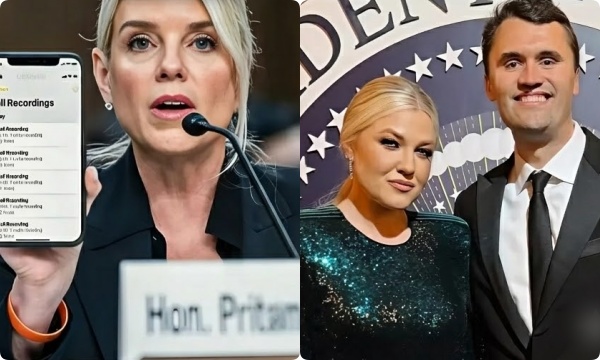
“LEAVE NOW,” Pam Bondi reportedly sent Erika Kirk an urgent warning when Charlie Kirk’s final audio surfaced — and the sounds heard afterward are now making social media believe the public has only been told part of the truth.
By the time dawn touched the edges of the blinds, Erika Kirk had already listened to the audio more times than she wanted to admit. Each replay made it feel less like evidence and more like a trap, the kind of fragment that invites the public to rush in before anyone knows where the edges really are. It was only forty-three seconds long, yet it had already begun rearranging the emotional temperature of the country.
Charlie Kirk’s name was moving everywhere at once. On television banners. In phone notifications. Across livestreams, private group chats, hurried opinion threads, and breathless segments where certainty arrived long before context did. For Erika, though, the noise did not feel national. It felt painfully intimate. It lived in the vibration of her phone against the kitchen counter and the silence that followed every unanswered call.
At 5:17 a.m., another message appeared on her screen. This one was short enough to look almost impolite. Leave now. No greeting. No explanation. No cushioning language. Just two words from Pam Bondi.
Erika stared at the message until the screen dimmed. She did not answer right away. Not because she did not understand urgency, but because those words meant something different coming from Pam than they would have coming from anyone else. Pam Bondi was not the kind of person who texted recklessly. If she chose brevity, it was because she thought detail was dangerous.
Outside, the morning was still gray, a wet and undecided kind of light settling over the neighborhood. The street beyond the front window looked like the sort of quiet American street people trust too easily—trimmed hedges, parked SUVs, early commuters, flags hanging from porches in still air. Nothing in the scene suggested collapse. Nothing warned that a family name could become a public battleground before breakfast.
Erika stood in the kitchen wearing yesterday’s sweatshirt, one hand around a mug of coffee that had already gone cold. The house carried the stale weight of an unfinished night. A lamp had been left on in the den. A hallway door was half open. On the dining table lay a legal pad covered in names, arrows, and questions she had written in the dark.
The most important question was still circled twice. Why this version first? Not why the audio existed. Not why people were reacting. But why this particular clip, this particular arrangement of sound, this particular timing. It was the question nobody on television seemed interested in asking. That alone made it feel important.
The first time Erika heard the audio, it came not from an official statement, not from an attorney, not from any channel that might suggest order. It came from a forwarded link sent by a number she did not recognize. The sender included no message, only the file. And once she pressed play, the day she thought she was living ended instantly.
It was Charlie’s voice. At least she believed it was. The internet had already decided it was, of course, and the internet tends to confuse volume with proof. But Erika knew the difference between general resemblance and private familiarity. She knew the rhythm of his breathing when he was speaking too fast. She knew the clipped edge his voice took on when he was exhausted and trying not to sound it.
Still, even recognition did not answer the real question. A voice can be real and a narrative can still be false. A recording can be authentic while its meaning is arranged, narrowed, framed, and weaponized by the order in which it is released. That possibility had lodged in Erika’s mind the moment she heard the final abrupt sound near the end of the clip.
Everyone else seemed fixated on the ending. The pause. The scrape. The tonal shift people kept replaying as though repetition might produce revelation. But Erika kept returning to the first seconds instead. Not what was obvious, but what felt missing. A strange absence where context should have been. An entry point that sounded too clean. Too intentional.
That was why Pam’s message unsettled her so deeply. Not because it was dramatic, but because it confirmed that someone else with far more experience than hers had reached the same conclusion. Something about the clip was wrong in structure, not necessarily in content. It had arrived already shaped. And shaped things rarely arrive innocent.
Erika finally called Pam back. The call rang once, then disconnected. She tried again. This time Pam answered immediately, but for a second neither woman spoke. The silence itself felt strategic. Then Pam said, very quietly, “Are you alone?”
Erika looked toward the den, though she already knew the house was empty. “Yes.” “Good,” Pam said, but she did not sound relieved. She sounded like someone confirming conditions before opening a door. “You need to leave the house for a few hours. Right now. Take your laptop, your phone charger, anything physical anyone might ask you about later.”
Erika leaned against the counter. “What is happening?” Pam did not answer directly. Instead she asked, “Has anyone contacted you claiming they have a longer version?” The question landed harder than if Pam had shouted. Because the answer was yes. And Erika had told no one.
The message had arrived less than twenty minutes earlier. Unknown sender. No signature. Just one sentence. You haven’t heard the beginning. Erika had not yet decided whether it was a bluff, harassment, or a calculated attempt to pull her into a chain of contact she would later regret. Now Pam’s question made that uncertainty feel more dangerous.
“How do you know that?” Erika asked. Pam exhaled slowly. “Because when material surfaces in fragments before any official process touches it, the fragments are usually the point.” Erika closed her eyes. That sentence was calm, precise, and somehow more frightening than panic would have been. It suggested design. Not chaos, but sequencing.
“What should I do with the message?” “Do not delete it. Do not respond yet. Screenshot everything. Then get out of the house.” Pam paused before adding, “And Erika, if anyone contacts you about what the public thinks the audio means, do not let them force you into a conclusion before you know what version they’re talking about.”
After the call ended, Erika moved through the house with a speed that did not feel like panic so much as delayed recognition. There are moments when a person understands that normal domestic space has suddenly become procedural. A kitchen is no longer a kitchen. It is a location. A laptop is no longer a tool. It is a repository. A hallway is a line of sight.
She packed quickly. Laptop. Notebook. External drive. Charlie’s old leather folio, which she had not opened in days because opening it felt too close to admission. On instinct, she also grabbed the small digital recorder from the side drawer in the study. She did not know whether it mattered. She only knew she no longer trusted herself to recognize what mattered in real time.
The front yard looked painfully ordinary when she stepped outside. A trash truck groaned two houses down. A sprinkler clicked somewhere behind a fence. The flag across the street lifted once in a weak breeze and dropped again. On mornings like this, America specializes in appearing uncomplicated. That was one of its most convincing illusions.
Erika got into the car and locked the doors before starting the engine. For a moment she sat still, phone in her hand, scanning mirrors she had never before thought of as tactical. No one was obviously watching. No black SUV idled at the curb. No stranger stood beneath a tree pretending to text. And yet she could not shake the feeling that the story around her had already expanded beyond what she could see.
She drove without destination for the first ten minutes. Not because she was lost, but because choosing a place suddenly felt like disclosing vulnerability. Hotels were too obvious. Family was too exposed. Restaurants meant windows, parking lots, and people with phones. Eventually she pulled into an older diner off the highway because it was open early and still looked like the sort of place where people minded their own business.
Inside, the air smelled like coffee, frying butter, and rain-soaked coats. A faded American flag hung near the register. Three construction workers sat in a booth beneath a muted television while a waitress wrote orders with the brisk confidence of someone who had worked every kind of morning this country can produce. Erika chose the corner booth farthest from the windows.
Only after sitting down did she realize her hands were shaking. Not dramatically. Just enough to turn the coffee spoon against the ceramic cup with a faint, rhythmic tap. She looked at her phone again. The unknown message was still there. You haven’t heard the beginning. Three seconds later, another message appeared. He knew the order mattered.
Erika felt her throat tighten. That phrasing was too specific to dismiss. Not “the truth.” Not “the full story.” The order. Sequence. Who spoke first, what was heard first, what the public was being taught to treat as the beginning. She suddenly understood why Pam had sounded so controlled. This was no longer just about content. It was about structure.
Pam arrived twenty-six minutes later in a dark coat and without the television version of composure Erika was used to seeing. There was no camera-ready sharpness to her this morning. Only focus. She slid into the booth, asked for black coffee, and said, “Show me everything,” before the waitress had even walked away.
Erika handed over the phone. Pam read the messages once, then again, more slowly. Nothing in her face revealed shock, but her stillness changed. Erika noticed it because in high-pressure moments, stillness can become its own form of alarm. When Pam finally looked up, her voice was even lower than before.
“Has anyone else seen these?” “No.” “Good.” Pam placed the phone face down between them. “Then listen carefully. You may already be standing closer to the center of this than people realize.” Erika almost laughed, but there was no humor in her body.
She had spent the last day watching commentators speak as though proximity automatically produced authority. Analysts, hosts, former insiders, new insiders, unnamed sources, people with professionally urgent voices saying things that sounded final because television rewards closure even when reality does not. Erika trusted none of them. That distrust was beginning to feel like instinct, not bitterness.
Pam asked her to describe exactly how the audio first reached her. Every step. Every timestamp. Every repost she saw before the clip seemed to become omnipresent. As Erika reconstructed the sequence, a pattern emerged that she had sensed but not fully articulated. The file appeared in unofficial circles first, then in online accounts that specialized in emotional escalation, then only later in coverage that presented the whole frenzy as though it had risen organically.
Pam nodded once. “That’s what I was afraid of.” “What does that mean?” Erika asked. “It means somebody wanted public interpretation moving at full speed before any stable record could slow it down.” Pam did not dramatize the sentence. She delivered it the way other people might read a weather alert. That made it harder to ignore.
Erika took the digital recorder from her bag and placed it on the table. “I found this in Charlie’s study drawer,” she said. Pam looked at it but did not touch it immediately. “You listened?” “No.” “Good.” The second time Pam said that word, it carried more weight than the first.
“You think there’s more on it?” Erika asked. Pam answered carefully. “I think Charlie was disciplined about records. I think he understood that sound can clarify a moment, but it can also be stripped of its frame. And I think if he kept anything, he did it because he was worried the public might hear a middle and mistake it for a beginning.”
Erika looked down at the recorder as though it might pulse under the napkin. Charlie had always been precise about details people around him dismissed as trivial. Timing. Room placement. Order of calls. Who entered through which door. At the time, she sometimes found it exhausting. Now it looked less like obsessiveness and more like pattern recognition.
Pam borrowed a pair of wired headphones from her bag, then hesitated. “We’re not playing this here,” she said. “Why not?” “Because if it contains what I think it may contain, the first hearing matters. Context matters. Chain of custody matters. And the second this becomes something people can fight over, every missing second will become a battlefield.” Erika nodded, though tension still coiled in her chest.
“What do you think is missing from the public clip?” Pam held her gaze for a moment. “Not necessarily content. Position.” Erika frowned. Pam continued. “Sometimes the most consequential thing in a recording is not what was said, but when the public is allowed to hear it in relation to everything else.”
That sentence sat between them like a third person. The waitress arrived with coffee and eggs no one had really wanted. Around them the diner kept moving in its ordinary way. Silverware clinked. A weather update rolled silently on the television. A man near the counter laughed at something in a newspaper. The world outside their booth remained offensively normal.
Pam finally gave Erika the outline of what worried her. Not a theory of guilt. Not a claim about crime. But a pattern she had seen before in high-profile public storms: a fragment emerges, people interpret it as whole, camps form instantly, and by the time a fuller record appears, most listeners are emotionally invested in the first version. At that point, sequence becomes destiny.
Erika absorbed the words slowly. She had been so overwhelmed by the emotional force of hearing Charlie’s voice that she had almost missed the architecture around it. Not the existence of the clip, but the choreography of its release. Who moved first. Which accounts amplified it. Which commentators pushed meaning before asking provenance. Once she saw that structure, she could not unsee it.
Pam suggested they move to a quieter location before doing anything else. Not a hotel. Not a relative’s home. Somewhere temporary and anonymous, with strong signal, limited foot traffic, and enough privacy to inventory what Charlie had left behind. Erika did not argue. By then, action felt easier than uncertainty.
They drove separately to a rental cottage on the far side of town, one of those professionally bland places that exist for weekend weddings and overflow guests. The living room held generic framed landscapes. A knitted throw blanket lay folded over a beige couch. In the kitchen, a bowl of decorative lemons tried too hard to imply cheer. The anonymity was a relief.
Once inside, they set up at the dining table. Laptops open. Phones charging. Legal pads ready. Pam began with process before emotion. “First, we document what exists. Then we document how it reached you. Then we separate what we know from what the internet has decided.” Erika almost smiled despite herself. It sounded like triage for narrative contamination.
They spent the next two hours building a timeline. The first post. The second repost. The first cable mention. The first headline that used the word final as though it had already been earned. At three points, Erika noticed suspiciously identical wording spreading through unrelated accounts. Pam circled those moments immediately. Manufactured emphasis often leaves fingerprints in repetition.
At noon, Erika finally opened Charlie’s leather folio. Inside were printed transcripts, two folded receipts, a parking validation stub, and a yellow legal sheet filled in Charlie’s handwriting. The writing was compact, slanted, and unusually dense, as if he had been compressing thought faster than time could keep up. One sentence appeared three times in slightly different forms. They’ll release the end first.
Erika felt a sharp ache behind her ribs. Not because the sentence solved anything, but because it sounded unmistakably like Charlie in his most analytic state. Not emotional. Not spiraling. Focused. Attempting to anticipate narrative movement the way other people anticipate weather. Pam read the line, then sat back very slowly.
“That,” she said, “is why I texted you.” Erika looked up. Pam tapped the page with one finger. “Because this means he had already identified the risk. He did not merely fear being misunderstood. He feared a sequence being imposed on what happened.” The distinction mattered more than Erika could yet explain.
The unknown sender texted again at 12:14 p.m. Don’t let them name the meaning before they show the entrance. Pam and Erika read the sentence in silence. It sounded half like warning, half like instruction. Either way, it was far too precise to dismiss as random cruelty from strangers feeding on a public story. Somebody understood the architecture. Maybe somebody had participated in it.
“Whoever this is,” Erika said, “they think the entrance matters.” Pam nodded. “In any recording, the entrance often tells you who had agency before the crisis became visible.” That line landed with almost physical force. Not guilt. Not innocence. Agency. Who set a moment in motion before the public arrived late and loud.
Late that afternoon, they listened to the recorder under controlled conditions, this time with a transcription app running offline and both women taking notes in real time. The first seconds were mostly room tone. Movement. A soft mechanical click. Then Charlie’s voice, quieter than in the leaked clip, saying something so low they had to replay it twice. Order matters.
Erika looked up instantly. Pam kept listening, one hand raised to stop her from speaking. A chair shifted somewhere in the background. Another voice entered, but not clearly enough to identify. No sensational revelation. No cinematic confession. Just human sound inside a real space before public narrative had reduced it to symbols. The power of it came from sequence, not drama.
Then Charlie again, clearer this time. “If they get the ending without the entrance, they’ll build the whole thing backward.” Pam stopped the recording. Neither woman spoke for several seconds. Outside the rental cottage, a lawn service droned somewhere down the block with such mundane steadiness it felt surreal. Inside, everything had sharpened.
The leaked public clip had not been fabricated from nothing. That much was obvious. But Charlie’s own words suggested that long before the internet began dissecting the audio, he had already worried about interpretive order. He believed people would receive the ending first and force the rest of reality to fit around it. That did not prove wrongdoing. It proved anticipation. And anticipation changes how a record must be read.
Pam replayed the early section twice more. The second voice remained indistinct. A presence, not an identification. And that, Erika realized, was almost worse in the current climate. Because ambiguity is where projection thrives. The less people truly hear, the more fiercely they insist they know. Public storms feed on that energy.
By early evening, Pam had arranged for a professional forensic audio review through a contact she trusted to prioritize authenticity over speed. No leaks. No cloud transfer. Physical handoff only. She also insisted on documenting the exact state of the recorder, the file metadata, and the circumstances of discovery. Everything boring. Everything essential. That was how truth survived spectacle.
When darkness fell, Erika stepped onto the small back porch alone. The yard behind the cottage was damp from a passing shower. Beyond the fence, the trees were black shapes against a dim Virginia sky. Somewhere nearby, someone’s television flickered blue through curtains. The ordinary intimacy of neighborhood life suddenly felt almost unbearable.
She thought about Charlie not as a headline but as a man who hated being misunderstood in small ways long before the country ever began doing it in large ones. He corrected timelines at dinner. He remembered the order of conversations years later. He noticed when quoted remarks were trimmed into cleaner but less honest versions. At the time, it seemed fussy. Now it looked prophetic.
Pam joined her on the porch a minute later. Neither woman spoke right away. The quiet between them was no longer empty; it had become functional, a place where words could wait until they were sturdy enough. Finally Erika asked the question she had been avoiding all day. “Do you think the public will care about order?”
Pam considered that longer than Erika expected. “Some will,” she said. “But most people attach to the version that reaches them first and flatters what they already want to believe.” She did not say it bitterly. Just accurately. “The challenge is not making everyone care. It’s preserving enough of the record that care remains possible.”
That answer stayed with Erika through the night. Preserving enough of the record. Not winning the whole argument. Not controlling the cycle. Just keeping structure intact long enough that reality still had a chance. It was a smaller hope than justice, but it also felt more real.
The next morning brought a preliminary finding from the audio specialist. The leaked clip circulating online appeared to begin after a natural acoustic lead-in, meaning the public version almost certainly did not represent the raw start of the interaction. No dramatic accusation came with that finding. Only the quiet certainty that the beginning had been displaced.
That was enough. Enough to justify caution. Enough to explain Charlie’s notes. Enough to make Pam’s urgent message feel less like overreaction and more like instinct refined by experience. Erika sat at the table, reading the specialist’s summary, and felt something inside her settle. Not relief. Direction.
For the first time since the audio surfaced, she understood what frightened her most. It was not that people were hearing Charlie. It was that they were hearing him from the wrong doorway. They were entering the event through a frame selected by someone else, then arguing as though they had seen the whole room. That was the distortion she could not accept.
By noon, calls from reporters were becoming more targeted. Not broad requests for comment anymore, but carefully phrased questions designed to tempt confirmation. Has Erika Kirk acknowledged the authenticity? Has Pam Bondi advised the family on response? Do they dispute the interpretation? Each question assumed an interpretation already existed as fixed ground. Pam answered none of them.
Instead, she drafted one statement and read it aloud to Erika before sending it anywhere. It was measured, spare, and almost frustratingly restrained. It did not accuse. It did not speculate. It simply stated that any public discussion of recently circulated audio should wait for full authentication and contextual review, including confirmation of whether the released version preserved original sequence.
“That’s too careful,” Erika said at first. Pam looked at her steadily. “Careful survives.” Erika wanted to resist that. Emotionally, she wanted thunder, certainty, correction, a clean moral shape to push against the frenzy. But deeper down she knew Pam was right. Once words are released in a public storm, they stop belonging entirely to the speaker.
By late afternoon, the statement was out. Predictably, it did not calm the noise. Nothing ever does in the first cycle. But it altered the field slightly. For the first time, some commentators were no longer discussing only what the public clip allegedly proved. They were asking whether the clip represented a beginning or a middle. That was not resolution. But it was movement.
Erika watched a cable segment in silence as one host replayed the now-famous audio while a legal analyst pointed out that sequence often determines perceived meaning. The host seemed disappointed by the lack of fireworks. Erika almost laughed. This was the problem in miniature. The truth, when it survives, often does so through procedural language that sounds dull beside outrage. And yet that dullness is exactly what makes it durable.
That evening, the unknown sender wrote one last time. You don’t need a new ending. You need the real beginning. Erika showed Pam immediately. Pam read it, then set the phone down without comment for several seconds. When she finally spoke, her voice carried neither fear nor surprise. Only recognition.
“That,” Pam said, “is the first honest sentence anyone has sent you.” Erika looked toward the dark window over the sink, where her reflection hovered faintly above the glass. Beyond it, the yard was still. No movement. No witnesses she could see. Yet the story around her had become clearer than it had been the day before. Not simpler. Just truer in shape.
Charlie’s voice, the public frenzy, Pam’s warning, the anonymous messages, the recorder on the table, the specialists parsing room acoustics and cut points—none of it had delivered a final answer. But final answers were not what this moment was made of. This moment was made of thresholds. Who crossed first. Who framed the first hearing. Who benefited when the country rushed past the door and argued about the room instead.
For hours after Pam went to bed, Erika remained awake in the cottage living room, notebook open across her knees. She wrote down everything she now understood. The audio could be real and still incomplete in meaning. A public narrative could feel organic while being structurally guided. And the difference between truth and distortion often begins in the first seconds no one thinks to protect.
Near midnight, she wrote one final line in the margin and underlined it twice. The first thing people hear becomes the shape of everything after. Then she closed the notebook and let the silence settle around her. For the first time since the clip surfaced, the silence did not feel empty. It felt like a place where sequence could still be restored.
Morning would bring more calls, more speculation, more people trying to turn uncertainty into performance. That part was inevitable. But now Erika understood her task more clearly than before. She did not need to outshout the storm. She only needed to protect the beginning long enough that the storm could no longer pretend it had arrived there first.
And somewhere beyond the noise, beyond the commentary, beyond the social feeds and the expert panels and the hungry choreography of modern outrage, Charlie’s own warning remained stubbornly intact. If they get the ending without the entrance, they’ll build the whole thing backward. Pam Bondi had understood that fast enough to send only two words. Leave now.
Not because the house itself was the center of danger. Not because flight was an answer. But because once the wrong version starts spreading, even ordinary space can become part of a story designed by other hands. And in a moment like that, survival does not always mean escape. Sometimes it means moving just far enough away to hear the structure clearly.
Erika finally turned off the lamp and stood in the darkened room for a moment, listening. The cottage hummed softly with refrigeration, settling wood, distant highway noise, and the thin ongoing life of a country that rarely pauses long enough to question the order in which it is told its own dramas. That was the problem. That might also be the opening.
Because if sequence can be manipulated, it can also be restored. If a beginning can be hidden, it can still be found. And if the public has been trained to treat the loudest fragment as truth, then perhaps the most necessary act is not to invent a stronger ending, but to walk back to the first doorway and insist on entering there.
That was where Erika understood the story now. Not at the point of impact. Not at the clipped final seconds replayed for outrage. But at the threshold. At the frame. At the moment before everyone else rushed in certain they already knew what they were hearing. And once she saw that clearly, she knew she could not go back to being merely overwhelmed.
She would still be watched. Still be called. Still be pressed by people who wanted comments faster than context. But the panic had changed form. It had become discipline. A quieter thing. A harder thing. The kind that does not look dramatic on camera but is often the only thing that survives one.
Outside, the first pale light of morning touched the edge of the yard. Another day was beginning whether she wanted it to or not. Erika picked up the notebook, the phone, and the recorder, and held them for a moment with both hands. No revelations. No certainty. Only record. For now, that was enough.
Because in the hours since Pam Bondi’s warning reached her screen, one truth had become impossible to ignore. The most dangerous thing about the Charlie Kirk audio was never simply what the public thought it heard. It was how quickly the country had been taught where to begin. And once that lesson is planted, undoing it becomes the real fight.
