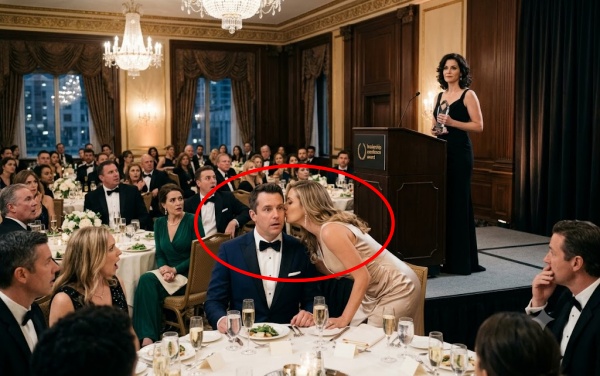
In front of six hundred guests at a Chicago leadership gala, my husband’s mistress walked up to his table and kissed him while I stood onstage holding the biggest award of my career. She thought she had humiliated me, and he thought I would stay quiet to protect our marriage and his reputation. What neither of them knew was…
PART I — THE APPLAUSE
My husband’s mistress kissed him in front of six hundred guests while I was accepting the most prestigious award of my career.
That sentence sounds impossible, even now.
Not because people are incapable of cruelty. I had spent fifteen years practicing corporate law in Chicago, so I knew perfectly well what polished, educated adults could do when they believed consequences were for other people.
It sounds impossible because of where it happened.
The ballroom of the Four Seasons Hotel Chicago was filled with judges, partners, nonprofit directors, university donors, journalists, and enough old-money families to make the flower arrangements feel underdressed. Crystal chandeliers hung above round tables dressed in white linen. Champagne glasses caught the light. A string quartet played softly near the entrance, because apparently nothing says professional achievement like violins and people pretending not to check stock alerts under the table.
It was the annual Midwest Women in Leadership Gala, and I was receiving the Eleanor Whitcomb Award for excellence in law and public service.
For twelve years, I had wanted that award.
Not in a childish way.
Not in a desperate way.
But in the quiet, private way women want recognition after decades of being told to be grateful for the seat, the microphone, the title, the promotion, the invitation, the “opportunity.”
My name is Claire Whitaker. At forty-two, I was a senior partner at Harrington, Wells & Cline, one of the largest law firms in Chicago. I specialized in complex commercial litigation and pro bono representation for women navigating workplace retaliation and financial abuse.
That last part mattered.
It would matter more than I understood when the evening began.
My husband, Grant Whitaker, sat at Table 3, directly in front of the stage. He wore a navy tuxedo, the Patek Philippe watch I had bought him for our tenth anniversary, and the practiced expression of a supportive spouse.
Grant was handsome in the expensive, controlled way that ages well in boardrooms. Silver had started threading through his dark hair at the temples. He had a clean jawline, an easy smile, and the kind of voice that made people feel reassured even when he was telling them something completely hollow.
He owned a boutique investment advisory firm in River North, managing money for doctors, tech founders, and divorced women who trusted him because he knew how to sound patient.
I had helped build that trust.
For years, I brought him into rooms he could not have entered alone.
Judges’ fundraisers.
Museum boards.
Private dinners in Lincoln Park.
Charity auctions where men discussed philanthropy with one hand and tax deductions with the other.
Grant liked to say we were a power couple.
I used to believe that meant partnership.
By the night of the gala, I knew better.
I had known for exactly forty-three days.
Forty-three days earlier, a woman named Lena Hart had sent me a message on LinkedIn at 2:13 a.m.
Mrs. Whitaker, I’m sorry to contact you this way, but I think you should know your husband is not who he says he is. Please don’t ignore this. I can prove it.
I almost deleted it.
Women in my position attract strange messages sometimes. Angry former clients. Opposing parties. People convinced every lawyer is hiding a conspiracy in a filing cabinet.
But something about the wording stopped me.
Not your husband is cheating.
Not Grant is sleeping with someone.
Your husband is not who he says he is.
The next morning, Lena sent screenshots.
Not intimate photos.
Not gossip.
Bank transfers.
Emails.
A private investment memorandum using my name as an informal reference.
A spreadsheet labeled Strategic Client Reallocation.
At first, I thought Lena was Grant’s mistress.
She was not.
She was his former operations manager.
And according to what she gave me, Grant had been moving client funds into unauthorized high-risk private placements, hiding losses with misleading quarterly reports, and quietly borrowing against accounts connected to people I knew.
Women I had introduced to him.
Widows.
Retired physicians.
A former federal judge’s sister.
My college roommate’s mother.
The affair came later.
Or rather, the proof of it did.
Her name was Sloane Mercer.
Thirty-five.
Brand consultant.
Divorced.
A board member at two arts nonprofits.
The kind of woman whose Instagram looked like it had been edited by a hotel concierge: Aspen, Tulum, Napa, Amalfi, always with one hand wrapped around a glass and the other resting on someone’s borrowed influence.
I had met her three times.
Once at a museum dinner.
Once at a fundraiser for girls’ scholarships.
Once at our house in Lake Forest, where she stood in my kitchen complimenting the marble countertops while wearing earrings I later learned Grant had bought her.
The betrayal was not that Grant wanted someone else.
That hurt, of course.
But desire is ordinary.
Weakness is ordinary.
Selfishness is ordinary.
What made it monstrous was that he had wrapped his affair around my professional reputation and used both to keep his financial lies breathing.
That night, as I sat beside him waiting for my name to be called, I already knew enough to destroy him.
I knew about the $187,000 line of credit he opened using our jointly owned lake house as collateral without telling me the full purpose.
I knew about the $74,300 in “consulting fees” paid to Sloane through a Delaware LLC.
I knew about the fake client updates.
I knew about the weekend trips listed as due diligence meetings.
I knew about the private email address.
I knew about the burner phone in the locked drawer of his home office.
I knew he had signed my name electronically on two internal reference documents implying I had reviewed investment materials.
That was the one that changed everything.
A cheating husband could break my heart.
A reckless husband could damage our finances.
But a husband who dragged my law license anywhere near his fraud had mistaken my silence for oxygen.
And I had already decided to remove it.
Still, when the emcee said my name and the room rose in applause, part of me wanted one clean moment.
Just one.
I wanted to walk up those steps as Claire Whitaker, attorney, advocate, mentor, woman who had worked for every inch of that stage.
Not wife.
Not victim.
Not future witness.
Just myself.
The applause was enormous.
Six hundred people stood.
My law partners clapped.
My mentees cheered.
My best friend Mara Bennett, a federal prosecutor, wiped under one eye with the side of her finger because she claimed she “didn’t do public emotion” and then failed publicly.
Grant stood too.
He clapped with both hands and smiled like he had helped lift me there.
That was when I saw Sloane.
She was not seated at our table.
She had no reason to be near it.
Yet as I reached the podium and accepted the glass award from the organization’s chair, Sloane walked directly toward Grant in a champagne satin dress that moved like water and attention.
At first, I thought she was approaching someone else.
Then she leaned down, placed one hand on Grant’s shoulder, and kissed him.
Not on the cheek.
Not a mistaken greeting.
On the mouth.
In front of six hundred people.
In front of my colleagues.
In front of cameras.
In front of the scholarship girls seated at the front table, the same girls I was supposed to address about dignity, perseverance, and power.
The room changed before it went quiet.
Applause faltered in waves.
First the tables closest to Grant.
Then the center.
Then the back.
The string quartet stopped playing.
Someone gasped loudly enough for the microphone to catch it.
Grant pulled back, stunned.
Sloane smiled up at him with the bright, theatrical confidence of a woman who thought she had just forced an ending.
Then she looked at me.
At the podium.
Holding the award.
She looked triumphant.
And for one second, I understood exactly what she believed.
She thought she had exposed me as the pathetic wife.
She thought she had interrupted my achievement with proof that I was not enough.
She thought humiliation was a weapon.
What she did not know was that I had walked into that ballroom carrying a flash drive in my clutch, a subpoena-ready evidence binder in my car, and a call scheduled with the Illinois Securities Department at 8:30 the next morning.
The kiss was not the bomb.
It was a match struck in a room already soaked with gasoline.
I adjusted the microphone.
The sound echoed softly through the ballroom.
Grant’s face had gone pale.
Sloane was still standing beside him.
Six hundred people were waiting to see whether I would cry.
I did not.
I smiled.
Not warmly.
Not gently.
Professionally.
The kind of smile opposing counsel learns to fear.
“Thank you,” I said into the microphone. “I appreciate everyone’s patience. It appears my husband has chosen an unusual way to celebrate women in leadership.”
A ripple moved through the room.
Not quite laughter.
Not quite shock.
Grant stood halfway, as if he intended to come toward the stage.
I lifted one hand.
“Please stay seated, Grant.”
He froze.
The room went so silent I could hear silverware touch china three tables away.
Then I looked down at my notes.
The speech I had written was about mentorship, access, and responsibility.
I had practiced it in my car.
I had timed it to nine minutes.
I had imagined thanking Grant at the end.
Instead, I folded the pages in half and placed them beside the award.
“Tonight, I planned to speak about power,” I said. “Specifically, about what happens when people confuse access with entitlement.”
Mara’s eyes locked on mine from Table 5.
She knew that tone.
Grant knew it too.
Sloane did not.
Not yet.
PART II — THE FORTY-THREE DAYS BEFORE
Forty-three days before the gala, I did not want to investigate my husband.
I want that understood.
There is a particular cruelty in realizing your instincts are asking you to become a detective in your own home. It is exhausting before it is devastating. Every receipt becomes a clue. Every delayed answer becomes testimony. Every affectionate gesture becomes suspicious because you no longer know whether love is love or theater.
Grant had been distant for months.
That part was not dramatic.
We were busy people.
He traveled.
I worked late.
Our marriage had become a calendar shared by two competent adults who mostly met at charity events and airport lounges.
But distance alone is not betrayal.
The first sign was the watch.
I noticed it missing from his nightstand in September.
The Patek.
The one I had given him.
When I asked about it, he said he had sent it for servicing.
Two weeks later, Sloane posted a photo from a rooftop bar in Miami. Her hand rested on a cocktail menu. Beside it was a man’s wrist wearing Grant’s watch.
She had cropped his face.
She had not cropped enough.
I said nothing.
Not because I was weak.
Because in law, you do not interrupt a witness while they are still making your case.
Then came the phone.
Grant had always been careless with devices because he believed himself too smart to be caught. His real phone was clean. Too clean. Calendar entries. Client texts. Golf plans. Weather alerts.
The second phone was hidden in the locked drawer of his home office beneath old tax files.
I did not break the drawer.
I had the key.
That mattered legally, and it mattered to me. I knew enough not to obtain evidence in ways that could damage me later. I photographed what I found in plain view once the drawer was open with a household key kept in our shared mudroom.
The phone was dead.
I charged it.
I did not guess the password.
I did not hack it.
I simply saw the lock screen light up with eight missed messages from S.M.
You said she wouldn’t be at the gala rehearsal.
I’m tired of being hidden.
You promised after the award.
Grant, answer me.
I photographed the screen.
Then I put the phone back exactly where it had been.
The affair had shape now.
But the financial pieces came through Lena.
We met at a coffee shop in Evanston, two blocks from the lake. She was younger than I expected, maybe thirty-one, with short auburn hair and dark circles under her eyes. She ordered tea and did not drink it.
“I signed an NDA,” she said immediately.
“I’m not your lawyer,” I told her. “And I can’t advise you as if I am unless we formalize that relationship. But I can listen.”
She nodded.
“I left his firm because I found things.”
“What kind of things?”
“Client statements that didn’t match custodial records. Transfers that were described one way internally and another way to clients. Side agreements. A private placement he pushed after losses started piling up.”
I kept my face still.
“What does this have to do with me?”
Lena looked directly at me.
“He used you.”
Those three words landed harder than he cheated ever could.
She slid a folder across the table.
Inside were printed emails.
Grant writing to a prospective investor:
Claire has reviewed the general structure and is comfortable with the compliance posture. Obviously she can’t formally advise due to conflict, but you know her reputation.
I had reviewed nothing.
I was comfortable with nothing.
My reputation had been placed like a tablecloth over a crime scene.
There were also client notes referencing introductions made through me.
A widow named Diane Feld.
A retired orthopedic surgeon named Dr. Rebecca Chu.
A nonprofit donor named Marjorie Ellis, who had sat at my dining room table three months earlier and asked Grant whether his conservative income fund was appropriate for someone “too old to recover from surprises.”
Grant had smiled and said, “That’s exactly why Claire trusts me.”
Claire trusts me.
I left the coffee shop and sat in my car for twenty minutes while waves hit the lake wall across the street.
Then I called Mara.
Not my divorce attorney.
Not yet.
Mara.
“Tell me hypothetically,” I said when she answered, “how fast a person’s life can become a securities investigation.”
She paused.
“Oh, Claire. Who?”
“My husband.”
Mara exhaled once.
“Are you safe?”
“I’m angry.”
“Different question.”
That was why she was my best friend.
Within twenty-four hours, I retained independent counsel: David Rosenthal, a white-collar attorney who had represented executives, whistleblowers, and once a state senator everyone pretended not to recognize in the lobby.
I also retained Helen Park, a divorce attorney with a calm voice and the emotional warmth of a scalpel.
Helen’s first instruction was simple.
“Do not confront him yet.”
David’s was similar.
“Do not access anything you are not authorized to access. Preserve what came to you. Keep metadata. Write contemporaneous notes. Do not warn him if there is ongoing misconduct.”
So I waited.
I smiled at breakfasts.
I attended two dinners beside Grant.
I let him kiss my temple at a museum event while knowing he had used a phrase from my published article in an investor pitch.
I watched him text under the table.
I watched his confidence.
There is a rage so hot it becomes discipline.
That was mine.
Thirty-one days before the gala, I learned Grant had moved $250,000 from our joint investment account into a “short-term liquidity vehicle” tied to his firm.
He told me after the fact.
“Just temporary,” he said, buttering toast.
“Our joint account?”
“It was sitting there underutilized.”
“That money was earmarked for the foundation pledge.”
“I’ll replace it before the pledge is due.”
“With what?”
He smiled.
“Have I ever not handled things?”
It is frightening how often women are taught to hear condescension as competence.
Twenty-two days before the gala, I found the Delaware LLC payments to Sloane.
Not directly.
Through a credit card statement Grant forgot to redirect and a consulting invoice Lena sent me after finding it in archived files.
Mercer Brand Strategy LLC — Reputation Development Retainer — $18,500
Another.
Stakeholder Narrative Advisory — $22,000
I almost admired the audacity.
He was paying his mistress from a business structure connected to client acquisition while telling me the expensive jewelry charges were “firm gifts.”
Sixteen days before the gala, Sloane messaged me.
Claire, I hope this isn’t awkward, but I’ll be at the Leadership Gala. Grant said you’d be thrilled. Can’t wait to celebrate you.
I showed Mara.
Mara read it twice.
“She’s either stupid or declaring war.”
“Those are not mutually exclusive.”
“Are you going to tell Grant not to bring her?”
“No.”
Mara looked at me.
“You’re letting her walk in?”
“I’m letting everyone walk in.”
She studied my face.
Then nodded.
“Remind me never to oppose you in court.”
Two days before the gala, Grant came home late smelling like Sloane’s perfume.
I was in the kitchen reviewing deposition prep, though the document open on my laptop was actually a timeline of his financial misconduct.
He poured himself bourbon.
“You nervous about Saturday?”
“No.”
He smiled.
“You should be. Big night.”
“It is.”
“You deserve it.”
I looked at him then.
He seemed almost sincere.
That was the thing about Grant. He could betray someone and still admire them. He could weaponize my name and still believe I was brilliant. He could lie beside me in bed and still feel proud when others applauded me.
Compartmentalization is a luxury dishonest people cannot stop buying.
“I’m glad you’ll be there,” I said.
His smile softened.
“Always.”
The word nearly made me laugh.
Always had become a location he visited when useful.
That night, after he fell asleep, I removed my wedding ring and placed it in the small velvet box where it had first arrived fourteen years earlier.
I did not cry.
I wrote three emails instead.
One to David.
One to Helen.
One to myself.
The subject line of the third email was:
If I lose my nerve.
The message read:
He used your trust, your work, your name, your friends, and your silence. Do not protect a man who made you evidence.
On the night of the gala, I wore a black Carolina Herrera gown, pearl earrings from my grandmother, and no wedding ring.
Grant noticed in the car.
“Where’s your ring?”
“At home.”
“Why?”
“It didn’t go with the dress.”
He laughed.
“Since when do you care about that?”
“Since tonight.”
He looked at me strangely.
Then his phone buzzed.
He turned toward the window to answer it.
I watched Chicago slide past us in the dark: Michigan Avenue lights, taxis, women in heels stepping over slush, couples walking arm in arm like trust was ordinary.
At the hotel entrance, Grant offered me his arm.
I took it.
Not because I forgave him.
Because sometimes you let the defendant escort you to the courtroom.
PART III — THE SPEECH I DIDN’T PLAN TO GIVE
The ballroom was still silent after my first sentence.
“Access,” I said, “is one of the most dangerous forms of power because it often arrives disguised as affection, mentorship, marriage, friendship, or opportunity.”
Grant’s eyes were fixed on me.
Sloane had finally stepped back from his chair, but she did not leave. Perhaps she thought I would not dare continue. Perhaps she wanted to watch me bleed gracefully.
I looked at the scholarship students in the front row.
They were young women from across the Midwest, selected for leadership potential. Some wore borrowed dresses. One clutched her program with both hands. Another had tears in her eyes already, though she could not possibly know what was happening.
I chose them.
Not Grant.
Not Sloane.
Not scandal.
Them.
“When I began practicing law,” I continued, “I believed excellence would protect me. I believed if I worked hard enough, prepared thoroughly enough, and behaved impeccably enough, I could build a life no one could casually diminish.”
A few women in the room nodded.
They understood.
“Then I learned what many women learn. Excellence does not protect you from being used. It only gives you better tools when the truth arrives.”
Mara leaned back slowly.
She knew I had left the prepared speech entirely.
My firm’s managing partner, Richard Cline, looked as though his soul had briefly exited his body to consult risk management.
I did not name Grant’s crimes from the stage.
That matters.
I did not accuse him publicly of securities fraud in front of six hundred guests. I did not expose client names. I did not turn a gala into a courtroom.
I am a lawyer.
I know the difference between a speech and a filing.
But I said enough.
Enough for Grant to understand I knew.
Enough for Sloane to realize she had misread the room.
Enough for every woman present to hear what I had actually come to say.
“Tonight,” I said, “I want to speak to anyone who has ever been asked to stay quiet to preserve someone else’s reputation. A husband’s. A boss’s. A donor’s. A firm’s. A family’s. A name on a building.”
The room was no longer frozen.
It was listening.
Really listening.
“If your silence is required for someone else’s image to survive, ask yourself what truth they are asking you to bury.”
Grant stood.
“Claire,” he said.
His voice carried.
I looked at him over the podium.
“This is not your stage.”
A sound moved through the room.
This time it was definitely not shock alone.
It was recognition.
Grant sat down.
Sloane’s face flushed.
I continued for exactly seven more minutes.
I thanked my mentors.
I thanked the young attorneys who challenged me.
I thanked the women who trusted me with their stories.
I thanked my late mother, who once told me that dignity was not the same as politeness.
I did not thank my husband.
When I finished, the applause came slowly at first.
Then louder.
Then the room rose.
Not everyone.
Some people were too uncomfortable.
Some men stared at their plates.
Some women stood with wet eyes and hard jaws, clapping like they had waited years for someone to say the thing plainly enough.
I stepped off the stage with the award in my left hand.
Grant intercepted me near the side curtain.
His smile was gone.
“What the hell was that?”
I glanced toward the room.
“Careful. People are watching.”
His jaw tightened.
“You humiliated me.”
That nearly made me laugh.
“You were kissed by your mistress while I was on stage.”
“She shouldn’t have done that.”
“That is your defense?”
“She’s upset.”
“Then perhaps you should have managed your affair with the same competence you used to mislead investors.”
His face went white.
There.
There it was.
The moment he understood the kiss was not the problem.
“What are you talking about?” he asked.
I smiled faintly.
“Grant, don’t insult both of us.”
He stepped closer.
“You don’t know anything.”
“I know about Mercer Brand Strategy. I know about the Delaware LLC. I know about the joint account transfer. I know about Diane Feld’s quarterly statement. I know you used my name in writing.”
His mouth opened.
Nothing came out.
From behind him, Sloane appeared.
“Grant, we need to go.”
I looked at her.
“No, Sloane. You need to stop speaking as though you are in control of anything happening tonight.”
Her eyes narrowed.
“You have no idea what he told me.”
“I’m sure he told you his marriage was dead, I was cold, he was trapped, and you were the first person in years who made him feel alive.”
Her expression flickered.
Predictable men are a public health issue.
Grant grabbed my elbow.
Not hard enough to bruise.
Hard enough to presume.
I looked down at his hand.
“Remove it.”
He did.
Mara appeared beside me as if summoned by rage.
“Everything okay here?”
Grant put on the face.
The charming one.
“Mara, this is private.”
“Not anymore,” she said.
Sloane crossed her arms.
“This is between the three of us.”
Mara turned her head slowly toward her.
“Oh, honey. If you think you’re the third person in this story, you have wildly overestimated the size of your role.”
I loved her then.
More than usual.
Grant lowered his voice.
“Claire, whatever you think you know, we can discuss it at home.”
“There is no home discussion.”
“We are married.”
“For the next several legal steps, yes.”
Sloane looked at Grant sharply.
“You said she wasn’t filing.”
Grant closed his eyes.
Another gift.
Another admission.
“Thank you,” I said.
Sloane realized too late.
Grant whispered, “Stop.”
I turned to Mara.
“Could you please ask Richard to bring my coat? I’m leaving.”
Grant followed me into the hallway.
The hotel corridor was quieter, lined with mirrors and cream wallpaper. Through the ballroom doors, applause and music resumed awkwardly, as if society had decided digestion required denial.
“Claire,” Grant said. “Listen to me.”
“No.”
“Just listen.”
“I spent fourteen years listening.”
He ran a hand through his hair.
“I made mistakes.”
“Plural is doing heroic work there.”
“I never meant to hurt you.”
“Men always say that after creating systems that require women not to notice pain.”
His eyes flashed.
“This self-righteous thing won’t hold up forever.”
“There he is,” I said softly.
“Who?”
“The man behind the tuxedo.”
For a moment, hatred moved openly across his face.
Then he tucked it away.
“I can ruin you too,” he said.
I tilted my head.
“With what? The documents you forged? The clients you misled? The mistress you paid through questionable consulting invoices? Please be specific. I enjoy precision.”
His breathing changed.
“You’d destroy everything we built?”
“No, Grant. I’m preserving what you tried to attach yourself to.”
Mara returned with my coat.
Behind her stood Richard Cline, pale and grave.
“Claire,” he said quietly, “do we need to talk tonight?”
“Not tonight. Tomorrow morning. Independent counsel is already involved.”
His relief was visible.
“Understood.”
That is how law firms express panic: in complete sentences with minimal adjectives.
I left the hotel through a side entrance.
Snow had started falling on Michigan Avenue.
Mara walked with me to the curb.
“Do you want me to come home with you?”
“No. I’m not going home.”
“Where?”
“The Peninsula. Helen told me not to stay in the house once I confronted him.”
Mara nodded.
“Smart.”
“I didn’t confront him. Sloane did performance art.”
“She kissed a man at his wife’s award ceremony. That’s not performance art. That’s a cry for therapy with contour.”
Despite everything, I laughed.
It came out shaky.
Mara hugged me.
Only then did I almost cry.
Not because of Grant.
Because for the first time all night, someone held me without wanting something.
PART IV — THE COST OF USING MY NAME
The next morning, Grant called twenty-six times before 9:00 a.m.
I answered none of them.
Helen Park filed the initial divorce petition in Cook County before lunch, citing irreconcilable differences. Illinois is an equitable distribution state, which meant our assets, debts, and marital property would be sorted with attention to fairness, not revenge.
That was fine.
I did not need revenge.
I needed separation, documentation, protection, and Grant’s hands off anything tied to my license, clients, or future.
David Rosenthal contacted the appropriate regulatory authorities and began guiding my cooperation. My firm’s general counsel opened an internal review to ensure I had not participated in or endorsed Grant’s investment materials.
That sentence still makes me angry.
Not at the firm.
At him.
Because he had placed me in a position where colleagues who respected me had to ask whether I had been careless with the reputation I spent my entire adult life building.
Grant’s defense evolved quickly.
Stage one: denial.
Stage two: marital misunderstanding.
Stage three: blaming Lena.
Stage four: blaming market volatility.
Stage five: suggesting I was emotional because of the affair and therefore misinterpreting sophisticated financial strategies.
That last one did not survive contact with documents.
Lena formally retained counsel and became a whistleblower.
Several clients came forward after receiving corrected statements. Diane Feld cried on the phone and said, “Claire, he told me you trusted the structure.”
I closed my eyes.
“I know. I’m so sorry.”
“You didn’t know?”
“No.”
“I believe you,” she said.
That nearly undid me.
Because she did not have to.
The investigation took months.
Grant was not dragged away in handcuffs from a gala, as online fantasies might prefer. Real consequences move more slowly. They arrive through subpoenas, document productions, frozen accounts, emergency motions, forensic accountants, uncomfortable depositions, and men who used to speak confidently suddenly saying, “On advice of counsel, I decline to answer.”
Sloane tried to disappear.
Her Instagram went private within forty-eight hours. Mercer Brand Strategy’s website changed from “elite reputation consulting” to a blank landing page. She sent one email to Grant that was accidentally produced during discovery because his attorney either missed it or angered God.
You promised me she knew everything and didn’t care. You said the money was clean. Do not make me the villain because you lost control of your wife.
Lost control of your wife.
I printed that email and placed it in a folder labeled Tone Poems from the Delusional.
Helen did not find that as funny as I did.
Mara did.
The divorce itself was brutal but efficient.
Grant wanted to protect the lake house.
I wanted it sold.
Grant wanted confidentiality.
I wanted lawful discretion, not silence.
Grant wanted me to sign a statement saying our separation was private and unrelated to his business affairs.
Helen looked at his attorney and said, “My client will not launder Mr. Whitaker’s reputation as part of property division.”
I enjoyed that.
Quietly.
The hardest part was not the money.
Though there was money.
The forensic accountant traced transfers, debts, and payments I had never approved. Some assets were frozen pending regulatory review. Some accounts were worth less than Grant had claimed. The lake house equity was complicated by the line of credit.
But money, while stressful, was at least countable.
The harder part was reputation.
For months, I walked into rooms and watched people decide whether to pity me, fear me, admire me, or distance themselves before my scandal became contagious.
Some women approached me in bathrooms, elevators, parking garages.
“My ex did something similar.”
“My boss used my name too.”
“I stayed quiet and wish I hadn’t.”
“My husband kissed someone at a Christmas party and everyone acted like I was dramatic for leaving.”
Pain has a way of creating underground networks.
Men network on golf courses.
Women network in whispered warnings.
At work, I took a temporary leave from certain matters while the internal review cleared my name. My partners were supportive in the careful way lawyers are supportive when malpractice carriers exist.
Richard called me into his office six weeks after the gala.
“We’ve completed the review,” he said.
“And?”
“There is no evidence you reviewed, approved, or participated in any of Grant’s materials. Quite the opposite. It appears your name was used without authorization.”
I nodded.
I had expected that.
Still, hearing it made my shoulders drop for the first time in weeks.
Richard folded his hands.
“I owe you an apology.”
That surprised me.
“For what?”
“For wondering, even briefly, whether ambition had made you careless.”
I looked out his window at the river.
“Thank you for saying that.”
“You’ve built extraordinary trust here, Claire. I should have remembered that before risk procedures made me forget it.”
That was the closest I came to crying at the office.
Not because a man validated me.
Because someone acknowledged the cost of suspicion.
By spring, Grant’s firm collapsed.
Clients withdrew.
Regulators expanded the investigation.
Civil claims followed.
His advisory license was suspended pending proceedings.
The BMW disappeared from our driveway.
The Patek watch, the one Sloane had so carelessly displayed beside a Miami cocktail menu, was eventually listed among marital assets. I requested it be sold and the proceeds applied toward legal fees.
Grant objected on sentimental grounds.
Helen wrote back:
Mr. Whitaker’s sentimental attachment to a watch he wore during undisclosed travel with a third party does not create a legal basis for exclusion.
I sent her flowers.
The gala organization invited me to return the following year as keynote speaker.
I almost said no.
Not because I was ashamed.
Because I was tired of my public strength being mistaken for unlimited availability.
But then I thought of the scholarship students in the front row.
The ones who had watched a woman be publicly humiliated and then remain standing.
I said yes.
PART V — THE SECOND SPEECH
One year after the kiss, I stood in the same ballroom.
Same chandeliers.
Same white linens.
Same Midwest winter pressing against the windows.
Different woman.
Not entirely healed.
I distrust that word when it is used like a finish line.
Healing, in my experience, is less like crossing a finish line and more like realizing you have gone a whole afternoon without rehearsing an argument with someone who no longer deserves a speaking role in your mind.
The divorce was final by then.
Grant had moved into a condo in Oak Brook owned by a friend. His legal troubles were ongoing. He had settled some civil claims and was still fighting others. Whether he would face further penalties was not mine to predict or manage.
Sloane had left Chicago.
Someone told me she moved to Scottsdale and was “rebranding.”
Of course she was.
I had kept my house in Lake Forest for eight months after the separation, then sold it. Too many rooms had been designed around a marriage that no longer existed. I bought a condo overlooking the lake, smaller than what people expected from me and exactly as quiet as I needed.
I learned new rituals.
Coffee alone at 6:00 a.m.
Sunday walks along the lakefront.
Dinner with Mara on Thursdays.
Therapy on Wednesdays.
No charity events where my attendance was really a service to someone else’s image.
No investment referrals for charming men.
No apologies for asking follow-up questions.
When I returned to the gala as keynote speaker, I wore deep red.
No ring.
No armor disguised as black satin.
Just red.
Mara sat at Table 2 this time, because she claimed she had “earned proximity to exits and dessert.”
The scholarship students were again seated in front.
Some had heard the story.
Of course they had.
The internet had done what the internet does: reduced a life to clips, captions, and strangers with theories.
A shaky video of Sloane kissing Grant had circulated for three days before being replaced by fresher humiliations. Comments ranged from supportive to grotesque. Some people praised my “composure.” Others asked what I had done to make my husband stray. A surprising number wanted to know where I bought the black gown.
Public opinion is a circus with Wi-Fi.
I stopped reading after day two.
That night, standing at the podium again, I looked out at six hundred faces and felt something I had not felt the year before.
Ownership.
Not of the room.
Of myself inside it.
“Last year,” I began, “I gave an unplanned speech.”
Soft laughter moved through the room.
“That is a generous description. Some might call it crisis communications in formalwear.”
More laughter.
Even Richard smiled.
“I have been asked many times how I stayed calm. The truth is, I didn’t. Calm is not what I felt. I felt fury, grief, humiliation, and a very specific desire to throw a water glass at a man whose attorney would later prove disappointingly expensive.”
This time the laughter was real.
“But composure is not the absence of emotion. It is the decision not to hand your emotions to people who have already mishandled your trust.”
The room quieted.
I looked at the young women.
“I want to tell you something I wish someone had told me earlier. Do not confuse being chosen with being safe. Do not confuse being admired with being respected. Do not confuse being needed with being loved. And never allow someone to use your name in rooms where you are not present.”
Mara raised her glass slightly.
I continued.
“Power is not loud all the time. Sometimes power is a folder. A timestamp. A separate bank account. A lawyer you called before confronting the person who hurt you. A friend who asks, ‘Are you safe?’ before asking for details. A refusal to sign the statement that makes everyone else comfortable.”
I paused.
“And sometimes power is standing on the same stage where someone tried to reduce you to a wife being betrayed, and reminding the room that you were never only that.”
The applause began before I finished.
I let it.
Not because I needed it.
Because this time, I could receive it without wondering who would take credit.
After the speech, a young woman approached me near the coat check. She was maybe twenty-two, wearing a navy dress and holding her program against her chest.
“Ms. Whitaker?”
“Claire is fine.”
She swallowed.
“My dad used my mom’s name on loans. She found out too late. She thinks leaving would embarrass the family.”
I felt the familiar ache.
“I’m sorry.”
“She watched your speech online last year.”
I braced myself.
“She filed for legal separation last month.”
For a moment, I could not speak.
The young woman smiled through tears.
“She said if you could stand there in front of all those people, she could stand in front of a judge.”
I reached for her hand.
“Tell your mother she already did the hardest part.”
“What’s that?”
“She believed herself.”
After she walked away, I stood alone for a moment under the chandelier where light fractured into a thousand small pieces across the ceiling.
A year earlier, I had thought the worst part of the night was Sloane’s kiss.
It was not.
The worst part had been realizing how many doors Grant had opened with my name while I was busy believing in our life.
The kiss was public.
Crude.
Embarrassing.
But it was also clarifying.
It turned every head toward a marriage that had already been rotting quietly behind polished doors.
Grant thought I would swallow the humiliation to protect us.
But there was no us left to protect.
There was only a man hiding behind my reputation, a mistress mistaking visibility for victory, and a room full of witnesses who expected me to shrink.
I did not shrink.
I adjusted the microphone.
That was where my old life ended.
Not with screaming.
Not with a shattered glass.
Not with a dramatic exit through rain.
With a sentence.
“This is not your stage.”
I meant it for Grant.
I meant it for Sloane.
I meant it for every person who had ever assumed a woman’s achievement could be interrupted and renamed as someone else’s scandal.
And I meant it for myself.
My life was not his stage.
My career was not his cover.
My silence was not his asset.
My dignity was not something he could gamble, borrow against, or kiss away in front of six hundred guests.
By the time Grant understood that, the applause had already turned.
Not for him.
Not for the marriage.
For me.
And for the woman I became the moment I stopped protecting the man who had been using my name to protect himself.
