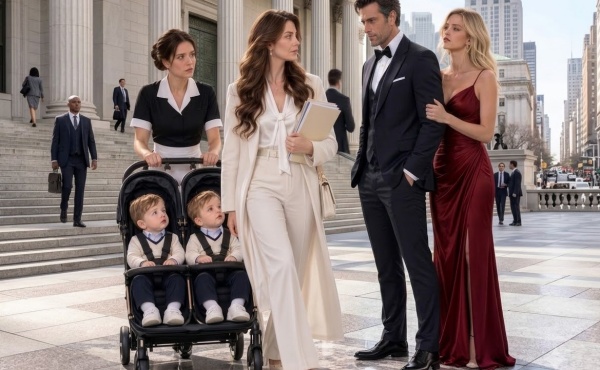
My billionaire husband walked out of our divorce hearing with his supermodel mistress clinging to his arm, both of them laughing as cameras captured my humiliation. He thought he had traded his ordinary wife for the perfect woman and won everything. But there was one secret I hadn’t revealed in that courtroom—and when it finally came to light, his billion-dollar future would never be the same.
Part 1: The Courthouse Steps
My billionaire husband walked out of our divorce hearing with his supermodel mistress wrapped around his waist, smiling as she humiliated me in front of the cameras. He thought he had finally escaped an ordinary wife, never imagining that the secret I was carrying would one day change everything he believed about his future. But what happened outside that courthouse wasn’t even the most shocking part of the day.
The hearing had lasted less than an hour. After months of negotiations, my attorney and I had reached an agreement with Daniel about the division of our property. The judge asked a few questions, reviewed the paperwork, and told us what would happen next.
I had expected to feel triumphant or devastated. Instead, I felt hungry, tired, and slightly dizzy. At seven that morning, before putting on my navy dress and driving to the courthouse, I had taken a pregnancy test.
Then I had taken another one.
Both tests showed the same result. My doctor’s office had arranged an appointment for the following day, but nothing about the morning had given me time to sit quietly with the possibility that I was pregnant. I had folded the tests into a paper bag and left them in the back of my bathroom cabinet.
Daniel and I had separated eight weeks earlier. We had also spent one confusing night together after the separation, when his mother was in the hospital and neither of us knew how to say goodbye to the life we had built. The following morning, he returned to his apartment, and we agreed it had changed nothing about the divorce.
Now it might have changed a great deal.
My attorney, Marisol Vega, walked beside me toward the courthouse doors. She asked whether I wanted to wait inside until the photographers left. I told her I didn’t want to spend another minute hiding because Daniel had invited an audience.
He had not technically invited the photographers, according to his publicist. They had apparently learned that Sloane Madison, the model Daniel had been seeing, would attend the hearing. Sloane had millions of followers, a face on billboards from New York to Los Angeles, and a talent for making an ordinary sidewalk look like a runway.
She had not come into the courtroom. She waited outside in a cream-colored coat and oversized sunglasses, standing beside a black SUV. When Daniel emerged, she stepped toward him and wrapped her arms around his waist.
The cameras began clicking.
Daniel smiled and placed a hand on her back. For a second, I saw the man I had married: handsome, composed, and delighted when a room turned toward him. Then Sloane looked over his shoulder and saw me standing near the doors.
One photographer asked whether she was excited about “a fresh start.” Sloane smiled and said, “I think Daniel’s ready for a life that finally matches who he is.” She looked me up and down before adding, “Some people are happier staying ordinary.”
Several people laughed. I couldn’t tell whether they were laughing at the comment or because they hoped another one would follow. Daniel heard it too, and he did not ask her to stop.
I had spent twelve years being described as ordinary by people who thought the word was an insult. I taught elementary school for the first half of our marriage, volunteered at the neighborhood library, and preferred making dinner at home to attending parties where the napkins had their own staff. Daniel used to say those were the things he loved about me.
After his company grew, his favorite stories changed. He talked about investors, magazine covers, and the houses we might buy in places I had never wanted to live. When someone asked what I did, he sometimes answered before I could: “Emma keeps me grounded.”
At first, I thought it was sweet. Eventually, I realized he said it when he wanted people to admire him for having a wife who didn’t compete for attention. Being grounded was useful, as long as I remained exactly where he left me.
Marisol touched my elbow. “The car is around the corner,” she said.
I nodded and began walking. A photographer called my name and asked whether I had a response to Sloane’s comment. I could have said many things, but none of them needed to become a headline while I was still trying to understand the two tests in my bathroom.
“No,” I said.
Daniel called after me. “Emma, can we talk?”
I turned. He had stepped away from Sloane, though her hand remained on his sleeve. His expression was serious now, and I wondered whether he regretted the comment or simply disliked being seen as the man who had allowed it.
“Not here,” I said.
“I just want to make sure you’re okay.”
Sloane’s hand slipped from his sleeve. I looked at the cameras, then at Daniel. “You could have asked that before we came outside.”
He opened his mouth, but I kept walking. Marisol and I reached the car, and the driver pulled away before anyone could ask another question. I watched the courthouse disappear behind us and rested my hand over my stomach.
Marisol noticed. “Are you feeling sick?”
“A little.”
“Do you want me to take you to a doctor?”
“I have an appointment tomorrow.”
She waited. Marisol had represented me for nearly six months, and she knew when a sentence carried more than I was ready to say. I looked out the window at the traffic and decided I trusted her with the truth.
“I think I’m pregnant.”
She did not gasp or ask whether I was certain Daniel was the father. She asked when I had taken the test, whether I had spoken to my doctor, and whether I had support at home. Then she said we could discuss any legal questions once I had medical confirmation and felt ready.
“I don’t want him to hear it from a photographer,” I said.
“Then we’ll make sure you decide how to tell him.”
The car stopped outside my apartment building in Brooklyn. I had moved there after the separation because I wanted a place where I could walk to the grocery store and hear children playing in the courtyard. Daniel had offered to pay for a larger apartment in Manhattan, but I chose a smaller one I could make feel like mine.
A package was waiting with the doorman. It was a plain brown box addressed in handwriting I recognized immediately. The return label belonged to my late mother-in-law’s attorney.
Ruth had died four months earlier after a short illness. She and I had remained close even as my marriage fell apart, and I still reached for my phone sometimes when I saw a recipe she would have liked. Her attorney had told me there might be a few personal items Ruth wanted me to have.
I carried the box upstairs and opened it at my kitchen table. Inside were a silver picture frame, a blue scarf, and an envelope with my name on it. Beneath the envelope was a second letter, sealed and addressed to Daniel.
I opened mine first.
Emma, if you’re reading this, I have left you with a burden I should have handled myself. Before you give Daniel the enclosed letter, please read the pages beneath it. I need you to understand why I was afraid to tell him the truth.
At the bottom of the box was a photograph of a young woman holding a baby. On the back, Ruth had written a date from twenty-two years earlier and a single sentence.
This is Daniel’s son.
Part 2: The Child Nobody Mentioned
I sat at the kitchen table until the light began to fade. The woman in the photograph looked about twenty, with dark hair pulled back and a blanket tucked beneath her arm. The baby’s face was partly hidden, but one tiny hand rested against her shoulder.
Daniel had never told me he had a child before we met. He had spoken about college girlfriends and one serious relationship that ended when he was twenty-one. He said the breakup had been painful, but he never explained why.
I turned the photograph over again. Ruth’s handwriting was unmistakable: careful, slightly slanted, with the final stroke of each letter curling upward. I had seen it on birthday cards, grocery lists, and the labels she placed on jars of homemade jam.
Beneath the photograph was a longer letter addressed to me. Ruth wrote that the young woman’s name was Julia Bennett and that she had dated Daniel during his last years of college. Ruth had met her several times and remembered her as thoughtful, funny, and unwilling to flatter anyone.
According to the letter, Julia became pregnant shortly before she and Daniel separated. Ruth said she had spoken to Julia after the breakup and had made a decision she regretted for the rest of her life. She did not describe every conversation, but what she wrote was enough to make me put the letter down.
I told Julia that Daniel knew about the pregnancy and wanted no part of it. That was not true.
I read the sentence again. Ruth claimed she had persuaded Julia not to contact Daniel directly, saying it would damage his future and make the situation harder for everyone. Julia later chose adoption for her child, and Ruth did not tell Daniel that the baby had been born.
The letter did not suggest that Ruth had arranged the adoption or had the authority to make Julia’s decision. It said Julia worked with an agency and made her own choice about the baby’s care. Ruth’s wrongdoing, as she described it, was giving Julia false information about Daniel’s wishes and keeping the pregnancy from him.
I wanted to call Daniel immediately. I also knew I had only Ruth’s account and a photograph. A letter written years after the fact could be important, but it could not settle every question about what happened or establish a biological relationship on its own.
There was another detail Ruth had included. Several years before her death, Julia contacted her again. The child was now an adult and had asked questions about his biological family and medical history.
Julia told me she had been in touch with him with his agreement. She said his name is Noah. I wanted to tell Daniel then, but I was ashamed of what I had done and afraid that telling him would reopen a wound for everyone.
Ruth had written that she eventually gave Julia a way to contact her attorney. She did not claim Noah wanted a relationship with Daniel. In fact, she wrote that he might want nothing more than accurate information.
Please do not turn him into a secret to be solved, Ruth wrote. He is a person with a life and a family of his own. If he wants contact, let him choose it.
I called Ruth’s attorney, Margaret Bell, the next morning. She confirmed that Ruth had asked her to send me the box after the divorce hearing. She also explained that she could not disclose private information about Julia or Noah beyond what she was authorized to share.
“Why send it to me?” I asked.
“Ruth trusted you to be careful.”
“She could have sent Daniel the letter directly.”
“She could have.” Margaret paused. “I asked her that.”
“What did she say?”
“She said she was afraid he would react before considering how the other people involved might feel. She hoped you would read her letter first and encourage him to proceed thoughtfully.”
I wanted to be angry with Ruth, and I was. I also remembered the woman who brought soup when I had the flu and sat with me through a difficult winter after my father died. Loving someone did not require me to pretend they had never made a cruel or cowardly choice.
“Is Noah expecting Daniel to contact him?” I asked.
“I don’t know. Julia has a way to reach my office if she or Noah wishes to share information. I would not assume either of them wants contact.”
The distinction mattered. Ruth’s letter had placed a story in my hands, but it had not given me the right to publish someone else’s life or arrange a reunion. I told Margaret I would speak with Marisol and think about the best way to give Daniel his letter.
My doctor confirmed the pregnancy that afternoon. It was early, and she gave me information about what to expect and which follow-up appointments to schedule. I listened, asked questions, and tried to absorb the idea that my body was beginning something my marriage had not survived.
When I left the office, I sat on a bench outside and called my sister, Kate. She lived in New Jersey with her husband and two children, and she had been the first person I called when Daniel and I separated. I told her about the pregnancy before I told her about Ruth’s box.
“Are you okay?” she asked.
“I think so. I’m scared, and I’m also trying not to get ahead of myself.”
“Do you want me to come over?”
“Yes.”
She arrived that evening with soup, crackers, and the ability to listen without turning my life into a problem she could solve in one conversation. I showed her Ruth’s letter and the photograph. She read everything slowly, then placed the pages back on the table.
“You need to tell Daniel,” she said.
“I know.”
“About both things?”
“I think so.”
“Do you want to tell him together?”
“I don’t know. I don’t want him to think one is leverage for the other.”
Kate nodded. “Then don’t make it one conversation.”
The next morning, I asked Marisol how the pregnancy might affect the legal arrangements we had made. She explained that I should not assume the divorce paperwork resolved future questions involving a child. She recommended that I get advice about the relevant legal and parenting matters and discuss them with Daniel when I felt ready.
I called him that afternoon. He answered on the second ring, sounding distracted until I said I needed to speak with him privately. We agreed to meet at a quiet café near my apartment.
He arrived without Sloane or a publicist. He wore a baseball cap and a dark jacket, though I doubted anyone would fail to recognize him if they looked closely. He sat across from me and asked whether something had happened.
“I’m pregnant,” I said.
He stared at me. “Are you sure?”
“My doctor confirmed it.”
He leaned back, his hand covering his mouth. We had talked about having children during the first years of our marriage, but later he told me he was no longer sure he wanted them. I had believed him because he sounded certain, and eventually I stopped raising the subject.
“Is the baby mine?” he asked.
“Yes.”
He looked down at the table. “I don’t know what to say.”
“You don’t have to say everything today.”
“I thought we were done.”
“Our marriage is ending. That doesn’t mean we can avoid talking about a child.”
He nodded slowly. “Does anyone else know?”
“My sister and my attorney.”
“What do you want me to do?”
“Start by keeping this private. I need time to think, and I don’t want our situation discussed in public.”
He agreed. For the first time in months, he did not try to shape the conversation into something that made him look composed. He looked frightened and uncertain, and I suspected I did too.
I did not mention Ruth’s letter that day. I wanted him to have time to absorb the pregnancy, and I needed to decide how to deliver the second piece of news without turning Noah into an announcement. Two days later, Margaret called with information that changed the decision again.
“Julia contacted my office,” she said. “Noah has asked whether Daniel has received Ruth’s letter.”
Part 3: The Young Man With the Red Guitar
Noah was twenty-two and lived in Philadelphia. He worked at a music store while finishing classes at a community college, according to the limited information Julia had given Margaret permission to share. He had a mother and father who had raised him, a younger sister, and a red guitar he had owned since high school.
I learned about the guitar because he mentioned it in an email to Margaret. He wrote that he did not know what to say in a message to a man who might be his biological father. He said music was the easiest place to begin because it had always made his life feel like his own.
He was not asking Daniel for money. He was not asking to be introduced at a public event or added to a family photograph. He wanted accurate medical history, and he was willing to consider a conversation if Daniel was respectful.
Margaret forwarded the message with Noah’s permission. I read it twice, struck by how carefully he had written to people who had been keeping secrets long before he was born. He ended with a sentence that made me think Ruth had finally understood something she should have known decades earlier.
I already have a family. I’m just trying to understand another part of my story.
I called Daniel and told him his mother had left a letter for him. He sounded wary, perhaps expecting a dispute about jewelry or a family photograph. When I said the letter concerned something Ruth had kept from him, he asked me to bring it to his apartment.
“I think you should read it somewhere private,” I said.
“My apartment is private.”
“Then I’ll bring it.”
Sloane was there when I arrived. She opened the door wearing jeans, a gray sweater, and no visible makeup. Without the cameras and the cream-colored coat, she looked younger and less certain of what role she was supposed to play.
“Daniel said you were coming,” she said.
“I’m here to give him something from Ruth.”
She stepped aside. I had expected to feel anger at the sight of her, and I did. But the letter in my bag had traveled through too many years of other people’s decisions for me to turn the visit into a confrontation about the courthouse.
Daniel came out of the kitchen holding a glass of water. I handed him the envelope and explained that Margaret had sent it to me because Ruth wanted me to read some background first. I also told him Julia and Noah deserved privacy and that nothing should be assumed before he read what Ruth wrote.
He opened the envelope while standing beside the dining table. After the first page, he sat down. Sloane remained near the doorway, and I wondered whether she knew she should leave.
“My mother says I have a son,” he said.
“She says you may have a son. Noah is willing to discuss confirming the relationship if you both choose.”
He looked up sharply. “You knew?”
“I learned about the letter after the hearing.”
“And you waited?”
“I spoke with Margaret because I didn’t know whether he wanted contact. I wasn’t going to hand you a name and let you decide what happened to someone else.”
He looked back at the page. “Julia told me she wasn’t pregnant.”
Ruth’s letter addressed that too. She claimed Julia had initially believed she was pregnant, then told Daniel she had been mistaken after Ruth insisted that he did not want a child and urged her to end contact. Julia’s account would be important, but the letter was the first explanation Daniel had seen.
“She told you that?” I asked.
“Yes. We were both relieved—or I thought we were.” He pressed his fingers against his forehead. “We broke up a few weeks later.”
Sloane moved toward the kitchen. “I can give you two some privacy.”
Daniel nodded without looking at her. She left the room, and I heard a door close farther down the hall. I sat across from him while he finished reading.
He stopped at the paragraph about Noah’s adulthood. “He has parents.”
“Yes.”
“And he wants medical information.”
“He may be open to talking too. That’s his choice.”
Daniel set the letter down. “I would have helped Julia.”
“I believe you might have.”
“You sound like you’re not sure.”
“I wasn’t there, Daniel. Neither of us can know exactly what would have happened.”
He flinched, but I did not take the sentence back. I knew he was grieving the possibility of years he had lost, and he deserved compassion. I also knew that imagining the father he would have been was different from knowing what Julia and Noah had lived through.
He read Noah’s email next. When he reached the part about the red guitar, he smiled briefly. “I played guitar in college,” he said.
“That could be a coincidence.”
“I know.”
“He already has a life. He isn’t waiting for you to give him one.”
“I know that too.”
He asked whether I would contact Margaret with him. I said I would give him her number, but I thought he should communicate directly and let Noah decide what he wanted. I had carried Ruth’s letter as far as it needed me to carry it.
Before I left, Sloane came back into the room. Daniel told her, in general terms, that Ruth had left him difficult family information. He did not share Noah’s name, and I was relieved he respected the privacy I had asked for.
At the door, Sloane stopped me. “I owe you an apology for what I said outside the courthouse.”
I looked at her. “Yes, you do.”
“I wanted to say something clever, and I knew the cameras were there. It was unkind.”
“It was.”
“I’m sorry.”
I appreciated that she did not say she had been misunderstood. I also did not feel obligated to make her comfortable. “Thank you for saying it,” I replied, and left.
Over the next few weeks, Daniel and Noah exchanged messages through Margaret’s office, then directly once Noah felt comfortable. They shared basic medical information and agreed that any questions about biological relationship should be handled privately and voluntarily. Later, with appropriate testing and consent, they confirmed that Daniel was Noah’s biological father.
Daniel called me after receiving the result. He did not sound triumphant. He sounded like a man trying to understand how an entire person could exist in the world without him knowing.
“He says his dad taught him to drive,” Daniel said.
“That’s good.”
“He calls him Dad.”
“He is his dad.”
“I know. I just keep thinking about what I missed.”
“You can grieve that without taking anything away from the family he has.”
He was quiet. Then he said, “He asked if I wanted to meet for coffee.”
“Do you?”
“Yes. I’m terrified.”
“That sounds like a reasonable place to start.”
By then, Daniel had attended one prenatal appointment with me, with my agreement. He had asked thoughtful questions and stayed afterward to make sure I had a ride home. He had also told Sloane about the pregnancy, because a secret involving a future child was not something we could keep from her indefinitely.
She did not contact me about it. Daniel said she needed time, and I understood that. Everyone involved was being asked to reconsider a future they thought they had already chosen.
The week before Daniel met Noah, another envelope arrived from Margaret. It contained copies of letters Ruth had kept but had never sent. One was from Julia, dated a few months after Noah’s birth.
In it, Julia had written that she did not expect Daniel to change her decision. She only wanted him to know the truth. At the bottom, in Ruth’s handwriting, were three words: Not yet. Protect him.
Part 4: What Protection Cost
Daniel read Julia’s letter in Margaret’s office. He asked me to come, and after checking that no one else’s privacy would be compromised, I agreed. I sat beside him while he held the pages in both hands.
Julia’s letter was not dramatic. She described the baby’s birth, said the adoption plan had been made carefully, and wrote that she hoped Daniel would someday know he had a son. She did not ask Ruth for money or demand that Daniel contact her.
At the end, she wrote: I don’t need him to fix anything. I just don’t want him to spend his life believing something that isn’t true.
Ruth had kept the letter in a folder with financial statements and family documents. Margaret found it while completing a review of Ruth’s personal papers. There was no evidence that Daniel had seen it before.
He sat very still. “She decided I couldn’t handle it.”
“It looks that way,” I said.
“She told me Julia wanted nothing to do with me.”
“That may have been easier for her to say than admitting what she had done.”
Daniel shook his head. “My mother was the person who told me to take responsibility for my choices.”
“People can give good advice and still fail to follow it.”
He let out a short laugh that held no humor. “You sound like her.”
“I learned a few things from her.”
He looked at me, and for a moment we shared the grief of missing Ruth and the anger of discovering what she had hidden. Those feelings did not cancel each other. They sat beside one another, uncomfortable and real.
Daniel asked Margaret whether Julia would be willing to speak with him. Margaret said she could pass along the request, but Julia was free to decline. He agreed and wrote a short note thanking her for the information and apologizing for any hurt caused by his family’s actions.
Julia responded a week later. She agreed to one phone call, with no promise of a continuing relationship. Before the call, Daniel asked me what he should say.
“Listen more than you explain,” I told him.
He smiled faintly. “That has never been my strongest skill.”
“I know.”
Afterward, he called me from his car. He said Julia had described being frightened, young, and unsure whom to trust. She had believed Ruth when Ruth said Daniel did not want to be involved, and by the time she learned that might not be true, years had passed.
“She doesn’t regret the family Noah grew up with,” Daniel said. “She was very clear about that.”
“Then believe her.”
“I do. She said his parents gave him a good life.”
“That’s something to be grateful for.”
“She also said she’s angry with my mother.” His voice caught. “I wanted to defend Ruth, and then I realized Julia wasn’t asking me to.”
A few days later, Daniel met Noah at a coffee shop in Philadelphia. He took the train alone and left his publicist at home. Noah chose the location because it was familiar and because he could leave whenever he wanted.
Daniel sent me one message afterward: We talked for two hours. He likes terrible coffee and excellent music.
I smiled when I read it. Then I put the phone down and went back to assembling a small bookshelf in the room I planned to use as a nursery. One of the shelves was upside down, and I had to take it apart twice before I understood the instructions.
My pregnancy progressed, and the questions Daniel and I needed to answer became more practical. We discussed appointments, expenses, where the baby would sleep during visits, and how we would communicate when we disagreed. Marisol recommended that I speak with a family law attorney about a parenting agreement rather than rely on informal promises.
Daniel hired his own attorney. The conversations were not always comfortable, but they were clearer than many of the conversations we had during our marriage. We were finally writing down expectations instead of assuming the other person had heard what we meant.
Sloane and Daniel’s relationship ended before the baby was born. He told me briefly and did not ask me to discuss the reasons. I was sorry for the pain it caused them, but I did not mistake their breakup for an invitation to rebuild our marriage.
Sloane sent me a private message a few weeks later. She said she hoped the pregnancy was going well and repeated her apology for the courthouse. I thanked her and wished her well, and we left it there.
Daniel and Noah continued talking. Sometimes they discussed family history; other times they argued cheerfully about which musician deserved to be called the greatest guitarist of all time. Noah’s parents knew about the contact, and Daniel made a point of respecting the role they had always played in his life.
One Saturday, Noah came to New York for lunch. Daniel asked whether I would like to meet him, but only if Noah was comfortable. I said yes, and Noah chose a small restaurant where we could sit without attracting attention.
He arrived carrying the red guitar in a worn case because he had a lesson later that afternoon. He was taller than Daniel, with Julia’s dark hair and an expression that reminded me of Ruth when she was deciding whether to trust someone. He shook my hand and asked whether I was tired of people commenting on my pregnancy.
“Very,” I said.
“Good. I had a whole list of things not to say.”
Daniel laughed, and some of the tension left the table. We talked about music, the restaurant’s unusually large sandwiches, and the fact that Noah’s younger sister was apparently better than he was at every board game they played. Nobody asked him to perform gratitude for the meeting.
Before we left, Noah looked at my stomach. “So I’m going to have a little sibling.”
“If you want to think of it that way,” I said.
“I do.” He smiled. “But I’m still getting used to the idea.”
“So are we.”
Outside, Daniel offered to buy him a new guitar case. Noah looked at the one in his hand and said it was fine. Daniel nodded, though I could see the familiar impulse to solve a problem with money.
Later, Noah told him what he actually wanted: a recording of Ruth’s voice, if one existed. Daniel searched through old family videos and found her singing badly while cooking Thanksgiving dinner. Noah listened to it privately and asked whether he could keep a copy.
The request surprised Daniel. He had imagined Noah might want a piece of jewelry or a formal introduction to the family business. Instead, Noah wanted to hear the grandmother he would never meet.
Ruth’s voice filled Daniel’s apartment for the first time in months. She was arguing cheerfully with someone about whether there was enough butter in the potatoes. In the background, Daniel could hear himself laughing.
“She sounds happy,” Noah said.
“She was,” Daniel replied. “And she was complicated.”
Noah nodded. “I think most people are.”
Part 5: An Ordinary Life
Our daughter was born on a clear morning in October. I had chosen Kate as my support person during labor, and Daniel waited nearby until I was ready for him to come in. When the nurse placed the baby in my arms, her eyes were closed and her hands were curled into two tiny fists.
I named her Ruth, but we called her Ruby. It was a name Daniel and I had liked years earlier, before we began treating every conversation about the future as something to postpone. I had wondered whether using it would hurt, but when I saw her face, the name felt like hers.
Daniel came into the room carrying a blanket and looking more nervous than he had at any business meeting I had ever seen. He asked before taking a photograph and asked again before holding her. Those small questions mattered to me.
“She’s beautiful,” he said.
“She is.”
“She has your nose.”
“Everyone says babies have someone’s nose.”
He smiled. “Then she has an excellent nose.”
We followed the parenting arrangements we had begun discussing before Ruby’s birth and adjusted them with professional advice as her needs changed. Daniel spent time with her regularly, and I learned that co-parenting required patience even when both people wanted to do well. Some conversations were easy; others involved three messages about a missing sweater.
Money was not the difficult part. Daniel could afford excellent childcare and a comfortable home, and he offered to cover more than the basic expenses we had discussed. I wanted Ruby to have security, but I also wanted decisions about her life to be made with care rather than purchased in a rush.
When she was six weeks old, he arrived with an elaborate stroller that looked as if it could travel to another state without assistance. It was too large for the narrow hallway in my building. We returned it and chose a simpler one that fit in the elevator.
“I thought the expensive one would be better,” he admitted.
“The one we can actually use is better.”
He laughed. “That sounds like something Ruth would have said.”
“She would have asked whether it came with someone to carry it upstairs.”
Noah met Ruby when she was two months old. He came to my apartment with Daniel and brought a soft toy shaped like a guitar. Ruby stared at him solemnly, then fell asleep while he held her.
“I think I’m making a strong impression,” he said.
“She sleeps through most of our best material,” I replied.
He stayed for lunch and told me about a song he was writing. Daniel listened, asking questions without offering to introduce him to a producer or buy him equipment. I could see the effort it took for him to let the conversation be enough.
After they left, I found a small note tucked beside Ruby’s toy. Noah had written, For my little sister: I promise to teach you the important things, like how to make too much noise and blame someone else. I put it in her keepsake box next to the first photograph I had taken of them together.
Daniel’s relationship with Noah grew slowly. There were dinners, missed calls, and moments when one of them said the wrong thing. They did not become close because a test confirmed a biological connection; they became closer because they kept choosing to learn about each other.
Noah’s parents remained central in his life. Daniel met them at a small family gathering, where Noah’s dad told a story about teaching him to drive a car with a stubborn manual transmission. Daniel listened and thanked him for caring for Noah, without suggesting he could repay twenty-two years of parenting.
A few months later, a magazine published a profile of Daniel. The interviewer asked about his divorce, his business, and whether he regretted how his public life had affected his family. Daniel said he had learned to be more protective of the people around him and declined to discuss details about his children.
The article referred to me as his former wife and noted that I had returned to teaching part-time. It did not call me ordinary, though I would not have minded if it had. I had spent enough time being measured against someone else’s idea of importance.
I taught third grade at a public school a short subway ride from my apartment. My students argued about whose turn it was to feed the classroom fish and wrote stories in which dogs solved mysteries. At the end of the day, I came home tired in a way that made sense to me.
Daniel sometimes asked whether I needed a larger apartment or a car. I told him when I needed help and when I didn’t. The difference was that he had finally learned to ask instead of deciding for me.
On Ruby’s first birthday, we held a small party in the courtyard of my building. Kate brought cupcakes, Noah brought his guitar, and Daniel arrived with balloons that immediately tangled around the gate. My neighbors came downstairs with their children, and the courtyard filled with the kind of noise Daniel had once said he found overwhelming.
He sat on the ground beside Ruby while she investigated a cupcake with both hands. Noah played a song softly enough that the children could still shout over it. At one point, Daniel looked up at me and smiled.
“I never imagined this,” he said.
“Which part?”
“All of it. Noah, Ruby, a birthday party in a courtyard with a bubble machine that won’t stop.”
“The bubble machine was Kate’s idea.”
“Of course it was.”
I looked at our daughter, at Noah helping a little boy catch bubbles, and at the neighbors balancing paper plates on their knees. The scene was not glamorous. It was also not the life Daniel had once described to interviewers when he spoke about the future.
He had believed he was leaving an ordinary wife behind. He had believed the marriage ended neatly at the courthouse doors. He had believed the family he knew was the whole story.
He had been wrong about all three.
When the party ended, Daniel helped carry folding chairs back inside. He did not ask whether I regretted the divorce, and I did not ask whether he regretted the photograph taken outside the courthouse. We had moved beyond needing that moment to explain everything.
As he was leaving, he stopped beside the gate. “I should have said something when Sloane made that comment.”
“Yes,” I said. “You should have.”
“I’m sorry.”
I nodded. The apology arrived late, but it was still honest. I did not need to turn it into a promise about who we would be to each other.
That evening, after Ruby was asleep, I opened the box Ruth had left me. Her blue scarf was folded beneath the silver frame, and the letters were in a separate envelope marked PRIVATE. I had given Daniel what belonged to him and returned the original photograph to Margaret for Julia and Noah to discuss.
I kept Ruth’s letter to me. It reminded me that love and disappointment could exist in the same place, and that protecting someone sometimes requires telling the truth rather than hiding it. I wished she had learned that sooner.
Before closing the box, I took out a photograph from Ruby’s party. She was sitting between Daniel and Noah, reaching for a bubble that had drifted just beyond her hand. None of them looked at the camera.
The picture was imperfect. Daniel’s eyes were closed, Noah’s hair had blown across his face, and Ruby had frosting on the front of her dress. I put it in the silver frame anyway.
The cameras outside the courthouse had captured a woman leaving her marriage while another woman smiled beside her husband. They had not captured the rest of the story: the child I was carrying, the young man discovering a new branch of his family, or the work it took for all of us to respect one another’s choices.
My life did not become valuable because Daniel learned what he had lost. It had been valuable when I taught school, bought groceries, and stayed home to make dinner. It was valuable now, with a daughter asleep in the next room and a stack of ungraded spelling tests on my table.
I turned off the lamp and checked on Ruby before going to bed. Her blanket had slipped down, so I tucked it around her and listened to her breathe. Outside, the courtyard was quiet, and tomorrow promised another wonderfully ordinary day.
