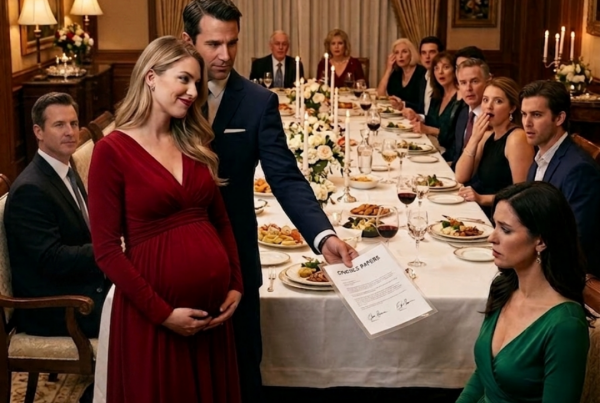
At the Whitmore mansion, I was offered a seat at the far end of the table while my husband’s pregnant mistress sat beside him like the future Mrs. Whitmore. My husband called the divorce “respectful” and asked me not to embarrass his family. What he did not know was…
Part 1: The Chair At The Head Of The Table
The first thing I noticed was not the woman’s face.
It was the chair.
My chair.
The high-backed walnut chair at the right hand of my mother-in-law’s dining table, the one I had sat in for nine years of Sunday dinners, charity luncheons, Thanksgiving arguments, and Christmas mornings staged like magazine spreads.
That chair was where I had learned to smile while Grant’s mother corrected my posture. It was where I had passed serving bowls of rosemary potatoes while listening to the Whitmore family discuss money as if it were weather. It was where I had placed my hand over Grant’s under the table when his father died and the entire room looked to him to become the next king of their small Connecticut empire.
Now another woman sat there.
She was young, maybe twenty-eight, with glossy brown hair, a cream sweater dress, and one hand resting carefully over the swell of her pregnant stomach. A delicate gold bracelet circled her wrist. Her nails were pale pink, perfect and still.
Grant stood behind her chair.
My husband’s hand rested on her shoulder.
For a moment, I honestly thought I had walked into the wrong room. The dining room looked familiar—the long mahogany table, the silver candlesticks, the oil portrait of Grant’s grandfather above the fireplace, the view of the private grounds stretching behind the Whitmore mansion in Greenwich. But the scene itself belonged to someone else’s life.
Grant’s mother, Eleanor Whitmore, sat at the head of the table in winter-white cashmere, her pearls glowing softly against her throat. She did not look surprised to see me. That was how I knew everyone had been waiting.
“Lydia,” she said, as if I had arrived late to brunch instead of being summoned into an ambush. “Please sit down.”
There were eleven chairs around that table.
Only one had been pulled out for me.
It was near the far end, beside the sideboard, where temporary guests sat when family overflowed into obligation.
I looked at Grant.
He avoided my eyes.
That hurt more than I expected.
Grant Whitmore could sell a condemned building to a nun and make her thank him for the opportunity. He had built his career on eye contact, charm, and the kind of smile that made bankers forget to ask second questions. But that afternoon, standing in his mother’s mansion with his pregnant mistress under his hand, he could not look at his wife.
The woman in my chair looked at me with careful softness.
“I’m sorry,” she said.
Her voice was small, almost rehearsed.
I wanted to hate her immediately. It would have been easier. But hatred requires certainty, and all I felt in that moment was the strange coldness that arrives when your body understands betrayal before your mind accepts it.
Grant cleared his throat.
“Lydia,” he said, finally looking up. “This is Madison.”
Madison.
Not “Ms. Carter from the office.” Not “a friend.” Not “someone you should hear about from me.”
Just Madison.
As if her name belonged in the room.
As if she had not been placed in my chair like a verdict.
My coat was still buttoned. Snow clung to the hem from the front walk. Outside, a black SUV idled near the circular driveway, its exhaust curling into the pale January air. I had driven forty minutes from our brownstone in Westport because Eleanor’s assistant had called and said there was a family matter too important to discuss over the phone.
I had thought someone was sick.
In a way, I was right.
“Is this a joke?” I asked.
No one answered.
Grant reached into the leather folder on the table. That was when I saw the papers.
Legal papers.
My stomach tightened.
“Sit down,” Eleanor said again, colder this time.
I did not.
Grant picked up the documents and slid them across the polished table toward the empty chair meant for me.
Divorce papers.
My name was printed in neat black letters.
Lydia Anne Whitmore.
I stared at the page as though it might change if I refused to blink. The legal language blurred in front of me: dissolution of marriage, division of assets, confidentiality clause, mutual non-disparagement, private settlement.
Grant’s voice became gentle, the way it did when he wanted to sound reasonable.
“This does not have to become ugly.”
I almost laughed.
The woman in my chair touched her stomach. Eleanor noticed and gave her a reassuring look.
A reassuring look.
In nine years, Eleanor Whitmore had never looked at me like that.
“Madison is pregnant,” Grant said.
“Yes,” I said. “I can see that.”
His jaw tightened. “The baby is mine.”
The room went silent after that, as if even the walls wanted to hear how I would break.
I thought of the three fertility clinics. The injections I gave myself in hotel bathrooms during Grant’s business trips. The ultrasound rooms where doctors used phrases like “low probability” and “another round if you feel ready.” I thought of the nursery I had once painted soft yellow before we quietly turned it into a guest room.
Grant had held me after the second miscarriage and whispered that it did not matter. That I was enough. That we were enough.
Now his pregnant mistress sat in my chair while his mother watched me like I was a problem to be solved.
I looked at Madison’s stomach again.
Then I looked at Grant.
“How long?” I asked.
He exhaled. “Lydia, that’s not productive.”
“How long?”
Madison lowered her eyes.
Grant said nothing.
Eleanor answered instead.
“That does not matter now.”
I turned to her. “It matters to me.”
Her expression hardened. “What matters is how this family moves forward.”
This family.
Not my marriage. Not my pain. Not the vow Grant had made before two hundred guests at St. Michael’s Episcopal Church while my father stood beside me trying not to cry.
This family.
The Whitmore name.
Grant pushed the papers a little closer.
“We’re prepared to be generous,” he said. “You’ll keep the Westport house for twelve months, then we’ll list it. You’ll receive a settlement, plus continued health insurance coverage through the transition. The foundation will announce that you’re stepping down for personal reasons.”
I stared at him.
“You planned the press release?”
“It’s not a press release,” Eleanor said sharply. “It’s a statement.”
Of course. In Eleanor’s world, betrayal became “transition,” adultery became “a private family matter,” and a wife being replaced by a pregnant mistress became “how this family moves forward.”
Grant sat down beside Madison.
Not beside me.
Beside her.
“That’s why we wanted to speak in person,” he said. “This can be handled quietly. Respectfully. No one has to be humiliated.”
I smiled then.
Not because anything was funny.
Because I finally understood the meeting.
They had not called me there to confess.
They had called me there to cooperate.
“You want me to protect your family name,” I said.
Grant’s face showed relief, as if I had finally found the script.
“Yes,” he said. “Exactly.”
Eleanor leaned forward. “You have been part of this family for nearly a decade, Lydia. You understand what is at stake. Whitmore Development employs more than four hundred people. We have donors, partners, board seats, legacy commitments. Scandal helps no one.”
“And Madison?” I asked.
Madison flinched.
Grant’s hand tightened on her shoulder. “Madison will not be part of any public discussion.”
“Convenient.”
“She’s carrying my child,” he said.
The sentence entered the room like a weapon wrapped in silk.
I felt it land exactly where he intended.
My breath caught, but I did not cry. Not there. Not in front of Eleanor’s portraited ancestors and polished silver and the woman who had been given my chair before I had been given the truth.
Instead, I picked up the divorce papers.
The settlement offer was insulting only because they expected me to call it generous. The Westport house was not theirs to offer for twelve months. My father had helped purchase it before the marriage, and Grant knew that. Or he should have.
There were other mistakes too.
Small ones at first.
Then a large one.
A very large one.
I read the paragraph twice.
Then I looked at Grant’s signature line, blank and waiting.
“Who prepared this?” I asked.
“Our attorneys,” Eleanor said.
“Your attorneys,” I corrected.
Grant frowned. “Lydia—”
“Did you read it?”
He looked irritated. “Of course I read it.”
That was a lie.
Grant never read documents when he trusted the people around him to protect him. He skimmed, signed, and smiled for the cameras. He had been doing it since his mother taught him that confidence mattered more than comprehension.
My father had warned me about that once.
A memory rose so suddenly I nearly lost my breath.
Dad sitting at our old kitchen table in New Haven, reading glasses low on his nose, sliding a folder toward me three months before my wedding. He was already sick then, though none of us said it plainly. His hands trembled when he turned pages, but his voice was steady.
“Love Grant if you choose,” he had told me. “But never let love make you careless.”
I had rolled my eyes, twenty-seven and certain that romance made caution look ugly.
Dad had tapped one page with his finger.
“There is one sentence in here that matters more than the rest. If the Whitmores ever forget what they owe you, that sentence will remind them.”
I had signed where he told me to sign.
Then I filed the document away and built a life with Grant.
Nine years later, sitting in Eleanor Whitmore’s mansion with divorce papers in my hand, I remembered.
One sentence.
Grant had never read it.
But my father had hidden it exactly where he knew men like Grant would not look.
In the operating agreement of Whitmore Harbor Holdings.
The company that owned the land beneath half of Grant’s empire.
I placed the divorce papers back on the table.
“I need time,” I said.
Eleanor’s eyes narrowed. “How much time?”
“My attorney will contact yours.”
Grant looked annoyed. “That’s not necessary.”
I finally looked directly at him.
“It is now.”
Then I turned and walked out of the dining room before any of them could see my hands shaking.
Behind me, no one followed.
That was their last mistake of the afternoon.
Part 2: The Sentence My Father Left Behind
My father, Thomas Hart, had not come from money.
He came from a two-bedroom apartment over a hardware store in Worcester, Massachusetts, where his mother cleaned offices at night and his father drove a delivery truck until his back gave out. Dad built his first construction company with a borrowed pickup, a used tool belt, and a habit of reading every contract twice.
By the time I was in college, he owned commercial lots across New England.
By the time Grant met me, Dad owned land the Whitmores wanted.
That was the part Grant never liked to remember.
The Whitmores had the name. My father had the dirt.
Not metaphorical dirt. Actual dirt. Acres of waterfront-adjacent parcels, old warehouse sites, mixed-use redevelopment zones, and parking lots that looked unimpressive until zoning changed and suddenly became worth eight figures.
Grant proposed to me before the Harbor Point project closed.
I used to think that timing was romantic.
Now I sat in my car outside Eleanor’s mansion, watching snow collect along the windshield, and wondered how much of my marriage had been a merger with candles.
My phone buzzed.
Grant.
I let it ring.
Then came a text.
“Please don’t make this harder than it has to be.”
I stared at the message until the screen dimmed.
Harder.
There it was. The language of men who break things and then complain about the noise.
I drove straight to my attorney’s office in Stamford.
Rachel Kim had represented my father for years before she represented me. She was precise, calm, and allergic to theatrics. When I walked into her conference room with wet hair, no makeup, and divorce papers under my arm, she did not ask if I wanted tea.
She said, “What did he do?”
I handed her the papers.
“Pregnant mistress,” I said. “Family meeting. My chair.”
Rachel’s expression did not change, but her pen stopped moving.
“Your chair?”
“At Eleanor’s dining table.”
“Ah,” she said. “Symbolic cruelty. Always classy.”
That almost made me laugh.
Almost.
Rachel read the documents in silence. Occasionally, she made small marks with a red pen. By page seven, her eyebrows had lifted. By page twelve, she sat back.
“They’re moving fast,” she said.
“They want silence.”
“They bought the wrong woman.”
I looked down at my hands. My wedding ring caught the overhead light. I had not taken it off yet because removing it felt like giving Grant something before I understood what he had already taken.
“Rachel,” I said, “do you remember the Harbor Holdings document Dad made me sign before the wedding?”
She went still.
“Yes.”
“He said there was one sentence that mattered.”
Rachel’s eyes met mine.
“He was right.”
She stood, crossed to a locked file cabinet, and pulled out a thick binder with a faded label: Hart / Whitmore Harbor Holdings / Original Agreements.
My throat tightened at the sight of my father’s name.
Rachel placed the binder on the table and turned pages with practiced care. She stopped near the back, at an amendment attached to the operating agreement. Her finger landed halfway down the page.
There it was.
One sentence.
“In the event of marital dissolution between Lydia Anne Hart Whitmore and Grant Everett Whitmore, whether initiated privately or through legal filing, all Class B voting units assigned to Grant Everett Whitmore through spousal transfer shall automatically revert to Lydia Anne Hart Whitmore upon written notice.”
I read it once.
Then again.
Then a third time.
Class B voting units.
Rachel waited.
“What does that mean now?” I asked.
“It means,” she said carefully, “that if Grant proceeds with divorce, he loses the voting control your father transferred to him as part of the Harbor Point partnership structure.”
My pulse changed.
The Harbor Point partnership was not just one project. It had become the foundation for Whitmore Development’s most profitable expansion. Luxury apartments, medical office space, retail leases, parking revenue, tax credits, redevelopment rights. Grant’s rise from heir to “visionary CEO” had been built on those assets.
Assets my father had helped him access.
Assets Grant had apparently forgotten came with conditions.
“How much control?” I asked.
Rachel turned another page.
“Enough to remove him from management decisions tied to Harbor properties. Enough to block refinancing. Enough to trigger review clauses with lenders. Enough to make his mother very unhappy.”
For the first time that day, I breathed fully.
Not because I wanted revenge.
At least, not only because of that.
Because my father had known.
Maybe not the affair. Maybe not Madison in my chair. But he had known the Whitmores. He had known charm could curdle into entitlement. He had known that if Grant ever decided I was disposable, he would need a reminder that I was never empty-handed.
Tears blurred my vision.
Rachel slid a box of tissues toward me.
I took one and pressed it under my eyes.
“I was so stupid,” I whispered.
“No,” Rachel said. “You were married.”
“That’s not a defense.”
“It’s not a crime either.”
I looked back at the sentence. The words were dry, legal, almost boring. But beneath them was my father’s voice.
Never let love make you careless.
Rachel closed the binder.
“Here’s what happens now,” she said. “We do not react emotionally. We send formal notice. We preserve records. We review every entity where your father contributed assets, capital, guarantees, or land. We do not sign their agreement. We do not discuss this by text with Grant. And we absolutely do not let Eleanor control the narrative.”
I nodded.
“What about Madison?” I asked.
“What about her?”
“She’s pregnant.”
Rachel’s expression softened slightly. “The baby is not responsible for the adults. But Grant’s child does not erase your rights.”
That sentence mattered too.
The baby was innocent. Madison might not be, but the baby was. I would not become cruel just because cruelty had been done to me.
Still, innocence did not require me to surrender.
That evening, I returned to the Westport house alone.
It was snowing harder now, fat flakes drifting beneath the porch light. The house sat quiet on the hill, all white trim and dark windows, looking like a life still intact from the outside.
Inside, Grant’s shoes were missing from the mudroom.
His golf clubs were gone.
Half his suits had been removed from the closet.
He had not even waited for me to come home before moving out.
Or perhaps he had moved out weeks ago and I had simply been too busy believing him.
I walked from room to room collecting evidence of absence. His watch box empty. His favorite bourbon gone from the bar cart. The framed photo from our trip to Napa missing from his office shelf.
But he had left our wedding photo in the living room.
Of course he had.
Grant always knew which props belonged in which rooms.
I took it down.
In the photo, I was laughing, my veil caught in the wind outside the church. Grant was looking at me like I was the only woman in the world. My father stood in the background, one hand over his mouth, trying not to cry.
I touched the glass over Dad’s face.
“I’m sorry,” I whispered.
My phone rang again.
Grant.
This time, I answered.
He sounded relieved. “Lydia.”
“What do you want?”
A pause. He was not used to that tone from me.
“I want us to be adults.”
“You brought your pregnant mistress to your mother’s house and put her in my chair.”
He sighed. “I know today was difficult.”
“Difficult is losing luggage at JFK.”
“Please don’t do this.”
“Do what?”
“Turn everything into a scene.”
I looked around the empty living room, at the wedding photo in my hand, at the house he had already begun leaving before he had the courage to tell me.
“No scene,” I said. “My attorney will contact yours tomorrow.”
“Lydia, listen to me. Madison is under a lot of stress.”
The room went very still.
“She is?” I asked.
“She’s pregnant. The last thing she needs is public drama.”
I closed my eyes.
Not once had he asked if I was okay.
Not once.
“Then you should have protected her from becoming part of your public mistake,” I said.
His voice hardened. “Be careful.”
There he was.
Not the apologetic husband. Not the concerned father-to-be. The Whitmore heir, finally arriving in full.
“Careful?” I repeated.
“This family has treated you well.”
I laughed then, softly.
“You should read documents before you threaten people, Grant.”
Silence.
“What does that mean?”
“It means goodnight.”
I ended the call.
Then I removed my wedding ring, placed it beside the photo, and went upstairs to sleep in the center of the bed for the first time in nine years.
Part 3: Eleanor Learns The Price Of Elegance
Rachel sent the notice at 8:00 a.m.
By 8:17, Grant called eleven times.
By 8:43, Eleanor called.
By 9:05, the Whitmore family attorney requested an emergency meeting.
Rachel declined.
I sat in her office drinking black coffee while the first domino tipped.
The written notice was polite, factual, and devastating. It stated that Grant had initiated marital dissolution through proposed divorce papers and that, under the operating agreement of Whitmore Harbor Holdings, his Class B voting units had automatically reverted to me upon written notice.
It also requested preservation of all communications, board materials, financial records, property transfer documents, and agreements involving Harbor assets.
It did not mention Madison.
It did not mention my chair.
It did not need to.
By noon, Rachel’s phone was lighting up like Times Square.
“Eleanor wants to speak with you directly,” she said.
“No.”
“Good answer.”
“She can speak to you.”
“She is speaking to everyone except God right now.”
I smiled despite myself.
At 2:00 p.m., Grant showed up at the Westport house.
I saw him through the security camera before he rang the bell. He wore a charcoal overcoat and no scarf, which meant he had left wherever he was staying in a hurry. His hair was slightly messy. Grant hated messy.
I did not open the door.
He rang again.
Then he called.
I answered from the kitchen.
“You can’t just show up,” I said.
“This is my house.”
“Not according to the deed.”
“Lydia, open the door.”
“No.”
“Please.”
That word almost worked.
Almost.
Because memories are dangerous. They arrive dressed as mercy. For a second, I remembered Grant bringing me soup when I had the flu, Grant holding my hand during my father’s funeral, Grant crying into my hair after our first miscarriage.
Then I remembered Madison in my chair.
“No,” I said again.
He looked up at the camera as if he knew I was watching.
“You don’t understand what you’re doing.”
“I understand better than you hoped.”
“This could destroy everything my family built.”
I leaned against the counter.
“Your family built the name. My father contributed the land.”
His face changed.
There it was. The truth finally entering his bloodstream.
“Lydia,” he said quietly. “We can fix this.”
“No. We can negotiate this.”
“That’s not who you are.”
I smiled sadly.
“No, Grant. That’s not who you needed me to be.”
He stood on the porch for nearly ten minutes after I ended the call. Snow gathered on his shoulders. For a brief moment, he looked less like a man who had betrayed me and more like a boy locked out of a house he had assumed would always open.
Then a black Mercedes pulled into the driveway.
Eleanor got out.
Of course.
She walked up the steps, her posture perfect even in freezing wind. Grant turned toward her, and they spoke in sharp, low voices. I could not hear the words, but I did not need to. Eleanor’s face said enough.
This was not about heartbreak for her.
It was about control.
My doorbell rang again.
I ignored it.
Then Eleanor looked directly at the camera.
“Lydia,” she said, as if addressing staff. “Open the door.”
I almost admired her confidence.
Almost.
Instead, I poured more coffee.
Three hours later, Rachel emailed me a summary of the Whitmore position. They claimed the reversion clause was unenforceable, outdated, never intended to apply under current circumstances, and potentially the product of “undue influence” by my late father.
Rachel’s note beneath it was short.
“They are panicking.”
The next week became a master class in polite warfare.
Grant’s attorneys tried to slow everything down. Rachel accelerated. Eleanor attempted to reach me through mutual friends from the foundation. I responded to no one. Grant sent long emails about our history, our marriage, and the importance of not letting “anger rewrite everything we were.”
Rachel filed them under Emotional Pressure.
Madison stayed quiet.
At first.
Then her photo appeared online.
Not by accident.
A lifestyle blog published a blurry picture of Grant and Madison leaving a private OB-GYN clinic in Manhattan. The headline called her “the mystery brunette linked to Connecticut developer Grant Whitmore.” Within hours, the story spread across local gossip pages, then business forums, then the kind of Facebook groups where wealthy scandals become community theater.
Eleanor blamed me.
I had done nothing.
That offended her more than if I had.
A family friend named Caroline called me that night.
“I probably shouldn’t say anything,” she began.
“Then don’t.”
She paused. “Eleanor is telling people you’re unstable.”
I looked at the ceiling.
There it was.
The oldest song.
A woman refuses to disappear quietly, and suddenly she becomes unstable.
“What exactly is she saying?” I asked.
“That you’re emotional about not having children. That Grant tried to handle this compassionately. That Madison is terrified of you.”
I sat up slowly.
“Terrified of me?”
“I’m sorry, Lydia.”
I thanked Caroline and ended the call.
Then I forwarded the information to Rachel.
Her response came two minutes later.
“Do not engage publicly. We will address through counsel if needed.”
So I did not post. I did not comment. I did not defend myself in Facebook threads or send midnight texts to mutual friends. I let Eleanor perform elegance in public while bleeding credibility in private.
Because the documents were moving.
And documents are patient.
Two days later, Rachel received confirmation from the escrow office that Grant’s voting units had been flagged for review. A lender on one of the Harbor properties requested clarification. A board member at Whitmore Development asked whether Grant had authority to approve refinancing scheduled for March.
Then Patricia Lowell called.
Patricia was not family. She was worse for Eleanor: an independent board member with money, discipline, and no sentimental attachment to the Whitmore name. She had worked with my father years ago and respected him more than she respected Grant.
“I hear Thomas left you a gift,” Patricia said.
“He left me protection.”
“Same thing, if a woman uses it correctly.”
Patricia asked if I intended to destroy the company.
“No,” I said. “I intend to stop being erased from it.”
“Good,” she replied. “Then we should talk.”
That conversation changed everything.
Patricia explained what Rachel already suspected: Grant had been using the momentum of Harbor-backed projects to secure financing for unrelated expansions. A luxury resort proposal in South Carolina. A mixed-use tower in Austin. A high-risk acquisition outside Nashville.
None of them were illegal on their face.
But all of them depended on confidence.
And confidence depends on the belief that the man signing papers has the authority to sign them.
If Grant’s control over Harbor assets was in question, the lenders would hesitate. If lenders hesitated, deals would stall. If deals stalled, investors would ask questions. If investors asked questions, Eleanor’s carefully polished family machine would begin making very ugly sounds.
“Does Grant know?” I asked.
Patricia laughed once.
“Grant is discovering many things this week.”
That evening, he emailed me again.
No lawyers copied.
Subject line: Please.
I should not have opened it.
But I did.
“Lydia, I know you’re hurt. I know I handled this badly. But you don’t know the pressure I’ve been under. My mother is impossible. Madison is scared. The baby is coming in May. I am trying to do right by everyone. Please do not punish an innocent child because you are angry with me.”
I read the last line three times.
Then I forwarded it to Rachel.
Then, against legal advice and maybe better judgment, I wrote one reply.
“Do not use your child as a shield from the consequences of your choices. I have made no threat against Madison or the baby. I am protecting what my father built and what you tried to take while replacing me at your mother’s table.”
I sent it.
Grant did not respond.
The next morning, Madison did.
Her email was short.
“Can we talk? Just us. No lawyers. There are things you don’t know.”
I stared at the screen for a long time.
Then I called Rachel.
She sighed.
“I know that tone,” she said.
“What tone?”
“The tone of a woman about to do something human and legally inconvenient.”
“I want to hear what she has to say.”
“Fine,” Rachel said. “But not alone. Public place. Daytime. You tell me where. You do not make promises. You do not threaten. You do not accept documents without sending copies to me. You do not hug anyone.”
“I wasn’t planning to hug her.”
“You’d be surprised what betrayal makes people do.”
So I agreed to meet Madison at a café in Darien the next morning.
I expected a villain.
What I found was a frightened woman in a beige coat, holding a cup of tea with both hands because they would not stop shaking.
Part 4: Madison’s Version
Madison Carter looked younger without Eleanor’s mansion around her.
At the café, beneath soft lights and the smell of burnt espresso, she seemed less like a mistress in my chair and more like someone who had been dressed for a role she was beginning to regret. Her makeup was minimal. Her eyes were swollen.
I sat across from her and placed my phone on the table, recording with her consent. Rachel had insisted.
Madison noticed.
“Smart,” she said.
“I’m learning.”
She winced. “I deserve that.”
I said nothing.
For a while, neither of us spoke. Outside, commuters in wool coats hurried past the windows. Somewhere behind the counter, a barista called out an oat milk latte for “Jen.”
Normal life continued with insulting ease.
Madison finally looked at me.
“Grant told me your marriage had been over for years.”
I had expected that. Still, hearing it hurt.
“He said you both agreed to live separate lives until it was convenient to announce it. He said you were more like business partners. He said you didn’t love him anymore.”
I gave a small laugh.
“Did he mention we renewed our vows in Vermont eighteen months ago?”
Her face went pale.
“No.”
“Did he mention we were still trying to have a baby last year?”
Madison’s eyes filled with tears.
“No.”
I looked away.
I did not want her tears. They complicated the shape of my anger.
“He said the fertility treatments ended years ago,” she whispered. “He said you didn’t want children anymore.”
The table between us felt suddenly too small.
Grant had not only betrayed me. He had edited me into permission.
Madison wiped her cheek quickly.
“I’m not asking you to feel sorry for me.”
“Good.”
She nodded. “I know. I wouldn’t either.”
“Why did you agree to sit in my chair?”
Her face crumpled.
“I didn’t know it was your chair.”
That answer surprised me.
She continued, voice shaking. “Eleanor told me where to sit. Grant said it would help everyone accept reality. I thought you knew about me. I thought the divorce was already negotiated. I thought you were angry because the announcement was happening sooner than planned.”
I leaned back slowly.
Eleanor.
Of course Eleanor had chosen the chair.
Not Grant. Grant was careless, selfish, cowardly.
Eleanor was precise.
Madison reached into her bag and pulled out a folder.
“I brought these because I don’t know what else to do.”
I did not touch it.
“What are they?”
“Emails. Texts. Calendar invites. Grant told me he was separated. Eleanor knew. She helped arrange the apartment in Manhattan. She told me not to worry about you because you were being ‘managed.’”
My skin went cold.
Managed.
That sounded like Eleanor.
“Why give these to me?” I asked.
Madison placed one hand over her stomach. “Because yesterday Grant asked me to sign an NDA.”
I almost smiled.
There was the Whitmore family pattern again. Create harm, rename it privacy, then paper it into silence.
“I refused,” Madison said. “He got angry. Eleanor called me ungrateful.”
“What do you want?”
She looked directly at me then.
“I want my baby protected. I want Grant to tell the truth. And I want to stop being used as proof that he did nothing wrong.”
For the first time since I had seen her in my chair, I believed her.
That did not make us friends.
It did not erase what she had done.
But it changed the map.
I pushed the folder back toward her.
“Send copies to your attorney. Then have your attorney send them to mine.”
“I don’t have an attorney.”
“Get one.”
“I can’t afford the kind Grant has.”
“You do not need the kind Grant has. You need the kind Grant fears.”
That almost made her smile.
Almost.
Before she left, Madison paused beside the table.
“I’m sorry,” she said. “For sitting there. For believing him. For all of it.”
I looked up at her.
“I believe you’re sorry,” I said. “That doesn’t make it okay.”
She nodded.
“I know.”
After she walked out, I sat alone for ten minutes.
Then I called Rachel.
“You were right,” she said after I finished.
“About what?”
“This is legally inconvenient.”
Madison’s documents arrived through a family law attorney two days later. Rachel reviewed them. Then corporate counsel reviewed them. Then Patricia reviewed them.
The emails were worse than expected.
Grant had misrepresented the state of our marriage to Madison. Eleanor had advised him to “control the sequence” and “resolve Lydia before public visibility increased.” There were discussions about moving Madison into a Whitmore-owned Manhattan apartment before the divorce papers were even drafted. There were references to “keeping Lydia emotionally contained.”
Contained.
Managed.
Resolved.
I had been married for nine years and reduced to a logistics issue.
Then came the email that changed the temperature in the room.
It was from Grant to Eleanor, sent six weeks before the dining room ambush.
“If Lydia pushes back, remind her that the Harbor structure is too complex for her to fight. She won’t want the embarrassment. She never does.”
Rachel read it aloud once.
Then silence filled the conference room.
Patricia, who had joined by video, removed her glasses.
“Well,” she said. “That was stupid of him.”
It was more than stupid.
It was revealing.
Grant had known Harbor mattered. Maybe he had not read the reversion clause, but he knew enough to believe complexity would scare me. He had counted on my grief, my infertility, my loyalty, my desire not to be publicly pitied.
He had counted on the old me.
The next phase moved quickly.
Rachel filed formal objections to the proposed divorce settlement. Madison’s attorney notified Grant’s counsel that she would not sign the NDA. Patricia called for a special board review of Grant’s authority over all Harbor-backed transactions. Lenders paused approvals pending clarification.
Eleanor requested mediation.
Not politely.
Urgently.
The mediation took place in a glass-walled office overlooking downtown Stamford. Grant arrived with two attorneys. Eleanor arrived with three. Madison did not attend, but her attorney did.
I wore a navy suit my father had bought me after I got my MBA.
Grant looked at me when I entered.
Really looked.
For the first time since the dining room, he seemed to understand that I was not arriving as his wounded wife.
I was arriving as a shareholder.
The mediator began with standard language about privacy, efficiency, and preserving relationships where possible. Eleanor nodded as if she invented dignity. Grant stared at the table.
Then Rachel spoke.
“My client will not sign the proposed agreement. She will not issue a false public statement. She will not surrender voting rights that reverted to her under the operating agreement. She will not accept blame for the reputational consequences of Mr. Whitmore’s conduct.”
Eleanor’s attorney objected to the wording.
Rachel continued anyway.
“My client is prepared to negotiate a lawful divorce settlement, a corporate transition plan, and appropriate protections for all parties, including the unborn child. But she will not be erased.”
Grant looked up.
“Lydia,” he said. “Can we speak alone?”
“No,” Rachel and I said at the same time.
His face tightened.
Eleanor leaned forward. “This is not necessary. Lydia, you know how much this family has given you.”
I turned to her.
“You gave me a seat at your table. Then you gave it to someone else while asking me to be grateful.”
Her lips thinned.
“You are being emotional.”
“No,” I said. “I am being specific.”
For once, Eleanor had no immediate answer.
The mediator cleared his throat.
Numbers followed. Assets. Properties. Accounts. Foundation positions. Voting units. Buyout options. Governance rights. Non-disparagement language.
Eleanor wanted silence.
I wanted accuracy.
There is a difference.
After six hours, Grant finally broke.
“What do you want from me?” he snapped.
Everyone went still.
I looked at him across the table.
“I wanted honesty before humiliation. I wanted respect before replacement. I wanted you to remember that my father trusted you, and I trusted you, and you used that trust like a bridge you could burn after crossing.”
His face changed.
For a second, I saw shame.
Then he looked away.
“I can’t undo it,” he said.
“No,” I replied. “You can’t.”
That was the saddest truth in the room.
Not the money.
Not the company.
Not the scandal.
The undoing was impossible.
By the end of the day, the Whitmores had agreed to temporary restrictions on Grant’s authority over Harbor assets. A revised divorce framework would be drafted. I would retain voting control unless and until a separate buyout agreement was reached. Any public statement would be mutually approved and factually neutral.
Eleanor signed last.
Her hand did not tremble.
But her eyes hated me.
Grant lingered after the lawyers stood.
“Lydia,” he said quietly. “I did love you.”
I picked up my bag.
“I know.”
He looked almost relieved.
Then I added, “That’s what makes what you did worse.”
I left him standing there.
Part 5: The Name He Could Not Save
The story did become public.
Not because I exposed it.
Because secrets surrounded by money rarely stay buried; they leak through assistants, filings, board calendars, investor calls, and people who pretend not to gossip while forwarding links before breakfast.
The local business press reported that Grant Whitmore was stepping back from Harbor-related operations pending governance restructuring. The article mentioned a “private marital matter” only once. It mentioned voting control three times.
That mattered more to Grant.
Men like him can survive looking unfaithful.
They have a harder time surviving looking weak.
Eleanor tried to protect the family name with all the tools she knew: donations, calls to editors, lunches with trustees, quiet pressure through old friends. But the Whitmore name had always depended on appearing untouchable. Once people saw fingerprints on the glass, they kept looking.
Grant moved into the Manhattan apartment originally arranged for Madison.
Madison moved out before he arrived.
She relocated to New Jersey to be closer to her sister and, through her attorney, established a formal co-parenting framework before the baby was born. I heard this from Rachel, not from Madison. That was enough.
The baby arrived in May.
A boy.
I sent a small gift through her attorney: a blanket from a children’s shop in New Haven and a card with one sentence.
“He deserves peace.”
Madison sent back a thank-you note.
Grant sent nothing.
My divorce became final in late June in a courthouse that smelled faintly of floor polish and old paper. There was no dramatic speech, no thunderstorm, no final accusation echoing off marble walls. Just signatures, a judge’s questions, and the legal ending of a marriage that had emotionally died at a dining table months earlier.
I wore my father’s watch.
Grant noticed.
His eyes dropped to my wrist and stayed there for a second too long.
Outside the courtroom, he asked if we could talk.
Rachel looked at me.
I nodded.
We stood near a window overlooking the parking lot. Grant looked thinner than before. Still handsome, still polished, but less certain, as if someone had removed the invisible lighting that used to follow him into every room.
“I’m leaving Whitmore Development,” he said.
That surprised me.
“Voluntarily?”
His mouth twisted. “As voluntarily as these things get.”
I said nothing.
“Mother thinks I damaged the brand beyond what I can repair in the short term. Patricia and the board agree. I’ll keep a minority position, but I won’t run operations.”
There it was.
The thing he had feared most.
Not losing me.
Losing the stage on which he performed himself.
“I’m sorry,” he said.
I believed he was.
Not fully. Not cleanly. Not in a way that changed anything. But enough to know the sentence cost him something.
“For the affair?” I asked. “For Madison? For the chair? For the divorce papers? For asking me to lie?”
He closed his eyes.
“All of it.”
I looked at the man I had loved from twenty-seven to thirty-six. The man who once brought me coffee in bed. The man who held me at my father’s funeral. The man who had also calculated my silence and underestimated my spine.
“I hope you become better than this,” I said.
His eyes opened.
“For your son,” I added.
The hope left his face, but maybe something more useful replaced it.
Understanding.
I walked away before either of us could turn the moment into nostalgia.
Two months later, the Westport house sold.
I bought a smaller home outside New Haven, not far from the neighborhood where my father had grown up. It had blue shutters, old maple trees, and a kitchen with terrible lighting that I loved anyway. For the first time in years, every room belonged to me.
I joined the board of Harbor Holdings in an official capacity.
Not as Grant’s wife.
Not as Thomas Hart’s daughter.
As myself.
At the first meeting, an older investor congratulated me on “handling a difficult personal transition with grace.” I smiled politely and corrected him.
“I handled a business matter with preparation.”
He blinked.
Patricia laughed into her coffee.
Eleanor did not attend that meeting. She sent counsel instead. That was fine with me.
Autumn came quietly.
I spent weekends walking by the water, visiting my father’s grave, and learning the strange art of not waiting for someone to come home. Some nights were still hard. Betrayal does not vanish because papers are signed. It becomes quieter, then smaller, then one day you realize it is no longer the first thing you reach for when you wake up.
In October, Rachel called to tell me the final corporate restructuring had closed.
Grant’s authority over Harbor-backed assets was permanently reduced. I retained voting rights. Whitmore Development would continue, but differently. The company my father helped build would no longer treat his daughter like a decorative attachment to a powerful man.
After the call, I drove to the cemetery.
The air smelled like leaves and rain. I brought white roses because Dad hated expensive arrangements and claimed roses were honest flowers: beautiful, thorned, and not pretending otherwise.
I stood by his grave with my hands in my coat pockets.
“You were right,” I said.
The wind moved through the trees.
I thought of the sentence he had hidden in that document years ago. Dry legal words tucked between clauses and signatures. Not dramatic. Not sentimental. Just protection from a father who knew love should never require helplessness.
I cried then.
Not for Grant.
For the younger version of myself who believed being chosen by a powerful family meant she was safe. For the years I spent shrinking my instincts so Grant could feel larger. For the babies I lost, the rooms I decorated and emptied, the chair I thought symbolized belonging.
Then I wiped my face and laughed softly.
Because in the end, Eleanor had been right about one thing.
Names mattered.
Whitmore had opened doors, filled rooms, and intimidated people into silence.
But Hart had built foundations.
And foundations last longer than names painted on office walls.
A week later, I received one final letter from Grant.
It came by mail, not email. His handwriting on the envelope made my chest tighten out of habit, but not pain. I opened it at the kitchen table in my blue-shuttered house while rain tapped against the windows.
“Lydia,
I found a copy of the Harbor agreement today. I read the sentence. I read it several times.
I don’t know how I missed it. Maybe because I never believed I would need to see you as someone separate from me. Maybe because I assumed love meant access. Maybe because your father understood me better than I understood myself.
I am not asking for anything. I only wanted to say that I understand now why he put it there.
He was protecting you from the man I became.
Grant.”
I folded the letter carefully.
Then I placed it in a box with the wedding photo, the divorce decree, and the old copy of the Harbor agreement. Not because I wanted to preserve the pain, but because evidence matters. A life should not be rewritten by the person who caused the damage.
That evening, I hosted dinner.
Not at a mansion. Not beneath portraits. Not at a table where chairs carried rank.
Just six friends, mismatched plates, pasta from a local market, and too much red wine. Rachel came late and brought cannoli. Patricia sent flowers. My neighbor brought a rescue dog who slept under the table and begged with shameless optimism.
At one point, my friend Anna lifted her glass.
“To Lydia,” she said. “Who kept the receipts.”
Everyone laughed.
I laughed too.
Then I looked around the table.
No one sat in my chair because there was no single chair that defined my worth anymore. No mother-in-law measured my posture. No husband translated betrayal into public relations strategy. No family name hovered over the room demanding sacrifice.
There was only warmth.
Conversation.
Ordinary noise.
Freedom, I discovered, did not always arrive like victory.
Sometimes it arrived as dinner in a kitchen with bad lighting, surrounded by people who did not need you to be silent in order to love you.
Months later, I saw Grant once more.
It was at a charity event in Boston, the kind of evening where everyone wore black and pretended not to notice who was speaking to whom. He stood near the far side of the ballroom, holding a glass of sparkling water, looking at a framed donor list where the Whitmore name had been moved below the Hart Foundation.
He saw me.
For a moment, neither of us moved.
Then he nodded.
Not charmingly. Not dramatically.
Just once.
I nodded back.
That was all.
Eleanor was there too, across the room in emerald silk and diamonds, speaking to a museum trustee with her usual perfect smile. When her eyes found me, the smile stayed, but the warmth disappeared. She looked toward the chair beside her, as if expecting the world to arrange itself according to her seating chart.
I turned away.
Some women spend years begging for a seat at the table.
I had done that.
I had smiled, softened, compromised, and waited to be treated like family by people who believed family was something they owned and distributed.
Now I understood.
My father had not left me one sentence so I could keep my place at their table.
He left it so I could walk away with the table, the land beneath it, and the dignity they thought I would trade for silence.
Grant brought his pregnant mistress into his mother’s mansion and put her in my chair.
He slid divorce papers across the table and asked me to protect his family name.
He expected tears.
He expected begging.
He expected me to disappear politely so his next life could begin without stains.
But he forgot that before I was Mrs. Whitmore, I was Lydia Hart.
And my father, even from the grave, had made sure I would never be powerless in a room full of people who mistook my grace for weakness.
