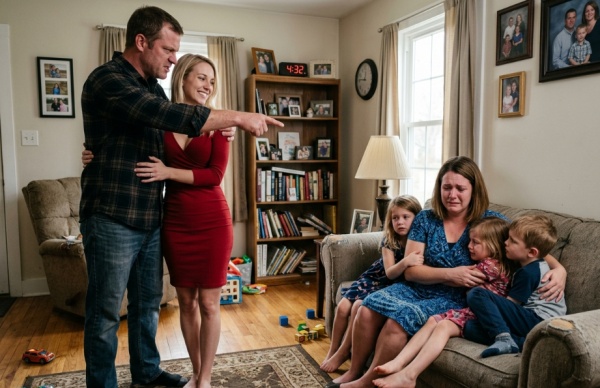
My Husband Chose His Fragile Ex Over Our 4 Children—Then Life Made Him Learn What Losing Everything Really Means
Anh ấy nói với tôi rằng Lily yếu đuối, cô đơn và cần một người bảo vệ. Rõ ràng là tôi quá giỏi giang để xứng đáng được trung thành, quá mạnh mẽ để xứng đáng được giúp đỡ, và quá bận rộn nuôi dạy con cái để được đối xử như một người phụ nữ có trái tim. Nhưng ảo tưởng mà anh ấy chọn thay vì gia đình chúng tôi đã không kéo dài—và khi nó sụp đổ, cuối cùng anh ấy cũng hiểu rằng anh ấy không chỉ mất đi một người vợ.
Part 1: The Woman Who “Needed” Him
He told me Lily was fragile.
That was the word he used over and over again, like it was a medical diagnosis, a court order, and a moral obligation all rolled into one. Fragile. Lonely. Overwhelmed. Someone who “didn’t have anyone else.” Someone who “just needed a little support until she got back on her feet.”
And apparently, I was the opposite.
I was too capable to need loyalty. Too organized to need help. Too strong to deserve softness. Too busy packing lunches, paying bills, driving carpool, remembering dentist appointments, buying birthday gifts, signing permission slips, and keeping four children alive to be treated like a woman with a heart.
My husband, Daniel, and I had been married for twelve years. We lived in a four-bedroom house in a suburb outside Denver, Colorado, the kind of neighborhood where people waved from driveways, kids rode scooters until sunset, and everyone pretended not to notice whose marriage was falling apart behind the garage door. We had four children: Ava was eleven, Noah was nine, Caleb was six, and Sophie had just turned four.
Our life was not glamorous, but it was full.
There were soccer cleats by the back door, crayon drawings taped to the fridge, Costco snacks stacked in the pantry, and tiny socks constantly disappearing into some mysterious household black hole. Daniel worked as a regional operations manager for a logistics company, and I worked part-time from home doing bookkeeping for small businesses. We were not rich, but we were comfortable enough to order pizza on Fridays, take one beach trip every summer, and keep the kids in activities if we were careful with money.
For years, I thought that was enough.
Then Lily came back.
Lily was Daniel’s ex-girlfriend from before we met. Not his ex-wife, not the mother of his children, not someone connected to our family in any legal or practical way. Just an old girlfriend from his twenties who had apparently resurfaced after a bad breakup and a “rough season,” as Daniel called it.
At first, I tried to be understanding.
When Daniel told me Lily had moved back to Colorado and didn’t know many people anymore, I nodded. When he said she was going through depression, I softened. When he said she needed someone familiar to talk to because she “trusted him,” I swallowed the strange pinch in my chest and told myself adults could have complicated histories without anything inappropriate happening.
That was before the late-night calls.
Before the Sunday afternoons that disappeared.
Before the money.
Before my children started asking why Daddy always had time to help Miss Lily, but never had time to build their LEGO sets, attend their games, or read them one bedtime story without checking his phone.
The first time I truly felt something shift was on a Thursday night in March.
Ava had a school choir performance. She had been practicing for weeks, walking around the house singing “Here Comes the Sun” in a voice so earnest it made me want to cry. Daniel promised he would be there. Not casually promised, either — he looked her in the eye at breakfast and said, “Front row, kiddo. Wouldn’t miss it.”
At 6:10 p.m., while I was trying to find Caleb’s missing shoe and Sophie was crying because her tights felt “too spicy,” Daniel texted me.
Lily’s having a panic attack. I need to go check on her. I’ll try to make it.
I stared at the message in the hallway, surrounded by backpacks and jackets and the sound of four children needing four different things at once.
I called him immediately.
He didn’t answer.
Ava saw my face and asked, “Is Dad still coming?”
I lied.
“Maybe he’ll be a little late.”
He never came.
That night, Ava stood on the stage in a white blouse and black skirt, scanning the audience between songs. I watched the hope leave her face in tiny increments. First she looked toward the entrance. Then toward the back row. Then at me.
I smiled too brightly and clapped too hard, because mothers learn to fill empty spaces with whatever we have left.
Daniel got home at 11:40 p.m.
By then, all four kids were asleep, the dishwasher was running, and I was sitting at the kitchen table with the program from Ava’s performance in front of me. He walked in smelling like cold air and women’s vanilla perfume. His expression was already defensive before I said a word.
“Don’t start,” he said, setting his keys down.
I looked at him.
“Don’t start what?”
“Making me feel guilty. Lily was in a bad place tonight.”
I almost laughed, but there was nothing funny about it.
“Ava was in a school performance tonight.”
He rubbed his face like I was exhausting him. “She’s eleven, Rachel. She’ll have other performances.”
“My name is Emily,” I said quietly.
He froze.
It was a small mistake, maybe. A tired brain mixing up names. But I knew then that Lily had taken up so much space in his mind that there was less and less room for the rest of us.
Including me.
Part 2: The Family He Stopped Seeing
After that night, Daniel’s devotion to Lily stopped pretending to be occasional.
He drove her to appointments. He fixed things in her apartment. He helped her compare insurance plans, took her car to the mechanic, brought her soup when she “couldn’t eat,” and spent hours talking her through emotional spirals that always seemed to happen during dinner, bath time, homework time, or right when one of our children needed their father.
If I questioned it, he made me the villain.
“She has no one, Emily.”
“She’s not like you.”
“You’re stronger than this.”
“You don’t understand what it’s like to feel completely alone.”
That last one always stunned me.
Because I was alone.
I was alone when Sophie had a fever of 103 degrees and Daniel didn’t answer his phone for two hours. I was alone when Noah got hit in the mouth with a baseball and needed an emergency dental appointment. I was alone when Caleb woke up crying because he had a nightmare and asked for Daddy, only for me to say Daddy was “helping a friend.”
I was alone inside a marriage with a man who kept insisting another woman was the lonely one.
One Saturday in April, Daniel missed Noah’s first baseball game of the season because Lily “couldn’t stop crying.” Noah pretended he didn’t care. He kicked dirt near the dugout and told me, “It’s fine. Dad doesn’t really like baseball anyway.”
But Daniel loved baseball.
He had played in high school. He had bought Noah his first glove. He had spent an entire afternoon last summer teaching him how to keep his elbow up when he swung.
Kids don’t stop wanting you when you disappoint them. They just start pretending they never wanted you that much in the first place.
That is how they survive it.
By May, the pattern had become our family’s weather. We planned around Daniel’s absences the way people in Colorado plan around sudden spring snow. You hope it won’t happen, but you keep boots by the door anyway.
The kids stopped asking if he would come.
Ava became quieter. She started helping me without being asked, which broke my heart more than rebellion would have. Noah got angry over small things — a missing pencil, a broken granola bar, the wrong color cup. Caleb started asking if Daddy still lived with us. Sophie began calling my brother “Uncle Daddy” as a joke, but Daniel didn’t think it was funny when he finally heard it.
One night, after I had gotten everyone to bed, Daniel came downstairs and found me folding laundry on the couch. There were four piles around me: tiny leggings, school uniforms, soccer shorts, and his work shirts. He stood there for a moment, watching.
Then he said, “Lily asked if I could stay at her place this weekend.”
I looked up slowly.
“Excuse me?”
“She’s going through a really dark time.”
“And your four children?”
He sighed. “They’ll be fine. They have you.”
There it was.
The sentence that finally cracked something open inside me.
They have you.
As if I were not a person, but a piece of household infrastructure. A refrigerator. A roof. A working furnace. Something expected to run quietly in the background while everyone else had needs, wounds, emergencies, and feelings.
I set down the shirt I was folding.
“Daniel, if you leave this weekend to stay with your ex-girlfriend, don’t come back pretending this is normal.”
His face hardened.
“You’re being cruel.”
“No,” I said. “I’m being clear.”
He shook his head, almost pitying me.
“You don’t get it. Lily needs protection.”
I looked at the laundry piles between us. Four children asleep upstairs. A mortgage payment due in six days. A marriage bending under the weight of his choices.
“And what do you think we need?”
He had no answer.
That weekend, he left with a duffel bag.
He told the kids he had to “help a friend.” Ava didn’t look up from her cereal. Noah asked if the friend was Lily. Caleb asked if Lily had kids too. Sophie just waved with sticky fingers and said, “Bye, Daddy,” like she was used to watching him go.
He kissed the top of her head and walked out.
I remember the sound of the front door closing.
Not slamming. Not dramatic.
Just closing.
Some endings don’t announce themselves with thunder. Sometimes they sound like a door clicking shut while your four-year-old eats Cheerios.
Part 3: The Line I Drew
Daniel came home Sunday night expecting gratitude.
He was tired, pale, and full of noble exhaustion. He told me Lily had barely slept. He said she was scared to be alone. He said he had made real progress helping her feel stable.
I asked if he knew Sophie had cried for him Saturday night.
His face flickered.
Then he said, “Emily, please don’t use the kids to punish me.”
That was when I stopped arguing.
Not because I agreed. Not because he had won. But because I finally understood that he had become fluent in a language where his choices were compassion, and my pain was manipulation.
So I changed languages.
I stopped pleading and started documenting.
Every missed pickup. Every canceled family commitment. Every late-night transfer from our joint account that he claimed was “for household stuff” but somehow lined up with Lily’s rent, Lily’s prescriptions, Lily’s car repair, Lily’s new furniture. I saved texts. I took screenshots. I printed bank statements. I opened a separate checking account in my name and moved my bookkeeping income there.
I also called a family law attorney.
Her name was Marisol Vega, and her office was in downtown Denver, twenty minutes from my house if traffic was kind. She was calm, practical, and not impressed by dramatic explanations. When I told her Daniel kept abandoning family responsibilities to care for his emotionally dependent ex, she listened without changing expression.
Then she said, “The court doesn’t punish someone for being a bad spouse. But custody decisions are based on the best interests of the children. Reliability matters. Financial conduct matters. Document everything.”
So I did.
For six weeks, I became quieter than Daniel had ever known me to be.
He mistook my silence for acceptance. That was his first mistake.
His second was money.
In June, I discovered he had paid Lily’s security deposit on a new apartment. Two months’ rent, plus fees. $4,850 transferred from our joint savings account, which we had built slowly over years for emergencies, dental work, car repairs, and the kids’ summer camp.
When I confronted him, he said he would “put it back.”
“With what money?” I asked.
He looked annoyed. “Don’t act like we’re broke.”
“We have four children, Daniel.”
“And Lily has no one.”
I stared at him for a long moment.
Then I said, “She has you.”
He didn’t hear the warning in my voice.
Two nights later, he missed Caleb’s kindergarten graduation because Lily “couldn’t breathe.” Caleb walked across the cafeteria stage in a paper cap and accepted his little certificate from his teacher. He looked at the rows of parents, saw only me, and smiled anyway.
Afterward, he asked if we could send Daddy a picture.
I said yes.
I took the photo. Caleb in his paper cap, missing one front tooth, holding his certificate with both hands.
I sent it to Daniel.
He replied three hours later.
Cute. Tell him I’m proud.
That was the moment my heart stopped breaking and started closing.
By the end of June, Daniel was barely home. He slept at Lily’s apartment “when things got bad,” which apparently meant any night he didn’t want to face the house he was abandoning. When he was home, he acted like a guest. He ate food I cooked, stepped over toys he didn’t pick up, and got irritated when the children wanted attention at inconvenient times.
One Friday evening, Ava finally asked him the question none of us had been brave enough to ask.
We were in the kitchen. I was making spaghetti. Daniel was checking his phone. Sophie was coloring at the table, Caleb was building a tower with plastic cups, and Noah was supposed to be doing math homework but was actually drawing a dinosaur wearing sunglasses.
Ava looked at Daniel and said, “Do you love Lily more than us?”
The room went silent.
Daniel looked startled, almost offended.
“Of course not,” he said. “Why would you ask that?”
Ava’s voice stayed calm, which made it worse.
“Because you choose her every time.”
He opened his mouth, then closed it.
For one second, I thought the truth might reach him.
Then his phone rang.
He looked down.
Lily.
And right there, in front of our daughter, he answered.
“Hey,” he said softly, turning away from us. “What happened?”
Ava pushed back her chair and walked upstairs.
Daniel followed the call into the garage.
I stood over the pot of boiling pasta and felt the last thread of my marriage burn clean through.
The next Monday, I filed for legal separation.
Part 4: The Fantasy Collapses
Daniel was furious when he got served.
Not ashamed. Not afraid. Furious.
He stood on the front porch with the envelope in his hand, his face flushed, and said, “You filed legal papers? Seriously? You’re making this ugly?”
I looked at him through the screen door.
“You made it real. I made it legal.”
He said I was overreacting. He said marriages had rough seasons. He said I was jealous of a vulnerable woman. He said he couldn’t believe I would “destroy our family over kindness.”
That one almost made me laugh.
Kindness.
Kindness would have been helping Lily find a therapist, a support group, community resources, and appropriate boundaries. Kindness would have been protecting his children from confusion and abandonment. Kindness would have been remembering that compassion for someone else does not excuse cruelty at home.
But Daniel didn’t want kindness.
He wanted to be needed.
And Lily was very good at needing him.
At first, he moved into her apartment and framed it as temporary. He told mutual friends he was “giving everyone space.” He told his parents I had become cold and controlling. He told himself, I think, that one day the kids would understand he had simply been too good-hearted for an ordinary wife.
But reality is expensive.
Lily’s rent was $2,400 a month for a one-bedroom apartment with mountain views she insisted were necessary for her “healing.” Her therapy copays, groceries, car payments, salon visits, and constant emergencies became Daniel’s responsibility. She didn’t work consistently. She said job interviews triggered her anxiety. She said bosses made her feel unsafe. She said she needed time, patience, and someone who believed in her.
Daniel believed in her with money that should have gone toward his children.
Then child support entered the conversation.
Marisol filed for temporary custody and support orders. Because I had been the children’s primary caregiver and Daniel’s schedule had become unstable, the court granted me primary residential custody while Daniel received parenting time every other weekend and one evening a week. He was ordered to pay temporary child support based on his income, plus his share of childcare, medical expenses, and school fees.
That was when Daniel discovered that abandoning your family does not erase your legal obligations.
He called me the night after the temporary order came through.
“This number is ridiculous,” he snapped.
“It’s calculated based on Colorado guidelines.”
“I can’t afford this and Lily’s rent.”
I was standing in the laundry room, folding Sophie’s pajamas.
“That sounds like a math problem, Daniel.”
He went quiet.
Then he said, “You’re enjoying this.”
“No,” I said. “I enjoyed being married to someone I trusted. This is just paperwork.”
The fantasy began cracking within weeks.
Daniel missed his first scheduled parenting weekend because Lily had “a crisis.” Marisol documented it. He missed the second Friday pickup because he had to work late after using too much personal time. Documented. He forgot Noah’s allergy medication during a visit, brought the kids back two hours early because Lily felt “uncomfortable with the noise,” and once asked if he could just take Ava because “four kids at once is a lot right now.”
I said no.
Not because I wanted to punish him. Because siblings are not luggage you divide based on convenience.
The children noticed everything.
Ava stopped answering his texts. Noah became sarcastic with him. Caleb asked if Daddy’s new house had room for him, and Daniel stumbled through an answer that made Caleb cry in the car. Sophie, the youngest, clung to me when he arrived and hid behind my legs like he was an uncle she barely remembered.
Daniel blamed me for that too.
“You’re turning them against me,” he said during one tense custody exchange in the driveway.
I looked at the minivan behind me, where all four children sat in silence.
“No, Daniel. I’m the one answering their questions after you keep breaking their hearts.”
By September, Lily’s fragility had become less poetic.
She didn’t like Daniel working late. She didn’t like him taking calls from his attorney. She resented the weekends he had the children and complained they “disrupted her peace.” She wanted him to pay for a wellness retreat in Sedona because she felt “spiritually depleted.” She cried when he said he couldn’t afford it.
For the first time, Daniel said no.
Lily did not take it well.
She accused him of choosing his “old family” over her. She said I was controlling him through the courts. She told him that if he really loved her, he would fight harder. She threatened to leave, then cried when he didn’t chase fast enough.
The protector finally realized the fragile woman had claws.
In October, Daniel’s employer demoted him.
His performance had slipped badly. Too many missed mornings, too many personal calls, too many emergency absences. He had once been considered dependable, maybe even promotable. Now he was the manager people whispered about when meetings started late.
The demotion came with a pay cut.
Which meant his child support calculation did not magically disappear, but his disposable income did.
Lily left two weeks later.
Not dramatically. Not with some grand confession. She simply packed her things while Daniel was at work and moved in with a man she had apparently met at a yoga studio in Boulder. She left Daniel a note on the kitchen counter of the apartment he could no longer afford.
I can’t be with someone who carries so much baggage. I need peace. Please don’t contact me.
The baggage was us.
His wife. His four children. His mortgage. His legal obligations. His consequences.
When Daniel called me that night, I almost didn’t answer.
But I did, because part of me already knew what had happened.
His voice was hollow.
“She’s gone,” he said.
I sat at my kitchen table, surrounded by spelling worksheets and half-finished cups of apple juice.
“I’m sorry,” I said, because I was. Not for losing Lily. For the size of the lesson he had created for himself.
“I gave up everything,” he whispered.
I looked toward the living room, where our children were watching a movie in a pile of blankets.
“No,” I said quietly. “You didn’t give it up. You traded it. There’s a difference.”
He began to cry.
I didn’t comfort him.
That was no longer my job.
Part 5: What Losing Everything Really Means
The final hearing was in December.
Denver was cold that morning, with slush along the sidewalks and Christmas lights still hanging from office windows downtown. I wore a navy dress, a wool coat, and the small pearl earrings my mother gave me when Ava was born. Daniel wore a suit that no longer fit quite right and looked like he had slept badly for months.
In court, there was no dramatic speech.
Real family court is not like television. No one gasps. No judge pounds a gavel while music swells. It is paperwork, schedules, financial affidavits, parenting plans, and adults being forced to explain whether they can put their children ahead of their feelings.
Marisol presented the documentation.
Missed visits. Unstable housing. Financial transfers. The children’s school reports. My work schedule. Daniel’s demotion. His request for expanded custody, which even he seemed unsure how to manage.
The judge was fair.
Not cruel. Not emotional. Fair.
I was awarded primary custody. Daniel received a structured parenting plan with alternating weekends, one weekday dinner, holiday rotation, and conditions requiring timely pickup, appropriate sleeping arrangements, and no unrelated overnight guests during parenting time for the first six months. Child support was finalized based on the guidelines. Communication was ordered through a parenting app, which meant no more late-night emotional phone calls disguised as logistics.
When we walked out of the courtroom, Daniel stopped me near the elevators.
“Emily.”
I turned.
He looked smaller than he used to. Not physically, exactly, though he had lost weight. Smaller in the way people look when the story they told themselves finally stops protecting them.
“I didn’t understand,” he said.
I didn’t ask what.
He continued anyway.
“I thought losing you meant losing… I don’t know. Comfort. Stability. The house. Someone who handled everything.” His eyes filled, but he kept talking. “But I lost them too. Not legally. I know I still get to see them. But I lost the way they looked at me.”
That was the truest thing he had said in a year.
I thought of Ava scanning the audience at her choir concert. Noah pretending not to care. Caleb asking if Daddy’s house had room for him. Sophie hiding behind my legs.
“You didn’t lose that in court,” I said. “You lost it one choice at a time.”
He nodded, tears slipping down his face.
“I know.”
I waited for the old version of myself to feel satisfaction.
She didn’t.
All I felt was tired.
Tired of being strong because he had been selfish. Tired of translating adult betrayal into child-sized explanations. Tired of watching him discover consequences only after everyone else had already paid for them.
“I hope you rebuild it,” I said.
He looked up quickly, surprised.
“With them,” I clarified. “Not with me.”
His face crumpled.
For a second, I could see the man I had married. The man who cried when Ava was born. The man who once drove three hours through a snowstorm because Noah had left his stuffed bear at a cabin. The man who used to dance with me in the kitchen while pasta boiled.
But memory is not a reason to reopen a wound.
“I love you,” he whispered.
I shook my head gently.
“You loved being needed. That’s not the same thing.”
Then I walked away.
The first few months after the divorce were not magically easy.
Single motherhood with four children is not a montage of fresh starts and golden sunlight. It is grocery bills, school emails, stomach bugs, sibling fights, snow tires, broken appliances, and trying to answer work calls while a four-year-old announces from the bathroom that something has gone terribly wrong. There were nights I cried in the laundry room because it was the only place nobody followed me.
But there was peace.
No more waiting for Daniel to choose us. No more watching my phone, wondering which emergency would outrank our children tonight. No more swallowing hurt so he could feel like a hero somewhere else.
The kids began to breathe differently too.
Ava joined theater in the spring and landed a small role in the school musical. When Daniel showed up on opening night with flowers, she accepted them politely. She didn’t run into his arms, but she didn’t turn away either. That was progress, and progress was allowed to be slow.
Noah let Daniel come to one baseball practice, then another.
Caleb started drawing pictures of two houses instead of one broken one.
Sophie eventually stopped hiding behind my legs when he arrived. One Saturday, she handed him her backpack and said, “Don’t forget my purple pajamas, okay?” with the authority of a tiny airport supervisor. Daniel nodded like he had been entrusted with national security.
To his credit, he tried.
He got a smaller apartment with bunk beds in the second bedroom. He took a financial planning class. He attended parenting counseling. He stopped blaming me in the parenting app and started writing things like, Caleb has a cough — did he take medicine this morning? and Ava mentioned a rehearsal Thursday. Can you send the details so I can attend?
It did not erase what he had done.
But it mattered to the children, and that mattered to me.
As for me, I rebuilt in pieces.
I increased my bookkeeping work and eventually rented a tiny office above a bakery downtown, mostly so I could drink coffee that was still hot when I finished it. I repainted my bedroom a soft green Daniel would have called boring. I took the kids camping near Estes Park and learned, through trial and error, how to put up a tent by myself in the wind.
One evening in July, nearly a year after Lily first reappeared, I sat on the back porch while the kids chased fireflies in the yard.
Ava was laughing — really laughing — as Noah tried to catch one in a mason jar. Caleb was explaining to Sophie that fireflies were “basically bugs with flashlights,” and Sophie was arguing that they were actually “baby stars.” The air smelled like cut grass, sunscreen, and grilled corn from a neighbor’s barbecue.
My phone buzzed.
A message from Daniel appeared through the parenting app.
Thank you for letting me come to Caleb’s game today. I know I don’t deserve your flexibility. I’m starting to understand how much you carried. I’m sorry.
I read it twice.
Then I set the phone facedown.
There had been a time when those words would have cracked me open. I would have wanted more. A longer apology. A confession. A moment where he named every wound perfectly and somehow made the pain feel witnessed.
But that night, I didn’t need it.
Because I had witnessed myself.
I had survived the slow humiliation of being treated as less urgent than another woman’s loneliness. I had protected my children without teaching them bitterness. I had learned that being strong did not mean accepting less love — it meant refusing to keep begging for it from someone determined to spend it elsewhere.
Daniel eventually learned what losing everything really meant.
It was not losing Lily.
It was not losing the house, or money, or the convenience of a wife who made life run smoothly.
It was losing the bedtime stories he didn’t read. The games he didn’t attend. The school concerts where one seat stayed empty. The easy trust in his children’s faces. The woman who would have stood beside him through almost anything, until he made her stand alone for too long.
And me?
I learned something too.
I learned that I was not “too strong” to deserve care. I was not “too capable” to deserve loyalty. I was not “too busy being a mother” to still be a woman worthy of tenderness, honesty, and respect.
Lily may have needed a protector.
But my children needed a father.
And I needed a partner.
Daniel chose wrong.
By the time he understood that, I had already chosen myself.
So when people ask if I regret leaving, I tell them the truth.
I did not leave because he helped someone fragile.
I left because he made our family fragile — then acted shocked when I refused to let us break.
And that is the part he will have to live with for the rest of his life.
