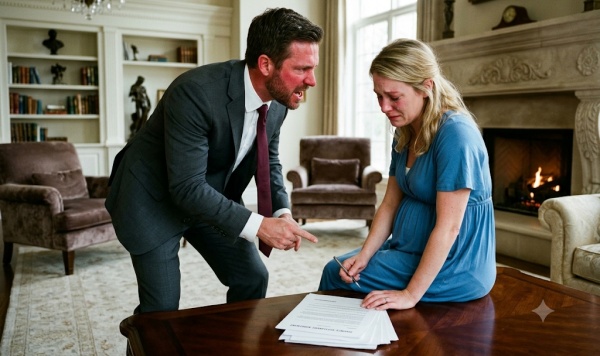
My husband divorced me when I was eight months pregnant, then married an old schoolmate with whom he had been having a secret affair behind my back. He believed I would leave with nothing while he and his new wife moved on, but…
Part 1: The Day I Signed
My husband divorced me when I was eight months pregnant. Seventeen days later, he married a woman he had known since high school and claimed was “just an old friend.” I learned about their wedding from a photograph posted by someone I barely knew.
In the picture, Derek stood outside a small courthouse wearing the gray suit he had bought for his brother’s wedding. The woman beside him wore a cream-colored dress and held a bouquet of white roses. Her name was Vanessa Lane, and for the previous six months, she had been telling me how excited she was to meet our baby.
The caption read, Some love stories find their way back.
I sat at my kitchen table with my phone in one hand and a half-finished bowl of cereal in front of me. My daughter shifted beneath my ribs, and I put my other hand over the spot. I had imagined many things for her first year of life, but I had never imagined explaining why her father’s wedding photograph had appeared before her birth announcement.
Derek and I had been married for seven years. We owned a modest house outside Philadelphia and a small catering company called Willow Table. I handled menus, suppliers, and staff schedules; he handled sales and the books.
When I discovered I was pregnant, we were already struggling. We argued about money, worked most weekends, and had grown so used to discussing invoices that we barely spoke about anything else. Still, when I showed Derek the test, he hugged me and said a baby might be exactly what our family needed.
By the time I was five months pregnant, he had moved into an apartment across town. He said he needed space and that our constant disagreements were making him miserable. He also said Vanessa had reconnected with him through a school reunion and had been helping him find a place to live.
I asked whether there was something between them. He looked offended and reminded me that Vanessa had a boyfriend in college, as though a relationship from fifteen years earlier answered my question. He said she understood what it was like to start over after a difficult marriage.
Vanessa had been coming around our house since early spring. She brought muffins, asked about my doctor’s appointments, and once spent an afternoon helping me sort through baby clothes my cousin had given me. She told me Derek was lucky to have a wife who worked so hard.
Now I knew why she had been interested in our marriage. I also knew that Derek had asked for a divorce before I understood how long the affair had been going on. What I did not yet know was how much of our financial life he had hidden while persuading me to sign.
The agreement had been presented as a practical solution. Derek said Willow Table was losing clients, that equipment loans were coming due, and that the business might not survive if we spent months fighting. He offered me a modest settlement, my car, and the furniture in the nursery.
In return, he would keep the company and take responsibility for the debts he described. We would sell the house, pay what we owed, and divide the remaining proceeds according to the agreement. He said I could use my share to rent an apartment until I returned to work after the baby was born.
I had an attorney review the paperwork, but the review depended partly on the financial information Derek supplied. He provided bank statements, tax returns, and summaries showing the company was barely breaking even. I was tired, anxious about the pregnancy, and afraid that a prolonged dispute would leave us both with nothing.
My attorney asked for additional records. Derek’s lawyer said they had provided the relevant material and that Derek needed an answer before a major payment came due. After several conversations and some revisions, I agreed to settle.
I signed because the arrangement seemed survivable, not because I believed Derek had treated me fairly. I wanted a stable place for my daughter and enough money to get through the first few months. I also wanted the constant arguments to stop before she arrived.
The divorce became final on a Tuesday in August. I was thirty-four weeks pregnant, and the judge’s order arrived while I was sitting in a waiting room for a routine appointment. Derek sent a text that evening saying he hoped we could be good parents together.
Seventeen days later, he married Vanessa.
I called him after seeing the photograph. He answered on the second ring, sounding cheerful until he heard my voice. When I asked how long he and Vanessa had been involved, he said their relationship had changed only after our separation.
“You were engaged in August,” I said. “We were still married in August.”
“We didn’t tell people because we knew you’d be upset.”
I stared at the empty cereal bowl. He was right that I was upset, but not for the reason he seemed to think. I was beginning to understand that he had been asking me to make financial decisions while keeping an entire part of his life hidden.
After the call, I opened my laptop and searched through old messages. I found a photograph from May in which Vanessa was standing in the background at one of our catering events. I found another from June, taken at a restaurant Derek had told me he visited with a potential client.
None of the photographs proved an affair by themselves. They did, however, remind me that Vanessa had been around the business far more often than I had realized. I wrote down the dates and sent them to my attorney with a copy of the wedding photograph.
That afternoon, my mother came over with groceries and a package she had found while clearing a shelf in her house. It was a large cream-colored envelope addressed to me in my grandfather’s handwriting. Across the front, beneath my name, he had written: To be opened when the next little one arrives.
Grandpa had been dead for nearly two years. I turned the envelope over, surprised that Mom had never mentioned it. She said she had found it inside an old tin with other family papers and had put it somewhere safe, then forgotten where.
“I’m sorry, honey,” she said. “I thought of it when you told me you’d chosen his name.”
I hadn’t chosen his name, exactly. I had decided our daughter’s middle name would be Ruth, after his mother, the woman who taught him to cook. I placed the envelope on the table and traced the familiar curve of his handwriting with my finger.
“I’ll open it when she’s born,” I said.
Mom looked at me, then at the photograph still open on my phone. “You don’t have to wait if you need him now.”
But the words on the envelope sounded like Grandpa. He liked a little ceremony, and he had always believed babies deserved their own stories. I tucked it into the drawer beside my bed, not knowing that a separate sealed envelope was already waiting for me in a lawyer’s office.
Part 2: The Business Derek Said Was Failing
Willow Table began in my grandfather’s kitchen. He had never owned the business, but he gave me my first set of commercial-size mixing bowls and let me test recipes on anyone who came through his door. He said a good meal was mostly an excuse to make people feel welcome.
Grandpa Walter had spent his working life running a small wholesale food business. By the time I was born, he had sold most of it and kept only a warehouse and a handful of investments. He wore the same brown cardigan for years, drove an old station wagon, and complained whenever a restaurant served a sandwich without enough mustard.
When Derek and I married, Grandpa liked him. Derek was charming, energetic, and good at talking to strangers. At family dinners, he cleared plates without being asked and listened to Grandpa’s stories about the early days of the food business.
I began catering small events on weekends while working at a restaurant. Derek helped with deliveries and eventually suggested we turn the work into a company. We rented kitchen space, bought used equipment, and named the business after the willow tree in Grandpa’s backyard.
For the first few years, the work was exhausting but satisfying. I loved planning menus with clients and watching our team pull off an event everyone had been worried about. Derek was good at finding new customers, and I trusted him to manage the finances because he had more experience with sales and accounting software.
That trust became a habit. I could read a budget and understand a bank statement, but Derek took over the day-to-day bookkeeping when our first child care contract and wedding season overlapped. He said it was easier if one person handled the payments, and I was grateful to have one fewer task.
After Grandpa died, we considered buying a larger kitchen. Derek said the company could not afford it and suggested we wait another year. Meanwhile, he became increasingly anxious about cash flow, often mentioning loans and overdue invoices at dinner.
Vanessa appeared during one of those anxious periods. Derek said she worked in marketing and could help us refresh our website. She came to the kitchen with a notebook, complimented our food, and proposed a set of social media campaigns aimed at corporate clients.
I liked several of her ideas. We needed better photographs, and our website had not been updated in years. Derek said her rates were reasonable and that he would handle the contract.
The first invoice I saw was for a photo shoot. It looked ordinary: photographer, editing, design work, and a small charge for printed materials. I approved the expense because we had discussed it and because the photographs were genuinely useful.
Over the following months, I saw fewer invoices. Derek said Vanessa’s work had expanded into ongoing marketing support and that he was paying her company directly. When I asked for a breakdown, he said he would send one after the quarterly accounts were complete.
Then I became pregnant. Between appointments, work, and the increasing strain at home, I stopped asking as often as I should have. Derek continued telling me that Willow Table was struggling, even though our calendar looked busier than it had the previous year.
I raised that contradiction more than once. He said higher food costs, equipment repairs, and a slow-paying corporate client had eaten up the profits. It was a plausible explanation in an industry where a busy calendar does not always mean a healthy bank account.
After the divorce, I stopped working at Willow Table. The agreement transferred my ownership interest to Derek in exchange for the settlement we had negotiated. I took a part-time position helping a local bakery with administrative work, planning to pause when the baby arrived.
A week after Derek’s wedding photograph appeared, I received an email from a former Willow Table employee named Maren. She had managed deliveries and kept copies of event schedules because she liked to check her hours against the payroll records. She asked whether I had a few minutes to talk.
We met at a coffee shop near the bakery. Maren looked uncomfortable and said she didn’t want to start a fight between me and Derek. She had left the company two months earlier because her schedule had become unpredictable.
“I kept hearing that there wasn’t enough money for extra staff,” she said. “But some of the events we did were much larger than the ones on the schedule Derek showed everyone.”
I asked what she meant. She said several corporate events had been booked through a company name she didn’t recognize, and the staff had been told to record them under a general project label. She had assumed it was a routine accounting choice until she saw a social media post about Derek and Vanessa’s wedding.
Maren showed me her personal calendar and several event confirmations she had received as an employee. One listed a corporate dinner for 180 people; another listed a three-day conference with breakfasts and lunches for more than 200 attendees. I remembered the events, but the revenue summaries Derek had shown me during the divorce appeared much lower than I would have expected.
“That doesn’t prove the business made more profit,” I said.
“No,” Maren replied. “I just thought you should know what I saw.”
I thanked her and asked whether she would be comfortable speaking with my attorney. She said yes, as long as she could bring only records she was permitted to keep. I did not ask her to access company accounts or take documents from her former workplace.
My attorney suggested we consult a forensic accountant. The accountant, Mr. Patel, reviewed the records I had and compared them with the summaries Derek had provided during the divorce. He found several questions worth pursuing, including payments to Vanessa’s marketing company and deposits that did not appear clearly in the materials I had received.
He did not tell me Derek had committed fraud. He said the records were incomplete and that some payments might have legitimate explanations. But the differences were significant enough that my attorney believed we should ask the court for an opportunity to examine them.
The day before she filed the request, Derek called me. He had received a letter asking for additional information and wanted to know why I was “making trouble” when I should be preparing for the baby. I told him preparing for the baby was exactly why I needed to understand our finances.
“You got what you agreed to,” he said.
“I agreed based on the records you gave me.”
“You had a lawyer.”
“Yes. And now I’m asking why some of the numbers don’t match.”
He said Vanessa had warned him I might become vindictive. The word startled me because I had spent the past week comparing invoices between doctor’s appointments and trips to the laundromat. I told him my attorney would handle further questions and ended the call.
That night, I opened the drawer beside my bed and looked at Grandpa’s envelope. I thought about opening it early, not because I expected money, but because I wanted to hear his voice in my head. In the end, I placed it back in the drawer and went to bed with a list of questions for my next appointment.
Three days later, my daughter arrived earlier than expected. She was healthy, loud, and furious about being introduced to the world under bright hospital lights. I named her Lucy Ruth and called my mother before I called anyone else.
Part 3: Two Envelopes
The first week with Lucy passed in a blur of feedings, laundry, and people telling me to sleep whenever she slept. I tried that advice once, but she woke after twelve minutes and seemed offended that I had taken my eyes off her. Mom stayed with me for several nights, and my cousin brought enough food to fill the refrigerator.
Derek came to the hospital after I told him Lucy had arrived. He held her carefully, with the startled expression of a man who had read every instruction but still couldn’t believe the baby was real. I told him when he could visit, and we began discussing a parenting schedule with help from our attorneys.
Vanessa did not come to the hospital. Derek asked whether he could bring her to a later visit, and I said I needed time to adjust before discussing introductions. Our attorneys helped us work through a plan that focused on Lucy’s needs rather than the circumstances of our breakup.
On the eighth day, Mom reminded me about Grandpa’s envelope. Lucy was asleep in a bassinet beside the couch, and the afternoon sun had turned the living room floor gold. I fetched the envelope from my bedroom and opened it carefully.
Inside was a letter and a photograph of Grandpa holding me when I was a baby. In the photograph, he wore a flannel shirt and looked terrified that he might drop me. On the back, Grandma had written, He checked every five minutes to make sure she was breathing.
The letter was addressed to “my girl and the little one.” Grandpa wrote about the first meal he ever cooked for me—mashed potatoes, most of which ended up on his shirt—and said he hoped I would tell my child stories about our family. At the bottom was a recipe for his apple cake, including the instruction: Use more cinnamon than seems sensible.
I laughed and cried at the same time. Mom read the letter over my shoulder, then sat beside me while I held the photograph. For a few minutes, the divorce, the accountant, and the questions about Willow Table felt far away.
The next morning, I received a call from a woman named Helen Marsh. She introduced herself as an attorney who had worked with Grandpa for many years. She said she was also one of the trustees responsible for a trust he had established before his death.
I remembered meeting Helen once at Grandpa’s house, but I had assumed she handled his business paperwork. When he died, Mom told me his estate had been settled and that he had left gifts to several family members. I had received a modest amount and used it to pay down a student loan.
Helen explained that Grandpa had also placed certain assets in a trust. I was one of its beneficiaries, and its terms allowed the trustees to consider support for me and my children under specified circumstances. She did not describe it as an unlimited inheritance or promise that every request would be approved.
“Why am I only hearing about it now?” I asked.
“You were given a summary after your grandfather died, but the trust had no immediate distribution scheduled for you then.” She paused. “Your mother mentioned Lucy’s birth when she called my office yesterday. That prompted me to review the relevant provisions and contact you.”
I remembered a packet of estate papers I had received while helping Mom clear Grandpa’s house. At the time, I focused on the distribution I could see and assumed the rest concerned investments being managed elsewhere. Helen offered to send me the documents and walk through them with my attorney.
She also mentioned a sealed envelope Grandpa had left with her. It contained personal instructions and a letter for me, to be delivered when I had a child or under other circumstances described in his notes. Helen had known the envelope existed, but she had not opened it because Grandpa had asked her to keep it sealed until delivery.
“Are the instructions part of the trust?” I asked.
“The trust itself is a separate signed document,” she said. “Your grandfather’s letter may explain his wishes, but it doesn’t automatically change the legal terms. We’ll review anything it asks for before acting.”
That distinction mattered. I had spent weeks dealing with a man who presented guesses as facts and assurances as guarantees. Helen’s careful answer made me trust her more.
We met at her office the following week. Mom came with me to help with Lucy, who slept through the first part of the meeting and woke just as Helen began explaining the trust’s assets. Helen offered us water, then handed me a folder with copies of the relevant documents.
One asset was the warehouse Grandpa had kept after selling his food business. It had been leased to several tenants over the years and was currently divided into storage units and a small commercial kitchen. I recognized the address because Willow Table had rented part of the kitchen during its first two years.
The trust received rental income from the property. After expenses and reserves, the trustees could consider distributions for purposes outlined in the trust, including education and certain family-support needs. Helen said they would need to review my circumstances and the trust’s finances before deciding what assistance was appropriate.
Then she gave me the sealed envelope. It was smaller than the one Mom had found and bore my name in the same careful handwriting. I opened it while Mom held Lucy against her shoulder.
Grandpa’s letter began with a joke about how I was probably reading it while someone else held the baby. Then his tone changed. He wrote that he had watched me build Willow Table and admired how much work I put into the business.
He also wrote that, before he died, he had become concerned about the way financial responsibilities were divided between Derek and me. Grandpa did not accuse Derek of a crime or claim to know about an affair. He said only that when he asked me basic questions about the company’s accounts, I often replied that Derek handled them.
“I know that can be an ordinary arrangement,” he wrote. “But I have seen too many good people trust a summary without understanding what lies beneath it.”
The last paragraph contained the directive that made me read the letter again. Grandpa asked that, if I ever needed support during a major family change, the trustees consider funding an independent financial review before deciding what further assistance to offer. He wanted me to have clear information, not simply a check that might solve one month’s problem and leave the next one untouched.
Helen explained that the trustees had discretion within the trust’s terms to consider professional advice and support for beneficiaries. They could not use Grandpa’s private letter to override those terms, but they could take his expressed wishes into account. She said the trustees would review my request promptly.
I told her about Mr. Patel and the questions he had already identified. She asked me to have my attorney contact her so they could discuss what work was needed and how any payment might be arranged. She also made clear that the trust would not automatically pay every legal bill or determine the outcome of my dispute.
On the drive home, Mom said Grandpa had always worried about people having enough information to make their own decisions. She reminded me how he insisted she learn to balance the books when she helped at his warehouse as a teenager. “He used to say a number isn’t frightening once you know what it means,” she said.
I looked at Lucy in the back seat, asleep with one fist beside her cheek. The letter had not delivered a fortune or undone the divorce. It had offered something I needed almost as badly: a way to keep asking questions without spending every dollar I had set aside for my daughter.
Part 4: The Numbers Beneath the Summary
The trustees approved a limited payment toward the independent financial review after considering my request and the trust’s terms. Mr. Patel explained what the approved work would cover and what would require further authorization. My attorney continued pursuing the records through the appropriate legal process.
Weeks passed before we received enough information to begin making sense of the payments. Some expenses were legitimate, including the photo shoot and website work I remembered. Others raised questions because the descriptions were vague, the amounts repeated, or the supporting invoices did not clearly identify what had been delivered.
Vanessa’s company had received a series of payments described as “campaign development” and “client acquisition support.” One invoice listed a substantial charge for a campaign that, according to the company’s own schedule, had never launched. Another appeared to bill Willow Table for an event presentation that a different vendor had already invoiced.
Derek’s attorney initially said the payments reflected consulting work and that not every service produced a public campaign. That was possible, and Mr. Patel did not dismiss it. He asked for contracts, work records, correspondence, and evidence of what had been provided.
The review also identified deposits from several large events that had moved through an account not included in the summaries Derek gave me during the divorce. Derek said the account had been used for temporary operating purposes and that the money was reflected elsewhere. Some transfers could be matched to ordinary business expenses, but others required more explanation.
The court permitted further examination of the disputed records. My attorney explained that asking a judge to revisit a financial agreement was not the same as automatically overturning it. We would need evidence, and Derek would have an opportunity to respond.
Vanessa became involved because her company had received payments and held records relevant to the questions being examined. She hired her own attorney. I heard nothing directly from her for several months, which was a relief.
The first hearing took place when Lucy was four months old. Mom watched her while I went to the courthouse with my attorney and a folder full of notes. I wore a navy suit I had bought years earlier and hoped it still looked professional despite the button I had replaced the night before.
Derek sat across the room with his lawyer. He looked tired and thinner than he had at the wedding, but seeing him no longer produced the same rush of confusion. I knew where to sit, what documents I needed, and which questions were mine to answer.
Vanessa arrived a few minutes later with her attorney. She did not look at me until we were waiting outside the courtroom. When our eyes met, she gave a small nod that I did not return.
The hearing was not dramatic in the way television had taught me to expect. There were arguments about records, deadlines, and the scope of the review. The judge asked precise questions and made clear that conclusions would depend on the evidence presented.
Afterward, Derek approached me in the hallway. His attorney was speaking with mine a few feet away, and Vanessa stood near the elevator. He asked whether we could resolve everything privately and avoid further expense.
“We tried to resolve it privately,” I said. “I need the complete information this time.”
He told me the marketing payments were real and that Vanessa had done more work than I understood. He also said some of the missing deposits had been used to cover business debts. I told him those explanations belonged in the records and could be reviewed by the people handling the case.
“You don’t think about what this is doing to the company,” he said.
“I helped build the company. Of course I think about it.”
“If we lose clients, that affects Lucy too.”
That was true in a limited sense: a struggling business could affect Derek’s finances and his ability to meet obligations. It did not mean I should stop asking whether the agreement had been based on incomplete information. I said I hoped the company remained healthy and that accurate records would help everyone understand its position.
Several weeks later, we received additional documents. They showed that some payments to Vanessa’s company had supported real work, including photography, client materials, and event planning. They also showed several large payments for which the available records did not clearly establish comparable services.
The accountant identified inconsistencies in the financial summaries used during the divorce negotiations. Some revenue had been recorded in ways that made the business appear less valuable in the summaries I received, while certain expenses required further substantiation. Derek’s side disputed the interpretation of several entries.
I wanted a simple answer: a single number that would tell me exactly what had been hidden. Instead, there were spreadsheets, explanations, counterexplanations, and pages of notes. My attorney reminded me that reaching a reliable conclusion often took more work than telling a dramatic story.
At a later hearing, the judge ordered additional disclosures and encouraged the parties to consider a settlement after the review was complete. The order did not declare Vanessa guilty of anything, and it did not send Derek to jail. It required the financial questions to be addressed more fully than they had been before.
During mediation, Derek finally acknowledged that the summaries I had received were incomplete. He maintained that he had not intended to mislead me, while my attorney explained why the omissions mattered to the agreement. I did not need him to use the word fraud before I could insist on a fairer resolution.
After several sessions, we reached a revised financial settlement. Derek agreed to pay an additional amount over time, with terms set out in writing, and certain issues involving the business were resolved separately. The agreement did not make me wealthy, but it gave Lucy and me more stability than the original arrangement.
Vanessa’s company also addressed its records as part of the broader resolution. I was not given every detail of her discussions with her attorney, and I did not need them. What mattered to me was that the questions had been examined rather than dismissed because I had signed once before.
On the day the agreement was finalized, I picked Lucy up from Mom’s house. She was sitting on a blanket with a wooden spoon, banging it against a plastic bowl. Mom said Grandpa would have approved of her choice of instrument, though perhaps not the volume.
I sat beside her and offered her a second spoon. She dropped the first one, grabbed the new one, and immediately tried to put it in her mouth. I laughed for the first time that day without feeling that I had to explain why.
That evening, I wrote Helen a thank-you note. I told her Grandpa’s letter had helped me ask for the support I needed, and I thanked the trustees for considering the request. Then I copied his apple cake recipe onto a card and tucked it into a cookbook I planned to keep for Lucy.
Part 5: What Grandpa Wanted Me to Have
Derek and I continued learning how to be parents after the financial dispute ended. It was not easy, and the settlement did not make the hurt vanish. But Lucy needed both of us to keep our conversations focused on her rather than on every injury we had caused or suffered.
We used a shared calendar for appointments, visits, and changes in her routine. When she developed a fever one evening at Derek’s apartment, he called me, and we followed the pediatrician’s advice together. He brought her home the next morning with a bag of medicine, clean pajamas, and a detailed note about when she had slept.
I thanked him for the note. For a long time, I had thought accepting any good thing from Derek would mean excusing what he had done. I came to understand that I could acknowledge him caring for Lucy without rewriting the past.
Vanessa remained part of his life. I met her briefly during a scheduled exchange when Lucy was older, and the conversation was polite and short. I did not become her friend, but I also did not want Lucy to grow up feeling that she had to hide her happiness in either home.
At my attorney’s suggestion, we kept disagreements about expenses and schedules in writing. That made it easier to solve problems without turning every conversation into an argument about the marriage. When we couldn’t agree, we used the process we had established rather than asking relatives to take sides.
I continued working at the bakery part-time. The owner, Mrs. Alvarez, let me bring ideas for seasonal lunches and eventually offered me a larger role managing small catering orders. I liked working with a team where I could see the invoices, ask questions, and understand how decisions were made.
Grandpa’s trust did not hand me control of the warehouse. Helen and the other trustees remained responsible for managing its assets according to the trust’s terms. When I asked about using the commercial kitchen for occasional baking classes, they considered a formal proposal and offered terms that reflected the property’s needs.
I started with one Saturday class for eight people. We made apple cake, chicken soup, and biscuits that rose unevenly but tasted wonderful. At the end, everyone took home a recipe card, and one participant asked when the next class would be.
I called the series Walter’s Table. Mom said Grandpa would have complained about the attention and then told every person he met where to sign up. She volunteered to wash dishes at the first few sessions and insisted on bringing Lucy, who entertained herself by dropping measuring cups from her high chair.
The classes grew slowly. Some months I held two; other months I held none because Lucy was sick, the bakery was busy, or I simply needed a weekend at home. I kept careful records and paid the kitchen fees we had agreed upon.
One afternoon, Helen came to observe a class. After everyone left, she helped stack chairs while I wiped down the counters. She said Grandpa had once talked about turning part of the warehouse into a place where people could learn practical skills from one another.
“He never got around to it,” she said.
“I didn’t know that.”
“He wrote it in one of his notebooks. There were a lot of ideas in those notebooks.”
I pictured him at his kitchen table, surrounded by newspaper clippings and lists written on the backs of envelopes. He had never told me I had to continue his work. He had simply made room for the possibility that one day I might find my own way to use what he left.
On Lucy’s first birthday, we held a small party at Mom’s house. There were paper decorations, a cake shaped like a strawberry, and enough folding chairs for the relatives who could come. Derek attended for the first hour, as we had agreed, and brought a gift wrapped in bright yellow paper.
Watching him with Lucy was complicated. I remembered the courthouse photograph, the empty summaries, and the months when I had been afraid I could not provide for her. I also saw him kneel beside her high chair and make a ridiculous face that caused her to laugh so hard she dropped a piece of cake.
After he left, Mom brought out Grandpa’s photograph. She had put it in a new frame, the one of him holding me as a baby. We placed it on the table beside Lucy’s cake, and several relatives took turns telling stories about him.
My cousin remembered Grandpa teaching her to change a tire. My uncle remembered him showing up with groceries whenever someone in the family was sick. Mom remembered the year he burned the Thanksgiving rolls and blamed the oven until Grandma found the timer unplugged.
I told them about the recipe in his letter and the instruction to use more cinnamon than seemed sensible. Then I told them about the second envelope, though I did not read the whole letter aloud. Some parts of it felt like a conversation between Grandpa and me, and I wanted to keep them that way.
“He wanted me to understand the numbers,” I said. “But I think he also wanted me to know I could ask for help understanding them.”
Mom nodded. She had watched me spend weeks worrying that accepting support from the trust meant I had failed. When I said that aloud once, she reminded me that Grandpa had spent his life planning for the people he loved.
After the guests left, I carried Lucy outside. The evening was warm, and the willow tree in Mom’s yard moved gently in the breeze. Lucy pointed at the branches and made a sound that might have been a word or might have simply meant she wanted to touch them.
I held her up so she could reach a leaf. She grasped it, studied it for a moment, and then offered it back to me. I took it carefully and tucked it into the pocket of my dress.
For months, I had imagined justice as a moment when Derek would stand before a judge and finally admit everything. The hearings had mattered, and the revised settlement had made a real difference. But there had been no single moment when a courtroom repaired what had happened.
What repaired me, slowly, was a collection of smaller things: my mother arriving with groceries, Tessa from the bakery covering a shift, Mr. Patel explaining a spreadsheet without making me feel foolish, and Helen taking my questions seriously. It was also the work of making decisions for myself, even when I was tired and unsure. None of those people could erase the past, but they helped me build something beyond it.
That night, after Lucy fell asleep, I opened Grandpa’s letter again. Beneath the paragraph about the financial review, there was one sentence I had read many times but only now felt ready to believe.
I hope you never need this help, Emma, but if you do, I hope you use it without shame.
I folded the letter and placed it back in the envelope. Then I set it beside the first one, the one with the apple cake recipe and the photograph of Grandpa holding me. Someday, when Lucy was old enough, I would tell her about the man who had left both.
