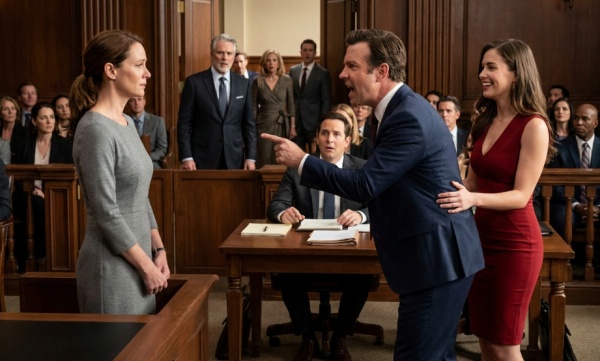
Ashton wanted the courtroom to become my humiliation. He brought the woman he cheated with, called me poor, and told everyone I had no right to anything he owned. By the time the judge heard the truth, the man who came to shame me could barely look up from the table.
Part 1: The Woman He Brought to Court
My husband brought his mistress to our divorce hearing like she was a trophy he had already won. She walked into the courtroom in a cream-colored designer dress, her hand tucked neatly around his arm, smiling at people who did not smile back. Ashton didn’t look ashamed, nervous, or even uncomfortable. He looked proud, like humiliating me was just another part of his closing argument.
I sat on the opposite side of the courtroom in a navy dress I had bought from a clearance rack two years earlier. My hands were folded in my lap, my wedding ring already gone, the pale circle on my finger still visible under the fluorescent lights. Ashton glanced at it once and smirked. Then he leaned close to his mistress and whispered something that made her cover her mouth and laugh.
The judge had not entered yet, but everyone could feel the tension gathering like a storm behind glass. My attorney, Mara Ellison, sat beside me with a sealed gray file in front of her. She had not opened it all morning. She simply rested one hand over it, as calm as a woman waiting for the right second to strike a match.
Ashton’s attorney, a polished man named Gregory Vance, adjusted his cuff links and pretended not to notice the mistress. He had spent the last six months describing me as an opportunist, a woman who had married above her station and was now trying to walk away with money she had not earned. In every filing, every email, every negotiation, they painted me as small. Poor. Lucky.
The truth was, I had let them.
When the bailiff asked everyone to rise, Ashton stood up slowly, as if the courtroom had been built for him. The judge, Honorable Rebecca Callahan, entered with a stack of papers and the expression of someone who had seen too many divorces turn into public theater. She sat, reviewed the case number, then looked over the room. Her eyes stopped briefly on Ashton’s mistress before moving on.
“Let’s proceed,” Judge Callahan said.
Gregory Vance stood first, confident and rehearsed. He spoke about the prenuptial agreement, about separate property, about Ashton’s “substantial contributions” to our lifestyle. He said I had entered the marriage with no meaningful assets and should leave with what I had brought. Then he paused, looked at me with professional pity, and said, “Nothing.”
Ashton lowered his head, but not because he was embarrassed. He was hiding a smile. His mistress squeezed his arm like he had just landed a business deal.
My attorney did not move.
Gregory continued, explaining that Ashton had built a successful logistics consulting company before our marriage. He said the prenup had been signed voluntarily, with witnesses present, and that I had declined independent review despite having time to obtain counsel. That was the story they had bought and polished until it shined. It sounded clean if you didn’t look underneath it.
But I remembered the night I signed those papers.
It had been three days before our wedding in Charleston, South Carolina, in the upstairs office of his parents’ lake house. Ashton told me it was just standard paperwork, something his business manager required before investors came in. He kissed my forehead, slid a pen into my hand, and said, “You trust me, don’t you?” I was twenty-eight, in love, and foolish enough to believe trust meant never asking questions.
The two witnesses were his college friend and his father’s accountant. Neither of them looked me in the eye. The document was thick, the language cold, and Ashton kept saying the caterer needed a final decision downstairs. So I signed.
Now, four years later, he wanted that signature to erase me.
Judge Callahan listened without interruption. She took notes, asked two questions about disclosed assets, then turned toward Mara. “Counsel?”
Mara stood and smoothed the front of her black blazer. She was not dramatic in the way television attorneys are dramatic. She did not raise her voice, wave her hands, or pace for effect. She simply picked up the sealed file and said, “Your Honor, before the court accepts Mr. Whitmore’s characterization of my client as financially insignificant, we need to address several material omissions.”
Ashton’s expression changed for the first time.
Gregory frowned. “Your Honor, we object to any surprise documents. Discovery has closed.”
Mara nodded politely. “These are not surprise documents. They are responses to subpoenas, forensic reports, and bank certifications produced after Mr. Whitmore amended his financial disclosure last Friday at 4:47 p.m.”
The judge looked at Gregory. “Is that accurate?”
Gregory hesitated just long enough for the courtroom to notice. “There was an amended disclosure, Your Honor, but—”
“But,” Mara said, opening the file, “it still failed to include eighteen million dollars Mr. Whitmore moved before the wedding, three shell accounts created during the marriage, and a digital access trail connecting his personal computer to my client’s family investment system three weeks before he filed for divorce.”
The room went silent.
Ashton stared at her, his mouth slightly open. His mistress loosened her grip on his arm. For the first time all morning, he looked at me as if I had become someone he did not recognize.
I did not smile.
I had promised myself I would not give him that satisfaction. Not when he brought another woman into court to shame me. Not when he told a judge I deserved nothing. Not even when the lie he built around me finally began to crack.
Part 2: The Poor Wife He Thought He Married
Ashton used to call me “simple” like it was a compliment. He said he loved that I didn’t care about fancy cars, private clubs, or the kind of people who introduced themselves by naming the prep school they attended. He said I was refreshing. Later, I understood that what he really loved was how little he thought I knew.
We met at a charity literacy event in Austin, Texas, where I was helping organize donated books for rural school districts. Ashton arrived late in a charcoal suit, carrying two boxes and apologizing loudly enough for every donor in the room to hear. He was handsome in an expensive, effortless way, with dark blond hair, a wide smile, and the confidence of a man who expected doors to open before he touched them. When he asked if I wanted coffee after the event, I thought he was charming.
He told me he came from money, but not “real money,” as he put it. His father had built a regional trucking company, sold part of it, and kept enough influence to make people in Texas listen when the Whitmore name was mentioned. Ashton had turned that connection into a consulting business, advising shipping companies on supply chain efficiency. He said he worked hard for everything.
I told him I worked remotely as an operations coordinator for a private family office. That was true, technically. I did not tell him the family office belonged to my grandfather, Benjamin Hartwell, or that Hartwell Capital managed investments large enough to make Ashton’s world look like a lemonade stand. My mother had raised me to be careful with that name. In America, money can open doors, but it can also attract people who see love as a merger.
So I drove an old Subaru Outback, rented a modest apartment, and bought coffee with coupons. I volunteered, shopped at Target, and split checks even when I didn’t have to. I wasn’t pretending to be poor. I was trying to live like someone whose life was not defined by a balance sheet.
Ashton found that adorable.
He would tease me when I packed leftovers from restaurants. “Baby, you know I can buy you another dinner, right?” he would say. If I wore the same black flats to three different events, he would joke that I was “low maintenance.” When his friends’ wives compared handbags, he would put his arm around me and say, “Olivia doesn’t care about that stuff. She’s not like other women.”
At first, I thought he was defending me. Later, I realized he was separating me from them in a way that made me seem beneath them.
His circle was full of women who measured each other through diamonds, Pilates studios, and country club gossip. They called me sweet, which was Southern for harmless. They asked where I got my dress and looked surprised when I named a store at the mall. One woman once patted my shoulder and said, “It must be nice not to worry about appearances.”
I smiled because I had been taught not to correct people unless the correction mattered.
Ashton proposed after ten months on a rooftop in Nashville, with downtown lights glittering behind him and a photographer hiding behind a planter. The ring was beautiful, a cushion-cut diamond he told everyone had cost more than my car. I cried because I loved him, not because of the ring. Looking back, I think he liked that difference until it stopped benefiting him.
The first year of our marriage was almost believable. We bought a house outside Dallas with white brick, black shutters, and a pool I rarely used. Ashton insisted on putting everything in his name because, as he said, “It’s cleaner for tax purposes.” I did not argue because I had my own accounts, my own work, and no desire to fight over paperwork when we were supposed to be building a life.
Slowly, the jokes changed.
If I questioned a charge on our joint credit card, he told me not to “act like a cashier.” If I asked why he needed to meet clients at restaurants where dinner cost more than a week of groceries, he said I was embarrassing him. When I suggested we set a budget, he laughed and asked if I wanted to cut coupons for our future children too. The man who once praised my simplicity began using it as a weapon.
Then came Madison Vale.
She was twenty-nine, glossy, and surgically confident, with a lifestyle account that showed hotel suites, champagne towers, and inspirational quotes about ambition. Ashton hired her as a brand consultant for his company after meeting her at a conference in Miami. He said she understood the image he needed. I said I understood exactly what image she was selling.
He called me insecure.
By the third year, Ashton stopped coming home before midnight. His phone stayed face down. He changed the passcode on his laptop and claimed it was because of client confidentiality. When I asked why Madison kept liking photos from our backyard, he said I was stalking people.
I did not hire a private investigator right away. That surprises people when I tell the story now. They think women in my position should immediately gather evidence, freeze accounts, and call lawyers. But when your marriage begins collapsing, your first instinct is not strategy. It is disbelief.
I wanted to be wrong.
I wanted to be paranoid, dramatic, unfair, anything but correct. I wanted him to walk through the door, apologize, and tell me the late nights were stress, not betrayal. Instead, one Friday evening, a hotel in Scottsdale accidentally emailed a reservation receipt to the address we used for household travel. The room was booked for two guests under Ashton’s rewards account.
Madison posted a photo from that hotel pool six hours later.
I confronted him on a Sunday morning while he was making espresso. He did not deny it. He leaned against the counter, arms crossed, and said our marriage had become “emotionally restrictive.” Then he said Madison made him feel respected in ways I never had.
I remember staring at the steam rising from his coffee cup.
That was the moment I stopped crying. Not because I was strong, but because something inside me had gone very still. He expected begging, screaming, maybe a scene. Instead, I asked whether he wanted a divorce.
He smiled with relief too quickly.
Two weeks later, he filed.
Part 3: The Trap He Set
Ashton moved fast because he thought speed was power. He emptied two accounts, canceled my access to a household credit card, and told our housekeeper not to let me remove “marital property” without his approval. He sent me an email saying I could keep my clothes, my old Subaru, and “whatever sentimental items fit into one vehicle.” Then he wrote, “Please be realistic about what you contributed.”
I read that line five times.
My contribution, according to Ashton, had been decorative. I had hosted dinners, remembered his mother’s birthday, edited proposals at midnight, and helped him prepare for client pitches he later claimed he had perfected alone. I had smiled through insults at charity events because confrontation made him uncomfortable. I had built a peaceful home around a man who mistook peace for weakness.
He also underestimated one important thing.
I had grown up around people who moved billions of dollars without raising their voices. My grandfather did not believe in loud wealth. He believed in documentation, patience, and knowing exactly where every dollar went. When I finally called him, I was standing in the parking lot of a grocery store because I did not want Ashton’s home security system recording me.
“Liv?” Granddad said. “Are you safe?”
That was the first question. Not “What happened?” Not “How much money?” Not “What did he take?” Just whether I was safe.
I said yes, and then I told him everything.
There was silence on the other end, the kind that made me imagine him taking off his reading glasses and setting them on his desk. Benjamin Hartwell was eighty-one, born in rural Kentucky, educated on scholarships, and richer than many people whose names appeared on buildings. He did not curse often. But after I finished, he said one word under his breath that would have made my grandmother tap his hand at the dinner table.
Then he said, “Do not sign anything else.”
By the next morning, Mara Ellison called me.
Mara was not the most famous divorce attorney in Texas, but she was the most dangerous kind of lawyer: one who listened more than she spoke. She asked for timelines, emails, bank statements, and the prenup. She asked who witnessed it, where it was signed, whether I had counsel, and whether Ashton had pressured me. When I told her I had signed three days before the wedding, in his parents’ house, while guests were arriving downstairs, she made a soft sound that was almost a laugh.
“That document may not be the fortress he thinks it is,” she said.
Still, Mara warned me that family court was not a revenge stage. Judges cared about facts, not feelings. Infidelity mattered less than people assumed unless it affected finances, custody, or fraud. Public humiliation might make Ashton look bad, but hidden assets could change the entire case.
So we followed the money.
At first, Ashton’s disclosures looked almost clean. Too clean. He claimed his business had slowed, his investments were modest, and most of his wealth predated the marriage. He listed debts I had never heard of and loans from friends who suddenly appeared as creditors. He made himself look wealthy enough to intimidate me but cash-poor enough to avoid paying anything meaningful.
Then Mara’s forensic accountant found the first thread.
Six weeks before our wedding, Ashton had moved eighteen million dollars through a Delaware holding company into an offshore account tied to an investment vehicle in the Cayman Islands. The money was not illegal by itself, but his failure to disclose it before I signed the prenup mattered. The prenup stated both parties had made full and fair disclosure of assets. Ashton had not.
The second thread was stranger.
During our marriage, Ashton’s company paid consulting fees to three vendors with vague names and nearly identical mailing addresses in Nevada. Those vendors sent money into accounts connected to Madison Vale’s lifestyle company. Some payments were labeled marketing strategy, others client entertainment, and one was simply called “special project.” Mara looked at the invoices and said, “That is either terrible bookkeeping or something much uglier.”
The third thread made my stomach turn.
Three weeks before Ashton filed for divorce, someone using credentials tied to his personal laptop attempted to access Hartwell Capital’s private investment reporting system. The system did not store money directly, but it did contain family office reports, trust structures, and confidential asset summaries. Ashton had never been granted access. The login failed twice, then succeeded through an old vendor portal that should have been disabled.
That was when Granddad stopped sounding like a worried grandfather and started sounding like the chairman of a company that had survived hostile takeovers.
Hartwell Capital’s internal security team traced the access, preserved logs, and contacted outside counsel. They did not accuse Ashton publicly. They did not threaten him. They simply gathered evidence the way winter gathers ice.
Meanwhile, Ashton kept performing.
He posted photos with Madison at restaurants in Dallas and Miami, always careful to caption them as “business development” or “new chapter energy.” Mutual acquaintances stopped texting me, probably unsure whether I was the victim or the scandal. His mother called once to say divorce was difficult for everyone and that I should avoid being “vindictive.” I thanked her for her concern and hung up.
Then Gregory Vance sent a settlement offer.
It proposed that I waive any claim to spousal support, accept no interest in Ashton’s business, leave the house within thirty days, and agree to a mutual non-disparagement clause. In exchange, Ashton would allow me to keep my car and pay for three months of apartment rent “as a gesture of goodwill.” At the bottom, he added that if I declined, they would pursue attorney’s fees for unnecessary litigation.
Mara read it, leaned back in her chair, and said, “He thinks you’re alone.”
I thought of all the dinners where Ashton corrected my pronunciation of wine labels. I thought of the time he told his friends I had never been skiing in Aspen, as if that proved I had climbed out of a ditch. I thought of Madison standing beside him in photos taken from hotel balconies. Then I thought of my grandfather’s voice telling me not to sign anything.
“No,” I said. “He thinks I’m still embarrassed.”
Mara smiled for the first time.
“Good,” she said. “Because embarrassed people settle quietly. Angry people sometimes get reckless. But clear-headed people win.”
For two months, we let Ashton believe he was winning. We responded through proper channels, asked for documents, followed court deadlines, and allowed his attorney to repeat the same story until it became familiar. Ashton grew bolder. He began telling people I was dragging out the divorce because I wanted money.
At one charity luncheon, someone I barely knew touched my arm and said, “It’s brave of you to show up.”
I wanted to ask whether it was brave to attend a luncheon or simply inconvenient that I had not disappeared. Instead, I smiled and said, “I’m learning a lot about people.”
By the time the hearing arrived, Ashton had convinced himself the room belonged to him. He brought Madison because he wanted me to feel replaced. He wore a gray Tom Ford suit because he wanted the judge to see success. He told Gregory to emphasize that I had brought nothing into his life because he wanted the humiliation on record.
He forgot records can cut both ways.
Part 4: The Sealed File
After Mara mentioned the eighteen million dollars, Gregory Vance demanded a recess. Judge Callahan gave him ten minutes, not thirty. Ashton stood abruptly, nearly knocking over his chair, and pulled Gregory toward the hallway. Madison followed them until Gregory turned and told her to wait outside the courtroom.
That was the first time I saw fear cross her face.
She looked smaller without Ashton’s performance wrapped around her. She sat alone on the bench behind him, her phone clenched in both hands, her eyes moving from Mara to me. I wondered what Ashton had told her. Maybe that I was greedy, unstable, desperate, or too poor to fight back.
Maybe he had told her the same thing he told himself.
When court resumed, Gregory’s voice had lost some of its shine. He argued that the offshore account had no bearing on the prenup because the funds were separate property. Mara replied that separate property was not the issue at that moment. The issue was whether Ashton had misrepresented his assets before obtaining my signature.
Judge Callahan looked down at the prenup. “The agreement includes a disclosure warranty.”
“Yes, Your Honor,” Mara said. “And Mr. Whitmore signed it while concealing an eight-figure account.”
Ashton whispered something to Gregory.
Mara continued, “We are also prepared to show the witnesses to the agreement had ongoing financial relationships with Mr. Whitmore’s family, and one received a payment of twenty-five thousand dollars two days after the signing.”
Gregory stood. “That characterization is inflammatory.”
“Bank records are often inconvenient,” Mara said.
The judge lifted one hand. “Counsel, keep moving.”
Mara did.
She presented the timeline without drama, which somehow made it worse for Ashton. The account transfer before the wedding. The rushed signing. The lack of independent counsel. The misleading disclosure schedule. The payments to witnesses. The amended financial statement filed after subpoena responses exposed inconsistencies.
With every sentence, Ashton’s posture changed. His shoulders stiffened, then sagged. His jaw worked like he was chewing words he could not safely say. Madison stared at the floor.
Then Mara reached the digital access issue.
“Your Honor,” she said, “three weeks before filing for divorce, Mr. Whitmore’s personal device accessed Hartwell Capital’s private investment reporting system. My client’s family office was not a party to this marriage. Mr. Whitmore had no authorization to enter that system.”
Gregory objected immediately. “There is no foundation tying my client to intentional access.”
Mara turned a page. “The forensic report identifies the device serial number, IP address, login timestamp, and credential pathway. That same device was used the next morning to send divorce planning notes to Mr. Whitmore’s attorney.”
The courtroom went so quiet I could hear the air conditioning.
Judge Callahan read the document Mara handed over. Her face revealed nothing. That was almost worse than anger. Anger gives people something to answer. Silence makes them wait.
Finally, she looked at Ashton. “Mr. Whitmore, are you currently under investigation regarding unauthorized access to a private financial system?”
Gregory jumped in. “Your Honor, my client has not been charged with any crime.”
“That was not my question,” the judge said.
Ashton swallowed. “There was a misunderstanding.”
Mara’s eyes did not leave him. “A misunderstanding involving two failed login attempts and one successful entry?”
“I didn’t know what it was,” Ashton said.
That was the first time he spoke directly in court. His voice sounded thin. Not guilty, not innocent, just cornered.
Mara opened another section of the file. “Then perhaps Mr. Whitmore can explain why, after accessing that system, he searched for terms including ‘Hartwell trust distributions,’ ‘spousal claim family assets,’ and ‘Texas divorce hidden beneficiary.’”
Gregory turned pale.
Madison covered her mouth, but not in laughter this time.
Judge Callahan leaned back. “Mr. Vance, I strongly suggest you confer with your client before he says anything further.”
The recess that followed felt different from the first one. Ashton did not strut into the hallway. Gregory walked fast, speaking low. Madison tried to follow, but Ashton snapped at her to stay where she was.
I almost felt sorry for her.
Almost.
During the break, my mother arrived. She entered quietly through the rear doors with my younger brother Daniel and my grandfather’s general counsel, Patricia Moore. Behind them came two more attorneys and a cybersecurity expert from Hartwell Capital. They did not storm the court like an angry mob. They walked in calmly, respectfully, and with enough legal firepower to make every head turn.
Ashton saw them when he returned.
His face changed in a way I will never forget. It was not just fear. It was recognition. He had seen my mother at the wedding, soft-spoken in a pale blue dress, and assumed she was a retired school administrator because she had discussed library funding with one of his aunts. He had met Daniel and dismissed him as a quiet tech guy because Daniel wore sneakers with his suit. He had shaken my grandfather’s hand and called him “sir” without knowing he had just met Benjamin Hartwell.
I had never lied about my family. Ashton had simply never been interested enough to ask the right questions.
My mother sat behind me and placed one hand on my shoulder. It was a small gesture, but Ashton’s eyes followed it like it had burned him. Daniel gave me a tight nod. Patricia Moore opened a leather folio.
Judge Callahan returned and looked at the suddenly fuller courtroom. “Let’s continue.”
Mara stood again. “Your Honor, given the evidence now before the court, we are requesting temporary orders preserving all known accounts, prohibiting further transfer of disputed assets, requiring expedited production of business records, and allowing supplemental discovery into fraud, coercion, and unauthorized access issues.”
Gregory objected, but it sounded like procedure more than belief. He argued the request was excessive, prejudicial, and beyond the scope of the hearing. Mara replied that the scope had changed when Ashton’s own amended disclosures revealed material omissions. The judge asked three precise questions and received three precise answers.
Then Ashton made his worst mistake.
He stood up without permission.
“This is insane,” he said. “She’s trying to punish me because I moved on.”
Judge Callahan’s eyes sharpened. “Mr. Whitmore, sit down.”
But Ashton had spent years believing volume could replace truth. “She came into my life with nothing. Nothing. I built everything we had. Now suddenly her family shows up with lawyers and wants to destroy me?”
I felt my mother’s hand tighten on my shoulder.
Mara did not interrupt. She let him speak, because sometimes the kindest thing a lawyer can do is let the other side keep digging.
Ashton pointed toward me. “She hid who she was. She played poor. She drove that old car and acted like she was grateful. Do you know what that does to a man? To find out your wife has some secret billionaire family?”
Judge Callahan’s voice was ice. “Mr. Whitmore, this is your final warning.”
But the damage was already done.
In one outburst, Ashton admitted what all his legal filings had tried to deny: he had not married me because I tricked him into believing I was rich. He had married me because he believed I was not. He did not feel deceived because I had taken his money. He felt deceived because he had failed to take mine.
Mara turned to the judge. “Your Honor, my client’s family assets are not marital property. But Mr. Whitmore’s apparent attempt to access them, combined with his concealment of premarital assets and suspicious transfers during marriage, goes directly to credibility, intent, and equitable relief.”
Judge Callahan looked at Ashton for a long moment.
Then she granted most of Mara’s requests.
Accounts were frozen. Business records were ordered produced. Supplemental discovery was allowed. The prenup would not be enforced until the court examined disclosure, coercion, and validity issues. The judge also warned both parties against public statements and asset movement.
Ashton sat as if someone had cut the strings holding him upright.
Madison stood to leave before the hearing ended. Ashton reached for her hand, but she pulled away. That tiny rejection traveled through the courtroom like a whisper. She walked out alone, her heels clicking against the tile.
I did not watch her go.
For months, Ashton had imagined this hearing as the day I would be stripped of dignity in public. Instead, it became the day his own arrogance entered evidence.
Part 5: What He Lost
The weeks after that hearing were not glamorous. They were not satisfying in the way people want revenge stories to be satisfying. There were depositions, subpoenas, forensic reviews, and long meetings in conference rooms that smelled like coffee and printer toner. Healing, I learned, does not always look like standing in sunlight. Sometimes it looks like reading bank statements until your eyes ache.
Ashton’s story unraveled one document at a time.
The eighteen million dollars had moved through more entities than he originally admitted. The witnesses to the prenup had not been neutral. One had received payment, and the other had been negotiating a business favor with Ashton’s father. The “standard paperwork” I signed three days before my wedding had been prepared weeks earlier while Ashton told me we did not need lawyers involved.
The court did not instantly throw out the prenup, because real life rarely moves like a movie. But the judge ordered a full evidentiary hearing on its enforceability, and that changed everything. Ashton could no longer wave the document like a magic shield. He had to answer questions under oath.
That was where arrogance finally met procedure.
In deposition, Ashton contradicted himself four times before lunch. He claimed he had forgotten the offshore account, then claimed his accountant handled it, then claimed it was irrelevant, then claimed I knew about it. Mara calmly asked where, when, and how I had supposedly known. He could not answer.
Madison did not protect him either.
When subpoenaed, she produced messages showing Ashton had promised her a condo in Miami once the divorce was finalized. He had written that I would “walk away broke” because the prenup was “bulletproof.” In another message, he joked that I was “too sweet to understand what was happening.” Reading that one hurt more than I expected.
Not because I still loved him.
Because I once thought sweetness was safe in his hands.
Hartwell Capital pursued the unauthorized access issue separately through proper legal channels. I was not involved in every detail, and I did not need to be. What I knew was enough: Ashton had tried to learn whether my family assets could be used, pressured, or exposed during the divorce. He had not stumbled into a private system by accident while checking baseball scores.
His consulting clients began asking questions.
People like Ashton survive on confidence. They sell trust, discretion, and competence. When rumors spread that he was tied up in asset concealment and a cybersecurity investigation, companies started reviewing contracts. One major client paused work pending legal review. Another quietly ended its relationship.
Ashton blamed me, of course.
He sent one email through attorneys accusing me of ruining his reputation. Mara responded with one sentence: “Mr. Whitmore’s reputation is responding to Mr. Whitmore’s conduct.” I printed that email and kept it in a drawer. Not because I needed revenge, but because sometimes a sentence becomes a handrail.
The house went on the market by court order after temporary arrangements were made. I walked through it once before leaving for good. The kitchen still had the marble island Ashton chose because he said it photographed well. The dining room still held the table where I had hosted Thanksgiving while Madison was texting him from Miami.
I stood in the doorway of the bedroom we had shared and felt nothing.
That surprised me. I had expected grief, rage, maybe nostalgia. Instead, the room looked like a hotel suite after checkout. A place where someone had stayed, left damage, and moved on.
My mother waited in the driveway beside my old Subaru. She had offered to buy me any car I wanted, but I told her not yet. There was something comforting about turning the key in a car Ashton had mocked. It started on the second try, stubborn and loyal.
Granddad invited me to stay at his ranch outside Santa Fe for a while. I went because I needed quiet, dry air, and mornings where nobody expected me to explain why I had not seen the betrayal sooner. The ranch sat under a huge New Mexico sky, with cottonwoods along the creek and mountains turning purple at dusk. For the first time in years, my phone did not feel like a weapon.
One evening, Granddad and I sat on the porch while the sun dropped behind the hills. He handed me a glass of iced tea and said, “You know none of this was your fault.”
I looked at him. “I signed the prenup.”
“You trusted your husband,” he said. “That is not a crime.”
Maybe that sounds simple. But when someone manipulates you, simplicity becomes hard to believe. I had spent months replaying every conversation, every warning sign, every moment I swallowed discomfort to keep peace. I thought if I could find the exact place where I failed, I could stop feeling foolish.
Granddad seemed to know.
“People like Ashton do not fool others because everyone around them is stupid,” he said. “They fool others because they study decency and use it as an entrance.”
I cried then.
Not loudly. Not dramatically. Just enough to let some of the poison leave.
The final settlement came almost a year after the hearing. The prenup was not treated as the absolute protection Ashton had imagined. Between the disclosure issues, suspicious transfers, and the court’s findings about credibility, the agreement lost much of its power. I received a fair settlement, reimbursement for certain legal costs, and a clean exit from the house and business entanglements.
Ashton did not go to prison in some spectacular courthouse finale, and I will not pretend he did for drama. Legal consequences take time, and some matters remained confidential. But he lost clients, status, control, and the story he had told about himself. For a man like Ashton, that may have been the first real punishment he understood.
Madison disappeared from his social media before the divorce was final.
I heard she moved to Los Angeles and rebranded herself as a wellness entrepreneur. Maybe she believed his promises. Maybe she saw the collapse coming and saved herself. Either way, she was never my real problem. She was only the mirror Ashton carried into court to show me I had been replaced.
But I was not replaced.
I was revealed.
A few months after everything ended, I attended a literacy fundraiser in Austin, the same kind of event where I had met Ashton years earlier. I wore a simple black dress, low heels, and the small pearl earrings my grandmother had left me. Someone asked if I was connected to Hartwell Capital, and for once, I did not dodge the question. I said yes.
Not because I wanted applause.
Because hiding had not protected me from being used. It had only protected people like Ashton from knowing exactly whom they were underestimating. I still did not lead with money, and I still drove the Subaru for another year before finally trading it in. But I stopped shrinking myself to make other people comfortable.
At the fundraiser, a young woman told me she was engaged and nervous about discussing finances with her fiancé. She said she did not want to seem distrustful. I looked at her and saw myself in the soft hope of her face. I told her trust is not weakened by clarity.
“Get your own attorney,” I said gently. “Read everything. Ask every question. The right person will not punish you for protecting yourself.”
She nodded like she needed permission to be careful.
Maybe that is why I tell this story now.
Not because I want people to hate Ashton. Hate still gives him a place in the room. I tell it because shame grows best in silence, and for too long, I let him decide what my silence meant. He thought it meant I was poor, powerless, and alone.
He brought his mistress to court to watch me lose.
He told a judge I should leave with the same nothing I had brought into his life.
But I had brought patience. I had brought loyalty. I had brought years of invisible labor, quiet strength, and the kind of family that did not need to shout to be heard. Most importantly, I had brought the truth.
And when the truth finally entered that courtroom, Ashton learned something money should have taught him long before he met me.
A person who looks modest is not always weak.
A person who stays quiet is not always afraid.
And a woman who walks into court with nothing left to lose may be carrying an entire storm in a sealed file.
