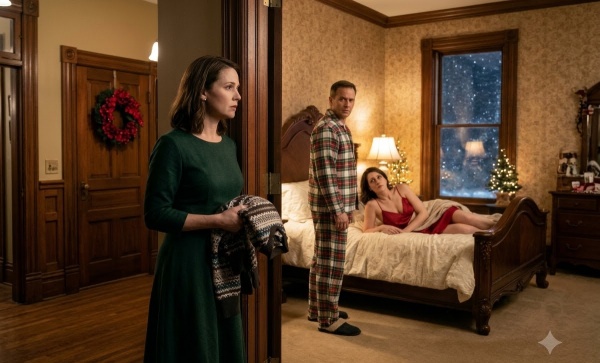
My Husband Brought His Mistress Home on Christmas Eve—Then Told Me to Leave My Own Bedroom… I was setting the table for Christmas dinner when my husband walked through the front door with another woman and an overnight bag. Minutes later, he sat her down on our wedding bed and told me I could pack my things and leave for my sister’s house. By Christmas afternoon, his carefully laid plans were already beginning to unravel.
Part 1: The Woman in My Bedroom
On Christmas Eve, my husband brought his mistress into our bedroom, sat her down on our wedding bed, and told me I could put my old clothes back on and leave. He said it as casually as if he were asking me to take out the trash. By Christmas morning, the house he thought he had won was already changing—and the deal he’d been counting on was about to fall apart.
My name is Claire Bennett, and until that night, I had been married to Daniel for eleven years. We lived in a four-bedroom Victorian house in a quiet Illinois neighborhood, about forty minutes outside Chicago. People who drove past it during the holidays slowed down to look at the white lights wrapped around the porch columns and the big wreath on the red front door.
My grandmother used to say a house should look like someone inside was happy to see you. She hung that wreath herself until her knees gave out, and after she died, I kept doing it. Even during the years when Daniel complained that climbing a ladder in December was “an accident waiting to happen,” the wreath went up.
The house had belonged to my grandmother for almost fifty years. She left it to me before Daniel and I got married, along with an old piano, a collection of mismatched Christmas ornaments, and a recipe box full of cards written in her looping handwriting. Daniel used to tell people he fell in love with me because I made him feel at home.
Somewhere along the way, he stopped saying that. He still loved the house, though—or at least he loved the way it looked when his friends came over. He liked the wide porch, the polished staircase, and the dining room big enough for a Thanksgiving table set for twelve.
That December, I was starting to notice how often he talked about the house as if it were a business opportunity. He had a new friend named Marcus Reed, a local developer who had been buying older properties in our area. Every time Marcus visited, Daniel followed him from room to room, pointing out the tall ceilings and the size of the lot.
“Imagine what this place could be worth,” Daniel said one evening, after Marcus had left. He was standing at the kitchen window with a glass of bourbon, looking out at the snow-covered backyard. “If we were smart, we’d do something with it.”
“We live in it,” I said. “That’s something.”
He laughed, but not because he thought I was funny. “Claire, that’s exactly what I mean. You’re emotionally attached to a building.”
I was emotionally attached to the dent in the kitchen floor where my grandfather had dropped a cast-iron skillet. I was attached to the window seat where my mother had read to me when it rained. And yes, I was attached to the dining room table where my grandmother had made room for anyone who needed a meal.
Daniel knew all of that. At least, I had spent eleven years believing he did. But during the last few months of our marriage, he began treating every memory I had as an inconvenience.
He worked in commercial insurance, and I managed the office for a small dental practice. Our schedules had never been particularly glamorous, but they used to leave room for Friday-night takeout and long conversations after dinner. That fall, Daniel started coming home late and telling me I worried too much when I asked where he’d been.
He also started mentioning a woman named Lauren. She worked in the same office building, he said, and occasionally joined his team for lunch. The first time he brought her up, he called her “easy to talk to,” which struck me as an odd way to describe someone whose last name I didn’t know.
By early December, her name had disappeared from his stories altogether. Daniel’s phone began spending more time facedown, and he took calls in the garage even when the temperature was below freezing. Whenever I asked if something was wrong, he looked at me with an expression I came to hate: patient disappointment.
“You’ve been different,” I told him one night. “If there’s something we need to talk about, I’d rather hear it from you.”
He kissed my forehead and said, “You’re tired, Claire. Everything looks worse when you’re tired.”
I wanted to believe him because the alternative was too big to examine before bedtime. I had Christmas cards to mail, a grocery list on the refrigerator, and a mother recovering from knee surgery. Denial, I discovered, can look a lot like keeping up with your errands.
On December 23, my younger sister, Megan, came over to help me bake cookies. She watched Daniel walk through the kitchen without saying hello and disappear upstairs with his phone. When she heard the bedroom door close, she set down the rolling pin.
“Are you two okay?” she asked.
“Honestly? I don’t know.”
Megan wiped flour from her hands and lowered her voice. “Mom said Daniel asked her last week whether Grandma ever put his name on the house.”
I stopped cutting out sugar cookies. “Why would he ask her that?”
“He said he was curious about your estate planning.” Megan’s mouth tightened. “I told Mom it sounded like a strange thing to ask over lunch.”
I remember looking at the star-shaped cookie cutter in my hand and feeling a little chill that had nothing to do with the weather. Daniel knew the house had come from my grandmother, but we had never had a detailed conversation about the deed. Whenever the subject came up, he waved it away and said he trusted me.
That evening, after Megan left, I checked the folder where I kept the important papers. The deed was there, along with copies of my grandmother’s will and the documents from when the estate was settled. My name was on the title; Daniel’s was not.
I didn’t know precisely what that would mean if our marriage ended. We had paid for some repairs from our joint account, and Daniel had spent weekends working on the porch. But I knew enough to understand that the question was more complicated than the one he had asked my mother.
On Christmas Eve, Daniel told me he had one last appointment at the office. I spent the afternoon making lasagna for the next day and wrapping a blue scarf for my mother. I also put on the green dress Daniel had bought me the previous Christmas, because I wanted one evening that felt like us.
Around seven, I heard his car pull into the driveway. I was setting two plates on the dining room table when the front door opened, followed by laughter that didn’t belong to my husband. A woman’s voice said, “Are you sure this is okay?”
Daniel answered, “I told you, it’s handled.”
He walked into the dining room with Lauren behind him. She was wearing a cream-colored coat and carrying a small overnight bag, and she stopped so abruptly when she saw me that the bag bumped against her leg. I had imagined a hundred versions of the truth by then, but none of them had prepared me for a stranger standing beneath my grandmother’s chandelier.
“Claire,” Daniel said, looking annoyed rather than ashamed. “I thought you were going to Megan’s tonight.”
“Megan’s tomorrow,” I said. “Who is this?”
Lauren looked from him to me. “You said she knew I was coming.”
Daniel ran a hand over his face. “Can we not do this in the dining room?”
He took Lauren’s elbow and led her upstairs before I could answer. I followed them, partly because I wanted an explanation and partly because I could not believe he was bringing her into my home. By the time I reached the bedroom, Lauren was sitting stiffly on the edge of the bed, still wearing her coat.
Daniel stood beside the dresser and looked at my green dress. “You can put your old clothes back on and go to your sister’s,” he said. “There’s no reason to make this uglier than it already is.”
For a second, I thought I had misheard him. Then Lauren stood up and said, “Daniel, you told me you were separated.”
“We are,” he said. “We’re just sorting out the details.”
I stared at the two of them, and something inside me grew very quiet. I didn’t throw a glass or scream; I didn’t even ask him how long it had been going on. I walked to the closet, took out a sweater, and said, “Lauren, did he tell you whose house this is?”
Daniel’s face changed before she could answer. It was only for a moment, but I saw it clearly: the first crack in his confidence. Then his phone buzzed, and the name on the screen was Marcus Reed.
Part 2: The Papers in the Drawer
Lauren looked at Daniel, waiting for him to answer my question. He silenced his phone and said the house belonged to “the marriage,” as if those words settled everything. I told him we could discuss that with attorneys, but he was not going to order me out of my bedroom.
Lauren picked up her bag. “I’m going to wait downstairs.”
“You don’t have to do that,” Daniel said.
“I really do,” she replied.
She left the room without looking at either of us. I heard her shoes on the stairs, followed by the soft click of the front door opening and closing. When I looked out the bedroom window, she was standing on the porch, holding her phone with both hands.
Daniel shut the bedroom door. “You didn’t need to embarrass her.”
I remember that sentence more clearly than anything else he said that night. After bringing another woman into my bedroom and telling me to leave, his first concern was that I had made her uncomfortable. I sat on the edge of the bed because my legs had started to shake.
“How long?” I asked.
“Since September.”
“And you told her we were separated?”
“We’ve been living like roommates for months, Claire.” He leaned against the dresser and folded his arms. “You can’t honestly say you’re surprised.”
I was surprised by the timing, by Lauren’s overnight bag, and by how calmly he could make our marriage sound like a problem I had failed to solve. But beneath the shock was a painful recognition. I had been lonely for months, and I had let him persuade me that loneliness was simply what happened after eleven years together.
Daniel’s phone buzzed again. He glanced at it, then slipped it into his pocket without answering. “I don’t want a fight tonight,” he said. “We can talk about the house tomorrow.”
“Why tomorrow?”
“Because Marcus is interested.” He hesitated, then added, “There’s an offer on the table, Claire. A very good one.”
The words seemed to come from a different conversation. Downstairs, the lasagna was still warm, and my mother’s scarf was wrapped beneath the tree. Yet Daniel was standing in our bedroom on Christmas Eve, talking about a real estate offer as if he had been waiting for the right moment to bring it up.
“I didn’t ask Marcus for an offer,” I said.
“He knows the market. He knows this property.” Daniel’s voice sharpened. “He also knows we’ve been considering a sale.”
“No. You’ve been considering a sale.”
He opened the top drawer of the dresser, pulled out a manila envelope, and handed it to me. Inside was a printed offer from Marcus’s company, Northline Development. The proposed price was $850,000, and the first page had my name and Daniel’s typed as the sellers.
For a moment, the number distracted me. It was more than I had expected the house might be worth, and Daniel knew exactly how to use a number like that. He waited while I looked at it, watching my face.
“This would solve a lot of problems,” he said. “You’d have money to start over, and I wouldn’t have to keep sinking cash into a place you treat like a museum.”
I turned another page and found a proposed closing date in February. There were conditions and deadlines I didn’t understand, but I did understand that no agreement to sell had my signature on it. I put the papers back in the envelope.
“I’m not signing this tonight.”
Daniel’s jaw tightened. “You don’t even know what the alternative is.”
“I know I don’t want to make a decision about my grandmother’s house five minutes after meeting your girlfriend.”
He stepped closer. “Marcus can withdraw the offer tomorrow. You need to think about what happens if you say no.”
The way he said it made me realize that the offer was not the only thing he was worried about. I asked him whether he had signed anything with Marcus himself. He looked toward the window and said, “Nothing you need to worry about.”
I had spent enough years with Daniel to know when he was trying to end a conversation before I reached the important part. I told him again that I wasn’t leaving the house, then went downstairs to check on Lauren. Her car was gone, but she had left her overnight bag on the porch.
There was a note tucked under the handle. I’m sorry. I didn’t know.
I carried the bag inside so it wouldn’t get wet and set it by the front door. Then I called Megan, who answered on the second ring. By the time I finished telling her what had happened, she was already putting on her boots.
“Don’t come if the roads are bad,” I said.
“Claire, I once drove across three counties because you thought your cat swallowed a ribbon. I’m coming.”
She arrived twenty minutes later with a bottle of sparkling cider, two toothbrushes, and a pair of sweatpants. Daniel had gone into the study and closed the door, so Megan and I sat at the kitchen table with mugs of tea. I showed her the offer and told her what he had said about Marcus withdrawing it.
“Did he sign something?” she asked.
“I think so, but he won’t tell me.”
Megan worked as a paralegal, though not in family law. She didn’t pretend to know how the property would be treated, and she warned me not to make assumptions. What she did know was the name of a family-law attorney who had helped one of her friends.
I sent the attorney a short email that night, expecting a reply after the holiday. I explained that the house had been inherited before marriage, that shared money had gone toward repairs, and that Daniel was pressuring me to sell. I attached a photograph of the offer and asked what I should do before signing anything.
Then Megan helped me gather copies of records I already had access to: the deed, my grandmother’s will, renovation invoices, and bank statements showing which accounts had paid for major work. We didn’t go through Daniel’s private messages or try to guess passwords. The papers were enough to show me that the life I had considered ordinary had become a collection of questions.
A little after ten, Daniel came into the kitchen. He looked irritated to find Megan there, but he kept his voice controlled. “Marcus is coming by tomorrow morning to explain the offer,” he said.
“He doesn’t need to,” I replied.
“He’s already made time.”
“Then he can use it for something else.”
Daniel looked at Megan. “This is between my wife and me.”
“She asked me to stay,” Megan said. “I’m staying.”
He went back to the study and shut the door harder than necessary. A few minutes later, his voice rose through the wall, though we couldn’t make out the words. Then my phone lit up with an email from my real estate agent, Ellen Foster.
I had spoken to Ellen a month earlier, after Daniel first began pushing the idea of selling. At the time, I had only wanted to know the house’s approximate value and what selling might involve. Ellen had also mentioned that she knew a family looking for an older home in the neighborhood, but I had told her I wasn’t ready.
Her email that night was brief. The family was still interested, and they had asked whether she would pass along a written offer. It was lower than Marcus’s—$810,000—but they were willing to be flexible about the closing date and had included a letter.
I almost set it aside. Then I saw the names at the bottom of the letter: Sarah and Michael Alvarez. Underneath, in a child’s uneven handwriting, someone had added, I like the window seat.
I read that line three times. Daniel wanted me to believe there was only one path forward, and he had given me until Christmas morning to take it. For the first time that night, I wondered what he would do if I chose a different one.
Part 3: The Offer He Never Expected
I didn’t know the Alvarez family, but I knew of them. Sarah was a reading specialist at the elementary school, and Michael ran a small landscaping business with his brother. They had two daughters, a rescue dog, and a rental house they had outgrown.
Their letter was simple. They liked the porch and the backyard, but what Sarah wrote about most was the kitchen. She said it reminded her of her aunt’s house, where relatives were always welcome and somebody was always making too much food.
“I know a letter doesn’t change the numbers,” she wrote. “But if you decide it’s time to leave, I wanted you to know we’d care for this place.”
Megan read it over my shoulder. “You don’t have to decide tonight,” she said.
“I know.”
But I kept looking at the words if you decide. Daniel had spent months speaking as if he were waiting for me to catch up to a decision he had already made. Sarah, a stranger, had managed to leave room for the fact that the house was mine to care about.
I emailed Ellen and asked whether the Alvarez offer was still open. I also asked her to tell them I would need time to understand my legal situation before making any commitment. She replied within minutes, apologizing for being on her phone during Christmas Eve but saying the family understood.
“They can wait,” she wrote. “And Claire, whatever Daniel is telling you, please don’t sign anything without advice.”
At midnight, Megan insisted I try to sleep. I took the guest room, not because Daniel had won the bedroom, but because I couldn’t bear to sleep beside him. Megan stayed in the room across the hall, and I lay awake listening to the furnace turn on and off.
At some point, I thought about the first Christmas Daniel and I spent in the house. The pipes had nearly frozen, the turkey had taken two hours longer than expected, and we had eaten dinner wearing sweaters. He had held my hand under the table while my grandmother told the same story about my grandfather for the hundredth time.
I had loved him then. That was the part I didn’t want the anger to erase. A marriage can end badly without every good memory having been a lie.
Around six in the morning, I came downstairs to find Daniel at the kitchen table. He was still wearing yesterday’s clothes, and there was an empty coffee mug beside his laptop. The envelope from Marcus’s company sat in front of him.
“Lauren went home,” he said.
“I know. She left a note.”
“She’s upset.”
I opened the refrigerator and took out the orange juice. “So am I.”
He watched me pour a glass. “I handled last night badly.”
“Yes, you did.”
“I was angry, and I shouldn’t have said you had to leave.” He rubbed his eyes. “But I meant what I said about the offer. This could be a clean break for both of us.”
I asked him again whether he had signed anything with Marcus. This time, he didn’t deny it. He closed his laptop and stared at the envelope for a long moment.
“Marcus advanced me some money,” he said.
“How much?”
“Thirty thousand dollars.”
I set my glass down. “For what?”
“He wanted help securing the property. If the sale closes, it comes out of a fee he agreed to pay me.” Daniel spoke quickly, as though he could get past the explanation before I understood it. “It’s between him and me. It doesn’t change what you get for the house.”
“Does he expect it back if the sale doesn’t happen?”
“There are terms.” Daniel looked away. “We can work it out.”
I asked to see the agreement. He refused at first, then said Marcus would explain when he arrived. What I understood was enough: my husband had accepted money tied to a sale I hadn’t agreed to, and he had been trying to make that sale sound like my only sensible choice.
The $30,000 also explained something else. In November, Daniel had paid off a credit card balance he had been worried about for months. I had congratulated him, and he had said he’d received a work bonus.
“Did you use Marcus’s money to pay the card?” I asked.
He didn’t answer. He didn’t have to.
Megan came downstairs in her sweatpants and stopped when she saw our faces. Daniel stood and told her that she was making a private situation worse. Megan walked past him, opened a cupboard, and took out three coffee mugs.
“I think that happened before I got here,” she said.
At eight-thirty, Lauren called me. I almost didn’t answer, but I remembered the note she had left with her bag. Her voice was shaky, and she apologized before I could say hello.
“Daniel told me you’d been separated for months,” she said. “He said you were staying in the house until the sale because it was easier financially.”
I looked at Daniel, who was standing near the sink. “We weren’t separated.”
“I know that now.” She paused. “He also told me Marcus was buying the house and that Daniel was going to use his share to put a down payment on a place for us.”
I asked whether she knew about the $30,000. She said Daniel had mentioned an advance but told her it was from work. Then she added something that made me sit down.
“Marcus’s company isn’t planning to keep the house,” she said. “Daniel showed me a sketch for the lot. They want to tear it down and build two new homes.”
I had assumed Marcus might renovate and resell it. I hadn’t imagined the window seat, the piano room, and my grandmother’s kitchen disappearing altogether. I thanked Lauren for telling me and asked whether she wanted to pick up her bag.
“Could you leave it with Megan?” she asked. “I don’t want to come inside.”
After the call, I asked Daniel about the demolition plan. He said the house was old, the lot was valuable, and Marcus would do whatever made business sense. When I told him he had never mentioned tearing it down, he gave a tired shrug.
“You wouldn’t have listened.”
“That’s not the same as telling me.”
He stood in the middle of the kitchen, looking at the cabinets my grandfather had painted twice because my grandmother disliked the first shade of white. “You’re choosing memories over money,” he said. “It’s irrational.”
“Maybe,” I replied. “But they’re my memories, and it’s my decision to make.”
At nine-fifteen, the attorney I had emailed called me back. Her name was Priya Shah, and she told me she had a few minutes before leaving for a family celebration. I explained the new information about Marcus and the advance while Megan took notes.
Priya was careful not to promise an outcome. She said an inherited house could be treated as separate property, but contributions from marital funds and other facts could matter. She also told me not to sign the offer or make promises about the house until she had reviewed the documents.
“What about Daniel being here?” I asked.
“Don’t try to force him out or change the locks,” she said. “We’ll discuss living arrangements and any necessary agreements properly. For now, focus on staying safe and getting advice.”
After we hung up, I called Ellen. I told her I was interested in the Alvarez offer, but only if it could be reviewed by my attorney and handled with all the necessary protections. Ellen said she would speak with the family and send the documents to Priya.
At ten o’clock, a black SUV pulled into the driveway. Marcus stepped out carrying a leather portfolio, and Daniel hurried to the front door before he could ring the bell. Through the window, I saw Daniel speak to him with the urgent expression of a man who had finally noticed the ground shifting beneath him.
Marcus entered the house smiling. “Merry Christmas,” he said, as if he were a guest arriving for brunch. Then he looked past me and saw the Alvarez family’s letter on the kitchen table.
His smile disappeared. “Daniel,” he said quietly, “what is that?”
Part 4: Christmas Morning
Daniel picked up the letter before Marcus could reach it. “It’s nothing,” he said. “Claire’s just looking at another offer.”
Marcus turned to me. “I thought we had an understanding.”
“You and I have never discussed an agreement,” I said. “You gave Daniel a proposal. I haven’t accepted it.”
He took off his coat but kept it folded over one arm, as if he expected the visit to be short. He was a broad-shouldered man in his fifties who spoke in the polished, reassuring tone of someone used to negotiating across expensive tables. That morning, his eyes kept moving between Daniel and the letter.
“My offer is forty thousand dollars higher,” he said. “I’d be interested to hear why you’re considering less.”
“I’d be interested to know why you didn’t tell me you were considering demolition.”
Marcus glanced at Daniel. “I assumed that had been discussed.”
“It hadn’t.”
He set his coat on a chair and opened the portfolio. Inside were copies of the proposed purchase offer, a property assessment, and a document he slid toward Daniel rather than me. I caught sight of the words advance and repayment, but Daniel placed his hand over the page.
“That’s our business,” he said.
“It became my business when you used it to pressure me into selling,” I replied.
Marcus drew the document back. “Daniel and I have an agreement that depends on several things, including whether a transaction closes. We’ll handle that separately.” He looked at Daniel as he spoke, and there was nothing reassuring in his expression.
Daniel gave a short laugh. “You’re not seriously going to make this difficult over a delay.”
“I’m not the one who told me you could deliver the property,” Marcus said.
The room went still. Megan, who had been quietly loading the dishwasher, turned off the faucet. I could hear the clock above the stove ticking between us.
“I never promised anything I couldn’t deliver,” Daniel said.
Marcus raised an eyebrow. “You told me Claire was ready to sign.”
“I said she would listen.”
“You said the marriage was ending and that she’d take the offer.” Marcus closed the portfolio. “Those were your words.”
Daniel looked at me, and for the first time since the previous evening, he seemed less angry than frightened. He had apparently built a plan in which I did exactly what he expected: got hurt, got overwhelmed, and took the money he put in front of me. He had not accounted for a sister with spare toothbrushes, an attorney willing to answer her phone, or a family who liked the window seat.
“You don’t understand what this could cost us,” he said.
“Then explain it,” I replied. “Show me the agreement.”
He shook his head. “I’ll talk to my own attorney.”
“That’s probably wise,” Megan said.
Marcus put his coat back on. Before he left, he reminded me that his offer remained open until five that afternoon. I told him I understood, but I would not be making a decision on his schedule.
When the front door closed, Daniel rounded on me. “You’re doing this to punish me.”
I wanted to say that bringing Lauren into our bedroom had done plenty of punishing without any help from me. Instead, I asked him whether he had ever planned to tell me about the advance. He said he would have told me after the sale, when there was no reason to worry.
“That’s not honesty, Daniel. That’s waiting until I can’t object.”
He picked up his laptop and went upstairs. I heard the guest-room door close, and a moment later my phone buzzed with a message from him. It said, You’re making a mistake that will hurt both of us.
I didn’t answer. I helped Megan put the lasagna in the oven, even though my hands were still unsteady. We had invited Mom and our uncle for Christmas dinner, and I considered canceling, but Megan asked me what I wanted.
“I want one normal thing,” I said.
“Then let’s give the lasagna a fighting chance.”
Mom arrived just after noon, leaning on her cane and carrying a tin of peppermint bark. She knew something was wrong as soon as she saw my face, so I told her the truth in the living room while Megan made tea. Mom listened without interrupting, then reached across the couch and took my hand.
“I’m sorry,” she said. “I wish I could fix it.”
“You don’t have to.”
“I know.” She squeezed my fingers. “But I can sit here with you while it hurts.”
That was when I finally cried. Not the careful tears I had swallowed in the bedroom, and not the silent ones I had wiped away before Megan arrived. I cried into my mother’s shoulder while the Christmas tree lights blinked and the dog next door barked at a delivery truck.
When I could breathe normally again, Mom told me something I had never heard about my grandmother. Years earlier, after my grandfather lost his job, they had considered selling the house. An investor offered them enough money to clear their debts, but he wanted to remove the old garden and divide the lot.
“Your grandmother spent three days trying to decide,” Mom said. “She wasn’t wealthy, and she knew what that money could do for the family.”
“What did she do?”
“She found another way through it, with help from people who loved her.” Mom smiled. “But she always said that if the day came when you needed to sell, you should. She left you the house, Claire. She didn’t leave you a sentence.”
That afternoon, Ellen called with an update. The Alvarez family had confirmed their offer and were willing to allow time for attorney review, inspections, and an orderly closing. They also understood that the terms would need to address occupancy and any other issues properly; they were not asking anyone to disappear by New Year’s.
Priya reviewed the proposed documents and spoke with Ellen. She explained which points needed attention and reminded me that agreeing to a sale did not make the divorce or the question of contributions disappear. I listened, asked questions, and made notes in the margin of a Christmas card envelope.
At three-thirty, I called Sarah Alvarez. I told her the truth: I was considering selling, but my circumstances had changed suddenly, and I couldn’t promise the process would be simple. She didn’t rush me or ask for details I didn’t want to share.
“We love the house,” she said. “But we don’t want you to feel pushed out of it.”
Her kindness made the decision clearer, though not easier. I wasn’t selling because Daniel had brought Lauren home, and I wasn’t selling just to keep Marcus from getting the property. I was selling because, after months of feeling trapped inside a place I loved, I could finally imagine choosing a different future.
With Priya’s guidance, I signed the Alvarez offer electronically that afternoon. Sarah and Michael signed after reviewing the terms, and Ellen confirmed that we had an agreement subject to the stated conditions. The house had not changed hands; that would require a later closing, and there were still important steps ahead.
At four-forty-five, Daniel came downstairs and asked whether I had signed Marcus’s offer. I told him no, then explained that I had agreed to sell to another family, subject to the contract’s conditions and the necessary legal arrangements. He stared at me as though I had started speaking another language.
“You’d rather take forty thousand dollars less than let me fix this?”
“I’d rather make my own decision than pay for yours.”
He looked toward the dining room, where Mom was setting out plates and Megan was searching for the good serving spoon. The table was crowded with food, the tree lights were on, and no one was waiting for his permission to begin Christmas. He had wanted the house to himself, but the next day it was already different: I had stopped treating his wishes as the rules.
Then his phone rang. Marcus’s name appeared on the screen, and Daniel stepped onto the porch to answer it. A few moments later, I saw him sit down on the top step, still holding the phone, while snow began to collect on the shoulders of his coat.
Part 5: What We Kept
Daniel came back inside before dinner and asked if we could talk privately. I led him into the study and left the door partly open. I wasn’t afraid he would hurt me, but after the past twenty-four hours, I wanted the comfort of hearing my family nearby.
“Marcus wants the advance repaid,” he said.
I looked at him. “What does your agreement say?”
“He says he has the right to demand it if the deal doesn’t close.” Daniel pressed his fingers against his forehead. “I don’t know whether that’s the end of it, or whether he thinks I owe him something else.”
I told him he needed his own attorney to review the document. I also told him I wasn’t going to decide what he owed Marcus based on a conversation in our study. He had made that agreement without me, and I would not make promises about it now.
“You could still change your mind,” he said.
“There’s a signed agreement with the Alvarezes, subject to its conditions.”
“They haven’t closed.”
“No,” I said. “And that doesn’t mean I can ignore what I signed because it’s inconvenient for you.”
He sat down in the chair by the desk. For the first time, he looked like the man who had once stayed up all night with me when my grandmother was in the hospital: tired, worried, and suddenly unsure of himself. I felt a pull toward comforting him, followed by the realization that I could care about his distress without taking responsibility for solving it.
“I thought you’d never leave this house,” he said.
“Neither did I.”
“Then why them?”
I considered giving him the practical reasons: the flexible closing, the attorney review, and the fact that the Alvarezes wanted to preserve the property. Those reasons mattered, but they weren’t the whole truth. “Because they asked me what I wanted,” I said.
Daniel looked down at his hands. After a while, he admitted that Lauren had ended their relationship that morning. She had called him after speaking with me and said she needed time away from the situation he had described so differently.
He tried to tell me that he had been unhappy for a long time. I told him I believed him, and that I had been unhappy too. But unhappiness did not explain why he had lied to both of us or accepted money on the assumption that I would do as I was told.
He didn’t come to dinner. He took a plate upstairs after everyone had finished, and no one tried to persuade him to join us. Mom, Megan, my uncle, and I ate lasagna at the long dining room table while the sky turned blue-gray outside.
It wasn’t a cheerful meal from beginning to end. There were silences, and my uncle asked a question about Daniel that Megan gently redirected. But we also laughed when Mom discovered that I had accidentally wrapped the blue scarf in paper printed with birthday cakes.
“Very festive,” she said.
“It was late,” I replied.
“So was I,” my uncle said. “By twelve years, according to your grandmother.”
We laughed harder than the joke deserved, perhaps because all of us needed to. Later, we played a card game at the kitchen table, and Megan cheated so obviously that even Mom called her out. For a few hours, the house felt less like a prize in someone else’s plan and more like the place my grandmother had wanted it to be.
The days after Christmas were not magically easy. Daniel and I each spoke with attorneys, and we had difficult conversations about our finances, the repairs made to the house, and where each of us would live. Priya was firm about documenting everything rather than making decisions out of anger.
Daniel eventually agreed to stay with his brother while we worked through temporary arrangements. We put that agreement in writing with help from our attorneys, including a plan for him to collect his belongings. I did not change the locks or put his things on the porch, and he did not surrender every possible claim simply by leaving.
He came back one Saturday with his brother and packed his clothes, books, and the framed photograph from his college graduation. I stayed in the kitchen with Megan, drinking coffee that had gone cold. When Daniel carried out the last box, he paused in the doorway.
“I really am sorry about Christmas Eve,” he said.
“I know you’re sorry it happened the way it did.”
He looked as if he wanted to argue, then nodded. “That’s fair.”
I watched his car pull away and expected to feel triumphant. Instead, I felt exhausted and sad, with a small space inside that might eventually become relief. Eleven years do not fit neatly into boxes, even when the person carrying them has given you every reason to let him go.
The sale to the Alvarezes took several more weeks. There were inspections, questions about the old electrical panel, and a negotiation over a repair credit. One afternoon, Priya called to explain that an issue raised in the divorce discussions needed to be addressed before we could proceed comfortably.
We did not pretend it would disappear. Through our attorneys, Daniel and I reached an interim agreement about the sale and how certain proceeds would be handled while the remaining financial questions were resolved. It wasn’t a dramatic courtroom victory; it was paperwork, careful advice, and a compromise I could live with.
Marcus and Daniel also had their own dispute to sort out. I never learned every detail, and I didn’t ask to see their final agreement. I did learn that Daniel had to repay at least part of the advance, and that the fee he expected from the sale never arrived.
That was the real surprise in the deal he had counted on. He had treated Marcus’s money as proof that the future was already settled, but the promised fee depended on a sale he did not control. The agreement had given him an immediate benefit and a problem to resolve—not the power to make my decision for me.
In February, after the remaining conditions were satisfied, the sale closed. I handed over the keys at the title office and sat in my car afterward, holding the small brass key ring my grandmother had used for decades. The house belonged to the Alvarezes then, not to me, and saying that aloud made me cry all over again.
A week before the closing, Sarah had asked whether I wanted to keep the old piano. I did, though I had no idea where it would fit in the smaller place I planned to rent. Michael helped arrange for movers, and Sarah told me her daughters were already arguing over which books to keep on the window seat.
On my last morning in the house, I walked through every room alone. I touched the banister where years of hands had worn the finish smooth and stood at the kitchen window looking at the bare garden. When I reached the dining room, I found a faint pencil mark on the doorframe that recorded my height when I was twelve.
I had forgotten it was there. For a moment, I wanted to call off everything and stay, even though the boxes were packed and the closing was hours away. Then I remembered my mother’s words: my grandmother had left me a home, not a sentence.
I took a photograph of the mark. I also slipped one of Grandma’s handwritten recipe cards into my coat pocket: her cinnamon-roll recipe, stained with butter and nearly impossible to read. The rest of the recipe box went with me, along with the ornaments and the old brass key ring.
The following Christmas, I lived in a smaller house with a narrow front porch and a kitchen that could barely fit four people at once. The piano stood in the living room beside a bookshelf I had assembled backward on my first attempt. Megan said the bookshelf had “character,” which was her polite way of saying it leaned.
That morning, an envelope arrived from Sarah. Inside was a photograph of the red front door with a wreath hanging on it, along with a note from her younger daughter. The note said, We read in the window seat every night. Thank you for letting us love the house.
I put the photograph on my refrigerator and stood there for a long time. The home my grandmother built her life in was still standing, full of different voices and new routines. I missed it, but I no longer felt as if leaving it meant losing her.
That evening, Mom and Megan came over for dinner. The cinnamon rolls burned slightly on the bottom, the smoke alarm went off, and we ate them anyway. Afterward, Megan opened the front door for the neighbors who had stopped by with a plate of cookies.
For a second, cold air rushed into the living room. Then everyone squeezed around the small table, making room for one more chair. I looked at the people I loved and thought of my grandmother’s old saying.
A house should look like someone inside is happy to see you.
For the first time in a long while, mine did.
