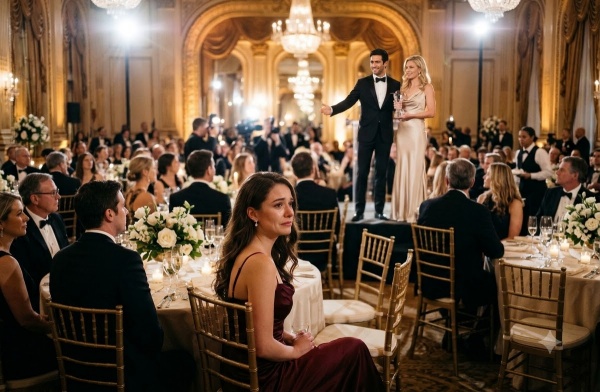
My Husband Announced He’d Been Married to Another Woman for Eight Years—While I Was Sitting in the Audience… Eight hundred guests applauded as Ethan wrapped his arm around Olivia and called her his wife. I sat near the back, wondering how many people knew that I was the woman he had actually married eight years earlier. Ethan thought I would wait until we got home to ask questions. He had no idea I already…
Part 1: The Woman Beside My Husband
My husband stood beneath a wall of cameras, wrapped one arm around another woman, and told eight hundred guests she was the woman he had been “secretly married to for eight years.” The room erupted in applause. I stood near the back with a glass of sparkling water in my hand, watching a woman I had met twice place her palm on my husband’s chest.
For a moment, I honestly thought I had misheard him. Ethan was smiling the way he smiled in photographs, his shoulders relaxed, his teeth bright under the lights. The woman beside him smiled too, although her fingers tightened around the microphone as he kissed the top of her head.
“Some of you know her as my business partner,” he continued. “But tonight, I’m proud to introduce you to my wife, Olivia.”
People turned to one another, delighted by the surprise. A woman at my table whispered that she had always suspected there was something between them. Someone else lifted a phone to record, and I saw my husband’s face appear on a dozen small screens across the ballroom.
I had been legally married to Ethan for eight years. Our wedding had taken place at a courthouse in Raleigh, North Carolina, on a warm Tuesday in May. My brother Mark had been our witness, and afterward the three of us ate barbecue at a restaurant with paper napkins and a ceiling fan that clicked every time it turned.
I knew the date because it was engraved inside my wedding band. I knew the marriage was real because, two months before the gala, I had ordered a certified copy of our marriage record. It was tucked into a folder in my apartment, between my birth certificate and the lease Ethan didn’t know I had signed.
From the stage, Ethan began telling a story about meeting Olivia at a coffee shop. He said they had kept their relationship private because they wanted to build something together without public attention. He described an intimate ceremony with close friends and a honeymoon they had postponed until the company was established.
The story sounded almost familiar. He had borrowed pieces of our life, changed the setting, and placed Olivia where I had once stood. I wondered whether the part about postponing the honeymoon was meant to make him sound devoted or whether he had simply forgotten he had made the same promise to me.
Olivia leaned toward the microphone and thanked everyone for respecting their privacy. She spoke about the company, about Ethan’s vision, and about the charitable foundation they were launching that night. She didn’t look in my direction, but I couldn’t tell whether that was because she knew I was there.
The man beside me, a sponsor from Atlanta, asked if I was all right. I realized I was gripping my glass so hard that water had spilled over my fingers. I set it down and told him I needed some air.
In the hallway outside the ballroom, I found a bench beneath a painting of a sailboat. My phone was vibrating inside my clutch, and I expected to see Ethan’s name. Instead, there were three messages from Mark, who had been watching a livestream from his house.
Tell me you’re not still in that room.
Then: I’m calling you.
Then: Rachel, please answer.
I called him before he could send another message. He picked up so quickly that I heard him take a breath. “Did he just say what I think he said?”
“Yes.”
“I’m coming to get you.”
“I have my car.”
“Then I’m coming to sit with you while you get it.”
That was Mark. He never pretended I couldn’t handle something, but he also knew I had spent years handling too much alone. I told him where I was and said I would wait in the hotel lobby.
Before he arrived, Ethan came through the ballroom doors. He was still wearing his microphone pack, and his expression changed the instant he saw me. For a second, he looked less like a man celebrating a triumph and more like a man who had forgotten he left something dangerous on the stove.
“Rachel,” he said. “I didn’t know you were here.”
“You invited me.”
“I sent you an invitation because the foundation sent one to everyone on the donor list. I didn’t think you’d come.”
I had indeed received a formal invitation, addressed to Mrs. Rachel Bennett. Ethan had told me the event would be crowded and boring, and he had suggested I stay home. I had accepted online anyway, using the same last name he had been asking me not to use around his colleagues for years.
He glanced toward the ballroom. “I can explain what you heard.”
“I hope so.”
“It’s a campaign. Olivia and I are presenting a certain image for the launch, and the board thought—”
“Did the board tell you to say you were married to her?”
His jaw tightened. He said I was making a scene, though we were alone in the hallway except for a server arranging coffee cups at the far end. Then he told me we should discuss it at home, where I could calm down and listen.
“I’m not going home with you.”
He looked at me as though I had said something in a language he didn’t understand. “Rachel, don’t do this here.”
That was the sentence he had used throughout our marriage whenever I asked a question he didn’t want to answer. Don’t do this at dinner. Don’t do this in front of my mother. Don’t do this while I’m working.
A familiar urge rose in me: apologize for the timing, lower my voice, and wait until he was ready. Instead, I reached into my clutch and checked that my car keys were there. Mark’s message appeared on my screen: At the entrance.
“I’m leaving,” I said.
Ethan stepped closer. “We’ll talk tomorrow.”
“No,” I told him. “You can contact my attorney.”
His face changed again. He had expected anger, perhaps tears, but he hadn’t expected the word attorney. He didn’t know that while he was preparing his big announcement, I had already spent three months preparing to leave.
Part 2: The Marriage Behind Closed Doors
When I met Ethan, he was thirty and running a small marketing firm out of a rented office above a pet supply store. I was twenty-eight and working as a project coordinator for an architecture company. He brought me coffee on our second date, remembered how I took it, and listened carefully when I talked about my plans.
We dated for two years before he proposed. He took me to the park where we had first met and asked me to marry him beside a pond full of ducks. There was no photographer hiding in the bushes, no crowd applauding, and at the time I loved him for making it feel private.
My mother flew from England for the wedding. She had grown up in Leeds and moved to the United States after marrying my father. She cried when she saw me in a simple cream-colored dress and told me I looked like myself, which was exactly what I had hoped to look like.
Ethan’s parents didn’t attend. He said his mother was ill and his father didn’t travel well, though both lived less than two hours away. He promised we would have a larger celebration once the business could afford it.
The celebration never happened. There was always a reason to wait: a new client, a difficult quarter, a disagreement with his father, or an important partnership that required his full attention. Eventually, I stopped asking when we might have it because the question had begun to sound, even to me, like a complaint.
At first, Ethan introduced me as his wife without hesitation. Then his business began to grow, and he started inviting me to fewer events. He said the people he worked with were exhausting and that he wanted to protect our evenings from talk about money.
I believed him because I had met some of those people and found them exhausting too. When he asked whether I minded being left off a company website, I said I didn’t. My own employer did not put spouses on its website, and I had no desire to become part of Ethan’s business.
But the requests became stranger. At a dinner with potential investors, he introduced me as Rachel, an old friend. In the car afterward, he said one of the investors was going through a bitter divorce and had been complaining about married couples all evening.
“Why would that mean you can’t say I’m your wife?” I asked.
“It was easier,” he said. “I didn’t want the whole night to turn into a conversation about his ex.”
I let it go. A month later, he asked me not to post a photograph from our anniversary dinner because a competitor had been watching his social media. He said people in his industry looked for anything they could use to distract him, and he wanted our relationship to remain ours.
The explanation made less sense each time he offered it, but it came wrapped in language that sounded caring. He said he wanted to protect me. He said strangers didn’t deserve access to our private life.
Over time, I stopped appearing beside him altogether. When his company moved into a larger office, I learned about the opening party from a photograph on a local business website. He told me the guest list had been limited, though several employees had brought their spouses.
At home, our life looked ordinary from the outside. We owned a house in a neighborhood with wide sidewalks and crepe myrtles along the street. We hosted Thanksgiving for Mark and his family, argued about whether the kitchen needed new cabinets, and kept a shared calendar on the refrigerator.
Ethan could be thoughtful when he wanted to be. He remembered my favorite bakery and brought home almond croissants on Saturdays. When my father died, he sat with me through the first terrible weeks and handled calls I couldn’t bear to make.
That was part of what made the later years so confusing. The man who held my hand at my father’s funeral was the same man who asked me to wait in a car while he met a colleague at a restaurant. I kept trying to reconcile those versions of him, as if understanding the difference would make the hurt easier to explain.
Three years into our marriage, I left my architecture job. Ethan had asked me to help organize a major project at his firm, and what was supposed to be a three-month contract became a full-time role. I managed schedules, reviewed budgets, and kept track of the details that everyone else seemed too busy to notice.
For a while, I enjoyed it. I was good at the work, and the company paid me a salary, although Ethan preferred that I use my maiden name, Rachel Morgan, on the payroll. He said it would prevent employees from assuming I had been hired because I was his wife.
I could understand the concern, but I noticed he never corrected anyone who called me his assistant. When I raised it, he said titles didn’t matter and that the people who mattered knew what I did. The people who mattered, increasingly, seemed to be people I was never allowed to meet.
Olivia joined the company four years before the gala. She was smart, confident, and good at presenting ideas in a room full of skeptical executives. I liked her at first, and I was relieved that Ethan had hired someone who could take some of the pressure off the rest of us.
Then the photographs started appearing. Ethan and Olivia at an industry dinner. Ethan and Olivia at a charity event. Ethan and Olivia standing outside the company’s new building while a reporter described them as the partnership behind its success.
I asked him once whether people thought they were a couple. He laughed and said people were free to think whatever they wanted. When I asked whether Olivia knew he was married, he said, “Of course she does.”
I believed that answer too. It took me another year to discover that there were many things Ethan could say confidently without their being true.
Part 3: The Folder in My Drawer
The first person to ask whether I was Ethan’s ex-wife was a woman named Denise. She had recently joined the company’s accounting department, and we met in the break room while waiting for the coffee machine to finish. She looked embarrassed the moment the question came out.
“I’m sorry,” she said. “I thought everyone knew. He mentioned that his first marriage ended a long time ago.”
I told her Ethan and I were still married. Denise stared at me, then apologized again and hurried back to her desk. I stood there holding an empty mug while the coffee machine beeped behind me.
That evening, I asked Ethan what he had told the accounting department. He said Denise must have misunderstood a conversation about his brother’s divorce. He sounded annoyed that I had brought a workplace misunderstanding into our home.
The next week, I found a company newsletter on the kitchen counter. It included a photograph of Ethan and Olivia at a fundraiser, with a caption referring to them as “partners in business and in life.” I circled the phrase and left the newsletter where he would see it.
He came home late and found me waiting at the table. Before I could ask anything, he said the caption was a mistake and the publication had already been contacted. I asked to see the correction, and he told me I was becoming suspicious of everything.
Maybe I was. But I had spent years accepting explanations that required me to ignore what I could plainly see. I was beginning to understand that suspicion can be a response to missing information, not proof that a person is unreasonable.
I called Mark the following Saturday. We had never stopped seeing each other, but I had become skilled at keeping our conversations focused on his family, his work, and my mother. When he asked about Ethan, I usually said he was busy.
That day, I told him about Denise and the newsletter. Mark listened without interrupting, which was unusual enough that I knew he was worried. When I finished, he asked a question I had been avoiding.
“Are you happy, Rachel?”
I opened my mouth to say yes. Instead, I started crying so suddenly that I had to pull my car into a grocery store parking lot. Mark stayed on the phone while I sat there, watching people push carts through the sunlight.
A week later, I met with an attorney recommended by a friend. I was careful not to describe our marriage as something I had already decided to end. I told her I needed to understand my options and what documents I should gather if I chose to separate.
She asked about our home, our accounts, my job, and the company. She did not promise me an outcome or tell me to take money from anyone. She suggested I keep copies of records I had a right to access and make a list of questions before our next meeting.
I went home with a yellow legal pad and a headache. Ethan was traveling that week, so I spread our household records across the dining room table and began writing down what I knew. The gaps in my knowledge frightened me more than the numbers.
I knew the mortgage payment because I paid it from our joint account. I knew the balance of my retirement account and the amount in the savings account my mother had helped me open years earlier. But I had no clear idea how much Ethan earned from the company, and I realized I had been signing tax documents after only the briefest review.
I called an accountant and scheduled an appointment. I changed the password on my personal email account and checked that the recovery information was mine. I also opened a new checking account in my name and began depositing my salary there, after discussing the change with my attorney.
None of it felt dramatic while I was doing it. It felt like making lists, sitting in offices, and asking questions I wished I had asked years earlier. Some nights I still cooked dinner for Ethan and listened to him talk about his day while a folder of documents sat in my desk drawer.
I had a second possibility to consider, one I had rarely discussed with anyone but Mark. My mother had kept her British citizenship, and through her I had British citizenship too. I had a current British passport, although the last time I had used it was on a trip to visit her family in England.
My cousin Hannah lived in Bristol, where she ran a small architectural drafting business. We had stayed close over the years, exchanging holiday cards and the occasional long email about work and family. When I told her I might need a change, she said there was a room available in her apartment and offered to connect me with people in her field.
I didn’t accept immediately. Moving across the Atlantic sounded like something a brave person in a movie would do, not something I could arrange between work deadlines and dental appointments. But Hannah sent photographs of the room, the street outside, and a bakery around the corner, and I began to imagine waking up somewhere Ethan couldn’t decide how I was introduced.
In August, I flew to Bristol for what I told Ethan was a visit with family. That was true, though it wasn’t the whole truth. I spent time with Hannah, met two people who might have freelance work, and viewed a small apartment above a shop.
The apartment had sloping ceilings and a kitchen barely large enough for a table. From the bedroom window, I could see a row of brick houses and a bus stop. It wasn’t glamorous, but the landlord was willing to rent it furnished, and the monthly cost was within the budget my accountant and I had discussed.
I signed a lease that would begin in October. I paid the deposit from my personal savings and told myself I could still change my mind about the move. Signing the papers did not mean I had to leave Ethan, but it meant leaving was no longer an impossible thought.
When I returned to North Carolina, Ethan barely asked about the trip. He was consumed by preparations for the foundation gala and spent most evenings on calls. He mentioned that Olivia would be helping him make an announcement, but he said the details were confidential until the board approved the presentation.
A few days before the gala, I found a draft press packet in our home office. Ethan had printed it and left it on the desk beside a stack of bills. On the first page was a photograph of him and Olivia, followed by the words husband-and-wife team.
I took a picture of the page. Then I called my attorney and asked whether she could see me the next morning. By the time I entered the ballroom on Saturday night, I knew I might hear my husband tell a lie in public, but I still wanted to believe he would stop short of saying it.
He didn’t.
Part 4: What Olivia Didn’t Know
Mark met me at the hotel entrance just after nine. He had thrown a jacket over a T-shirt and was wearing the sneakers he used to mow his lawn. When he saw me, he opened his arms, and I let him hold me for a moment.
“I’m okay,” I said.
“I know you are.” He pulled back and studied my face. “But you don’t have to prove it in this parking lot.”
We drove separately to his house, where his wife, Jen, had made up the guest room. She gave me a pair of soft pajamas and a glass of water without asking for a detailed account. I sat on the edge of the bed and took off my wedding ring, leaving it on the nightstand beside my phone.
Ethan called six times that night. He sent messages saying the announcement was a misunderstanding, then saying I had embarrassed him by leaving. Near midnight, he wrote that Olivia was distraught and that I needed to think about the effect my behavior was having on everyone else.
I took screenshots and forwarded them to my attorney. Then I put my phone on silent and slept for four hours. In the morning, I woke to the smell of coffee and found Mark sitting at the kitchen table with the gala livestream paused on his laptop.
“You don’t have to watch that again,” I told him.
“I know.” He closed the laptop. “I wanted to make sure I hadn’t imagined it.”
By Monday, clips from the gala had spread through local business pages. Most people treated the announcement as a romantic surprise, and a few praised Ethan and Olivia for keeping their private life private. One article described them as a married couple who had quietly built a company together.
My attorney sent Ethan a letter that morning. It stated that I intended to separate and asked that future communication about our finances, property, and the marriage go through counsel. She also contacted the company about my employment and the records I had requested.
I did not post the marriage certificate online. I did not write a public accusation or contact every person who had applauded at the gala. I was angry, but my attorney cautioned me to keep the records, document what I saw, and let her help me decide what needed a response.
On Tuesday afternoon, Olivia emailed me. The subject line read, Can we talk? The message was brief: she said she had been told I was Ethan’s former wife and had only learned the previous day that our divorce had never taken place.
I read it three times. Then I forwarded it to my attorney, who suggested that if I chose to meet Olivia, I should be clear about the purpose and avoid making promises. I replied that I was willing to meet in a public place and that I wanted to understand what Olivia had been told.
We met at a café on Wednesday morning. Olivia arrived without makeup and kept turning her coffee cup in its saucer. She looked different from the woman onstage, though I reminded myself that looking distressed did not automatically make her account true.
“I thought you and Ethan separated years ago,” she said. “He told me the divorce was finished, but that you still worked with the company because you were good at your job.”
“You knew he had been married?”
“Yes. He said it was a short marriage, and that you wanted privacy.” She paused. “He told me you were seeing someone else.”
I thought of all the evenings I had spent at home waiting for him to return. I thought of the weekends when he said he had to travel and I used the time to catch up on work. For a second, I wanted to make Olivia feel every hour of that loneliness.
Instead, I asked when their relationship had begun. She told me it had started about eighteen months earlier. Ethan had first suggested keeping it private because, he said, workplace gossip would damage their professional credibility.
“He said he wanted us to get married,” Olivia added. “He even showed me a ring.”
I looked at her. “Did you have a wedding?”
“No. He kept postponing it.” She pressed her fingertips against the table. “When the board started discussing the gala, he said we should tell people we’d already married quietly. He said it would be easier than explaining why we’d waited.”
“Why did you agree?”
She took a long time to answer. “I thought the truth would make it look like I’d been pressuring him, or that our relationship was less stable than the image we were trying to present. I knew saying we were married wasn’t true, but I thought it was a lie about us, not about you.”
Her honesty did not make the choice harmless. She had stood on a stage and supported a story she knew was false. But it helped me understand the shape of Ethan’s deception, and it gave me information I hadn’t expected to have.
Olivia said she had asked Ethan for proof of his divorce after a colleague mentioned seeing me at the gala. He told her the records were with his attorney, then admitted there had never been a divorce. She had left his office and gone home, and she was meeting her own lawyer later that day.
“Did the board know?” I asked.
“I don’t know what everyone knew.” She hesitated. “Some of them knew we weren’t actually married. I was told it was a public-relations decision.”
I asked her to put anything she wanted to share in writing and speak with her lawyer before sending me documents. I didn’t want to pressure her into handing over records she wasn’t permitted to share. She nodded and asked whether I had known about their relationship.
“Not until recently,” I said. “I suspected something, but I didn’t know what was true.”
“I’m sorry.”
I believed she meant it, but I wasn’t ready to offer comfort. I told her I needed to leave, and she did not try to stop me. Outside, I called Mark and sat on a bench while I told him what I had learned.
That evening, the foundation issued a brief statement saying its announcement had contained inaccuracies and that it was reviewing its communications. The local business article was updated, though the new version did not explain all the circumstances. My attorney told me corrections might take time and advised me to keep copies of both versions.
Ethan called from an unfamiliar number the next day. When I answered, he said, “I never meant for any of this to happen.”
“You told a room full of people you were married to someone else.”
“I meant the fallout. Olivia shouldn’t have contacted you, and the board is overreacting.”
He sounded tired, but beneath the fatigue was the same expectation I had heard for years: that I would help him manage the consequences. He asked me to come home so we could talk privately. He said we had built too much together to let one night destroy it.
“One night didn’t do this,” I said. “You had plenty of chances to tell me the truth before the gala.”
He began to argue, and I ended the call. A few minutes later, he sent a message asking where I was staying. I did not answer directly; my attorney had already given his attorney a way to contact me about anything urgent.
That night, I opened the folder in my drawer and checked the date on my plane ticket. I would leave in six days. For the first time since I bought it, I was certain I would use it.
Part 5: The Life Waiting Across the Ocean
Leaving did not mean disappearing. My attorney explained what would need to continue after I moved, including financial disclosures, discussions about the house, and the legal process of ending the marriage. We arranged how I would receive documents and attend meetings remotely when possible.
I also gave notice at work. I had enough savings to cover the move and several months of expenses, but I knew I would need a reliable income. Hannah had introduced me to two firms that used freelance project coordinators, and I had one small contract lined up to begin after I arrived.
There were practical tasks I hadn’t expected. I had to cancel appointments, decide what to store, and figure out which winter coat was worth packing. Mark helped me carry boxes to a storage unit, while Jen labeled them in handwriting so large that even I could find things later.
My mother called every evening. She lived in South Carolina now, close enough to visit but far enough that she worried about me being alone. When I told her about Bristol, she went quiet for a moment before asking whether I remembered the bakery Hannah had shown me.
“The one on the corner?” I said.
“Yes. Your aunt used to take me there when we were girls.” She laughed softly. “Buy yourself something with too much icing, and tell me if it’s still as good.”
On my last Saturday in North Carolina, I went back to the house with Mark. Ethan had agreed through his attorney to be away while I collected my personal belongings. I took clothes, photographs, books, my father’s watch, and a ceramic bowl my mother had given me when we bought the house.
I left furniture and shared property for the attorneys to address. I didn’t want another argument about who owned a dining table or whether I had taken something I shouldn’t. There would be time to make those decisions with proper records and advice.
In the bedroom, I found the cream-colored dress I had worn to the courthouse. It was folded in a garment bag at the back of the closet, and the fabric had yellowed slightly at the shoulders. I held it against me and remembered my mother smoothing the skirt before the ceremony.
For a few minutes, I considered leaving it behind. Then I folded it again and put it in my suitcase. The dress belonged to a day I had lived, even if the marriage that followed had become something I no longer recognized.
On the way out, I noticed the refrigerator calendar still hanging in the kitchen. Ethan had written GALA in the square for the previous Saturday, surrounded by three thick circles. In the square for the following week, in my handwriting, were the words Dentist, 10:30.
I took the calendar down and placed it on the counter. Mark was waiting by the door with my final box, and he asked if I was ready. I looked around the kitchen once more, then turned off the light.
Ethan asked to see me before I left. His attorney made the request, and mine passed it along without telling me what I should do. After thinking about it overnight, I agreed to meet in a conference room at my attorney’s office, with both attorneys present.
He arrived carrying a brown paper bag from the bakery I used to love. He placed it on the table between us and said there were almond croissants inside. For a moment, the familiar gesture made my chest ache.
Then he began talking about the company. The board had hired someone to review its communications, and a major client had paused a contract while waiting for answers. He said the situation had become much bigger than either of us wanted.
“I need you to tell them we were already separated,” he said.
“We weren’t.”
“We were practically living separate lives.”
“You were living a separate life,” I said. “I was still married to you.”
He rubbed his forehead. “Rachel, I know I handled this badly. But if you make me look like a liar, people could lose their jobs.”
I looked at the paper bag, then pushed it gently back across the table. I cared about the people who worked at the company, many of whom had been kind to me. But I could not protect them by confirming a story I knew was false.
My attorney spoke then, reminding him that any questions about company matters should go through the appropriate representatives. Ethan sat back in his chair and looked at me as though he were trying to find the version of me who would smooth things over. I understood why he expected to find her; she had spent years making herself available.
“You’re really moving?” he asked.
“Yes.”
“For how long?”
“I don’t know yet.”
He said Bristol was a long way from my family and that I would be lonely there. He pointed out that I had never run a business of my own and suggested I would struggle to find enough work. I recognized the pattern: each concern contained a possibility worth considering, but he offered them as reasons I should stay where he could see me.
“I’ve thought about those things,” I said.
“With who?”
“My attorney, my accountant, Hannah, Mark, and Mom.”
His eyes narrowed. “You discussed our marriage with all those people?”
“I discussed my life with people I trust.”
He opened his mouth, then closed it. Our attorneys moved the conversation back to the matters on their list, and twenty minutes later the meeting was over. Ethan took the paper bag with him when he left.
At the airport, Mark hugged me so tightly that my carry-on tipped over. Jen slipped a packet of tissues into my coat pocket, and my mother kissed both my cheeks. I promised to call when I landed and again after I got the keys to the apartment.
On the plane, I sat beside a woman traveling to visit her son. We exchanged a few polite words, then she put on headphones and fell asleep. I watched the map on the seatback screen as the little airplane crossed the Atlantic, and I thought about how many ordinary decisions had brought me there.
Hannah met me at the airport in a raincoat and sensible shoes. She took one look at my two suitcases and asked whether I had brought anything besides boots. I told her I had packed six sweaters, and she said that sounded about right.
The first weeks were a mixture of relief and paperwork. I learned which bus to take, found a grocery store, and spent an entire afternoon trying to understand a heating system with more settings than seemed necessary. Hannah came over with groceries and showed me how to make the kitchen feel warmer without opening every cabinet in search of a manual.
Work began slowly. My first freelance project involved organizing schedules for a small renovation, and I worried over every email before sending it. When the client thanked me for catching an error in a delivery date, I printed the message and pinned it above my desk.
The divorce took longer than I had imagined. There were questions about the company, the house, and the work I had done over the years. My attorney kept me informed, and I learned to read each update without letting it consume the rest of my day.
Ethan sent a few messages that had nothing to do with the legal process. Some were apologies; others were memories of trips we had taken or photographs of places we used to go. I read them, saved the ones my attorney wanted me to keep, and did not answer most of them.
One rainy afternoon, almost a year after the gala, I received confirmation that the divorce was final. I was at my small kitchen table with a cup of tea and a stack of project notes. I read the message, set down my phone, and stared at the window while rain moved down the glass.
I had expected to feel triumphant. Instead, I felt sad for the life I had believed we were building and grateful that I no longer had to defend my place in it. Both feelings stayed with me as I called Mark, then my mother, then Hannah.
That evening, Hannah came over with a cake from the bakery around the corner. It had far too much icing, just as my mother had hoped. We ate it at the little kitchen table, and I called Mom so she could see it before we cut the last slice.
A few weeks later, I attended a professional gathering in Bristol. A woman I had worked with introduced me to a potential client, who asked what kind of projects I handled. I told him about my experience, the schedules I managed, and the renovation I had just helped complete.
He listened, asked for my card, and said he would be in touch. There were no cameras, no applause, and no one standing beside me to explain who I was. When the conversation ended, I realized I had introduced myself without checking whether anyone else approved.
My name was Rachel Morgan. I had work to do in the morning, a mother waiting for a phone call, and a cousin who would probably arrive with leftovers if I mentioned I hadn’t cooked. The life I had prepared in secret was becoming an ordinary life, and that was exactly what I wanted.
