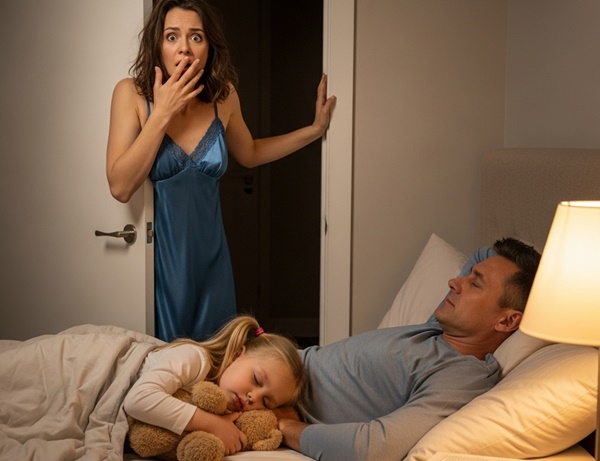
My eight-year-old complained of being “squeezed” in her sleep every night: “Mom, my bed feels too small…”. At 2 a.m., I checked the hidden camera to prove my daughter was just dreaming. What I saw on the screen made my blood run cold, then broke my heart into a million pieces.
My name is Sarah Miller.
If you saw our house in the suburbs of Austin, Texas, you’d think we were living the quintessential American Dream. It’s a beautiful four-bedroom Craftsman with a wrap-around porch and a lawn so green it looks painted. By day, the house is filled with the sounds of a busy family. But at night, the silence of the Hill Country takes over—a silence so heavy you can hear the hum of the refrigerator from two rooms away.
My husband, Mark, is a trauma surgeon. He’s a man of science, logic, and long hours. We have one daughter, Maya. She’s eight years old, has my curly hair, and possesses an imagination that could fill a stadium.
From the day Maya was born, Mark and I made a pact: we would raise an independent woman. We didn’t want a child who was afraid of the dark or couldn’t handle being alone. We wanted her to be strong.
We worked hard for this life. Our home is valued at nearly $850,000, a testament to a decade of eighty-hour work weeks and skipped vacations. We started Maya’s 529 College Savings Plan before she even lost her first tooth. Everything was calculated. Everything was in its place.
Especially Maya’s sleep schedule.
The Fortress of Solitude
Maya started sleeping in her own room when she was just three years old. In some cultures, that might seem cold, but in our world, it was about fostering “self-soothing.”

We turned her bedroom into a sanctuary. It wasn’t just a room; it was a $5,000 interior design project.
- A custom-made queen-sized bed with a memory foam mattress that felt like a cloud.
- Bookshelves lined with every Harry Potter and Percy Jackson book.
- A galaxy projector that mapped the constellations across her ceiling.
- The softest weighted blanket money could buy.
Every night at 8:30 p.m., I’d tuck her in, read a chapter of whatever adventure we were on, kiss her forehead, and say, “See you at sunrise, kiddo.”
Maya was a champ. She never complained about monsters in the closet. She never had “accidents.” She was the perfect, independent child we had raised her to be.
Until last Tuesday.
“Mom, I’m Being Squeezed”
It started as a passing comment over blueberry pancakes.
“Mom,” Maya said, poking at her syrup. “I think my bed is shrinking.”
I laughed, pouring more coffee. “Maya, you have a queen-sized bed. You’re barely four-foot-two. You could fit four of you in that bed.”
She frowned, her little eyebrows knitting together. “I know. But last night… it felt really cramped. Like I didn’t have any room to turn over.”
“Maybe you left your giant Squishmallows on the bed again?” I suggested.
She shook her head slowly. “No. I put them on the chair like you told me to.”
I didn’t think much of it. Kids go through phases. Maybe she was having a growth spurt and her proprioception was off. I told her to make sure her sheets were tucked in tight and sent her off to the school bus.
But the next morning, it was worse.
“I didn’t sleep at all, Mom,” she whispered. Her eyes had dark circles under them. “I felt like I was being pushed to the very edge. I almost fell off.”
A cold prickle of unease crawled up my spine. My mind, fueled by too many true-crime podcasts, immediately went to the worst-case scenario. Was someone in the house? Was there a squatter in the attic? This is America—we hear those horror stories on the news every day.
“Maya,” I said, my voice dropping to a serious tone. “Did you see anyone? Did you hear anything?”
She looked down at her lap. “No. But I felt… breath. Soft breath on my neck. And it felt like someone was heavy next to me. I thought it was you, Mom. Were you in there?”
I felt the blood drain from my face. “No, baby. I was in my room with Dad all night.”
The Digital Witness
That evening, I didn’t tell Mark. He was coming off a 24-hour shift at the hospital and was already exhausted. Instead, I went to Best Buy. I bought a Nest Cam—one of those discreet ones with high-definition night vision.
I told Maya it was a “magic night light” to help her feel more secure. I installed it in the upper corner of her room, angled perfectly to cover the bed and the door.
That night, I sat in the living room with my iPad, watching the grainy black-and-white feed.
9:00 p.m.: Maya is fast asleep. 10:30 p.m.: She tosses once, but stays in the center of the bed. 11:45 p.m.: Mark comes home, kisses me, and crashes in our room.
I eventually drifted off on the sofa, the iPad still glowing in my lap.
I woke up at exactly 2:14 a.m. The house was freezing. The Texas wind was rattling the windowpanes. I glanced down at the screen, expecting to see a sleeping child.
My heart stopped.
The bedroom door—which I knew I had latched shut—was standing open.
A shadow was moving across the carpet. It was a slow, shuffling movement. My breath hitched in my throat. I was ready to scream, ready to run into the kitchen for the steak knife, ready to call 911.
Then, the figure stepped into the glow of the galaxy projector.
It wasn’t a stranger. It wasn’t a monster.
It was Evelyn, my mother-in-law.
The Ghost in the Hallway
Evelyn is 76. She moved in with us six months ago after she started “forgetting” things—leaving the stove on, forgetting her own address, calling Mark by his father’s name. The diagnosis was Early-Onset Alzheimer’s.
We had set her up in the guest suite on the first floor. We thought she was happy. We thought she was safe.
On the screen, I watched as Evelyn reached the side of Maya’s bed. She didn’t look like the sharp, vibrant woman who used to run a successful bakery in Chicago. She looked frail. She looked like a lost child.
Gently, with agonizing slowness, she lifted the corner of Maya’s expensive weighted blanket. She climbed into the bed, her movements stiff and careful.
She didn’t wake Maya. She just lay there, perfectly still, staring at the back of her granddaughter’s head. Then, she reached out a trembling hand and stroking Maya’s hair, she whispered something the camera couldn’t catch.
Maya, in her sleep, felt the presence and moved to the very edge of the mattress to make room, just like she had complained about.
I sat in the dark living room, tears streaming down my face, silent sobs wracking my body. I wasn’t scared anymore. I was heartbroken.
The Memory of Warmth
I realized then what was happening. Evelyn wasn’t “wandering.” She was searching.
Evelyn’s husband—Mark’s father—had died in a tragic car accident when Mark was only five. For thirty years, Evelyn had been a single mother in a cold city. She worked three jobs to put Mark through Vanderbilt and then Johns Hopkins.
Mark told me once that when he was little and they couldn’t afford to turn on the heat in their tiny apartment, they would sleep in the same bed to stay warm. He remembered her humming to him until he fell asleep.
The Alzheimer’s was stripping away her present, but it was unlocking her deepest, most primal memories. In her mind, at 2 a.m., she wasn’t a grandmother in a suburban Texas home. She was a young, scared mother in a freezing Chicago flat, trying to keep her only child warm.
She wasn’t trying to take Maya’s space. She was trying to find the only place she ever felt needed.
The Morning After
The next morning, I didn’t call a doctor. I didn’t look for a nursing home.
I showed Mark the footage. We sat on the edge of our bed, the blue light of the iPad reflecting in his eyes. He didn’t say a word for ten minutes. He just cried—the kind of deep, silent heaving that comes from a man who realized he had been so busy saving lives that he’d forgotten to cherish the one that gave him his own.
“She’s looking for me, Sarah,” he choked out. “She’s looking for the little boy she saved.”
The New Normal
We changed things that day.
We didn’t lock the doors. We didn’t medicate her into a stupor. Instead, we leaned into the truth.
We moved Evelyn’s room directly across from ours. We installed a motion-sensor chime that would alert us—not Maya—if she got up. And every night now, before I tuck Maya in, we go to “Grandma’s Room” first.
We sit with her. We hold her hand. Mark tells her stories about Chicago, even if she doesn’t remember them. We give her the warmth she spent her whole life giving away.
Maya knows now, too. She’s only eight, but she has the heart of a giant.
Last night, I walked past Maya’s room. The door was cracked open. I peeked in.
Maya wasn’t complaining about the bed being too small. Instead, she had moved her pillows to the very center, and she was holding her grandmother’s hand as they both drifted off to sleep.
“It’s okay, Mom,” Maya had told me earlier that day. “Grandma’s just cold. And I have plenty of room to share.”
In a world that tells us to be independent, to be successful, and to build bigger houses with more locks, we realized that the only thing that actually matters is how much room we make for the people who loved us when we had nothing.
Maya’s bed was never too small. Our hearts were. But they’re growing now.
If this story touched you, please Share and comment “FAMILY” to spread the message that we must never forget those who cared for us.
