I returned early from my father’s estate settlement only to uncover the shocking double life of my ‘paralyzed’ husband and our ‘kind’ neighbor.
The smell of antiseptic, damp towels, and that lingering, stale scent of a body confined to a bed for years—that has been the “fragrance” of my life for a decade.
My name is Elena, I’m 38, but when I look in the mirror, I see a woman in her late 50s staring back. My eyes are sunken, my skin is sallow, and my hands are calloused and rough. All of this is because of Mark. Ten years ago, a construction site accident turned my vibrant, powerhouse of a husband into a “vegetable.” The doctors said the brain damage was catastrophic. He lay there, day after day, a husk of a man staring blankly at the ceiling of our small house in Scranton, Pennsylvania.
Everyone told me to put him in a state-run facility and move on. “You’re young, Elena. Don’t throw your life away,” they’d say. But I couldn’t. We took vows: In sickness and in health. I decided I would be his hands, his legs, and his heartbeat.
My life was a machine. Up at 4 AM, bed at midnight. Sponge baths, changing adult diapers, blending meals into liquid, and turning him every few hours to prevent bedsores. I worked two remote data-entry jobs just to afford his meds and the specialized bed. The neighbors called me a “Saint.” I didn’t want to be a saint; I just wanted my husband back.
Among those neighbors was Brenda, a widow from next door. She was “kindness personified.” She’d bring over casseroles, sit with me when I was exhausted, and offer to watch Mark for a few hours so I could run to the pharmacy or the grocery store. I loved Brenda like a sister.
Last week, my mother called me from my hometown in Virginia, her voice trembling. “Elena, the lawyers are finally ready to close your father’s estate. You need to be here in person to sign the final inheritance papers for the family house. It was your father’s last wish that you get your fair share.”
I was torn. I didn’t want to leave Mark alone, but this was a legal matter involving my father’s legacy. That’s when Brenda stepped in. “Elena, honey, you go take care of your father’s business,” she said with a warm, sisterly smile. “I’ll stay here and watch Mark. I’ll look after him like he’s my own brother. You go secure your future; don’t let those lawyers wait.”
I felt a wave of gratitude. I even tried to press a $200 check into her hand for her trouble, but she pushed it back. “Save it for the gas money,” she insisted. I drove south, my mind spinning with legal documents and grief, never imagining that the moment I pulled out of the driveway, the “tragedy” in my house would suddenly end.
The estate settlement was supposed to be a two-day affair, but on the first night, a cold dread washed over me. Call it “wife’s intuition.” I couldn’t sleep. At 11 PM, I hopped in my car and drove six hours back to Scranton in the pitch black.
I pulled into the driveway at 5 AM. The house was dark, except for a faint, dim glow coming from Mark’s bedroom window. I let myself in through the back door, moving like a ghost so I wouldn’t wake Brenda.
As I reached the hallway, I stopped.
Brenda’s red high heels were tossed carelessly in the middle of the living room. Next to them was a pair of old leather slippers. Mark’s slippers. The ones I had bought him 10 years ago and kept in the back of the closet as a memento. Why were they out?
My heart began to hammer against my ribs. A sick, cold shiver raced down my spine. I crept toward the bedroom.
Then, I heard it.
Laughter. Low, deep, masculine laughter. Followed by a woman’s giggle.
“You’re so bad, Mark. What if she comes back early?” Brenda’s voice cooed.
“She won’t. She’s too busy playing the martyr in Virginia,” a man’s voice replied. Mark’s voice.
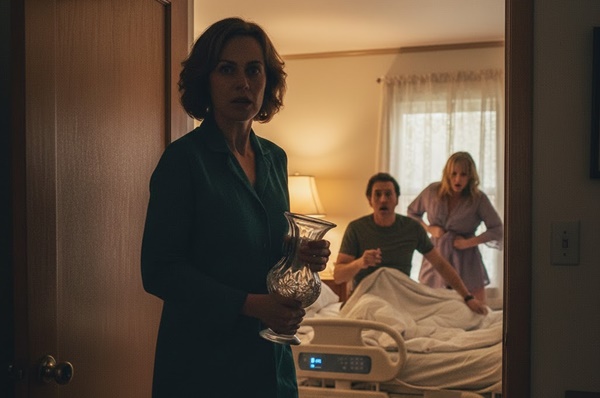
I felt like the floor had turned into liquid. My husband hadn’t spoken a word in a decade. I grabbed a heavy glass vase from the hallway table, my knuckles white, and I kicked the bedroom door open.
The scene was a nightmare.
On the $5,000 medical bed I had broken my back to pay for, two people were tangled together. They scrambled apart as I stood there, the vase trembling in my hand.
It was Mark.
My “paralyzed” husband was sitting upright, his face flushed, looking very much alive. His muscles had atrophied a bit, but he was agile. His eyes—the ones I thought were “lost”—were sharp, cunning, and currently filled with panic.
“Elena… you’re… you’re home early,” Mark stammered. His voice was raspy, but clear.
I was paralyzed. My throat felt like it was filled with broken glass. I pointed at him, then at Brenda, who was frantically pulling on her robe.
“You can talk? You can move? For ten years… Mark, what is this?” I screamed.
Mark realized the game was up. His face shifted. The panic vanished, replaced by a cold, arrogant smirk. He reached over to the nightstand, grabbed a pack of cigarettes—cigarettes?!—and lit one.
“Yeah, I’m awake, Elena. Have been for about four years now.”
“Four years?” I felt the world collapsing. “And you let me scrub your body? You let me change your diapers? You let me work myself to the bone while you lay there like a statue? Are you a man or a demon?!”
I lunged at him, but he easily shoved me back onto the floor.
“Grow up, Elena!” Mark snapped. “I woke up and realized I had a pretty sweet deal. If I ‘recovered,’ I’d have to go back to work, pay off the mountain of medical debt, and listen to you nag. But if I stayed ‘sick’? I get Social Security disability checks, insurance payouts, and a 24/7 maid who thinks I’m a hero for breathing. Plus, Brenda here… she actually knows how to have a good time. You? You just smell like bleach and misery.”
I stared at him, my heart breaking into a million jagged pieces. Every sacrifice, every missed meal, every tear I cried over his “lifeless” body was just a joke to him. For the last four years, he had been waiting for me to leave the house so he and my “kind” neighbor could play house in my own bed. He treated me like a high-end servant, a fool to be milked for labor and sympathy.
I looked at Brenda. She whispered, “Elena, I’m sorry… he just… he said he was lonely…”
I didn’t scream. I didn’t cry anymore. The pain had been replaced by a white-hot, diamond-hard disgust.
I stood up, wiped the dust off my jeans, and looked at the man I once loved.
“You know, Mark? You’re right. You did have a sweet deal.”
I walked to the safe in the office, grabbed the deed to the house (which my father had left solely to me), and my personal savings records.
“Mark, congratulations on your ‘miraculous’ recovery. But here’s the thing: This house is mine. Every cent in the bank is mine. And since you’re so healthy that you can ‘service’ the neighbor, you’re clearly healthy enough to find a new place to sleep. Get out. Both of you. Now.”
Mark laughed. “You can’t kick me out! I’m a disabled vet!”
“Actually,” I said, pulling out my phone and opening the Social Security Administration website. “You’ve been committing felony fraud for four years. I have cameras in the living room for your ‘safety,’ remember? I have four years of footage of you walking around and laughing while I was at work. I can either call the police and the feds right now, or you can take your slippers and vanish.”
Mark’s face went gray. He knew the “Golden State” of his fraud was over.
“Cút!” I yelled, the Vietnamese word for ‘get out’ slipping from my tongue in my rage. “Get out before I livestream your ‘miracle’ to the entire town!”
That night, I watched them scurrying out like rats. I stood in the middle of that empty, antiseptic-smelling room and I sobbed. I sobbed for the ten years I lost, for the girl I used to be, and for the man I thought I was saving.
But when the sun came up the next morning, the “smell” was gone. I opened all the windows. The air was fresh.
I lost a decade, but I found my life. And Mark? He’s about to find out how hard the world is when you don’t have a “Saint” to carry you.
