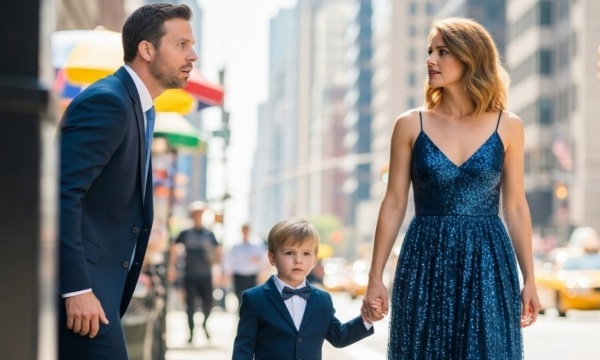
The day my husband told me he was in love with my baby sister, I lost everything—my marriage, my family, even my parents’ support. They actually told me to accept it “gracefully” because it kept him in the family. So I walked away from all of them and built a new life in silence. Then He Saw My Son and Realized What He’d Lost.
PART ONE: The Day Everything Shattered
The rain was coming down hard the afternoon Mark told me he was leaving. It was the kind of Portland rain that doesn’t just fall—it attacks, relentless and cold, turning the streets into rivers and the sky into a sheet of gray. I remember standing in our kitchen, the one we’d renovated together two summers ago, watching water stream down the windows while my husband of eight years told me he was in love with someone else.
“I never meant for this to happen, Claire,” he said, his voice barely above a whisper. “But I can’t keep pretending.”
My hands were shaking as I set down the coffee mug I’d been holding. “Pretending what? That you love me? That our marriage means something?”
He looked away, unable to meet my eyes. “I do love you. I just… I’m not in love with you anymore.”
It’s funny how people use that phrase like it’s supposed to soften the blow. Like there’s a meaningful difference when your world is ending.
“Who is she?” I asked, though some part of me already knew. The late nights. The new cologne. The way he’d been pulling away for months, like I was something he was trying to shed.
Mark’s silence was deafening.

“Mark. Who is she?”
“It’s Emily.”
For a moment, I couldn’t process the words. Emily. My sister. My baby sister, who I’d helped raise after our father died. Who I’d taken to her first day of high school. Who’d been a bridesmaid at our wedding, wearing a pale blue dress and crying happy tears.
“You’re lying,” I whispered.
“I’m sorry, Claire. I’m so sorry.”
But he wasn’t sorry enough to stay. He wasn’t sorry enough to fight for us. He wasn’t sorry enough to choose me over my twenty-seven-year-old sister with her Instagram-perfect life and her effortless charm.
I should have screamed. I should have thrown things. Instead, I just stood there, frozen, while my husband packed a bag and walked out of our home—our home—and drove to her apartment in the Pearl District.
PART TWO: The Family That Failed Me
I thought my parents would be furious. I thought they’d take my side, condemn Emily, demand that she end this sick relationship immediately.
I was wrong.
“These things happen, sweetheart,” my mother said when I showed up at their house in Beaverton, mascara streaking my face, unable to breathe through my sobs. “People fall in love. You can’t control the heart.”
“She’s my sister, Mom. He’s my husband.”
“I know it’s painful right now—”
“Painful?” I couldn’t believe what I was hearing. “This isn’t a breakup. This is betrayal. From both of them.”
My father, who’d been silent until then, finally spoke. “Your mother and I think it’s best if you don’t make this harder than it needs to be. Emily is still family. Mark will still be around. We need to find a way to move forward together.”
“Move forward? You want me to just… accept this?”
“We want you to be mature about it,” my mother said gently, like she was talking to a child throwing a tantrum. “At least he’s staying in the family. At least we won’t lose him completely.”
I stared at my parents—these people who were supposed to protect me, defend me, love me unconditionally—and realized I was completely alone.
Two months later, Emily and Mark got engaged. The announcement came via a cheerful Instagram post: a photo of them at Cannon Beach, Emily’s hand extended to show off a diamond ring, the Haystack Rock looming in the background. The caption read: “When you know, you know. ❤️ #Engaged #LoveWins”
Three hundred and forty-seven people liked it. Including my mother.
I blocked them all that night and never looked back.
PART THREE: Starting Over
The divorce was finalized on a Tuesday in February. I signed the papers in a conference room that smelled like stale coffee and broken dreams, dividing eight years of marriage into neat columns of assets and debts. Mark got the house—I didn’t want it anymore, didn’t want to walk through rooms haunted by the ghost of who I used to be. I took my car, half our savings account ($23,000), and my freedom.
I moved into a one-bedroom apartment in Southeast Portland, near Hawthorne. It was small—barely 650 square feet—but it was mine. No memories. No ghosts. Just blank walls and the possibility of starting over.
I threw myself into work at St. Mary’s Hospital, where I’d been a registered nurse for six years. The ICU was demanding, exhausting, and exactly what I needed. Twelve-hour shifts left me too tired to think, too numb to feel. My coworkers became my family: Denise, the charge nurse who brought me homemade tamales; Marcus, the respiratory therapist who made me laugh even on the worst days; and Dr. Sarah Chen, who took me out for drinks and let me cry into my margarita without judgment.
“You’re going to be okay,” Sarah told me one night at a bar in the Alberta Arts District. “I know it doesn’t feel like it now, but you will. You’re stronger than you think.”
I wanted to believe her. But strength felt like something I’d lost along with my marriage and my family.
Then, six months after the divorce, something happened that changed everything.
His name was Jacob.
PART FOUR: The Light in the Darkness
I met Jacob on a Thursday in August, during a shift that had already been brutal. A multi-car accident on I-5 had flooded the ER with trauma cases, and by 9 PM, I was running on fumes and stale vending machine coffee.
That’s when they brought him in.
He was four years old, small for his age, with dark curly hair and enormous brown eyes that looked far too old for his face. He’d been in foster care for two years, bouncing between homes, and his current placement had brought him to the ER with a broken arm—an “accident,” they claimed, though the bruises told a different story.
I sat with him while we waited for X-rays, and he didn’t cry. He just stared at me with those ancient eyes and asked, “Are you going to hurt me too?”
My heart shattered.
“No, sweetheart,” I whispered. “I’m here to help you feel better. I promise.”
He studied my face for a long moment, then nodded. “Okay.”
I couldn’t stop thinking about him after my shift ended. I called Sarah, who worked with Child Protective Services cases, and asked about his situation. The prognosis wasn’t good: his biological parents had lost custody due to severe neglect and substance abuse. He had no other family. He was alone in a system that was overwhelmed and underfunded.
“He needs someone,” Sarah said quietly. “Someone who’ll fight for him.”
I visited him three times that week. By the third visit, he was calling me “Miss Claire” and showing me drawings he’d made—stick figures holding hands under a smiling sun.
“That’s you and me,” he explained. “We’re happy.”
Two months later, I became a licensed foster parent. Three months after that, Jacob moved into my tiny apartment with a garbage bag full of clothes and a stuffed elephant named Mr. Trunks.
“Is this my home now?” he asked, standing in the middle of my living room, looking small and uncertain.
“Yes,” I told him, kneeling down to his level. “This is your home. And I’m going to take care of you. Is that okay?”
He thought about it, then threw his arms around my neck. “Okay.”
For the first time in over a year, I felt like I could breathe again.
PART FIVE: Building a Life
The next three and a half years were the hardest and most beautiful of my life. Jacob had trauma—night terrors, anxiety, attachment issues that required weekly therapy sessions and infinite patience. But he also had resilience, humor, and a capacity for love that astounded me.
We built routines: Saturday morning pancakes at Slappy Cakes, trips to OMSI, movie nights with popcorn and Disney films. I taught him to ride a bike in Laurelhurst Park. He taught me that healing doesn’t happen all at once—it happens in tiny moments, in small victories, in the gradual building of trust.
When Jacob was six, I officially adopted him. The judge asked him if he wanted me to be his mom, and he said, “She already is. We’re just making it official.”
I cried so hard I couldn’t speak.
I didn’t tell my parents about Jacob. I didn’t tell Emily or Mark or anyone from my old life. They’d made their choice, and I’d made mine. My real family was the one I’d built: Jacob, Sarah, Denise, Marcus, and a small circle of friends who showed up when it mattered.
I was happy. Genuinely, surprisingly happy.
And then, on a Saturday in October, four years after Mark had walked out of my life, I ran into him at the Portland Farmers Market.
PART SIX: The Reckoning
Jacob and I had just finished buying apples and fresh bread when I heard someone call my name.
“Claire?”
I turned, and time seemed to stop.
Mark stood ten feet away, holding hands with Emily. She looked exactly the same—blonde, beautiful, glowing in an expensive-looking camel coat. Mark looked older, tired around the eyes, his hairline receding slightly. But it was still him. Still the man I’d loved. Still the man who’d destroyed me.
“Oh my God,” Emily breathed. “Claire. Hi.”
I couldn’t speak. My hand instinctively moved to Jacob’s shoulder, pulling him slightly behind me.
Mark’s eyes dropped to Jacob, and I watched his face change. The color drained from his cheeks. His grip on Emily’s hand loosened. His mouth opened, then closed.
“Is that…” He couldn’t finish the sentence.
Jacob, bless him, peeked out from behind me. “Hi,” he said shyly. “I’m Jacob. I’m seven.”
“Seven,” Mark repeated, his voice hollow. His eyes shot to mine, doing the math. “Claire, is he—”
“He’s my son,” I said firmly. “We should go. Nice seeing you.”
I started to walk away, but Mark grabbed my arm. “Wait. Please. Is he mine?”
The question hung in the air like a bomb.
Emily’s face went white. “Mark, what are you talking about?”
I looked at my ex-husband—this man who’d chosen my sister over me, who’d walked away without a backward glance—and I saw fear in his eyes. Fear that he’d made a terrible mistake. Fear that he’d abandoned something precious. Fear that karma had finally caught up with him.
I could have told him the truth right then: that Jacob wasn’t biologically mine, that I’d adopted him, that Mark had no claim to this child or this life I’d built.
But I didn’t.
“Jacob,” I said calmly, “say goodbye.”
“Bye!” Jacob waved cheerfully, clutching his toy truck.
We walked away, leaving Mark standing frozen in the middle of the farmers market, his face ashen, his world crumbling.
PART SEVEN: The Aftermath
Mark called me seventeen times that night. I blocked his number.
He showed up at my apartment the next morning. I didn’t answer the door.
He sent emails, texts from different numbers, even tried to reach me through the hospital. Each message was the same desperate plea: “Is Jacob my son? Please, Claire. I need to know. I made a mistake. I’m sorry. Please.”
Sarah came over on Sunday night with wine and Thai food. “So,” she said, settling onto my couch while Jacob played with Legos in his room, “are you going to tell me what happened?”
I told her everything.
“Holy shit,” Sarah said when I finished. “He thinks Jacob is his biological son?”
“Apparently.”
“Are you going to tell him the truth?”
I thought about it. I thought about Mark’s pale face, his shaking hands, the way he’d looked at Jacob like he was seeing a ghost.
“No,” I said finally. “Let him wonder. Let him think about what he threw away. Let him live with the possibility that he abandoned his own child. Maybe that’s the consequence he deserves.”
“That’s cold, Claire.”
“He married my sister. He destroyed my family. He doesn’t get closure from me.”
Sarah raised her wine glass. “Fair enough.”
PART EIGHT: Moving Forward
Three weeks later, I got a letter. Not an email or a text—an actual handwritten letter, delivered to my apartment.
Dear Claire,
I don’t know if you’ll read this. I don’t know if I deserve for you to read this. But I need to try.
I’ve spent the last month thinking about that little boy. About the possibility that he might be my son. About what kind of man I’d have to be to walk away from my own child without even knowing he existed.
Emily and I are getting divorced. Not because of Jacob—though that’s part of it. But because I’ve been living a lie for four years. I convinced myself that what I did was about love, about following my heart. But it wasn’t. It was cowardice. It was selfishness. It was me running away from a good woman because she asked me to be better than I was capable of being.
You deserved so much more than what I gave you. You deserved loyalty, respect, partnership. Instead, I gave you betrayal and excuses.
I don’t expect forgiveness. I don’t expect anything. But if Jacob is my son, I want to be in his life. I want to try to be the father he deserves, even though I know I don’t deserve the chance.
If he’s not mine… then I’m sorry for bothering you. I’m sorry for everything.
Mark
I read the letter three times, then put it in a drawer and didn’t respond.
EPILOGUE: The Truth
Six months later, Mark showed up at Laurelhurst Park while Jacob and I were flying a kite. He didn’t approach us—just stood at a distance, watching. When Jacob ran off to the playground, Mark walked over.
“Claire,” he said quietly. “Please. I just need to know.”
I looked at this man who’d once been my whole world. He looked broken, haunted, nothing like the confident person who’d walked out of our marriage.
“Jacob isn’t your biological son,” I said finally. “I adopted him two years after our divorce. He has nothing to do with you.”
Mark’s face crumpled. “Oh.”
“But you know what? It doesn’t matter. Because even if he was yours, you’d already proven what kind of father you’d be. You’d already shown me that when things got hard, you run. That’s who you are.”
“I’m trying to change—”
“Good. Change for yourself. But stay away from my son. Stay away from my life. You made your choice four years ago. Live with it.”
I walked away, back to Jacob, who was laughing on the swings, his face bright with joy.
Mark stood there for a long time, then finally turned and left.
I never saw him again.
FINAL THOUGHTS: Two Years Later
Jacob is nine now. He’s thriving—straight A’s, soccer team, a best friend named Oliver who comes over every weekend. He still has hard days, moments when the trauma resurfaces, but they’re fewer and farther between.
My parents reached out last year, wanting to “reconnect.” I declined. Some bridges, once burned, aren’t meant to be rebuilt.
Emily sent a card on my birthday. I threw it away without opening it.
I’m dating someone now—a kind, patient man named David who works as a teacher and adores Jacob. We’re taking it slow, building something real on a foundation of honesty and respect.
Sometimes people ask if I regret not telling Mark the truth sooner, not giving him closure.
I don’t.
Because closure isn’t something you owe to people who broke you. Closure is something you give yourself, in your own time, on your own terms.
And I found mine the day I chose to build a life with a little boy who needed me as much as I needed him.
That’s the family that matters. That’s the love that lasts.
Everything else is just noise.
