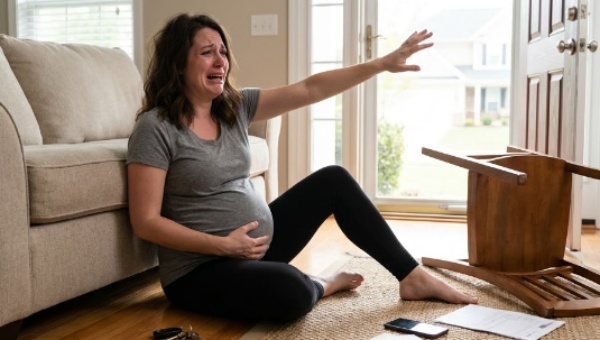
I Called My Husband Begging for Help at 8 Months Pregnant — He Said I Was Being Dramatic. Then I Started Bleeding...
PART 1 — The Morning the Pain Started and the Husband Who Wouldn’t Come Home
My name is Emily Carter, and I am twenty-nine years old, writing this from my mother’s house in Portland, Oregon, where I have been living for the past three months with my newborn daughter after the day my husband left me alone and bleeding on our living room floor while I was eight months pregnant.
I am writing this because what happened on that Friday in January, when I called Jason begging for help and he told me I was being dramatic, became the defining moment of my marriage, my motherhood, and my decision to leave. I am also writing this because I believe there is real value in sharing stories about medical emergencies during pregnancy, about partners who fail when they are needed most, and about the moment you finally understand that being alone is safer than being with someone who does not care whether you live or die.
That Friday morning in mid-January started the way most of my days had started during the final stretch of pregnancy: slowly, quietly, and with the particular exhaustion that settles into a body carrying another life. I woke at 7:00 a.m., made breakfast, and settled in for what I expected to be an uneventful day at home. I was thirty-four weeks along, eight months pregnant with our first child, a daughter Jason and I had already named Sophie.
I had stopped working as a graphic designer two weeks earlier because the pregnancy had become physically overwhelming. My feet were swollen by noon every day, my back ached with a persistence that no pillow arrangement could fix, and even simple tasks like walking to the mailbox left me winded. Jason, who worked as an account manager at a marketing firm in downtown Portland earning $78,000 a year, had supported my decision to take early maternity leave. Or at least, that was what I believed at the time.
Around 9:30 a.m., I was walking from the kitchen to the living room of our two-bedroom rental house in the suburbs when I felt a sudden, sharp pain low in my abdomen. It was nothing like the normal pregnancy discomfort I had been managing for months. This was different, intense and twisting, the kind of pain that makes your body go still before your mind catches up. I stopped mid-step and grabbed the edge of the kitchen counter, my breath catching hard in my throat.
The pain lasted about thirty seconds, then faded to a dull, warning ache. I stood there with one hand on my belly, trying to decide if I was overreacting. Then another wave hit, stronger than the first, and I gasped out loud.
I pulled my phone from my pocket and called Jason.
He answered on the third ring, his voice distracted in the way it always was when he was already mentally inside a meeting. “Hey, what’s up? I’m about to go in.” I tried to keep my voice steady, but fear had already moved into it. “Jason, something’s wrong. I’m having really bad pain. It’s not normal. I think something might be wrong with the baby. Can you please come home?”
There was a pause.
Then Jason sighed.
Not a sigh of worry. A sigh of irritation, the kind that said he had already decided what this was before I finished speaking. “Emily, you’re eight months pregnant. Everything feels dramatic right now. You’re probably just having Braxton Hicks. I have a meeting in twenty minutes. Lie down, drink some water, and stop panicking. You’ll be fine.”
Tears came before I could stop them. “Jason, this doesn’t feel like Braxton Hicks. This feels different. I’m scared. Please come home.” His voice hardened. “Emily, I can’t leave work every time you get nervous. You’re pregnant, not dying. Call your doctor if you’re that worried. I have to go.”
Then he hung up.
I stood in my kitchen staring at my phone while another wave of pain made me double over and grip the counter with both hands. My husband, the man who had promised to love and protect me, the father of the child I was carrying, had just dismissed my fear and ended the call.
Ten minutes later, the pain intensified.
I called Jason again. No answer. I texted him: “Jason, the pain is getting worse. I really need you. Please come home.” He replied five minutes later with three words I will never forget for the rest of my life.
“You’ll be fine.”
I was not fine.
I tried calling my mother next, but she was on a flight from Chicago and would not land until that evening. I tried my best friend Ava, but she was teaching a class and did not see her phone. I was alone in my house, eight months pregnant, in pain that was escalating with every passing minute, and the one person who should have been on his way to me had already decided I was not worth leaving a meeting for.
I sat on the couch and tried to breathe through the waves. I told myself Jason was right. I told myself I was overreacting. I told myself this was normal. I told myself every lie that a woman tells herself when the alternative is admitting that the person she loves has failed her completely.
The pain did not care what I told myself.
By 11:00 a.m., I could no longer stand.
PART 2 — The Blood, the 911 Call, and the Paramedics Who Saved My Life
By 11:30 a.m., I was on the living room floor.
The pain had become unbearable, sharp cramping waves that radiated from my abdomen down my legs and up into my back with a relentlessness that left no space between them for recovery. I could not stand. I could barely breathe. I was lying on my side on the carpet, one arm wrapped around my belly, trying to stay calm and failing completely.
I reached for my phone and tried Ava again. Voicemail. I tried my mother’s number knowing she was mid-flight, because desperation does not always operate logically. I lay there on the floor of the home I shared with my husband, surrounded by the ordinary furniture of our ordinary life, and I had never felt more alone.
I stretched my arm toward the hospital bag I had packed weeks earlier and left propped against the couch, thinking maybe I could get myself to the hospital somehow, maybe I could drive, maybe I could manage this alone the way I had been managing everything alone for months. But as I reached for it, another cramp hit, the worst one yet, and I cried out and collapsed back against the floor.
That was when I felt it.
Wetness.
I looked down and saw blood on my leggings.
Not a catastrophic amount. But enough. Enough to make my heart stop mid-beat. Enough to make every rational thought in my mind go silent and be replaced by one single, primal understanding: something was very, very wrong with my baby.
I grabbed my phone from under the coffee table where it had fallen and dialed 911 with hands that were shaking so badly I had to try twice.
The dispatcher answered immediately. A woman with a calm, steady voice that I will be grateful for until the day I die. “911, what’s your emergency?” I was sobbing so hard the words came out broken. “I’m pregnant. Eight months. I’m bleeding. I’m having terrible pain. I think something’s wrong with my baby. Please help me. Please.”
“Okay, ma’am, I need you to stay calm. I’m sending paramedics to you right now. Can you tell me your address?”
I gave her my address. She stayed on the line with me, asking me questions, telling me to breathe, telling me help was coming, her voice never wavering. I pressed my palm against my belly and felt Sophie move, and I said out loud to no one and everyone, “Please be okay. Please, baby, please be okay.”
The paramedics arrived in eight minutes.
Two men and a woman in dark blue uniforms came through my front door, which I had managed to unlock during a brief break between cramps before collapsing again. They knelt beside me with the practiced efficiency of people trained to walk into the worst moments of strangers’ lives and make them survivable. They checked my vital signs, asked about the pain and the bleeding, and spoke to me in the calm, direct tones of people who needed me to stay present.
One of the paramedics, a man in his forties named Tom, asked, “Is your husband home? Is anyone here with you?”
I shook my head. Tears were still streaming down my face. “He’s at work. I called him. He wouldn’t come home. He said I was overreacting.”
Tom’s expression shifted for just a fraction of a second, a flicker of something that looked like controlled anger, before he refocused entirely on me. “Okay. We’re going to get you to the hospital. You’re going to be okay. Is there anyone we can call for you?”
I gave them my mother’s number and Ava’s number. One paramedic stepped aside to make the calls while the others prepared the stretcher. As they lifted me, Tom asked, “Do you want us to try your husband again? To let him know we’re taking you to the hospital?”
I looked at my phone. At the text thread with Jason. At those three words sitting there like a door slammed in my face.
“I don’t know if he’ll come,” I said.
The ambulance ride to Oregon Health & Science University Hospital was a blur of pain, fear, the sound of sirens, and the paramedics’ voices keeping me tethered to the present. They kept me talking. They kept monitoring my vitals. They kept telling me I was going to be okay with the specific conviction of people who needed that to be true as much as I did.
But I did not feel okay.
I felt like I was losing my daughter. I felt like I was dying. And underneath all of it, beneath the fear and the pain and the blood, I felt something I had not expected to feel in that ambulance: a cold, clarifying anger at the man who had told me I was being dramatic while I was bleeding on our floor.
I held onto that anger.
It kept me breathing.
PART 3 — The Emergency, the Surgery, and the Husband Who Finally Showed Up
At the hospital, I was rushed into the labor and delivery unit where a team of doctors and nurses moved around me with the focused urgency of people who understood immediately that time mattered.
An ultrasound confirmed what the pain and bleeding had already told my body: I had a partial placental abruption, a serious and potentially life-threatening condition in which the placenta separates from the uterine wall before delivery, cutting off oxygen and nutrients to the baby. The doctor, a woman in her fifties named Dr. Patricia Lin, explained this to me with the careful directness of someone who respected my ability to handle the truth even while terrified.
“We need to perform an emergency cesarean section,” Dr. Lin said, holding my hand. “To protect Sophie and to protect you. We need to move quickly.” I asked if my baby was going to be okay. She looked at me steadily. “We are going to do everything we can. But we need to go now.”
I was prepped for surgery within minutes.
As they wheeled me toward the operating room, a nurse asked if there was anyone they should contact. I gave them Jason’s number again. She stepped out to make the call and returned with the quiet expression of someone delivering incomplete news. “I left a message,” she said. “I told him it was an emergency and that you were going into surgery.” I nodded and stopped thinking about Jason. All I had room for was Sophie.
The surgery was performed under a spinal block. I was awake but numb from the chest down, aware of pressure and movement but no pain. I stared at the ceiling and listened to the voices of the surgical team and tried to breathe steadily. I thought about Sophie’s name. I thought about the yellow nursery we had painted in our rental house. I thought about the small white onesie folded in the hospital bag that was still sitting on my living room floor.
At 1:47 p.m., I heard my daughter cry.
It was the most beautiful sound I have ever heard in my life, and I hope I never forget a single note of it.
Dr. Lin lifted Sophie briefly into my line of sight, a tiny, red-faced, furious, perfect baby, and said, “She’s here. She’s breathing. She’s okay.” I sobbed so hard the surgical team paused for a moment. Sophie was taken immediately to the NICU for monitoring given her prematurity and the distress she had been under, but she was alive. She was breathing. She was okay.
I was moved to a recovery room after surgery, exhausted and overwhelmed and flooded with a gratitude so large it had no edges. A nurse named Karen stayed with me, monitoring my vitals and updating me on Sophie’s condition. Sophie weighed 5 pounds, 2 ounces and was breathing on her own. Small, but strong. “You did great, Emily,” Karen said. “You and your baby are both going to be fine.”
Then I asked the question I had been holding since the ambulance.
“Has my husband called? Has he come?”
Karen checked her notes. Then she looked at me with the careful gentleness of someone who had delivered this kind of answer before. “Not yet. But your mother and your friend Ava are on their way. They’ll be here soon.”
My mother and Ava arrived at 3:15 p.m.
My mother came through the door of my recovery room and crossed it in three steps and held me without saying anything for a long time. Ava stood at the foot of the bed with her hand over her mouth and tears running down her face. These two women, who had dropped everything and come, filled the room with exactly what Jason’s absence had emptied out of it.
Jason arrived at 4:30 p.m.
More than five hours after I had called 911. More than two hours after his daughter had been born. He walked into my recovery room looking inconvenienced rather than devastated, his expression carrying the particular irritation of a man who felt he had been summoned to deal with someone else’s overreaction.
“Emily, what the hell happened?” he said. “I got like five voicemails from the hospital saying you were in surgery. You scared the crap out of me.”
I stared at him.
“Jason, I almost lost our baby. I had a placental abruption. I had emergency surgery. Sophie is in the NICU right now. Where were you?”
He shrugged. “I was at work. I told you I had meetings. I didn’t think it was that serious. You’re always so dramatic about every little thing.”
The room went very quiet.
My mother’s face went still in the way it does when she is deciding whether to speak. Ava looked at the floor. I looked at my husband, the man I had married, the father of the daughter currently fighting in the NICU down the hall, and I felt something settle inside me with the cold finality of a door locking from the inside.
“I called you this morning begging you to come home,” I said. “I told you I was in pain. I told you I was scared. You told me I was overreacting. I was bleeding on our living room floor, Jason. I had to call 911 because you would not help me. Our daughter could have died. I could have died. And you are standing there calling me dramatic.”
Jason’s face flushed. “Don’t put this on me. You panicked instead of handling it calmly. If you had just gone to the doctor like I told you, none of this would have happened.”
I looked at him for one long, clear moment.
“Get out,” I said.
He blinked. “What?”
“Get out of this room.”
Jason stared at me, then at my mother, then at Ava. No one moved to help him. He turned and walked out without another word, and the door swung shut behind him, and the room became quieter and cleaner than it had been in a very long time.
PART 4 — The Police Officer, the Discovery, and the Truth About Jason
What I did not learn until the following morning was that while I was in surgery, something else entirely was unfolding at our house.
When the paramedics had rushed me to the ambulance, the front door had been left unlocked in the urgency of the moment. My neighbor, Mrs. Helen Kowalski, a retired schoolteacher in her late sixties who had watched the ambulance from her front window with growing alarm, walked over to check on the house and secure the door. What she found inside gave her pause: my phone on the floor, the hospital bag knocked sideways, and a small bloodstain on the living room carpet.
Mrs. Kowalski called the Portland Police Bureau’s non-emergency line to report what she had seen and ask whether someone should properly secure the property.
Officer Daniel Marsh was dispatched to the house around 3:00 p.m. He secured the premises and, after reviewing the dispatch notes about the earlier 911 call and ambulance transport, decided to wait for a resident to return so he could gather information about the incident.
At 5:45 p.m., Jason arrived home from the hospital.
He walked through the front door, saw Officer Marsh standing in the kitchen, and stopped. “Who are you? What are you doing in my house?” Officer Marsh identified himself, explained that a neighbor had reported a possible medical emergency, and said he was there to ensure the property was secure and to gather information about what had happened.
Jason, rather than explaining that his wife had been taken to the hospital, became immediately defensive. “There’s no emergency. My wife is fine. You need to leave.” Officer Marsh, who had already been briefed on the 911 call records and the ambulance transport, said, “Sir, I’m aware your wife was taken to the hospital this morning with a medical emergency. I need to ask you a few questions. Can you tell me where you were when she called 911?”
Jason’s face went pale. “I was at work. I didn’t know she called 911. She didn’t tell me it was that serious.”
Officer Marsh looked at him steadily. “Sir, according to the 911 call records and your wife’s phone records, she called you multiple times this morning reporting severe pain and asking you to come home. Is that correct?”
Jason stammered. “Yeah, but I thought she was just being dramatic. She’s pregnant. She worries about everything.”
Officer Marsh said, “Sir, your wife had a life-threatening medical emergency. She experienced a placental abruption and required emergency surgery. She and your baby could have died. And you’re telling me you believed she was being dramatic?”
Jason did not answer.
Officer Marsh continued. “I’m going to file a report on this incident. I’m also going to recommend that the hospital social worker speak with your wife about her home situation and whether she feels safe.”
Jason exploded. “Safe? Are you implying I did something wrong? I didn’t hurt her! She had a medical problem! That’s not my fault!” His voice had risen to the pitch of a man who had just realized the narrative was no longer his to control.
Officer Marsh said calmly, “Sir, I’m not making an accusation. But when a pregnant woman contacts her partner multiple times during a medical emergency begging for help, and that partner declines to come home, that raises concerns about neglect and the welfare of both the mother and the child. The hospital will be conducting a welfare assessment.”
Jason tried to backtrack. “Look, I made a mistake, okay? I should have come home. But I didn’t know how serious it was. I’m not a bad person.” His voice had shifted from anger to the particular pleading tone of someone who had just understood that consequences were no longer theoretical.
Officer Marsh handed Jason a card with a case number. “You’ll need to speak with the hospital social worker and potentially with Child Protective Services. They’ll want to verify that your wife and baby are in a safe environment going forward.” Then Officer Marsh left, and Jason stood alone in the house where I had bled on the floor that morning, finally understanding that the world had been watching.
The next morning, a hospital social worker named Linda came to my room.
She explained that the police had filed a report expressing concerns about potential neglect and that the hospital was required to conduct a welfare assessment before discharging me and Sophie. She asked me detailed, careful questions about my relationship with Jason, about whether I felt safe at home, about whether he had been neglectful or dismissive before. I told her the truth: Jason had always been emotionally distant and quick to minimize my concerns, but I had never named it as neglect until the day he refused to come home while I was in crisis.
Linda said, “Emily, your husband’s refusal to help you when you were in pain and bleeding could have resulted in the death of you and your baby. That is not acceptable. I want to make sure you have support and resources if you decide you need to leave this relationship.” She placed pamphlets on the table beside me: domestic violence resources, legal aid services in Multnomah County, and temporary housing options for mothers with newborns.
I took every single one.
Not because I had decided yet. But because someone was finally taking my situation seriously, and that felt like the first solid ground I had stood on in a very long time.
PART 5 — The Decision, the Divorce, and the Life I’m Building Without Him
Jason came back to the hospital the next day with flowers.
Grocery store flowers, still in the plastic sleeve, the kind purchased quickly by someone who understood that a gesture was required but had not thought deeply about what gesture meant. He stood in the doorway of my room holding them with the uncertain posture of a man who was not sure whether he was being forgiven or evaluated.
He said he was sorry. He said he had made a terrible mistake. He said he would do better. He said the words in the correct order, with the correct expression, and I sat in my hospital bed and listened to all of them and felt nothing shift.
I looked at Jason and understood something I had been circling for months without landing on it directly: I did not trust him anymore. Not with my safety. Not with Sophie’s. Not with the ordinary, daily vulnerability of being a person who sometimes needed help and deserved to receive it without having to justify the need first.
I told him I wanted a separation.
He was shocked. Then angry. Then he cycled back through sorry and I’ll change and you’re not being fair, the full rotation of a man who had never been told no by the person he expected most to absorb his failures. But I had been on a living room floor. I had called 911 alone. I had gone into surgery without him. I had heard my daughter cry for the first time without him beside me. The version of me who might have softened under pressure had been left behind on that carpet.
I did not back down.
My mother, who had flown from Chicago and arrived the night of the surgery and had not left my side since, supported my decision without qualification. She offered her house in Portland for as long as Sophie and I needed it. Two weeks after the surgery, once Sophie was discharged from the NICU healthy and strong and furious at the world in the way of babies who have already survived something, I moved into my mother’s house with my daughter and did not look back.
I filed for divorce three weeks after that.
I worked with a family law attorney in Portland who reviewed the police report, the hospital social worker’s documentation, and the 911 call records. Jason contested the divorce initially, as people do when they are still operating under the belief that the story can be managed. But when his attorney reviewed the full picture, including Officer Marsh’s report and Linda’s welfare assessment, Jason agreed to a settlement rather than a contested proceeding.
I was granted primary physical and legal custody of Sophie. Jason was ordered to pay $950 per month in child support. He was granted scheduled visitation under a structured parenting plan, with provisions that prioritized Sophie’s wellbeing and my ability to make medical decisions for her without requiring his approval in emergencies.
That last provision mattered to me more than any dollar amount.
I am twenty-nine years old, and I am writing this from my mother’s house in Portland, Oregon, three months after the day my husband told me I was being dramatic while I was bleeding on our floor.
Sophie is asleep in the next room in a white bassinet my mother bought the week I moved in. She weighs eight pounds, four ounces now, which is remarkable for a baby who arrived six weeks early under emergency circumstances. She has dark hair that sticks up in the morning, a grip that could hold a grown adult accountable, and the specific, ancient expression of someone who has already decided she is not here to be underestimated.
She looks like herself.
She looks like someone who survived.
I think about the morning the pain started more than I expected to. Not with the raw terror of those hours, but with a kind of quiet inventory. I think about the counter I gripped in my kitchen. I think about the three words Jason sent while I was alone and frightened. I think about Tom the paramedic, whose expression flickered for just a second when I told him my husband would not come home. I think about Dr. Lin holding my hand before surgery. I think about Karen telling me Sophie was breathing. I think about my mother crossing the room in three steps.
I think about all the people who showed up.
And I think about the one who did not.
Jason was not a violent man. He did not hit me or threaten me or take my money or lock me in rooms. The harm he did was quieter and more ordinary than that, the harm of a person who had decided, somewhere along the way, that my needs were inconveniences and my fear was performance. That kind of harm is harder to name and harder to leave because it does not look like what people picture when they picture danger.
But I was on a living room floor.
And he was in a meeting.
And those two facts, held together, told me everything I needed to know about the life I would have if I stayed.
Linda the social worker gave me a pamphlet that first day that had a line I have thought about many times since. It said: Safety is not the absence of violence. Safety is the presence of people who will come when you call.
I have that line written on a notecard on my mother’s refrigerator, next to Sophie’s first hospital photo and a drawing my niece made of our family that includes a dog we do not own but apparently should.
I am divorced. I am a single mother. I am living in my mother’s house in Portland with a baby who arrived six weeks early and a life that looks nothing like what I planned. I am also the woman who called 911 when the person who should have come would not, who told a man to leave her hospital room and meant it, who filed paperwork and showed up to meetings and built a structure around her daughter’s future with the same hands that had gripped a kitchen counter alone in the dark.
Jason never expected any of it.
He expected me to absorb it, recover quietly, and return to the version of myself that made his life easier. He expected the woman who had been managing everything alone to keep managing everything alone, including his absence.
He did not expect Officer Marsh in the kitchen.
He did not expect Linda with her pamphlets and her careful questions.
He did not expect a wife who had spent three hours on a living room floor and come out the other side knowing exactly what she was worth.
Sophie will grow up knowing that her mother called for help when she needed it, that she did not apologize for needing it, and that she built something real and safe on the other side of the hardest day of her life.
She will also grow up knowing that the people who love you come when you call.
Not because it is convenient.
Not because the meeting is over.
But because you called.
That is the only lesson that matters.
And it is the one I am going to spend the rest of my life teaching her.
