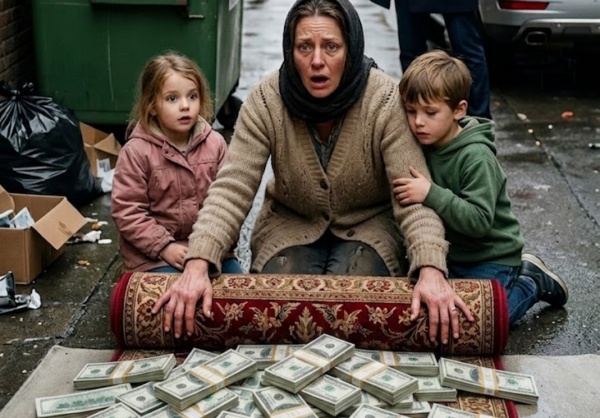
A Widow Digging Through Trash Saw a Rich Man Dump a Rug. When she opened it, she was shocked…
Part 1: The Widow at the Dump and the SUV That Stopped Too Close
My name is Camila Reyes, and I am 38 years old, and I am writing this from a small house in San Antonio, Texas that I now own free and clear — a house that sits on two acres of land with a garden in the back and a swing set for my children, a house that I purchased six months ago with money that came from the most unlikely source imaginable.
I am writing this because what happened on that afternoon at the municipal dump on the east side of San Antonio has been reduced to rumor and speculation by people who were not there, and because I want to tell the truth in my own words, with all the specific details that matter, before the story is taken from me and turned into something it is not. I am also writing this because I think there is value in documenting the moment when desperation meets opportunity, and when a single decision made in seconds can change the entire trajectory of a life.
I need to describe where I was before that day, because understanding the depth of my desperation is essential to understanding why I made the choices I made. My husband Mateo died two years ago in a construction accident on a job site in downtown San Antonio. He was 41 years old, working as a framer for a residential construction company, and he fell from a third-story scaffold when a safety harness failed. He died instantly.
The company paid me $15,000 in a settlement that their attorney said was “generous” and that my attorney — a court-appointed lawyer who spent twenty minutes reviewing my case — said I should accept because fighting for more would take years and cost money I did not have. I accepted the settlement. I used $8,000 to pay for Mateo’s funeral and the remaining $7,000 to cover rent and food for as long as it would last.
Mateo and I had two children: Luz Marina, who was six years old when he died, and Joaquin, who was four. After Mateo’s death, I tried to work. I got a job cleaning houses for $12 an hour, but the hours were irregular and I could not afford childcare, so I had to bring the kids with me or leave them with neighbors who were not always reliable.
I got a job at a laundromat folding clothes for $10 an hour, but the owner fired me after three weeks because I had to leave early twice to pick up Joaquin from school when he was sick. I applied for government assistance — food stamps, Medicaid, housing vouchers — and I received some help, but it was not enough to cover rent and utilities and food and everything else two growing children need.
Six months ago, I was evicted from the apartment we had been living in — a two-bedroom unit in a run-down complex on the south side that cost $850 a month, an amount I could no longer pay. The eviction process took thirty days, and during that time I tried desperately to find another place we could afford. I applied to fifteen different apartments and was rejected by all of them because I had an eviction on my record and no steady income.
I asked family for help — my sister, my cousins, Mateo’s brother — but everyone had their own problems and no one had space for a woman and two children. On the day the sheriff came to remove us from the apartment, I packed everything we owned into two suitcases and three garbage bags, and I took my children to a homeless shelter on the west side of San Antonio.
We stayed at the shelter for two weeks. It was loud, crowded, and frightening. Luz cried every night. Joaquin stopped talking. I felt like I had failed them in the most fundamental way a mother can fail her children — I could not provide them with safety, stability, or a home. Then a woman at the shelter told me about the dump.
She said people threw away things that were still useful — furniture, clothes, toys, sometimes even food that was still sealed and safe to eat. She said if you went in the late afternoon, after the trucks had made their deliveries but before the gates closed, you could find things that would help you survive. I was ashamed. But I was also desperate. So I took my children to the dump.
Part 2: The Rug That Was Too Fine to Be Trash
We had been going to the dump for three days when it happened. The routine was always the same: I would park my old Honda Civic — a 2008 model with 187,000 miles that barely ran — near the entrance, and we would walk through the piles of trash looking for anything useful. I found a lamp that still worked. I found a bag of children’s clothes that were clean and only slightly worn.
I found a sealed package of rice that someone had thrown away, probably because it was past the expiration date but that was still perfectly safe to eat. Luz and Joaquin played nearby, making games out of bottle caps and broken toys, too young to understand that their mother was digging through garbage to keep them fed.
On the fourth day, a Thursday afternoon in late March, we were searching through a pile near the back of the dump when I heard the sound of a vehicle approaching. I looked up and saw a black SUV — a new model, expensive, with tinted windows and chrome trim that gleamed even in the dusty air of the dump.
The SUV stopped about thirty yards from where we were standing. The driver’s door opened and a man stepped out. He was in his fifties, wearing a dark suit that looked like it cost more than I used to make in three months, and he moved with the impatient, irritated energy of someone who did not want to be there and wanted to leave as quickly as possible.
The man opened the back of the SUV and pulled out a rolled carpet — a large Persian rug, maybe eight feet by ten feet, heavy and ornate even from a distance. He dragged it to the edge of the nearest trash pile and shoved it off the tailgate, letting it fall into the dirt and garbage. Then he got back in the SUV and drove away quickly, without looking back, without noticing that I was standing there watching him.
The whole interaction took less than two minutes. But something about it felt wrong. The rug was too nice to be thrown away. The man was too well-dressed to be disposing of his own trash. And the way he had looked around before dumping the rug — furtive, nervous, like he was afraid of being seen — made me think that whatever he was throwing away was not just a rug.
I waited until the SUV was gone. Then I walked over to the pile where the rug had been dumped. It was heavy — I could tell that just from looking at it — and it was beautiful, with intricate patterns in deep reds and blues and golds, the kind of rug you see in expensive homes or hotels.
I called to Luz and Joaquin to stay where they were, and I grabbed one end of the rug and started dragging it away from the pile. It took all my strength to move it. When I had pulled it far enough that I could unroll it without it touching the trash, I knelt down and started to open it.
The rug unrolled slowly, heavy and stiff. And as it opened, I saw something that made my heart stop: there was a slit in the fabric lining on the underside of the rug, and through that slit I could see bundles of cash — stacks of hundred-dollar bills bound with rubber bands, dozens of them, maybe more. I froze. I looked around to see if anyone was watching.
The dump was nearly empty — just a few people searching through trash on the other side of the lot, too far away to see what I was doing. I reached into the slit and pulled out one of the bundles. It was real. I could feel the texture of the bills, could see the watermarks and security strips. This was not fake money. This was real, and there was a lot of it.
I kept unrolling the rug, my hands shaking now, and I found more bundles — twenty, thirty, forty of them, each one containing what looked like $10,000. And then, near the center of the rug, I found something else: a sealed manila envelope with a name written on it in black marker. The name was Mateo Reyes. My dead husband’s name.
Part 3: The Envelope With My Husband’s Name and the Truth I Never Knew
I stared at the envelope for a long time, trying to make sense of what I was seeing. Mateo had been dead for two years. He had worked in construction, making $18 an hour, living paycheck to paycheck like we all did. He had never mentioned having money hidden anywhere.
He had never mentioned knowing anyone wealthy enough to own a rug like this or to have hundreds of thousands of dollars in cash. And yet here was his name, written on an envelope hidden inside a rug that a rich man had just thrown away at a dump. None of it made sense. But I knew, with absolute certainty, that I needed to open that envelope.
I picked up the envelope and tore it open. Inside were three things: a handwritten letter on expensive stationery, a photograph, and a key. The photograph showed Mateo standing next to the man I had just seen — the man in the suit who had dumped the rug.
They were both younger in the photo, maybe in their early thirties, and they were standing in front of a construction site with their arms around each other’s shoulders, smiling. On the back of the photo, someone had written: “Mateo and David, 2015.” The letter was dated three weeks ago, and it was addressed to me. It said:
“Mrs. Reyes, if you are reading this, it means I am dead or I have decided I can no longer carry this secret. Your husband Mateo saved my life eleven years ago. We were working on the same construction crew, and I fell from a scaffold. Mateo caught me and pulled me back up. I would have died if not for him. After that day, I told Mateo that I owed him a debt I could never repay. Mateo laughed and said I didn’t owe him anything, that he had just done what anyone would do. But I never forgot.
I became successful after that — I started a real estate development company that made me very wealthy. I tried to help Mateo over the years, offered him jobs, offered him money, but he always refused. He said he didn’t want charity, that he was proud of the work he did and the life he had built. When Mateo died, I wanted to help you and your children. I set aside $500,000 in cash for you.
But I was afraid that if I gave it to you directly, you would refuse it the way Mateo always refused my help, or that people would ask questions about where the money came from. So I hid it in this rug and I planned to have it delivered to you anonymously. But I lost my nerve. I was afraid of the legal complications, afraid of what people would think, afraid of everything.
So I am leaving this rug at the dump, hoping that you will find it, hoping that you will understand that this money is not charity. It is a debt repaid. It is what Mateo earned by saving my life. Please take it. Use it to build a better life for your children. And please forgive me for not having the courage to give it to you directly. — David Castellanos.”
I read the letter three times. Then I sat down in the dirt beside the rug and I cried — not from sadness, but from the overwhelming, disorienting relief of realizing that the nightmare I had been living for two years was about to end. The key that was in the envelope was labeled with an address and a unit number. It was a storage unit key. The letter explained that David had rented a storage unit in my name and prepaid it for five years, and that inside the unit were additional documents and items that had belonged to Mateo — things David thought I should have.
Part 4: The Decision I Made and the Life I Built With the Money
I did not take the rug back to the shelter. What I did was re-roll it carefully, load it into the trunk of my car with Luz and Joaquin’s help, and drive directly to a bank. I opened a safety deposit box and I deposited the bundles of cash — all $500,000 of it, counted and verified by a bank employee who looked at me with curiosity but who did not ask questions. Then I went to the storage unit that the key opened.
Inside were boxes containing Mateo’s personal belongings from the construction site — his tools, his work boots, photographs, and a file folder containing documents that David had compiled: records of the accident that killed Mateo, records of the settlement I had received, and a notarized letter from David explaining the origin of the money and stating that it was a gift, not income, and therefore not subject to income tax.
I consulted with an attorney — a real attorney this time, not a court-appointed one, but a tax attorney who specialized in large gifts and estates. I paid her $2,500 for a consultation, and she reviewed all the documents and confirmed that the money was legally mine, that it was structured as a gift and therefore exempt from income tax under federal law, and that as long as I reported it properly and kept the documentation, I would not have any legal problems. She helped me set up a trust for my children and helped me create a financial plan that would ensure the money lasted and grew over time.
I used the money carefully and deliberately. I bought the house in San Antonio for $185,000 — a small three-bedroom house with a yard and a good school district nearby. I paid cash. I set aside $100,000 in a college fund for Luz and Joaquin, invested in a 529 plan that will grow over time. I set aside $50,000 as an emergency fund. I used $20,000 to buy a reliable used car — a 2022 Honda CR-V with 30,000 miles.
I used $10,000 to furnish the house and buy clothes and supplies for the kids. And I invested the remaining $135,000 in a diversified portfolio of index funds that generates enough passive income that I do not have to work full-time, which means I can be home with my children and be the mother they need me to be.
I also did something else. I found David Castellanos. It was not hard — he was a prominent real estate developer in San Antonio, and his company’s address was listed online. I wrote him a letter thanking him for what he had done, telling him that his gift had saved my family, and asking if I could meet him in person to express my gratitude. He agreed. We met at a coffee shop in downtown San Antonio, and I brought Luz and Joaquin with me. David cried when he saw them.
He said they looked like Mateo. He said he had been carrying guilt for two years, guilt that he had not done more to help Mateo when he was alive, guilt that he had not had the courage to help me directly after Mateo died. I told him he had nothing to feel guilty about, that what he had done was more generous than he could possibly know, and that Mateo would have been proud of him.
Part 5: The Widow Who Found More Than Money in the Trash
I am 38 years old and I am writing this from the living room of my house in San Antonio, where my children are playing in the backyard and where I no longer have to choose between paying rent and buying food. I am writing this because I want people to know that David Castellanos is not a villain or a coward — he is a man who tried to repay a debt in the only way he knew how, and who gave my family a future when we had none.
I am also writing this because I want people to understand that sometimes the things we find in the trash are not trash at all — they are lifelines, second chances, evidence that someone, somewhere, was thinking of us even when we thought we were forgotten.
The rug is still in my house. I had it cleaned and repaired, and it now sits in my living room as a reminder of the day everything changed. People ask me sometimes how I can stand to look at it, how I can live with a rug that was literally pulled from a garbage dump. I tell them that the rug is not garbage. It is a gift. It is proof that Mateo’s kindness mattered, that the life he saved went on to save mine, and that even in death he was still taking care of his family.
Luz is eight years old now and Joaquin is six. They go to a good school. They have their own rooms. They have clothes that fit and food on the table and a mother who is not exhausted and desperate every single day. They do not remember the shelter or the dump or the days when we had nothing. And I am grateful for that.
I want them to grow up believing that the world is a place where good things can happen, where people help each other, where a single act of kindness can ripple forward through time and change lives that the original actor will never meet.
I saw a wealthy man throw a luxury rug into the trash. I decided to pick it up and unroll it, and the moment I opened it, my whole body began to tremble. Not because I found money — though I did, and it changed everything — but because I found proof that my husband had mattered, that his life had meant something, and that the man whose life he saved had not forgotten him. The rug was not trash. It was a message. And I received it.
