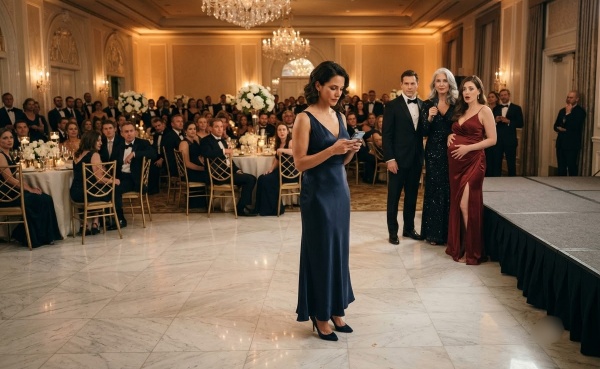
My mother-in-law took the microphone and ordered me to kneel in front of the woman carrying my husband’s baby. When I refused, my husband sided with her and threw his wedding ring at my feet. I was heading for the door when my phone buzzed with a warning… Then I saw my mother-in-law’s face—and realized she knew exactly what the message meant.
Part 1: The Woman in the Green Dress
My husband’s wedding ring landed between my shoes with a small, bright sound.
It rolled across the marble floor, struck the leg of a chair, and settled beneath the table where the mayor’s wife was sitting. Three hundred people watched me stand there, holding a champagne flute I hadn’t touched, while my mother-in-law told me to get on my knees.
The woman she wanted me to kneel before was six months pregnant.
Her name was Claire Bennett, and until that evening, I thought she was my husband’s executive assistant. She stood beside him in a dark green dress, one hand pressed protectively against her stomach, looking almost as horrified as I felt.
“Apologize to her,” Vivian Hawthorne said.
Her voice carried through the ballroom because she was still holding the microphone she’d used to welcome our guests. Behind her, a string quartet had stopped playing, leaving the room so quiet I could hear a waiter setting down a tray.
“For what?” I asked.
Vivian tilted her head the way she always did when she wanted to make me feel like the slowest person in the room. Her diamond earrings caught the light, and somewhere near the stage, a camera shutter clicked.
“For refusing to accept that this child is part of our family.”
I looked at my husband.
Daniel Hawthorne was a man who had appeared on the covers of business magazines, a man whose company owned office towers and apartment buildings from Manhattan to Miami. He was also the man who had held my hand through my father’s funeral and once driven forty miles in a snowstorm because I said I missed the pie from a diner near my hometown.
I waited for him to tell his mother to stop.
Instead, he adjusted the cuff of his tuxedo and said, “Eleanor, don’t make this harder than it needs to be.”
I had learned about Claire and the baby less than an hour earlier. Daniel had called me into a private room at the hotel and explained, with the calm efficiency of someone reviewing a quarterly report, that he and Claire had been involved for almost a year.
“I was going to tell you after the gala,” he’d said.
“After we raised money for families who can’t afford housing?” I had asked. “That’s when you thought you’d find a convenient moment?”
He hadn’t answered. He’d only asked me to stay for the speeches because the Hawthorne Foundation’s largest donors expected to see us together.
I should have walked out then.
But the foundation’s annual gala funded a housing program I’d spent seven years building, and several women from the program had come as my guests. I didn’t want them to think the work mattered less than the wreckage of my marriage, so I’d returned to the ballroom, planning to make my speech and leave.
Vivian had other plans.
She stepped onto the stage before I could reach it, thanked the guests for supporting “the next generation of the Hawthorne family,” and called Claire to her side. Then she announced the pregnancy to the room.
I can still remember the applause.
It began hesitantly, a few polite claps from people who didn’t understand what they were hearing. Then Vivian smiled, Daniel put his arm around Claire, and the applause spread because no one wanted to be the only person who hadn’t joined in.
“Claire has endured a great deal of unpleasantness,” Vivian said into the microphone. “I think it’s time we showed her some respect.”
I had barely spoken to Claire that evening. The only thing I’d said after Daniel told me the truth was that I needed a moment alone.
“What unpleasantness?” I asked.
Vivian looked directly at me. “Your refusal to step aside gracefully.”
A few people shifted in their seats. Someone near the back whispered, “Oh my God,” loud enough for the nearest tables to hear.
Daniel moved toward me, and for one foolish second, relief rose in my chest. I thought he was finally going to take the microphone from his mother.
“Mom’s asking you to acknowledge Claire,” he said. “A small gesture could settle this.”
“What kind of gesture?”
Vivian answered before he could.
“Kneel,” she said. “And apologize.”
Claire turned toward her. “Vivian, no.”
But Vivian’s eyes stayed on me. She had spent twelve years treating every boundary I set as a challenge, and now she had an audience large enough to make my refusal look like a public offense.
I set my champagne flute on a nearby table.
“No.”
The word sounded small in that enormous room, but it was mine.
Vivian’s smile disappeared. “After everything this family has given you?”
I looked around at the guests, at the tables covered in white roses and the enormous gold letters spelling out THE HAWTHORNE FOUNDATION. The foundation had paid for the flowers, but I knew the names of the women whose stories had brought the donations in.
“I’m not kneeling,” I said. “And I won’t apologize for being hurt.”
Daniel’s jaw tightened. He slid his wedding ring off his finger and held it up between us.
“If you walk away tonight,” he said, “don’t expect to come back.”
Then he threw it.
It hit the marble at my feet. A woman at the nearest table gasped, and Claire stepped away from him.
I wanted to pick the ring up and throw it back. I wanted to ask Daniel how he could make a spectacle of me after twelve years of marriage, but I could feel my hands shaking, and I refused to give Vivian the satisfaction of seeing me fall apart.
So I turned toward the doors.
That was when my phone lit up.
I almost ignored it. My best friend, Mara, had been texting since I told her what was happening, and I couldn’t bear another message asking if I was all right.
But this message wasn’t from Mara.
It was from Ruth Adler, the foundation’s longtime accountant. Ruth had retired four months earlier, and the last time we’d spoken, she’d sounded nervous about something she refused to discuss over the phone.
Do not sign anything tonight. I found the transfer records. They used your name.
I stopped walking.
A second message appeared before I could reply.
And Eleanor—Daniel’s father knew. I have his letter.
Arthur Hawthorne had died three years ago.
He had left me a handwritten note that said he trusted me to keep the foundation honest. I had carried those words with me through every argument with Vivian, believing they were a blessing.
Now Ruth was telling me there had been another letter.
I turned back toward the ballroom.
Across the room, Vivian was watching my face. The moment she saw the phone in my hand, she went pale.
And for the first time that night, my mother-in-law looked afraid.
Part 2: The Letter He Never Gave Me
I didn’t confront Vivian in the ballroom.
I had spent enough years around the Hawthornes to know that a public accusation without proof would become a story about my “emotional reaction.” By morning, Daniel’s lawyers would be polishing the edges off the truth, and I would be the jealous wife who couldn’t handle a difficult evening.
I slipped through the side doors and called Ruth from the hotel’s empty coatroom.
She answered on the first ring. “Did they ask you to sign?”
“Not yet. Ruth, what transfer records?”
There was a pause, followed by the rustle of papers. I pictured her at her kitchen table in Queens, wearing the reading glasses she kept on a chain around her neck.
“Three transfers from the foundation’s housing fund,” she said. “The total is $4.8 million.”
My stomach tightened.
That fund paid for emergency rent, temporary housing, and legal assistance for families at risk of eviction. We had spent the previous six months telling applicants that grant money was delayed while the board reviewed the budget.
“Where did it go?”
“To a company called Bridgepoint Development. The records list the payments as consulting and property acquisition costs.”
I had never heard of Bridgepoint.
“I raised concerns before I retired,” Ruth said. “Vivian told me the transactions had been approved and that you’d handled the authorization.”
“I didn’t.”
“I know. I found copies of the authorizations this afternoon, Eleanor. Your name is on them, but the signatures don’t look like yours.”
I leaned against the wall.
The coatroom smelled of wool coats and someone’s expensive perfume. A minute earlier, I had been trying to understand how my husband could betray me; now I was trying to understand whether someone had used my name to move millions of dollars.
“Why didn’t you tell me sooner?”
“I asked for the original records. They kept saying they were being sent, and then I retired, and I told myself I was being paranoid.” Her voice broke. “Today a former colleague called me. She said they were preparing a statement blaming the delays on financial decisions you made.”
Footsteps sounded in the hallway.
“Where are you?” I whispered.
“At home. I made copies of everything I could access lawfully while I was working there, and I kept Arthur’s letter because he asked me to give it to you if anything happened to him.”
“What letter?”
“He wrote it after he found out about Bridgepoint. He was going to confront Vivian and Daniel, but then he got sick.”
I closed my eyes.
Arthur’s final illness had come quickly. In those last weeks, Vivian controlled who could visit him, and I had been grateful whenever she let me sit by his bed.
“Why didn’t he give it to me himself?”
“He thought there would be time,” Ruth said. “I should have brought it to you after he died. I’m sorry.”
The coatroom door opened.
Claire stood in the doorway. Up close, she looked exhausted, and her lipstick had faded where she’d been pressing her lips together.
“I’ll call you back,” I told Ruth.
Claire waited until I lowered my phone. “I didn’t know she was going to do that.”
I believed her, which somehow made everything worse.
“Did you know Daniel was married?”
“Yes.” She swallowed. “He told me you’d been separated for months and were waiting until after the gala to announce it.”
I stared at her.
“He said you lived in the guesthouse,” she continued. “He said the marriage was over, but that you both wanted to protect the foundation.”
The guesthouse was where I worked when I needed quiet. I had eaten breakfast with Daniel that morning in the kitchen of our shared home, and he’d kissed my cheek before leaving for the city.
“I’m sorry,” Claire said. “I should have asked you. I should have found a way to speak to you before it got this far.”
I wanted to be angry with her. Part of me was, but she was standing in front of me telling the truth as she understood it, and Daniel was still inside the ballroom letting his mother clean up his mess.
“Why did you follow me?” I asked.
She held out a cream-colored envelope. “Vivian told me to make sure you got this before you left.”
Inside was a document headed RESIGNATION AND RELEASE. It stated that I was resigning from my position at the foundation and releasing certain claims, with language I wasn’t about to pretend I understood.
At the bottom was a signature line.
“She said you’d already agreed,” Claire said.
“She lied.”
Claire looked over her shoulder. “There’s something else. Daniel asked me to put a folder in Vivian’s car this afternoon, and I saw your name on one of the documents.”
“What kind of document?”
“I only saw the top page. It had the foundation’s letterhead and a list of transfers.” She hesitated. “Daniel told me not to mention it to you.”
For a moment, neither of us spoke.
Then Claire said, “I think they’re going to say you approved them.”
Before I could answer, Daniel appeared behind her.
“Eleanor,” he said, “we need to talk privately.”
I folded the resignation document and put it back in the envelope.
“No,” I said. “We need lawyers.”
His expression changed. The polished concern slipped, and I saw the impatience underneath.
“You’re overreacting.”
“Am I?”
He glanced at Claire, then back at me. “Mother can be dramatic. You know that.”
“You threw your ring at me.”
“Because you humiliated us in front of our donors.”
I almost laughed. In Daniel’s version of the evening, my refusal to kneel had somehow become the offense.
He stepped closer. “The foundation needs stability. Sign the resignation, and we can handle the rest quietly.”
“What rest?”
“The financial review. There are some questions, but nothing that can’t be resolved.”
“Questions about Bridgepoint?”
His face went still.
It was a tiny change, but I had been married to him long enough to recognize it. Daniel only became that motionless when he was deciding which version of the truth would serve him best.
“Who told you about Bridgepoint?” he asked.
I tucked the envelope under my arm. “You just did.”
He reached for my wrist, then stopped himself when Claire moved between us.
“Let her go,” she said.
Daniel looked at her as though he had forgotten she was a person capable of making a choice. Then he stepped back, and I walked past him into the hallway.
Outside, the November air was cold enough to sting. I called Mara, who lived in Brooklyn and owned the kind of practical winter coat I had always borrowed when I visited her.
She arrived twenty minutes later in a battered Subaru, took one look at my face, and unlocked the passenger door without asking questions. As we pulled away from the hotel, she handed me a bottle of water and said, “You can tell me when you’re ready.”
We were halfway across the bridge when Ruth sent a photograph of Arthur’s letter.
It was dated six weeks before he died. I recognized his slanted handwriting immediately, along with the way he always crossed his sevens.
The letter began:
Eleanor, if you are reading this, I failed to fix what I helped create.
I read that sentence twice.
Then I scrolled down.
Bridgepoint belongs to Daniel. Vivian knows, and I believe money intended for the housing fund has been sent there.
I gripped the phone so tightly my fingers hurt. I had expected to discover that Vivian had manipulated Daniel into another one of her schemes.
Arthur’s letter suggested something different. My husband might not have been protecting his mother at all.
He might have been protecting himself.
Part 3: The House with the Blue Door
Mara’s apartment smelled like coffee and the cinnamon candle she kept burning whenever she was stressed.
By the time we arrived, she had made up her couch with clean sheets and found me a pair of sweatpants. I changed out of my evening gown in her bathroom, where the bright overhead light showed every streak in my makeup.
My phone buzzed constantly.
Daniel called six times. Vivian sent one message that read, You are making a terrible mistake, followed by another reminding me that the house in Greenwich was owned through a family entity.
I didn’t answer either of them.
Instead, Mara helped me find a New York attorney experienced in divorce and complex financial matters. The next morning, I met with a woman named Leila Grant, who listened without interrupting while I described the gala, the affair, and Ruth’s message.
When I showed her the resignation document, she read it carefully and slid it back across her desk.
“Good decision not to sign,” she said. “I can’t tell you what you’re entitled to until we review the agreement and the financial records, but your husband throwing a ring doesn’t end a marriage or decide property rights.”
I let out a breath I hadn’t realized I was holding.
Daniel had made everything sound so simple the night before: leave the ballroom, lose the marriage, lose the life. Hearing someone separate his threats from the actual process made me feel steadier.
“What about the foundation money?” I asked.
“That needs its own review. We should preserve what you already have, and the foundation should involve independent counsel.”
Leila advised me not to access accounts or files I wasn’t authorized to use. She also told me to save the messages I’d received and write down what I remembered from the gala while it was fresh.
It was the first sensible plan I had heard in twenty-four hours.
Ruth arrived at Mara’s apartment that afternoon carrying a folder and a loaf of lemon cake. She apologized for the cake being slightly lopsided, then sat down at the kitchen table and spread the documents between us.
Arthur’s original letter was on top.
He had written that he helped Daniel establish Bridgepoint years earlier, when it was supposed to develop affordable housing on properties the Hawthorne company no longer needed. At first, Arthur believed the arrangement could serve both the business and the community.
Then he saw the invoices.
Bridgepoint had charged the foundation for consulting work that Arthur could not verify. He asked Vivian for documentation and told Daniel the arrangement needed independent review.
According to the letter, Daniel promised to bring the records to the foundation board. Arthur later learned that no such presentation had happened.
“I wanted to believe I misunderstood,” the letter said. “Your husband is my son, and I was afraid of what the truth might do to him. I am more ashamed that I was afraid of that than of what might happen to the families waiting for our help.”
I lowered the page.
Arthur had not been an innocent man who discovered a problem at the last minute. He had seen enough to act and had waited, hoping his son would repair it quietly.
The letter ended with a request.
Please make sure the board sees everything. Do not let anyone tell you that protecting our name is the same as doing what is right.
Ruth placed copies of three transfer authorizations beside it. My name appeared on each form, and the signatures resembled mine in the way a photocopy of a flower resembles the real thing: recognizable from a distance, wrong when you looked closely.
The dates were wrong, too.
One authorization was dated during a week when I had been in Arizona caring for my sister after surgery. Another was supposedly signed on a Sunday when Daniel and I had been at a family wedding in Vermont.
“I need Leila to see these,” I said.
Ruth nodded. “The board needs to see them too.”
The foundation’s board had nine members, including me, Vivian, and Daniel. The remaining six included donors, community advocates, and a retired judge named Martin Ellis, who had never seemed particularly impressed by the Hawthorne family name.
I called Martin from Mara’s kitchen.
He didn’t promise to take my side. He asked for a description of what I had, told me not to send sensitive records through an unsecured channel, and said he would contact the board’s independent counsel.
That evening, he called back. An emergency board meeting had been scheduled for Monday.
I should have felt relief, but all I could think about were the families on our waiting list.
So the next morning, I drove to a small house in Newark with a blue front door.
The house belonged to a nonprofit called Harbor House, one of the organizations our foundation supported. Its director, Denise Walker, had been trying to reach me for weeks about a grant payment that hadn’t arrived.
I had told her the budget review was taking longer than expected.
When she opened the door, she looked surprised to see me without an appointment. Behind her, I could hear children talking and a television playing softly.
“Eleanor,” she said. “Is everything okay?”
“No,” I admitted. “Can we talk?”
We sat in her office, surrounded by mismatched chairs and framed drawings made by children who had stayed at the shelter. Denise poured coffee into two mugs, one of which said WORLD’S OKAYEST BOSS.
I told her there were questions about the foundation’s finances and that an independent review was being arranged. I didn’t share the details Ruth had given me, because I didn’t yet know what the review would establish.
Denise listened, her hands wrapped around her mug.
“I need you to know what the delay has meant,” she said. “We’ve been covering motel rooms on credit. Our landlord agreed to wait for one payment, but I don’t know how much longer we can do that.”
“How many families?”
“Eleven are waiting for longer-term housing. Six are staying in motels right now.”
I thought about the white roses at the gala. The flowers alone had cost enough to cover several weeks of motel rooms.
“I’m sorry,” I said.
“I know you are.” Denise looked toward the window. “But sorry doesn’t keep the lights on.”
She wasn’t cruel about it. That made the truth harder to hear.
I asked her for a written breakdown of the immediate needs, and she agreed to send one. I couldn’t promise foundation money before the board reviewed the accounts, but I told her I would explore what I could personally contribute.
When I got back into my car, there was a message from Claire.
Daniel told me you’re trying to destroy him. I asked him about Bridgepoint. He said you’re confused.
A second message followed.
But I found something you should see.
She attached a photo of a printed email. It was from Daniel to Vivian, sent two weeks before the gala.
If Eleanor keeps asking about the housing fund, we need to make her look unreliable before the board meeting. The announcement at the gala should do it.
I read the message three times.
The affair had been real. The pregnancy was real.
But the public humiliation hadn’t been a spontaneous outburst from Vivian. Daniel had anticipated a scene and believed it would discredit me.
I forwarded the screenshot to Leila and asked Claire to preserve the original email. Then I sat in my car outside Harbor House, watching a little boy carefully place a paper turkey in the window.
Daniel had wanted me to spend the night wondering whether I had lost everything.
I was beginning to wonder how much he had already taken from people who had never even met him.
Part 4: What the Board Heard
On Monday morning, I walked into the foundation’s conference room wearing a navy suit I had owned for years.
Vivian was already there. She looked at me, then at the empty chair beside Daniel, as if she expected me to sit down and resume the role I had played for twelve years.
I chose a chair at the other end of the table.
Martin was there with the foundation’s independent counsel, a woman named Priya Shah. Leila attended with me, and a forensic accounting firm had been asked to begin examining the records.
Priya made it clear that the meeting was not a trial. The board’s immediate job was to protect the foundation, preserve information, and determine what steps were necessary while the review proceeded.
Vivian folded her hands.
“I understand Eleanor is upset about a personal matter,” she said. “I hope we can keep that separate from the foundation’s important work.”
“I agree,” I said. “That’s why I’m here.”
I placed Arthur’s letter on the table.
Daniel recognized his father’s handwriting before anyone said a word. He reached for the page, but Priya asked him to wait until she had distributed copies to the board.
As the members read, the room became quiet.
Vivian was the first to speak. “Arthur was very ill when he wrote this.”
“The letter is dated before his hospitalization,” Ruth said.
She had joined by video from her apartment. Her lemon-colored kitchen wall was visible behind her, and her voice shook only slightly as she described the transfers and the questions she had raised before retiring.
Daniel leaned forward. “Bridgepoint performed legitimate work. The payments were reviewed.”
“By whom?” Martin asked.
“By the appropriate people.”
“Please name them.”
Daniel glanced at Vivian. She looked down at her notes.
Priya said the accounting firm would need contracts, invoices, bank records, board minutes, and explanations from everyone involved. Until that review was complete, she recommended that the board consider temporary safeguards over the foundation’s accounts.
I watched Daniel’s face as she spoke. He had always been at ease in rooms full of powerful people, but that morning he kept touching the place where his wedding ring used to be.
Then Priya brought up the authorizations bearing my name.
Daniel said I had approved the transfers. He claimed I must have forgotten because I had been dealing with family issues and traveling frequently.
I gave Leila the copies of my flight and hotel confirmations from Arizona, along with photographs from the Vermont wedding. They didn’t prove every detail by themselves, but they raised questions about the dates on the forms.
“The originals and electronic records will need to be examined,” Priya said.
Vivian gave a short laugh. “Are we really going to build a scandal around a few dates?”
“No,” Martin said. “We’re going to review $4.8 million in foundation payments.”
For the next hour, board members asked questions neither Vivian nor Daniel answered clearly. Daniel said he would provide contracts later; Vivian said she had relied on the finance department.
At one point, Daniel turned to me.
“If you had concerns, you should have come to me.”
“I did,” I said. “For six months, I asked why the housing grants were delayed. You told me the board was being cautious.”
“We were being cautious.”
“Denise Walker has families in motel rooms because she was waiting for money we told her was coming.”
He looked away.
The board voted to suspend Daniel and Vivian from their officer roles while the review proceeded. Priya explained that the decision did not establish wrongdoing; it allowed the foundation to secure records and continue operating under independent oversight.
I did not vote. Leila and Priya had discussed the conflict created by my marriage and the allegations involving my name, and I followed their advice to step back from the decision.
The board also approved an emergency assessment of pending grants. Martin asked Denise and other partner organizations to submit their most urgent needs so the foundation could determine what it could responsibly release.
It was a beginning, not a solution.
After the meeting, Daniel followed me into the hallway.
“You could have handled this privately,” he said.
“We just did.”
“You know what I mean.”
He looked tired, and for a moment I saw the man I had married. Then I remembered the email about making me look unreliable, and the feeling passed.
“Did you plan the whole thing?” I asked.
“Mother planned the announcement.”
“But you knew she wanted to humiliate me.”
“I knew you were going to find out about Claire eventually.” He lowered his voice. “I thought if you were angry enough to leave, you’d stop digging.”
The honesty startled both of us.
“Why?”
“Because Bridgepoint was supposed to work.” He rubbed his forehead. “The market changed, construction costs went up, and the project ran short. I moved money around to keep it alive.”
“Foundation money.”
“I was going to put it back.”
“You told me the housing fund was short because donations were down.”
“I was trying to buy time.”
I thought about Denise’s spreadsheet and the six families in motel rooms. Daniel had been buying time with money that was supposed to buy them somewhere safe to sleep.
“And the signatures?” I asked.
His eyes flickered. “I didn’t sign your name.”
That wasn’t the same as saying he didn’t know who had.
Before I could press him, his phone rang. He looked at the screen, silenced it, and put it back in his pocket.
“Claire?” I asked.
“She’s moved out.”
I hadn’t known they were living together. He saw the realization on my face and looked embarrassed, though I couldn’t tell whether it was because he’d deceived me or because he’d been caught doing it.
“She says she’s keeping the baby,” he said.
“That’s her decision.”
“She wants an attorney involved when we discuss support and arrangements.” He gave a bitter smile. “Apparently, everyone wants an attorney now.”
“Maybe that’s because you keep asking people to trust you while you lie to them.”
He opened his mouth, then closed it.
As I walked toward the elevator, he called after me. “Eleanor, whatever happens with us, don’t let my mother take the fall for everything.”
I turned around.
“Is that what she’s planning?”
His face told me the answer before he spoke.
“She told Priya she acted on instructions from the finance department,” he said. “If they find the signatures, she’ll say someone else did it.”
“Did she do it?”
“I don’t know.”
But he looked frightened.
That evening, Leila called. Priya had received a package at her office, delivered by a courier with no return address.
Inside was a copy of a document appointing me to oversee the housing fund’s payments. It carried my signature and a date from two years earlier.
There was also a handwritten note.
Ask Vivian what happened to the original.
Part 5: What I Chose to Keep
For three days, I thought about that note.
Leila told me not to contact Vivian about it directly. Priya’s team was already requesting the original document, and anything I said in anger might complicate an investigation that needed facts, not family arguments.
So I did what I could control. I wrote down every conversation I remembered about the housing fund and gathered copies of records I was entitled to share.
On Thursday, I met Claire at a café near Bryant Park.
She arrived early and chose a table by the window. When I sat down, she pushed a paper cup toward me.
“I remembered you drink your coffee with cream,” she said.
I looked at the cup. I had once thanked her for bringing me coffee during a foundation meeting, back when I thought she was simply being thoughtful.
“Thank you,” I said.
She had brought her own attorney, a quiet woman named Jessica, who sat at the next table to give us some space. Claire told me she had already given Priya’s team the email and other documents she had kept in the ordinary course of her work.
“I’m not doing this to get back at Daniel,” she said. “I just don’t want to be part of another lie.”
I appreciated that she didn’t ask me to forgive her.
She told me Daniel had promised her a future, then asked her to keep waiting whenever she wanted to discuss it. When Vivian learned about the pregnancy, she had treated it as an opportunity to force an announcement on her own terms.
“I should have walked away when I realized something was wrong,” Claire said. “I kept believing him because believing him meant I didn’t have to face what I’d done.”
I looked out at the people hurrying past the window, their collars turned up against the cold.
“I was angry with you,” I said. “I’m still angry about some of it.”
“I know.”
“But Daniel made promises to both of us. And whatever happens between the adults, your child doesn’t deserve to be treated like a problem.”
Claire’s eyes filled. She nodded once, then took a breath and told me something she had been afraid to say over the phone.
A few weeks before the gala, Vivian had asked her to retrieve an old file from a cabinet in Daniel’s office. Claire remembered seeing a document about authority over foundation payments, but it had not been signed when she placed it in Vivian’s folder.
“Are you sure it was the same document?” I asked.
“I’m not certain,” she said. “I only saw it briefly.”
That distinction mattered. She agreed to tell Priya exactly what she remembered, including what she wasn’t sure about.
The review took months.
There was no dramatic moment when a single document solved everything. Accountants traced payments, attorneys requested records, and board members held meetings that lasted well past dinner.
Some Bridgepoint expenses were supported by invoices. Others could not be adequately explained, and the records raised serious concerns about how foundation funds had been authorized and used.
An examination of the disputed documents did not establish that I had signed them. The foundation referred its findings to the appropriate authorities, and the matter continued beyond what I was able to see.
I learned not to confuse an investigation with a verdict. I also learned that waiting for an official answer didn’t mean pretending nothing had happened.
Daniel and I began divorce proceedings.
There were difficult conversations about our home, our accounts, and the agreement we had signed before our wedding. Leila explained that the outcome would depend on the documents, the facts, and New York law—not on a declaration Daniel had made in a ballroom.
We eventually reached a settlement with the help of our attorneys. I received assets and support under its terms, and I left the house in Greenwich without needing Vivian’s permission to rebuild my life.
I kept a small set of dishes my mother had given us when we married. Daniel kept the dining table he had chosen, though I doubt he noticed I had never liked it.
The wedding rings stayed with me.
After the gala, a hotel employee had found Daniel’s ring beneath the chair and given it to me. I put it in a box beside my own, not because I thought we might reconcile, but because I wasn’t ready to decide what those twelve years meant.
As for the foundation, the board made changes I had requested for years: independent financial oversight, clearer grant reporting, and regular meetings with the organizations receiving support. More importantly, it released emergency funding after reviewing what was available and what had been promised.
Harbor House received enough to cover its immediate motel bills and continue its housing work. Denise called to tell me the news, then spent most of the conversation explaining what still needed to be done.
“That sounds like you,” I said.
“That sounds like work,” she replied. “You coming to help or not?”
I did.
On a Saturday in early spring, I drove back to the house with the blue door. The paper turkey was gone from the window, replaced by a row of bright flowers made from construction paper.
Denise put me to work sorting donated bedding. A little girl helped me match pillowcases, then informed me that the yellow ones were obviously the best because they looked like sunshine.
At lunchtime, we ate sandwiches around a crowded table. Nobody asked about my divorce or whether I missed living in Greenwich.
I did miss parts of my old life. I missed the garden in June, the sound of rain against the bedroom windows, and the man I had believed Daniel was when we first married.
Leaving hadn’t erased the love I’d once felt. It had only forced me to see that love could not make his choices for him.
A month later, I received a letter from Claire. Her baby had arrived safely, and she had enclosed a photograph of a tiny hand wrapped around her finger.
She didn’t ask me to be part of the child’s life. She simply wrote, I wanted you to know we’re okay.
I sent a card back wishing them both well.
That night, I opened the box with the rings. I held Daniel’s in my palm and remembered the sound it made when it hit the marble.
For months, that sound had followed me into quiet moments. I would hear it while brushing my teeth or sitting at a red light, and suddenly I’d be back in the ballroom with three hundred people watching.
But that evening, I remembered something else.
I remembered saying no.
I put the rings back in the box and slid it onto a shelf. One day I might sell them, or give them away, or leave them exactly where they were.
For the first time, I understood that I didn’t have to decide that night.
The next morning, Denise called to ask whether I could help interview candidates for a new position at Harbor House. I told her I could be there by ten, then made myself breakfast and opened the kitchen window.
Outside, someone was walking a dog down the sidewalk. A delivery truck stopped at the corner, and the driver carried a package up the steps across the street.
It was an ordinary morning.
I had never realized how much peace could fit inside one.
