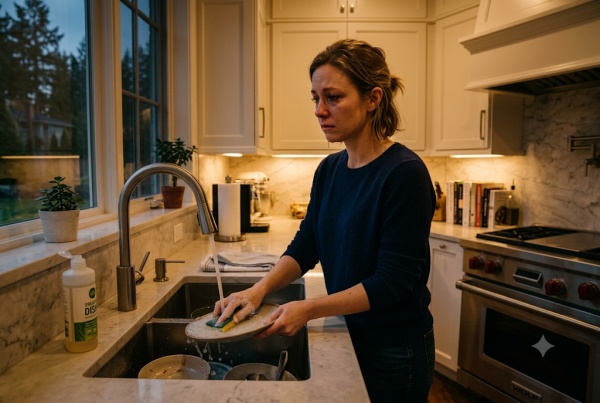
My husband ordered me to stay home washing dishes while he took his mistress to a luxury Chicago gala… Calvin stood in our Lake Shore Drive kitchen wearing half a tuxedo, laughed at the plate in my hands, and told me to stay home washing dishes because the luxury gala at the Drake Hotel was “business” and I would only embarrass him. He walked out with his mistress on his arm, planning to charm the mysterious investor who could save his collapsing Chicago development company…
PART I — THE DISHES
My husband ordered me to stay home washing dishes while he took his mistress to a luxury Chicago gala, where he planned to beg a mysterious billionaire for the money to save his collapsing company.
He laughed when he said it.
That was the part I remembered later, long after the photographers stopped calling, long after his attorney stopped using the word “misunderstanding,” long after the board minutes, forensic reports, and bank records proved what I had already suspected. He laughed because he believed I was exactly what he had spent nine years telling himself I was: a quiet wife, a decorative failure, a woman with no real power beyond keeping his shirts pressed and his house presentable.
What Calvin didn’t know was that I owned the investment empire he was desperate to impress.
And I had already uncovered a secret far worse than his affair.
My name is Eleanor Whitcomb, though almost nobody in my public life used that name. To most people in Chicago finance, I was simply E. W. Bennett, founder and majority owner of Bennett Meridian Holdings, a private investment office that managed stakes in healthcare technology, logistics, clean energy infrastructure, and distressed real estate across the Midwest. I had built it quietly, deliberately, and legally through a combination of inherited family assets, early-stage investments, and a stubborn refusal to place my name on anything that could be used by people who confused visibility with value.
My late father, Arthur Bennett, had taught me that lesson.
“Power announces itself only when it has to,” he used to say. “Everything before that is advertising.”
Calvin Vale, my husband of nine years, had mistaken my silence for emptiness.
When I married Calvin, he was not yet the man who would one day stand in our marble kitchen on Lake Shore Drive and tell me to stay home because I would embarrass him at a gala. He was charismatic then, ambitious, funny in a way that felt intimate rather than cruel. He owned a small commercial development firm called Vale Urban Partners, focused on mixed-use properties in Chicago neighborhoods that were attracting new investment.
I had met him at a fundraiser for affordable housing in River North.
He had talked passionately about rebuilding vacant properties without pushing out longtime residents. I had believed him. More importantly, I had wanted to believe him because I was thirty-one, grieving my father, tired of men who treated my last name like a door they wanted opened, and Calvin had looked at me as if I were simply Eleanor.
Not Bennett.
Not an asset.
Not an access point.
Just Eleanor.
It took me years to realize that he had not seen less than the others.
He had simply been more patient.
For the first three years of our marriage, I kept most of my financial world separate from him. That was not secrecy in the legal sense; our prenuptial agreement disclosed my family assets, my ownership interests, and the existence of my investment entities. Calvin had signed it with his attorney present. He knew I had money.
What he did not know was the scale.
That was not because I hid it improperly. It was because he never cared enough to understand what he was reading. He saw trusts, holding companies, and family-office structures and dismissed them as old Bennett money parked somewhere boring and conservative. He believed my role was passive.
He believed I inherited comfort.
He did not understand that I had spent my twenties studying financial statements the way some women studied art history. He did not know I had turned a modest family office into a disciplined investment platform that had quietly become one of the most influential private capital sources in Chicago. He did not know that Bennett Meridian Holdings had a reputation for saving companies when banks would not, but only after examining every ledger, every loan covenant, every related-party transaction, and every lie the desperate men in expensive suits had told themselves was not yet a lie.
The industry knew E. W. Bennett.
Calvin knew Eleanor, his wife.
He never connected the two.
That was his arrogance.
The gala was the St. Anselm Children’s Hospital Winter Benefit, held every December at the Drake Hotel, where Chicago’s old money, new money, medical leadership, civic donors, and ambitious climbers gathered under crystal chandeliers to prove they cared about sick children in ways that photographed well. Bennett Meridian had quietly underwritten a pediatric cardiac wing at St. Anselm three years earlier through a donor-advised structure. My public attendance had never been required.
This year was different.
Bennett Meridian was considering a rescue financing package for several Chicago companies affected by the tightening credit market. One of those companies, by desperate application and persistent lobbying, was Vale Urban Partners.
Calvin’s company.
He had submitted a confidential financing request to Bennett Meridian six weeks before the gala, asking for a $28 million bridge facility secured by development assets, future lease revenue, and personal guarantees he described as “limited but meaningful.” The request came through an investment banker who did not know Calvin was my husband because the review process at Bennett Meridian was deliberately firewalled and professional. I did not handle the initial intake.
But the moment the file reached my desk, everything changed.
Not because my husband needed money.
Because the numbers were wrong.
The first thing I noticed was the debt schedule. Vale Urban Partners claimed outstanding secured obligations of $41.6 million across five projects. But the internal cash-flow model attached to the application referenced interest payments consistent with at least $57 million in obligations. That discrepancy alone would have triggered enhanced diligence.
The second thing I noticed was a vendor named North Pier Consulting, paid $1.8 million over eighteen months for “entitlement strategy” and “community engagement.” The invoices were vague, repetitive, and strangely round. The address listed for North Pier was a mailbox suite in Oak Brook.
The third thing I noticed was a transfer of $740,000 labeled “partner distribution” to an entity called Lake Finch LLC.
Lake Finch LLC was not listed as a partner.
Lake Finch LLC, after twenty minutes of database searching by my chief compliance officer, was registered to a woman named Sabrina Cole.
Calvin’s mistress.
At that point, the affair became the least interesting part of the file.
The affair explained the arrogance.
The money explained the danger.
I did not confront him immediately. People think the moment of discovery is the moment to act, but that is usually wrong. The moment of discovery is the moment to stop giving away information for free. I sent the Vale Urban Partners application to forensic review under standard protocols, disclosed the marital connection to Bennett Meridian’s outside counsel, recused myself from the investment committee vote, and instructed my team to continue the diligence as if the applicant were any other distressed borrower with suspicious related-party activity.
Then I went home and watched my husband lie to me over dinner.
That happened for nineteen days.
Nineteen days of Calvin asking whether I had picked up his tuxedo from the tailor. Nineteen days of him texting under the table. Nineteen days of him telling me he was working late while security-camera logs from a Bennett-owned parking garage showed his Mercedes entering after hours with Sabrina Cole in the passenger seat because, in his carelessness, he had chosen a garage owned by one of my subsidiaries.
Sabrina was twenty-nine, a public relations consultant who had worked on two of Calvin’s development launches. She was pretty in a highly maintained way, with glossy dark hair, sculpted cheekbones, and the sharp social hunger of someone who believed proximity to powerful men made her powerful too. She had also received hundreds of thousands of dollars from entities tied to Calvin’s company.
The affair was humiliating.
The financial trail was actionable.
By the afternoon of the gala, my team had compiled enough preliminary evidence to justify declining the bridge loan and referring certain findings to outside counsel for possible civil action and regulatory reporting. We had not yet concluded whether criminal conduct had occurred. That was not our job to declare. But we had identified possible misrepresentations in financing materials, undisclosed related-party transfers, suspicious vendor invoices, and potential misuse of company funds at a time when Vale Urban Partners was failing to pay subcontractors on two South Side projects.
That mattered.
Small contractors were waiting on money.
Employees were worried about payroll.
Tenants in partially completed buildings were being told delays were temporary.
Meanwhile, Sabrina Cole’s LLC had received $740,000.
And Calvin thought his real problem was whether I would look plain beside him at the Drake.
He came into the kitchen at 5:10 p.m. wearing his tuxedo pants and an unbuttoned white dress shirt, holding his phone in one hand and cufflinks in the other. I was standing at the sink rinsing a plate because our housekeeper had taken the afternoon off for her grandson’s school concert, and unlike Calvin, I knew dishes did not disappear because a person had money.
He leaned against the island and looked at me.
“You’re not wearing that, are you?”
I glanced down at my black sweater and jeans.
“I wasn’t aware I was invited.”
He laughed.
“There it is.”
“What?”
“That tone.”
I turned off the water.
“What tone, Calvin?”
“The wounded-wife tone,” he said. “Eleanor, tonight is important. I can’t spend the evening explaining you to people.”
I looked at him.
That sentence contained an entire marriage.
“Explaining me.”
“You know what I mean.”
“I don’t think I do.”
He sighed, as if I were exhausting him by requiring basic decency.
“The investors I’m meeting tonight are serious people,” he said. “Bennett Meridian may have someone there. Maybe even E. W. Bennett’s people. This is not one of your museum lunches or charity board teas. This is business.”
I dried my hands on a towel.
“And what would you like me to do?”
He smiled.
Not kindly.
“Stay home,” he said. “Wash the dishes. Relax. Let me handle the room.”
There are insults that arrive like slaps.
There are others that arrive like keys.
That one opened something.
“And who are you taking instead?” I asked.
His face flickered.
Only for a second.
But enough.
“Sabrina has contacts in PR,” he said. “She understands the optics.”
“I’m sure she does.”
“Don’t do this tonight.”
“Do what?”
“Make it ugly.”
I looked at the man I had married.
He looked handsome in the unfinished tuxedo, silver at the temples, blue eyes steady with the confidence of someone who believed charm could refinance debt. He also looked, for the first time, small to me. Not poor. Not desperate. Small in the way of men who confuse performance with substance until substance comes due.
I picked up the plate, rinsed the last soap from it, and placed it in the drying rack.
“Good luck tonight,” I said.
He blinked.
He had expected tears.
Maybe anger.
Maybe an argument he could later describe as instability.
He did not know what to do with calm.
He pushed away from the island.
“Try not to wait up,” he said.
Then he left our apartment to take his mistress to a gala where he intended to impress the woman standing barefoot in his kitchen.
I waited until the elevator doors closed.
Then I called my driver.
“Bring the navy gown,” I said. “And the Bennett file.”
PART II — THE EMPIRE HE DIDN’T SEE
The Drake Hotel looked like old Chicago money trying very hard not to notice the weather.
Snow moved sideways across East Walton Place, bright under the streetlights, dusting the shoulders of men in tuxedos and the hair of women stepping from black cars in gowns that cost more than some monthly mortgages. The doormen moved quickly, practiced and expressionless, opening doors, guiding donors through the wind, managing the choreography of wealth.
I arrived at 7:42 p.m.
Calvin and Sabrina had arrived at 7:18.
I knew because Bennett Meridian’s security consultant had sent me a discreet update, along with a photo captured by the gala’s press line. Calvin stood in his tuxedo, one hand at Sabrina’s lower back, smiling the smile he used when he wanted cameras to believe in him. Sabrina wore emerald satin and diamonds I recognized from a credit card statement Calvin had classified as “client entertainment.”
Client entertainment.
That was one way to describe it.
I sat in the back of the car for a moment before stepping out.
The navy gown my driver had brought was a Carolina Herrera piece I had purchased for a Kennedy Center event the previous year and never worn. It was simple, structured, and severe in the best way: long sleeves, clean neckline, no glitter, no apology. My hair was pulled back. My earrings were diamonds from my mother, small enough not to announce themselves, real enough not to need to.
My general counsel, Rebecca Shaw, was already inside.
Rebecca had been with Bennett Meridian for eleven years and had the rare combination of legal precision, moral clarity, and a face that revealed absolutely nothing in public. She had reviewed the Vale file with outside counsel that afternoon and advised me on every boundary. I could attend the gala as a donor. I could not use the event to publicly accuse Calvin of misconduct. I could, however, decline any investment discussion, disclose conflicts when appropriate, and allow board-level processes already in motion to proceed.
“Do not improvise,” she had told me.
“I don’t improvise.”
“No,” she said. “You detonate slowly.”
That was fair.
Inside the Drake, the Gold Coast Room glowed with chandeliers, white roses, violin music, and the low hum of people accustomed to being important. St. Anselm’s development team had done what development teams do beautifully: transformed generosity into a room full of assigned seating, sponsor signage, silent-auction packages, and carefully arranged proximity.
My name was not on the public sponsor wall.
Bennett Meridian’s gift had been listed through the Whitcomb Family Pediatric Fund, one of my donor-advised vehicles. Calvin knew the Whitcomb name, obviously. He had never asked where the fund’s money came from.
Again, arrogance.
I entered through a side corridor with Rebecca.
The hospital CEO, Dr. Margaret Ellison, saw me first. She was sixty-two, silver-haired, brilliant, and one of the few people outside my firm who knew the full structure of my giving. Her eyes widened for half a second before she recovered.
“Eleanor,” she said warmly. “I didn’t know you were coming.”
“I decided at the last minute.”
“I’m glad.”
She glanced over my shoulder at Rebecca, then back to me.
“Is everything all right?”
“Not yet,” I said.
Dr. Ellison was too experienced to ask more in a ballroom.
She simply nodded.
“We’ve seated the Whitcomb Fund at table one, of course. You’re welcome there.”
“Thank you.”
Table one was near the stage.
Calvin was at table nine.
That was not an accident. His company had bought a mid-tier sponsorship months earlier, when he still had cash enough to purchase appearances. Bennett Meridian, through the Whitcomb Fund, had underwritten the evening’s matching gift challenge at a level that placed me at the front of the room even without my public name.
Calvin did not see me at first.
Sabrina saw me before he did.
That was satisfying in a quiet way.
She was standing beside the bar, one hand on Calvin’s arm, laughing at something said by a man from a regional bank. Her laughter stopped when her eyes found me. The change in her expression moved like a shadow across glass.
Recognition.
Confusion.
Alarm.
Then calculation.
She leaned toward Calvin and whispered.
He turned.
For one long second, my husband stared at me as if I were an object that had appeared in the wrong room.
Then he excused himself and walked toward me too quickly.
“What are you doing here?” he hissed when he reached me.
“Attending a fundraiser.”
“I told you—”
“Yes,” I said. “You told me to wash dishes.”
His jaw tightened.
“Eleanor, not here.”
“I agree.”
He looked at my gown, my earrings, Rebecca standing beside me, the way Dr. Ellison had greeted me. He was processing new information and failing to organize it fast enough.
“Who is this?” he asked, looking at Rebecca.
“Rebecca Shaw,” she said, extending a hand. “General counsel, Bennett Meridian Holdings.”
Calvin took her hand automatically.
Then the words reached him.
General counsel.
Bennett Meridian Holdings.
His eyes moved from Rebecca to me.
“Why is Bennett Meridian’s counsel with you?”
I smiled faintly.
“Because she works for me.”
The room did not go silent.
Real life rarely grants that kind of theatrical convenience.
But Calvin went silent.
Utterly.
Rebecca’s expression remained professional.
“Mr. Vale,” she said, “given the active financing request your company submitted to Bennett Meridian, and given your marital relationship to Ms. Whitcomb, I’m going to advise that any discussion tonight remain social only. Formal communications should proceed through counsel or the designated investment team.”
Calvin looked at me.
“Ms. Whitcomb,” he repeated.
“Yes,” I said.
“You’re E. W. Bennett.”
“No,” I said. “E. W. Bennett is a professional name. I am Eleanor Whitcomb Bennett. You signed a prenuptial agreement disclosing that nine years ago.”
His face changed color.
I had seen Calvin embarrassed before.
I had seen him angry.
I had never seen him afraid.
Not truly.
Not until then.
Across the room, Sabrina was watching us.
She had gone very still.
“Eleanor,” Calvin said quietly, “we need to talk.”
“No,” Rebecca said.
He blinked at her.
She continued, calm and precise.
“Not about the financing request. Not about any business matter involving Vale Urban Partners. Not without counsel present.”
“This is my wife.”
“And my client.”
The words landed beautifully.
Calvin looked around then, becoming aware that several people were watching. Not enough to create a scene. Enough for reputation to feel temperature.
He lowered his voice.
“You set me up.”
“No,” I said. “You submitted an application to my firm containing material omissions. That was your decision.”
His mouth opened.
Closed.
I leaned slightly closer, lowering my voice so only he could hear me.
“The affair is humiliating, Calvin. The rest is dangerous.”
He stared at me.
“What rest?”
That was when I knew.
Not that he was innocent.
No.
I knew he did not know how much I knew.
That is a different kind of guilt.
Before he could speak again, the dinner chimes sounded.
Guests began moving toward their tables.
I stepped around him.
“Enjoy the gala,” I said.
Then I walked to table one.
PART III — THE SECRET WORSE THAN THE AFFAIR
The most important conversations at galas rarely happen at the table.
They happen in corridors, beside coat checks, near restrooms, behind sponsor backdrops, and in the five-minute gaps when powerful people believe no one is listening because the orchestra is loud and the champagne is good. Calvin knew that. It was why he had brought Sabrina. He thought she could help him work the room, charm potential backers, soften the optics of a company quietly running out of cash.
What he did not know was that the room had already shifted.
By 8:15 p.m., three people had approached Rebecca privately to ask whether Bennett Meridian was actually considering Vale Urban Partners. She answered each with the same careful sentence: “We do not comment on active or inactive investment opportunities.” That sentence, in finance, can mean anything.
That night, paired with my presence, it meant enough.
At 8:40 p.m., the silent auction closed.
At 8:45, the hospital showed a short film about pediatric cardiac patients, and for seven minutes the room was reminded of why it was supposed to be there. Children in hospital gowns. Parents explaining fear with brave faces. Surgeons discussing outcomes. Nurses holding babies small enough to make every adult in the room feel suddenly unimportant.
I watched Calvin during the film.
He did not look at the screen.
He looked at me.
Sabrina looked at him looking at me.
That triangle told its own story.
After the first course, a banker named Martin Keller stopped by table one. Martin was managing director at North Shore Commercial Bank, one of Vale Urban Partners’ lenders. He was also on St. Anselm’s finance committee and had known my father. He bent to kiss my cheek, then glanced toward Calvin’s table.
“I assume you’ve seen the lien filings,” he said quietly.
Rebecca, seated to my right, looked up.
“What lien filings?” she asked.
Martin’s eyebrows moved.
“You haven’t?”
“Not as of this afternoon,” Rebecca said.
Martin exhaled slowly.
“Two subcontractors filed mechanics liens yesterday on the South Halsted project. Another one is expected Monday. Total is around $2.3 million, maybe more.”
I kept my face still.
Vale Urban Partners had not disclosed pending subcontractor disputes.
That was not a minor omission.
“Send me what’s public,” Rebecca said.
Martin nodded.
“Eleanor,” he said, softer now, “I don’t know what your exposure is, but be careful. There are rumors about escrow irregularities.”
Escrow irregularities.
A polite phrase.
A dangerous one.
“What kind?” I asked.
Martin looked uncomfortable.
“Tenant improvement allowances not reaching tenants. Construction draws being redirected. I haven’t seen enough to say more.”
“Then don’t,” Rebecca said.
He nodded, grateful for the boundary.
“I’ll send the filings.”
He walked away.
Rebecca made one note on her phone.
“That escalates things,” she said.
“Yes.”
“You need to remain publicly neutral.”
“I am neutral.”
She looked at me.
“You are many things. Neutral is occasionally one of them.”
At 9:05, I received a text from my chief compliance officer, Daniel Cho.
Urgent. New document set from vendor review. North Pier Consulting bank records indicate transfers to Lake Finch LLC and to an account associated with Alderman R. Voss campaign committee. Need outside counsel review before any action.
I read it twice.
Alderman Raymond Voss.
Calvin had needed zoning approvals for two projects in Voss’s ward.
If funds had moved from a suspicious vendor through consulting accounts into political channels, this was no longer merely marital betrayal or corporate mismanagement. It had the potential to involve campaign finance violations, bribery concerns, false invoicing, or other regulatory issues. I was not a prosecutor. I was not going to label it beyond what we knew.
But what we knew had just become significantly worse.
I handed the phone to Rebecca.
She read it.
Her expression changed by almost nothing, which meant a great deal.
“We leave now,” she said.
“No.”
“Eleanor.”
“Five minutes.”
“For what?”
I looked toward table nine.
Calvin was no longer there.
Neither was Sabrina.
I stood.
Rebecca stood too.
We found them in the corridor outside the ballroom near a marble alcove by the service elevators. Sabrina was speaking sharply, her voice low but heated. Calvin had one hand raised in that calming gesture men use when they believe the real problem is a woman’s volume rather than the facts causing it.
“You told me she was nobody,” Sabrina said.
Calvin glanced around and saw me.
His face hardened.
Sabrina turned.
For the first time that night, she looked less like a rival and more like a person realizing the ladder she had climbed was leaning against a burning building.
“I think I should leave,” she said.
“That would be wise,” Rebecca said.
Sabrina looked at her.
“Am I in trouble?”
It was a revealing question.
Rebecca answered carefully.
“You should retain independent counsel before discussing any business payments, consulting arrangements, or entities connected to Vale Urban Partners.”
Sabrina went pale.
“Business payments?”
Calvin said, “Sabrina, don’t say anything.”
I looked at him.
“There he is,” I said quietly.
His eyes snapped to mine.
“What is that supposed to mean?”
“It means you’re finally worried about the right thing.”
Sabrina took a step away from him.
“Calvin, what is she talking about?”
He did not answer.
Rebecca placed one business card on a small marble table.
“Ms. Cole,” she said, “if you are contacted by investigators, regulators, creditors, or counsel for any party, do not destroy documents. Do not delete messages. Do not coordinate stories. Get your own attorney.”
Sabrina looked at the card like it might burn her.
Then she picked it up.
Calvin laughed once, sharply.
“This is ridiculous. Eleanor, you’re angry because of Sabrina, and now you’re trying to make it into something else.”
“No,” I said. “I was angry because of Sabrina. Then I read your financing materials.”
His face tightened.
I continued.
“Then I saw Lake Finch. North Pier. The undisclosed debt. The subcontractor liens. And now possible political transfers.”
Sabrina whispered, “Political transfers?”
Calvin’s eyes flashed.
“You have no idea what you’re talking about.”
“That may be true,” I said. “Which is why outside counsel will handle it.”
“You can’t do this to me.”
“I didn’t.”
I let the sentence settle.
“You did this to yourself.”
For a moment, the corridor held all of us in place: the wife he had left at home, the mistress he had brought as a credential, the lawyer who knew where the bodies of paper were buried, and the husband whose empire was beginning to understand gravity.
Then Calvin made his second worst mistake of the night.
He stepped closer to me and lowered his voice.
“If you think I’m going to let you humiliate me publicly, you don’t know me at all.”
Rebecca moved slightly.
Not dramatically.
Enough.
“Mr. Vale,” she said, “do not threaten my client.”
Calvin looked at her, then at me.
The old Calvin would have smiled.
The current Calvin looked hunted.
“I’m going to fix this,” he said.
“No,” I said. “You’re going to cooperate.”
Sabrina’s phone buzzed. She looked down, then up at Calvin.
“It’s the Tribune,” she whispered.
His face drained.
Mine did not.
I had not called the press.
Rebecca had not called the press.
But subcontractor liens are public. Campaign filings are public. Desperate companies leave public smoke long before private fires are visible.
Calvin grabbed for the phone.
Sabrina pulled it back.
That was the first intelligent thing I had seen her do all night.
“I’m leaving,” she said.
Then she walked toward the elevators alone.
Calvin watched her go, and I saw the exact moment he understood that even the woman he had chosen over me was choosing distance from him now.
I almost felt sorry for him.
Almost.
PART IV — THE MORNING AFTER THE GALA
By sunrise, Vale Urban Partners was no longer a troubled development company seeking rescue capital.
It was a crisis.
The Chicago Tribune published a business brief at 6:12 a.m. reporting mechanics liens filed against two Vale Urban Partners projects and lender concerns about delayed payments. The article did not mention Bennett Meridian. It did not mention me. It did not mention Sabrina. It did mention that subcontractors on the South Halsted redevelopment alleged nonpayment despite project draws being released.
At 6:28, Martin Keller emailed Rebecca the lien documents.
At 6:41, Daniel Cho sent the preliminary vendor tracing report.
At 7:03, outside counsel at Barlow & Finch recommended issuing a formal litigation hold within Bennett Meridian for all documents related to Vale Urban Partners and notifying Vale’s counsel that the financing application had been declined due to material diligence concerns.
At 7:20, Calvin came home.
I was in the dining room, not the kitchen.
That mattered to me.
There were papers on the table, my laptop open, Rebecca on speakerphone, Daniel joining remotely, and a pot of coffee beside me. I had changed out of the gown into a gray cashmere sweater and black pants. My wedding ring was still on my finger, though not for sentimental reasons. Removing it would come later, carefully, with counsel.
Calvin walked in wearing last night’s tuxedo shirt under his overcoat.
He looked ten years older.
Rebecca said through the speaker, “Mr. Vale has entered?”
“Yes,” I said.
Calvin stopped.
“You have your lawyer on speaker?”
“My general counsel.”
“In our home?”
“In my dining room.”
His eyes moved to the documents.
“You planned all of this.”
“I planned none of your conduct.”
He laughed bitterly.
“Right. You just happened to own the firm I was applying to.”
“You applied to Bennett Meridian because your banker told you E. W. Bennett was disciplined, discreet, and willing to finance difficult situations if the underlying assets were sound.”
His mouth tightened.
“He said that.”
“He was right.”
I closed one folder.
“Your assets were not the problem, Calvin. Your truth was.”
He sat down across from me without being invited.
For the first time in nine years, he looked at me as if he was trying to see the person in front of him rather than the role he had assigned her.
“How long?” he asked.
“How long what?”
“How long have you been… this?”
I smiled without warmth.
“Before I met you.”
His face tightened again, wounded pride looking for somewhere to land.
“You let me think—”
“I let you read a prenuptial agreement with your own attorney and draw lazy conclusions.”
That silenced him.
Rebecca said, “Eleanor, I recommend no further substantive discussion without Mr. Vale’s counsel present.”
Calvin looked at the phone.
“This is still my marriage.”
“No,” I said quietly. “This is now several things. A marriage. A potential divorce. A failed financing request. A creditor problem. A possible civil dispute. And depending on what outside counsel determines, perhaps a regulatory matter.”
He put his elbows on the table and covered his face.
For one second, I saw not the cruel man from the kitchen, not the arrogant man at the gala, not the husband with a mistress and a collapsing company, but the ambitious man from River North who once talked about rebuilding neighborhoods.
“What happened to you?” I asked.
He lowered his hands.
The question seemed to hit harder than accusation.
“What?”
“What happened? When did the mission become invoices from fake consultants and money to Sabrina’s LLC?”
He looked away.
“North Pier wasn’t fake.”
“Then explain it.”
He said nothing.
“Explain Lake Finch.”
Still nothing.
“Explain the payments routed around your own CFO.”
His eyes came back to mine.
“How do you know that?”
There it was.
Not denial.
Alarm at the precision.
“Your former controller contacted our diligence team anonymously two weeks ago,” I said. “He was worried payroll taxes might be late and that project funds were being moved without proper approvals.”
Calvin went still.
“Marcus?”
“I won’t confirm the source.”
“It was Marcus.”
“Again, I won’t confirm.”
He stood suddenly and began pacing.
“Everything got tight after the Fulton Market deal fell apart,” he said. “The bank pulled back, costs went up, two anchor tenants delayed signing, and everyone wanted to be paid. I was trying to buy time.”
“By moving money through consulting entities?”
“I was trying to keep the projects alive.”
“By paying Sabrina?”
His face twisted.
“That was different.”
“No,” I said. “That was clarifying.”
He gripped the back of a chair.
“I loved you.”
That almost made me laugh.
Not because it was funny.
Because men like Calvin often reach for love when accounting fails.
“You loved being married to a woman who didn’t challenge your image of yourself,” I said. “That is not the same thing.”
He looked at me with real hatred then.
Brief but unmistakable.
“You enjoyed this,” he said.
“No.”
“You enjoyed humiliating me.”
“No, Calvin. If I wanted humiliation, I would have crossed that ballroom last night, taken the microphone, and introduced myself as the owner of the firm you were begging while your mistress wore jewelry bought with misclassified expenses.”
His face paled.
“I didn’t do that.”
He had no answer.
Rebecca said softly through the speaker, “Eleanor.”
I knew what she meant.
Enough.
I took a folder from the stack and slid it across the table.
“This is a list of counsel you should consider. Independent counsel, not your company’s general corporate attorney. You need someone who understands insolvency, lender disputes, and internal investigations.”
He did not touch the folder.
“What about us?”
I looked at him for a long time.
The marriage deserved grief.
It did not deserve performance.
“I have an appointment this afternoon with a family law attorney,” I said. “I will not discuss divorce terms with you directly. I will not interfere with any lawful investigation. I will not lie for you. I will not rescue your company with my investors’ money. And I will not wash dishes while you take another woman to beg me for capital.”
His mouth moved slightly.
No words came.
That was when he understood.
Not the money.
Not the company.
Not even Sabrina.
He understood the contempt had been the unforgivable part.
Affairs can sometimes be survived.
Debt can sometimes be restructured.
Companies can sometimes be rebuilt.
But contempt, once fully visible, changes the face of a marriage forever.
Forty-eight hours after he told me to stay home, Calvin Vale sat in my dining room and realized he had not been living with a worthless wife.
He had been living with the only person in Chicago who might once have known how to save him.
And he had made sure she would never want to.
PART V — WHAT I DID NOT SAVE
The next six months were expensive, public, and strangely quiet.
Expensive because attorneys are expensive, forensic accountants are expensive, restructuring consultants are expensive, and the truth, once neglected long enough, charges interest. Public because Vale Urban Partners had borrowed from banks, delayed payments to contractors, and attached its name to neighborhood projects that city officials cared about. Quiet because I stopped explaining myself to people who had benefited from misunderstanding me.
Bennett Meridian formally declined the financing request.
Our letter was brief, factual, and reviewed by counsel. It cited unresolved diligence concerns, incomplete disclosures, related-party questions, and pending creditor issues. It did not accuse Calvin of crimes. It did not need to. Precision is stronger than adjectives.
Vale Urban Partners’ board placed Calvin on administrative leave two weeks later after its outside directors received preliminary findings from an independent review. His CFO resigned. The former controller, Marcus, cooperated through counsel. North Pier Consulting became a central focus of civil discovery after several vendors denied performing work described in invoices.
Sabrina Cole retained an attorney.
That was wise.
Her lawyer later claimed she had believed Lake Finch payments were legitimate consulting fees for public-relations strategy, event planning, and community outreach. Whether that was true was not for me to decide. She returned a portion of the funds as part of a confidential civil settlement with Vale’s creditors, according to filings I later reviewed. She also disappeared from Chicago’s PR scene so thoroughly that even gossip stopped finding her useful.
As for the alleged political transfers, outside counsel referred the matter to appropriate authorities after completing a preliminary review. I will not exaggerate what happened after that, because stories become irresponsible when they turn every suspicion into a conviction. What I can say is that subpoenas were issued, campaign filings were amended, and Calvin spent many unpleasant hours with attorneys in conference rooms where charm had limited evidentiary value.
No dramatic arrest happened.
No handcuffs.
No television crews outside our building.
Real consequences are often less cinematic and more durable.
Loans were called.
Projects were sold.
Creditors negotiated.
Subcontractors eventually received partial payments through settlements tied to asset sales and insurance claims. Some received less than they were owed, which angered me more than anything Calvin had done to me personally. Powerful men often describe business failure as if it happens in boardrooms, but the damage lands in payroll accounts, family budgets, mortgage payments, and workers trying to explain to spouses why a check did not come.
I thought often about the dish in my hand that night.
How small it had seemed.
How deliberate.
How Calvin had looked at me and seen domestic labor as proof of insignificance.
He had never understood that competence does not become smaller because it is performed in a kitchen.
My divorce filing was clean.
Illinois is an equitable distribution state and recognizes no-fault divorce based on irreconcilable differences. Our prenuptial agreement controlled much of the property division, especially premarital assets, family trusts, and Bennett Meridian ownership. Calvin’s attorney tried briefly to challenge certain provisions, then stopped after reviewing the disclosures he had ignored nine years earlier.
There was some marital property to divide.
The Lake Shore Drive apartment sold.
I kept my mother’s jewelry, my father’s letters, my ownership interests, and my name.
Calvin kept what remained of his pride, though not as much of his company as he had expected.
He asked to speak to me privately only once after the dining-room conversation.
I agreed on the condition that our attorneys remain in adjacent offices and that the discussion not concern business, finances, or settlement terms. We met in a conference room overlooking the Chicago River in late March, three months after the gala. The river was still winter-dark, the sky low and gray, the city caught between seasons.
Calvin looked thinner.
He also looked less polished, which made him seem more human and less convincing.
“I owe you an apology,” he said.
“Yes.”
He almost smiled.
“You’re not going to make it easy.”
“No.”
He nodded.
“I’m sorry for the affair.”
I waited.
“I’m sorry for bringing Sabrina to the gala.”
I waited.
“I’m sorry for what I said in the kitchen.”
That was closer.
He looked down at his hands.
“I’m sorry I decided you were small because it made me feel bigger.”
There it was.
Not complete.
But real enough to register.
“Thank you,” I said.
He looked up.
“Did you ever love me?”
The question was so human, so poorly timed, and so useless that for a moment I felt the full sadness of all of it.
“Yes,” I said. “Very much.”
His eyes reddened.
“Then why didn’t you tell me who you were?”
“I did.”
He frowned.
“No, you didn’t.”
“I told you in documents. In conversations. In invitations to understand my work. In every moment you chose not to listen because the version of me you preferred was easier for you.”
He looked away.
Outside, a tour boat moved slowly along the river, absurdly cheerful in the cold.
“I think,” I said, “you wanted a wife you could underestimate. So you married one you didn’t bother to know.”
He closed his eyes.
When he opened them, he looked older again.
“What happens to me now?”
I shook my head.
“That is not mine to manage anymore.”
He nodded slowly.
I stood.
“Goodbye, Calvin.”
He did not stop me.
The St. Anselm Children’s Hospital pediatric cardiac wing opened the following October.
I attended the ribbon cutting publicly under my full name: Eleanor Whitcomb Bennett. There were cameras, though fewer than gossip had hoped. Dr. Margaret Ellison introduced me not as a mysterious donor, not as a billionaire, not as the woman whose husband had imploded at a gala, but as a partner in care.
That mattered to me.
Children and families walked through the new wing that morning. Nurses showed me patient rooms with sleeper chairs for parents, improved monitoring equipment, softer lighting, better family spaces, and windows wide enough to let nervous mothers look out at the city while holding themselves together. A little boy in dinosaur pajamas waved at me from a hallway.
I waved back.
That was the part worth photographing.
After the ceremony, Rebecca found me near the elevators.
“You survived,” she said.
“I did.”
“You also made three venture partners visibly nervous by existing in public.”
“That’s a public service.”
She smiled.
My phone buzzed.
A message from an unknown number.
For a second, old reflexes stirred.
Then I opened it.
It was from Marcus, Calvin’s former controller.
Ms. Bennett, I wanted you to know the last subcontractor settlement cleared today. It wasn’t full payment, but it helped. Thank you for pushing the issue.
I stared at the message for a moment.
Then I typed back:
Thank you for telling the truth when it cost you.
Because that, in the end, was the line.
Not wealth.
Not marriage.
Not reputation.
Truth.
People imagine power as the ability to destroy.
Sometimes it is.
But the kind of power my father taught me to respect was different. It was the ability to refuse a lie even when accepting it would be more convenient. It was the ability to let consequences reach people who had built walls against them. It was the ability to stand in a kitchen with dish soap on your hands and know exactly who you are, even when the person across from you cannot see it.
Calvin’s company did not survive in its original form.
Parts of it were sold. Parts were restructured. A few projects were completed by other developers under court-supervised agreements and lender oversight. Calvin eventually took a consulting role out of state, far from Chicago’s old rooms, where everyone remembered too much.
I did not follow his life closely.
That was a gift I gave myself.
Sabrina sent one apology through her attorney during the civil settlement process. It was carefully worded, likely reviewed several times, and admitted no legal wrongdoing. Still, one sentence seemed hers: I believed him when he said you were nobody, and I am ashamed of how badly I wanted that to be true.
I read that sentence twice.
Then I put the letter away.
I did not forgive her in any grand, glowing way.
I simply stopped carrying her.
There is a difference.
A year after the gala, I moved from Lake Shore Drive to a quieter condo in Lincoln Park with a kitchen that overlooked trees instead of traffic. I kept the kitchen deliberately simple: white tile, oak shelves, deep sink, no marble island large enough for a man to lean against while insulting me. I cooked more there than I had in years.
And yes, I washed dishes.
Gladly.
Not as punishment.
Not as proof of humility.
As ordinary life.
There is dignity in ordinary things when no one is using them to make you small.
Sometimes people ask whether I regret not revealing myself earlier. Whether I should have told Calvin plainly, years before, that I controlled Bennett Meridian. Whether the marriage might have been different if he had known the size of my power.
Maybe.
But I have come to believe that a person who needs proof of your power before offering respect was never offering love.
Calvin did not lose me because I was secretly rich.
He lost me because he thought I was worthless when he believed I was not useful.
That is the truth at the center of everything.
The gala only revealed it.
The affair only decorated it.
The financial collapse only documented it.
The marriage had been dying every time he looked at me and saw less than a person.
On the anniversary of that night, I hosted a small dinner at my new condo for Rebecca, Dr. Ellison, Daniel Cho, and a few friends who had known me before, during, and after Calvin Vale. We ate roast chicken, winter salad, and a chocolate cake one friend brought from a bakery in Andersonville. Nobody mentioned Calvin until dessert.
Then Rebecca raised her glass.
“To dishes,” she said.
Everyone laughed.
I did too.
Because by then, the word had changed.
It no longer belonged to the night he tried to make me small.
It belonged to the morning after, and every morning since, when I woke up inside a life no longer arranged around being underestimated.
I thought of my father then.
Power announces itself only when it has to.
That night at the Drake, it had to.
But the real power had not been walking into the ballroom in a navy gown and watching my husband understand who owned the room he was trying to enter.
The real power had been standing at the sink before any of that happened, holding a plate under running water, listening to a man laugh at the woman he thought he had diminished, and feeling no need to correct him too soon.
Because I knew the truth.
I knew the empire.
I knew the documents.
I knew the difference between silence and weakness.
And forty-eight hours later, so did he.
