My Husband’s Mistress Slapped Me at a Charity Gala. He Protected His Mistress After She Hit Me — Until Her Bracelet Exposed the Secret He Thought I’d Never Find
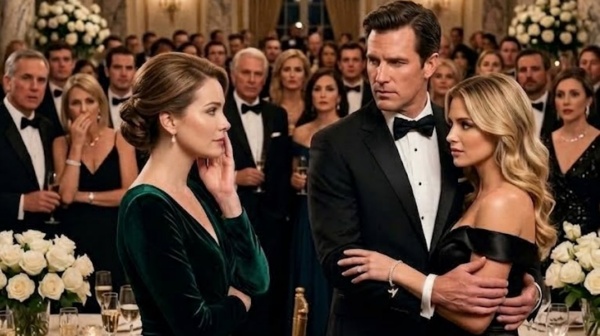
Then his mistress slapped me in front of three hundred people at a Dallas charity gala, and he stepped in front of her instead of me. He warned me that if I touched her, our marriage would end that night — as if I was the embarrassment in the room. But when the chandelier light caught the bracelet on her wrist, I realized he had not just betrayed me; he had stolen something I could never replace.
PART I — THE SLAP
My husband’s mistress slapped me in front of three hundred people, and for one full second, the ballroom went so silent I could hear the ice shifting in someone’s glass.
Her name was Vanessa Hart, though everyone at the gala knew her as the new public relations consultant for my husband’s company. She was twenty-nine, polished in that careful way women become when they know wealthy men are watching. Her black satin dress fit like it had been poured over her, and the diamond tennis bracelet on her wrist caught the chandelier light every time she moved her hand.
My name is Caroline Whitmore, and until that night, I had spent ten years being the kind of wife men like my husband depend on.
I smiled at fundraisers when I knew he had been cruel at home. I hosted holiday dinners for board members who never saw the way he dismissed me once the guests left. I fixed his mistakes, softened his sharp edges, remembered birthdays for clients, wrote apology notes he signed without reading, and turned his ambition into something respectable enough for other people to admire.
My husband, Preston Whitmore, was the founder and CEO of Whitmore Development Group, a commercial real estate company based in Dallas, Texas. He specialized in luxury mixed-use projects: hotel towers, high-end retail, office complexes with glass lobbies and rooftop restaurants. In public, he was charming, generous, and disciplined. In private, he treated tenderness like a weakness he had outgrown.
For most of our marriage, I told myself I was being loyal.
That was the word women are taught to use when they are exhausted and afraid to call it self-abandonment.
The gala was held at the Adolphus Hotel downtown, inside a grand ballroom full of white roses, black tuxedos, champagne flutes, and people who had practiced laughing quietly at expensive jokes. It was a charity event benefiting a children’s hospital, and Preston had donated $250,000 through the company foundation. That made him the evening’s honorary chair, and it made me, as usual, the wife expected to stand beside him like proof of his decency.
I wore a deep emerald gown and my mother’s pearl earrings. I remember that because after Vanessa slapped me, one earring loosened and fell against my collarbone. It was such a small, delicate thing, that pearl touching my skin while my cheek burned in front of the entire room.
The slap happened near the silent auction tables.
I had not confronted Vanessa dramatically. I had not screamed, thrown wine, or made a scene, though God knows half the women in that room would have understood if I had. I simply approached her after seeing her lean too close to my husband near the side exit, her fingers grazing the sleeve of his tuxedo in a way no consultant touches a client.
“Vanessa,” I said quietly, “this is not the place.”
She turned with a smile that was already a weapon.
“Excuse me?”
“You heard me.”
Her smile sharpened.
Preston stepped forward from behind her, his face hard with warning.
“Caroline,” he said.
Not my love.
Not honey.
Not what’s wrong?
Just my name, spoken like a leash.
I looked at him and saw ten years of practice in his expression. He expected me to understand the rules. Smile. Step back. Protect his image. Do not embarrass him. Do not give people a reason to whisper.
But something inside me was tired beyond obedience.
“I’m not doing this tonight,” I said.
Vanessa laughed softly.
“You mean you’re not pretending anymore?”
Several guests nearby turned toward us.
Preston’s jaw tightened.
“Vanessa,” he said under his breath.
But she had an audience now, and some people are incapable of resisting one.
She looked me up and down.
“You know, Caroline, it must be exhausting being married to a man who has outgrown you.”
The words hit harder than they should have because they sounded so much like Preston. Not exactly his words, but his tone. His contempt. His private cruelty dressed in a younger woman’s mouth.
I took one step closer.
“Be careful.”
That was all I said.
Two words.
Be careful.
Vanessa’s eyes flashed, and before I could react, her hand came across my face.
The sound cracked through the ballroom.
A woman gasped.
Someone dropped a dessert fork.
My cheek stung, and the heat spread instantly from my skin to my eyes. Not from tears. Not yet. From humiliation so fierce it became physical. Three hundred people had just watched my husband’s mistress strike me.
And then Preston moved.
For one impossible second, I thought he was stepping toward me.
I thought, foolishly, that even if our marriage had rotted from the inside, some old instinct would survive. I thought he would ask if I was all right. I thought he would take my arm, lead me away, finally remember I was his wife.
Instead, he stepped between me and Vanessa.
To protect her.
He raised one hand toward me, palm out, as if I were the threat.
“Don’t,” he said.
I stared at him.
“Don’t?”
His eyes were flat.
“If you touch her, Caroline, we will divorce tonight.”
A low murmur moved across the guests like a wind over dry leaves.
Vanessa stood behind him, breathing hard but smiling faintly. She looked triumphant, one hand lifting to smooth her hair. Her bracelet flashed again, bright against her wrist.
I should have been watching my husband.
I should have been collapsing under the weight of public betrayal.
Instead, my eyes locked on that bracelet.
Diamonds set in white gold.
Delicate oval clasp.
A small custom charm near the hinge, almost hidden by the way it turned against her skin.
A tiny gold hummingbird.
My stomach dropped.
Not because it was expensive.
I had seen expensive jewelry before. Preston collected expensive things the way insecure men collect evidence they matter. Watches. Cars. Club memberships. Campaign photos with elected officials. Women who looked good beside him in hotel bars.
No, I recognized that bracelet because it was mine.
Or rather, it had belonged to my mother.
My mother, Marianne Caldwell, had left it to me when she died of ovarian cancer four years earlier. She had worn that bracelet every Christmas Eve of my childhood, every anniversary dinner with my father, every church fundraiser and family wedding. The hummingbird charm had been added after I was born because she said I had arrived early, tiny and stubborn, like a little bird refusing to wait.
That bracelet had disappeared from my jewelry safe six months ago.
Preston had told me I must have misplaced it.
He had even helped me search for it.
He had stood in our bedroom, watching me cry over the last valuable thing my mother had left me, and said, “Caroline, you need to stop getting emotional over objects.”
Now it was on Vanessa Hart’s wrist.
In front of three hundred people.
Given to her, almost certainly, by my husband.
A strange calm came over me then.
The room did not change, but I did.
The slap still burned. The guests still whispered. Preston still stood between us like a man proud enough to believe he controlled the ending.
But he had miscalculated one thing.
For ten years, I had stayed quiet because silence seemed safer than war.
He thought humiliating me publicly would force me back into that silence.
He did not know the bracelet had just reminded me exactly who I used to be before I became his wife.
I lifted my hand slowly and touched my cheek.
Then I looked at Vanessa.
“Where did you get that bracelet?”
Her smile flickered.
Preston’s shoulders stiffened.
“What bracelet?” he said.
I did not look at him.
“The one on her wrist.”
Vanessa pulled her arm slightly behind her back.
Too late.
Several people had already looked.
Preston turned his head just enough to see it, and for the first time all evening, his confidence cracked.
It was subtle.
A tightening around the eyes.
A slight parting of his lips.
A flash of recognition he could not swallow quickly enough.
He knew.
Of course he knew.
Because he had taken it.
Because he had given it to her.
Because rich men who think wives are permanent often forget that stolen heirlooms do not become gifts just because they are placed on another woman’s body.
“Caroline,” he said quietly.
Now my name sounded different.
Not like a leash.
Like a warning he suddenly feared he had lost the right to give.
I smiled then.
Not happily.
Not kindly.
But clearly.
“Preston,” I said, “you may want to call your attorney.”
PART II — TEN YEARS OF CLEANING UP AFTER HIM
People imagine dramatic divorces begin with screaming.
Mine began with stillness.
After I told Preston to call his attorney, no one moved for several seconds. Vanessa looked from him to me, trying to understand why the room’s attention had shifted away from her slap and toward the bracelet on her wrist. She was smart enough to know something had changed, but not smart enough to know what it would cost.
Preston recovered first.
He leaned close to me and spoke through a smile meant for the room.
“Not here.”
There it was again.
His favorite phrase.
Not here.
Not now.
Don’t embarrass me.
Don’t make this harder.
Don’t act like a woman with a right to be wounded.
For ten years, those words had trained me. At dinner parties, after he made jokes at my expense: not here. In his office, when I found lipstick on a glass that was not mine: not now. At his parents’ ranch outside Fort Worth, when his mother said women who complained about marriage usually had too much free time: don’t embarrass me.
But a woman can only swallow so much disrespect before one final insult becomes a key in a locked door.
I turned away from him and addressed Vanessa directly.
“That bracelet belonged to my mother.”
Vanessa’s face flushed.
Preston grabbed my elbow.
Not hard enough to hurt.
Hard enough to remind me of the past.
I looked down at his hand, then back up at him.
“Remove your hand.”
His eyes flashed.
“Caroline.”
“Remove it.”
Maybe it was the room watching. Maybe it was the tone of my voice. Maybe it was the fact that for once, I did not sound wounded enough to manage.
He let go.
A few feet away, Lydia Monroe, a family law attorney I knew socially, had her phone in her hand, though she was not recording. Lydia and I had served together on the hospital charity board. She had once told me over coffee that women like me often waited until the humiliation became public because private pain was too easy for powerful men to deny.
I had smiled politely then, pretending the sentence did not apply to me.
Now Lydia was watching my face with careful concern.
“Caroline,” she said softly, “do you want to step outside?”
I nodded.
Preston immediately said, “She’s fine.”
Lydia looked at him.
“I asked Caroline.”
That small correction felt like oxygen.
Before I could move, Vanessa raised her wrist and laughed, but the sound was brittle.
“This? Preston gave it to me. If you have an issue, take it up with your husband.”
I looked at her for a long moment.
“I am.”
That was the first time the room understood that I was not going to compete with her.
I was going to hold him accountable.
There is a difference.
Preston lowered his voice.
“You are making a scene.”
“No,” I said. “You made the scene when you brought your mistress to a charity gala and let her strike your wife.”
His face darkened.
Vanessa snapped, “I am not his mistress.”
Three hundred people did not need proof to know a lie that obvious.
Preston turned toward her sharply.
“Stop talking.”
That did what my words had not.
It scared her.
Not because he was protecting me.
Because he was protecting himself.
I walked out of the ballroom with Lydia beside me and did not look back. My cheek was still burning, but I kept my shoulders straight until we reached a quiet hallway near the restrooms. Then I leaned against the wall and finally let my breath shake.
Lydia handed me a tissue.
“Do you need medical attention?”
“No.”
“Do you want hotel security?”
I thought about it.
Vanessa had slapped me. Technically, I could report it as assault. Texas law did not treat public humiliation as less real because rich people wore formalwear. But I also understood strategy. Tonight was no longer about the slap alone.
“No police right now,” I said. “But I want the incident documented by the hotel.”
Lydia nodded.
“Smart.”
“I want the security footage preserved.”
“Also smart.”
“And I want a photograph of the bracelet.”
Lydia’s eyes sharpened.
“Is it valuable?”
“Financially? Maybe $35,000. Emotionally? More than he can afford.”
She understood immediately.
“Was it missing?”
“Six months ago.”
“Did you file a police report?”
“No. Preston convinced me I had misplaced it.”
Lydia’s expression changed in a way I had seen before in women who were too professional to say exactly what they were thinking.
“Do you have proof it belonged to you?”
“Yes. Photos. Insurance appraisal. Estate documents from my mother’s trust.”
“Good.”
I looked toward the ballroom doors.
“I need to leave.”
“Do you want me to walk you out?”
“Yes.”
But before we reached the elevator, Preston appeared at the end of the hallway.
He had followed alone.
No Vanessa.
No audience.
Just the man I had married and the mask he wore when no one important was watching.
“What the hell do you think you’re doing?” he said.
Lydia stepped slightly forward.
“I’d be careful, Preston.”
He ignored her.
“You think you can embarrass me in front of donors, board members, city officials?”
I laughed once.
It surprised both of us.
“Your mistress slapped me in public, and you’re upset that I embarrassed you?”
“She lost her temper because you provoked her.”
There it was.
The old pattern.
His mistake became my responsibility.
His cruelty became my overreaction.
His betrayal became my failure to behave.
I looked at him and felt something inside me detach.
Not dramatically.
Not with fireworks.
More like a thread finally snapping after years of strain.
“Where did she get my mother’s bracelet?”
His face tightened.
“I don’t know what you’re talking about.”
“Try again.”
Lydia’s phone was still in her hand.
Preston noticed.
His voice dropped.
“Caroline, go home. We will discuss this privately.”
“No.”
He blinked.
I had said no to him before, but usually softly, surrounded by explanations. This one was plain. No decoration. No apology.
His expression hardened.
“You are my wife.”
“I know,” I said. “That’s why this is so embarrassing for you.”
Lydia made a sound that might have been a cough.
Preston stepped closer.
“Do not threaten me.”
“I’m not threatening you. I’m informing you that the bracelet on Vanessa’s wrist is stolen property unless you can explain how she legally obtained an heirloom from my late mother’s estate.”
He went very still.
I watched the word land.
Stolen.
Not gifted.
Not borrowed.
Not misunderstood.
Stolen.
For years, Preston had made me afraid of divorce. He told me I would never maintain the house, never understand the finances, never survive the attorneys he could afford. He said women who fought powerful men ended up poor, bitter, and alone.
He forgot one important thing.
For ten years, I had been cleaning up his messes.
And cleaning up a powerful man’s messes teaches you where the bodies are buried, even when the bodies are only documents, offshore transfers, shell vendors, and invoices no one wants examined.
When we married, I did not sign a prenuptial agreement.
Preston’s father had pushed for one. His mother insisted on it. Preston refused because he was proud and romantic back then, or at least proud enough to enjoy defying them. He told me love did not need contracts.
Later, after the company grew, he regretted that decision.
I knew because during arguments, he said so.
I also knew because I had quietly kept records.
Not to destroy him.
To survive him if I ever had to.
Bank statements.
Emails.
Calendar entries.
Photographs.
Copies of insurance policies.
Screenshots of messages he forgot were synced to the home office iMac.
Donation pledges.
Expense reports.
Vendor contracts I had reviewed because Preston hated details and trusted me to catch what his expensive executives missed.
He thought I was decorative.
That was useful.
Decorative women are often allowed to hear everything because arrogant men assume they are not listening.
“Caroline,” Preston said, voice softer now, “let’s not escalate.”
Too late.
The word had already become laughable.
He had publicly protected the woman wearing my dead mother’s bracelet after she struck me in front of hundreds of people, and now he wanted restraint because legal consequences had entered the hallway.
“You should go back to your guests,” I said.
“Our guests.”
“No,” I said. “Not anymore.”
His eyes narrowed.
“If you leave tonight, don’t come home expecting sympathy.”
I looked at him with genuine curiosity.
“Do you think I have been coming home to sympathy?”
For the first time, he had no answer.
I left with Lydia.
Outside the hotel, Dallas air hit my face, warm even at night. Valets moved quickly under the portico. Behind us, music continued inside the ballroom as if a woman’s life had not just split in half between the silent auction and the dessert course.
Lydia waited beside me until my car arrived.
“Caroline,” she said, “do not go home alone if he might be there.”
“He won’t leave the gala yet. His donors matter more than I do.”
She did not correct me.
“I can refer you to someone tomorrow.”
“A divorce attorney?”
“Yes.”
I looked at the hotel entrance.
Through the glass, I could see Preston in the lobby, phone pressed to his ear, face controlled but pale.
“Tomorrow,” I said, “I want the best one.”
Lydia put a hand on my arm.
“I’ll make calls tonight.”
As I got into the car, my phone buzzed.
A text from Preston.
Do not do anything stupid.
I stared at it for a few seconds.
Then I typed back:
I already did. I stayed quiet for ten years.
I turned off my phone before he could reply.
PART III — THE BRACELET WAS ONLY THE BEGINNING
I did not go home that night.
I checked into a suite at the Rosewood Mansion on Turtle Creek under my maiden name, Caroline Caldwell, because I needed one night in a room Preston did not own, decorate, monitor, or enter without knocking.
The first thing I did was photograph my cheek in the bathroom mirror.
It looked worse under the soft hotel lighting than it had felt in the ballroom. A red mark spread from below my eye toward my jaw, not severe enough for emergency care, but visible enough that no one could pretend Vanessa had merely “touched” me. I took photos from multiple angles, saved them to a secure cloud folder, and emailed them to myself and Lydia.
Then I opened my laptop.
For ten years, I had organized Preston’s life.
That meant I knew where he became careless.
Men like Preston assume secrecy lives in locked drawers and encrypted phones. They forget it also lives in receipts, shared calendars, old passwords, deleted email folders, jewelry insurance schedules, hotel rewards accounts, and the casual arrogance of assistants asked to make problems disappear.
I searched for the bracelet first.
The insurance appraisal was exactly where I remembered: a PDF attached to an email from Caldwell Family Trust dated four years earlier. My mother’s bracelet was listed as an inherited personal asset, appraised at $38,500, with detailed photographs showing the custom hummingbird charm.
I found Christmas photos from my childhood, my mother wearing it beside our fireplace in Atlanta.
I found a close-up from my wedding rehearsal dinner, when I had worn it myself and Preston had kissed the inside of my wrist.
That photograph made me stop.
Not cry.
Not yet.
Just stop.
There are moments when betrayal becomes too layered for the mind to process. He had kissed that bracelet when it was on my wrist. Years later, he gave it to the woman who slapped me.
I added the photos to the folder.
Then I searched our home security archives.
Six months earlier, on the day the bracelet disappeared, Preston had told me a cleaning service must have misplaced something. I remembered the date because I had called him from our primary bedroom, panicked, while standing in front of the open safe. He came home early that day, calm and irritated, insisting I had probably moved it to another drawer.
The safe had not been forced open because Preston knew the code.
The hallway camera showed him entering our bedroom at 2:14 p.m. two days before I discovered the bracelet missing. He had told me he was in Houston that afternoon. The camera did not show the safe, but it showed him leaving the room seventeen minutes later carrying a small navy jewelry pouch.
I watched the clip three times.
Then I saved it.
My hands were steady.
That frightened me a little.
At 1:18 a.m., Lydia texted me the name of a divorce attorney: Margaret “Maggie” Ellis, partner at a Dallas family law firm known for representing high-net-worth clients. Lydia wrote, She’s discreet, aggressive when necessary, and not impressed by men like Preston. Call her at 8:00. I already gave her a heads-up.
I slept two hours.
At 7:56 a.m., I called Maggie.
By 10:30, I was sitting in her office overlooking Klyde Warren Park, wearing the same emerald gown beneath a borrowed black cardigan from her assistant because I had not packed clothes.
Maggie Ellis was in her early fifties, with silver-streaked hair, sharp glasses, and the calm expression of a woman who had watched hundreds of wealthy husbands discover too late that wives can read financial statements.
She listened without interrupting.
The slap.
The affair.
The bracelet.
The public threat of divorce.
The missing heirloom.
The ten years of financial records.
When I finished, she leaned back.
“Do you want a divorce?”
The question was simple.
The answer should have been complicated.
It was not.
“Yes.”
Maggie nodded.
“Texas is a community property state. That doesn’t mean everything is split exactly fifty-fifty, but assets acquired during marriage are generally subject to division. We need to identify separate property, community property, business interests, waste of marital assets, and any evidence of fraud or dissipation.”
I had known some of that.
Hearing it in a law office made it real.
“What about the bracelet?”
“If he took your separate property and gave it to another woman, that matters. It may also be a criminal issue depending on facts and value, though we’ll coordinate carefully if you choose to report it.”
“I want it back.”
“Good. We’ll demand preservation and return.”
“I also want the hotel footage.”
“We’ll send a preservation letter today.”
“And Vanessa?”
Maggie watched me.
“What do you want from her?”
The question surprised me.
I had imagined answers: apology, humiliation, consequences. But in that moment, what I wanted most from Vanessa was distance.
“She struck me,” I said. “I want documentation. I don’t want to turn this into a public circus unless she forces it.”
Maggie nodded approvingly.
“That is a strong answer.”
Then I told her something I had not told Lydia.
“I think the affair is connected to the company.”
Maggie’s expression sharpened.
“How?”
“Vanessa was hired through a consulting contract last year. The company pays her firm $22,000 a month. But I found duplicate reimbursements on Preston’s personal card and company card. Trips. Jewelry. A lease on an apartment in Uptown Dallas. Some invoices may have been categorized as crisis communications or investor relations.”
“Do you have records?”
“Yes.”
“How many?”
I opened my laptop.
“Enough to make his CFO very nervous.”
For the first time, Maggie smiled.
“Mrs. Whitmore, I think you and I are going to work well together.”
By the end of that day, Maggie had filed for divorce and requested temporary orders. She sent preservation letters to the hotel, Whitmore Development Group, Vanessa’s consulting firm, Preston’s personal attorney, and the company’s general counsel. She also advised me not to return to the marital home without arrangements, so I stayed at the hotel and sent my assistant to gather clothes with a security escort.
Preston called seventeen times.
I did not answer.
He texted apologies, threats, explanations, and finally, insults.
You’re overreacting.
Vanessa is unstable when provoked.
The bracelet was a misunderstanding.
You’re going to destroy everything we built.
That last one almost made me laugh.
Everything we built.
How easily men remember women’s labor when consequences arrive.
At 6:42 p.m., he finally wrote:
Name your number.
I stared at that message for a long time.
Ten years of marriage reduced to a settlement instinct.
I forwarded it to Maggie.
She replied:
Do not respond. Also, thank him for being predictable.
I did not thank him.
But I did begin to understand something important.
Preston was not afraid of losing me.
He was afraid of discovery.
The bracelet had opened one door.
Behind it were others.
The apartment lease in Vanessa’s name had been guaranteed by a subsidiary of Whitmore Development Group. The invoices from her PR firm were signed off personally by Preston, bypassing standard vendor review. Several charges from luxury stores had been reimbursed as “client entertainment.” A weekend trip to Napa Valley was marked as an investor retreat, though no investors appeared on the calendar.
Then there was the donation.
The $250,000 pledge to the children’s hospital had been announced publicly at the gala, but the actual funds had not yet cleared. I knew because the foundation director had emailed me privately two weeks earlier asking whether there was a delay. Preston had told me accounting was handling it.
Accounting was not handling it.
The company had cash flow problems.
Not catastrophic, at least not yet, but serious enough that Preston had been courting a major financing deal with Bexley Capital, a private investment firm from New York. Several Bexley partners had been in the ballroom when Vanessa slapped me and Preston protected her.
So had two city council members.
So had a reporter from a Dallas business magazine.
So had half the donor board of the hospital.
Preston had humiliated me in front of people whose opinions he needed.
But the bracelet made it worse.
A public affair was scandal.
A stolen heirloom was character.
Possible misuse of company funds was exposure.
By the third day, Preston’s attorney contacted Maggie requesting a private meeting.
Maggie asked me if I wanted to attend.
“No,” I said.
She looked pleased.
“Correct.”
At the meeting, Preston’s attorney offered an early settlement framework that included the house, a significant cash payment, and a confidentiality agreement.
The confidentiality agreement was eighteen pages long.
Maggie sent it back with two words:
Absolutely not.
Preston then tried a different approach.
He showed up at the hotel.
The front desk called my room at 9:12 p.m. to tell me Mr. Whitmore was asking to come up.
“No,” I said.
Five minutes later, he texted:
I’m downstairs. Don’t make me stand here like a criminal.
I looked at the message.
Then I looked at the security photo I had printed of him carrying my mother’s jewelry pouch out of our bedroom.
I texted back:
Then stop behaving like one.
He left after forty minutes.
The next morning, Vanessa posted a vague quote on Instagram about “older women confusing bitterness with dignity.”
It was the kind of post that begged for attention while pretending to rise above it.
Within two hours, someone from the gala leaked the story anonymously to a local gossip account.
No names at first.
Just enough details.
Dallas charity gala.
CEO.
Mistress.
Wife slapped.
He protected the mistress.
People speculated instantly.
By noon, Preston’s company issued an internal memo reminding employees not to engage with “unverified personal rumors.”
By dinner, the rumors had names.
Mine.
His.
Hers.
The bracelet.
Vanessa deleted her post.
Too late.
Screenshots are the unpaid interns of accountability.
That evening, Maggie called.
“Caroline, there’s something else.”
I sat down.
“What?”
“Whitmore Development’s general counsel received our preservation letter. They are concerned enough that they have retained outside counsel for an internal review.”
“Because of Vanessa?”
“Because of Vanessa, the reimbursements, the apartment, and the possibility that company funds were used for personal benefits.”
I closed my eyes.
Preston had always said the company was untouchable.
He was wrong.
Maggie continued.
“And there’s another issue.”
“What issue?”
“The bracelet appears in a photograph from Vanessa’s social media three months ago.”
My stomach tightened.
“Wearing it?”
“Yes. At a private event in Miami.”
“Okay.”
“There is also a company expense report from that same weekend listing a jewelry purchase from a boutique in Miami for $41,200.”
I frowned.
“But the bracelet was mine.”
“Exactly,” Maggie said. “So now we have a question.”
“What question?”
“Was that expense reimbursement for the bracelet, or was there another jewelry purchase? Either way, someone submitted something that may not match reality.”
I understood then.
The bracelet was not only theft from me.
It might be connected to false reimbursement documentation.
Preston had not just given his mistress my mother’s heirloom.
He may have used company paperwork to hide other gifts, other payments, other lies.
Before that night was over, I had noticed something on Vanessa’s wrist that made my husband’s confidence disappear.
By the end of the week, I understood why.
It was the loose thread.
And his whole life was stitched together with things he thought no one would pull.
PART IV — THE WOMAN HE THOUGHT WOULD STAY QUIET
Preston tried to apologize only after his board got involved.
That detail matters.
He did not apologize when Vanessa slapped me.
He did not apologize when I recognized my mother’s bracelet.
He did not apologize when I left the gala, filed for divorce, or documented the missing heirloom.
He apologized after Whitmore Development Group’s independent directors requested an emergency meeting to review potential misuse of corporate resources.
He called from a number I did not recognize.
I answered because Maggie had instructed me to be aware of all communication, but to keep it brief.
“Caroline,” he said.
His voice sounded tired.
For ten years, that would have softened me.
Not anymore.
“Yes?”
“I want to fix this.”
“You should speak to Maggie.”
“I don’t want to talk to your attack dog.”
“She prefers attorney.”
He exhaled sharply.
“This isn’t funny.”
“No. It stopped being funny somewhere around the moment your mistress hit me while wearing my dead mother’s bracelet.”
Silence.
Then, quieter:
“I didn’t know she would do that.”
“But you knew she had the bracelet.”
He did not answer.
“Preston.”
“I made a mistake.”
A mistake.
People love that word because it has no edges.
Mistake can mean forgetting milk.
Mistake can mean betraying a marriage.
Mistake can mean stealing from your wife and calling it misplacement.
“Did you take it from my safe?”
Another silence.
“I was going to replace it.”
My hand tightened around the phone.
“You were going to replace my mother’s bracelet?”
“I didn’t think you wore it much.”
The cruelty of that sentence was so casual that it almost stole my breath.
I did not wear it much because I was afraid of losing it.
Because my mother was dead.
Because grief makes some objects too sacred for ordinary days.
“You watched me cry when it was missing,” I said.
“I panicked.”
“No, Preston. You performed concern.”
His voice hardened.
“You want to destroy my life over jewelry?”
“No,” I said. “You destroyed our marriage over entitlement. The jewelry just proved it.”
He tried again.
“If this goes public, a lot of innocent people could be hurt. Employees. Investors. The hospital.”
There it was.
His favorite move.
Make my silence a moral duty.
I had seen him do it in business. When contractors complained about unpaid change orders, he talked about jobs at risk. When tenants protested rent hikes, he talked about economic development. When I questioned his affairs, he talked about stress.
Powerful men often turn accountability into harm caused by the person naming it.
“I am not responsible for consequences created by your choices,” I said.
“You think you’re innocent?”
“No. I think I’m done being useful to your lies.”
That ended the call.
The board meeting happened two days later.
I was not there, but pieces came back through legal channels and people who had suddenly rediscovered their conscience. Preston was asked to temporarily step back from certain financial approvals while outside counsel reviewed vendor relationships. The company framed it as governance strengthening. Everyone knew better.
Vanessa’s consulting contract was suspended.
Her attorney sent Maggie a letter accusing me of harassment and reputational harm.
Maggie replied with a detailed timeline, witness list, photographs, hotel preservation notice, jewelry appraisal, and a polite invitation to refrain from defamatory statements.
We did not hear from Vanessa’s attorney again for eleven days.
During those eleven days, I moved into a furnished apartment in Highland Park and began learning what silence had cost me.
Not financially.
Emotionally.
The first morning alone, I made coffee and waited for dread to arrive.
It did not.
There was no one criticizing the strength of the brew. No one asking why I had not scheduled his dry cleaning pickup. No one tossing his phone on the counter and expecting me to ignore the messages lighting up the screen. No one filling the room with tension and calling it leadership.
The apartment was smaller than our house.
It felt enormous.
My friends came in waves.
Some women arrived with flowers and fury.
Some admitted they had suspected the affair.
Some apologized for not saying more.
One, Tessa, cried on my couch and confessed that Preston had once cornered her at a fundraiser and told her she looked lonely in her marriage.
“I didn’t tell you because I thought you’d hate me,” she said.
I took her hand.
“I don’t.”
But I hated him a little more.
Not with the hot hatred of the gala.
A colder kind.
The kind that arrives when patterns become visible.
Preston’s mother called me once.
Evelyn Whitmore was a Dallas society woman who could insult you with a compliment and leave you thanking her for the lesson. She had never liked me because I came from Atlanta money that had thinned over generations into manners, education, and furniture nobody wanted to insure. She preferred women born into wealth or young enough to be impressed by it.
“Caroline,” she said, “I hope you understand how painful this has been for the family.”
I almost admired the audacity.
“For the family?”
“For everyone.”
“Evelyn, your son’s mistress slapped me in public.”
“Yes, Vanessa sounds unstable. But you know Preston is under tremendous pressure.”
I looked around my apartment, at the boxes still unpacked, at my mother’s framed photograph on the counter.
“Your son stole my mother’s bracelet.”
“He made an error in judgment.”
“No. He made a series of choices.”
She sighed.
“You have always been dramatic when hurt.”
That sentence was meant to shrink me.
It did not.
“I learned from the best,” I said.
Then I hung up.
Maggie laughed when I told her, then reminded me not to make a habit of unsupervised family conversations.
The divorce process became uglier after Preston realized I would not sign a broad confidentiality agreement.
He claimed I had contributed little to the company’s growth.
Maggie produced emails showing I had hosted investor dinners, reviewed proposals, helped manage philanthropic relationships, and advised on reputational crises without formal compensation.
He claimed the bracelet was a marital asset.
Maggie produced the estate documents proving it was my separate property.
He claimed Vanessa had received it by mistake.
Maggie produced the security clip of him removing the jewelry pouch and photographs of Vanessa wearing it months before the gala.
He claimed company reimbursements were standard business expenses.
Outside counsel began asking why a PR consultant’s apartment lease had been guaranteed by a development subsidiary.
Every lie required three more.
Eventually, lies become expensive.
Meanwhile, Vanessa grew impatient with being the disposable part of Preston’s strategy.
That was predictable.
Women like Vanessa often believe proximity to a powerful man makes them powerful too. Sometimes it does, temporarily. But when the damage reaches balance sheets and boardrooms, men like Preston protect the structure first. Mistresses, consultants, assistants, even wives—everyone is replaceable when the empire is threatened.
Vanessa contacted me through a new attorney.
She wanted to return the bracelet.
Maggie arranged for it to be delivered to her office, documented and photographed. Vanessa did not come personally. A courier brought it in a velvet case that did not belong to my mother.
When Maggie called to tell me it had arrived, I drove over immediately.
The bracelet lay on the conference table under fluorescent light.
For a moment, I could not touch it.
My mother’s hummingbird charm rested near the clasp, smaller than I remembered and more powerful than it should have been. I thought of her hands fastening it before church. Her voice telling me never to confuse being gracious with being weak. Her thin fingers wrapped around mine in the hospital when she knew she was running out of time.
I picked it up.
Then I cried.
Maggie quietly left the room.
When I finally clasped it around my wrist, it felt like an inheritance restored not only in gold and diamonds, but in backbone.
Two days later, Vanessa’s attorney sent a settlement offer in exchange for my agreement not to pursue civil claims against her.
It included a written apology.
The apology said Vanessa regretted “the unfortunate physical contact.”
Maggie looked offended on behalf of the English language.
“Absolutely not,” she said.
I rewrote it myself.
Vanessa did not have to grovel. I did not want theater. But the apology needed to name reality.
I apologize for striking you at the gala. My action was inappropriate and unacceptable. I also apologize for wearing jewelry that I now understand belonged to your late mother and should never have been in my possession.
She signed it.
I accepted.
Some people thought I should sue her publicly.
Maybe I could have.
But Vanessa was not the architect of my marriage.
She was a symptom with good hair and terrible judgment.
Preston was the illness.
The final fracture came when Bexley Capital paused its financing deal pending the outcome of Whitmore Development’s internal review. That sent shock through Preston’s world. Not because he lost money immediately, but because confidence is the oxygen of real estate finance. Once lenders start wondering what else they do not know, every handshake becomes heavier.
Preston requested mediation.
Maggie warned me he would try to charm, threaten, and rewrite history.
“He’s done that for ten years,” I said.
“Good. Then you know the playbook.”
The mediation took place in a private office near Uptown Dallas. Preston arrived in a navy suit, wedding ring still on his finger. I wore cream trousers, a black blouse, and my mother’s bracelet.
He noticed immediately.
His face changed.
Good.
Let him see it where it belonged.
During the first hour, he spoke through attorneys. Assets. Valuations. Real estate holdings. Retirement accounts. Foundation roles. The house. The company. Confidentiality. Non-disparagement.
Then, during a break, he asked to speak to me privately.
Maggie said no.
I said yes.
Maggie looked at me sharply.
“Five minutes,” I said. “With the door open and you ten feet away.”
Preston almost smiled at that, as if the old me had returned.
He was wrong.
We stood near a window overlooking traffic on McKinney Avenue.
“You look good,” he said.
“No.”
He blinked.
“No?”
“You don’t get to start there.”
His jaw tightened.
“I miss my wife.”
I looked at him.
“You miss your shield.”
That landed.
For a moment, he looked angry enough to say something ugly, but too many attorneys were nearby.
“I loved you,” he said.
“I think you loved what I absorbed for you.”
“That’s not fair.”
“It’s more fair than you deserve.”
He glanced at my wrist.
“I shouldn’t have taken it.”
“No.”
“I don’t know why I did.”
“Yes, you do.”
He looked away.
I said it for him.
“Because you believed everything in our life belonged to you.”
His eyes met mine then, and for once, he had no performance ready.
Maybe that was the closest he had ever come to honesty.
“I didn’t think you’d leave,” he said.
There it was.
The whole marriage in six words.
Not I thought you’d forgive me.
Not I thought we could fix it.
I didn’t think you’d leave.
He had mistaken endurance for permission.
I touched the bracelet.
“I know.”
Then I walked back to Maggie.
By sunset, we had the outline of a settlement. Favorable property division. Return of separate assets. Compensation related to misused community funds. My removal from all foundation obligations tied to Preston. No broad confidentiality provision preventing me from speaking truthfully about my own life, though we agreed not to disclose private company documents unlawfully or discuss third parties beyond documented facts.
Maggie called it a strong result.
I called it air.
PART V — THE NIGHT I STOPPED PROTECTING HIS NAME
The divorce was finalized seven months after the gala.
By then, Dallas had moved on to other scandals, because every city has a short attention span when wealthy people misbehave unless lawsuits keep feeding the fire. Preston remained at Whitmore Development, but not as untouchable as before. The board created new approval controls, Bexley Capital renegotiated harsher terms, and Vanessa quietly relocated to Scottsdale, Arizona, according to someone who told someone who told Tessa.
I did not ask.
I had my bracelet back.
I had my name back.
I had a house of my own, smaller than the one in Preston Hollow but filled only with things I chose. A blue velvet sofa. Framed botanical prints. My mother’s silver tray on the dining table. No cigar smell in the study. No locked wine cabinet for entertaining men who mistook volume for wisdom.
For the first few weeks after the divorce, I kept waiting to feel grief.
It came, but not in the way I expected.
I did not miss Preston as he had become. I missed the man I had believed in at the beginning, the one who danced barefoot with me in a half-renovated condo before the first big deal closed. I missed the version of myself who laughed easily and did not scan rooms for emotional weather. I missed the marriage I had performed so well that even I sometimes believed it was real.
Therapy helped.
So did telling the truth without turning it into a weapon.
My therapist, Dr. Helen Morris, once asked me what I regretted most.
I expected to say marrying him.
Instead, I said, “Teaching him that I would always recover quietly.”
That was the real wound.
Not only his affair.
Not only Vanessa’s slap.
Not only the bracelet.
The deeper wound was that I had participated in my own erasure because I confused peace with silence.
I had not caused his cruelty.
But I had built routines around surviving it.
That distinction mattered.
One afternoon, months after the divorce, I attended a luncheon for the children’s hospital. I almost declined. The last event I had attended for that organization ended with a red mark on my face and my marriage collapsing under chandelier light.
But the foundation director called me personally.
“Caroline,” she said, “you don’t owe us anything. But I want you to know many of us would be happy to see you.”
So I went.
Not in emerald.
Not in armor.
In a simple navy dress with my mother’s bracelet on my wrist.
The room was smaller than the gala, maybe eighty people, mostly women, physicians, donors, and hospital staff. A few people looked surprised to see me. A few looked relieved. One woman hugged me so tightly I almost laughed.
Then I saw Preston across the room.
He had arrived late.
Of course he had.
He looked thinner, still handsome, still polished, still carrying himself like a man determined not to be pitied. Our eyes met over the centerpiece of white tulips. For a moment, I felt the old instinct rise: smile gently, smooth the air, make this easier for everyone.
I did not.
I looked away first.
Not because I was afraid.
Because I was free.
During the luncheon, the hospital honored several donors and volunteers. My name was mentioned for years of service on the board. People applauded. I stood briefly, embarrassed but steady.
Afterward, Preston approached me near the coffee table.
“Caroline.”
“Preston.”
He glanced at my wrist.
“You wear it often now.”
“Yes.”
“My mother asked about you.”
I almost smiled.
“I doubt that.”
He sighed.
“She asked if you seemed bitter.”
“That sounds more accurate.”
For a second, his mouth twitched.
Then he looked serious.
“I am sorry for that night.”
I studied him.
“Which part?”
He looked down.
“All of it.”
I believed that he meant it as much as he was capable of meaning it.
That did not make it enough.
“Thank you,” I said.
He seemed surprised.
Maybe he expected anger.
Maybe he expected forgiveness.
Maybe he still did not understand that acknowledgment is not reconciliation.
“I’ve been in therapy,” he said.
“That’s good.”
“It’s been…” He searched for the word. “Uncomfortable.”
“It should be.”
He nodded.
“I didn’t realize how much you did.”
That sentence once would have fed me for a year.
Now, it simply arrived too late to be useful.
“I know,” I said.
“I mean it.”
“I believe you.”
He looked at me as if waiting for more.
There was no more.
Finally, he said, “Are you happy?”
I thought about my house. My quiet mornings. My work with the hospital. My friends. My mother’s bracelet. My own reflection no longer asking permission to exist.
“Yes,” I said. “Most days.”
His face softened with something like sadness.
“I’m glad.”
Maybe he was.
Maybe he was only learning how to say the right thing.
Either way, it no longer determined the shape of my life.
As I left the luncheon, a younger woman stopped me near the valet stand. I recognized her vaguely from the charity board’s volunteer committee. She looked nervous, twisting her fingers around the strap of her purse.
“Mrs. Whitmore?”
“Caldwell,” I said gently. “Caroline Caldwell.”
“Right. I’m sorry.”
“It’s okay.”
She hesitated.
“I just wanted to say… I was at the gala.”
My body remembered before my mind did.
The sound.
The silence.
The heat in my cheek.
“I’m sorry you saw that,” I said.
Her eyes widened.
“No. I’m sorry we all just stood there.”
That sentence moved through me quietly.
She continued.
“I’ve thought about it a lot. How everyone waited for you to decide whether it counted as wrong.”
I had never heard it put that way.
Whether it counted as wrong.
Public humiliation often becomes a test placed unfairly on the person harmed. If she laughs, it was nothing. If she cries, she is unstable. If she leaves, she is dramatic. If she stays, people decide she must accept it.
“I didn’t know what to do,” the woman said.
“Most people don’t.”
“What should someone do?”
The question stayed with me.
What should someone do when a woman is humiliated in a room full of people trained to protect comfort over truth?
“Stand beside her,” I said. “Ask what she needs. Don’t let the room pretend it didn’t happen.”
She nodded, eyes shining.
“I will next time.”
I hoped there would not be a next time.
But there always is, somewhere.
A month later, I started a private initiative through the hospital charity network to support women navigating major life transitions after betrayal, coercive financial control, or public scandal. Not a dramatic foundation. Not a revenge project. Just referrals, legal education seminars, emergency planning resources, and quiet grants for women who needed a safe place to stay or a consultation they could not afford.
We called it The Hummingbird Fund.
At the launch meeting, Lydia spoke about documentation and safety planning. Maggie spoke about knowing your financial rights before crisis hits. A therapist spoke about shame and why silence often protects the wrong person. I spoke last.
I did not name Preston.
I did not name Vanessa.
I did not need to.
I told the women in that room that dignity is not the same as silence. I told them that leaving does not always begin with a suitcase; sometimes it begins with a file folder, a phone call, a photo, a bank statement, or one sentence spoken without apology. I told them that being publicly hurt is not the same as being publicly defeated.
Then I told them about my mother’s bracelet.
Not the scandal version.
The real version.
A woman left her daughter a piece of jewelry because she wanted her to remember she was loved before anyone tried to make her feel small. The daughter lost it, or thought she had, because someone she trusted decided his desire mattered more than her grief. One night, under ballroom lights, she saw it on another woman’s wrist and realized the theft was not only of diamonds.
It was of memory.
Of inheritance.
Of voice.
Of the right to name harm.
And then she took it back.
After the event, I went home and sat on my porch with a cup of tea. Dallas was warm, the sky streaked pink over the neighborhood roofs. My phone buzzed with messages from women who had attended, some simple thanks, some stories too painful to answer quickly. I read each one carefully.
Then I looked at my wrist.
The hummingbird charm rested against my skin.
Small.
Bright.
Stubborn.
Just like my mother said I had been.
Sometimes people ask if I wish Vanessa had never slapped me.
The honest answer is complicated.
I do not believe anyone deserves to be struck, humiliated, or betrayed. I do not romanticize pain as destiny. I do not think suffering is valuable just because something better can grow afterward.
But I also know this:
If Vanessa had not raised her hand in that ballroom, Preston might have kept explaining away the affair.
If Preston had not stepped in front of her, I might have kept pretending there was something left to protect.
If the bracelet had not flashed under the chandelier light, I might not have seen the theft clearly enough to understand the entire marriage.
That night did not make me strong.
I had been strong for years.
That night made me stop using my strength to hold together a life that was cutting me.
Preston thought humiliating me publicly would force me to do what I had done for ten years.
Stay quiet.
Protect his name.
Clean up the damage.
But before that night was over, I noticed my mother’s bracelet on his mistress’s wrist, and even his confidence disappeared.
He finally understood what I had forgotten.
I was not quiet because I had nothing to say.
I was quiet because I had been choosing mercy.
And mercy, once mistaken for weakness, has every right to end.
