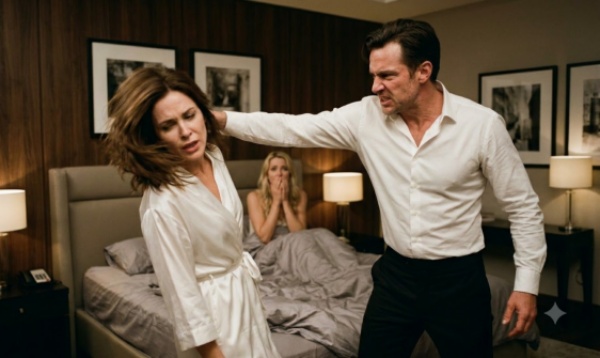
I Caught My Husband With His Secretary in Bed. What I did not expect was for my husband to raise his hand against me, then protect his secretary like I was the threat. By sunrise, I had a bruise, twenty-seven photographs, and enough evidence to prove that the powerful man Las Vegas admired was not the man everyone thought he was.
Part 1: The Door That Should Have Stayed Closed
The night I found my husband in bed with his secretary, he did not apologize.
He did not scramble for an explanation, did not beg me to calm down, did not say my name like a man afraid of losing his wife. Instead, Victor Kane looked at me from the tangled sheets of an apartment I had never seen before and said, “You shouldn’t have come here.”
For twelve years, I had been Mrs. Victor Kane.
In Las Vegas, that name meant something. It was printed on charity programs, hospital donor walls, luxury real estate invitations, and the side of a glass building downtown where Kane Hospitality Group managed hotels, restaurants, and private event venues across Nevada and Arizona.
To most people, Victor was a self-made success story. He was the son of a casino bartender, the man who built a hospitality company from one renovated motel near Fremont Street into a regional brand worth more than $80 million. He gave interviews about discipline, loyalty, and “family values in business.”
I used to sit beside him during those interviews and smile.
My name is Evelyn Marlowe Kane, though by the end of that night, I would start remembering the woman I had been before I became his last name. I was thirty-eight years old, a former commercial real estate analyst, a mother to no children by choice and by grief, and the quiet half of a marriage everyone assumed was polished.
We lived in Henderson, in a house with desert landscaping, glass walls, a wine cellar Victor loved showing off, and a view of the Strip glowing in the distance like a row of electric promises. Our neighbors thought we had the kind of marriage people envied. Expensive dinners, black-tie fundraisers, anniversary posts with professional photos.
What they did not see was how Victor spoke to me when no one important was listening.
He had a way of making cruelty sound like correction. If I questioned a business decision, I was “emotional.” If I asked why he came home smelling like another woman’s perfume, I was “insecure.” If I told him I felt alone, he said loneliness was what happened when women had too much time and not enough purpose.
For the last year, his secretary, Brooke Ellis, had become a shadow in my house without ever crossing the doorway.
Her name appeared on his phone at all hours. Brooke needs this. Brooke found that. Brooke reminded me. Brooke booked the suite. Brooke handled the donor list. Brooke understands how busy I am.
She was twenty-nine, blonde, sharp, and always dressed like she expected to be photographed exiting a private elevator. At company events, she stood too close to Victor and laughed half a second too long. When I looked at her, she smiled with the calm confidence of a woman who believed she had already won something.
I asked Victor about her once.
We were in our kitchen, and he was opening a bottle of Napa Cabernet that cost more than my first car payment. He did not even look at me when I said her name.
“Brooke is efficient,” he replied.
“That’s not what I asked.”
He sighed, as if I had placed a boring document in front of him. “Evelyn, don’t become one of those wives.”
“One of what wives?”
“The kind who makes a secretary feel important by being jealous of her.”
I remember that sentence because it was the first time I realized he was not denying the affair. He was only denying my right to object to it.
The apartment was in a luxury high-rise near Summerlin, twenty minutes from our home and close enough to Victor’s office that he could lie about late meetings without needing imagination. I found it because of a receipt, of all things.
Not lipstick. Not a text. Not some dramatic hotel key hidden in a suit pocket.
A receipt.
It was folded inside the center console of his Mercedes, from a local florist. Two dozen white roses, delivered to Unit 1704 at The Meridian. The card message printed at the bottom said: For the woman who makes the noise disappear. — V
The noise.
That was what I was, apparently. The mortgage papers, the annual dinners, the memories of miscarriages we stopped discussing, the woman who remembered his mother’s birthday and sat through three-hour board dinners pretending he did not interrupt me. Noise.
I did not confront him right away. That is something people never understand until it happens to them. Sometimes the truth is so large that you do not run toward it. You circle it, collect evidence, and wait for your mind to catch up.
Over the next two weeks, I watched.
Victor said he had late investor calls. His car went to The Meridian. Brooke’s Instagram stories showed cropped photos of city lights, champagne flutes, and manicured fingers resting on marble counters. She never showed Victor, but she did not need to.
Then, on a Thursday night in October, Victor told me he was flying to Phoenix for a two-day operations review.
He kissed my cheek in the foyer, not my mouth, because he had stopped pretending affection when no audience was present. He wore a charcoal suit and the steel watch I gave him for our tenth anniversary.
“Don’t wait up,” he said.
“I won’t,” I replied.
He left at 7:12 p.m.
At 8:03 p.m., I drove to The Meridian.
The lobby smelled like leather, citrus candles, and money. A security guard looked up from his desk when I entered, and I told him I was there to see my husband. I said it with enough confidence that he asked no questions after calling upstairs.
Someone buzzed me in.
That detail still haunts me.
One of them let me up.
I rode the elevator to the seventeenth floor with my heart beating so hard I could hear it. The hallway was silent, carpeted in gray and cream, with brass numbers on each door. Unit 1704 stood at the end, city lights spilling from beneath the frame.
The door was not fully closed.
Music played softly inside. A woman laughed. Then I heard Victor’s voice, lower than usual, intimate in a way that made my stomach turn.
I pushed the door open.
The living room was all white furniture, glass tables, expensive rugs, and a balcony overlooking Las Vegas. A pair of high heels lay near the couch. Victor’s jacket was draped over a chair. Brooke’s silk blouse hung from the back of a dining chair like a flag planted in conquered territory.
I walked down the short hallway toward the bedroom.
The door was open.
They were in bed.
I will not describe the details, because some images deserve to die without being repeated. What mattered was not what I saw, but how they looked at me when I saw it.
Brooke gasped and pulled the sheet to her chest. Victor turned his head slowly, annoyed more than ashamed.
For one frozen second, no one spoke.
Then I said, “Phoenix looks different than I expected.”
Brooke started crying immediately. Not with grief. With panic.
Victor got out of bed and put on his pants with the stiff precision of a man preparing for a meeting. “Evelyn,” he said, “you need to leave.”
I laughed once, but it came out broken. “I need to leave?”
“This is not the place.”
I looked around the room, at the roses on the nightstand, the men’s watch charger, the framed desert photograph I had chosen for our guest suite years ago. “Whose apartment is this?”
Victor buttoned his shirt. “It’s a corporate rental.”
“For your secretary?”
“For business.”
Brooke whispered, “Victor, please.”
He turned toward her, and his face softened.
That was the moment that hurt more than the affair itself.
Because I knew that look.
I had not seen it directed at me in years.
I pulled out my phone and took a picture of the room. Not of them exposed, not anything humiliating in a way that would cross a line, but enough: his jacket, her blouse, the roses, the apartment number visible through the open door behind me, his face as he stepped toward me.
Victor’s expression changed.
“Put the phone down,” he said.
“No.”
“Evelyn.”
I took another photo.
He crossed the room in three strides and grabbed my wrist. I pulled back, and the phone stayed in my hand. Brooke began sobbing harder from the bed, repeating, “Please, please, please.”
Victor looked at her, then at me.
And then he slapped me.
The sound was louder than I expected. Sharp, flat, unbelievable.
My head turned with the force of it, and for a moment, the whole room disappeared into white heat. My cheek burned. My ear rang. My husband stood inches from me, breathing hard, his hand still raised like even he could not believe what it had done.
But he did not apologize.
Instead, he said, “Look what you made me do.”
That sentence woke something in me that fear had kept asleep for years.
I lifted my phone again.
This time, I took a picture of my face.
Part 2: Twenty-Seven Photographs
Victor moved quickly after that.
Not with remorse. With management.
He told Brooke to get dressed. He told me to sit down and stop acting “unstable.” He said I had invaded private property, threatened an employee, and created a situation that could damage the company if I did not calm down.
I remember touching my cheek with two fingers and seeing the faint color starting there. My hand shook, but my voice did not.
“You hit me,” I said.
He stepped closer. “I restrained a situation.”
“You hit me.”
Brooke emerged from the bedroom wearing leggings and Victor’s dress shirt. She would not look at me. Her tears had stopped, replaced by something colder. Calculation, maybe. Or fear of losing what she thought she had earned.
Victor put one arm around her shoulders.
He protected her.
Not me.
Not the woman he married in Nevada under a flower arch at the Bellagio, before one hundred and forty guests and a judge who said marriage was a contract of trust. Not the woman whose signature helped secure the first hotel refinancing. Not the woman who sat beside him when his father died, holding his hand in a hospital room while he cried like a little boy.
He protected her.
“We’re leaving,” he told Brooke.
She nodded.
I moved toward the door first. Victor blocked me.
“You are not going to make a scene downstairs,” he said.
“I’m going home.”
“You’re going to listen to me.”
“No.”
His eyes narrowed. “Do not test me tonight, Evelyn.”
That should have frightened me. It did frighten me. But fear had become less powerful than clarity.
I stepped back, lifted my phone, and took another picture. His body blocking the doorway. Brooke behind him in his shirt. My cheek reddening in the reflection of the hallway mirror.
“Every word,” I said quietly. “Every move. I’m documenting everything.”
Victor’s face changed again.
He had always underestimated my silence. But he had never underestimated documentation.
That was one thing he respected.
Numbers, contracts, timestamps, photographs, signatures. Things that could not be charmed at a dinner table.
He lowered his voice. “If you try to use this against me, my lawyers will bury you.”
Brooke looked up sharply.
Victor continued, “I will say you followed me, broke in, attacked Brooke, and forced me to defend her. I will make the city believe you are unstable, jealous, and dangerous.”
There it was.
Not just betrayal.
A plan.
I had known Victor could be cruel. I had not known he could be this prepared.
I took one more picture. Not because the photo showed anything useful, but because I needed my hand to keep moving so my knees would not give out.
Victor carried Brooke’s overnight bag from the closet like a husband carrying luggage for his wife. He placed his hand at her back and guided her past me. She smelled like white roses and my life ending.
At the elevator, Victor looked at me over his shoulder.
“Go home,” he said. “Sleep this off. Tomorrow, we’ll decide how generous I feel.”
The elevator doors closed.
I stood alone in the hallway of The Meridian with my face burning and my marriage lying behind me like a crime scene.
For a full minute, I did not move.
Then I went back inside Unit 1704.
I was careful. I touched nothing without photographing it first. The roses. The receipt on the counter. Two wineglasses. Victor’s cufflink on the nightstand. A printed lease renewal email addressed to his assistant but copied to his private account. A company tablet charging beside the bed.
I photographed the framed business license on the small desk, the Wi-Fi card with Brooke’s name written on it, the closet with two of Victor’s shirts hanging inside. I photographed the apartment number from inside and outside. I photographed my cheek again under the bathroom light, where the red mark had deepened.
Twenty-seven photographs by 12:19 a.m.
I did not post them. I did not send them to friends. I did not call his mother, though I wanted to. I did not write a dramatic caption or threaten him in a text.
Instead, I called 911 from the parking garage.
My voice sounded strangely calm when the dispatcher answered. I gave my name, my location, and said my husband had struck me across the face during a domestic dispute. The word “domestic” felt ugly in my mouth. It also felt accurate.
Two officers arrived fifteen minutes later.
By then, I was sitting in my car with the doors locked. One officer was a woman named Ramirez, with kind eyes and a firm voice. The other, Officer Denton, stood a few feet away taking notes.
Ramirez asked if I needed medical attention.
I said no, then yes, then I did not know.
She told me that was common.
Common.
That word nearly broke me.
She photographed my cheek. She asked if I wanted to make a report. She asked whether there were weapons in the home. She asked if I felt safe going back there.
That last question was harder than it should have been.
The house in Henderson had my clothes, my books, my mother’s china, my passport, my marriage certificate, and the garden I had planted after our second miscarriage because I needed something living to stay. But safety is not the same as ownership.
“No,” I said finally. “I don’t think I do.”
Ramirez nodded like she had heard that sentence many times. “Do you have somewhere else to go tonight?”
I thought of hotels, friends, the lake of neon beyond the garage, the empty desert roads outside the city. Then I thought of my older brother, Nathan, who lived in Boulder City with his husband and their two rescue dogs.
“Yes,” I said. “My brother.”
Officer Ramirez gave me information about protective orders, victim services, and how to request a copy of the report. She did not tell me what to do. She only gave me options, which felt like the first respectful thing anyone had offered me that night.
At 1:34 a.m., I drove to Nathan’s house.
He opened the door before I knocked, wearing sweatpants and the face of someone who had aged five years while waiting. I had texted only three words: I need you.
When he saw my cheek, his expression changed from worry to rage.
“Where is he?” Nathan asked.
“Don’t.”
“I’m serious, Evie.”
“So am I.”
His husband, Marco, appeared behind him and gently pulled the door wider. “Come inside.”
I stepped into their living room, where a golden retriever named Biscuit immediately pressed against my legs like he had been assigned to hold me upright. Nathan reached for my face, then stopped himself.
“Did Victor do this?”
I nodded.
Nathan closed his eyes.
Marco brought me an ice pack wrapped in a dish towel. I sat on their couch under a throw blanket while Nathan paced and Marco made tea none of us drank. For a while, nobody asked for details.
That kindness mattered.
Around 3 a.m., I plugged my phone into Nathan’s laptop and copied the photographs into three folders. One on the computer. One on a flash drive. One in encrypted cloud storage Marco set up while muttering in Spanish under his breath.
At 4:12 a.m., Victor started calling.
I watched his name flash on my screen.
Then the texts came.
Where are you?
You need to answer me.
You have no idea what you’ve done.
Brooke is terrified.
If you go public, I will respond accordingly.
Then, at 5:03 a.m.:
You attacked her. Don’t forget that.
Nathan read the message over my shoulder and said a word I will not repeat.
I took screenshots.
By sunrise, I had one bruise, twenty-seven photographs, six threatening texts, one police report number, and no idea that a marriage license in Nevada would eventually cost Victor the company bearing his name.
At that moment, I only knew one thing.
I was not going home.
Part 3: The Marriage License
My attorney’s name was Margaret Sloan, and she had the calmest voice of any woman I had ever met.
Nathan found her through a colleague who handled high-asset divorces in Clark County. Her office was in a low glass building near downtown Las Vegas, with a view of palm trees and traffic moving toward the courthouse. I arrived wearing sunglasses large enough to cover half my face.
Margaret did not ask me to remove them.
She listened for forty minutes without interrupting. I told her about the apartment, Brooke, the slap, the photographs, the threats, and the police report. I told her about the company, the house, the accounts, and the way Victor liked to say everything was “his” because he had built it.
When I finished, she folded her hands on the desk.
“First,” she said, “you are safe right now?”
“Yes.”
“Second, do not meet him alone. Do not go to the house without an escort or law enforcement standby if needed. Do not respond emotionally to threats. Keep every message.”
I nodded.
“Third,” she continued, “Nevada is a community property state.”
I knew that, vaguely. I had worked around contracts, titles, and property structures before I married Victor. But marriage has a way of making intelligent women forget that the law may remember what husbands prefer to erase.
Margaret leaned back. “When exactly did you marry Victor?”
“June 14, twelve years ago.”
“And Kane Hospitality Group existed then?”
“Yes, but it was small. One motel, one restaurant lease, and a management contract he almost lost.”
“Did you contribute?”
I almost laughed. “To the business?”
“To the marriage. To the growth. To financing. To operations. To relationships. Anything.”
I thought of the early years.
The motel with broken air conditioning and online reviews so bad Victor wanted to shut it down. The investor deck I rewrote at our dining table. The bank meeting where I translated his ambition into numbers lenders could trust. The hospitality conference in San Diego where I introduced him to the developer who later became his biggest partner.
I thought of the $62,000 inheritance from my grandmother that I agreed to use as collateral when Victor needed emergency liquidity. He called it “temporary.” It was never returned, just absorbed into the business like so many pieces of me.
“Yes,” I said. “I contributed.”
Margaret’s eyes sharpened. “Do you have records?”
Victor used to mock my files.
“Evelyn keeps paper like the IRS is coming to dinner,” he would say at parties, and everyone would laugh.
I smiled for the first time in Margaret’s office. “Yes. I have records.”
“Good,” she said. “Men who build companies during marriages often remember the building and forget the marriage. Courts do not always forget so easily.”
By noon, Margaret had a plan.
Protective order consultation. Divorce filing. Financial restraining order to prevent unusual transfers. Preservation letters for records. Request for company documents. A forensic accountant if needed.
It sounded expensive.
It also sounded like breathing.
Victor’s first mistake was thinking fear would send me back. His second was thinking I did not understand money. His third was forgetting Nevada.
He had married me before the company became an empire.
That marriage license, filed in Clark County, meant the growth of Kane Hospitality Group during our marriage mattered. It meant my contributions mattered. It meant the story he told investors about being a lone genius was not the same as the story the court would examine under oath.
Victor did not know that yet.
Or maybe he knew and had spent years hoping I did not.
By the time I filed, Victor had already begun his campaign.
A society blogger posted a blind item about a “prominent hospitality wife” having a jealous breakdown over an employee. Two board spouses suddenly stopped responding to my messages. A friend from a charity committee called and awkwardly asked whether I was “getting help.”
Getting help.
That phrase had Victor’s fingerprints all over it.
Then Brooke filed a complaint with HR claiming I had entered her private residence and made her fear for her safety. She described Victor as a “witness who intervened.” She did not mention the affair, the apartment paid through a company-related arrangement, or the fact that my cheek had been photographed by police.
Margaret read the complaint and raised one eyebrow.
“Convenient,” she said.
“Can she do that?”
“She can say many things. Saying is not proving.”
Victor’s attorney sent a letter accusing me of harassment, trespass, reputational threats, and emotional instability. Margaret’s response was short, professional, and devastating. She attached notice of the police report, preservation demands, and a warning against retaliation or destruction of evidence.
Victor called me within ten minutes of receiving it.
I did not answer.
He left a voicemail.
His voice was low and controlled, the voice he used when negotiating with vendors. “Evelyn, you are escalating this beyond repair. Brooke is young. She is scared. You are turning one emotional night into a war you cannot win.”
I saved the voicemail.
Young.
Scared.
As if I had become a natural disaster that happened to poor Brooke.
For two weeks, I lived in Nathan and Marco’s guest room. Biscuit slept outside my door every night. I wore makeup to cover the bruise when I had to go out, then stopped covering it because hiding felt like helping him.
I returned to the Henderson house once with a police standby and Nathan beside me. Victor was not there. His closet was half empty, but his cologne still sat on the bathroom counter like arrogance in a bottle.
I packed documents first.
Bank statements. Tax returns. Loan agreements. Old emails printed and stored in labeled folders. The original record of my inheritance transfer. Meeting notes from early investor calls. Copies of personal guarantees I had signed when Victor still needed my credit and confidence.
Then I packed clothes, jewelry from my mother, photographs of my family, and a small ceramic bowl I bought in Santa Fe before I met Victor. I left behind the wedding album.
Nathan saw me looking at it.
“You sure?” he asked.
“I don’t need proof it happened.”
He nodded.
Before leaving, I stood in the garden. The desert sun was sharp, and the lavender bushes moved slightly in the dry wind. I had planted them after the second miscarriage, when I stopped knowing how to talk to Victor about grief.
Back then, he said, “Maybe this is for the best. Kids slow everything down.”
I should have understood him then.
Maybe part of me did.
The divorce became public in the quiet way wealthy divorces become public. Not headlines at first, just whispers. Victor moved into a suite at one of his own hotels. Brooke took “personal leave.” Kane Hospitality Group issued no statement.
But investors noticed when Margaret subpoenaed financial records.
They noticed when a forensic accountant named Alan Price began reviewing growth, compensation, distributions, related-party transactions, and executive expenses. They noticed when questions arose about the Summerlin apartment, Brooke’s salary increases, and vendor contracts she approved through Victor’s office.
Victor had always told people I was decorative.
It turned out decorative women can still read spreadsheets.
Part 4: The Company Bearing His Name
The first time I saw Victor after that night was in a conference room on the twenty-fourth floor of his company headquarters.
Not our house. Not court. Not a restaurant where he could perform sadness over a linen napkin.
A conference room.
He sat across from me wearing a navy suit, a white shirt, and no wedding ring. His cheek was clean. Mine had healed, though I could still feel the memory of his hand whenever the room got too quiet.
Beside him sat his attorney, a man named Preston Vale who looked like he charged in six-minute increments. Beside me sat Margaret, Alan the forensic accountant, and my brother Nathan, who was technically only there for support but looked ready to bite through steel.
Victor’s first offer was insulting.
He wanted me to keep the Henderson house, receive a lump sum, sign a confidentiality agreement, waive claims related to the company, and issue a joint statement about “private marital challenges.” He described it as generous.
Margaret slid the paper back across the table.
“No,” she said.
Victor looked at me. “Evelyn, be reasonable.”
I had heard that word for years. Reasonable meant smaller. Quieter. Cheaper. Easier for him.
“I am being reasonable,” I said. “That is why we are in a conference room and not on every television station in Las Vegas.”
Preston cleared his throat. “Threats are not productive.”
Margaret smiled politely. “Neither is pretending community property law doesn’t exist.”
Alan opened a folder.
The room changed.
Numbers have a way of making powerful men sit straighter.
Alan reviewed the growth of Kane Hospitality Group during the marriage, the marital funds used, my documented contributions, the personal guarantees, the inheritance collateral, and the compensation structures that blurred business and personal benefit. He did not exaggerate. He did not need to.
Then came the apartment.
The lease had been arranged through a subsidiary vendor account. Furniture purchases were classified as “executive client hosting.” Monthly expenses were routed in ways Alan described as “unusual enough to require further review.”
Victor’s face hardened. “That apartment was for business development.”
Margaret glanced at the photographs. “Then your business development had very intimate bedding.”
Nathan made a sound that might have been a cough.
Victor looked at me with hatred then. Not heartbreak. Hatred. Because I had done the one thing he could not forgive.
I had made him measurable.
Over the next month, the company board became involved. Kane Hospitality Group had outside investors, lender obligations, and governance rules Victor had treated as obstacles for other people. A founder can put his name on a company, but that does not mean he can set fire to its credibility without consequence.
The board hired independent counsel.
Brooke was interviewed.
So was I.
I told the truth carefully. No extra drama. No speculation. No insults. Just dates, documents, photographs, messages, and what happened when Victor struck me.
The independent counsel asked whether I wanted criminal charges pursued. I said I wanted the truth documented and my safety protected. The legal process would decide the rest.
That answer surprised people.
They expected rage.
I had rage, of course. It lived under my ribs like a second heartbeat. But rage is not strategy, and I had learned that strategy was the language Victor understood.
Brooke resigned before Thanksgiving.
Her resignation email leaked within the company, because people who build careers around secrets often forget that offices have printers, assistants, and group chats. She wrote that she had been placed in an “impossible personal and professional situation.” She did not apologize to me.
I did not expect her to.
Victor tried to frame her resignation as a personal sacrifice caused by my “campaign.” But the board was less interested in romance than liability. They cared about undisclosed relationships, expense approvals, workplace power dynamics, and whether Victor had exposed the company to claims.
That word appeared again and again.
Liability.
Not husband. Not founder. Not visionary.
Liability.
On December 3, Victor was asked to step down as CEO pending the outcome of the internal review. He resisted, threatened, appealed to loyalty, called investors personally, and reminded everyone that the company carried his name.
The board appointed an interim CEO within forty-eight hours.
A woman named Denise Carver, who had run operations better than Victor for years while he took credit from podiums.
I sent her flowers.
Not white roses.
Yellow tulips.
The divorce negotiations shifted after that.
Victor no longer sounded like a king dividing land. He sounded like a man counting exits.
His attorneys proposed mediation. Margaret accepted. We met in a neutral office near the courthouse, where the coffee tasted like regret and the mediator had the patient face of someone who had watched rich people become children over furniture.
Victor and I sat in separate rooms.
The mediator carried offers back and forth.
By lunch, Victor had increased the settlement. By three, he agreed to reimburse my inheritance contribution with appreciation. By five, he conceded that a significant portion of the company’s growth during the marriage was subject to valuation.
At 6:20 p.m., he asked to speak to me directly.
Margaret advised against it.
I said yes, but only with her present.
Victor entered the room looking older. For the first time since I had known him, his expensive suit did not help him. His confidence had shrunk around him.
He stood near the door. “Evelyn.”
I did not stand.
He looked at Margaret, then back at me. “Can we have one private minute?”
“No,” I said.
His mouth tightened, then softened. “I’m sorry.”
Margaret’s pen paused.
I waited.
Victor swallowed. “I should never have hit you.”
“No,” I said. “You shouldn’t have.”
“I was trying to protect—”
“Stop.”
He did.
I felt Margaret glance at me, but I kept my eyes on Victor.
“You were not protecting Brooke,” I said. “You were protecting the version of yourself you sold her. And the version you sold the city. And the version you sold me until I became inconvenient.”
His eyes glistened, but I no longer trusted tears as evidence.
“I lost everything,” he said.
“No,” I replied. “You lost control.”
He looked away.
For years, I had imagined that if Victor ever apologized, it would free me. But apologies do not always open cages. Sometimes they arrive after you have already found the door yourself.
“I did love you,” he said quietly.
“I know,” I answered. “That was part of the damage.”
He looked at me then, confused.
“Because loving someone doesn’t mean you are safe with them,” I said. “It took me too long to learn that.”
Victor lowered his head.
The mediation did not finish that night, but it changed after that. The fight did not disappear, but the fantasy did. Victor’s attorneys stopped pretending I was a hysterical wife with a bruise and started treating me like a partner with documents.
By January, the company review concluded.
Victor had violated internal policies, misused company resources, failed to disclose a relationship with a subordinate employee, and exposed Kane Hospitality Group to reputational and employment risk. The board negotiated his exit. He retained some equity, but lost executive control.
The company bearing his name continued without him.
That was the part people whispered about most.
Not the affair. Not the slap. Not the secretary.
The name stayed on the building, but Victor no longer had the keys.
Part 5: The Woman With the Bruise
The divorce was finalized on a cold February morning, cold by Las Vegas standards, which meant everyone complained if the temperature dropped below 50 degrees.
I wore a cream-colored suit because I refused to wear black to the legal end of a marriage that had already died in a Summerlin apartment. Margaret sat beside me in court. Victor sat across the aisle with Preston, staring straight ahead.
The judge reviewed the settlement.
The Henderson house would be sold. I would receive my share of marital assets, reimbursement tied to my early contributions, and a structured payout related to the company valuation. Confidentiality terms were limited, mutual, and did not prevent me from cooperating with legal or regulatory inquiries.
Most importantly, there was language about no contact except through attorneys for a defined period.
That paragraph felt like oxygen.
When the judge granted the divorce, I expected to feel triumph.
Instead, I felt tired.
Twelve years ended in less than twelve minutes. A marriage that had included hospital rooms, business loans, vacations, funerals, miscarriages, holiday cards, and one terrible apartment became a stamped document in Clark County.
Outside the courthouse, Victor approached me.
Margaret stiffened slightly, but he stopped several feet away.
“I won’t bother you,” he said.
I nodded.
He looked thinner, humbled in a way that might have been real or might have been temporary. I no longer needed to decide which. That was one of the gifts of divorce.
“You were never ornamental,” he said.
The word hit me harder than I expected.
For years, I had carried that insult like a stone in my pocket. Small enough to hide. Heavy enough to change how I walked.
“No,” I said. “I wasn’t.”
He nodded once, then turned away.
I watched him go without longing.
That surprised me too.
In the months that followed, I rebuilt my life in ordinary ways before I attempted extraordinary ones.
I rented a condo near the Arts District with brick walls, noisy neighbors, and a balcony just big enough for two chairs and a pot of basil. Nathan complained the building had terrible parking. Marco said it had character. Biscuit approved because the elevator smelled like everyone’s dinner.
I started consulting again in commercial real estate finance. At first, I took small projects because my confidence had been badly bruised in places no one could photograph. Then a developer I knew from years ago called and said, “Evelyn, I always wondered why Victor was the one in the spotlight when you understood the numbers better.”
I laughed after hanging up.
Not because it was funny.
Because I was finally hearing things I should have believed without permission.
The bruise on my cheek faded in less than two weeks. The emotional bruise took longer. Sometimes a slammed door made me flinch. Sometimes a man lowering his voice in a restaurant made my hands go cold. Sometimes I woke at 3 a.m. furious that I had ever allowed Victor to make me feel small in my own life.
Therapy helped.
So did boxing classes, oddly enough. Not because I wanted to hurt anyone, but because I wanted to remember my body belonged to me. The first time I hit a heavy bag, I cried so hard the instructor pretended to adjust the music.
I donated money to a local domestic violence nonprofit under my maiden name.
Marlowe.
Seeing that name on the receipt made me cry too.
Not all tears are grief. Some are recognition.
Kane Hospitality Group rebranded the following summer. Not completely. The board decided the Kane name still had market value, which irritated me less than I expected. Victor had lost control of the company, but no court order could erase the fact that he had built part of it.
Life is rarely clean enough to satisfy us.
Denise Carver became permanent CEO. Under her leadership, the company stabilized, then quietly improved. She invited me to lunch once, not as Victor’s ex-wife, but as someone whose early financial structuring had helped the company survive its first expansion.
We ate at a restaurant in downtown Las Vegas where the iced tea came in glasses large enough to qualify as buckets.
Denise raised her glass. “To accurate records.”
I smiled. “To women who keep them.”
She laughed.
Brooke disappeared from Las Vegas for a while. I heard she moved to Scottsdale and took a marketing job with a boutique hotel group. Someone told me she was telling people Victor had manipulated her. Maybe that was true. Maybe it was partial truth. Maybe it was the version that let her sleep.
I did not contact her.
I did not need an apology from Brooke to heal from Victor.
That was another thing I learned. Sometimes we chase apologies from the wrong person because confronting the central betrayal feels too large. Brooke had participated in my humiliation, yes. But Victor had made vows to me. Victor had struck me. Victor had threatened to make me look dangerous because I had witnessed his danger.
The responsibility had a name.
His.
One year after the night at The Meridian, I drove past the building.
I did not plan to. I had a client meeting nearby, and traffic sent me down the same street. The tower rose above the sidewalk, all glass and confidence, reflecting the desert sun.
For a moment, my hands tightened on the steering wheel.
I remembered the elevator. The hallway. The white roses. The slap. The sentence: Look what you made me do.
Then I kept driving.
That was all.
No dramatic breakdown. No need to park and stare. No urge to prove anything to a building that had held one chapter of my life.
I kept driving.
That evening, Nathan and Marco hosted dinner. Marco made enchiladas, Nathan overcooked rice, and Biscuit stole half a tortilla from the counter with no remorse. We ate outside under string lights while the desert cooled around us.
Nathan asked if I was okay.
I looked at my brother, at Marco, at the dog pretending innocence under the table, and at the open Nevada sky turning purple beyond the wall.
“Yes,” I said. “Not every minute. But yes.”
Later that night, back in my condo, I opened the folder of photographs for the first time in months.
Twenty-seven images.
The roses. The door. The cufflink. The lease email. My face under bathroom light, cheek red and eyes bright with shock.
I had once thought those photographs were weapons.
Now I understood they were witnesses.
They had witnessed the night I stopped letting Victor define reality. They had witnessed the moment I chose documentation over collapse, safety over shame, truth over the performance of a perfect marriage.
I copied the folder one last time onto a secure drive, then placed it in a small fireproof box with my birth certificate, passport, divorce decree, and the deed to my new condo.
My important papers.
My life, in documents no one else controlled.
A week later, I attended a fundraiser for the nonprofit I had supported. I almost did not go because public rooms still made me nervous. Then I put on a navy dress, my mother’s pearl earrings, and lipstick the color of red desert flowers.
The event was smaller than Victor’s old galas. No chandeliers. No champagne towers. Just round tables, donated centerpieces, and women speaking honestly about survival.
One speaker said, “Leaving is not one moment. It is a series of moments where you choose yourself again.”
I wrote that sentence down on the back of the program.
When the director thanked donors, she said my maiden name.
“Evelyn Marlowe.”
I stood.
People clapped politely, unaware of the long road between Kane and Marlowe. That was fine. Not every victory needs witnesses.
But I had one.
Me.
After the event, a woman in her twenties approached me near the exit. She had careful makeup and eyes that looked too tired for her age. She said she had heard I was a financial consultant and asked, almost shyly, whether I ever helped women understand assets during divorce.
I gave her my card.
Then I wrote my personal number on the back.
“Call me,” I said. “Even if you only have questions.”
She looked at the card like it weighed something.
On the drive home, I thought about the woman I had been before The Meridian. The woman who swallowed insults because they were easier than explosions. The woman who let Victor call her unstable when her instincts were simply awake.
I did not hate her.
She had survived the only way she knew how until she learned another way.
People like Victor expect women to break loudly so they can point and say, See? Dangerous. Unreasonable. Emotional.
But I did not break the way he needed me to.
I documented.
I reported.
I filed.
I remembered the law.
I remembered my name.
The night I caught my husband in bed with his secretary, he did not apologize. He struck me across the face, carried her out of their secret apartment, and promised his lawyers would make Las Vegas believe I was the dangerous one.
By sunrise, I had one bruise and twenty-seven photographs.
By winter, I had a divorce decree.
By summer, he had lost control of the company bearing his name.
And by the time the bruise faded completely from my memory, I finally understood something Victor never wanted me to know.
A marriage license can make a woman legally visible.
A paper trail can make her impossible to erase.
And the moment she stops protecting the man who hurts her, the whole city may discover he was never as powerful as he looked.
