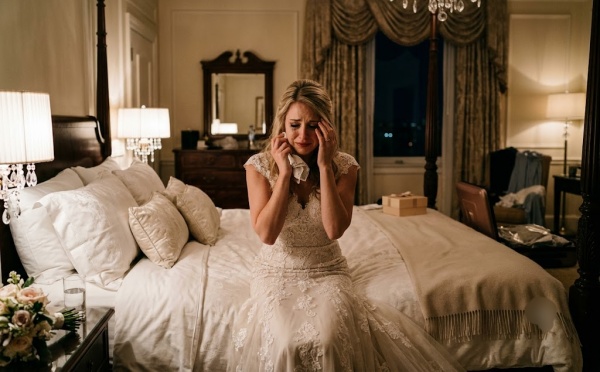
On Our Wedding Night, My Husband Left Me in My Wedding Dress to Comfort His Ex… When his ex called crying, he left his new wife alone in the bridal suite and said he had promised to come whenever she needed him — even after marriage. Amelia did not scream, beg, or chase him; she quietly took off her rings and disappeared into…. A week later…
Part 1: The Empty Bridal Suite
On our wedding night, my husband left me in my white dress to go comfort the woman he had loved before me.
Not because she was in danger.
Not because there had been an accident.
Not because any reasonable person would have looked at the situation and said, Yes, a groom should leave his wife alone three hours after the reception ends.
He left because Vanessa Reed called him crying.
And because Ethan Walker still believed her tears were more urgent than my vows.
My name is Amelia Grant, and I was thirty-one years old when I married Ethan on a bright September Saturday in Charleston, South Carolina, under live oak trees dripping with Spanish moss and string lights. The ceremony was held at a restored historic estate outside the city, the kind of place tourists photograph because it looks like every Southern wedding fantasy ever pinned to a mood board.
White roses.
Gold chairs.
A gospel choir during the recessional.
Shrimp and grits served in tiny cast-iron skillets.
My mother crying into a linen handkerchief.
Ethan’s father giving a toast about legacy, loyalty, and the importance of choosing your partner every day.
I remember that line now because of the cruelty of timing.
Choosing your partner every day.
Ethan did not even make it through the first night.
We had dated for three years before the wedding. Ethan was a commercial real estate attorney in Atlanta, sharp, charming, careful with words, and raised in a family where reputation mattered almost as much as Sunday dinner. I worked as a brand strategist for a hospitality group, traveling between Atlanta, Charleston, and Nashville for hotel launches and restaurant campaigns.
We met at a fundraiser for a children’s hospital in Buckhead.
He spilled bourbon on his own sleeve while reaching for my business card.
I laughed before I could stop myself.
He later said that was the moment he decided he wanted to know me.
At the beginning, Ethan made love feel steady.
He called when he said he would.
He remembered small things.
He drove across town in traffic because I mentioned I was sick and left soup at my apartment door. He came to my father’s retirement dinner and listened to him talk about highway engineering for forty minutes as if it were the most fascinating topic in the world.
He was not flashy.
Not in the obvious way.
He was polished, but warm. Ambitious, but not arrogant. He had that Southern legal charm: direct eye contact, a low voice, and the ability to make older women feel respected and younger women feel chosen.
I knew about Vanessa before our third date.
That was one of the reasons I trusted him.
He told me he had been in a complicated on-and-off relationship with her for almost eight years. They had dated in college at the University of Georgia, broken up, reunited in law school, broken up again, and remained tangled through holidays, family friendships, and mutual social circles.
“She’s part of my past,” he said.
We were sitting outside a restaurant in Inman Park, and the evening was warm enough that the ice in my tea melted too quickly.
“Is she only part of your past?” I asked.
He looked at me.
“Yes.”
I believed him because he did not look away.
That would become one of the hardest lessons of my life.
People can look directly into your eyes and still be lying, especially if they have lied to themselves first.
Vanessa Reed was beautiful in the way women become when everyone has told them so since childhood. Blonde hair, green eyes, soft voice, expensive vulnerability. Her father owned a construction company that had done business with Ethan’s family for years, and her mother chaired every charity committee within fifty miles of Atlanta.
Ethan described her as “fragile.”
I would learn later that fragile women can still be very strategic.
When Ethan and I became serious, Vanessa began appearing at the edges of our life.
A birthday dinner for a mutual friend.
A holiday party.
A charity auction.
A group weekend at Lake Oconee where she wore Ethan’s old sweatshirt one morning and pretended not to notice my silence.
Ethan always explained.
“She forgot a jacket.”
“She’s going through a hard time.”
“She doesn’t have many people she trusts.”
“You know how long we’ve known each other.”
At first, I tried to be gracious.
No woman wants to become the insecure fiancée in other people’s stories. I told myself that adulthood meant accepting history. I told myself that if Ethan had chosen me, then Vanessa’s presence did not threaten me.
But the problem was not Vanessa’s presence.
The problem was Ethan’s response to it.
If she called during dinner, he checked the phone.
If she looked sad at an event, he noticed before anyone else.
If she needed a recommendation, a ride, a legal referral, a dinner companion because “her anxiety was bad,” Ethan somehow became available.
I confronted him six months before the wedding.
We were in my apartment in Midtown Atlanta, sitting on opposite ends of the couch while rain tapped against the windows.
“You still prioritize her,” I said.
He looked exhausted.
“I don’t.”
“You do.”
“She’s been in my life a long time.”
“So have I.”
“That’s different.”
“Exactly,” I said. “It should be.”
He rubbed his forehead.
“Amelia, she doesn’t have what you have. You’re strong. You’re stable. Vanessa spirals.”
I stared at him.
“So my reward for being stable is being left alone?”
He looked wounded, which somehow made me feel guilty.
“That’s not fair.”
“No,” I said quietly. “It isn’t.”
He promised boundaries.
That was the word he used.
Boundaries.
He said he would not take late-night calls unless there was an emergency. He said Vanessa needed to accept that he was getting married. He said he wanted peace with me more than nostalgia with her.
Then he took me ring shopping.
I thought the promise and the ring were connected.
I did not understand that some men use commitment as a curtain. They pull it across the window and hope you stop noticing what happens outside.
The week before the wedding, Vanessa texted me.
Not Ethan.
Me.
I hope you know I only want him to be happy.
I stared at the message in my office for ten minutes.
Then I wrote back:
Then please respect his marriage.
She did not respond.
At the rehearsal dinner in Charleston, she arrived in a pale blue dress and hugged Ethan too long.
She had not been invited by me.
She came as the guest of Ethan’s cousin.
When I saw her across the courtyard, my stomach dropped.
Ethan noticed.
“She won’t cause trouble,” he said.
“That’s comforting. Did you know she was coming?”
“No.”
The answer came too fast.
But it was the night before my wedding, and I was tired of fighting ghosts.
So I smiled through dinner.
I listened to speeches.
I accepted hugs.
I let myself believe that after tomorrow, everything would change because public vows would do what private promises had failed to do.
The wedding day itself was beautiful.
That almost makes it worse.
If there had been rain, a ruined cake, a missing photographer, some obvious sign from the universe, maybe I would remember it as disaster from the beginning. But the day was golden. Warm without being humid. Breezy enough to move my veil. Perfect enough to make what came later feel like an ambush.
My dress was ivory silk with long sleeves and tiny pearl buttons down the back. My mother fastened each one while crying softly. My younger sister, Lila, made jokes until I laughed because she knew I was nervous.
“You look like Grace Kelly if Grace Kelly had better eyebrows,” Lila said.
“You’re ridiculous.”
“You’re welcome.”
Before walking down the aisle, I received a handwritten note from Ethan.
Amelia,
Today I choose you in front of everyone we love. Tomorrow I will choose you again. And the day after that. And every day after that.
E.
I carried that note in my bouquet.
At 5:00 p.m., I walked toward him.
Ethan cried when he saw me.
Real tears.
His hands shook when he took mine.
During the vows, his voice broke on the words, “forsaking all others.”
I thought that meant he understood the weight of them.
Now I wonder if some part of him knew he was already failing.
The reception lasted until nearly midnight.
We danced under lights strung between oak trees.
Ethan fed me cake and got frosting on my lip.
His mother hugged me and said, “We are so happy you’re officially ours.”
My father danced with me to “You Are My Sunshine,” the song he used to sing badly when I was little. Lila gave a toast that made everyone laugh and then cry. Even Ethan seemed lighter than he had in months.
Vanessa stayed mostly at the edge of the reception.
I saw her once near the bar, watching us during our first dance.
Her face was unreadable.
After the sparkler send-off, Ethan and I were driven to the hotel in downtown Charleston where we had booked the bridal suite for one night before flying to Maui for our honeymoon. I was exhausted, happy, and emotionally emptied in the way brides are after smiling for ten straight hours.
In the elevator, Ethan kissed my hand.
“Mrs. Walker,” he said.
I smiled.
“Don’t get too comfortable. I’m still deciding if I like the sound.”
He laughed.
The suite overlooked the harbor. Someone had arranged champagne, strawberries, white roses, and a handwritten note from the hotel staff. My overnight bag was placed near the closet. My veil was pinned crookedly because Ethan had kissed me too hard in the hallway.
For fifteen minutes, I thought we had made it.
Then his phone rang.
He looked at the screen.
The air changed.
I saw it before he spoke.
“Don’t,” I said.
He swallowed.
“It’s Vanessa.”
I stepped back.
“No.”
“Amelia—”
“No. It is our wedding night.”
“She wouldn’t call unless—”
“Unless she knew you would answer.”
The phone stopped ringing.
Then immediately started again.
Ethan stared at it.
I stared at him.
That was the moment.
Not the later conversation.
Not the door closing.
That moment, with his phone glowing in his hand and me standing in my wedding dress, waiting to see who my husband would become.
He answered.
“Vanessa?”
I felt something inside me fold.
His face softened while he listened.
That was the part I cannot forget.
The softness.
The same softness he should have reserved for the woman he had married ninety minutes earlier.
“What happened?” he asked.
He turned away from me.
I stood in the middle of the bridal suite, still wearing my silk dress, the train pooled around my feet like spilled milk.
He listened for almost two minutes.
Then he said, “Okay. Just breathe. I’m coming.”
My entire body went cold.
He ended the call.
“She’s at her hotel,” he said. “She’s having a panic attack.”
“No.”
“She’s alone.”
“No.”
“She said she can’t breathe.”
“Then she should call 911 or the hotel front desk.”
“It’s not like that.”
“It is exactly like that.”
He looked pained.
“I promised her years ago that if she ever needed me, I’d come.”
I stared at him.
“Even after marrying me?”
He did not answer quickly enough.
That was the second answer.
“Ethan,” I said slowly, “if you walk out that door tonight, do not expect me to be standing here when you come back.”
He looked at me as if I had become unreasonable.
“Amelia, I’ll be gone thirty minutes.”
“No. You won’t.”
“She needs me.”
“I am your wife.”
“I know that.”
“No,” I whispered. “You don’t.”
He reached for his jacket.
Something in me began screaming, but no sound came out.
He came toward me, perhaps to kiss my forehead, perhaps to calm me like I was the one behaving badly. I stepped away.
“Don’t,” I said.
His face tightened.
“I can’t abandon someone in crisis.”
“But you can abandon me on our wedding night?”
“That’s not what this is.”
“That is exactly what this is.”
He opened his mouth, closed it, and picked up his keys.
“I’ll fix this when I get back,” he said.
That sentence ended my marriage more cleanly than any court order later would.
Because he still believed I would be there to receive his explanation.
He left at 12:43 a.m.
The door clicked shut.
For a moment, I stood completely still.
Then I walked to the bathroom, locked the door, and looked at myself in the mirror.
My makeup was still perfect.
My earrings still sparkled.
My wedding dress still looked like something from a magazine.
I looked like a bride.
But I was already becoming a woman who would disappear from the life a man assumed she had no courage to leave.
Part 2: The Silence He Mistook for Waiting
I did not leave the suite immediately.
That is the part people never understand.
They imagine betrayal creates instant action, like a woman in a movie tearing off her veil, throwing a ring, and marching barefoot into the night with perfect music behind her.
Real betrayal is quieter.
It makes you sit on the bathroom floor in a $900-a-night hotel suite, still wearing your wedding dress, wondering if your marriage lasted long enough to count as a marriage.
I stayed there for almost an hour.
At 1:22 a.m., Ethan texted.
She’s calming down. I’ll be back soon. I’m sorry.
I read it once.
Then I turned my phone face down.
At 1:58 a.m.:
I know you’re upset. Please don’t spiral. We’ll talk.
Please don’t spiral.
Those words were so revealing I almost laughed.
Vanessa had a “panic attack,” and he ran to her.
I had a husband leave me on our wedding night, and my grief was framed as spiraling.
At 2:31 a.m.:
Heading back in a bit.
At 3:04 a.m.:
She fell asleep. I don’t want to leave her alone like this. Please understand.
There it was.
He was not coming back.
Not soon.
Maybe not until morning.
Maybe after sleeping on a chair beside her bed, noble and exhausted, while I waited in white silk like an unpaid emotional invoice.
I stood up.
My legs were stiff.
I unbuttoned my dress slowly, each pearl button a tiny act of disbelief. It took me nearly ten minutes because my hands shook. When the dress finally slipped down, I caught it before it touched the bathroom floor.
Even then, I protected the dress.
That detail makes me sad now.
I changed into leggings, a sweater, and sneakers from my overnight bag. I packed only what belonged to me: my wallet, phone charger, makeup bag, passport, medications, a change of clothes, my mother’s bracelet, and the folded note Ethan had written before the ceremony.
I placed the wedding dress carefully in its garment bag.
Then I removed my rings.
The engagement ring.
The wedding band placed on my finger hours earlier.
I set them on the desk beside the untouched champagne.
For a moment, I considered leaving a note.
Something devastating.
Something he would read and remember forever.
But then I realized he had left me with enough silence. I did not owe him words to decorate it.
Instead, I called Lila.
She answered on the second ring, voice thick with sleep.
“Amelia?”
“I need you to come get me.”
She was instantly awake.
“Are you safe?”
“Yes.”
“Is Ethan with you?”
“No.”
Silence.
Then, very quietly:
“I’m on my way.”
No questions.
That is love.
Lila arrived twenty-four minutes later wearing pajama pants, a sweatshirt, and the expression of a woman prepared to commit crimes but hoping for context.
When I opened the hotel room door, her eyes moved from my face to the garment bag over my arm to the rings on the desk behind me.
“Oh, Amelia,” she whispered.
That was when I cried.
Not dramatically.
Not loudly.
Just a sound leaving my body like something breaking underwater.
She stepped inside and closed the door.
“What happened?”
“He went to Vanessa.”
Lila’s face changed.
“On your wedding night?”
I nodded.
“She called. He said he promised her he would come if she needed him. Even after marrying me.”
Lila looked toward the desk.
“Where is he now?”
“With her.”
“Still?”
“Yes.”
My sister inhaled slowly through her nose.
“Okay. We are leaving.”
She did not tell me to wait.
She did not suggest we talk to him.
She did not ask whether I was overreacting.
She helped me gather my things, took photos of the rings on the desk, documented the time, and sent a message to my parents that said only:
Amelia is with me. She is safe. Please do not call Ethan if he contacts you. I’ll explain soon.
Lila was a pediatric nurse.
Crisis made her efficient.
We left the hotel through a side exit because I could not bear to pass the lobby where people might still recognize me as the bride from the ballroom.
Outside, Charleston smelled like salt, jasmine, and morning rain.
I looked back once at the hotel windows.
Somewhere in the city, Ethan was choosing to remain beside a woman who had learned his vows did not apply to her.
My honeymoon suitcase was already packed for Maui.
Lila drove me to her Airbnb, where she and my parents had planned to stay one more night before returning to Atlanta. I slept for maybe forty minutes on the couch under a thin blanket while Lila sat in the armchair watching me as if I might vanish.
By morning, Ethan began calling.
At 7:16 a.m.
7:18.
7:23.
7:30.
Then texts.
Where are you?
Amelia, answer me.
This isn’t funny.
I came back and you were gone.
Why are your rings here?
I stared at that one for a long time.
I came back and you were gone.
He had returned at some point after sunrise.
Late enough for the bed to remain untouched.
Late enough for the champagne to be warm.
Late enough for his bride to become a missing consequence.
Lila took my phone gently.
“Do you want to respond?”
“No.”
“Okay.”
My mother arrived twenty minutes later.
She still had her wedding hairstyle half pinned up, and her face was pale with fear. My father followed behind her, jaw clenched so tightly I worried about his blood pressure.
When my mother saw me, she reached for me like I was a child.
I fell into her arms.
My father stood by the door, one hand over his mouth.
He looked devastated.
Not disappointed.
Not angry at me.
Devastated for me.
That mattered.
After I told them what happened, my father walked outside and stood on the porch for nearly fifteen minutes. When he came back, his eyes were red.
“I am going to say this once,” he said. “I will support whatever you decide. If you want an annulment, divorce, counseling, distance, anything, your mother and I are behind you. But you are not going back to that man today.”
I cried again.
Because some women are told to be patient.
To avoid embarrassment.
To think of the guests.
To remember the expense.
To protect the family name.
My family told me to protect myself.
Ethan called my mother next.
She did not answer.
Then my father.
He did not answer.
Then Lila.
She answered.
I could hear Ethan through the phone even though she had not put him on speaker.
“Where is my wife?”
Lila’s eyes went cold.
“Safe.”
“Where?”
“With people who did not leave her alone on her wedding night.”
“Lila, don’t do this. You don’t know what happened.”
“I know enough.”
“She’s overreacting.”
Lila looked at me.
I shook my head once.
My sister said, “If you use that word again, I will make sure every bridesmaid knows exactly where you were at 3:00 a.m.”
Silence.
Then Ethan’s voice dropped.
“She needs to talk to me.”
“No,” Lila said. “You want her to talk to you. That is different.”
She hung up.
By noon, Ethan had driven to the Airbnb.
We saw his car pull up from the window.
A black Range Rover, rented for the wedding weekend.
My mother reached for my hand.
My father opened the door before Ethan could knock.
Ethan looked destroyed.
I do not say that with satisfaction.
His hair was messy, his suit from the night before wrinkled, his eyes bloodshot. He looked like a groom who had woken up inside the consequences of his own choices and found them less negotiable than expected.
“Mr. Grant,” he said.
My father stepped onto the porch and closed the door behind him.
They spoke outside.
I could not hear much.
Only fragments.
“Need to see her.”
“Not today.”
“My wife.”
“Then act like it.”
Ethan’s voice rose once.
My father’s did not.
After five minutes, Ethan left.
He sent one text afterward.
I made a mistake. But disappearing is cruel.
I almost responded.
My fingers hovered over the screen.
Then I thought about the bridal suite.
The ringing phone.
The way he said, She needs me.
The way he expected my pain to remain where he left it.
I did not answer.
Because for the first time in our relationship, Ethan would have to sit with silence without being allowed to define it.
Part 3: The Week I Did Not Come Home
I did not return to Atlanta with my husband.
I returned with my family.
That distinction mattered more than any legal document at the time.
The next day, instead of flying to Maui, I sat in the back seat of my parents’ SUV while my father drove north on I-95 and my mother kept turning around to ask if I needed water. Lila followed behind us in her rental car with my wedding dress laid carefully across the back seat.
My phone remained on airplane mode.
Not because I wanted to be dramatic.
Because every message from Ethan pulled me toward the version of myself that wanted to explain, soften, manage, and forgive before I had even understood what had happened.
I needed quiet.
Not disappearance in a dangerous way.
Not vanishing from the world.
Just distance from the man who thought proximity guaranteed access.
When we reached Atlanta, I did not go to the townhouse Ethan and I had leased near Virginia-Highland. I went to my parents’ home in Decatur, where my childhood bedroom had become a guest room with too many quilts and a bookshelf full of paperbacks I had not touched in years.
My mother made soup.
Lila called out of work.
My father contacted a family law attorney before I asked him to.
“I’m not pushing you,” he said when he handed me the name. “I’m giving you tools.”
Tools.
Not opinions.
Not pressure.
Tools.
The attorney was Nora Whitfield, a calm, practical woman in her fifties whose office overlooked Peachtree Street and whose voice made emotional chaos feel administratively possible. Georgia law, she explained, allowed divorce, and annulment in limited circumstances, but annulment was not guaranteed simply because the marriage had immediately collapsed. There were residency considerations, procedural steps, property questions, and the reality that a legal marriage had occurred.
“Do I have to decide today?” I asked.
“No,” Nora said. “You do not need to decide your entire future while still recovering from your wedding night. Today we focus on safety, documentation, and communication boundaries.”
Safety.
I almost objected.
Ethan had never hit me.
Never threatened me physically.
Never screamed in my face.
But Nora seemed to understand the thought before I said it.
“Safety includes emotional and legal safety,” she said. “You have the right not to be pressured, tracked, harassed, or manipulated into private conversations before you’re ready.”
I cried in her office.
Quietly.
Embarrassed.
She handed me tissues without comment.
Good attorneys do not perform sympathy.
They make room for it.
Nora advised me to write down everything while my memory was fresh. Times, texts, exact words. She told me not to delete messages, not to post on social media, and not to make accusations publicly while legal options were still being evaluated.
“Truth is strongest when handled carefully,” she said.
So I wrote.
I wrote the exact moment Vanessa called.
The exact words Ethan said.
I promised her years ago that if she ever needed me, I’d come.
Even after marrying me?
His hesitation.
The door closing.
The texts.
The time he returned.
The rings on the desk.
Lila’s pickup.
My father’s porch conversation.
Every detail became a brick in the wall between memory and gaslighting.
Because Ethan began rewriting almost immediately.
On day two, he emailed me.
Amelia,
I know I hurt you. I am not denying that. But I need you to understand that Vanessa was in a genuine crisis, and I made a split-second decision to help someone who has struggled emotionally for years. I intended to come back quickly. Things got complicated.
Leaving without speaking to me, removing your rings, and refusing contact has turned a painful mistake into a public disaster. Our families are confused. People are asking questions. We owe it to ourselves and everyone who supported our marriage to talk privately before this becomes something it doesn’t have to be.
I love you. I married you. That matters.
Ethan
I read it twice.
Then I forwarded it to Nora.
She replied:
Do not respond yet. Note the framing: he acknowledges hurt but shifts focus to your reaction and public impact. We will prepare a controlled response if needed.
I had not noticed that at first.
I had only seen I love you.
That is how women get pulled back into burning houses.
They look for the one sentence that sounds like water.
On day three, Vanessa texted me.
Amelia, I am so sorry. I never meant for Ethan to leave you. I was scared and not thinking clearly. Please don’t punish him for being kind.
I stared at the screen.
Please don’t punish him for being kind.
There are sentences so manipulative they almost become art.
I did not answer.
I sent it to Nora.
Then to Lila, who responded:
I hope her phone falls into a swamp. Respectfully.
That made me laugh for the first time since the wedding.
On day four, Ethan came to my office.
I had not returned to work yet, but my assistant called me in a panic.
“Ethan is here. He says he needs to pick up some documents from your desk.”
My blood went cold.
“What documents?”
“He didn’t say.”
“Don’t let him into my office.”
“I won’t.”
I called Nora.
She called Ethan’s attorney.
By the end of the day, Ethan sent an apologetic text claiming he only wanted to retrieve a wedding vendor contract from my files.
Nora’s response was formal and sharp:
Mr. Walker is not authorized to access Ms. Grant’s workplace, personal files, devices, or communications. Future attempts will be documented.
That was the day I stopped thinking of my silence as emotional.
It had become protective.
On day five, Ethan’s mother called mine.
Mrs. Walker was elegant, churchgoing, and socially fluent in the language of concern that contains accusation.
My mother put the call on speaker with my permission.
“We are all heartbroken,” Mrs. Walker said. “But I worry Amelia is making permanent decisions in a temporary state of shock.”
My mother’s face went still.
“She is taking time.”
“Of course. But marriage requires grace.”
“Marriage also requires the groom not to leave the bride on their wedding night.”
Silence.
Then Mrs. Walker said softly, “Vanessa has a history. Ethan felt responsible.”
My mother looked at me.
I looked down.
There it was again.
Vanessa’s pain as responsibility.
Mine as inconvenience.
My mother said, “Then Ethan should not have married my daughter until he understood who his responsibility was.”
She ended the call politely.
Southern women can cut glass with manners.
On day six, Ethan sent flowers.
White peonies.
My wedding flowers.
The card said:
Come home. We can still save this.
I placed the flowers outside.
Not in anger.
I simply could not breathe with them in the room.
That night, I finally turned on my phone fully and saw dozens of messages from friends, bridesmaids, coworkers, and cousins.
Some were worried.
Some curious.
Some clearly fishing.
I did not explain.
Instead, I posted one neutral statement to a private family group, reviewed by Nora:
I am safe and staying with family while Ethan and I address a private marital matter. I appreciate concern and ask for privacy. Please do not speculate or contact either of us for details.
No accusations.
No drama.
No revenge.
Just enough to stop the rumor machine from turning my silence into absence.
On day seven, Ethan came to my parents’ house again.
This time, he arrived with Vanessa.
That was his greatest mistake.
My father saw them through the front window and said one word I had never heard him use in my life.
My mother gasped, “David.”
He said, “I stand by it.”
Ethan knocked.
My father opened the door but did not invite them in.
Vanessa stood behind Ethan wearing a beige sweater, no makeup, and the expression of someone auditioning for forgiveness.
“Amelia needs to hear from both of us,” Ethan said.
I stood behind my father in the hallway, unseen at first.
“No,” my father said.
Ethan tried to look past him.
“Amelia, I know you’re there.”
I stepped into view.
His face changed with relief so intense it almost hurt to see.
“Amelia.”
Vanessa began crying immediately.
Of course.
“I am so sorry,” she said. “I never wanted to ruin your wedding.”
I looked at Ethan.
“You brought her here?”
He swallowed.
“I thought if you saw she wasn’t trying to hurt you—”
“You thought bringing the woman you left me for on our wedding night to my parents’ house would help?”
His face reddened.
“I didn’t leave you for her.”
“You left me because of her.”
“That’s not the same.”
“It was to me.”
Vanessa wiped her eyes.
“I was in crisis.”
I looked at her then.
Really looked.
“I believe you were upset. I also believe you knew exactly who you were calling and exactly what night it was.”
Her tears stopped for half a second.
Enough.
Ethan noticed too.
That was the first crack.
“Vanessa?” he said quietly.
She looked at him.
“I was scared.”
“But you knew it was our wedding night,” he said.
Her mouth trembled.
“I didn’t think he’d actually come.”
That sentence fell onto the porch like a dropped knife.
Ethan turned pale.
I almost felt sorry for him.
Almost.
Because for the first time, he heard what I had understood the moment he answered the phone.
Vanessa had tested him.
And he had failed.
I stepped back.
“You need to leave.”
Ethan looked at me with panic in his eyes.
“Amelia, please.”
“No.”
“We can talk without her.”
“No.”
“I made the wrong choice.”
“Yes,” I said. “You did.”
He reached toward me.
My father moved slightly.
Ethan dropped his hand.
I removed the folded note he had written me before the ceremony from my pocket. I had carried it for a week like evidence from another life.
I handed it to him.
His fingers shook when he took it.
“Read your own words,” I said. “Then ask yourself why I should believe new ones.”
I closed the door before he answered.
That evening, Nora filed the first legal paperwork.
A week after my wedding, I had not come home.
And Ethan finally understood that silence was not forgiveness.
Part 4: When He Realized What He Lost
Ethan changed after the porch.
Not enough to save us.
Enough to make the tragedy clearer.
That is an important distinction.
People love stories where a man realizes too late, suffers beautifully, changes completely, and wins back the woman he hurt. But real life is not obligated to reward delayed remorse. Sometimes a man’s awakening is real, and the marriage still dies because the woman he broke no longer wants to live inside the lesson.
Ethan stopped defending Vanessa.
That happened first.
He sent me one email through Nora, not directly.
I understand now that bringing Vanessa to your parents’ home was another violation. I am sorry. I also understand that she called me knowing it was our wedding night. That does not excuse my choice. I made it. I left. I am responsible.
Nora read it and said, “This is better.”
I hated that it was.
Because some part of me had wanted him to remain awful enough to make every decision easy.
But remorse complicates grief.
It asks you to mourn not only what happened, but what might have happened if maturity had arrived sooner.
Ethan began counseling.
I learned that from his attorney, not from him.
He also ended contact with Vanessa, at least for a while. Her texts to me stopped. Her social media went private. Mutual friends whispered that she had gone to stay with her aunt in Savannah.
I did not care where she went.
That surprised people.
They expected me to be obsessed with Vanessa.
But Vanessa did not owe me wedding vows.
Ethan did.
Yes, she manipulated.
Yes, she knew exactly when to call.
Yes, she weaponized fragility.
But Ethan was the one who opened the door and walked out.
The legal process was slower than my heartbreak.
That felt unfair.
Because emotionally, the marriage had ended in one night.
Legally, it had to be unwound through filings, waiting periods, financial disclosures, property lists, insurance questions, name changes, and the strange bureaucratic reality of separating lives that had barely begun officially but had been intertwined for years.
We had no children.
No shared mortgage.
No major joint assets beyond wedding gifts, bank accounts, and honeymoon reservations. The simplicity should have been a blessing, but it made the emotional scale feel almost absurd. How could paperwork look so small when the wound felt enormous?
Ethan wanted marriage counseling before finalizing anything.
I agreed to one session.
Not because I planned to reconcile.
Because I needed to say certain things in a room with a witness trained to recognize deflection.
The therapist’s office was in Brookhaven, soft gray walls, two chairs angled just enough to prevent confrontation from feeling like litigation. Ethan arrived before me. He stood when I entered.
He looked thinner.
Older.
There were shadows under his eyes.
“Amelia,” he said.
I nodded.
The therapist, Dr. Marion Bell, invited us to begin with why we were there.
Ethan spoke first.
“I betrayed her trust on our wedding night.”
I looked at him.
He continued, voice rough.
“Vanessa called me. I believed she was in crisis. I left Amelia alone in the bridal suite. I stayed with Vanessa for hours. I minimized it afterward. I tried to make Amelia’s response the problem because I couldn’t face what my choice meant.”
I stared at my hands.
There it was.
The confession I had wanted a week earlier.
Clear.
Unqualified.
Late.
Dr. Bell asked, “Amelia, what do you feel hearing that?”
I answered honestly.
“Angry that he knows how to say it now.”
Ethan closed his eyes.
“I deserve that.”
I looked at him then.
“No, Ethan. That’s the problem. You think this is about what you deserve. It isn’t. It’s about what I can survive.”
He nodded slowly.
“I want to understand.”
So I told him.
I told him what it felt like to stand in my wedding dress while he answered her call. What it felt like to hear him say he had promised another woman he would come if she needed him, even after marrying me. What it felt like to realize his vows had a hidden exception clause.
I told him about unbuttoning my dress alone.
About placing the rings on the desk.
About seeing his text telling me not to spiral.
He flinched at that.
Good.
I told him about the humiliation of imagining hotel staff finding the untouched bridal suite. About my parents’ faces. About my sister driving through Charleston in pajamas because he had made our wedding night into an emergency for everyone except his wife.
Ethan cried.
Quietly.
He did not interrupt.
When I finished, Dr. Bell asked him what he wanted to say.
He took a long time.
Finally, he said, “I treated your strength like permission to neglect you.”
That sentence found a place in me I did not want him to reach.
Because it was true.
I had been calm, competent, forgiving, reasonable. Ethan had used those qualities as proof that I would be okay while Vanessa’s visible distress demanded rescue.
I said, “Yes.”
He wiped his face.
“I am so sorry.”
“I believe you.”
He looked up quickly.
“But I’m still leaving.”
His face broke.
That moment hurt more than I expected.
Not because I wanted to change my mind.
Because I remembered loving him.
People think leaving becomes easy when the other person is wrong. It does not. Sometimes you leave someone who is finally saying the right words, and your body still aches from the history that taught you not to trust them.
Ethan asked if there was anything he could do.
“Yes,” I said. “Do not turn this into a campaign. Do not make me responsible for your healing. Do not send your family after me. Do not use Vanessa as an excuse. And do not call my silence cruelty when it was the first boundary I ever kept.”
He nodded.
“I won’t.”
To his credit, he mostly did not.
Mostly.
There were moments.
A late-night email he should not have sent.
A box of childhood photos from his mother with a note about “what family means.”
A message from one of his friends saying men make mistakes and women should consider context.
Nora handled those.
Efficiently.
Legally.
Politely enough to be terrifying.
The divorce finalized eight months after the wedding.
By then, I had moved into a small apartment in Old Fourth Ward, close enough to the BeltLine that I could walk when my thoughts became too loud. I returned to work, slowly at first, then with a focus that surprised me. I stopped using Walker before I had legally changed it back. I cut my hair to my shoulders. I sold my wedding dress through a consignment bridal shop and donated the money to a nonprofit supporting women leaving controlling relationships.
That felt right.
Not because Ethan was violent.
He was not.
But because control has many forms, and emotional abandonment wrapped in social pressure can trap a woman just as effectively as locked doors.
Ethan moved out of the townhouse we had planned to share.
I heard he sold some furniture.
I heard he left the law firm where Vanessa’s father’s company was a major client.
I heard he went to therapy weekly.
I heard he stopped attending certain events.
I heard many things.
I tried not to collect them.
Healing required me to stop using news of Ethan as weather.
One afternoon, nearly a year after the wedding, I ran into him at Ponce City Market.
It was early evening.
I was carrying a paper bag of takeout and a bottle of sparkling water. He was standing near the bookstore, holding a coffee he had not drunk.
We saw each other at the same time.
For a moment, neither of us moved.
Then he approached carefully, stopping several feet away.
“Hi,” he said.
“Hi.”
He looked at me with the kind of sadness that no longer asked to be comforted.
That was new.
“You look well,” he said.
“I am.”
His eyes softened.
“I’m glad.”
I believed him.
We stood in the noise of the market, surrounded by people buying dinner and laughing and living ordinary lives.
“I owe you something,” he said.
“You don’t owe me another apology.”
“I know. This isn’t that.”
I waited.
He took a breath.
“I used to think your leaving destroyed me.”
I said nothing.
“But it didn’t. What destroyed me was realizing you had been asking me to choose you for months, maybe years, and I kept calling it insecurity because that was easier than admitting I liked being needed by someone else.”
My throat tightened.
He continued, “Your silence after the wedding was the first time I couldn’t talk my way out of what I did.”
I looked down at the paper bag in my hand.
The handles were cutting into my fingers.
Finally, I said, “I didn’t leave to teach you a lesson.”
“I know.”
“I left because staying would have taught me one.”
He nodded.
“That your pain had to wait.”
“Yes.”
“I’m sorry.”
“I know.”
This time, the apology did not hook into me.
It passed through the air and landed where it belonged.
In the past.
Ethan stepped back.
“Take care of yourself, Amelia.”
“You too.”
He walked away.
I did not cry until I got home.
Not because I wanted him back.
Because I finally understood that closure is not always a door slamming. Sometimes it is seeing the person who hurt you clearly, hearing the words you once needed, and realizing they no longer decide where you go next.
Part 5: What Disappearing Really Meant
People still misunderstand what happened.
They hear that I disappeared after my wedding night and imagine scandal, revenge, drama, maybe even danger.
That is not what I did.
I did not vanish from the world.
I did not hide in a way that made people fear for my safety.
I did not run off with another man or stage a public humiliation or leak private messages to punish Ethan.
I simply removed myself from the place where my pain was being negotiated by the person who caused it.
That is what disappearing meant.
I stopped answering calls designed to pull me into explanations before I was ready. I stayed with family. I spoke to an attorney. I documented facts. I protected my workplace, my phone, my finances, my privacy, and my ability to decide without Ethan standing in front of me, crying, apologizing, and asking for access to a heart he had just abandoned.
Silence was not punishment.
Silence was triage.
When a relationship has trained you to be reasonable at your own expense, distance can feel cruel to the person who benefited from your availability. Ethan thought my silence was unforgiving because he was used to my words softening the consequences of his choices.
But I had spoken before.
Many times.
Before the wedding, I told him Vanessa had too much access.
I told him his loyalty was divided.
I told him being “strong” did not mean I needed less care.
I told him her emergencies always seemed to occur when our relationship required his full attention.
He promised boundaries.
Then, on our wedding night, he showed me the truth.
A promise without action is not a boundary.
It is decoration.
I am thirty-four now.
Three years have passed.
I live in Charlotte, North Carolina, where I took a senior role with a hospitality branding firm after deciding Atlanta held too many ghosts. My apartment has big windows, too many plants, and a kitchen island I bought myself because I liked it, not because a future husband might approve.
I date sometimes.
Carefully.
I have learned that kindness at the beginning is not enough. I listen for how a man talks about former partners. I watch what happens when I say no. I pay attention to whether he respects quiet or tries to fill it with persuasion.
I am not cynical.
I am calibrated.
There is a difference.
Lila says I became “peacefully difficult.”
I take that as a compliment.
My parents still have the framed wedding photo they had ordered before everything happened. They did not display it, obviously. My mother asked once if I wanted to burn it. I said no.
I keep one photo from that day in a box.
Not of Ethan and me at the altar.
Not our first dance.
Not the kiss.
It is a picture Lila took while my mother buttoned my dress. I am looking over my shoulder, laughing at something my sister said. My face is full of hope.
For a long time, I could not look at it.
Now I can.
I no longer hate that woman for not knowing.
She was not foolish.
She was hopeful.
Hope is not a crime.
Trust is not stupidity.
Being betrayed does not mean you invited betrayal.
That lesson took time.
Ethan never married Vanessa.
That is what I heard through mutual friends about a year later. Their connection collapsed almost immediately after our divorce process began. Without secrecy, without rescue, without me as the stable woman in the background making him feel noble for choosing chaos occasionally, whatever they had lost its shape.
I do not know where Vanessa is now.
I hope she got help if she needed it.
I hope she stopped confusing access with love.
I hope she learned that being chosen in another woman’s absence is not the same as being cherished.
But I do not carry her anymore.
As for Ethan, I heard he eventually moved to Nashville and joined a smaller firm. I heard he volunteers with a mental health nonprofit, which surprised me at first, then made sense. Guilt can become performance or service, depending on what a person does with it.
I hope he chose service.
I genuinely do.
That does not mean I wish him back.
Forgiveness, for me, was not reopening the door.
It was setting down the belief that I had to stand beside it forever, guarding my pain.
Sometimes women write to me after hearing pieces of my story through friends of friends. They ask what they should do when their fiancé still answers his ex’s late-night calls. They ask whether they are being insecure. They ask whether marriage will fix a loyalty problem.
I always say the same thing:
Marriage magnifies what already exists.
It does not magically create priorities.
It does not turn emotional entanglement into respect.
It does not make a man stop enjoying being needed by someone else if he has never learned to choose boundaries over ego.
A wedding is not a cure.
It is a ceremony.
The truth walks down the aisle with you whether you invite it or not.
I also tell them this:
Do not compete with another woman’s crisis for your partner’s basic loyalty.
If he consistently treats her distress as urgent and your hurt as manageable, you are not in a love triangle.
You are in a hierarchy.
And you are not at the top.
That may sound harsh.
It is also freeing.
Because once you see the structure clearly, you can stop begging for better placement inside it and decide whether you want to live there at all.
On the anniversary of my wedding, I used to stay home.
The first year, I cried all day.
The second year, I worked late and pretended I forgot.
The third year, Lila flew to Charlotte, and we went to dinner at a restaurant where nobody knew my old last name. We ordered oysters, steak, chocolate cake, and champagne. She raised her glass and said, “To the best disappearing act in Georgia history.”
I laughed so hard I nearly spilled my drink.
Then I toasted back.
“To being found by yourself.”
That is what happened, really.
Ethan lost me.
But I found me.
Not immediately.
Not cleanly.
But slowly, through legal appointments, therapy sessions, new routines, quiet mornings, returned last names, difficult dates, honest friendships, and the steady discovery that peace does not always announce itself dramatically.
Sometimes peace is waking up alone and realizing alone no longer feels like abandoned.
Sometimes it is making coffee in your own kitchen without wondering whose tears will outrank yours that day.
Sometimes it is wearing white again because a color does not belong to one ruined night.
A few months ago, I visited Charleston for work.
I had avoided the city for years, but a hotel client insisted on a campaign meeting there, and I decided I was tired of letting geography hold emotional title. After the meeting, I walked near the harbor at sunset.
The air smelled like salt and flowers.
A wedding party was taking photos near the water.
The bride was laughing, lifting her dress slightly so it would not drag across the stone. The groom looked at her like the rest of the world had politely disappeared. For a moment, sadness touched me, but lightly. Not like a wound reopening. More like a scar noticing the weather.
I wished them well.
Then I kept walking.
I passed the hotel where Ethan had left me.
I stood across the street and looked up at the windows.
Somewhere behind one of them, years earlier, a bride had taken off her rings and learned that her life did not end because a man failed to honor his vows.
I wanted to tell her something.
Not that everything would be easy.
It would not.
Not that Ethan would suffer.
He would, but that was not the point.
Not that she would never miss him.
She would, in strange moments, for longer than pride wanted to admit.
I wanted to tell her this:
Leaving quietly is still leaving.
Choosing not to argue is not weakness.
Refusing to be available for persuasion is not cruelty.
And disappearing from a life where you are not chosen may be the first time you truly appear for yourself.
On our wedding night, Ethan chose Vanessa.
A week later, when I still had not come home, he finally understood that silence was not forgiveness.
But by then, I had understood something more important.
His regret could not become my responsibility.
His awakening could not become my marriage.
And the woman he left in a white dress was no longer waiting in the room where he expected to find her.
