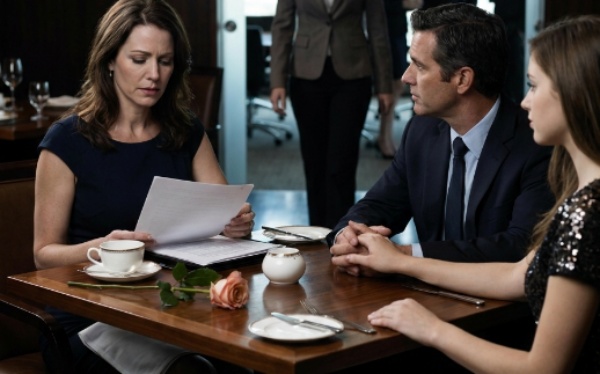
Across the candlelit table, with his mistress beside him, my husband called me replaceable and slid the divorce papers toward my plate.
He smiled while he handed me the divorce papers, certain I had no money, no leverage, and no way to fight back. I walked out with my heart broken, But buried in an old box were the documents he hoped I would never find. By the time the truth came out…
Part 1: The Anniversary Table
My husband handed me divorce papers on our seventh wedding anniversary.
Not in our kitchen. Not in a lawyer’s office. Not even in the quiet privacy of our car, where at least the damage would have belonged to us alone. He did it at a white-tablecloth restaurant in downtown Chicago, with candlelight flickering between us and a string quartet playing somewhere near the wine bar.
Ethan slid the envelope across the table as if he were passing me the dessert menu.
Beside him sat a woman I had never met, but whose hand was wrapped around his like she had every right to be there. She was young, polished, and smiling with the careful confidence of someone who had already been promised the ending. Her red nails rested on Ethan’s wrist, and when I looked at them, I noticed she was wearing the bracelet I had bought him for his birthday.
For a few seconds, I thought I was misunderstanding everything.
I looked at the envelope, then at Ethan, then at the woman beside him. The waiter had just refilled my glass of sparkling water. The anniversary card I had brought for Ethan was still tucked inside my purse, unsigned because I had planned to write something sweet after dinner, something private and foolishly hopeful.
“Ethan,” I said quietly. “What is this?”
He leaned back in his chair, wearing the same expression he used in board meetings when he believed he had already won. Calm. Patient. Slightly bored. Like my heartbreak was an inconvenience interrupting his evening.
“It’s time we stop pretending, Claire.”
The woman beside him lowered her eyes, but not before I caught the corner of her smile.
I opened the envelope with fingers that did not feel attached to my body. Inside were divorce papers, neatly clipped, professionally prepared, with yellow tabs marking every place my signature was expected. My name was typed in black ink: Claire Whitman Foster.
That name had been mine for seven years.
I stared at it until the letters blurred.
“You brought her here?” I asked.
Ethan sighed, as though I had missed the point entirely. “Madison is part of my life now. I didn’t want to keep hiding.”
The way he said it almost made it sound noble.
Around us, silverware clicked softly against porcelain. A woman at the next table laughed at something her date had said, then stopped abruptly when she noticed my face. I became aware, all at once, of how public this was. How many strangers were close enough to hear every word.
“This is our anniversary,” I whispered.
Ethan glanced at Madison, then back at me. “Exactly. Seven years is long enough.”
I felt something inside me go still.
There are moments in life when pain arrives too large to process, so your body protects you by becoming formal. You sit straighter. You fold your napkin. You keep your voice level, because if you let even one sound crack, the entire world might hear you break.
“You could have told me at home,” I said.
“I wanted witnesses,” Ethan replied.
That was when the first true chill moved through me.
He did not look ashamed. He looked strategic.
“Witnesses?” I repeated.
Madison touched his sleeve. “Ethan, maybe we don’t have to—”
“No,” he said, loud enough that several heads turned. “She needs to understand this isn’t a negotiation.”
I knew that tone. I had heard it when he dismissed vendors, corrected junior analysts, and talked over women in conference rooms who were twice as prepared as he was. I had never imagined he would use it on me in the middle of a restaurant where we had once celebrated our first big contract.
“I’m offering you a fair settlement,” he said. “You’ll be comfortable.”
Comfortable.
The word landed like a slap.
I had spent seven years building his comfort. I had worked eighty-hour weeks beside him when his company was nothing more than an idea and a rented office above a dentist’s practice in Evanston. I had taken calls at midnight, fixed budgets at 3 a.m., pitched investors while running a fever, and skipped vacations because payroll came first.
But according to Ethan, I was now being offered comfort.
Madison finally looked at me fully. She was beautiful in the bright, effortless way some women are before life has ever asked them to carry anything heavy. Her dress probably cost more than my first car. Around her neck hung a delicate gold pendant, and I wondered if Ethan had bought it with the bonus check from the quarter I saved with a restructuring plan he later claimed as his own.
“You’ll be okay,” Madison said softly.
I looked at her.
She flinched, not because I glared, but because I didn’t.
“I don’t believe I asked you,” I said.
Ethan’s jaw tightened. He hated when I sounded composed. Anger he could use against me. Tears he could dismiss. But composure made him uncertain, because it reminded him that before I was his wife, before I was his unofficial strategist, before I was the woman he introduced at parties as “the heart of the home,” I was someone else.
Someone with a mind he had once feared and admired.
He leaned forward. “Don’t make this ugly.”
I almost laughed.
He had chosen the restaurant. He had chosen the date. He had chosen to sit beside another woman and hand me divorce papers in public. Yet somehow, ugliness would begin only if I reacted.
I placed the papers back into the envelope.
“I’ll have my attorney review these.”
Ethan’s mouth curved slightly. “You don’t have an attorney.”
“Then I’ll get one.”
“That costs money.”
I held his gaze. “I know what attorneys cost.”
Madison shifted in her seat.
Ethan’s smile widened. “Claire, let’s not pretend. You haven’t worked in a formal executive position in years. Everything is in my name. The house, the investment accounts, the company shares. You walked away from your career to support mine.”
I remembered the exact day I had “walked away.”
It was not a choice so much as a trade made in good faith. Ethan had begged me to leave my consulting role because his startup needed someone he trusted, someone who understood operations, partnerships, and investor language. He promised we were building something together. He said titles didn’t matter between husband and wife.
I believed him because I loved him.
That is the most expensive mistake some women ever make.
“You’re replaceable, Claire,” he said.
He said it clearly. Loudly. With at least forty strangers close enough to hear.
The room went quiet in the way rooms do when people pretend not to listen. Someone’s fork paused halfway to their mouth. The waiter froze near the bar. A man in a navy suit glanced at me, then quickly looked away because witnessing humiliation makes cowards of many decent people.
Replaceable.
I repeated the word silently until it lost meaning.
For years, I had replaced everyone Ethan could not afford. I was his chief operating officer before he hired one. His brand strategist before he hired an agency. His recruiter, negotiator, speechwriter, damage control team, and sometimes his conscience. I replaced sleep, weekends, health, and ambition so his name could rise.
And now he had decided I was replaceable.
I looked down at the anniversary table. Two untouched entrées. A small vase of white roses. The envelope between us. Ethan’s mistress wearing a satisfied silence.
Then something unexpected happened.
I stopped feeling embarrassed.
Not because it didn’t hurt. It hurt in a deep, humiliating way that would come back later when I was alone. But in that restaurant, beneath the chandelier and the pitying eyes of strangers, a colder truth rose inside me.
Ethan had made a mistake.
Not by leaving me. People fall out of love. People fail each other. People choose badly.
His mistake was believing the quiet woman across from him was powerless.
I took my purse from the back of the chair and stood.
Ethan blinked. “Where are you going?”
“Home.”
“We haven’t discussed the terms.”
“There’s nothing to discuss without counsel.”
His nostrils flared. “Claire.”
I paused beside the table.
Madison looked almost nervous now. Perhaps she had expected screaming, begging, some dramatic collapse that would confirm every story Ethan had told her about me. Instead, I smiled faintly.
“Happy anniversary,” I said.
Then I walked out before dessert arrived.
Outside, Chicago’s November air struck my face like cold water. The city glittered around me, all glass towers and headlights, the river black beneath the bridges. I stood under the restaurant awning and realized I had no ride because Ethan had insisted we take his car.
For one absurd second, that nearly broke me.
Not the mistress. Not the papers. Not the word replaceable. It was the simple fact that after seven years of marriage, I was standing alone on a sidewalk in heels, needing to order my own way home from the anniversary dinner where my husband had ended our life.
I opened my phone with shaking hands.
There were three missed calls from my older brother, Daniel, and one text from an unknown number.
The text read:
Mrs. Foster, this is Helen Park from Whitestone Capital. I apologize for contacting you directly, but your name came up in a matter involving old ownership documents. Please call me at your earliest convenience. It may be important.
I stared at the message.
Whitestone Capital.
I knew the name. Everyone in private equity knew the name. They were not the kind of firm that contacted ordinary people by accident.
A car honked. Somewhere behind me, a couple walked out of the restaurant laughing, then lowered their voices when they saw me. I pressed Daniel’s name first because family felt safer than mysteries.
He answered immediately.
“Claire? Are you okay?”
I opened my mouth, but no sound came out.
“Claire,” he said again, voice changing. “Where are you?”
I looked back through the restaurant window.
Ethan was still at the table. Madison was leaning toward him, speaking urgently. He was not looking at the door. He believed the hardest part was over.
He had no idea it had just begun.
“I’m downtown,” I said finally. “Can you come get me?”
Daniel did not ask questions.
“I’m on my way.”
I ended the call and stood beneath the cold Chicago sky with divorce papers in my purse and a message from Whitestone Capital glowing on my phone.
For the first time that night, I breathed.
Not easily. Not peacefully.
But like someone who had survived the first wave and was beginning to see the shape of the storm.
Part 2: The Woman He Forgot
Daniel arrived in twenty-two minutes, which meant he must have broken several traffic laws from Lincoln Park.
He pulled up in his old black Ford Explorer, jumped out before I could open the passenger door, and wrapped me in a hug so familiar and solid that I nearly fell apart right there on the curb. I had not cried in the restaurant. I had not cried under the awning. But the second my brother said, “I’ve got you,” my throat closed.
Still, I forced the tears back.
Not yet.
Daniel took one look at the envelope in my hand and understood more than I wanted him to. He had never liked Ethan, not openly, because Daniel believed adults had the right to choose their own mistakes. But he had once told me that Ethan had the smile of a man who counted favors like assets.
“Did he hurt you?” Daniel asked.
“Not physically.”
His eyes hardened. “That’s not what I asked.”
I looked away.
“He brought her.”
Daniel went very still.
“To the restaurant?”
I nodded.
“He handed me divorce papers beside her.”
For a moment, my brother said nothing. Then he opened the passenger door with careful restraint, the way men do when rage has to pass through manners. “Get in.”
The ride to my house was quiet except for the heater and the low hum of the interstate. Chicago moved past the windows in streaks of gold and red. I watched office buildings disappear behind us and wondered how many women were sitting in beautiful homes at that exact moment, realizing the lives they had built were legally owned by men who called it love until it became inconvenient.
Daniel finally spoke when we were near Oak Brook.
“You’re not signing anything.”
“I know.”
“You need a lawyer before sunrise.”
“I know.”
“And you need to pull every document you can find before he starts hiding things.”
I turned to him.
He kept his eyes on the road. “Don’t look at me like that. I’m a contractor, not an idiot. Men like Ethan don’t just leave. They prepare exits.”
The house came into view a few minutes later.
It was a six-bedroom stone colonial in a gated neighborhood where lawns looked painted and every mailbox seemed designed by an architect. Ethan loved that house because it photographed well. He loved the marble kitchen, the wine cellar, the heated driveway, the two-story foyer that made guests look up as soon as they entered.
I used to love the back porch.
That was where I drank coffee at sunrise and answered emails before Ethan woke up. It was where I planned product rollouts, revised investor decks, and once spent an entire night negotiating a licensing dispute while Ethan slept upstairs after telling me he was too stressed to think.
Daniel parked in the driveway but did not turn off the engine.
“Do you want me to come in?”
“Yes.”
My voice surprised me with its certainty.
Inside, the house smelled like cedar candles and emptiness. Ethan had clearly planned to come back later, maybe after spending the night elsewhere, maybe after giving me time to “calm down.” His coat was gone from the hall closet. So was the small leather overnight bag he used for business trips.
The signs had probably been there for months.
I had been too busy being useful to notice.
Daniel followed me to Ethan’s home office. The door was locked.
I stared at it.
“Do you have a key?” he asked.
“No.”
He looked almost pleased. “Good thing I install doors for a living.”
“Daniel.”
“What? You live here.”
Ten minutes later, the lock gave way with a soft metallic click and my brother stepped aside like a magician finishing a trick. Ethan’s office smelled like expensive coffee and arrogance. Framed magazine covers hung on the walls, each featuring his face beside words like visionary, disruptor, founder, and future of logistics.
Not one mentioned me.
I moved to the filing cabinets first.
Ethan was organized, but he trusted appearances more than systems. That meant the documents meant to impress were easy to find, while the ones meant to disappear were probably hidden badly. I pulled folders labeled tax, property, insurance, personal, equity, partnership, legal.
Daniel found a banker’s box in the closet.
“Claire,” he said.
Inside were old documents from the earliest days of FosterRoute, Ethan’s logistics software company. Before the downtown office. Before the magazine covers. Before the private jets and conference panels and dinners where people asked him how it felt to build an empire from nothing.
I sat on the floor and began reading.
There were incorporation papers from Illinois. Early investor agreements. Convertible notes. Advisory contracts. A handwritten operating plan in my own handwriting. And then, near the bottom, a folder labeled Legacy Structure.
I did not recognize it.
Inside was a stock certificate.
My name was on it.
Not Claire Foster.
Claire Whitman.
The certificate stated that I had been issued a founding equity interest in the original entity that later became part of FosterRoute’s holding structure. The percentage made my pulse slow down, then speed up so sharply that I had to grip the edge of the box.
Daniel crouched beside me.
“What is it?”
“I don’t know.”
But I did know enough.
Years earlier, Ethan and I had created the first version of the company together. We had used my savings, my market research, and the routing algorithm framework I had developed while consulting for a freight client in Indiana. I remembered signing documents in a rush before our first seed meeting. Ethan had said they were standard.
Later, he told me the structure had changed and my interest had been converted into marital support, whatever that meant. I was overwhelmed at the time. My mother had been sick. The company was growing. I trusted him.
Trust is not a legal strategy.
I took photos of everything.
Then I remembered the text from Whitestone Capital.
I called the number while sitting on the office floor, surrounded by the paper bones of a company Ethan claimed he had built alone.
A woman answered on the second ring.
“This is Helen Park.”
“My name is Claire Foster. You texted me.”
There was a pause, professional but alert. “Mrs. Foster. Thank you for calling. Is this a good time?”
I looked at Daniel. “Yes.”
“I understand this may be unexpected,” Helen said, “but Whitestone Capital is conducting due diligence related to a potential acquisition involving FosterRoute Technologies and several subsidiary entities.”
My hand tightened around the phone.
“An acquisition?”
“Yes. I’m limited in what I can disclose until counsel is involved, but during our review, we found an unresolved equity instrument attached to an early entity. Your name appears as the beneficial holder.”
Daniel’s eyebrows rose.
I closed my eyes.
“How significant is it?”
Helen was quiet for a moment.
“Potentially very significant.”
I heard my own breathing.
“What does that mean?”
“It means,” she said carefully, “that if the documents are valid and the conversion history is incomplete, you may have rights that were never properly extinguished. Given the size of the transaction under review, you should speak to an attorney immediately.”
“How large is the transaction?”
Another pause.
“Current valuation discussions are north of nine billion dollars.”
The room tilted.
Nine billion.
Ethan had been negotiating a multibillion-dollar acquisition while handing me divorce papers designed to make me disappear quietly.
Of course he had wanted witnesses.
Of course he had wanted me humiliated.
A humiliated woman signs faster. A frightened woman asks fewer questions. A woman convinced she is replaceable does not look in old boxes.
“Mrs. Foster?” Helen said.
“I’m here.”
“I need to be clear. Whitestone is not your attorney, and we do not represent your interests. But our team cannot proceed cleanly while there is uncertainty around ownership. Someone should have contacted you before.”
Someone.
I almost smiled.
“I understand.”
“Do you have legal representation?”
“I will by morning.”
“Good,” Helen said. “And Mrs. Foster?”
“Yes?”
“Do not sign anything tonight.”
After we hung up, Daniel let out a low whistle.
Then he said something I will never forget.
“He didn’t leave you because you were replaceable. He left because he was afraid you’d remember.”
I slept two hours that night.
At 6:15 a.m., Daniel drove me to the office of Nora Ellison, one of Chicago’s most feared divorce attorneys and, by reputation, a woman who could read a financial disclosure the way a priest reads confession. Daniel had found her through a client who once said, “If the truth exists on paper, Nora will drag it into daylight.”
Nora was in her late fifties, silver-haired, sharp-eyed, and dressed in a charcoal suit that looked expensive without trying to impress anyone. She listened without interrupting as I described the anniversary dinner, the mistress, the documents, the text from Whitestone, and the old stock certificate.
When I finished, she removed her glasses.
“Your husband is either very arrogant,” she said, “or very badly advised.”
“Both,” Daniel muttered.
Nora ignored him but did not disagree.
She looked at me. “Claire, I’m going to ask you something plainly. During your marriage, did you materially contribute to the growth of FosterRoute?”
“Yes.”
“Were you paid?”
“Not consistently. Sometimes consulting fees, sometimes nothing. Ethan said it was all ours anyway.”
Nora’s expression did not change, but the air in the room did.
“Of course he did.”
She made three calls in the next ten minutes.
By noon, I had a forensic accountant, a corporate attorney, and a litigation hold notice drafted. By 3 p.m., Ethan had received formal communication instructing him not to destroy, alter, transfer, conceal, or misrepresent any documents related to marital assets, ownership rights, corporate equity, or acquisition negotiations.
At 3:17 p.m., he called me.
I let it ring.
He called again.
Then he texted.
You’re making a mistake.
A minute later:
This doesn’t have to get hostile.
Then:
Call me before you embarrass yourself.
I showed Nora.
She smiled slightly. “Good. He’s nervous.”
By evening, the house felt different.
Not safer, exactly. But claimed.
I moved into the guest room because I could not sleep in the bed where Ethan had lied beside me for months. Daniel changed the security codes. Nora advised me not to block Ethan, only to stop engaging directly. Every message became evidence.
At 10:04 p.m., Madison sent me a message on Instagram.
I stared at her profile picture for a long time before opening it.
Claire, I know this is hard, but Ethan loves me. Please don’t punish him for choosing happiness.
I laughed then.
Not loudly. Not kindly.
Just once, in disbelief.
Choosing happiness.
That was what people called destruction when they were not the ones being destroyed.
I did not reply.
Instead, I opened my laptop and began building a timeline.
Date by date. Contract by contract. Pitch deck by pitch deck. I listed every investor meeting I attended, every client relationship I opened, every strategy document I created, every unpaid role Ethan had folded into the word wife.
At first, I did it for the lawyers.
Then something changed.
Around midnight, as I found an old email from Ethan saying, “Claire, your model is the only reason they’re interested. I owe you everything,” I stopped feeling like a discarded woman trying to prove she mattered.
I started feeling like a founder.
A tired one. A betrayed one.
But a founder all the same.
And by dawn, I had remembered more than Ethan ever wanted me to.
Part 3: The Company Behind the Man
The first time Ethan saw me after the restaurant was in a conference room on the forty-second floor of a glass tower overlooking the Chicago River.
He arrived with two attorneys, a private wealth advisor, and the expression of a man determined to appear generous while hiding a knife behind his back. His suit was navy, perfectly tailored, and his wedding ring was gone. I wondered if Madison had helped him choose that detail.
I sat across from him with Nora on my right and Graham Patel, my corporate attorney, on my left.
Ethan looked at Graham first.
Then at the folders stacked in front of me.
Then at me.
For just one second, I saw panic.
He covered it quickly.
“Claire,” he said, warm enough for the room. “This has gotten out of hand.”
Nora clicked her pen. “Mr. Foster, please direct your comments through counsel.”
His jaw tightened.
One of his attorneys, a polished man named Victor Lang, cleared his throat. “Our position is that the proposed divorce settlement is more than equitable. Mrs. Foster would receive the Oak Brook residence, a cash payment of eight million dollars, and continued health coverage for a period of—”
“Eight million?” Graham interrupted.
Victor smiled. “A substantial amount by any reasonable standard.”
Graham opened a folder. “Not if Mrs. Foster holds unresolved founder equity in an entity involved in a transaction valued above nine billion.”
The room cooled.
Ethan leaned back. “That equity was voided years ago.”
“Show us where,” Graham said.
Victor slid a document forward. “Restructuring memo, 2019.”
Graham glanced at it, then passed it to Nora.
Nora read for less than thirty seconds. “This is unsigned by my client.”
Victor’s smile faded slightly. “There were subsequent actions consistent with—”
“Unsigned,” Nora repeated.
Ethan finally looked at me. “You knew we restructured.”
“I knew what you told me.”
“You were busy with your mother. You said you trusted me.”
The words hung there, ugly in their precision.
My mother had died that year after a long illness. Ethan had used my grief like a blindfold and called it business necessity.
For a moment, I was back in the hospital room in Naperville, holding my mother’s hand while answering Ethan’s texts about investor language. He had sent flowers to the funeral and left halfway through the reception for a call with Seattle. I had defended him to relatives because the company was under pressure.
The company.
Always the company.
Nora placed the memo down. “Mr. Foster, are you suggesting my client waived a multimillion-dollar interest while caring for her dying mother, without counsel, without compensation, and without a signed instrument?”
Ethan’s face flushed.
Victor stepped in. “We are not suggesting anything improper.”
“Good,” Graham said. “Then provide the complete capitalization history, board consents, operating agreements, tax filings, option pool records, investor communications, and all documents related to the pending acquisition.”
Victor’s eyes narrowed. “That’s an extremely broad request.”
“It’s a very expensive company,” Graham replied.
I said nothing.
That bothered Ethan more than anything.
He had prepared for tears, accusations, maybe emotional bargaining. He had not prepared for silence. Silence gave my lawyers room to speak in numbers, statutes, dates, and signatures. Silence made Ethan confront the woman he had erased from the company story and realize she had come back with receipts.
Halfway through the meeting, Victor requested a break.
Ethan stood immediately and walked toward the windows. He pulled out his phone, then seemed to remember everything might be discoverable and shoved it back into his pocket. Madison was probably waiting somewhere for updates, imagining this was just an unpleasant delay before her new life began.
Nora leaned toward me.
“You’re doing well.”
“I feel like I’m going to throw up.”
“That’s fine. Just don’t do it on the documents.”
I almost smiled.
When the meeting resumed, Ethan changed strategy.
“Claire,” he said, ignoring Nora’s warning, “I don’t want to fight you. You helped me. I know that.”
Helped.
I finally spoke.
“No, Ethan. I built with you.”
His expression flickered.
“You supported me,” he said.
“I designed the original client acquisition model. I wrote the first enterprise pitch. I negotiated the Midwest freight pilot. I built the implementation workflow that cut onboarding time by forty percent. I found the Louisville partner when your first rollout failed.”
The room went very still.
I continued, voice steady.
“I trained the first operations team from our dining room table. I rewrote the Series A deck the night before your meeting in Boston. I convinced Halberd Ventures to stay in when they wanted to walk. I handled the lawsuit threat from Klein Shipping while you were at a golf retreat calling it relationship building.”
Ethan stared at me.
“You told the world you built FosterRoute from nothing,” I said. “But nothing had my laptop, my savings, my contacts, and my unpaid labor.”
No one spoke for several seconds.
Then Graham slid another document across the table.
“This is an email from Mr. Foster to Mrs. Foster dated March 18, 2017. Quote: ‘Your framework is the backbone of this company. We need to make sure your ownership is protected no matter what.’”
Victor closed his eyes briefly.
It was the first beautiful thing I had seen in days.
The legal fight lasted nine months.
Not constant courtroom drama, the way television makes it look. Real legal battles are slower and colder. They happen through subpoenas, depositions, financial disclosures, expert reports, late-night document reviews, and emails where every comma feels loaded.
Ethan tried everything.
First, he tried charm. He sent flowers to the house with a note saying he hoped we could remember the good years. Nora photographed the note and filed it.
Then he tried intimidation. He claimed I was damaging the acquisition and risking thousands of jobs. Graham responded by asking why a valid ownership claim would damage a properly managed transaction.
Then he tried pity. He said Madison was pregnant and stress was bad for her. I read that message three times, felt the old wound open, and still did not answer.
Then he tried revision.
In deposition, Ethan described me as “emotionally supportive” but “not operationally central.” My attorneys played a recording from an old investor prep call where Ethan said, “Claire runs the entire backend. If she walks, we’re dead.”
The transcript of that moment became my favorite document.
Not because it hurt him.
Because it told the truth.
Madison lasted longer than I expected.
At first, she posted soft-focus photos from hotel balconies and captions about choosing peace. Then the photos slowed. Then her account went private. Rumor reached me through mutual acquaintances that she had not known about the acquisition or the extent of my involvement. Ethan had told her I was a stay-at-home wife who resented his success.
I almost felt sorry for her.
Almost.
But compassion does not require volunteering to be someone’s doormat.
By month six, Whitestone Capital paused acquisition talks pending resolution of the ownership dispute. That was when Ethan’s board turned on him.
The board had tolerated arrogance when it produced growth. They had tolerated a messy personal life when it remained private. They did not tolerate a founder whose failure to clean up early equity documents threatened a multibillion-dollar exit.
One director, a former UPS executive named Marjorie Hill, requested a private meeting with me.
We met at a quiet coffee shop in River North on a rainy Tuesday morning. Marjorie was in her sixties, direct, and elegant without softness. She ordered black coffee and looked me over like an investor evaluating risk.
“I owe you an apology,” she said.
I did not expect that.
“For what?”
“For not asking more questions.”
I wrapped both hands around my mug. “About me?”
“About the company’s origin story. Ethan always spoke about you like background music. Present, pleasant, not essential. I should have known better.”
“Why?”
“Because men who build alone usually talk about teams. Men who steal help talk about genius.”
I sat with that.
Marjorie opened a folder and removed several printed emails.
“These were in board archives. I thought your counsel should have them.”
I looked down.
They were messages from the early years, forwarded between investors and board observers. My name appeared again and again. Claire’s model. Claire’s rollout plan. Claire’s retention forecast. Claire’s contract language.
Proof does not heal betrayal.
But it gives betrayal a spine.
“Why are you helping me?” I asked.
Marjorie looked out at the rain streaking the window.
“Because I’ve been you, in smaller rooms.”
That answer stayed with me.
Two weeks later, Ethan was removed as CEO pending the acquisition process. Officially, it was called a transition to protect shareholder value. Unofficially, he had become too expensive to keep in the chair.
He blamed me, of course.
He sent one long email at 1:38 a.m., full of grief, accusation, nostalgia, and self-pity. He wrote that I was destroying the dream we had built together. He wrote that he never meant to hurt me. He wrote that Madison understood him in a way I never had.
Then, near the end, he wrote:
You were never supposed to find those papers.
I read that line several times.
Then I forwarded it to Nora.
Her reply came back four minutes later.
Christmas came early.
The settlement negotiations changed after that.
Not quickly. Men like Ethan do not surrender in clean lines. They retreat while insisting they are advancing. But the numbers changed. The tone changed. The people CC’d on emails changed.
By month ten, the divorce was finalized under confidential terms, though enough became public through corporate filings for journalists to start asking questions.
I received recognition of my founder equity, a substantial cash settlement, and a seat in the acquisition negotiations through a holding company created to manage my interest. The final amount was not something I could process at first. It had too many zeros. It looked fictional on paper.
When Whitestone and a consortium of institutional investors completed the acquisition, the total transaction value exceeded eleven billion dollars.
My portion, after taxes, fees, structured holdings, and reinvestment vehicles, made me one of the wealthiest self-made women in the country.
The headlines called me an overnight billionaire.
That was the funniest lie of all.
There had been nothing overnight about it.
It took seven years of labor, one year of humiliation, nine months of legal war, and a lifetime of learning not to confuse love with surrender.
I did not buy a yacht. I did not move to Miami. I did not hire a publicist to pose me beside a staircase.
Instead, I created Whitman Atlas Ventures, a fund focused on logistics technology, women-led infrastructure companies, and founders whose contributions were likely to be underestimated by people who liked clean myths more than complex truths.
Marjorie Hill became chair of my advisory board.
Daniel became impossible to impress.
“You’re a billionaire,” he said one Sunday while fixing a loose hinge on my pantry door.
“And you’re still making me hold the flashlight?”
“You’re holding it wrong.”
Some things, thankfully, money does not change.
Sixteen months after the restaurant, I received an invitation to speak at the American Enterprise Leadership Summit in New York City. It was one of those events where chief executives, governors, cabinet officials, and billionaires gathered in a ballroom to discuss the future of markets as if the future were something they personally had under contract.
The keynote slot had originally belonged to Ethan.
After his removal, the committee offered it to me.
I said yes.
Not because I wanted revenge.
At least, not only because of that.
I said yes because there are rooms where a woman’s presence becomes a correction.
And I was ready to correct the record.
Part 4: The Room That Stood Up
The summit was held at a hotel near Central Park, the kind with marble floors, discreet security, and floral arrangements large enough to have their own zip codes.
New York in early spring felt like a city pretending it had never suffered winter. Yellow taxis flashed past the entrance. Men in dark suits spoke into phones. Women with conference badges moved through the lobby with the focused expressions of people who had fought hard to be taken seriously and were not about to waste the badge.
My team arrived twenty minutes before the keynote.
I wore a cream suit, simple diamond studs that had belonged to my mother, and heels comfortable enough to walk through a battlefield. Nora had once told me never to wear shoes you could not stand in while someone lied to you. I had adopted the rule broadly.
Backstage, Marjorie reviewed the speaker lineup.
“He’s here,” she said.
I did not ask who.
I already knew.
Ethan’s name had appeared on the attendee list as a guest of a mid-tier venture fund trying to rehabilitate his image. After the acquisition, he had not become poor. Men like Ethan rarely fall all the way. But he had lost control, status, and the story he loved most: that he was the singular genius behind FosterRoute.
Now he was a cautionary panelist at side events.
I was the keynote.
“Madison?” I asked.
Marjorie’s eyebrow rose. “Didn’t see her.”
Their relationship had ended months earlier, according to gossip I never requested but somehow kept receiving. Apparently, Madison discovered that being chosen by a man who betrays easily means eventually becoming the woman he betrays next. I took no pleasure in that.
Well, maybe a small human amount.
But not enough to build a life around.
A coordinator with a headset approached. “Ms. Whitman? We’re ready for you.”
Ms. Whitman.
After the divorce, I had taken back my name.
Not because Foster was cursed, but because Whitman had carried me before Ethan did. My father’s hardware store in Peoria had been named Whitman & Sons, though I was the child who did the bookkeeping after school. My mother used to say, “Claire, never let anyone make you feel lucky to be invited into a room you helped build.”
At the time, I thought it was just one of her sayings.
Now it felt like prophecy.
The ballroom held more than twelve hundred people.
From behind the curtain, I could hear the low thunder of conversation. A massive screen displayed the summit logo. Rows of tables stretched beneath chandeliers, filled with CEOs, investors, government officials, journalists, and founders hoping proximity might become opportunity.
The host stepped onto the stage.
“Our keynote speaker is the founder and managing partner of Whitman Atlas Ventures, a major investor in next-generation logistics, infrastructure software, and equitable founder governance. Please welcome Claire Whitman.”
Applause began politely.
Then I walked out.
Something shifted.
At the front tables, several executives stood. Then others followed. Marjorie rose first, because of course she did. A CEO from Atlanta stood beside her. Then a transportation secretary, two governors, a dozen fund managers, and finally the room became a wave of people rising to their feet.
Every chief executive in that ballroom stood.
Not because they all loved me. Business rooms are not built on love. They stood because power recognizes power, and because sixteen months earlier, I had been called replaceable in a restaurant by a man who believed the room would always belong to him.
Near the left aisle, I saw Ethan.
He was standing too.
Not quickly. Not proudly. Slowly, like his body understood before his pride did that remaining seated would be noticed.
Our eyes met.
The ballroom noise faded.
For a heartbeat, I saw the restaurant again. The candlelight. The envelope. Madison’s hand on his. The forty strangers pretending not to hear when he called me replaceable.
Then the memory passed.
I stepped to the podium.
“Thank you,” I said.
The applause settled.
I looked out at the room, at all those polished faces waiting for insight, strategy, prophecy, profit. I had written three versions of the speech. One about innovation. One about logistics infrastructure. One about founder governance and hidden labor.
I chose the third.
“When we talk about companies,” I began, “we often tell the simplest story. One founder. One vision. One heroic rise from a garage, a dorm room, or a rented office with bad lighting.”
A soft ripple of laughter moved through the room.
“But simple stories can be expensive. They can erase the people who built the operating systems, held the relationships, carried the risk, and made the vision executable.”
I did not look at Ethan.
I did not need to.
“In my career, I’ve learned that the most dangerous phrase in business is not ‘we’re out of money.’ It is ‘don’t worry, the paperwork is just a formality.’”
More laughter, sharper this time.
“Paperwork is memory. Equity is memory. Governance is memory. And when memory is left to whoever controls the narrative, entire contributions can disappear.”
I spoke for twenty-eight minutes.
I talked about invisible labor in startups. About spouses and early employees who work without proper titles because loyalty is mistaken for legal protection. About women who are praised as supportive until support becomes profitable, then erased when ownership is counted.
I talked about building companies where contribution is documented, not romanticized.
I talked about the difference between generosity and fairness.
“Generosity,” I said, “depends on the mood of the person holding power. Fairness survives their mood.”
That line made it into three newspapers the next morning.
Halfway through the speech, I finally looked toward Ethan.
He was no longer standing. He sat with his hands folded tightly on the table, staring at me with an expression I could not fully read. Regret, maybe. Resentment, certainly. Understanding, at last.
But understanding is not redemption.
Some people only understand the value of what they lost when the world starts pricing it correctly.
After the speech, the standing ovation lasted long enough that I became uncomfortable. I smiled, nodded, and left the stage before emotion could catch me in public.
Backstage, Marjorie handed me a bottle of water.
“Well,” she said, “that should ruin his lunch.”
I laughed, genuinely this time.
My phone buzzed nonstop. Messages from investors, founders, journalists, old friends, women I had mentored, women I had never met. One text from Daniel read:
Mom would’ve said your posture was excellent.
That one nearly got me.
Then another message appeared.
From Ethan.
For a moment, I considered deleting it unread. But curiosity, like old grief, is stubborn.
Can we talk? Just ten minutes. Please.
I showed Marjorie.
She studied my face. “Do you want to?”
“No.”
“Then don’t.”
It should have been that simple.
Maybe it was.
But a younger version of me had waited years for Ethan to ask to talk with humility instead of strategy. That younger woman still lived somewhere inside me, carrying old grocery lists, old hopes, old anniversary cards. She deserved to hear me say no.
I typed:
No. I wish you well, but there is nothing left to discuss.
Then I sent it.
My hands did not shake.
That evening, there was a private reception at a rooftop venue overlooking Manhattan. The sky turned violet behind the skyline, and the city lights came on like a thousand tiny decisions. I stood near the railing with a glass of club soda and listened as a founder from Denver pitched cold-chain software for rural hospitals.
For once, no one asked where my husband was.
No one asked if I planned to slow down.
No one called me lucky.
Around 9 p.m., I stepped away from the crowd and found a quieter terrace. The air smelled like rain and expensive perfume. Below, traffic moved along the avenues in red and white streams.
I thought about the restaurant again.
Not with pain this time, but with distance.
That night had felt like an ending. In truth, it had been a door. A brutal one. A humiliating one. A door I would never have chosen. But still a door.
My mother used to say that life sometimes tears down the house because you refused to leave the room.
I had refused for years.
I had made excuses for Ethan’s ego because ambition was stressful. I had accepted invisibility because marriage was teamwork. I had called exhaustion devotion. I had let love make me administratively careless and emotionally overdrawn.
But I was not ashamed of having loved him.
That mattered.
The shame belonged to the person who weaponized trust, not the person who offered it honestly.
When I returned to the reception, a young woman was waiting near the doorway. She looked about twenty-seven, nervous, wearing a black dress and a conference badge that read Avery Kim, Founder.
“Ms. Whitman?” she said.
“Claire is fine.”
She swallowed. “I just wanted to say thank you for your speech. My co-founder keeps telling me we don’t need to formalize my equity until after seed funding. He says I should trust him because we’re friends.”
I looked at her for a long moment.
Then I handed her my card.
“Call my office Monday. Not because you need me specifically, but because you need a lawyer before you need a lesson.”
Her eyes filled with tears she clearly hated.
“Thank you.”
As she walked away, I realized something important.
Revenge is loud for a moment.
Restoration echoes longer.
Ethan had wanted to make me small in front of strangers.
Now strangers were leaving rooms larger because I had told the truth.
That was better than revenge.
Though, I admit, the view was excellent.
Part 5: The Life She Built Again
Three months after the summit, I sold the Oak Brook house.
People expected me to keep it as a trophy or burn it down emotionally through some dramatic renovation. But the house had never really been mine. It was Ethan’s monument to being admired. Every room had been designed to impress guests who stayed for dinner and left before the loneliness settled.
I bought a brownstone in Brooklyn and a smaller lake house in Michigan.
The brownstone had creaky floors, morning light in the kitchen, and a tiny backyard where nothing grew properly until Daniel visited and insulted the soil. The lake house had a screened porch, old pine trees, and a dock that turned silver at sunrise. I liked both places because they felt lived in rather than displayed.
Whitman Atlas grew faster than anyone predicted.
We invested in freight optimization, disaster-response supply chains, warehouse safety systems, and technology that helped small manufacturers compete with giants. I insisted every founder we backed had clean governance documents, transparent cap tables, and written agreements with spouses, co-founders, advisors, and early employees.
Some investors called it excessive.
I called it cheaper than betrayal.
Once a quarter, I hosted a private dinner for women founders at my Brooklyn office. No press. No panels. No inspirational slogans printed on napkins. Just twelve women, good food, honest conversation, and a corporate attorney available in the next room for anyone who suddenly realized “we’ll figure it out later” was not a plan.
At the first dinner, Avery Kim attended.
By the end of the year, she had secured her equity, raised seed funding, and fired the co-founder who told her paperwork was negative energy. Her company later became one of our strongest investments.
Every time I read her updates, I thought about alternate timelines.
How many women lose fortunes, companies, homes, or identities not because they lack intelligence, but because someone taught them that asking for clarity is distrustful?
I wanted to change that.
Not for everyone. No one changes everything.
But for enough people to matter.
Ethan appeared in headlines occasionally.
He launched a consulting firm that advised founders on leadership transitions, which made Daniel laugh so hard he had to sit down. He gave interviews about resilience, lessons learned, and the importance of humility. In one podcast, he referred to me as “my former partner in life and business,” a phrase so polished it almost slipped past the truth.
Almost.
I never corrected him publicly.
Not because he deserved mercy, but because I no longer wanted to spend my life footnoting his version of events. The people who mattered knew. The documents knew. I knew.
That was enough.
Then, almost two years after the anniversary dinner, I saw him again.
It happened at LaGuardia Airport on a Friday afternoon, because life has a strange sense of humor and apparently enjoys fluorescent lighting. My flight to Chicago had been delayed, and I was standing near a coffee kiosk answering emails when I heard my name.
“Claire.”
I looked up.
Ethan stood ten feet away, holding a carry-on bag and wearing a gray sweater instead of a suit. He looked older. Not ruined, not tragic, just smaller in the way people look when the spotlight they depended on has moved elsewhere.
For a moment, neither of us spoke.
Then he said, “You look well.”
“I am.”
He nodded, as if the answer hurt but also confirmed something.
“I watched your summit speech,” he said.
“I assumed.”
A faint smile crossed his face and disappeared. “You were always better in front of a room than you thought.”
I said nothing.
Old patterns are doors too. If you are not careful, you walk through them just because they are familiar.
Ethan shifted his bag to his other hand. “I owe you an apology.”
The airport noise seemed to dull around us. Boarding announcements echoed overhead. A child cried near the window. Someone dropped a suitcase with a heavy thud.
I waited.
He looked down, then back at me. “Not the kind that asks for anything. Not forgiveness, not friendship, not a conversation after this. Just an apology.”
That was new.
So I let him continue.
“I humiliated you because I thought if I made you feel powerless, you’d accept less than you deserved. I told myself it was business. I told myself you’d be fine. I told myself a lot of things because the truth made me the villain, and I didn’t want to be one.”
His voice was quiet.
“I stole credit. I hid behind technicalities. I used your trust. And when you found out, I blamed you for making me face it.”
There was a time when those words would have cracked something open in me.
Now they landed gently, like rain on a roof I no longer lived under.
“Thank you for saying that,” I said.
He nodded.
“I’m sorry, Claire.”
“I believe you.”
His eyes lifted quickly, almost hopefully.
So I added, “And it doesn’t change anything.”
The hope faded, but he did not argue.
Maybe that was growth. Maybe exhaustion. Maybe both.
“I know,” he said.
My boarding group was called.
I picked up my bag.
“Take care of yourself, Ethan.”
He gave a small nod. “You too.”
I walked away without looking back.
On the plane, I sat by the window and watched New York shrink beneath the clouds. I expected to feel triumphant or sad or haunted. Instead, I felt spacious. Like a room after heavy furniture has been removed.
Forgiveness, I realized, is not always a reunion.
Sometimes it is simply the moment someone’s debt stops living inside your body.
I spent that weekend in Chicago visiting Daniel and his family. His twins were eight by then and deeply unimpressed by my net worth, though very interested in whether my lake house had kayaks. We ordered deep-dish pizza, argued about baseball, and watched an old movie while snow began falling outside.
On Sunday morning, Daniel and I drove past the restaurant where Ethan had handed me the divorce papers.
I had not planned it.
Traffic rerouted us downtown, and suddenly there it was, the same awning, the same polished windows, the same place where my old life had collapsed over untouched entrées.
Daniel glanced at me. “Want me to throw something?”
“No.”
“You sure? I’ve got half a granola bar.”
I laughed.
Then I looked at the restaurant and felt… nothing sharp.
Not because the night no longer mattered. It mattered enormously. It had been cruel, humiliating, and unnecessary. But it was no longer the center of the story.
It was the first chapter of the part where I stopped disappearing.
“Keep driving,” I said.
Daniel did.
Years later, people would still ask me about Ethan.
Interviewers loved the drama, the betrayal, the public humiliation, the billionaire twist. They wanted clean lessons, preferably ones that could fit into a headline. They asked if success was the best revenge, if I believed karma had worked, if I thought women should never trust their husbands in business.
I always gave the answer they did not expect.
Trust is not the enemy.
Love is not the enemy.
Partnership is not the enemy.
The enemy is any relationship that requires your silence to protect someone else’s power.
The enemy is paperwork you are discouraged from reading.
The enemy is being told that asking questions makes you disloyal.
The enemy is shrinking so someone else can feel like a giant.
I did not become powerful because Ethan betrayed me. I had power before him, beside him, and after him. What changed was that I stopped handing him the authority to define it.
On the third anniversary of my divorce, Whitman Atlas closed its second fund.
We held the signing ceremony in our New York office, in a conference room overlooking the East River. Around the table sat partners, attorneys, analysts, founders, and several women whose companies had once been dismissed as too niche, too operational, too unglamorous.
Together, they represented the future of infrastructure.
Not flashy. Not loud.
Essential.
After the final documents were signed, Marjorie raised a glass of sparkling cider because half the room had early flights and no one trusted champagne near contracts.
“To clean paperwork,” she said.
Everyone laughed.
I raised my glass.
“To visible work,” I added.
That night, after everyone left, I stayed behind for a while.
The office was quiet except for the hum of the city beyond the windows. On one wall hung a framed copy of Whitman Atlas’s first investment memo. On another was a black-and-white photograph of my mother standing in front of my father’s hardware store, arms crossed, looking like she could negotiate with God and win.
I sat at the conference table and opened the old anniversary card I had never given Ethan.
I had found it months earlier in a box from the Oak Brook house. The envelope was bent, the card still blank inside. For a long time, I considered throwing it away. Instead, I kept it in my desk, not as a wound, but as evidence of the woman I had been.
That woman had loved sincerely.
She had believed promises.
She had worked too hard for too little credit.
She had ignored signs because hope can be louder than instinct.
But she had also walked out of that restaurant with her spine straight.
She had called her brother.
She had opened the box.
She had remembered.
I took a pen and wrote inside the card at last.
Dear Claire,
You were never replaceable.
Then I closed it.
Outside, Manhattan glittered in the dark, restless and alive. Somewhere, another woman was probably sitting across from someone who underestimated her. Somewhere, someone was being told to be reasonable, quiet, grateful, replaceable.
I hoped she would stand up.
I hoped she would call someone who loved her.
I hoped she would read every page before signing anything.
And if she could not yet imagine a room full of powerful people rising when she entered, I hoped she could at least imagine leaving the table.
Because sometimes that is where the whole kingdom begins.
Not with applause.
Not with money.
Not with revenge.
But with one woman pushing back her chair, picking up the papers meant to erase her, and walking into the cold night finally ready to become impossible to overlook.
