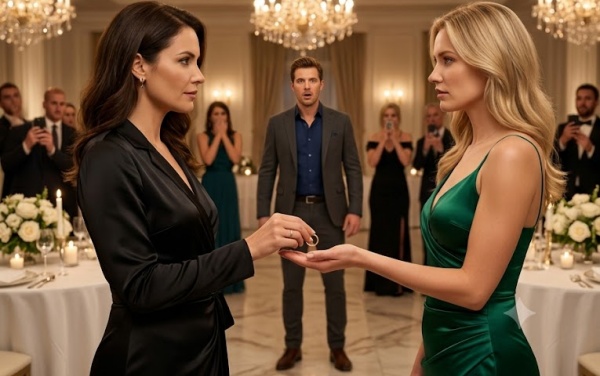
On my birthday, my husband introduced his mistress without saying a single word. So I stood up, took off my wedding ring, placed it in her hand, and told her, “He’s all yours.” Everyone thought I’d finally broken. They couldn’t have been more wrong. Because the moment my husband proudly put that ring on her finger, every guest in the room witnessed the beginning of the biggest mistake of his life—not the end of mine.
Part 1: The Birthday Dinner
On my birthday, my husband introduced his mistress without saying a single word.
He did not stand up and call for attention. He did not clear his throat, confess, or offer the room some polished explanation about love changing shape. He simply walked into the private dining room at Harbor & Vine with another woman on his arm and let everyone understand what he was too cowardly to say.
Her name was Celeste.
I knew her name because I had seen it on restaurant receipts, hotel confirmations, and the screen of my husband’s phone at 2:13 in the morning. I knew the exact spelling because she dotted the second “e” in her signature with a little heart on the birthday card she once sent him to his office. She probably thought that was cute.
I thought it was useful.
My husband, Graham Caldwell, arrived twenty-three minutes late to my thirty-ninth birthday dinner wearing the navy suit I had bought him for our tenth anniversary. Celeste wore a champagne-colored silk dress, delicate gold heels, and a smile that said she already believed she had won something. The room went quiet in the way rooms do when everyone sees the disaster before the person at the center of it is allowed to react.
My sister stopped mid-sentence.
My mother’s fork hovered over her salad.
Graham’s business partner looked down at his glass as if eye contact might make him legally responsible for what was happening.
And me?
I sat at the head of the table with a birthday candle still unlit in the dessert waiting beside me.
Harbor & Vine was one of those upscale restaurants in Charleston, South Carolina, where the lighting made everyone look softer than they were and the wine list was longer than the menu. Graham had insisted on hosting my birthday there because “appearances matter,” though I had told him I would have been happy with takeout Thai food and a quiet night at home.
But Graham loved an audience.
That was why he chose that night.
He wanted people to see him choose her.
For years, I had been the wife who made him look stable. I remembered names, sent thank-you notes, smoothed over awkward conversations, and turned business dinners into relationships. I was the reason people trusted Graham even when his charm became too sharp.
But that night, he looked at me as if I were a chair he no longer needed.
“Sorry we’re late,” he said.
We.
Not I.
We.
Celeste smiled at the table like she belonged there. “Traffic on King Street was awful.”
My mother’s face went pale.
My best friend, Lena, leaned toward me and whispered, “Do you want to leave?”
I looked at Graham.
He did not look ashamed. That was the first important thing. He looked nervous, yes, but underneath it he looked proud. Proud that he had finally forced the truth into the room without having to take responsibility for saying it.
So I stood.
Every chair seemed to hold its breath.
Graham’s eyebrows lifted slightly, as if he expected tears. Maybe a slap. Maybe a scene he could later describe as proof that I was unstable, emotional, impossible to live with. Men like Graham do not only betray; they prepare their defense while doing it.
I did not give him one.
I looked at Celeste and smiled.
Not warmly.
Politely.
Then I reached for my left hand.
The ring had been on my finger for eleven years. A three-stone diamond ring, platinum band, old European cuts from my grandmother’s original wedding set. Graham had not bought it. He had proposed with it because my grandmother gave it to me before she died and told me, “Only give this to a man who knows what it means.”
I had been wrong about Graham.
But my grandmother had been right about the ring.
I slid it off slowly.
The room watched.
Graham’s face changed for the first time that night. The pride flickered. Confusion entered.
I walked toward Celeste.
She took one small step back, then caught herself. I could see the calculation in her eyes. If she refused the ring, she looked guilty. If she accepted it, she looked chosen. Celeste had built her victory on being seen, so of course she held out her hand.
I placed my wedding ring in her palm.
“He’s all yours,” I said.
Someone gasped.
My mother made a small sound like pain.
Graham stared at me as if I had spoken in a language he did not know.
Celeste’s fingers closed around the ring. For a second, I saw triumph flash across her face. She thought I had surrendered. She thought I had handed her the symbol of the life she had been trying to take.
Then Graham did the thing that turned my birthday into the beginning of the biggest mistake of his life.
He took the ring from Celeste’s palm.
He smiled, though his hand shook slightly, and slipped it onto her finger.
Not her ring finger, at first. It did not fit. My ring was too small for her. That should have been enough of an omen, but Graham was too committed to the performance to notice. He pushed it onto her right hand instead and lifted her fingers like he had just crowned her.
A few guests looked away.
Lena whispered, “Oh my God.”
Celeste laughed softly, a brittle little sound. “I guess this is official.”
Graham looked at me then.
He expected me to collapse.
Everyone did.
They thought I had finally broken.
They could not have been more wrong.
Because while Graham stood there, proudly placing my grandmother’s ring on his mistress’s finger in front of my family, friends, and half the people whose trust kept his business alive, I finally understood something.
He had not taken my place in the story.
He had stepped exactly where I needed him to stand.
In the open.
Under the lights.
With witnesses.
I picked up my clutch from the chair, kissed my mother on the cheek, and said, “Happy birthday to me.”
Then I walked out before dessert was served.
Part 2: What He Thought He Knew About Me
Graham always said I was “graceful under pressure.”
He meant quiet.
He meant useful.
He meant I did not embarrass him.
When we met, I was twenty-seven and managing events for a boutique hotel in Savannah. Graham was thirty-two, newly promoted at a commercial real estate firm, with a smile that made people forgive him before he even asked. He was ambitious, funny, and hungry in a way I mistook for purpose.
He loved how calm I was.
At least, he said he did.
“You make people feel taken care of,” he told me on our third date. “That’s rare.”
Back then, I thought he saw my heart.
Later, I realized he saw a skill.
I knew how to create comfort. I knew how to remember details, solve problems quietly, and make people believe everything was fine even when the kitchen was on fire and the florist was lost on the wrong side of town. That talent helped Graham more than any of his business degrees ever did.
When he started Caldwell Coastal Development, I was the one who organized the first investor dinner.
I chose the menu, arranged the seating, coached Graham on which investor had a sick wife and which one loved college football. I made sure the wine flowed, the lights were warm, and the evening felt less like a pitch and more like destiny. Three investors committed within two weeks.
Graham called it his breakthrough.
I called it Tuesday.
For years, I built the rooms where he became important.
Then, when people started calling him a rising star in Charleston real estate, he began believing the rooms had built themselves.
Our marriage looked beautiful from the outside. We had a restored historic home south of Broad, weekend invitations to Kiawah, charity gala photos, and a circle of people who loved success as long as it came dressed well. I wore simple dresses, planned elegant dinners, and stood beside Graham while he talked about legacy.
But inside the house, legacy looked different.
It looked like unpaid contractors calling my phone because Graham avoided hard conversations.
It looked like me reviewing documents late at night because he skimmed details.
It looked like me transferring money from my separate savings to cover gaps he called “temporary cash flow issues.”
It looked like me smiling when he corrected me in public about things I had explained to him in private.
By year eight, Graham’s compliments changed.
“You’re too practical,” he said.
“You worry too much.”
“You don’t dream big enough.”
Then came the worst one.
“You’ve become small, Elise.”
My name is Elise.
For the record, I had never been small.
I had simply stopped making myself large for a man who only liked my strength when it served him.
Celeste entered his life through a fundraising committee for a children’s hospital expansion. She was thirty-one, a marketing consultant with glossy hair and a talent for making every sentence sound like a compliment to herself. She posted photos from charity events with captions about purpose, elegance, and “building a beautiful life.”
Graham loved that.
He loved words that sounded meaningful without requiring sacrifice.
At first, Celeste called him “brilliant” in public comments. Then she began tagging him in posts. Then came the late meetings, the private lunches, the sudden interest in wearing cologne again.
I noticed everything.
Wives usually do.
But noticing and proving are different things.
The first hard proof came from a hotel charge in Atlanta. Graham told me he was attending a development conference. The hotel sent a confirmation email to our shared account by mistake, including two spa appointments and a dinner reservation for two under the note: Anniversary package.
Not our anniversary.
Theirs, apparently.
I did not confront him.
Instead, I printed the email.
Then I called an attorney.
Her name was Vivian Harper, and she had the kind of office that smelled like coffee, paper, and controlled consequences. She specialized in high-asset divorce, business ownership disputes, and the kind of men who thought charisma counted as documentation.
I brought her everything I had.
Bank records. Business formation documents. My grandmother’s trust paperwork. Emails showing my early contributions to Caldwell Coastal Development. Transfers from my separate inheritance into business accounts. Receipts. Text screenshots. The Atlanta hotel package.
Vivian reviewed the files in silence.
Then she looked at me over her glasses and said, “Your husband underestimates you.”
I laughed once.
It came out like a cough.
“He thinks I’m decorative,” I said.
Vivian tapped the folder. “Decorative people don’t bring organized evidence.”
That was the first time in months I breathed fully.
Vivian explained what mattered and what did not. South Carolina divorce law allowed different grounds, including adultery, but court was not a stage for emotional revenge. We needed strategy. We needed financial clarity. We needed to separate what was marital, what was nonmarital, what had been commingled, and what Graham had misrepresented.
Most importantly, we needed to protect what my grandmother left me.
Graham thought my family money was “our cushion.”
It was not.
Some of it had been used in ways that complicated the picture, yes. But Vivian believed we could document where funds came from and where they went. She also believed Graham had crossed lines in how he used business and marital accounts to support his affair.
“Do not warn him,” she said. “Do not threaten him. Do not make speeches before we are ready.”
So I became quiet.
Graham thought silence meant weakness.
Celeste thought silence meant defeat.
They both mistook patience for permission.
By the time my birthday arrived, Vivian had prepared the initial filings. We were not waiting for drama. We were waiting for Graham to stop hiding long enough to make his own arrogance useful.
Then he walked into Harbor & Vine with Celeste.
And put my grandmother’s ring on her finger.
In front of witnesses.
That was the kind of arrogance even Vivian could appreciate.
Part 3: The Ring Was Never His to Give
I spent the night of my birthday at Lena’s guesthouse.
Not crying into a pillow, though I understand why people assumed that. I did cry once, in the bathroom, while washing off my makeup. Not because Graham had chosen Celeste. I had known that long before the dinner.
I cried because my grandmother’s ring had been on another woman’s hand.
Grief is strange that way.
Sometimes the symbol hurts more sharply than the betrayal itself.
Lena knocked softly on the bathroom door. “Do you want tea or bourbon?”
I looked at myself in the mirror.
Mascara under one eye. Lipstick faded. Hair still pinned neatly because even disaster had not managed to undo the work of a good stylist.
“Tea,” I said. “And maybe bourbon near it.”
Lena opened the door and leaned against the frame. “You scared me tonight.”
“I know.”
“When you handed her the ring, I thought—”
“That I had lost my mind?”
“A little.”
I dried my hands. “I knew what I was doing.”
Lena studied me carefully. “Please tell me there’s a plan.”
“There is.”
“Does the plan involve getting the ring back?”
“Oh,” I said. “Absolutely.”
The next morning, Graham texted at 7:04 a.m.
That was cruel and unnecessary.
I stared at the message while eating toast at Lena’s kitchen island.
The audacity of unfaithful men should be studied by scientists.
A second message followed.
You embarrassed me in front of everyone.
Lena read it over my shoulder and nearly choked on her coffee.
“You embarrassed him?”
I took a sip of tea. “Apparently.”
Another message arrived.
We need to talk like adults.
There it was.
The phrase men use after behaving like children.
I sent the only response Vivian had approved.
All communication should go through my attorney.
Then I sent Graham Vivian’s contact information.
His reply came fast.
Attorney? Are you serious?
I did not answer.
By noon, Graham had been served.
Vivian arranged it at his office because he had a habit of avoiding the house when consequences were waiting there. According to someone who later told Lena, Graham was walking into a meeting with two lenders when the process server approached him.
He laughed at first.
Then he opened the envelope.
Then he stopped laughing.
The petition included divorce on appropriate legal grounds, requests for temporary financial orders, preservation of assets, disclosure of accounts, and return of separate property. The ring was specifically identified as my nonmarital family heirloom, documented by my grandmother’s estate records, photographs, insurance appraisals, and testimony from multiple relatives.
In simpler terms: Graham had put something that was not his on Celeste’s finger.
Publicly.
With witnesses.
That afternoon, Celeste posted a photo.
Of course she did.
Her hand rested on a white linen table beside a cappuccino. My ring caught the light. The caption said:
Sometimes life gives you what was always meant for you.
Lena sent it to me with a message:
I am trying to be evolved but I may become feral.
I forwarded the post to Vivian.
Vivian replied:
Helpful. Save the original link and screenshot. Do not comment.
So I did not comment.
Several people did, though.
One woman wrote, Isn’t that Elise’s wedding ring?
Another wrote, This feels inappropriate.
Celeste deleted the comments.
Too late.
By evening, Graham called Lena because I would not answer him.
Lena put him on speaker without telling him I was sitting there, which was legally unhelpful but emotionally satisfying.
“Where is Elise?” he demanded.
“Safe,” Lena said.
“She needs to stop this.”
“She left you with your girlfriend wearing her ring in a restaurant.”
He exhaled sharply. “She gave it to Celeste.”
Lena looked at me.
I shook my head.
Lena said, “Maybe tell that to a judge.”
Graham’s voice dropped. “You don’t understand what she’s doing. She’s trying to ruin me.”
“No,” Lena said. “I think you handled that part yourself.”
He hung up.
For three days, Graham tried to control the story.
He told friends I had made a theatrical scene at my own birthday party. He said the marriage had been dead for years. He said Celeste was not the cause, just the person who helped him realize he deserved happiness. He used the word “healing” so many times that Lena threatened to ban it from her house.
Celeste helped too.
She posted quotes about courage, choosing yourself, and refusing to live a lie. She never mentioned that the lie had involved wearing another woman’s heirloom ring over breakfast. She framed herself as brave because some people believe any desire becomes noble if they say it in soft lighting.
Meanwhile, Vivian filed motions.
The court issued temporary orders preventing Graham from transferring certain assets, altering accounts, or disposing of disputed property. He was instructed through counsel to ensure the ring was preserved and returned pending final determination.
Celeste did not return it immediately.
That was mistake number two.
Mistake number one was taking it.
Mistake number two was believing Instagram captions counted as ownership.
When Vivian told me the ring still had not been returned, I felt the old anger rise. Not loud. Not reckless. A clean flame.
“That ring is my family,” I said.
Vivian nodded. “Then we retrieve it properly.”
A week later, at a temporary hearing in Charleston County Family Court, Celeste arrived with Graham.
She wore a cream suit, pearl earrings, and my grandmother’s ring.
On her right hand.
Vivian saw it before I did.
Her expression did not change, but she wrote something on her legal pad.
Graham sat at his attorney’s table, avoiding my eyes. Celeste sat behind him, turning the ring unconsciously with her thumb. I wondered if she knew my grandmother had worn it through forty-eight years of marriage, three children, breast cancer, my grandfather’s funeral, and every Sunday dinner of my childhood.
Probably not.
To Celeste, it was proof she had been chosen.
To me, it was proof she had been careless with another woman’s history.
When the judge asked about the ring, Graham’s attorney tried to soften the issue.
“Your Honor, there was an emotional exchange at a private dinner,” he said. “Mrs. Caldwell voluntarily handed the ring to Ms. Vale.”
Vivian stood.
“Your Honor, Mrs. Caldwell did not gift her separate family heirloom to her husband’s romantic partner. She placed it in Ms. Vale’s hand during a public confrontation after Mr. Caldwell arrived at Mrs. Caldwell’s birthday dinner with Ms. Vale. Mr. Caldwell then took the ring and placed it on Ms. Vale’s finger in front of witnesses. The ring is documented separate property and should be returned immediately.”
The judge looked at Celeste’s hand.
“Ms. Vale,” the judge said, “are you wearing the ring now?”
Celeste’s face flushed.
“Yes, Your Honor.”
“Remove it.”
The room went silent.
Celeste looked at Graham.
Graham looked at the table.
Slowly, Celeste removed the ring and handed it to a court officer, who passed it to Vivian.
Vivian did not hand it to me right away.
She placed it in a small evidence pouch.
That hurt, oddly.
But it was safe.
My grandmother’s ring was finally off Celeste’s hand.
For the first time since my birthday, I felt my shoulders drop.
Graham still would not look at me.
Good.
I was done being a mirror he could use only when he liked the reflection.
Part 4: The Mistake Behind the Performance
The ring was only the visible mistake.
The larger one sat inside Graham’s accounts.
Discovery is not glamorous. It does not look like a dramatic confrontation in a restaurant or a woman walking away in slow motion. It looks like PDFs, spreadsheets, bank statements, credit card records, loan documents, business ledgers, emails, and attorneys charging by the hour to make lies readable.
Graham had been careless.
Not because he was stupid.
Because he was arrogant.
He had used business funds for personal expenses and marital accounts for affair-related spending. Hotels, flights, jewelry, dinners, spa weekends, a rental house on Sullivan’s Island for “client entertainment” that turned out to be a private getaway with Celeste. He had also transferred money from accounts connected to projects where investors expected clean reporting.
Vivian was careful.
“We are not accusing beyond what documents show,” she told me. “But the documents show plenty.”
They did.
Enough to make Graham’s attorney stop calling me emotional.
Enough to make two investors request independent financial review.
Enough to make Celeste realize that being publicly chosen by Graham meant being publicly tied to his mess.
That part came later.
At first, she remained loyal.
Or performed loyalty.
She appeared beside him at events, though fewer people invited them. Charleston society can forgive affairs more easily than embarrassment, and Graham had created both. People whispered about the birthday dinner, the ring, the court hearing, and the financial review.
My mother hated the whispers.
I did not.
Whispers meant the story no longer belonged only to Graham.
One afternoon, about three months after my birthday, I returned to the house with Vivian’s permission to gather additional belongings. I brought Lena and a professional organizer because Vivian said, “Do not be alone with him, and do not rely on memory when emotions are involved.”
Graham was there.
I had not expected him to be.
He stood in the living room wearing jeans and a white shirt, looking thinner than before. The house smelled stale, as if no one had opened windows in weeks.
“Elise,” he said.
I stopped near the doorway.
“Vivian said you wouldn’t be here.”
“I needed to talk to you.”
Lena stepped forward. “Absolutely not.”
“It’s fine,” I said, though it was not fine. “Five minutes. With Lena present.”
Graham looked like he wanted to object, then thought better of it.
We stood in the room where we once hosted Christmas parties, investor dinners, and my mother’s seventieth birthday brunch. The sofa we chose together sat under the window. A framed photo from our wedding still rested on the bookshelf, turned slightly toward the wall.
He saw me notice it.
“I couldn’t take it down,” he said.
I almost laughed.
“You could bring Celeste to my birthday,” I said. “But the picture was too hard?”
He flinched.
“I deserve that.”
“You deserve more than that. But I’m trying to be efficient.”
He looked down.
Then he said, “Celeste left.”
I did not respond.
He waited, maybe expecting shock.
I gave him none.
“She said this was too much,” he continued. “The legal issues, the business review, people judging her. She said she didn’t sign up to be humiliated.”
Lena made a small sound behind me.
I kept my face still.
“That must have been disappointing,” I said.
Graham’s eyes lifted. “That’s all?”
“What would you like me to say?”
“I don’t know. Something human.”
That was when I felt anger.
Not hot anger. Old anger. The kind stored in bone.
“Human?” I repeated. “I was human when you brought her to my birthday. I was human when you put my grandmother’s ring on her finger. I was human when you let people think I was frigid, cold, controlling, difficult. I was human every time you used my work, my money, and my loyalty to build your reputation.”
His face reddened.
“You did not want human,” I said. “You wanted convenient.”
He sank onto the edge of the sofa.
“I made a mistake.”
“No, Graham. You made a series of choices. The mistake was believing I would keep protecting you after you stopped protecting me.”
He covered his face with both hands.
There had been a time when that would have undone me.
Graham in pain used to activate every tender part of me. I would sit beside him, touch his shoulder, translate his guilt into stress, his cruelty into fear, his selfishness into childhood wounds. I was very good at making him understandable.
That day, I let him be exactly what he was.
A man facing consequences.
“I’m going to lose the company,” he whispered.
I looked around the room.
The house. The books. The expensive rug. The life he thought his charm had built.
“You might,” I said.
He looked up, wounded by my honesty.
“How can you be so cold?”
“I’m not cold. I’m no longer on fire trying to keep you warm.”
Lena’s eyes filled behind me.
Graham said nothing.
I went upstairs and packed what I came for.
Clothes. Books. My grandmother’s recipe box. A small painting I bought before the marriage. The quilt my mother made. The photo albums, minus the ones Graham’s attorney claimed were disputed marital property, which was so ridiculous even Vivian sighed when I told her.
As I left, Graham stood in the hallway.
“Elise,” he said softly.
I paused.
“If I had chosen differently that night…”
I looked at him.
“That night didn’t create who you were,” I said. “It revealed it.”
Then I walked out with my boxes.
Six months later, Caldwell Coastal Development settled with two investors and quietly restructured. Graham stepped down from his leadership role as part of the agreement. The official statement called it “a strategic transition.”
Charleston called it something else.
Part 5: The Beginning of My Life
The divorce was finalized almost a year after my birthday.
By then, I had turned forty.
I celebrated that birthday very differently.
No private dining room. No public performance. No husband using my life as a stage for his ego. Just dinner in Lena’s backyard with my mother, my sister, a few friends, string lights, grilled shrimp, sweet tea, and a lemon cake that leaned slightly to one side because Lena insisted on baking it herself.
“It has character,” she said.
“It has structural concerns,” I replied.
We laughed until my mother cried.
After dinner, Lena brought out one candle.
“Make a wish,” she said.
I looked around the table.
At the women who helped me pack boxes.
At my mother, who had once whispered, “I’m sorry I didn’t see how lonely you were.”
At my sister, who offered to move in with me for a month even though we both knew we would fight about thermostat settings.
At the empty seat where Graham no longer sat.
Then I looked down at my hand.
My grandmother’s ring was not there.
It rested in a safe deposit box, where I had placed it after it was returned. I did not wear it anymore. Not because Celeste had ruined it, though for a while I feared she had. But because I needed time to remember it belonged to my family before it belonged to my marriage.
Maybe one day I would reset the stones.
Maybe I would pass them to my niece.
Maybe I would keep them as they were, proof that precious things can survive being placed in the wrong hands.
I blew out the candle.
My wish was simple.
Peace.
Not revenge.
Not a new man.
Not Graham’s suffering.
Peace.
The final settlement was fair enough, which is not the same as satisfying. Divorce rarely gives anyone everything they deserve. It gives paperwork, deadlines, signatures, tax consequences, and the legal end of something that emotionally ended long before.
I kept my separate inheritance.
I received a portion of marital assets.
Graham took the damaged business reputation, the investor consequences, and whatever remained of the life he had tried to build with Celeste. I heard through mutual friends that she moved to Miami and rebranded herself as a “luxury lifestyle consultant.” That sounded exactly right.
I did not hate her forever.
Hate is heavy, and I had already carried enough things that belonged to other people.
But I did learn something from her.
Some women think being chosen by a married man means they are more special than the wife. Usually, it only means they are meeting a man at the stage where his lies have become practiced. Celeste thought Graham’s public gesture made her permanent.
It made her evidence.
As for Graham, he apologized once after mediation.
We were standing in a courthouse hallway, both of us holding folders, both exhausted. His hair had more gray than before. His suit looked expensive but tired.
“I’m sorry about the ring,” he said.
I looked at him carefully.
“Only the ring?”
His eyes filled.
“No,” he said. “Not only the ring. But I think that was the moment I became someone I couldn’t explain away.”
I believed him.
That did not change anything.
“I hope you become better than that person,” I said.
He nodded. “Do you forgive me?”
A year earlier, that question would have mattered.
That day, it felt like a door I did not need to open.
“I’m not carrying you anymore,” I said. “That will have to be enough.”
I walked away before he could ask for more.
After the divorce, I rented a small office downtown and started my own event consulting firm. Not the kind of events Graham loved, where wealthy men congratulated each other under chandeliers. I worked with nonprofits, women-owned businesses, family foundations, and community organizations that needed rooms designed with care.
My first major client was a literacy nonprofit expanding across the Lowcountry.
The irony was not lost on me.
I had spent years helping Graham create rooms where people believed in him. Now I created rooms where people believed in causes that deserved it.
The business grew slowly.
Honestly.
No inflated promises. No borrowed shine. No husband taking credit for invisible labor. My name was on the contracts, invoices, website, and door.
Elise Caldwell Events.
I kept the last name for business reasons at first.
Then one day, I changed it back.
Elise Whitaker Events.
Seeing my own name on the door made me cry in the hallway.
A delivery driver asked if I was okay.
I said yes.
And meant it.
Two years after the birthday dinner, Harbor & Vine invited me to design a charity luncheon in the same private dining room where Graham had walked in with Celeste. I almost declined. Then I thought about it for a day and accepted.
The room looked smaller when I returned.
That surprised me.
Trauma has a way of enlarging places. In memory, that dining room had become a courtroom, a theater, an execution chamber. In reality, it was just a room with velvet chairs, polished glassware, and beautiful light.
I stood at the head of the table where I had once removed my ring.
The staff moved around me, setting linens and flowers. White roses, pale blue hydrangeas, candles in glass holders. The event would raise money for housing assistance for women leaving unsafe or financially controlling marriages.
Lena came early to check on me.
“Full circle?” she asked.
“Something like that.”
“Do you feel weird?”
I looked around.
“No,” I said. “I feel tall.”
She smiled. “You are tall.”
“I’m five-five.”
“Emotionally tall.”
That made me laugh.
During the luncheon, I gave a short welcome speech. Nothing personal. Nothing dramatic. Just gratitude, purpose, and a reminder that dignity does not require silence, but sometimes silence gives a woman time to choose her next move.
Afterward, a woman approached me near the dessert table.
She was maybe in her late thirties, wearing a gray dress and holding her purse with both hands.
“I was at your birthday dinner,” she said quietly.
I recognized her vaguely as the wife of one of Graham’s former investors.
“I remember,” I said.
She looked embarrassed. “I thought you were broken that night.”
“A lot of people did.”
“I’m sorry.”
I softened. “You don’t have to apologize for what you didn’t understand.”
She swallowed. “My husband is doing something similar. Not as public. But I know.”
I reached into my clutch and handed her Vivian’s card.
“Then talk to someone before you talk to him,” I said.
Her eyes filled.
“Thank you.”
That moment stayed with me longer than Graham’s apology.
Because that was the real ending.
Not him losing Celeste.
Not the business restructuring.
Not the ring returning to my family.
The real ending was standing in the room where I had been humiliated and becoming useful to someone else.
People still tell the story sometimes.
They say, “Did you hear about the woman who gave her wedding ring to her husband’s mistress at her own birthday dinner?”
Some versions make me sound wild.
Some make me sound tragic.
Some make Graham sound like a fool, which is the most accurate part.
But the truth is quieter.
I did not give Celeste my ring because I had given up.
I gave it to her because I was done holding a symbol of vows Graham had already broken. I gave it to her because he wanted a performance, and I understood performances better than he ever did. I gave it to her because I knew the room would remember what happened next.
And Graham, proud and blind, did exactly what men like him do when they think they are winning.
He overplayed his hand.
The moment he put that ring on her finger, every guest in the room witnessed not the end of my life, but the beginning of his consequences.
As for me?
I did not break.
I left.
I rebuilt.
I reclaimed my name, my work, my peace, and eventually even the room where he tried to shame me.
On my birthday, my husband introduced his mistress without saying a single word.
So I stood up, took off my wedding ring, placed it in her hand, and told her, “He’s all yours.”
Everyone thought I had finally lost him.
But the truth was simpler.
I had finally returned him.
