I Came Home at 4:05 A.M. I Thought I Was Hiding My Affair From My Family — Then I Found My Son’s Crayon Note on the Kitchen Table
I thought the worst thing that could happen was my wife finding out about the affair. I was wrong. At 4:05 in the morning, I walked into our silent kitchen and found a note written by my seven-year-old son. One sentence in blue crayon told me I had already lost more than my marriage.
Part 1
At 4:05 in the morning, I pulled into my driveway with my headlights off before the car even stopped rolling. It was a stupid habit I had developed over the past three months, like silence could somehow make betrayal smaller. The neighborhood was still asleep, every house on our street in suburban Ohio tucked behind dark windows and wet lawns silvered by the porch lights.
I sat in the car for almost a full minute, gripping the steering wheel, listening to the ticking engine cool down. My shirt smelled faintly like perfume that was not my wife’s, and my phone still had a message on it I had not been brave enough to delete. I told myself the same lie I told myself every time: this was the last time.
The house was dark when I stepped inside. Usually, even at that hour, there was some proof that my family existed there — a night-light glowing in the hallway, a forgotten Lego under my shoe, the hum of the dishwasher my wife always ran before bed. But that morning, the silence felt arranged, like someone had set it carefully on the kitchen counter and waited for me to notice.
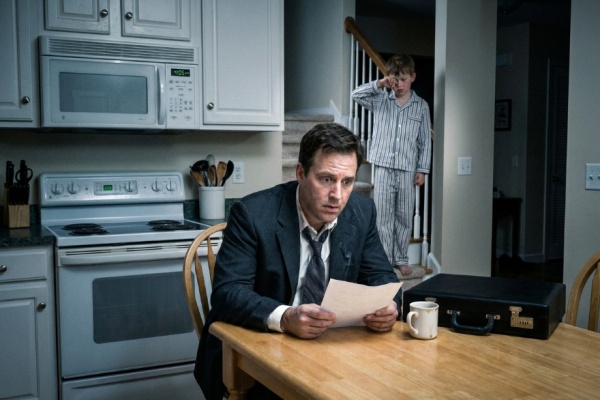
I took off my shoes by the door and moved through the hallway without turning on the lights. The kitchen came into view first, with the small lamp over the sink left on. Under its yellow circle of light sat an envelope, my name written across the front in blue crayon.
Not “Dad.” Not “Daddy.” My name.
“Michael.”
For a second, I thought my wife had done it to make a point. Maybe she had finally found the restaurant receipt in my jacket pocket, or the hotel charge I thought I had hidden by paying cash for everything else. Maybe she had gone through my phone while I was in the shower and read enough to understand why I had been working late so often.
But when I picked up the envelope, I saw the crooked letters and the uneven pressure of a child’s hand. There were little stars drawn in the corners, some colored yellow, some orange, one scribbled so hard the crayon had torn the paper. My stomach dropped before I even opened it.
Inside was a single sheet torn from my son Ethan’s school notebook. He was seven years old, in second grade, missing one front tooth, and still believed cereal tasted better from the blue bowl than the green one. At the top of the paper, he had written, “Things I am learning.”
The first line said, “I am learning how to tie my shoes by myself.”
The second line said, “I am learning how to make Mom coffee when she cries.”
The third line was the one that destroyed me.
“I am learning how not to need Dad.”
I read it once. Then twice. Then a third time, because my mind refused to accept that those words had come from the little boy who still asked me to check his closet for monsters. My hands started shaking so badly the paper made a soft rattling sound in the quiet kitchen.
I sank into the chair at the table, the same chair where I used to help Ethan with spelling words while my wife, Laura, packed his lunch for the next day. There was still a faint ring on the wood from the apple juice he had spilled two weeks earlier. I remembered being annoyed about it, like a mark on a table mattered more than the mark I had been leaving on my family.
No one came downstairs. No one screamed. No one threw a lamp, or demanded answers, or called me the names I deserved. The house gave me something worse than anger: proof that life had started continuing without me.
I sat there until the sky began to pale behind the kitchen blinds. The letter stayed open in front of me, and every innocent, misspelled word felt heavier than any confession. By the time the first bird started singing outside, I understood that my affair had not been a secret.
It had simply been a wound my family had been bleeding from quietly.
Part 2
Laura and I had been married for ten years. We met at a community college parking lot in Dayton, where she was trying to jump-start a dead Honda Civic and I pretended I knew more about cars than I did. She laughed when I mixed up the cables, then called her brother, who fixed it in five minutes and made me look like an idiot.
Somehow, she still agreed to get coffee with me afterward. She ordered a vanilla latte, I ordered black coffee because I wanted to seem mature, and we sat for two hours talking about nothing and everything. By the end of that afternoon, I knew she was the kind of woman who made ordinary places feel like home.
We built our life slowly, the way most people do. A small apartment with loud upstairs neighbors, a used couch from Facebook Marketplace, bills paid on Fridays, dreams postponed until tax refunds came in. When we bought our first house, a three-bedroom ranch with a maple tree in the front yard, Laura cried in the empty living room because she said she could already hear kids running through it.
Ethan arrived two years later during a snowstorm in January. I remember driving to the hospital at twenty miles per hour, one hand on the wheel and one hand holding Laura’s while she breathed through contractions. When the nurse placed him in my arms, I promised him out loud that I would always show up.
For a while, I did. I changed diapers, warmed bottles, read bedtime stories, and learned which dinosaur names were acceptable and which ones Ethan said I pronounced wrong. I worked hard, came home tired, and still got down on the carpet to build train tracks across the living room.
Then life became what I told myself was routine. Mortgage payments, insurance premiums, grocery lists, broken appliances, soccer practice, dentist appointments, PTO meetings, and the kind of tiredness that gets into a marriage like dust. Laura and I still loved each other, but we stopped looking at each other for longer than necessary.
She became the person who reminded me about the water bill. I became the person who forgot to take the trash cans to the curb. We spoke in schedules, updates, and half-finished sentences shouted from different rooms.
I did not wake up one morning intending to become a man who lied to his wife. That is the part cowards like me always say, as if betrayal requires a dramatic beginning to be real. The truth is worse: I drifted into it one small selfish choice at a time.
Her name was Natalie, and she worked for a vendor our company used. She was funny, sharp, and always seemed impressed by things I said, even when they were not worth being impressed by. The first time she called me “brilliant” during a meeting, I carried that word around all day like a medal.
At home that night, Laura asked if I could pick up milk because Ethan needed it for breakfast. I sighed like she had asked me to carry the house on my back. She looked at me for a second, really looked, then said, “Never mind, I’ll go.”
I should have noticed the hurt in her voice. I should have followed her to the garage and told her I was sorry. Instead, I stood there feeling misunderstood, as if being needed by my family was an insult.
The messages with Natalie started harmless enough. A joke about a client. A complaint about office coffee. A “you still awake?” sent at 11:38 p.m. while Laura slept beside me with one hand tucked under her cheek.
Every line I crossed, I renamed. Flirting became “venting.” Secrets became “privacy.” Emotional betrayal became “having someone who understands me.” I built a vocabulary that allowed me to keep looking in the mirror.
By the time it became physical, I had already betrayed Laura a hundred times in my mind. The first time I came home late and kissed my wife on the forehead while she slept, I felt sick. The second time, I felt guilty.
By the tenth time, I felt practiced.
That is how you ruin a family. Not all at once, not with thunder and broken glass, but with receipts hidden under floor mats and passwords changed for “security.” You do it by becoming comfortable with the sound of your own excuses.
I thought Laura did not know because she did not confront me. I thought Ethan did not notice because he was seven. I thought if the house still looked the same when I walked through the door, then maybe the damage had not reached the walls yet.
But children notice absences before adults notice lies. They notice the empty chair at dinner, the missed school concert, the way Mom wipes her face quickly when footsteps come down the hall. They notice when Dad’s laugh lives in his phone but not at home anymore.
And Ethan had been noticing me disappear.
Part 3
The morning after I found the letter, I stayed in the kitchen until 6:12 a.m., when I heard Ethan’s bedroom door open. His footsteps came down the hallway in soft little thumps. I folded the paper quickly, then unfolded it again because hiding it felt like continuing the same sickness.
He appeared in the doorway wearing dinosaur pajamas and holding his stuffed dog by one ear. His hair stuck up on one side, and his eyes were puffy with sleep. For half a second, he looked like the same little boy who used to run to me every morning and yell, “Daddy, guess what?”
But he did not run. He stopped when he saw me. Then his eyes went to the paper on the table.
“You found it,” he said.
His voice was not angry. That was the worst part. It was small, careful, and tired in a way no seven-year-old’s voice should ever be.
I tried to speak, but the first sound that came out of me was not a word. I cleared my throat and said, “Buddy, did you write this?”
He nodded, looking down at his socks. One had a hole near the toe. I remembered Laura asking me two weeks earlier to pick up new socks for him from Target, and I remembered forgetting because I had been texting Natalie in the parking lot.
“Why did you write it?” I asked, even though I already knew.
Ethan shrugged one shoulder. “Mrs. Patterson said we should write things we’re learning. Everybody wrote stuff like riding bikes or adding big numbers.” He rubbed his eye with his fist. “I didn’t want to write it at school.”
I swallowed hard. “So you wrote it here?”
He nodded again. “Mom said writing helps when your heart feels too full.”
The words hit me harder than if Laura had slapped me. I imagined my wife sitting beside our son on his bed, trying to explain adult sadness in a way that would not make him feel responsible for it. I imagined Ethan watching her cry and deciding the answer was to become smaller, quieter, less needy.
“Ethan,” I whispered, “you can always need me.”
He looked up then, and his face changed. Not dramatically, not like in movies, but enough that I knew I had said the wrong thing. His mouth tightened, and his eyes filled with tears he was trying not to let fall.
“But you’re not here,” he said.
Four words. That was all it took.
I had prepared lies for Laura. I had rehearsed phrases in the car, the kind men use when they want forgiveness without confession. “I’ve been stressed.” “Work has been insane.” “You’re imagining things.” “It’s not what you think.”
But there is no defense against a child telling the truth plainly.
I got down on one knee, but Ethan stepped back. That single step crushed something in me I did not know could still break. My son had learned distance from me.
Laura appeared behind him a moment later in a gray sweatshirt, her hair pulled into a messy bun. She looked older than she had a year ago, not because of age, but because grief had been using her face as a place to sit. Her eyes moved from Ethan to me, then to the letter.
“I told him to leave it on the table if he wanted you to read it,” she said.
Her voice was calm. Too calm. The calm of someone who had cried until there was no water left.
“Laura,” I said, standing. “I need to explain.”
“No,” she replied. “You need to listen.”
Ethan leaned into her side, and she placed a hand on his shoulder. It was not dramatic. It was not performative. It was a mother keeping her child steady in a room where his father had become unsafe in ways no bruise could show.
“I know about Natalie,” Laura said.
My chest tightened. Hearing the name out loud in our kitchen made it ugly, real, and ridiculous. Natalie did not belong near Ethan’s cereal bowls, Laura’s coffee mug, or the family calendar covered in dentist reminders and soccer games.
“How long?” I asked, because guilt makes people ask stupid questions.
Laura laughed once, but it had no humor in it. “Long enough to stop wondering if I was crazy.”
She told me she had noticed the late nights first. Then the way I guarded my phone. Then the cologne I had suddenly started wearing again, the ATM withdrawals, the mileage on the car, the conference in Columbus that did not exist.
“I wasn’t snooping because I wanted to catch you,” she said. “I was looking because I needed to know whether the person sleeping next to me was still my husband.”
Ethan looked between us, confused by some of the words but not the feeling in the room. Laura noticed and bent down. “Go brush your teeth, honey. I’ll make pancakes in a minute.”
He hesitated. “Is Dad leaving?”
The question opened the floor under me.
Laura closed her eyes for one second. “Dad and I need to talk.”
“That means yes,” Ethan said.
“No, buddy,” I said quickly. “I’m not leaving.”
But Laura looked at me, and in that look was a truth I had not earned the right to avoid. Staying in the house was not the same thing as being a father. Sleeping beside my wife was not the same thing as being a husband.
Ethan walked away down the hall, dragging his stuffed dog behind him. I watched him go and realized I had spent months chasing the feeling of being wanted by another woman while my own child was learning how to survive without wanting me at all.
When his bedroom door clicked shut, Laura sat at the kitchen table. She looked at the chair across from her, not inviting me exactly, but allowing the conversation to happen. I sat because my legs did not feel reliable.
“I am not going to scream,” she said. “I did that in the shower already. I did that in the car. I did that into a pillow so our son wouldn’t hear me.”
I stared at my hands.
“I am also not going to beg you to choose us,” she continued. “Because if a man has to be begged to choose his family, then he already made a choice.”
I wanted to say I was sorry. I wanted to say I loved her. I wanted to say every sentence that guilty people reach for when consequences finally arrive.
But Laura held up one hand.
“Before you apologize,” she said, “understand this. I spoke with an attorney last week.”
The room went still.
She did not say it to threaten me. That somehow made it worse. She said it like a woman who had spent nights researching custody laws, bank accounts, mortgage responsibilities, and how to protect a child from the emotional storm his father had created.
“I don’t know what I’m going to do yet,” she said. “But I know what I’m not going to do. I’m not going to let Ethan grow up thinking love means waiting at the window for someone who keeps choosing not to come home.”
That sentence stayed with me longer than any insult could have.
Part 4
The first real consequence came at 7:45 a.m., when Ethan refused to let me drive him to school. I had driven him every Thursday since kindergarten, stopping at the same gas station for a chocolate milk if he had a good week. That morning, he stood by the front door with his backpack on and said, “Mom can take me.”
I looked at Laura, hoping she would help me. She did not. She simply picked up her keys from the bowl near the door and said, “Okay.”
I followed them outside into the cold morning air. Our maple tree was bare, and frost clung to the windshield of Laura’s SUV. Across the street, Mr. Donnelly was bringing in his newspaper, completely unaware that my life had collapsed between breakfast and sunrise.
“Ethan,” I said, “can I at least say goodbye?”
He climbed into the back seat and buckled himself in. That was new. I had taught him how to click the seat belt two months ago, then missed the next several mornings because I was “leaving early for work.”
Laura paused before closing his door. Ethan looked at me through the open space and said, “Bye, Michael.”
Not Dad. Not Daddy.
Michael.
I stood in the driveway as they pulled away, and for the first time I understood the cruelty of what I had done. I had not just broken vows made in front of adults who understood them. I had broken the invisible contract with a child who believed I was permanent.
Inside the house, I called in sick to work. Then I sat on the edge of the bed Laura and I had shared for a decade and stared at the framed photo on her nightstand. It showed the three of us at Lake Erie two summers earlier, wind messing up our hair, Ethan holding a melting ice cream cone, Laura laughing at something I had said.
I picked up the frame and studied my own face in the picture. I looked happy. Not trapped, not ignored, not unloved. Happy.
That realization left me with nowhere to hide.
I ended things with Natalie that morning. Not with poetry, not with drama, not with the soft landing I had once imagined I owed her. I sent a message that said, “My wife knows. My son is hurt. This has to end, and I’m taking responsibility for what I’ve done.”
She called twice. I did not answer. Then she sent one sentence: “So I was just your midlife crisis?”
I stared at the message for a long time. There was a version of me that would have argued, defended, explained, or tried to make myself seem less selfish. Instead, I typed, “You deserved honesty too. I didn’t give anyone that.”
Then I blocked her number.
Blocking her did not make me noble. Ending the affair after getting caught did not make me brave. It was simply the first time in months I had chosen not to make the wound deeper.
When Laura came home around 9:30, she found me at the kitchen table with Ethan’s letter in front of me. She set her purse down slowly. Her face did not soften.
“I ended it,” I said.
She nodded once. “Okay.”
That was all.
I had expected something more, maybe a crack in the wall, maybe a tear, maybe a sign that the right sentence could reverse the damage. But Laura had already spent too long surviving my wrong sentences.
“I want to fix this,” I said.
“You don’t get to fix people like they’re a leaky faucet,” she replied. “You broke trust. Trust is not repaired by announcing that you’re ready to be better.”
I deserved that. Still, hearing it hurt.
“What do I do?” I asked.
Laura sat across from me. “You start by telling the truth without making me dig for it. All of it. You schedule therapy for yourself, not because it sounds good, but because you need to understand why you gave yourself permission to do this. And you stop using Ethan’s pain as a way to make yourself feel forgiven.”
I flinched. “I would never—”
“You already are,” she said. “You want him to call you Dad again because it hurts you that he doesn’t. But have you thought about what it cost him to stop?”
I looked down at the crayon letter.
“You don’t get to rush him,” she continued. “You don’t get to buy him a bike and expect repair. You don’t get to cry in front of him until he feels responsible for comforting you.”
Every word was a boundary, and every boundary was one I had made necessary.
That afternoon, I booked an appointment with a therapist whose office was fifteen miles away. I also called my older brother, Daniel, and told him the truth. He was quiet for a long time, then said, “I love you, man, but you need to stop talking like this happened to you.”
That sentence made me angry for about three seconds. Then it made me ashamed.
Over the next week, I moved into the guest room. Laura did not ask me to leave the house, but she made it clear we were not “back to normal.” We opened separate checking accounts, discussed bills, and agreed that if we separated, Ethan’s routine would come first.
Those conversations were humiliating in their ordinariness. There was no dramatic soundtrack, no cinematic rain against the windows. Just two adults at a kitchen table talking about mortgage payments, school pickup, health insurance, and whether our son needed a counselor.
He did.
His counselor’s office had a waiting room with wooden puzzles, paper cups of water, and posters about feelings. The first time we took him, Ethan sat between us without touching either of us. When the counselor called his name, he looked at Laura, not me, for permission to stand.
I stayed in the waiting room while Laura went in with him. Through the wall, I could not hear words, only the muffled rise and fall of voices. I sat under a poster that said, “Children spell love T-I-M-E,” and hated how accurately it accused me.
That evening, Ethan came home with a drawing. It showed a house split down the middle by a thick black line. On one side, he had drawn himself and Laura under a yellow sun; on the other, he had drawn me standing next to a gray car.
I wanted to ask why I was outside the house. I did not. Some questions are really just demands for comfort.
Instead, I said, “Thank you for showing me.”
He shrugged and put the drawing on the fridge with a magnet shaped like Michigan from a vacation we took years ago. Then he went to his room. I stood there looking at the picture until Laura came into the kitchen and saw it too.
She did not say anything. She just covered her mouth with one hand and turned away.
That night, I slept in the guest room and listened to the house breathe without me. For the first time in months, I did not touch my phone. I did not look for escape.
I lay awake and let the truth stay.
Part 5
Rebuilding did not look like forgiveness. At least not at first. It looked like waking up at 6:30 every morning to make Ethan’s lunch even when he would not eat the sandwich I packed.
It looked like showing up to school pickup and staying in the car because he wanted Laura to walk to the door. It looked like sitting through his soccer practice in forty-degree weather while he avoided looking at the bleachers. It looked like learning that presence is not a performance if you only do it when someone claps.
For weeks, Ethan called me Michael. Each time, it landed like a stone in my chest. But I remembered what Laura had said, so I did not correct him, did not beg, did not turn my pain into his assignment.
One Saturday morning in March, I made pancakes the way he liked them, with chocolate chips shaped into a crooked smiley face. He came into the kitchen, saw the plate, and frowned. “Mom makes them smaller,” he said.
“You’re right,” I replied. “I’ll make the next ones smaller.”
He stared at me like he expected me to argue. I did not. He took the plate to the table and ate two pancakes without thanking me, and somehow it felt like progress.
Laura watched from the sink, her expression unreadable. We were in marriage counseling by then, though neither of us knew whether we were trying to save the marriage or end it carefully. Some days, the sessions felt like digging through ashes looking for a shape we could recognize.
I learned things about myself that were not flattering. I learned that I had confused being appreciated with being adored. I learned that instead of telling Laura I felt invisible, I had chosen someone who made me feel shiny for a few hours at a time.
I learned that shame can become another form of selfishness if you use it to avoid repair. There were days I wanted to collapse into “I’m a terrible person” because it sounded like accountability. My therapist helped me understand that accountability was not self-hatred; it was changed behavior over time.
Laura had her own anger, and she let it breathe. Sometimes she asked questions I did not want to answer. Sometimes she asked the same question twice, weeks apart, because betrayal makes memory unreliable and reassurance expensive.
I answered anyway.
Not perfectly. Not gracefully. But honestly.
There were nights she cried in the laundry room while folding Ethan’s pajamas, and I stood in the doorway knowing I was the reason. In the past, I would have tried to fix the moment quickly because her pain made me uncomfortable. Now I said, “I’m here if you want me to listen,” and accepted it when she said, “Not tonight.”
Spring came slowly. The maple tree in the front yard grew small green leaves. Ethan’s soccer team switched from indoor practice to the park three miles from our house, where the wind smelled like wet grass and concession-stand hot dogs.
One evening after practice, he came over to me holding his cleats. His socks were muddy, his cheeks red from running. “Can you tie these together so I can carry them?” he asked.
It was the first thing he had asked me to do for him in weeks.
I tied the laces together carefully, making a knot strong enough to hold but loose enough for him to undo later. He watched my hands. Then he said, “You used to tie my shoes too tight.”
I smiled a little. “I remember. You used to say your feet were being hugged by a gorilla.”
He tried not to smile. Failed. Then looked away quickly, like the smile had escaped without permission.
That night, he left another note on the kitchen table. I saw the paper before bed and froze, afraid of what it might say. Laura was beside me, and we both stood under the sink lamp like we had months earlier.
This one was written in pencil.
“Things I am learning,” it said again.
“I am learning fractions.”
“I am learning that Mom is strong.”
“I am learning that Michael comes to soccer now.”
It was not forgiveness. It was not “Dad.” But it was a door opened one inch, and I knew better than to push it wider.
I kept the first crayon letter in my wallet. Not because I wanted to punish myself forever, but because I needed to remember the exact cost of becoming careless with love. Some men need a photograph; I needed a child’s handwriting telling me the truth.
In May, Laura and I attended Ethan’s school open house. His classroom smelled like dry-erase markers and construction paper. On the wall, each child had written a short essay titled “My Family.”
I found Ethan’s paper between a drawing of a golden retriever and a story about someone’s baby sister. My hands went cold before I read it. Laura stood beside me, close enough that our shoulders almost touched.
“My family is my mom and Michael,” it began.
I felt the small sting of it and accepted it.
“My mom makes pancakes and helps me when I am scared. Michael made a bad choice and made us sad. He goes to soccer now and he listens better.”
Laura inhaled sharply.
The last line said, “I don’t know what will happen, but I know grown-ups can learn too.”
I read it three times. Then I stepped into the hallway because I did not want Ethan to see me cry and think he had to comfort me. Laura came out a minute later.
For a while, neither of us spoke.
Finally, she said, “He’s giving you more grace than you deserve.”
“I know,” I said.
She looked at me, and for the first time in months, her eyes held something other than exhaustion. Not trust. Not yet. But maybe the memory of trust, standing far away and deciding whether to come closer.
“We’re still not okay,” she said.
“I know.”
“But he sees you trying.”
I nodded because I could not speak.
“And so do I,” she added.
That sentence did not heal us. Real life does not work that cleanly. But it gave me something fragile to protect, and this time I understood that fragile things do not survive carelessness.
Summer arrived with heat that made the sidewalks shimmer. Ethan turned eight in July, and we had his birthday party in the backyard with a rented bounce house, two coolers of soda, and a grocery-store cake that cost $28.99. He invited twelve kids, and somehow twenty showed up.
I spent the afternoon grilling burgers while Laura arranged paper plates and kept track of gifts. We moved around each other carefully, not like strangers, but not like we used to. Sometimes rebuilding a family looks like passing ketchup without flinching.
When it was time for cake, Ethan stood in front of the candles while everyone sang. He closed his eyes to make a wish, cheeks puffed with importance. I wondered what he wished for and hated that I had given him reasons to wish for things other kids took for granted.
After the party, when the yard was littered with napkins and deflated balloons, Ethan helped me carry trash bags to the curb. The evening air smelled like charcoal and cut grass. Fireflies blinked near the maple tree.
He walked beside me in silence for a few seconds. Then he said, “Michael?”
“Yeah, buddy?”
He kicked a pebble down the driveway. “If I call you Dad sometimes, do I have to do it all the time?”
My throat tightened so fast I had to stop walking.
“No,” I said carefully. “You can call me whatever feels okay. You don’t have to make me feel better.”
He nodded, still looking at the ground. “Okay.”
We carried the trash to the curb. On the way back, he slipped his hand into mine.
It was small, sticky from frosting, and hesitant. I held it gently, like something borrowed. I did not squeeze too hard.
Laura saw us from the porch. She did not smile exactly, but her face changed. She looked at our joined hands, then at me, and I knew she was seeing both the damage and the effort in the same frame.
That night, after Ethan went to bed, Laura and I sat on the back steps with two glasses of iced tea. The neighborhood was quiet except for cicadas and the distant sound of someone mowing late. For a long time, we just listened.
“I don’t know if I can stay married to you,” she said.
The words hurt, but they no longer shocked me. “I understand.”
“I’m not saying I’m leaving tomorrow.”
“I understand that too.”
She looked down at her glass. “I hate that I still love you.”
I closed my eyes. That sentence carried more pain than comfort. Love had not saved us from my choices; it had only made the damage more intimate.
“I’m sorry,” I said.
“I know you are,” she replied. “I just need sorry to keep becoming something.”
That became the rule I lived by.
Sorry became getting up early. Sorry became answering questions without defensiveness. Sorry became therapy, school pickup, clean boundaries, shared calendars, and no secret passwords.
Sorry became telling Ethan, “I was wrong,” without adding, “but.” Sorry became accepting that Laura might choose divorce and still deserved honesty, respect, and financial fairness. Sorry became understanding that the legal end of a marriage, if it came, would not erase the moral duty of fatherhood.
By fall, Ethan called me Dad again more often than not. The first time it happened, he was half asleep on the couch after watching a movie. He murmured, “Dad, can you get my blanket?” and my entire body went still.
I got the blanket. I tucked it around him. Then I went into the kitchen and cried silently over the sink.
Laura found me there. She did not hug me, but she stood beside me. Sometimes presence is the only mercy available.
A year after the morning I found the letter, I opened my wallet in a grocery store and saw the folded paper tucked behind my driver’s license. The edges were soft from being handled. The blue crayon had smudged slightly, but the sentence was still clear.
“I am learning how not to need Dad.”
I used to think the worst thing my affair could do was make Laura stop loving me. I was wrong. The worst thing was teaching my child that needing me was dangerous.
That is a lesson no parent should ever give.
If you are reading this because you are hiding something, let me save you the fantasy. Secrets do not stay in hotel rooms, deleted texts, or late-night excuses. They come home with you, sit at your dinner table, and teach your children what love feels like.
They hear the silence. They study the distance. They learn from what you do not say.
I do not know yet how my story ends. Laura and I are still healing, still deciding, still living inside the consequences of choices I cannot undo. Some days we laugh like we used to, and some days grief walks back into the room and sits between us.
But I know this: the morning my son’s crayon note destroyed me was also the morning I stopped confusing being exposed with being ruined. Exposure was not the end. It was the truth arriving after I had ignored every gentler messenger.
My little boy did not destroy me because he hated me.
He destroyed the version of me that thought love could survive neglect without changing shape. He destroyed the man who believed coming home before sunrise was the same as coming home. He destroyed the father who thought a child’s heart was too young to keep score.
And because of that, I finally began learning too.
