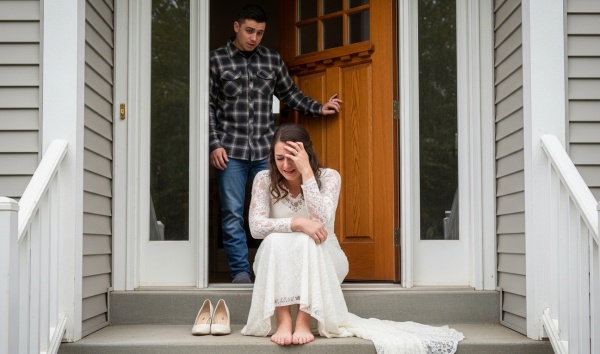
My Maid of Honor Was in Bed With My Groom. Two Hours Later, In a Wedding Dress, Bleeding and Pregnant, I Fell at the Door of My Worst Enemy. What He Did Changed Everything I Thought I Knew.
Part 1: The Wedding That Ended Before the First Dance
My name is Sophia Hartwell, and the night I collapsed on my enemy’s front porch in a wedding dress, I was supposed to be cutting a four-tier cake in a ballroom full of people who loved me. Instead, I was bleeding through ivory satin on the doorstep of the one man I had spent five years holding responsible for the worst chapter of my family’s story, in the rain, in Charleston, South Carolina, on what was supposed to be the happiest night of my life. I am 31 years old.
I am a landscape architect at a firm in downtown Charleston. I drive a gray Volvo XC40 with a cracked left taillight that I keep meaning to fix. I am telling this story because it has been four months since that night and I am only now capable of telling it in a way that is honest rather than simply raw, and because the truth of what happened — all of it, not just the parts that are easy to explain — deserves to be said out loud at least once.
The wedding was held at the William Aiken House on King Street, which is a historic antebellum property that hosts events and that I had booked fourteen months in advance because the venue had a garden that I loved professionally and personally and because I had wanted, for reasons I understand better now than I did then, to be married somewhere that felt rooted in something older and more permanent than the present moment. White garden roses.
A string quartet that played Debussy during the processional. Ivory pillar candles in brass holders that my mother and I had spent two Saturdays arranging. Six bridesmaids in dusty sage, which was a color I had agonized over for three weeks and which looked, on the day, exactly right. And a groom named Marcus Webb, who was 34 years old, a commercial real estate developer in Charleston, and who had spent two years and four months persuading me, with the patient, deliberate charm of a man who is very good at persuasion, that what I needed was stability and that stability was what he offered.
I should say something honest about Marcus before I say anything else, because honesty is the only thing this story has going for it. Marcus Webb is handsome in the specific, well-maintained way of a man who understands that appearance is a professional asset and invests in it accordingly. He is articulate, socially fluent, and genuinely skilled at making the person he is talking to feel like the most interesting person in the room.
I had been attracted to those qualities in the beginning, and I had stayed attracted to them longer than I should have, partly because after years of carrying a particular kind of grief and anger I had confused the feeling of being seen with the feeling of being safe. They are not the same thing. I know that now. I did not know it well enough on the morning of my wedding, when I stood in the bridal suite of the William Aiken House in my grandmother’s pearl earrings and told myself that the unease I felt was nerves and not instinct.
The ceremony itself was, by every external measure, beautiful. My vows came out steady. My father — who had driven up from Savannah and who cried during the processional in the specific, helpless way of fathers at their daughters’ weddings — squeezed my hand at the altar and whispered that he was proud of me. My twelve-year-old nephew, who had been assigned the ring pillow, dropped it during the exchange and then looked so stricken that the entire room laughed, and the laughter broke the formality of the moment in a way that felt genuine and warm.
For approximately forty-five minutes, standing in that garden with the afternoon light coming through the live oaks and the string quartet playing something soft, I let myself believe that I had made it — that the years of anger and grief and the particular weight I had been carrying since my father’s company collapsed were behind me, and that what was ahead was ordinary and bright and mine.
Part 2: The Text Message and the Room I Should Never Have Opened
The text arrived at 5:47 PM, while I was in the bridal suite on the second floor of the William Aiken House, sitting on a velvet ottoman and changing from my ceremony heels into the lower pair I had planned to wear for the reception. My phone was on the vanity table, and I saw the notification from across the room — unknown number, no preview text, just the notification itself sitting there with the quiet, patient quality of something that is waiting to be opened. I almost didn’t open it. I almost left it for later, for after the first dance and the toasts and the cake cutting, for the part of the evening when the formal obligations were behind me and I could sit down and breathe. I opened it.
It was a photograph. Marcus, at a hotel bar — the bar at the Dewberry Hotel, which I recognized by the distinctive lighting — two nights before our wedding. He was in a dark jacket, leaning toward the woman beside him, and his hand was under the bar top on her thigh in the specific, unhurried way of two people who are entirely comfortable with each other and are not concerned about being seen. The woman was my maid of honor, Claire Donovan.
Claire, who had been my closest friend since our sophomore year at the College of Charleston. Claire, who had thrown my bridal shower three weeks earlier and who had given a toast at the rehearsal dinner the previous night that had made my mother cry. Claire, whose hand was resting on Marcus’s forearm in the photograph with the easy familiarity of something that had been going on for long enough to be comfortable.
I stared at the photograph until my vision went soft at the edges. Then a second message arrived from the same unknown number: Room 412 if you want to see the rest. I sat on the velvet ottoman in my wedding dress in the bridal suite of the William Aiken House and I looked at those words and I felt something move through me that was not quite any single emotion but a combination of several — shock, and the specific, nauseating clarity of something you have been half-sensing and have been refusing to look at directly, and underneath both of those things a cold, settling anger that was quieter and more complete than the hot kind. I put the phone in my bouquet hand. I walked to the elevator. I pressed four.
The hallway outside room 412 was empty and carpeted and very quiet, and I stood outside the door for a moment before I touched the handle, and in that moment I heard voices through the door — Marcus’s first, and then Claire’s, and then Claire saying something that I am going to write here exactly as I heard it because I think the exactness matters: “By the time she figures out which one of us you actually meant when you said forever, it’ll be too late to matter.”
I opened the door. Marcus was half-dressed. Claire was sitting on the edge of the bed. They both looked at me with the specific, frozen expression of people who have been caught and have not yet decided what to do about it. Marcus said my name. He said it three times, in three different registers — surprise, then placation, then something that was trying to be apology — and I stood in the doorway in my wedding dress with my bouquet in my hand and I looked at the two people who had known every fear I had carried into this marriage and had chosen to do this anyway, and I felt the anger go from cold to absolute.
Part 3: The Drive I Should Not Have Taken and the Street Sign That Changed Everything
I left before anyone could stop me. Not through the main lobby — I was not capable, in that moment, of walking through a lobby full of wedding guests in a dress that was already telling its own story. I went through the service corridor, down the back stairwell, out through the kitchen exit into the alley behind King Street where the catering trucks were parked and the rain had started in the quiet, steady way that Charleston rain starts in October — not dramatic, just present, just there.
I got to my car in the side parking lot because my keys were in my small reception clutch, which I had been carrying since the ceremony, and I got in and I sat there for a moment with the rain on the windshield and the sound of the reception starting somewhere above me — I could hear the bass line of the first song the DJ was supposed to play — and I thought about going back inside. I thought about it for approximately thirty seconds. Then I started the car.
I should not have been driving. I know this with the complete, unambiguous clarity of someone who has had four months to think about it. I was in shock, in a wedding dress, in the rain, on a Friday evening in downtown Charleston, and my judgment was not available to me in any meaningful way.
I pulled out of the parking lot and I drove north on King Street without a destination, just moving, because movement felt like the only alternative to sitting still in a parking lot in a wedding dress while my reception played out one floor above me. By the time I reached Calhoun Street my breathing had gone wrong — too fast, too shallow, the specific hyperventilation of a body that is trying to process something the mind has not yet caught up to. And then the cramp hit.
It was low and sharp and sudden, and it stopped my breath completely for a moment, and I pulled over on the side of Calhoun Street and gripped the steering wheel and waited for it to pass. It did not fully pass. I had been ignoring a version of this pain since early afternoon, telling myself it was the stress of the day, the heels, the corset boning in the dress, anything that was not what I knew, somewhere underneath the telling myself, that it actually was.
Because the truth — the truth I had been carrying for three weeks and had not yet told Marcus, had been planning to tell him after the honeymoon, had been saving for a quiet moment that now would never come — was that I was nine weeks pregnant. And the pain I was feeling was not stress. It was not the heels. It was something that needed a doctor, and I was alone in a car in a wedding dress in the rain and I was not thinking clearly enough to call one.
I drove another six blocks in a state that I can only describe as dissociated — aware of the street, aware of the rain, aware of the pain that was coming in waves now rather than as a single event, but not fully connected to any of it in the way that would have produced a rational decision. And then I saw the street sign. Mercer Street. And without making a decision in any conscious sense of the word, I turned.
Because three blocks down Mercer Street, in a craftsman house with a wide front porch and a light on in the front window, lived the one person I had spent five years blaming for my father’s financial ruin. The one person who had been my father’s business partner and who had walked away from their joint venture at exactly the wrong moment, taking his capital with him and leaving my father to absorb a loss that had cost him everything.
The one person I had told myself, on multiple occasions and with genuine conviction, that I never wanted to see again. His name was Nathan Cole. And I drove to his house because some part of me that was operating below reason remembered that five years ago, before everything went wrong, he had been the person I called when I didn’t know what else to do.
Part 4: The Door That Opened and the Night That Followed
I made it to the porch. That is the honest summary of what happened between turning onto Mercer Street and the moment the front door opened — I made it to the porch, which required parking the car at the curb, getting out in the rain, walking up the front path in wet satin that weighed approximately fifteen pounds, climbing four porch steps while holding the railing with both hands, and pressing the doorbell once with a finger that was not entirely steady.
Then the door opened. Nathan Cole was standing in it, in a gray t-shirt and jeans, holding a coffee mug, with the specific, unguarded expression of a man who was not expecting anyone and is therefore showing his actual face rather than the managed version. He looked at me. His face went through several things very quickly — recognition, confusion, and then something that was not either of those things, something that looked like alarm. I opened my mouth to say something. Then the porch came up to meet me.
I woke up on a couch. Not the porch — a couch, inside, with a blanket over me that smelled like cedar and laundry detergent, and a lamp on low on the table beside me, and Nathan Cole sitting in the armchair across from me with his phone in his hand and the expression of a man who has been watching someone sleep and is relieved to see them wake up. He had called 911 — I learned this in the first thirty seconds of consciousness, when he told me that an ambulance was four minutes away and that I needed to stay still.
I tried to sit up. He said, “Please don’t do that.” His voice was calm in the specific way of someone who is managing their own alarm by focusing on practical tasks. I lay back down. I looked at the ceiling of Nathan Cole’s living room and I thought, with the particular clarity of someone who has just regained consciousness, that this was possibly the strangest night of my life.
The paramedics arrived in three minutes and forty seconds, which I know because Nathan told me later that he had been counting. They were thorough and efficient and entirely professional, and they asked me questions that I answered as honestly as I could given that I was nine weeks pregnant, in a wedding dress, and had just fainted on a man’s porch under circumstances that were difficult to summarize quickly.
Nathan gave them the information I couldn’t — that I had been conscious when I arrived, that I had collapsed almost immediately, that I had been in visible pain. He gave them this information with the precise, factual delivery of someone who has organized it in his head and is presenting it in the order that is most useful.
One of the paramedics looked at him and asked if he was family. He said, “No. But I’m coming with her.” The paramedic looked at me. I said, “Yes.” I don’t know why I said yes. I said it before I had time to think about whether I meant it, and I think that the not-thinking was the most honest thing I did that night.
The hospital was MUSC Medical Center on Jonathan Lucas Street, and the emergency department team was exactly what you want an emergency department team to be — fast, competent, and focused on the problem rather than the story surrounding it. The OB on call was a woman named Dr. Renee Okafor, who examined me with the calm, thorough attention of someone who has seen complicated situations and understands that the complication is not the point.
She told me, after the ultrasound, that the pregnancy was intact — that what I had experienced was a threatened miscarriage brought on by extreme physical and emotional stress, and that with rest and monitoring the prognosis was cautiously good. She said cautiously good in the specific way of a doctor who means it and wants you to understand both words. I said I understood.
I lay in the hospital bed in what remained of my wedding dress and I looked at the ceiling and I cried for the first time since I had opened that hotel room door, quietly and completely, in the way that crying happens when you have been holding everything together through sheer will and the will has finally run out.
Part 5: The Morning After and the Truth About Nathan Cole
Nathan was in the waiting room when Dr. Okafor came out to update him, which she did because I had listed him as my emergency contact — not because I had planned to, but because the intake nurse had asked for a name and he was the only person in the building and I had given his name before I had thought about what that meant.
My mother was on her way from the hotel, having been called by my cousin when I disappeared from the reception. My father was driving up from Savannah. The world was reorganizing itself around what had happened, the way it does, and Nathan Cole was sitting in a plastic chair in the MUSC emergency waiting room at midnight on a Friday, still in his gray t-shirt, still holding the coffee mug he had been holding when he opened the door, because he had carried it to the ambulance and apparently no one had thought to take it from him.
He came in when the nurse said he could. He sat in the chair beside the bed and he looked at me with the direct, steady gaze that I had forgotten about — that specific quality of attention that had once been one of the things I valued most about him and that I had spent five years trying to reframe as arrogance.
It was not arrogance. It was just the way he looked at things — fully, without looking away. He said, “How are you?” I said, “I’ve been better.” He almost smiled. I said, “Nathan, I need to ask you something.” He said, “Okay.” I said, “Why did you bring me inside? You could have called 911 from the porch.” He was quiet for a moment. Then he said, “Because it was raining and you were hurt and I wasn’t going to leave you on the porch, Sophia. Whatever you think of me, I wasn’t going to do that.”
I had spent five years believing a story about Nathan Cole that I had constructed from incomplete information and sustained through the specific, self-reinforcing logic of grief that needs someone to blame. My father’s business had failed. Nathan had withdrawn his investment at a critical moment.
I had connected those two facts with a line of causation that felt, at the time, entirely clear and entirely justified. What I had not done — what I had been too angry and too grief-stricken to do — was ask Nathan directly what had happened and why. I had assumed. I had built the assumption into a conviction. I had carried the conviction for five years like a stone in my chest.
Lying in a hospital bed at MUSC at one in the morning, with my wedding dress folded on the chair in the corner and my pregnancy intact and my marriage ended before the first dance, I asked him. I said, “Tell me what actually happened with my father’s company.” And he told me.
The story Nathan told was not the story I had been telling myself. He had withdrawn his investment, yes — but he had withdrawn it after discovering that the third partner in the venture, a man named Greg Harlow whom my father had brought in without Nathan’s full knowledge, had been misrepresenting the company’s financials to outside investors in a way that constituted fraud.
Nathan had gone to my father first. He had shown him the documentation. He had given my father two weeks to address it before he pulled out, and he had pulled out not to protect himself but because staying in would have made him legally complicit in something that was going to collapse regardless. My father had known. My father had chosen not to tell me, because he was ashamed, and because it was easier to let me believe that Nathan’s departure had been the cause rather than the symptom.
Nathan had never corrected my belief because my father had asked him not to, and because Nathan — this man I had spent five years hating — had respected my father’s request even at the cost of his own reputation with me.
I called my father from the hospital room at 2 AM. He answered immediately, which told me he had not been sleeping. I told him I knew. He was quiet for a long time. Then he said, “I’m sorry, Sophia. I should have told you years ago.” He said it with the specific, exhausted honesty of a man who has been carrying something for a long time and is relieved to put it down. I said, “I know, Dad.” I said, “I love you.” I said, “Drive carefully.” I hung up.
I looked at Nathan, who had heard the whole conversation and who was looking at the middle distance with the careful expression of someone who is trying to give a moment its privacy. I said, “I owe you five years of an apology.” He said, “You don’t owe me anything.” I said, “I do. And I’m going to give it to you properly when I’m not in a hospital gown.” He looked at me then — the full, direct look — and he said, “I’ll hold you to that.”
My mother arrived at 2:30 AM and took over with the efficient, loving authority of a woman who has been managing crises since before I was born. The pregnancy continued. Marcus Webb received, through my attorney, the documentation required to begin annulment proceedings, which in South Carolina are available under specific circumstances that a wedding night discovery of infidelity with the maid of honor qualifies for with very little ambiguity.
Claire Donovan has not contacted me. I have not contacted her. Some silences are their own resolution. Nathan and I had the proper conversation — the apology, the full accounting of five years of misunderstanding, the long and honest reckoning with what had been lost and what might, carefully and without rushing, be found — three weeks after the hospital, over coffee at a place on East Bay Street that we both knew from before everything went wrong.
It lasted four hours. We have had several conversations since. I am not going to tell you what they mean yet, because I don’t fully know, and because some things deserve to be understood before they are announced.
What I know is this: I am 31 years old, I am going to be a mother in approximately six months, and the night I collapsed on my enemy’s porch in a wedding dress was the night I stopped carrying a story that had never been entirely true. The man I thought I hated turned out to be the man who carried me inside out of the rain. The marriage I thought I wanted turned out to be built on the same incomplete information as the hatred.
And the life I am building now — slowly, honestly, without the weight of the story I had been telling myself for five years — is already, in its early and uncertain shape, more real than anything I had before that night. Some doors close in ways that feel like endings. Some of them, it turns out, are just the rain stopping.
