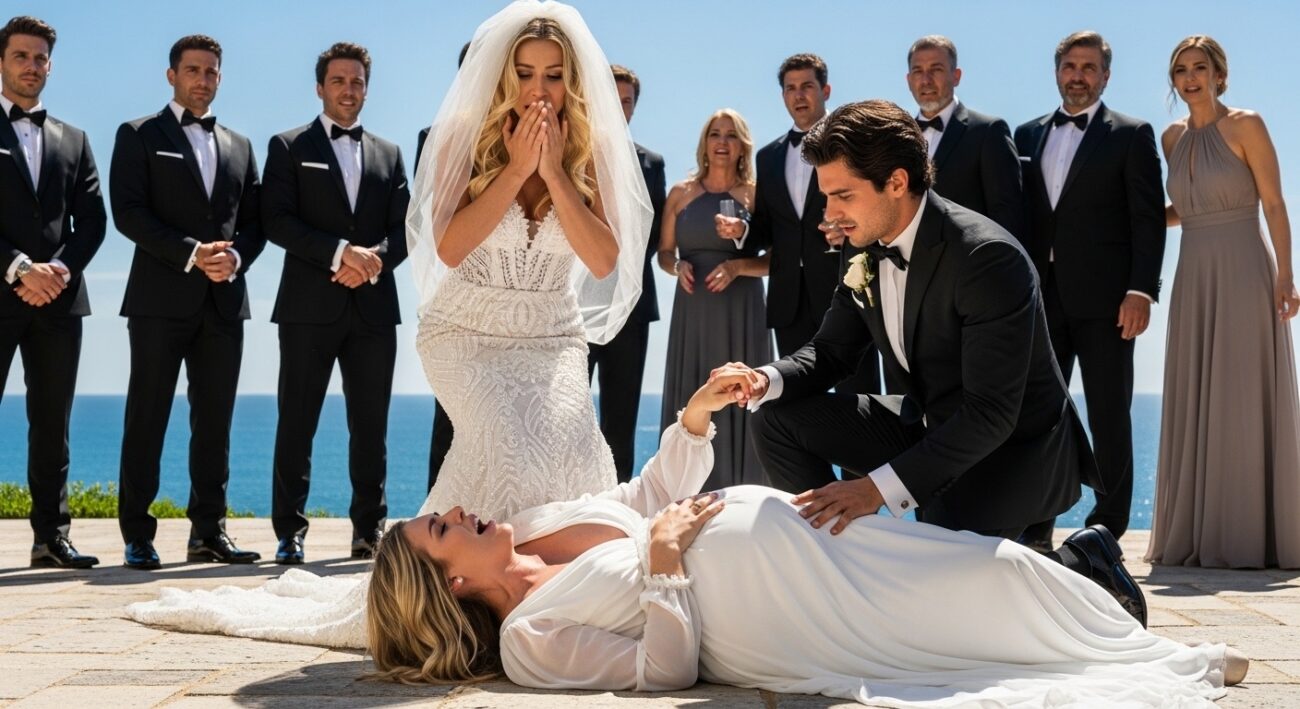
He Left Me for Someone Else — Seven Months Later, I Collapsed at His Wedding and He Found Out I Was Carrying His Triplets, And what happened next was so terrible…
Part 1: The Marriage That Ended Before I Knew What I Was Carrying
My name is Rachel Donovan, and I am 32 years old, and I am writing this from a hospital bed in Nashville, Tennessee, with three heartbeats on a monitor beside me and a story that I have been carrying alone for seven months and that I can no longer carry alone. I am a freelance graphic designer who works from home, or who did work from home before the bed rest order that has kept me in this room for the past three weeks.
I drive a 2019 Subaru Outback that my mother helped me buy after the divorce, and I live in a two-bedroom rental in the East Nashville neighborhood that costs $1,850 a month and that I have been paying for entirely on my own since last February. I am telling this story because something happened eleven days ago at the Hermitage Hotel in downtown Nashville that I did not plan and could not have predicted, and because the people who were in that ballroom deserve to understand what they witnessed, and because I am tired — genuinely, physically, emotionally tired — of being the only person who knows the whole truth.
I need to start with Marcus, because nothing that follows makes sense without him. Marcus Cole is 38 years old, the founder and CEO of Cole Ventures, a Nashville-based private equity firm that manages approximately $340 million in assets and that he built from a $200,000 seed investment at age 27 into something that has made him, by any honest accounting, genuinely wealthy.
He is six foot two, with the specific, composed confidence of a man who has been successful for long enough that success has become his natural register rather than something he is performing. He is not cruel. I want to say that clearly, because this story could be told in a way that makes him a villain, and I do not think he is a villain. I think he is a man who made decisions that were wrong and that he did not fully understand were wrong until eleven days ago, in a hotel ballroom, when he saw me on the floor.
Marcus and I met at a design conference in Nashville six years ago, when I was 26 and he was 32 and his company was three years old and growing fast. I had been hired to do some branding work for a startup that was presenting at the conference, and he was there as an investor evaluating pitches.
We ended up at the same table at the conference dinner, and we talked for four hours about things that had nothing to do with business — about the city, about music, about the specific experience of building something from nothing and not being sure, on most days, whether it was going to work. He was the most interesting person I had talked to in a long time. I told him so. He laughed and said I was the most honest person he had talked to in a long time. We exchanged numbers. He called the next morning.
We dated for fourteen months and married in a small ceremony at a vineyard outside Nashville that cost $28,000 and that felt, on that day, like exactly the right expression of who we were — not extravagant, not performative, but real and chosen and built on something solid. We bought a house in the Green Hills neighborhood for $680,000.
We built a life that worked, that was genuinely good, that had the specific warmth of two people who like each other as much as they love each other. I was happy. I believe Marcus was happy too, in the way that people are happy when things are going well and they have not yet been tested by anything that requires them to choose between what they want and what is right.
Part 2: The Divorce I Did Not See Coming and the Secret I Did Not Know I Was Keeping
The marriage lasted three years. The ending came in the way that some endings come — not with a dramatic rupture but with a gradual, accumulating distance that I kept trying to close and that kept reopening, until one evening Marcus sat across from me at the kitchen table of the Green Hills house and told me, with the careful, rehearsed honesty of someone who has been preparing this conversation for a while, that he did not think we were right for each other anymore.
He said he had been feeling disconnected for about a year. He said he cared about me deeply but was not sure he was in love with me in the way that a marriage required. He said he had met someone — a woman named Courtney Briggs, 29, a commercial real estate broker — and that nothing had happened, but that the fact of his feelings for her had clarified something for him about what was missing between us.
I sat at that kitchen table and I listened to my husband tell me our marriage was over with the specific, suspended disbelief of someone receiving information that their body has not yet processed. I did not cry. I did not argue. I asked him one question: “How long have you known?” He said, “Honestly? About eight months.” Eight months.
He had known for eight months and had said nothing, had continued our life together in the ordinary, daily way of a marriage while carrying the knowledge that he was ending it, and I had noticed nothing — or rather, I had noticed the distance and had attributed it to the stress of the business and had not looked more closely because looking more closely felt, at the time, like borrowing trouble. I had been wrong about that. The trouble had already arrived. I just hadn’t been told.
The divorce was handled through attorneys — his, a family law partner at a large Nashville firm, and mine, a solo practitioner in Midtown who was thorough and fair and who helped me reach a settlement that I considered equitable. We had a prenuptial agreement, which Marcus had asked for before the wedding and which I had signed without resentment because I understood his reasons and because I trusted him.
The settlement gave me $85,000 as a transitional support payment, my car, and my personal property. The Green Hills house was his. I moved into the East Nashville rental in February, two months after the kitchen table conversation, and I began the specific, unglamorous work of rebuilding a life that had been interrupted.
What I did not know, when I signed the divorce papers and moved into the rental and began the rebuilding, was that I was pregnant. I did not know because I did not find out until six weeks after the divorce was finalized, at a routine appointment with my OB-GYN that I had scheduled because I had been feeling unusually tired and had attributed it to the stress of the divorce and the move. My doctor ordered a blood panel. She called me two days later.
She said, “Rachel, your HCG levels are elevated. I’d like you to come in for an ultrasound.” I came in the next morning. The ultrasound technician was quiet for a moment after she started the scan, and then she said, in the careful, measured tone of someone delivering significant information: “Rachel, I’m seeing three gestational sacs.” Three. I stared at the ceiling of the exam room and I did not speak for a long time.
Part 3: The Seven Months I Carried This Alone
I want to be honest about the decision I made in the days after that ultrasound, because I think the honesty is important and because I have examined that decision from every angle for seven months and I stand by it even knowing how it ended. I decided not to tell Marcus. I made this decision for reasons that were not simple and that I am going to explain as clearly as I can. The divorce had been finalized. Marcus had moved on — he and Courtney were together, publicly and apparently seriously, and the life he had chosen was proceeding in the direction he had chosen.
I was not willing to insert myself back into that life with a pregnancy announcement that would feel, to everyone involved, like a complication or a claim. I was not willing to be the woman who used a pregnancy to pull a man back from a relationship he had chosen. I was not willing to put my children — my three children, a fact I was still absorbing — in the position of being obligations rather than desires.
I also, if I am being entirely honest, did not know how Marcus would respond. The man who had sat across from me at the kitchen table and told me our marriage was over with eight months of prior knowledge had demonstrated a capacity for compartmentalization that I had not previously understood him to have. I did not know whether the news of triplets would bring out the best version of him or a version I had not yet seen, and I was not in a position — financially, emotionally, physically — to manage his response on top of everything else I was managing.
So I said nothing. I told my mother, who cried and then immediately started researching triple strollers. I told my best friend Diane, who said “oh my God” approximately fourteen times and then started a meal prep schedule. I told no one else. I went to my appointments. I did my prenatal yoga. I worked from my laptop in bed when the fatigue allowed it. I grew, slowly and then all at once, in the way of a woman carrying three.
The pregnancy was classified as high-risk from the beginning, which is standard for triplet pregnancies, and my maternal-fetal medicine specialist — Dr. Patricia Okafor, at Vanderbilt University Medical Center — was thorough and careful and honest with me about the risks and the monitoring requirements.
I was on modified activity restriction from month four and full bed rest from month six. I had gained 38 pounds by month seven, which Dr. Okafor said was appropriate and which felt, on the days when I could not get comfortable in any position, like an abstract fact about someone else’s body. I was tired in a way that I had not known tiredness could be — not sleepy, but depleted, the specific exhaustion of a body that is doing something enormous and drawing on every reserve to do it.
I knew about the wedding because Nashville is not a large city in the ways that matter, and because Diane, who moves in overlapping professional circles with Marcus’s world, had heard about it and told me with the careful, watchful expression of someone delivering information they are not sure you want. Marcus and Courtney were getting married at the Hermitage Hotel on the first Saturday of November.
I noted this information and I filed it and I told myself it had nothing to do with me. I was seven months pregnant with triplets and on bed rest and the wedding of my ex-husband was not my concern. I believed this. I continued to believe it until the Thursday before the wedding, when my mother called to tell me that her sister — my Aunt Carol, who had been a friend of Marcus’s mother for twenty years and who had been invited to the wedding in that capacity — had fallen and broken her wrist and could not attend and had asked, with the specific, well-meaning obliviousness of a woman who does not fully understand the situation, whether I might want to use her seat.
I should have said no. I know I should have said no. I said no, initially, and then I spent two days thinking about it, and on Saturday morning I put on the only dress that still fit — a navy wrap dress that accommodated the full, extraordinary fact of my midsection — and I drove to the Hermitage Hotel. I have asked myself many times since why I went, and the honest answer is that I do not fully know. Curiosity, maybe. Closure, possibly.
The specific, irrational impulse of a pregnant woman in her third trimester who has been alone with a secret for seven months and who wanted, for reasons she could not entirely articulate, to be in the same room as the person the secret was about. I parked the car. I walked inside. I found my seat in the back of the ballroom. I told myself I would leave after the ceremony.
Part 4: The Moment Everything Stopped
The ballroom of the Hermitage Hotel holds approximately 280 people, and it was full. The ceremony was scheduled for 4 PM, and I arrived at 3:45 and found my seat in the last row on the left side, near the aisle, which I had chosen deliberately because it was close to the exit and because I had told myself, multiple times on the drive over, that I was going to leave the moment the ceremony ended.
The room was decorated in the specific, expensive way of a wedding with a significant budget — white florals, candlelight, the kind of aesthetic that requires a professional coordinator and a number with a comma in it. Courtney’s bridesmaids were in dusty rose. The groomsmen were in charcoal. Everything was exactly as it should be, and I sat in my chair in the last row and I breathed carefully and I told myself I was fine.
Marcus walked out first, with his best man, and I saw him from across the room before he could possibly have seen me. He was in a dark navy suit, and he looked the way he always looked at events — composed, present, slightly apart from the room in the way of someone who is accustomed to being watched. He was smiling.
Not the performed smile of a man going through the motions, but a real smile, the one I recognized from the early years of our marriage, and seeing it produced in me a feeling that I was not prepared for — not jealousy, exactly, but something adjacent to grief, the specific grief of recognizing something that used to belong to you and understanding, finally and completely, that it no longer does.
The music started. Courtney appeared at the back of the aisle, and the room turned to look at her, and I turned with it, and she was beautiful in the specific, radiant way of a woman who is exactly where she wants to be. I watched her walk down the aisle. I watched Marcus’s face when he saw her. I watched the officiant begin the ceremony with the standard words about love and commitment and the choice to build a life together.
And somewhere in the middle of the vows — somewhere between to have and to hold and for as long as we both shall live — I felt something that was not grief and not emotion but physical, a wave of dizziness so complete and so sudden that I reached for the back of the chair in front of me and missed it.
I do not remember hitting the floor. I remember the dizziness, and then I remember voices — several of them, close and urgent — and then I remember a face above me that I recognized as belonging to a woman I did not know, who was saying my name and asking me to stay with her. I learned later that she was an ER nurse who had been seated two rows ahead of me and who had reached me within seconds. I learned later that the ceremony had stopped.
I learned later that Marcus had come down the aisle at a pace that several guests described as running. What I remember, from my position on the floor of the Hermitage Hotel ballroom, is opening my eyes and seeing his face — the face of the man I had been married to, the man whose children I was carrying, the man who had been in the middle of marrying someone else — looking down at me with an expression I had never seen on him before.
Not composure. Not the managed, careful affect of a man who is always in control. Something rawer than that. Something that looked, from where I was lying, like fear.
Part 5: What He Learned and What Comes Next
The ambulance arrived in eleven minutes. I know this because the nurse who stayed with me — her name was Jennifer Castillo, and I have since sent her flowers and a note that was entirely inadequate to what she did — kept talking to me in the calm, steady way of someone who is monitoring a situation and keeping a patient present, and she told me later that she had been timing the response. Marcus rode in the ambulance. I did not ask him to.
He simply got in, and no one stopped him, and he sat across from me on the narrow bench seat and he looked at my midsection — at the full, unmistakable reality of a pregnancy that was seven months along and carrying three — and he said nothing for a long time. Then he said, very quietly: “Rachel. How long?” I said, “Seven months.” He said, “Are they—” He stopped. He started again. “Are they mine?” I looked at him. I said, “Yes.”
He was quiet for the rest of the ambulance ride. Not the quiet of a man who is shutting down, but the quiet of a man who is absorbing something enormous and does not have the words for it yet. At the hospital, Dr. Okafor’s team took over with the efficient, focused urgency of people who had been briefed by the paramedics and understood the situation. I was assessed, monitored, stabilized.
The babies — two girls and a boy, which I had known for two months and had not told anyone except my mother and Diane — were on the monitors, all three heartbeats steady and present and exactly where they should be. Dr. Okafor told me I had experienced a vasovagal episode, likely triggered by the heat of the room and the physical stress of sitting upright for an extended period, and that I and the babies were not in immediate danger but that the bed rest order was now absolute and non-negotiable. I said I understood. She gave me a look that said she was going to hold me to that.
Marcus stayed. Courtney came to the hospital — I learned this from Diane, who was in the waiting room and who texted me a running account with the specific, loyal efficiency of a best friend who understands that information is what you need right now. Courtney and Marcus spoke in the hallway for a long time.
I do not know what was said. I know that Courtney left the hospital at 7:43 PM, which was three hours and twenty-two minutes after the ambulance had arrived, and that Marcus did not leave with her. He came into my room at 8 PM, after the nurses had settled me and dimmed the lights and the monitors were doing their steady, reassuring work. He sat in the chair beside the bed. He looked at the three waveforms on the monitor for a long time without speaking. Then he said: “Tell me what you need.”
I told him the truth. I told him that I had not told him because I did not want to be a complication in a life he had chosen, and that I stood by that decision even knowing how it had ended. I told him that I was not asking him for anything — not money, not presence, not a role he did not want to play.
I told him that the babies were his and that I had always intended to tell them that when they were old enough to ask, and that I had a plan for raising them and a support system and a life that was going to be sufficient for the four of us. I told him all of this in the calm, practical way that I tell hard things, and when I was done he was quiet for a moment and then he said: “Rachel, I have three children on that monitor. I don’t need you to tell me what you need. I’m asking because I want to know. And I’m not going anywhere until we figure this out together.”
I do not know what comes next. I want to be honest about that, because this is not a story with a clean resolution, and I am suspicious of stories that end too neatly. Marcus and I are not getting back together — that is not what this is, and I think we both understand that clearly.
What we are is two people who share three children who are not yet born and who are going to have to figure out, together and carefully and probably with the help of attorneys and mediators and possibly a therapist or two, what that means for the next eighteen years. Marcus has been at the hospital every day since I was admitted. He brings coffee for my mother, who has been here most days, and he sits with me in the evenings and we talk — not about the past, not about the wedding that did not finish, not about the seven months of silence, but about the babies.
About names. About the logistics of a triplet nursery. About what kind of father he wants to be. He talks about it with the focused, earnest seriousness of a man who has been given information that has reordered his priorities and is trying to rise to the reordering.
I have three babies coming. Two girls and a boy, all of them healthy, all of them on the monitor beside me right now as I write this. I have a mother who has already bought three of everything and a best friend who has a meal prep schedule that runs through March. I have a life that is about to become something I could not have imagined a year ago, or seven months ago, or even eleven days ago when I put on a navy wrap dress and drove to a hotel where I had no business being.
I have a story that I have been carrying alone and that I am putting down here, finally, because the carrying alone is finished. The next part — whatever it is, however it goes — I am not going to do alone. That much, at least, I know.
