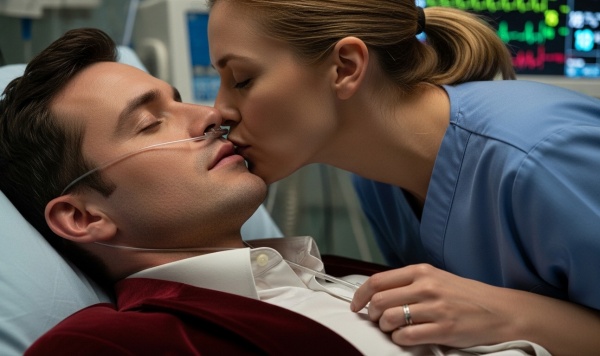
A Nured Kissed a Coma Patient at 2:30 AM Thinking He Would Never Wake Up…. But Seconds Later He Opened His Eyes and Held her”
I’m a nurse at Northwestern Memorial in Chicago, and I did something I can’t fully justify. After four months caring for Connor Hayes—a 34-year-old architect in a coma after a car accident—I kissed his forehead at 2:30 AM during a quiet overnight shift and whispered that I saw him as more than a patient. Seconds later, his hand tightened around mine. Then he opened his eyes for the first time in four months…. KISSED A COMA PATIENT THINKING HE WOULD NEVER WAKE UP… BUT SECONDS LATER, HE OPENED HIS EYES AND EMBRACED HER.”
Part 1: The Patient Who Changed Everything
My name is Rachel Donovan, and I’m 31 years old, working as a registered nurse at Northwestern Memorial Hospital in Chicago, Illinois. I’ve been a nurse for seven years, and in that time, I’ve seen things that would break most people—deaths, recoveries, miracles, and tragedies. I thought I’d built enough emotional armor to handle anything this job could throw at me. I was wrong. Because eight months ago, a man named Connor Hayes was brought into our ICU after a catastrophic car accident on I-90, and nothing about my carefully constructed professional walls survived the next four months of caring for him.
I need to be clear about something before I tell this story: what I did was unprofessional, and I’ve thought about it every single day since it happened. I’ve questioned my judgment, my ethics, my fitness to be a nurse. But I’ve also come to understand that sometimes the heart does things the mind can’t fully explain, and sometimes those inexplicable things lead to the most profound moments of your life. This is one of those stories. And I’m telling it because I think other people need to hear that love doesn’t always follow the rules we set for it.
Connor Hayes was 34 years old when he was admitted to our ICU on a Tuesday night in February. He’d been driving home from a late meeting when a drunk driver ran a red light on Michigan Avenue and hit his car at approximately 55 miles per hour. The impact was devastating. Connor suffered a traumatic brain injury, three broken ribs, a punctured lung, and internal bleeding that required emergency surgery lasting six hours. When he came out of surgery, he was alive but unconscious, placed on a ventilator, and given what the attending physician, Dr. Marcus Webb, described as “a guarded prognosis.”
In plain terms, nobody knew if Connor would wake up. The brain injury was severe enough that Dr. Webb told Connor’s family—his mother, Patricia Hayes, and his younger sister, Megan—that there was a real possibility he might never regain consciousness. He was in what doctors call a minimally conscious state, which is different from a true coma but still meant he showed no reliable signs of awareness. Patricia, a 62-year-old retired teacher from Naperville, sat by his bed every day from 8 AM to 8 PM, talking to him, reading to him, playing his favorite music. Megan, who lived in Denver, flew in every weekend. They were devoted, loving, and absolutely heartbroken.
I was assigned to Connor’s care on my second week back from a leave of absence I’d taken after my own difficult period. My mother had passed away from ovarian cancer six months earlier, and I’d taken eight weeks off to grieve and recover. Coming back to the ICU was hard—every patient felt more fragile, every family felt more real, every loss felt more personal. My supervisor, Charge Nurse Linda Torres, had suggested I might want to request a different unit, something less intense. But nursing was how I processed things, how I found meaning, and I needed to be where I felt most useful.
Connor was in Room 7, the corner room with the window that looked out over Lake Michigan. On clear days, the water was visible from his bed, a strip of deep blue between the buildings. I don’t know why I noticed that detail on my first day caring for him, but I did. I thought about whether he’d appreciate that view when he woke up, whether he was the kind of person who loved the lake. I found myself wondering about him as a person, not just as a patient, which was unusual for me. I’d always been good at maintaining professional distance. With Connor, that distance started eroding from day one.
Part 2: The Man I Came to Know Without Words

Over the first two weeks, I learned everything about Connor Hayes from the people who loved him. Patricia talked constantly while she sat with him—she was the kind of woman who filled silence with stories, and I think it was her way of coping. From her, I learned that Connor was an architect who’d founded his own firm, Hayes Design Group, at 29 years old. The firm had grown to 45 employees and had designed several notable buildings in Chicago, including a community center on the South Side that Connor had done pro bono because he believed in the neighborhood. He was, by all accounts, a genuinely good man.
Megan brought photos and taped them to the wall beside his bed—Connor at his firm’s opening party, laughing with colleagues. Connor at a Cubs game, wearing a blue cap and grinning. Connor hiking in Colorado, standing at the top of a mountain with his arms spread wide. Connor at Christmas with his family, his arm around his mother, looking like a man who was completely at peace with his life. I looked at those photos every time I came into the room, and I felt like I was getting to know him in a strange, one-sided way. I knew his laugh before I ever heard it. I knew his eyes before they ever opened.
I also learned that Connor had been single for two years, since ending a long-term relationship with a woman named Diane who’d moved to Seattle for a job opportunity. Patricia mentioned it matter-of-factly one afternoon, not as gossip but as context. “He’s been focused on the firm,” she said. “He always says there’s time for love later. He doesn’t realize later can become never.” She looked at her son lying in the bed, and her voice broke. “I just want him to have more time. More of everything.”
As weeks turned into months, Connor’s condition remained stable but unchanged. He breathed on his own after the first three weeks—the ventilator was removed, which was a good sign. His vital signs were strong. Dr. Webb said his brain activity showed patterns that suggested awareness was possible, maybe even likely. But he didn’t wake up. Days turned into weeks, weeks turned into months, and Connor Hayes lay in Room 7 while the world outside continued without him.
I developed routines around his care that went beyond what was strictly required. I talked to him while I checked his vitals, telling him about the weather outside, about what was happening in the city, about small things I thought might interest him based on what I’d learned from his family. “The Cubs won last night,” I’d say, adjusting his IV. “Patricia says you’d be happy about that.” Or, “There’s a new building going up on Wacker Drive. I don’t know if it’s one of yours, but I thought you’d want to know.” I knew he probably couldn’t hear me. But I also knew that talking to coma patients was medically supported, that familiar voices and stimulation could help. So I talked.
What I didn’t admit to myself for a long time was that I looked forward to those conversations. That Room 7 had become the part of my shift I thought about most. That I’d started reading about architecture on my days off, so I’d have more to tell him. That when I walked past his room on days I wasn’t assigned to him, I’d find reasons to stop in and check on him. My colleague and closest friend, Nurse Priya Sharma, noticed before I did. “Rachel,” she said one afternoon, “you know you’re in that room twice as much as you need to be, right?” I told her I was just being thorough. She gave me the look that said she didn’t believe me for a second.
Part 3: The Night Everything Changed
Four months after Connor’s admission, on a Thursday night in June, I was working the overnight shift. The ICU was quiet—as quiet as an ICU ever gets—and I was doing my rounds. Patricia had gone home at 8 PM as usual, and Megan was back in Denver. Connor had no visitors, which was unusual. The floor was understaffed that night because two nurses had called in sick, which meant I was covering more rooms than normal and running on my third cup of coffee.
At 2:30 AM, I went into Room 7 to do Connor’s vitals check. The room was dim, lit only by the soft glow of the monitors and the ambient light from the city outside the window. Lake Michigan was invisible in the darkness, but the city lights reflected off the water in a way that made the window glow faintly. I checked his blood pressure—normal. His heart rate—steady and strong. His oxygen levels—perfect. Physically, Connor Hayes was in excellent health for a man who hadn’t been conscious in four months.
I stood beside his bed, looking at him. In four months, I’d memorized his face the way you memorize a place you love—every detail familiar and comforting. The strong jaw with the slight stubble that his family kept trimmed. The dark lashes against his cheeks. The small scar above his left eyebrow that Megan had told me came from a childhood bike accident. He looked peaceful, which was both a comfort and a heartbreak. He looked like a man who was simply sleeping, like he might wake up at any moment and ask what time it was.
I don’t know exactly what happened in that moment. I’ve tried to explain it to myself a hundred times, and the best I can do is say that four months of grief, loneliness, and unexplained connection collided in the quiet of that room at 2:30 in the morning. I thought about my mother, who’d died without me getting to say everything I needed to say. I thought about Patricia, who came every day and talked to her son because she refused to give up hope. I thought about Megan’s photos on the wall and the man in them who looked so alive, so full of joy, so present in his own life.
I reached out and took Connor’s hand, the way I’d done dozens of times before for clinical reasons. But this time, I held it like it meant something. “I don’t know if you can hear me,” I said softly, my voice barely above a whisper. “But I want you to know that I see you. Not just as a patient. I see the person your family talks about, the person in those photos, the man who built a community center because he believed in a neighborhood. I see someone worth waking up for.” I paused, feeling foolish and emotional and not caring. “Your mom needs you to wake up. Your sister needs you. And I know this is completely inappropriate, and I know you don’t even know my name, but I—”
I stopped. I looked at his face, so still and so familiar. And then I did something I cannot fully explain and have never been able to fully justify. I leaned down and pressed my lips gently to his forehead. Not a romantic kiss—more like the kind of kiss you give someone you’re terrified of losing. The kind of kiss that says please come back more than anything else. It lasted maybe two seconds. I pulled back, my face burning with embarrassment, grateful that the room was empty and the cameras in the ICU only covered the doorways, not the patient beds.
“I’m sorry,” I whispered, to him and to myself. “That was completely unprofessional. I just—” And then Connor Hayes moved. His fingers, which had been still in my hand, tightened. Slowly, unmistakably, his hand closed around mine. I froze, staring at our joined hands, telling myself it was an involuntary muscle response, that it meant nothing, that it happened sometimes with unconscious patients. But then his eyelids fluttered. Once. Twice. And then, after four months of stillness, Connor Hayes opened his eyes.
Part 4: The Awakening That Defied All Expectations
For a moment, neither of us moved. Connor’s eyes were open—dark brown, exactly as they appeared in Megan’s photos—and they were looking directly at me. Not the unfocused gaze of someone emerging from unconsciousness, not the confused blinking of a man who didn’t know where he was. He was looking at me with a clarity that made my heart stop. His hand was still holding mine. Then, slowly, with the careful deliberateness of someone relearning how to use their body, he lifted his other arm and reached toward me.
I should have stepped back. I should have called for the attending physician immediately, should have followed protocol, should have done the dozen things a nurse is trained to do when a coma patient regains consciousness. Instead, I stood there, completely frozen, as Connor Hayes—who had been unconscious for four months—put his arm around me and pulled me gently toward him. Not forcefully, not with the confused strength of a disoriented patient. Gently, like he knew exactly what he was doing.
I found myself leaning into him, my hand still in his, my face close to his. “Connor,” I said, my voice shaking. “Connor, can you hear me? Do you know where you are?” His lips moved. The first words he’d spoken in four months came out as a rough whisper, his voice hoarse from disuse. “You talked to me,” he said. “About the Cubs. About the building on Wacker Drive.” I felt tears streaming down my face. “You could hear me?” “Not always,” he whispered. “But sometimes. Your voice was… it was something to hold onto.”
I finally did what I should have done immediately—I pressed the call button, and within minutes, Room 7 was full of people. Dr. Webb arrived in scrubs, clearly pulled from sleep, his expression shifting from irritation to shock when he saw Connor sitting up in bed, eyes open, responding to questions. The night charge nurse, two other nurses, and a neurologist on call all crowded into the room. Connor answered their questions slowly but coherently. He knew his name. He knew the year. He knew he’d been in an accident. His cognitive function, while understandably slow and foggy, was remarkably intact.
I stood in the corner of the room, out of the way, watching the medical team work. I was still shaking, still processing what had happened. Dr. Webb kept glancing at me with an expression I couldn’t read—not accusatory, but curious. When the initial assessment was done and Connor had been stabilized, Dr. Webb pulled me aside in the hallway. “Walk me through what happened,” he said. I told him everything. Almost everything. I told him I’d been doing Connor’s vitals check, that I’d been talking to him as I usually did, that his hand had tightened around mine and then he’d opened his eyes. I left out the kiss. I left out everything I’d said to him in the dark.
Dr. Webb nodded slowly. “His brain activity has been showing increasing patterns of awareness for the past two weeks. We knew he was getting closer. Sometimes all it takes is the right stimulus at the right moment—a familiar voice, a touch, something that gives the brain a reason to fight its way back to consciousness.” He paused. “You’ve been talking to him regularly?” “Every shift,” I admitted. “I know it’s more than required. I just thought—” “It may have helped,” Dr. Webb said. “Genuinely. We don’t fully understand what reaches patients in his state, but stimulation and familiar voices are consistently associated with better outcomes. You did good work, Rachel.”
Patricia arrived at 6 AM, called by the night charge nurse. I was still on shift when she walked into Room 7 and saw her son sitting up in bed, and the sound she made—somewhere between a sob and a laugh—was one of the most beautiful things I’ve ever heard. She held his face in her hands and cried, and Connor held her and said, “I’m here, Mom. I’m here.” Megan was on a flight from Denver by 8 AM. I watched the reunion from the doorway, and I felt something shift in my chest—a grief I’d been carrying for months, for my mother, for all the patients I’d lost, loosening just slightly.
Part 5: The Love That Grew in the Light
Connor’s recovery was remarkable by any medical standard. Within a week, he was off most monitoring equipment. Within two weeks, he was doing physical therapy, relearning the muscle coordination that four months of immobility had affected. His speech returned fully within days. His cognitive function, while requiring some rehabilitation, was assessed as largely intact. Dr. Webb called it “one of the most complete recoveries from prolonged unconsciousness” he’d seen in twenty years of practice.
I was not assigned to Connor’s care after he regained consciousness. That was standard protocol—once a patient in the ICU becomes fully conscious and stable, their care transitions to a different team. I told myself I was relieved, that the professional distance was necessary and appropriate. But I thought about him constantly. I wondered how his recovery was going, whether he remembered what he’d heard during his unconscious months, whether he remembered what had happened in Room 7 at 2:30 AM. I wondered if he remembered me at all, or if I was just a voice in the fog of a long, dark dream.
Three weeks after Connor woke up, I was eating lunch in the hospital cafeteria when someone sat down across from me. I looked up and saw Connor Hayes—upright, walking, dressed in jeans and a gray sweater, looking thinner than his photos but unmistakably, vitally alive. He had a slight limp from the physical therapy he was still doing, and he moved carefully, but his eyes were bright and clear. “Rachel Donovan,” he said. “I asked around to find out your name. I hope that’s okay.”
I stared at him, unable to speak for a moment. “You’re walking,” I finally managed. “You’re here.” “I’m here,” he agreed, smiling. “I’m being discharged tomorrow. I wanted to find you before I left.” He paused. “I wanted to thank you. My mom told me you talked to him every shift. That you went above and beyond in ways you didn’t have to.” “I was just doing my job,” I said automatically. Connor shook his head. “No, you weren’t. You were doing something more than your job. I know because I heard you. Not everything, not clearly, but enough. I heard you tell me about the Cubs. About the building on Wacker Drive. About things that mattered.”
I felt my face flush. “Connor, I need to tell you something. About the night you woke up. I did something that was unprofessional, and I’ve been—” “I know,” he said quietly. “I know what happened. I felt it.” The cafeteria was noisy around us, full of hospital staff and visitors, and yet it felt like we were in our own quiet space. “I’m not here to make you uncomfortable,” Connor said. “I’m not here to cause any problems for your career. I just wanted you to know that whatever happened that night, whatever you said to me, it reached me. Something reached me, and I came back.”
We talked for two hours in that cafeteria. He told me about what it was like to be unconscious—not darkness, exactly, but a kind of weightlessness, a sense of being untethered from everything. He said there were moments of clarity, brief flashes where he could hear voices and feel sensations, and then long stretches of nothing. He said my voice had been one of the things he heard most consistently, and that it had felt like a thread connecting him to the world. “I didn’t know who you were,” he said. “I just knew your voice. And it made me feel like there was something worth coming back to.”
I told him about my mother, about coming back to work after her death, about why I’d become so invested in his recovery. I told him about the loneliness of the overnight shifts, about talking to him because it helped me as much as I hoped it helped him. I told him things I hadn’t told anyone, and he listened with the focused attention of someone who understood that words were precious because silence had been his world for four months. By the time we finished talking, I knew that whatever this was, it was real and it was significant, and I wasn’t going to pretend otherwise.
Connor was discharged the next day. He called me that evening. We had dinner the following week—a quiet Italian restaurant in Lincoln Park where we talked for four hours and closed the place down. We’ve been together for six months now, and I won’t pretend it’s been simple. Dating someone you cared for as a patient raises ethical questions that I’ve had to sit with honestly. I spoke with my supervisor and the hospital’s ethics board, who determined that since Connor was no longer my patient and hadn’t been for weeks before we began dating, there was no violation of professional standards. It wasn’t comfortable, but it was necessary, and I’m glad I did it.
Connor’s firm is back in operation—he returned to work part-time three months ago and full-time last month. He walks with a slight limp that his physical therapist says will likely resolve completely with time. He’s designing a new project, a mixed-income housing development on the North Side that he says is the most important work of his career. He’s fully, vibrantly alive, and watching him live his life with the intensity of someone who knows how close he came to losing it is one of the most beautiful things I’ve ever witnessed.
Patricia calls me her “second daughter,” which makes me cry every time. Megan flew back to Chicago last month and the three of us had dinner together, and she told me that she believed I’d saved her brother’s life—not medically, but in the way that matters most. “You gave him a reason to come back,” she said. “When everything was dark and quiet, you gave him a voice to follow.” I don’t know if that’s true. I don’t know if a kiss on the forehead and a whispered confession at 2:30 in the morning actually reached a man who was lost somewhere between consciousness and the void. But I know what happened next. I know he opened his eyes and reached for me. And I know that sometimes love doesn’t wait for appropriate circumstances or professional boundaries or the right moment. Sometimes it just happens, in a quiet hospital room, in the dark, when someone needs a reason to come back to the world. And sometimes, against all odds, it’s enough.
