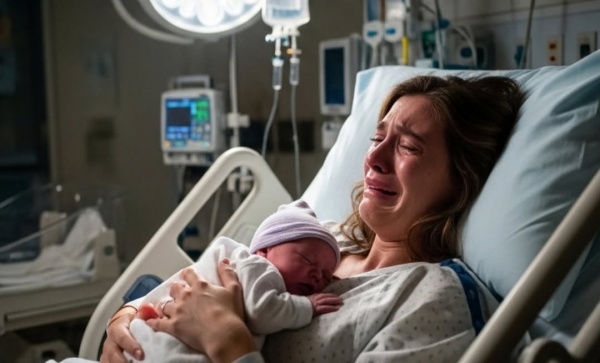
For twelve months, Liam told me he was managing a major construction project in Florida while I raised our sick baby alone in Connecticut. But while he was living in a luxury condo with his young mistress, I was collecting photos, recordings, financial records, and every unanswered call from the night our son was in the ER. When he finally came home whistling like a king, the only welcome waiting under his pillow was the truth.
PART 1 — The King Comes Home
Liam Henderson stepped out of the black Uber at exactly 6:17 p.m., whistling like a man who expected applause.
The sound carried down our quiet street in Greenwich, Connecticut, bright and careless beneath the bare branches of late March. His designer suitcase hit the curb with a soft thud, and he adjusted his cashmere coat as if he were arriving home from a heroic year of sacrifice. To anyone watching from behind a curtain, he probably looked like a successful husband returning from a long work assignment.
That was the story he had spent twelve months selling.
A massive construction project in South Beach.
A demanding client.
A difficult site.
Endless meetings, delayed permits, inspections, weather issues, staffing problems, and “one more month, babe, I swear.”
For a year, Liam told everyone he was practically living out of airports and job trailers in Florida. He told his parents he was exhausted. He told our neighbors he was building something important. He told me I should be proud to have a husband who worked so hard to provide for his family.
But there had never been a construction site.
Not the way he described it.
There were company trips. There were invoices. There were hotel rooms and “client dinners” and expense reports dressed up professionally enough to fool people who wanted to be fooled. But the real reason Liam spent a year “in South Beach” was named Sienna Vale, a twenty-two-year-old Instagram model with glossy lips, rented handbags, and a luxury condo less than ten miles from the airport he claimed he was always flying out of.
He had not been deployed.
He had been hiding.
While I labored alone.
While I learned to nurse our baby through cracked skin and feverish nights.
While our son, Ethan, developed respiratory complications and spent more nights under fluorescent hospital lights than any infant should.
Liam had been playing house with another woman.
And he thought I did not know.
That was the part that almost made me laugh by the end. Not because any of it was funny. Because arrogance, when it finally meets consequences, has a sound. It sounds like a man whistling on a sidewalk while walking toward a locked future he no longer owns.
He paid the Uber driver through the app, lifted one hand in a lazy wave, and rolled his luggage up the stone path to the front door.
The porch light was on.
That must have reassured him.
The wreath was still hanging there too, though it had faded from winter green to tired brown. I had left it intentionally. Liam was the kind of man who noticed expensive things but missed the meaningful ones. He would see the porch light and the wreath and believe home had been waiting for him.
It had not.
Home had been emptied of him long before he arrived.
He unlocked the front door with the key he still believed meant access.
Inside, the foyer was cold and silent.
No baby crying.
No lullaby playing from the nursery.
No smell of soup simmering on the stove, no dryer humming, no sound of me calling from upstairs, “Is that you?”
Just polished floors, dim hallway light, and the kind of stillness that makes a house feel less like shelter and more like evidence.
“Maya?” he called.
His voice echoed.
“I’m home!”
The words landed in the empty air and fell flat.
He stepped inside, closing the door behind him. His shoes clicked against the marble entryway. He looked toward the living room, expecting toys on the rug, burp cloths over the couch, bottles by the sink, some visible proof that life had continued exactly where he left it.
But the house was too clean.
Not cozy clean.
Not guest-ready clean.
Sterile.
The kind of clean that comes after someone has removed everything personal and left only the shell.
Liam frowned.
He walked through the foyer into the living room.
The baby swing was gone.
The framed maternity photo above the fireplace was gone.
The silver rattle his mother had bought Ethan was gone.
The basket of blankets, the stack of board books, the tiny blue socks that used to appear under furniture like evidence of a sweet little ghost — all gone.
He turned slowly, irritation beginning to replace confusion.
“Maya?”
No answer.
I sometimes wonder what he felt then.
Not guilt. Not yet.
Men like Liam do not reach guilt first. They reach annoyance. They see other people’s absence as inconvenience before they understand it as escape.
He dragged his suitcase upstairs, grumbling under his breath. Later, I imagined him thinking I had taken Ethan to my mother’s house to punish him. That would have fit the version of me he preferred: emotional, postpartum, dramatic, needy. Easier to dismiss. Easier to manage.
He did not know that by the time he entered that house, my son and I were already crossing state lines.
He did not know his return had been scheduled into my plan like a weather event.
He did not know that the “naive wife” he left behind had spent the last year becoming a woman he would not recognize.
In the master bedroom, he dropped his suitcase near the closet and loosened his tie. He had probably come straight from Sienna’s condo, though he would have claimed airport fatigue if anyone asked. His “flight” from Miami had been, in reality, a fifteen-minute drive from a building with valet parking, a rooftop pool, and a front desk staff that knew him as Mr. H.
He sat on the edge of the bed.
Then leaned back.
Then stopped.
Something hard pressed beneath the pillow.
Liam lifted his head and stared at the crisp white pillowcase.
For a second, he probably thought I had left him a note.
Maybe even a gift.
Maybe he imagined tears, apology, gratitude. Maybe he pictured me trying to make our anniversary special despite his absence, because that was what I used to do. I used to create warmth around his neglect and call it marriage.
He flipped the pillow over.
Underneath was a black USB drive.
A thick stack of high-resolution photographs.
And a legal-sized envelope with his name written across the front in my handwriting.
LIAM.
No hearts.
No “welcome home.”
No “I missed you.”
Just his name.
He picked up the photographs first.
That was appropriate.
Liam always understood pictures faster than words.
The first photo showed him walking out of Whole Foods Market on Alton Road with Sienna, one hand wrapped around hers, the other carrying a bouquet of white tulips. He was wearing the linen shirt I had bought him for Father’s Day, though he had missed Father’s Day because of an “emergency subcontractor meeting.” The timestamp was printed clearly in the lower corner.
June 18 — 3:42 p.m.
The next photo showed him kissing her beside a rooftop pool. Her arms were around his neck. His sunglasses were pushed into his hair. Behind them, Miami glittered like a city built entirely for people without consequences.
August 7 — 6:11 p.m.
Another photo.
Another date.
Another lie.
Dinner at Prime 112.
A jewelry store in Bal Harbour.
A private beach club.
A hotel lobby where he should have been meeting a client, but was instead standing with his hand low on Sienna’s back while she laughed up at him.
Then came the photo that made him stop.
The waiting room of an OB-GYN clinic.
Sienna seated beside him, one hand resting on her flat stomach, the other holding a packet of paperwork. Liam was leaning toward her, smiling in a way I had not seen directed at me since before Ethan was born.
Timestamped.
Documented.
Unmistakable.
His other child-to-be.
I know because the private investigator told me he went pale when he saw it. Yes, there was a private investigator. There was also an attorney, a forensic accountant, and a best friend from college who happened to be one of the sharpest estate lawyers in Fairfield County.
Liam thought I had my mother.
That was the joke he told himself.
Maya has her mom. She’ll be fine.
He forgot I also had a brain.
And time.
And pain.
And pain, when it stops begging to be understood, becomes strategy.
He fumbled for his laptop and plugged in the USB drive.
The first file opened automatically.
Audio.
His voice filled the room.
Clear, casual, cruel.
“Don’t worry, babe,” Liam said, laughing. “I’ll tell the Warden the project got extended again. She’s too busy with diapers and pediatric appointments to notice.”
Sienna giggled.
The Warden.
That was what he called me.
Not wife.
Not mother of my child.
Not Maya.
The Warden.
Then his voice continued.
“Once things cool off, I’ll push her to sell the house. She won’t fight me. She hates conflict. I’ll give her enough to keep her quiet, and you and I can start fresh somewhere fun.”
Sienna asked, “Like Bali?”
Liam laughed.
“Exactly. Bali, Dubai, wherever. I’m not spending the rest of my life trapped in Connecticut with a crying baby and a depressed wife.”
The recording ended.
For a moment, the room must have been silent again.
Then I imagine Liam’s breathing changed.
The envelope waited beside him.
He opened it last.
Inside were divorce papers.
A notice from my attorney.
A preliminary financial disclosure request.
Copies of complaints filed with his company’s Board of Directors regarding potential misuse of corporate funds and false expense reporting.
And on top, attached with a yellow Post-it note, was my final message to him.
PART 2 — The Wife He Left Behind
A year earlier, I still believed Liam was overwhelmed, not unfaithful.
That is embarrassing to admit now, but honesty matters.
When you are pregnant, exhausted, and married to a man who has mastered confidence, you can mistake distance for pressure. You can look at missed calls and late flights and tell yourself successful men are busy. You can hear irritation in his voice and convince yourself he is scared of fatherhood, not escaping it.
I was seven months pregnant when Liam first mentioned the South Beach project.
We were sitting in our kitchen in Greenwich, the one with the white oak island and the pendant lights he insisted were worth the extra money. I was swollen, nauseous, and trying to eat toast because Ethan had decided every real meal was offensive. Liam was scrolling through his phone with the half-smile he used when texting someone he did not want me to ask about.
“This Florida project is becoming a monster,” he said.
I looked up. “The hotel renovation?”
“Mixed-use development,” he corrected automatically. “Hotel, retail, luxury residential. Big money. Big visibility.”
“That sounds like your boss’s dream.”
“It could be mine too.”
I smiled because I wanted to be supportive. “That’s good, right?”
He exhaled like the world had placed a crown of thorns on his head. “It means they need someone on site for a while.”
“How long is a while?”
He did not meet my eyes.
“A few months, maybe.”
I laughed because I thought he was joking.
Then I realized he was not.
“Liam, I’m due in eight weeks.”
“I know.”
“You can’t move to Florida right before the baby comes.”
“I’m not moving. I’ll fly back and forth.”
“You hate flying.”
“I’ll manage.”
I remember staring at him across the island, waiting for the part where he said he had already told them no. Waiting for the husband who painted Ethan’s nursery with me, who cried at the first ultrasound, who promised he would never become one of those fathers who “helped” like parenting was charity.
That husband did not appear.
Instead, Liam said, “This is how I provide, Maya.”
That sentence became his shield.
If I objected, I was ungrateful.
If I cried, I was hormonal.
If I asked questions, I did not understand the pressure he was under.
So I swallowed my fear and said we would make it work.
Then Ethan came three weeks early.
Labor began at 2:13 a.m. on a Wednesday. Liam was in Florida. He did not answer his phone for forty-seven minutes. When he finally called back, he sounded groggy and annoyed until he realized my water had broken.
“I’ll get the first flight out,” he said.
He did not.
He arrived fourteen hours after Ethan was born.
My mother was the one who held my hand through contractions. My best friend, Nora Patel, was the one who parked the car, filled out forms, and argued with insurance when the hospital system glitched. Liam walked into the room wearing airport clothes and guilt like cologne, kissed my forehead, and said, “I got here as fast as I could.”
I wanted to believe him.
Ethan was tiny.
Only 5 pounds, 11 ounces, with a narrow little chest and a cry like a kitten. He had trouble feeding from the beginning. Then came reflux, breathing issues, and a terrifying night at six weeks when his lips turned bluish during a coughing fit and I called 911 while Liam’s phone went straight to voicemail.
That was the first time something inside me changed.
Not died.
Changed.
The paramedic asked, “Is anyone else home with you?”
I said no.
At the hospital, I sat under fluorescent lights with my son hooked to monitors while Liam texted hours later:
Sorry babe, phone died during a site meeting. Is he okay?
Is he okay?
Three words.
No call.
No panic.
No flight home.
Just a question he could send between whatever he was really doing.
Still, I tried.
For months, I tried.
I sent photos of Ethan sleeping.
Videos of Ethan smiling.
Updates from pediatric appointments.
Bills.
Questions.
Can you come home this weekend?
Can you join the telehealth appointment?
Can you please call before bedtime so he hears your voice?
Sometimes Liam sent money.
Sometimes flowers.
Sometimes a message that said:
You’re doing amazing. I wish I could be there.
But wishes cost nothing.
His absence cost everything.
By spring, I stopped asking when he was coming home and started asking where the money was going.
That was not because I suspected an affair at first.
It was because bills did not match his explanations.
Hotel charges appeared on cards that should have been reimbursed.
Restaurant bills listed as client development were dated on weekends.
Uber rides began and ended in residential areas nowhere near the job sites listed in his calendar.
I asked him once.
He snapped.
“Maya, do you want me to support this family or do you want to audit me?”
That night, after Ethan finally fell asleep against my chest, I opened my laptop and did exactly that.
I audited him.
Not illegally.
Not recklessly.
I gathered what I had access to as his wife and as co-owner of our household accounts. Credit card statements. Shared calendar entries. Travel receipts. Insurance documents. Mortgage paperwork. Bank transfers. I did not hack his accounts. I did not impersonate him. I documented what lived in plain sight because Liam had always assumed I was too overwhelmed to read.
He was almost right.
Almost.
The first real proof came from a charge at a boutique baby store in Miami.
$486.72
I had not bought anything there.
Ethan’s clothes came from Target, gifts from my mother, and hand-me-downs from Nora’s sister. Liam claimed the charge was a client gift. Then I found a public Instagram story posted by Sienna Vale, showing a pale yellow baby blanket with the caption:
He spoils us already.
Us.
That word stayed under my skin.
I clicked her profile.
I recognized Liam’s sunglasses reflected in one of her photos.
I recognized his watch on a man’s wrist holding two champagne glasses.
I recognized the corner of a linen shirt I had washed, folded, and packed for his “site visits.”
My hands shook so violently I almost dropped the phone on Ethan’s sleeping head.
I did not confront him.
That was the moment I became dangerous to him, though he did not know it.
Because a woman who screams gives a liar something to manage.
A woman who goes quiet gives herself time.
I called Nora the next morning.
Nora and I met freshman year at Georgetown, when she caught me crying in a dorm laundry room because I had shrunk every sweater I owned. She became a lawyer. I became a nonprofit development director. She was godmother to my son and the kind of friend who would bring groceries, hold your baby, and then calmly ask if you wanted emotional support or tactical support.
“I need both,” I told her.
She came over that night with Thai food, a legal pad, and eyes that turned colder with every screenshot I showed her.
“Maya,” she said carefully, “do not confront him yet.”
“I want to ruin him.”
“I know. We’ll put that in the parking lot.”
“The parking lot?”
“The place where satisfying but legally stupid ideas go to die.”
That made me laugh for the first time in weeks.
Then she became serious.
“You need a family law attorney. You need a financial advisor. If company funds are involved, you need documentation, not accusations. And you need to protect Ethan.”
Protect Ethan.
That became the center of everything.
Not revenge.
Not humiliation.
Protection.
Nora connected me with Angela Morris, a family law attorney in Stamford who had handled high-asset divorces and custody issues for women whose husbands underestimated paperwork. Angela was calm, precise, and allergic to drama.
“Your pain is valid,” she told me during our first meeting. “But the court will care about facts, finances, parenting, and the child’s best interests. So we build with facts.”
Facts became my oxygen.
I hired a licensed private investigator through Angela’s referral.
I collected bank statements.
I forwarded Liam’s messages.
I logged every missed pediatric appointment, every unanswered emergency call, every canceled trip home.
I also reviewed documents Liam had signed months earlier.
That part deserves explanation.
About a year before his return, Liam had become obsessed with “asset protection” after a colleague went through a messy lawsuit. He wanted trusts, tax strategies, liability shields, the whole performance of wealth management. Nora, who specialized in estate planning and business structures, had reviewed some documents for me and suggested a legitimate trust for Ethan’s benefit.
Liam barely listened.
He was distracted, texting under the table while Nora explained that transferring certain assets into a properly drafted irrevocable trust would have legal consequences. The house was partly in my name already, and we restructured ownership as part of an estate plan for Ethan. Liam signed documents he had been told to read carefully.
He did not read them.
He joked, “That’s why we pay lawyers.”
He thought he was being clever.
He thought he was protecting assets from theoretical lawsuits and tax exposure.
In reality, he transferred his interest in the house into a trust for Ethan, with me as trustee, under terms he approved while half-listening and smirking at his phone.
As for retirement funds, no one “transferred his entire 401k” with a signature and a wink. That is not how U.S. retirement law works. But Liam had updated beneficiary designations, authorized certain marital planning changes, and created a paper trail that would later prevent him from pretending I had manipulated him. Angela made sure every step we took was legal, documented, and defensible.
I did not steal from him.
I let him sign his own arrogance.
There is a difference.
PART 3 — The Night Ethan’s Fever Hit 104
The night before Liam came home, Ethan’s fever reached 104 degrees.
He was nine months old.
Too small for the amount of suffering his body had already carried.
It started with fussiness around dinner, then flushed cheeks, then a cough that sounded wrong. I gave medication exactly as directed by his pediatrician, called the after-hours nurse line, and tried to keep him hydrated. By midnight, he was burning against my chest.
At 12:37 a.m., Ethan’s body stiffened.
His eyes rolled slightly.
For several seconds, the world narrowed to the sight of my baby seizing in my arms.
I called 911 with a voice I did not recognize as mine.
The dispatcher stayed with me until the ambulance arrived. My mother arrived right behind it, wearing mismatched shoes and a coat over pajamas. Nora met us at the ER fifteen minutes later, hair in a bun, face bare, already carrying a folder with Ethan’s medical records because she knew me well enough to know I would forget something.
I called Liam fifty times.
Not once.
Not twice.
Fifty.
Every call went unanswered.
I texted:
Ethan is in the ER. Fever 104. Possible seizure. Call me now.
No response.
I sent a photo of Ethan in the hospital bed with monitors attached to his tiny chest.
No response.
I called his assistant, who said Liam was “unreachable due to travel.”
Travel.
That word would later make me laugh too.
Because at the time I was standing in a hospital hallway in Connecticut, Liam was ten miles away from Sienna’s condo, not across the country. He had not been unreachable because of work. He had been unreachable because he had placed his real life on silent.
At 3:18 a.m., Nora received the investigator’s final update.
Photos from that evening.
Liam entering Sienna’s building.
Liam leaving again after midnight.
Sienna beside him, visibly pregnant under a fitted cream dress.
The message was simple:
Subject remained at residence during emergency contact window.
Subject.
That was what the investigator called my husband.
It helped.
A subject could be studied.
A subject could be documented.
A subject could be removed from the center of my heart and placed into a file.
Ethan stabilized by morning.
The doctors believed it was a febrile seizure, terrifying but not uncommon in young children with high fever. Because of his medical history, they recommended follow-up with a pediatric specialist out of state. My mother cried quietly in the corner when the doctor said he would likely be okay.
I did not cry.
Not then.
I had moved past tears into something steadier.
Angela came to the hospital at 8:30 a.m. with coffee, legal documents, and the kind of expression that told me she had done this for women before.
“Are you sure?” she asked.
I looked at Ethan asleep in the hospital crib, his lashes resting against cheeks still pink from fever.
“Yes.”
We filed that day.
Petition for Dissolution of Marriage.
Emergency requests regarding temporary custody and parenting communication.
Financial preservation notices.
Formal letters to Liam’s employer requesting preservation of records related to travel, reimbursements, and corporate expenses.
Not accusations screamed into the internet.
Documents.
Receipts.
Timelines.
Lawful, careful, devastating paperwork.
Nora handled the trust records.
Angela handled the divorce.
The private investigator delivered the final evidence packet.
My mother packed Ethan’s medical equipment, clothes, documents, and every sentimental item I could not bear to leave behind. We arranged transport to a pediatric specialty clinic in Boston, where Ethan had an appointment coordinated through his doctor. I did not flee recklessly. I left with medical advice, legal guidance, and a paper trail.
That mattered.
By noon, the house in Greenwich was almost empty of us.
Not empty of furniture.
Empty of life.
I left Liam’s clothes.
His gym equipment.
His bar cart.
His framed awards.
His ridiculous espresso machine.
I left the expensive whiskey he loved to display but rarely drank.
I took Ethan’s crib mattress, medical supplies, clothing, documents, and the rocking chair where I had spent hundreds of nights feeding him alone.
In the master bedroom, I placed the USB drive, photographs, envelope, and Post-it note under Liam’s pillow.
I considered writing something cruel.
Something sharp enough to make him bleed.
But by then, cruelty felt too intimate.
Instead, I wrote the truth.
Dear Liam,
While you were playing house, I was in the ER. Our son had a 104-degree fever and a seizure last night. I called you 50 times. You were busy — I assume with your other child-to-be.
I’ve left you a final gift: the truth you thought I was too exhausted to find. The photos are dated. The recordings are preserved. The financial records are with my attorney.
Remember the estate planning documents you signed last year? The ones you called “boring tax stuff” while texting her at our dining room table? You transferred your interest in this house into Ethan’s trust. I am the trustee. You signed every page.
I have filed for divorce. I have notified the appropriate parties regarding your possible misuse of company funds. I have preserved every message, every receipt, every missed emergency call, and every lie you told while our son was sick.
Do not come looking for us. Communication about Ethan will go through counsel until temporary orders are in place. If you want to be a father, start by learning that fatherhood is not a performance you return to when the baby becomes convenient.
Happy Anniversary.
Maya
I placed the note on top of the papers.
Then I stood in that bedroom for a long moment.
It was the room where I had once imagined growing old with him.
The room where I folded his shirts for Florida.
The room where I cried quietly after he told me I was “too sensitive” three weeks postpartum.
The room where he would soon learn that the woman he called the Warden had unlocked the door herself.
I did not feel victorious.
Not yet.
I felt hollow.
But hollow is not weak.
Sometimes hollow means there is finally room for something new.
At 2:05 p.m., I walked out with Ethan in my arms.
At 2:12 p.m., the security system code changed.
At 2:20 p.m., Angela confirmed Liam had been electronically served through proper legal channels and physical service was being coordinated.
At 4:50 p.m., my mother and I left for Boston in a medically equipped transport van arranged through Ethan’s care team.
At 6:17 p.m., Liam stepped out of his Uber and whistled.
Timing can be poetic when patience has done the writing.
PART 4 — The Kingdom Falls Quietly
Liam called me seventeen times after finding the envelope.
I did not answer.
He called Nora.
She did not answer.
He called my mother.
She sent one text:
All communication through Maya’s attorney.
Then she blocked him.
By 7:04 p.m., his messages turned from confusion to rage.
What the hell is this?
You can’t just take my son.
That house is mine too.
Pick up the phone.
Maya, you are making a huge mistake.
At 7:22 p.m., Angela received an email from Liam that began with the words:
Your client is unstable.
Angela forwarded it to me later with a note:
Do not respond. This is useful.
Useful.
That word became another kind of comfort.
Liam drove to the hospital around 8:00 p.m., according to what we later pieced together. He demanded information at the front desk. Because Ethan had already been discharged and transferred with proper documentation, the staff gave him nothing beyond what privacy rules allowed. One nurse, who had seen me sitting beside Ethan’s bed all night while my phone lit up unanswered, reportedly looked at him like he was something stuck to her shoe.
He texted me from the hospital lobby.
Where is my son?
I replied only after Angela approved the message:
Ethan is safe and receiving appropriate medical follow-up. Your attorney may contact mine regarding temporary parenting arrangements.
He replied:
I am his father.
I stared at that message for a long time.
Then I typed nothing.
Biology is not a badge you flash after abandoning the post.
Liam’s company investigation began within days.
I did not “destroy his career” by making false claims. I submitted documentation through counsel to the appropriate corporate channels: expense reports, travel claims, dates, photos showing personal travel represented as business activity, and recordings where he discussed extending a fictional project timeline to maintain his affair.
His employer did the rest.
Internal audit.
Board review.
Suspension pending investigation.
Liam tried to tell colleagues I was vindictive and postpartum. That worked for approximately forty-eight hours. Then the expense records surfaced. Then someone in finance found duplicated hotel charges. Then Sienna posted a now-deleted video from a luxury condo during a time Liam had billed as an out-of-state vendor meeting.
The internet did not ruin him.
His receipts did.
Sienna, meanwhile, was not the loyal escape he imagined.
I did not care about her beyond what affected my son, but the investigator had documented more than Liam knew. She had also been spending time with Graham Whitlock, Liam’s direct supervisor, a man with a boat, a weak chin, and a wife who owned half his assets. Whether Sienna was carrying Liam’s child, Graham’s, or someone else’s was not my problem.
That sentence took growth.
Earlier, I might have cared.
Earlier, I might have obsessed over her.
Was she prettier?
Younger?
More exciting?
Did she laugh at his jokes?
Did she know how he took his coffee?
Did he tell her the same stories he told me?
By the time Liam came home, I no longer needed to study the woman he chose.
His choice had already told me enough about him.
At the first temporary hearing in Stamford Superior Court, Liam arrived looking like a man who had not slept. His lawyer tried to present him as a hardworking provider blindsided by an emotionally reactive spouse. Angela presented a timeline.
Timeline of pregnancy.
Timeline of postpartum care.
Timeline of Ethan’s medical events.
Timeline of Liam’s absences.
Timeline of payments.
Timeline of unanswered emergency calls.
Timeline of corporate expense concerns.
The judge did not gasp.
Judges rarely do.
Real consequences arrive in calm voices.
Temporary orders gave me primary physical custody while Ethan’s medical needs were assessed and stabilized. Liam received structured visitation to begin gradually, with requirements around communication, medical updates, and parenting education. He was ordered not to remove Ethan from the state without written agreement or court order.
Liam looked offended.
As if fatherhood had been taken from him rather than measured against his choices.
Financially, things were complicated, but not in the fantasy way Liam wanted to claim.
He could not simply be made homeless overnight by a Post-it note. The law is not a revenge movie. But the house was held in Ethan’s trust because Liam had voluntarily transferred his interest months earlier, and my own interest was protected. He could challenge, delay, argue, and spend money on lawyers. But he could not pretend he had never signed.
He had signed.
In blue ink.
On every page.
Nora still had the email where she wrote:
Please review carefully before signing. These transfers have real consequences.
Liam had replied:
Looks fine. Let’s just get it done.
Sometimes the most expensive sentence in a man’s life is the one he sends because he thinks he is too important to read.
The joint account became another battle.
I did not drain it illegally. Before filing, under advice of counsel, I moved funds necessary for Ethan’s medical care, household expenses, and legal retainers into protected accounts with full documentation. I left an accounting. I preserved records. I did exactly what Angela told me to do and not one dramatic thing more.
That restraint saved me.
It also infuriated Liam.
He wanted me to be reckless.
He needed me to be reckless.
If I screamed, stole, lied, or posted every detail online, he could make me the problem.
So I remained boring.
Legally boring.
Financially boring.
Emotionally boring in writing.
Ethan’s appointment is Tuesday at 10:00 a.m.
Medication list attached.
Please confirm receipt.
Visitation will follow the temporary order.
Inside, I was not boring.
Inside, I was a storm with teeth.
But I learned something that year: you do not have to show someone your storm for it to change the landscape.
PART 5 — The Warden Was Free
Boston in early spring is not gentle.
The wind comes off the harbor sharp enough to slice through wool, and the sidewalks hold dirty snow longer than seems fair. But the pediatric clinic had specialists who listened, and for the first time in months, I felt like Ethan was being treated as a whole child instead of a chart that kept moving between offices.
We rented a small furnished apartment near Brookline while his evaluations continued.
One bedroom.
Tiny kitchen.
Radiators that hissed at night.
A view of a brick wall and, if you leaned far enough, a sliver of sky.
It was not the Greenwich house.
It did not have a formal dining room, a wine fridge, or imported tile in the powder room.
But when Ethan cried at 3:00 a.m., no part of me waited for footsteps that would never come.
That peace was worth more than square footage.
My mother stayed for three weeks.
Nora visited every other weekend, bringing groceries and sarcastic commentary about Liam’s legal filings. Angela called when necessary and refused to indulge my late-night desire to know whether Liam was suffering.
“Suffering is not a legal strategy,” she reminded me.
“I know.”
“Do you?”
“Not emotionally.”
“That’s what therapy is for.”
So I went.
At first, therapy felt like another appointment on a calendar already overflowing with pediatric visits, legal deadlines, feeding schedules, and insurance calls. But slowly, it became the one place where I did not have to be strategic. I could be furious. Humiliated. Lonely. Grief-struck. Relieved.
Sometimes all in the same hour.
I grieved the husband I thought Liam was.
That surprised me.
Because the real Liam had been cruel, selfish, and dishonest.
But the imagined Liam had held my hand on our first date in New Haven, kissed me under a hotel awning during a summer storm, cried when I told him I was pregnant, and spent one entire Sunday assembling a crib incorrectly while we laughed until we gave up and ordered pizza.
That Liam was not entirely fake.
That was the hardest part.
People want villains to be villains from the beginning.
But most betrayal is committed by people who were once capable of tenderness.
That is why it hurts.
If Liam had always been a monster, leaving would have felt simple. Instead, I had to accept that a man could love parts of me, love the idea of a family, even love our son in some shallow, convenient way — and still choose himself whenever love required sacrifice.
Ethan got stronger.
Not overnight.
There were more fevers, more inhalers, more specialist visits, and more nights where I watched his breathing instead of sleeping. But there were also first claps, first mashed banana smeared across the highchair, first belly laughs, first time he reached for me and said something close to “Mama.”
That one broke me open.
In the best way.
Liam’s visits began months later under structured conditions.
The first time he saw Ethan after everything collapsed, he cried.
I did not comfort him.
Ethan stared at him with cautious curiosity, then reached for the zipper on Liam’s jacket. Liam laughed through tears and said, “Hey, buddy.”
Buddy.
Not exactly fatherhood.
But a start.
Maybe.
I allowed myself to want Liam to become a better father.
Not for Liam.
For Ethan.
That distinction mattered.
Co-parenting did not mean forgetting. It did not mean forgiving on command. It did not mean handing over trust like a participation trophy. It meant building a system where Ethan could have access to his father without his mother being emotionally dragged back into the fire.
We used a parenting app.
We followed orders.
We documented medical needs.
We communicated like two professionals managing a very important project, because that is what raising a child after betrayal becomes.
A project with a heartbeat.
Liam lost his job six months after the investigation began.
The official language was careful: violation of company policy, improper expense submissions, breach of fiduciary responsibility. He tried consulting afterward, but Greenwich is smaller than people think when reputations start leaking. Men who once slapped his back at charity golf events suddenly became unavailable.
I did not celebrate.
Not publicly.
Privately, I sat on the floor beside Ethan’s play mat and whispered, “Actions have consequences.”
Ethan responded by chewing a rubber giraffe.
Fair.
The divorce finalized fourteen months after Liam came home to the USB drive.
The settlement reflected the trust, the marital assets, documented expenditures, Ethan’s needs, and support obligations. Liam did not end up penniless, because courts do not exist to create poetic justice. But he lost the house, much of the lifestyle he had performed, and the illusion that he controlled the story.
I kept my dignity.
That was not in the decree, but it should have been.
Sienna had her baby that fall.
Whether Liam was legally established as the father became gossip I refused to chase. I had enough paperwork in my life. I did hear, through channels I did not ask for, that Graham Whitlock’s wife had filed for divorce and that Sienna had moved back to Fort Lauderdale.
The glamorous escape plan did not become Bali.
It became child support hearings and Instagram silence.
As for Liam, he eventually apologized.
Not the first apology.
The first ones were useless.
“I’m sorry you felt abandoned.”
“I’m sorry things got complicated.”
“I’m sorry I didn’t know how bad it was.”
Those apologies were just escape routes wearing nicer shoes.
The real apology came almost two years later outside Ethan’s preschool in Connecticut, after I had moved back closer to family and taken a new job with a nonprofit foundation. Liam had just finished a supervised transition that had gone well. Ethan ran into my arms holding a finger painting that looked like a blue explosion.
Liam stood by his car, thinner than before, older around the eyes.
“Maya,” he said.
I looked at him.
“I called you the Warden because I needed to make you the prison,” he said. “But I was the one lying. I was the one who wanted freedom without responsibility.”
I said nothing.
He continued, voice rough.
“You were in the ER with our son and I didn’t answer. I don’t think I’ll ever forgive myself for that.”
“You shouldn’t,” I said.
He flinched.
“Not quickly,” I added. “Not cheaply. Use it. Become the kind of father who never needs to be called fifty times.”
He nodded.
For once, he did not argue.
That was growth.
Not redemption.
Growth.
There is a difference.
Today, Ethan is three.
He has Liam’s eyebrows, my stubbornness, and a laugh that can pull light into any room. His health is stable, though I still keep medication in every bag like a woman who has learned never to assume safety will be convenient. He loves trucks, blueberries, and yelling “No, Mama, I do it!” while absolutely not doing it.
We live in a smaller house now.
Not in the same Greenwich neighborhood.
This one has a cracked front walkway, old maple trees, and a kitchen that needs updating. But every room feels honest. Every bill is known. Every lock opens to a life I chose.
Sometimes people ask if I regret waiting so long to confront Liam.
No.
If I had confronted him when I first saw Sienna’s Instagram story, he would have lied.
If I had screamed after the Whole Foods photo, he would have called me unstable.
If I had threatened him after the OB-GYN picture, he would have moved money, hidden records, and sharpened lawyers before I understood the battlefield.
Silence saved me.
Not the silence of submission.
The silence of preparation.
There is a difference.
The woman Liam left behind was tired, bleeding, leaking milk through shirts, apologizing for needing help, and trying to make a marriage out of crumbs.
The woman he came home to did not exist anymore.
She had become the woman who could sit beside a hospital crib, count fifty unanswered calls, and decide that love without protection was not love at all.
She became the woman who read every document.
Saved every receipt.
Called every lawyer.
Held her son through fever and fear.
Left a USB drive under a pillow like a final sermon.
And walked away before the king returned to find his castle already transferred out of his name.
I did not win because Liam suffered.
I won because Ethan and I survived with our future intact.
I won because the name he used to mock me became meaningless the moment I stopped guarding the prison he built.
I was never the Warden.
I was the woman holding the keys.
And when I finally used them, the door opened toward freedom.
