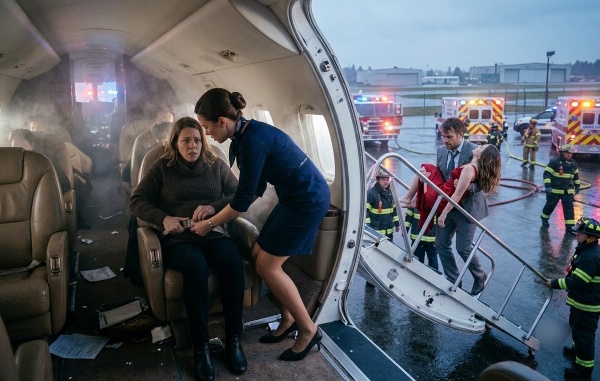
Smoke was filling the cabin when my husband lifted his injured first love and carried her toward the exit. I was eight months pregnant, struggling with my seat belt and calling his name. A flight attendant came back for me, but my husband never came to the hospital. Three years later, he met a little boy without realizing who he was.
Part 1: The Landing
When our private jet made an emergency landing, my billionaire husband carried his injured first love to safety while leaving me, eight months pregnant, inside the smoke-filled aircraft. Three years later, he would face the consequences of that choice in a way he could never have imagined. But what happened after he walked away was not even the most shocking part.
The woman in his arms was Claire Bennett. She had been Daniel’s first love, the girl he dated before college and the person he still mentioned whenever a conversation turned to “the one that got away.” I had spent years pretending those stories did not bother me.
We were on our way from Chicago to a charity event in Colorado. Daniel’s foundation was funding a new children’s learning center, and Claire had been invited as a consultant on the project. She worked in early childhood education, which was the reason Daniel gave when he asked whether she could join us on the flight.
“You don’t mind, do you, Hannah?” he asked as we boarded.
I minded that he asked while Claire was standing beside him with her overnight bag. I minded that he had not mentioned her invitation until the car was already taking us to the airport. But I was tired, my back hurt, and I did not want to begin the trip with an argument.
“Of course not,” I said.
The flight began normally. Claire sat across from Daniel, showing him photographs of a school she had helped renovate. I sat farther back with a book I barely read and a bag of crackers my doctor had suggested I keep nearby.
Daniel was a successful technology investor whose fortune was usually described in magazines as though it belonged to a character rather than a person. The number changed depending on the publication and the value of his holdings, but “billionaire” appeared often enough that strangers recognized his name. I had learned that people tended to assume money could solve any problem we had.
Money had not solved the distance in our marriage. Over the previous year, Daniel had missed appointments, canceled dinners, and spent more time discussing Claire’s project than our baby’s arrival. When I told him I felt alone, he said he was building a future for our family.
I wanted to believe him. I also wanted him to come home before midnight once in a while and ask how I was feeling without checking his phone. Those seemed like small requests until I realized how often I had to repeat them.
The trouble on the flight began with an announcement from the cockpit. The pilot said there was a technical problem and that we would be landing at a nearby airport as a precaution. His voice was calm, but the flight attendant, Maya, moved quickly through the cabin checking that everyone was seated.
I fastened my seat belt and tried not to imagine what a technical problem might mean. Claire reached across the aisle for Daniel’s hand. He held it until the aircraft touched down.
The landing was hard enough to throw loose items onto the floor. The plane came to a stop, and almost immediately I smelled something sharp. Smoke began to enter the cabin from the front, and Maya shouted for us to leave our belongings and move toward the exit.
Claire cried out when she tried to stand. A bag that had shifted during the landing had struck her leg, and she could not put weight on it. Daniel lifted her before Maya reached their seats.
I pressed the release on my seat belt. It did not open on the first attempt. My hands were shaking, and the angle of the belt against my stomach made it difficult to reach.
“Daniel,” I called.
He looked back. Claire was holding on to his shoulders, and Maya was opening the exit. For a second, I believed he would put Claire down and come back for me.
“Hannah needs help,” Claire said.
Daniel turned toward the door. “Maya will get her.”
Then he carried Claire down the steps.
I do not know whether I called his name again. I remember coughing, the sound of Maya’s voice, and the feeling of panic rising as I struggled with the belt. Maya came back through the cabin and knelt beside me.
“Look at me,” she said. “I’m here.”
She helped release the belt and guided me toward the exit. Outside, airport emergency crews were already responding. A medic took my arm, another asked how far along I was, and I realized I had been holding my breath.
I saw Daniel several yards away. He had set Claire down near an emergency vehicle, where medical personnel were examining her leg. She pointed toward the plane and said something to him, but he was looking at his phone.
I wanted him to come to me. I wanted him to ask whether I was hurt or whether the baby was moving. Instead, a paramedic wrapped a blanket around my shoulders and helped me into an ambulance.
At the hospital, the medical team checked me and the baby. They explained that the stress of the landing and the symptoms I was experiencing meant they wanted to monitor us closely. I asked whether Daniel had called, and the nurse said no one had reached the unit for me yet.
My sister, Rachel, answered when I called her from the hospital. She lived in Denver and arrived with a phone charger, a sweatshirt, and a face that told me she had driven there as quickly as she could. She held my hand while the doctor explained what they were watching.
“Where is Daniel?” she asked after the doctor left.
“I don’t know.”
“Did he know you were brought here?”
“I think so.”
The truth was that I did not know what Daniel had seen after he left the aircraft. I knew he had looked back when I called his name. I knew he had said Maya would help me.
Claire called Rachel’s phone that evening after obtaining the number from Daniel’s assistant. She said her leg was injured but that she had been treated and released. She also asked whether I was safe.
“I told him to make sure someone knew you were still inside,” she said.
“Did he?”
“I don’t know. The emergency crews were already moving toward the plane.”
“Where is he now?”
There was a pause. “He’s with his team.”
I thanked her for calling. I did not ask whether she and Daniel were having an affair because, at that moment, I needed the answer to a different question. I wanted to know whether my baby would be okay.
Early the next morning, the doctors told me that my symptoms had changed and that they needed to discuss delivery. They explained the options, answered my questions, and made a plan with me. Rachel stayed beside me while I tried to absorb that our son might arrive weeks before I had expected.
I called Daniel. His phone went to voicemail, so I left a message saying the doctors were concerned and that I needed him to call. Then I sent a text with the hospital’s name.
He did not respond before our son was born.
The baby was small, and the hospital team needed to care for him closely. They let me see him and explained what they were doing before taking him to the neonatal unit. I named him Theo, the name Daniel and I had chosen together on a quiet Sunday months earlier.
Rachel called Daniel’s assistant and said, “Hannah and the baby need Daniel to contact them.” The assistant promised to pass on the message. Hours later, I received a text from Daniel.
I heard you’re receiving good care. I need some time to process what happened.
He did not ask about Theo. He did not come to the hospital. I looked at my son through the nursery window and understood that Daniel had made another choice after leaving the plane.
Part 2: The Story He Told
I sent Daniel a message the following morning. I wrote that Theo had been born, that he was being cared for in the neonatal unit, and that I wanted Daniel to call me directly. The message showed as sent, but I received no reply.
Rachel left another voicemail with his assistant. She did not include every medical detail because she wanted Daniel to contact us himself. The assistant said she had passed along the earlier message and would try again.
Three days after the landing, a statement appeared on the website of Daniel’s foundation. It said the passengers had experienced a frightening emergency and thanked the flight crew and airport responders for their professionalism. It also said Daniel was “grateful that everyone was safe.”
The statement did not mention my pregnancy or Theo’s birth. I did not expect it to share private medical information, and I was relieved it did not. But the photograph accompanying it showed Daniel beside Claire outside the hospital, with no reference to where I had been.
A local television segment repeated the statement. The anchor said Daniel had helped an injured passenger from the aircraft. That was true, but the story made it sound as if his role had ended only after everyone was out.
I called his assistant again. She said Daniel was traveling back to Chicago and had asked for privacy. When I asked whether he had received my message about Theo, she said she had passed along that I wanted him to call but could not tell me what he had read.
“Please tell him his son was born,” I said.
“I will.”
I wanted to believe her. I also knew that sending a message through an assistant was a poor substitute for speaking with the person who should have been there. The nurse had taught me how to hold Theo’s tiny hand through the opening in his incubator, and I wanted Daniel to see it for himself.
Theo spent several weeks receiving care. The medical team explained his progress day by day, and Rachel sat with me whenever she could. Some mornings felt hopeful; others were full of waiting for numbers and updates I was still learning to understand.
I sent Daniel two more messages. One included a photograph of Theo’s hand wrapped around my finger. The other said, He’s here. Please tell me if you intend to be part of his life.
There was no answer.
Later, I learned that Daniel had changed phones shortly after returning to Chicago. His assistant had filtered calls and messages while he dealt with the aftermath of the emergency and a flood of media requests. Whether he personally read any of my early messages remained unclear to me for a long time.
What I did know was that he did not contact the hospital. He did not call Rachel. He did not come to see me or ask my attorney how I was doing.
I moved to Denver when Theo was ready to leave the hospital. Rachel had a small guest room and a husband who made excellent soup. Their children were old enough to understand that the baby needed a quiet home, though they still argued about who would get to hold him first.
I spoke with a family law attorney about my options. She explained that Daniel might have legal rights and responsibilities as Theo’s father, and that those questions should not be decided by my anger or his silence alone. I was not ready to begin a formal proceeding while Theo’s care and my recovery took most of my attention.
“Should I contact his attorney?” I asked.
“If you want to make sure he receives notice, we can discuss appropriate ways to do that. We should also keep records of the messages you’ve already sent.”
I asked her to send a letter to the address Daniel’s office had used for family correspondence. The letter said Theo had been born and invited Daniel to communicate through counsel about parenting and support. It was returned after his office changed locations, and we did not attempt formal service at that time.
That detail mattered later. I had tried to tell him, but I had not obtained confirmation that he received the letter. I also had not brought the question before a court or taken steps that would necessarily have put the information in front of him.
A few months after Theo was born, Claire called me. She said she had left the project with Daniel’s foundation. She wanted me to know that she had asked him about me after the landing.
“He told me you wanted space,” she said.
“I wanted him to call.”
“He said his assistant was handling it.”
“Did he tell you the baby had been born?”
“No. I asked once, and he said he didn’t know what was happening.” She paused. “I should have called you again.”
“Why didn’t you?”
“I was angry with him, and I thought you might not want to hear from me.”
She was right about part of that. I had not wanted Claire involved in the most vulnerable days of my life, especially after watching Daniel carry her away. But I had also wanted someone to tell him that his son existed.
“Were you and Daniel involved?” I asked.
“No.” She took a breath. “He had feelings he didn’t know what to do with. I should have set clearer boundaries, but we weren’t having an affair.”
I believed her. Their relationship had made me uncomfortable, and Daniel had treated her as the person he needed to protect. But I did not need to invent an affair to explain why his choices hurt me.
Claire told me something else about the landing. After Daniel carried her outside, she had asked him to tell the responders that I was still aboard. He replied that Maya was helping me, and one of the crew members had already given emergency personnel the passenger information.
“I kept asking where you were,” Claire said. “A medic told me the crew was checking the aircraft. Daniel stayed with me while they treated my leg.”
I did not want him to reenter a smoke-filled aircraft against the crew’s instructions. I wanted him to make sure someone knew I needed help and then come to me when it was safe. Those were different expectations, and Claire seemed to understand the difference.
“Did he know Maya got me out?” I asked.
“I told him I saw you with the medics. He said he would call the hospital.”
“He didn’t.”
Claire was silent. Then she said, “I’m sorry.”
Over the next year, Daniel’s foundation expanded its work in children’s education. A profile described him as a man whose experience during the emergency had made him value family more deeply. The article quoted him saying, “In a crisis, you learn that the people you love come first.”
I read that sentence while sitting on Rachel’s couch with Theo asleep against my chest. I wondered which people Daniel had meant. I also wondered whether he had read any of the messages I sent after the birth.
I did not call him. My attorney and I discussed the options again, but I was still trying to establish a stable life for Theo and myself. I returned to work as a freelance exhibit designer and rented a small apartment near Rachel’s family.
I kept copies of my messages and the returned letter. I did not tell Theo stories about a father who had died or invent an explanation for his absence. He was too young to ask much, and I knew that one day I would need advice about how to answer honestly and gently.
When Theo was nearly three, I accepted a project designing an interactive room for a children’s museum in Chicago. The museum was part of a network supported by several donors, including Daniel’s foundation. I knew that, but I was told the design team would work with museum staff rather than individual donors.
The project lasted six months. Theo stayed with a trusted caregiver while I worked, and Rachel visited whenever she could. I did not expect Daniel to appear at the family preview on the final day.
He arrived just as Theo was building a tower of wooden blocks near the entrance. A photographer hired by the museum was taking pictures of the room, not of individual children without permission. Daniel stopped beside the tower and asked the little boy whether he needed another block.
Theo looked up at him. “The blue one,” he said.
Daniel handed it to him. Then he smiled in a way I had not seen since the day we chose our son’s name.
Part 3: The Boy With the Blue Block
I was across the room speaking with the museum director when I saw Daniel kneel beside Theo. My first instinct was to cross the floor and pick my son up. My second was to stop and breathe, because Theo was safe and nothing had happened yet.
Daniel did not recognize him. Why would he? The last time he had seen me, Theo had not yet been born, and the child in front of him had a full head of dark hair and a serious expression that belonged entirely to himself.
Theo placed the blue block on top of the tower. The structure leaned, and Daniel reached toward it. Theo put out a hand to stop him.
“I can do it,” he said.
Daniel sat back on his heels. “All right. You’re in charge.”
The tower fell a second later, scattering blocks across the floor. Theo looked at the pile, then at Daniel, and both of them laughed. I felt a sharp ache at the sight of a moment that should not have been so surprising.
The museum director noticed my expression. I told her quietly that I knew Daniel and needed a moment. She did not ask for an explanation.
I walked toward them. Theo saw me first and held up the blue block. “Mama, the tower fell.”
“I saw,” I said.
Daniel stood. He looked at me, then back at Theo, and the smile disappeared from his face. For a second, the noise of the room seemed to move farther away.
“Hannah?”
“Hello, Daniel.”
He glanced at Theo again. “How old is he?”
“Three.”
His eyes moved from my face to the child. He did not ask the next question aloud, but I saw it forming. I knelt beside Theo and told him the caregiver would take him to the reading corner while I spoke with a friend.
“I’m not done building,” he said.
“You can build again in a few minutes.”
The caregiver came over, and Theo took her hand after collecting two blocks. He looked back once to make sure I was still there. I waved, and he continued toward the books.
Daniel’s voice was barely audible. “Is he mine?”
“Yes.”
He sat down on the small bench beside the exhibit. I remained standing because I did not want to have the conversation at a child-sized table surrounded by paper trees and painted stars. Daniel pressed his hands together.
“You told me the baby was born?”
“I sent messages. Rachel called your assistant, and my attorney sent a letter that was returned.”
“I never saw them.”
“I know that may be true. I also know you didn’t call me to ask.”
He looked toward the reading corner. Theo was sitting cross-legged on the rug, listening to a story and turning one of the blocks in his hands. Daniel started to stand.
“Please don’t tell him who you are right now,” I said.
He stopped. “He’s my son.”
“Yes. And he’s three, in a busy room, with a stranger he met five minutes ago.”
“I’m not a stranger.”
“To him, you are.”
The words hurt him. I could see it, and I did not enjoy saying them. But Theo’s understanding mattered more than the urgency of Daniel’s shock.
Daniel sat back down. “What does he know about me?”
“He knows he has a father who doesn’t live with us. He hasn’t asked many questions yet.”
“You could have found me.”
“I called after the landing. I called after he was born. You told me you needed time to process what happened, and then you disappeared behind your assistant.”
“I thought you didn’t want me there.”
“I wanted you to call.”
He covered his face. For a moment, I thought he might cry in the middle of the museum. Instead, he lowered his hands and looked at Theo again.
“I don’t know what to say.”
“Then don’t say anything to him yet.”
“I want to hold him.”
“He doesn’t know you.”
“I can change that.”
“Maybe. But not by announcing it in front of a room full of people.”
The museum director approached and quietly asked whether we needed a private room. I thanked her and said yes. Before we moved, I told the caregiver that Theo could stay in the reading corner and that I would be nearby.
In the private room, Daniel asked me everything at once. He wanted to know about the birth, the hospital, Theo’s first words, and whether he had been sick. I answered what I could, then told him I would not turn three years into a list he could absorb in ten minutes.
“Why didn’t you file for divorce?” he asked.
“Because I was focused on Theo, work, and rebuilding my life. I spoke with an attorney, but I wasn’t ready to begin that process.”
“And support?”
“We managed with my work and help from Rachel. That doesn’t settle what may be appropriate going forward.”
He nodded slowly. “I should have come.”
“Yes.”
“I thought Claire was the only person badly hurt. My assistant told me you were receiving care and didn’t want visitors.”
“I didn’t ask her to say that.”
“I know that now.”
He explained that after the landing, his team was handling calls from the press, the aircraft operator, and the foundation. He had told his assistant he needed space from personal calls until he could think. When she later said I had contacted the office, he assumed it was about our marriage and asked her to tell me he would respond.
“Did you see the message that said the baby was born?”
“No.”
“The photograph?”
“No.”
“Did you ask why I was in the hospital?”
“I assumed they were checking you after the landing. Then Claire told me you were stable.”
“Stable didn’t mean I didn’t need you.”
“I know.”
It was possible his assistant had mishandled the messages. It was also possible that Daniel’s instructions had made her think he did not want them passed through. Either way, he had chosen not to make a direct call when he knew his pregnant wife had been taken to a hospital.
“I’m not going to pretend those years didn’t happen,” I said. “If you want to be involved now, we need advice and a plan that puts Theo first.”
“I’ll do whatever you ask.”
“No. You’ll get your own advice, and I’ll get mine. Then we’ll work out what’s appropriate.”
He looked at the door. “Can I say goodbye to him?”
“You can say goodbye as the man he met today. Please don’t tell him more until we’ve agreed how.”
Daniel nodded. He was not legally unable to say the words in that room. He chose not to, because we had not prepared Theo for them and because a crowded museum was not the place to change a child’s understanding of his family.
We returned to the exhibit. Theo held up a picture of a green dinosaur and asked Daniel whether he liked it. Daniel crouched beside him and said it was the best dinosaur he had seen all day.
When it was time to leave, Theo waved. Daniel waved back, his hand trembling slightly. He watched his son walk away without calling him “my boy,” though the words were plainly on his face.
That night, Daniel’s assistant sent him a copy of an old message she found in an archived account. It was the message I had sent from the hospital: Theo was born this morning. Please call me. She also found the photograph of his tiny hand around my finger.
Daniel forwarded both to me with one sentence. I should have looked for you myself.
Part 4: The Story Unraveled
After the museum, I contacted the attorney I had spoken with when Theo was born. She recommended a family law professional in Chicago who could advise me about the next steps. Daniel retained his own attorney, and we began discussing parentage, support, and a gradual introduction.
I did not want the attorneys to turn Theo into a prize. I wanted clear arrangements and independent advice about what was appropriate for him. Daniel said he wanted the same, though wanting it and practicing it would take time.
A child development professional helped us think about how to introduce Daniel’s role in language Theo could understand. We agreed that the first meetings would be short and familiar, with me present. We would not ask Theo to call Daniel anything before he was ready.
At their first planned visit, Daniel came to a park near our apartment. He brought no cameras, no publicist, and no expensive gift. He did bring a small container of sidewalk chalk, which turned out to be the correct choice.
Theo drew a blue circle, then asked Daniel to draw a dinosaur. Daniel’s dinosaur looked more like a dog wearing a long green coat. Theo laughed so hard that he fell backward onto the grass.
“Again,” he demanded.
Daniel drew another one. I sat on a bench watching them, aware that the moment did not erase the missing years. It was simply a beginning.
Afterward, Daniel asked whether I had ever believed he wanted nothing to do with our son. I told him I had not known what to believe. His silence had left me to make practical decisions without the answers I needed.
“I thought about calling you every birthday,” he said.
“Why didn’t you?”
“I was ashamed. The longer I waited, the harder it became.”
“You didn’t know about his birthdays.”
“I didn’t know his name or whether he was born. I thought about calling you on the anniversary of the landing.” He looked down. “I told myself you’d reach out when you were ready.”
“I did reach out.”
“I know.”
While we were trying to build a plan for Theo, the foundation announced that it would honor Daniel at its annual benefit. The award recognized his financial support for children’s education and included a short film about the emergency landing. A preview of the film appeared online.
In the preview, Daniel said, “I made sure everyone got out before I left the aircraft.”
I watched it twice. The statement was not a matter of how he felt about that day. It was a claim about what he had done, and I knew it was false.
Maya had returned for me. Emergency crews had accounted for the passengers using information from the flight team. Daniel had carried Claire out while I remained inside.
The preview also showed a photograph of Daniel beside Claire after the landing. A narrator described his “calm leadership” without mentioning the crew members who had helped me. I did not want the film to reveal Theo’s private medical history, but I did not want an inaccurate rescue story presented as fact.
I called the foundation’s board chair, a woman named Miriam Cole whom I had met years earlier. I told her the statement about Daniel making sure everyone got out was inaccurate and suggested she speak with Maya and the other people involved. I did not ask her to cancel the event or remove Daniel from the board.
Miriam thanked me and said the foundation would review the film. She asked whether I would provide a written account. I agreed after discussing it with my attorney and made clear that I did not consent to Theo’s identity or medical details being made public.
Claire also contacted Miriam. She confirmed that Daniel had carried her out and that Maya had helped me. She said Daniel had not checked that I was out before leaving the aircraft.
Maya provided her own account through the appropriate channel. She declined to be treated as a celebrity and asked that the focus remain on the whole flight and emergency response team. The foundation respected that request in its revised materials.
Daniel called me after learning the film was under review. “You could have called me first.”
“I called the board because it was their film.”
“I didn’t write the narration.”
“You said you made sure everyone got out.”
“I believed Maya was coming for you.”
“That isn’t the same as making sure I was out.”
He was quiet. Then he said, “I should have corrected it when I saw the draft.”
“Yes.”
“I wanted the story to be about what I learned.”
“What did you learn?”
“That I don’t get to decide the ending just because I’m the one being interviewed.”
It was a better answer than some he had given me in the past. I hoped he meant it. The board still needed to decide what to do with the film and the award.
The foundation hired an independent reviewer to examine the public statements and the production process. The review did not investigate every aspect of the aviation incident, which remained the responsibility of the relevant authorities. It focused on whether the foundation’s account was accurate and how it had been approved.
The reviewer found that the film’s rescue claim was unsupported and contradicted by witness accounts. The foundation withdrew the preview and revised the benefit program to recognize the flight crew and airport responders. Daniel agreed not to receive the planned award.
Several board members also questioned his judgment in approving the inaccurate account. After a meeting, Daniel stepped down as chair of the foundation. He remained a donor, but the board appointed independent leadership to oversee the programs.
A newspaper reported the change and said the foundation had corrected an inaccurate description of the emergency response. It did not identify Theo or publish the photograph from the neonatal unit. I was grateful that the story stayed focused on the public claim rather than turning our son into a headline.
Daniel sent me the article without a comment. I replied that I appreciated the foundation protecting Theo’s privacy. He wrote back, I should have protected the truth too.
Around the same time, our attorneys helped us reach an initial parenting agreement. It addressed Daniel’s financial responsibilities, communication, and a schedule that could expand as Theo became comfortable. It did not force a relationship to appear overnight.
We also began the process of ending our marriage. I had delayed that step for reasons that made sense to me while Theo was small, but I was ready to address it now. The financial arrangements and parenting questions required careful advice, not assumptions based on Daniel’s wealth.
One afternoon, Daniel arrived for a visit and found Theo building a tower in our living room. He sat on the rug and waited to be invited into the game. Theo handed him a block without looking up.
“Don’t make it fall,” Theo said.
“I’ll do my best.”
“It fell last time.”
“That’s true.”
Theo considered this, then gave him a second chance. Daniel looked at me with an expression that mixed amusement and disbelief. I understood it; three-year-olds can offer forgiveness over a fallen block more easily than adults can repair three lost years.
Part 5: The Name He Learned
We told Theo who Daniel was over several conversations. The child development professional advised us to use simple language, answer the questions he actually asked, and avoid making promises about feelings he might not have. We also agreed to keep the story of the landing and our marriage for a time when he was old enough to understand it.
“Daniel is your father,” I told him one evening. “That means he is one of the people who helped bring you into the world, and he wants to be part of your life.”
Theo considered this while pushing a toy truck across the rug. “Does he like dinosaurs?”
“He does.”
“Even the green one?”
“Especially the green one.”
That was enough for the first conversation. He did not ask why Daniel had not been there when he was a baby. I knew the question might come later, and I planned to answer honestly without asking Theo to carry my pain.
Daniel’s visits became more regular. He learned which cup Theo preferred, which book had to be read twice, and how particular he was about the order of his blocks. He also learned that buying a larger toy did not automatically make a visit better.
Once, he arrived with a toy garage so large it barely fit through the door. Theo played with the box for twenty minutes and ignored the garage until Daniel had taken it home and assembled it. Afterward, Daniel began asking before bringing anything that required tools.
“You were right,” he told me.
“About the garage?”
“About not being able to buy my way into the time I missed.”
“I didn’t say you couldn’t buy a garage.”
“No, but I think that was implied.”
The divorce was finalized the following spring. Our agreement addressed property and financial support, and our parenting plan remained subject to the appropriate legal process and Theo’s changing needs. I did not return to Daniel’s house, and he did not ask me to.
The foundation’s work continued under its new leadership. Daniel funded several programs without attaching his name to every room or event. Miriam told me the board had adopted a stricter review process for public stories involving participants and families.
Claire sent me a note after the benefit. She said she regretted how often she had allowed Daniel to speak for what happened on the plane. She had assumed that because everyone survived, the story would settle into the truth on its own.
“I was wrong,” she wrote. “I should have corrected it sooner.”
I thanked her for speaking with the reviewer. We did not become friends, but the note gave me a better understanding of her place in that day. She had been injured and frightened too, and she had not asked Daniel to leave me behind.
Maya accepted an invitation to visit the children’s museum. She came on a quiet weekday, accompanied by a colleague, and looked around the exhibit Theo had been playing in when Daniel arrived. I thanked her again for returning to my seat.
“I was doing my job,” she said.
“You did it when I couldn’t help myself.”
She smiled. “You helped by listening.”
I introduced her to Theo without telling him the entire story. I said Maya was someone who had helped me before he was born. He offered her a blue block and informed her that the green dinosaur was missing an eye.
Maya examined the drawing. “I think he’s winking.”
Theo thought about that. “Maybe.”
By the time he was four, Daniel had become a familiar part of his week. He picked Theo up for short outings, returned him when promised, and called if a plan needed to change. The consistency mattered more to me than any statement he had made about valuing family.
One Saturday, Daniel took Theo to the museum’s dinosaur exhibit. When they returned, Theo ran inside holding a drawing of a creature with purple wings. He announced that Daniel had helped him spell its name.
“What’s it called?” I asked.
“Purple Rex.”
“That sounds accurate.”
Daniel stood near the door while Theo searched for a magnet to put the drawing on the refrigerator. “He told a child at the museum I was his dad,” he said.
“How did he seem about it?”
“Like it was ordinary.”
“That’s good.”
Daniel’s eyes filled, but he smiled. “I spent three years imagining I’d never have a family. He said it while asking me to buy a pretzel.”
I did not remind him that he had already had a family. He knew that now, and Theo was waiting for help with the magnet. Daniel went into the kitchen and fixed the drawing at the child’s eye level.
A few months later, the aviation authorities released their findings about the aircraft incident. The report examined the technical problem, the landing, and the response. It did not turn our marriage into an aviation lesson or assign responsibility for our later separation.
I read the sections relevant to me with the help of an attorney. I was relieved to have an official account of the event, though no report could describe exactly how long the cabin felt while I waited for Maya. The facts mattered; so did the memories that would never fit neatly into a document.
Daniel asked once whether I could ever forgive him for the plane. I told him I had stopped asking myself that question every day. Some days I felt anger, some days I felt gratitude that we had survived, and most days I was busy making breakfast.
“Does that mean maybe?” he asked.
“It means I’m living my life. I don’t want my peace to depend on reaching a particular answer.”
He accepted that. We did not become close friends, but we learned how to speak about Theo without reopening every wound. When we disagreed, we returned to the plan and, when necessary, asked for help.
On Theo’s fifth birthday, we held a party at a neighborhood park. Rachel brought cupcakes, Daniel brought paper plates after confirming which ones I had already purchased, and Theo insisted that everyone wear a dinosaur sticker. He gave Daniel a green one and me a blue one.
The children played while the adults tried to keep napkins from blowing away. Daniel helped set up the cake, then stepped back when Theo asked me to light the candles. I watched my son take a deep breath and blow hard enough to scatter a little frosting.
After the party, Theo sat between us on a bench eating the last cupcake. His face was covered in frosting, and he was tired enough to lean against my shoulder. Daniel offered him a napkin, which he refused.
“I had a good birthday,” Theo announced.
“I’m glad,” I said.
“Next year I want a dragon.”
“We’ll discuss it,” Daniel replied.
Theo nodded as if negotiations had already begun. Then he asked whether Daniel would come to his school play. Daniel said yes and put the date in his phone while Theo watched.
That small act caught me by surprise. Years earlier, I had waited in a hospital room for Daniel to answer a message about our son. Now Theo was watching him save the date for a school play, expecting him to come.
Daniel looked at me after Theo ran back to the playground. “I know I can’t get those years back.”
“No.”
“I’m grateful you let me start.”
“I wanted Theo to have the chance to know you. The rest depended on what you did.”
He nodded. There was no speech that could make the past disappear, and neither of us tried to create one. We watched our son climb the steps to the slide, turn around, and wave.
Three years after the landing, Daniel met his child and could not tell him who he was in that moment. Not because his money had been taken or because someone had erased his rights, but because a little boy deserved an introduction that belonged to him. Daniel had to wait, listen, and earn the familiarity he had once assumed would always be there.
What happened after he walked away from the plane changed all of us. I learned to build a life without waiting for him to return. Daniel learned that being a father was not a title he could claim in a crowded room; it was a relationship he had to show up for.
Theo reached the bottom of the slide and shouted for us to watch him do it again. We did. This time, when he called “Dad,” Daniel answered.
