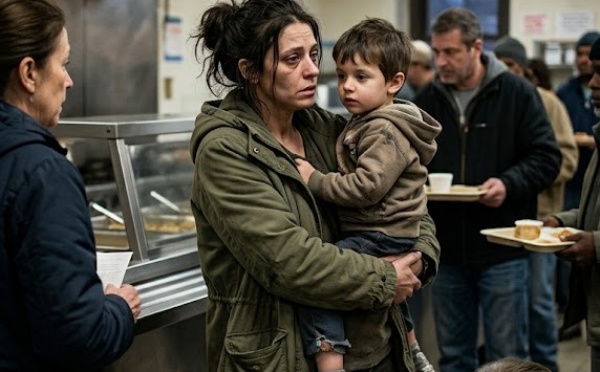
I spotted my sister in a soup-kitchen line, clutching her son in duct-taped sneakers. Last Christmas she’d sent me photos from her new house; now she whispered, “We’re fine, Patricia. Miguel’s between jobs.” I was a retired FBI forensic accountant, and one look at her hollow eyes told me she was lying—to herself. By sunset I’d checked one record, pulled one deed, and realized the truth: my brother-in-law hadn’t lost their home. He’d stolen it.
The first thing I saw were the shoes.
They were once-white sneakers, the kind you buy on clearance at Walmart when money is tight but you’re trying to pretend it isn’t. The canvas was gray now, stained with Florida red clay and frayed at the edges, and someone had carefully wrapped silver duct tape around the sole of the left one so it wouldn’t flap open when she walked.
My sister Elena used to wear cute sandals to work at Coral Springs Elementary. Pretty little wedges that matched her sundresses and the gold teacher necklace her son Diego had made her for Mother’s Day. Those sandals had always clicked confidently across the polished terrazzo floors of the school where she’d taught third grade for eight years.
These shoes didn’t click. They shuffled.
They shuffled slowly along the sun-baked sidewalk as she inched forward in the line outside St. Mary’s Community Kitchen in downtown Fort Lauderdale. It was a Tuesday morning in July, the kind of South Florida summer day that felt like being trapped inside a steam room—humid, oppressive, with heat waves shimmering off the asphalt like mirages. A city bus rumbled by, belching diesel exhaust into air that was already thick enough to chew.
Elena stood in a line that snaked around the corner of the old church building—construction workers with sun-weathered faces, elderly Cuban women clutching worn purses, a few teenagers with hollow eyes who looked far too old for their years. She was near the middle of the line, one hand clasped around the small, sweaty palm of her eight-year-old son, Diego.
Diego’s hand clung back like she was the last solid thing on a crumbling foundation.

I recognized him first. He was taller than the last time I’d seen him at Easter, all knobby knees and sharp elbows in a Miami Heat T-shirt that was just a little too small, the bottom hem riding up whenever he moved. I saw the familiar cowlick at the back of his head, the way his dark hair stuck up despite Elena’s constant attempts to smooth it down with her hands.
I saw him, and my brain said, Diego.
But my brain refused, absolutely refused, to match him to the woman holding his hand.
That can’t be Elena, I thought.
My sister lived in a beautiful three-bedroom house in Plantation with a screened-in pool and a mango tree in the backyard. She’d sent me pictures last Christmas—Diego sitting cross-legged on their tile floor, wrapping paper everywhere, a palm tree decorated with lights visible through the sliding glass doors. She’d texted me a photo of the Honda CR-V she’d bought with her teacher’s salary with the caption: “Look at me, Patricia, finally got my Florida mom car!”
That sister had glossy hair and bright eyes and a smile that came as easily as the afternoon thunderstorms.
This woman’s hair was scraped back into a messy ponytail held with a rubber band, dark roots showing through what had once been professionally highlighted blonde. Her face seemed sharper somehow, like someone had gone in with an eraser and rubbed away all the softness. Her cheekbones jutted out. Her shoulders were hunched, as if she’d been bracing against hurricane winds instead of standing in the blazing sun.
2. And yet—it was her.
I knew it the moment she turned half-sideways to adjust Diego’s shirt, and I caught sight of her profile. Same nose she used to complain about. Same little scar near her left temple from when she’d fallen off her bike trying to keep up with me when we were kids. Same hands—the hands that once braided my hair before school when I was too impatient to do it myself.
I felt something twist hard in my chest, like a knife turning.
“Elena,” I said.
My voice came out rougher than I intended, cracking like I was thirteen again. I cleared my throat and tried again.
“Elena.”
She turned.
There are moments in life that split everything into Before and After. I’d had several in my twenty-eight years with the FBI—standing in a Miami penthouse filled with drug money, watching a grandmother realize her grandson had been stealing her social security checks, seeing a young agent’s face when he discovered his first case of child trafficking.
But nothing had ever cut quite like the look on my sister’s face when she recognized me in that soup kitchen line.
Her dark eyes went wide for a split second. Pure, unfiltered panic flashed there, raw and desperate, before she shoved it down and tried to paste something that might pass for a smile over it.
“Patricia?” Her voice cracked on my name. She forced out a thin laugh that sounded like breaking glass. “¿Qué haces aquí?”
The Spanish slipped out automatically—the language of our childhood, of whispered secrets and shared fears. It made everything worse somehow.
“I volunteer here on Tuesdays,” I said, switching to English. The words were muscle memory by now. “Been doing it since I retired.”
I’d been serving food at St. Mary’s every Tuesday for three years, ever since I’d left the Bureau and moved back to South Florida to be closer to family. I thought I’d seen every kind of story that came through those doors. Single mothers working three jobs. Veterans struggling with PTSD. Elderly folks choosing between medication and groceries.
I was wrong.
“What are you doing here?” I asked, much more quietly.
She shifted her weight from foot to foot, a nervous habit I remembered from childhood. Diego, half hiding behind her, peered at me with wary curiosity. His eyes were too big for his thin face.
“We just…” She glanced around as if the people near us might be listening, might judge her. “We just needed lunch today. That’s all.”
Her voice was light, artificially bright, the kind of tone you use when you’re trying to convince a police officer you definitely weren’t speeding. My investigator brain, which I’d never successfully turned off even in retirement, catalogued details while my heart was still catching up.
Her jeans were faded and worn thin at the knees, patched with little iron-on flamingos that Diego would have picked out. The fabric was soft with age and too many washings. Her T-shirt, once a cheerful coral pink, had faded to the color of old seashells.
The line shuffled forward a few inches. Elena took a tiny step, tugging Diego along with her. He clung to her hand like a lifeline, his knuckles white against his brown skin.
“Where’s your car?” I asked. The question slipped out naturally, as if we were in the parking lot of Publix and I’d just run into her by chance. “The CR-V.”
“Oh.” She stared at the cracked sidewalk, where weeds pushed through the concrete like stubborn hope. “Miguel needed it for work. He had meetings today. We, uh… we took the bus.”
In ninety-five-degree heat. With a hundred percent humidity. With an eight-year-old. To stand in line for free soup.
A bead of sweat rolled down the side of my face, but I barely felt it. A familiar coldness started to spread from somewhere deep inside my chest, the same feeling I used to get when I opened a case file and saw the pattern hidden in the numbers—not the details yet, but the shape of the lie.
Something’s very wrong here.
“How are you, mijo?” I glanced down at Diego, forcing my voice into an approximation of the cheerful aunt I used to be. “You remember your Tía Patricia?”
He gave a half-shrug, half-nod, the universal eight-year-old response to adult questions. But his eyes, bigger than I remembered, scanned my face as if trying to decide if I was safe to trust. There was a watchfulness there I recognized from too many interviews with children whose home lives had imploded.
My heart sank another inch toward my stomach.
“Elena,” I said softly, “what’s really going on?”
“Nothing.” Her fingers tightened around Diego’s hand until he winced slightly. “Everything’s fine. We just… Miguel’s between jobs right now, and money’s a little tight, and we—” She stopped herself mid-sentence, as if she’d almost said too much. “We just need to get through lunch, okay? Then we have somewhere to be.”
“Have you two eaten today?” I asked.
She flinched, almost imperceptibly. But I’d spent three decades reading people’s tells, and Elena had never been good at lying to me anyway.
“We’re fine, Patricia. Really. Please don’t make a scene.”
“I’m not making a scene.” I stepped a little closer, lowering my voice so only she could hear over the rumble of traffic and the chatter of people in line. “I’m your sister. I’m asking you when you last had a real meal.”
Diego tugged on her arm. “Mami,” he whispered, “tengo hambre.”
I’m hungry.
The sound of his small voice in Spanish did something to me. I’d heard thousands of recordings of people crying for help over the years. I’d listened to FBI wiretaps where grown men wept when they realized their crimes were exposed. I’d sat across from victims whose lives had been destroyed by financial predators.
None of that had ever made my throat tighten quite like that small, tired “tengo hambre.”
The Investigation Begins
“Come on,” I said, making a decision that would change everything. “You’re coming home with me.”
“Patricia, no.” Elena’s voice was sharp with panic. “We can’t. Miguel expects us back by—”
“Miguel can wait.” I pulled out my phone. “I’m calling an Uber.”
“We don’t have money for—”
3. “I’m paying.” I was already opening the app. “And we’re stopping at Publix on the way. Diego, what do you want for lunch? Real lunch.”
His eyes lit up for the first time since I’d seen him. “Can we get the chicken tenders? The ones with the honey mustard?”
“We can get whatever you want, baby.”
Elena looked like she might cry. “Patricia, you don’t understand. We can’t just—”
“Yes, we can.” I put my arm around her shoulders, feeling how thin she’d gotten. “We absolutely can.”
The Uber ride to my condo in Aventura was quiet except for Diego’s excited chatter about the chicken tenders and whether we could also get the mac and cheese from the deli counter. Elena stared out the window at the palm trees and strip malls, her jaw clenched tight.
While Diego devoured his lunch on my balcony overlooking Biscayne Bay, I cornered Elena in my kitchen.
“Talk to me,” I said. “And don’t lie. I’ve been investigating financial crimes for thirty years. I know when someone’s hiding something.”
She leaned against my granite counter, her hands shaking slightly. “It’s complicated.”
“Uncomplicate it.”
“Miguel…” She took a shuddering breath. “He lost his job at the construction company six months ago. But he didn’t tell me for weeks. He kept leaving every morning, pretending to go to work.”
My investigator instincts started pinging. “What was he really doing?”
“I don’t know. Gambling, maybe? He came home one day and said we had to move out of the house. Said the bank was foreclosing.”
“Did you see the foreclosure notice?”
“He said he’d handle it. That we just needed to find a cheaper place temporarily.” Her voice got smaller. “We’ve been staying at this weekly motel on Federal Highway. It’s… it’s not safe, Patricia. There are drug dealers in the parking lot. Diego’s scared to go outside.”
I felt that familiar cold rage building in my chest. “Elena, show me your phone.”
“What?”
“Your phone. I want to see the pictures you sent me at Christmas.”
With trembling fingers, she pulled up the photos. There was Diego on Christmas morning, sitting in front of a beautiful tree in what looked like a magazine-perfect living room. Hardwood floors, crown molding, French doors leading to a pool area.
“This was your house?”
“Yes.”
“And Miguel told you the bank foreclosed?”
“Yes.”
I was already pulling out my laptop. “What’s the address?”
“Patricia, what are you doing?”
“My job.” My fingers flew across the keyboard, accessing databases I still had clearance to use. “What’s the exact address?”
She gave it to me reluctantly. Within minutes, I had pulled up the property records for 1247 Coral Ridge Drive, Plantation, Florida.
What I found made my blood run cold.
“Elena,” I said carefully, “come look at this.”
She peered over my shoulder at the screen.
“This is the deed to your house,” I explained. “See this date? Three weeks ago, the property was transferred to a new owner.”
“Right, the bank—”
“No.” I pointed to the screen. “Not the bank. Look at the name.”
Her face went white as she read: “Miguel Santos Herrera.”
“That’s Miguel’s full name, isn’t it?”
She nodded, confusion clouding her features.
“Elena, Miguel didn’t lose the house to foreclosure. He transferred it into his name only. He removed you from the deed.”
The silence stretched between us like a taut wire.
“I don’t understand,” she whispered.
But I was already digging deeper, my forensic accounting skills kicking into high gear. Bank records, credit reports, property transfers—it all painted a picture that made me sick to my stomach.
“Elena, sit down.”
4. “Just tell me.”
“Miguel has been planning this for months. Maybe years.” I turned the laptop toward her. “Look at these transactions. He’s been moving money out of your joint accounts into accounts with only his name. He refinanced the house without telling you and took out a second mortgage. Then he transferred the property to himself and… Elena, he sold it.”
“He sold our house?”
“Three weeks ago. For $340,000.”
She sank into my kitchen chair like her legs had given out. “But we lived there. Diego’s room… his toys…”
“Where are Diego’s toys now?”
“Miguel said we had to put everything in storage. That we’d get it back when we found a new place.”
“Elena, there is no storage unit. Miguel sold everything. The house, the furniture, probably your car too.”
As if on cue, her phone buzzed with a text message. She looked at it and her face crumpled.
“What does it say?”
“Miguel says he can’t pick us up today. Says the car broke down and he’s getting it fixed.”
I grabbed the phone and called the number. It went straight to a disconnected line.
“Elena, when’s the last time you actually saw Miguel?”
“This morning. He dropped us off at the bus stop and said he’d pick us up at six.”
“What time is it now?”
She checked the clock on my stove. “Four-thirty.”
“He’s not coming back.”
The words hung in the air like smoke from a fire.
The Full Truth Emerges
Over the next hour, as Diego napped on my couch with his belly full of real food for the first time in weeks, I pieced together the full scope of Miguel’s betrayal.
He had been systematically stripping their life away piece by piece. The house sale was just the final move in a chess game Elena hadn’t even known she was playing.
“He’s been planning to leave you,” I told her gently. “The foreclosure story was to explain why you had to move out. The weekly motel was temporary—just long enough for him to finalize everything and disappear.”
“But why?” Elena’s voice was broken. “We were happy. I thought we were happy.”
“Because he’s a predator, Elena. And you were an easy target.”
I showed her the records I’d found. Miguel had been living a double life for over a year. While Elena was teaching school and caring for Diego, Miguel had been gambling away their savings, running up credit card debt, and apparently involved with another woman—a woman whose name was now on the deed to a condo in Miami Beach that Miguel had purchased with the proceeds from selling Elena’s house.
“He stole your life,” I said simply. “But Elena, you’re not powerless here.”
“What do you mean?”
“I mean I’m calling the FBI field office in the morning. What Miguel did—transferring property without your knowledge, forging documents, identity theft—these are federal crimes.”
“But he’s Diego’s father.”
“He’s also a criminal who left his wife and child homeless while he moved in with his girlfriend.”
I pulled up more records on my screen. “Elena, look at this. Miguel bought that Miami Beach condo two months ago. He’s been planning this exit strategy while you were worried about buying groceries.”
She stared at the screen, and I watched something change in her face. The defeated, frightened woman was being replaced by someone harder, angrier.
“He let us stand in that soup kitchen line,” she said quietly.
“Yes.”
