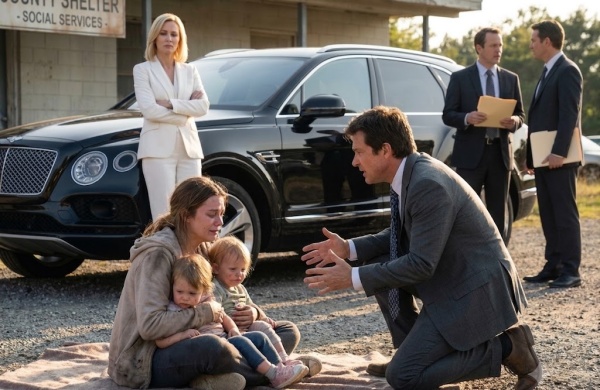
I Divorced My Wife After Believing a Lie from My Lover—Then I Discovered She Was Homeless with Two Twins Who Looked Just Like Me
Part 1: The Lie I Wanted to Believe
My name is Ethan Walker, and if you had asked me two years ago whether I was a good man, I would have said yes without hesitation.
I paid my bills on time. I had a steady job as a construction project manager in Austin, Texas. I owned a four-bedroom house in a decent neighborhood, drove a Ford F-150, coached my nephew’s Little League team on weekends, and called my mother every Sunday after church. By every ordinary measure, I looked like the kind of man people could trust.
But looking decent from the outside and being decent when it matters are two very different things.
My wife, Claire, used to say that character is what you do when the truth costs you something. At the time, I thought that sounded like something from a graduation speech. I didn’t understand that one day, those words would become the mirror I hated looking into.
Claire and I had been married for six years. She was a second-grade teacher with soft brown eyes, a patient voice, and the kind of laugh that made strangers smile before they even knew why. She remembered everyone’s birthday, kept emergency granola bars in her purse, and cried during commercials where old dogs found new homes.
She was not dramatic. She was not flashy. She was the kind of woman who made a house feel safe just by walking into it.
And I betrayed her for a woman who made me feel important.
Her name was Vanessa Hart.
Vanessa worked in commercial interior design and had been assigned to one of my company’s downtown renovation projects. She was polished, confident, and always smelled like expensive perfume and spearmint gum. She laughed at my jokes too loudly, touched my arm when she spoke, and looked at me like I was the answer to a question she had been asking her whole life.
At first, I told myself it was harmless.
A longer lunch here. A few texts after work there. Compliments that crossed lines slowly enough that I could pretend I didn’t notice. I told myself I deserved to feel seen because Claire had been tired lately, quieter than usual, distracted by school stress and fertility appointments and the endless practical rhythms of marriage.
That was the first lie I told myself.
The second was that I was lonely.
The truth was, I was selfish. Claire and I had been trying to have a baby for almost two years. The process had worn on both of us, but Claire carried most of the emotional weight, because that is what women are often expected to do while men stand nearby pretending helplessness is support.
She tracked appointments. She took tests. She cried in the bathroom when another month passed with nothing. I hugged her, yes, but part of me also resented the sadness that had moved into our home like a guest who refused to leave.
Vanessa offered escape.
With her, there were no ovulation calendars, no medical bills, no careful hope. There were cocktails at rooftop bars, flirty messages, and the intoxicating feeling of being wanted without being needed. She never asked me to be steady. She asked me to be interesting.
And I was weak enough to confuse that with love.
The affair lasted four months before Claire found out.
She didn’t scream when she saw the messages on my phone. That would have been easier, honestly. Anger gives a guilty man something to fight against. But Claire just sat on the edge of our bed with my phone in her hand, her face pale, her wedding ring catching the lamp light.
“How long?” she asked.
I stood in the doorway like a teenager caught stealing.
“Claire—”
“How long, Ethan?”
I told her.
She closed her eyes for a second, and when she opened them again, I saw something inside her had changed. Not disappeared. Not broken entirely. Just stepped back from me, like her soul had moved to a safer distance.
“I’m pregnant,” she said.
Those two words should have dropped me to my knees.
Instead, they terrified me.
I asked how far along. She said about nine weeks. The timeline made sense, but my guilty mind had already become a dangerous place. Once a man starts lying, he starts looking for lies everywhere else because that makes his own betrayal feel less lonely.
Vanessa found out about the pregnancy two days later.
I didn’t tell her on purpose. She saw a text from Claire when I left my phone on a table during lunch. The message said, The doctor confirmed everything looks good so far. I know things are awful between us, but you deserved to know.
Vanessa read it and went quiet.
Then she did what skilled manipulators do best: she didn’t attack the truth directly. She planted doubt beside it and watered it with my shame.
“Ethan,” she said softly, “are you sure it’s yours?”
I snapped at her at first. I told her not to say that. I told her Claire wasn’t like that.
Vanessa looked down at her hands and said, “I don’t want to hurt you. But I saw Claire at The Roosevelt Bar in February with some guy. They were very close. I didn’t tell you because I didn’t want to cause trouble.”
I remember the exact sound of the restaurant around us when she said that — silverware on plates, a server laughing near the bar, rain tapping against the window. I remember feeling heat crawl up my neck. I remember wanting, desperately, for Vanessa to be wrong.
But I also remember something worse.
Part of me wanted her to be right.
Because if Claire had betrayed me too, then I wasn’t the villain anymore. I was just one of two damaged people in a failing marriage. That version of the story was easier to live with.
So I believed it.
Not because the evidence was strong.
Because my conscience was weak.
Part 2: The Divorce I Rushed
Claire denied it, of course.
She denied it with tears in her eyes, with shaking hands, with the exhausted disbelief of a woman who had already been wounded and was now being accused by the man holding the knife. She said she had never been to The Roosevelt Bar in February. She said she had never been with another man. She said the baby was mine and that even if our marriage was in trouble, I had no right to turn my guilt into an accusation.
I told her Vanessa had seen her.
The moment Vanessa’s name left my mouth, Claire stared at me as if I had become a stranger in front of her.
“Your mistress is your witness against your wife?” she asked.
I didn’t answer.
There are questions so clear that answering them would require you to become honest, and I was not ready for honesty.
Instead, I became cruel.
I told Claire I wanted a divorce. I told her I couldn’t raise another man’s child. I told her I would not be trapped by a pregnancy I could not trust. Every sentence that came out of my mouth was shaped like logic but fueled by cowardice.
She stood in our kitchen, one hand resting on her still-flat stomach, and listened to me destroy her life in a calm voice.
“You know me,” she whispered.
I looked away.
That was the worst part.
I did know her.
I knew Claire paid for the person behind her at Starbucks when she had extra cash. I knew she stayed late after school to help kids whose parents couldn’t afford tutors. I knew she still sent Christmas cards to my grandmother even after my grandmother forgot her name. I knew she folded my T-shirts the way I liked and always left the porch light on when I came home late.
I knew she was loyal.
But loyalty is inconvenient when you are trying to justify leaving.
So I called her emotional. I called her manipulative. I said she was using the pregnancy to control me. I said things no decent man says to the woman who once held his face in both hands and promised to love him when life got hard.
Within three weeks, I moved into Vanessa’s apartment.
Within six weeks, my attorney filed divorce paperwork.
In Texas, divorce is common enough that the process can feel almost routine if you have money and no one is fighting over much. We had the house, savings, retirement accounts, vehicles, and debts like any married couple. Claire asked to stay in the house through the pregnancy until things were settled.
I said no.
I told my attorney I wanted to sell the house and split the proceeds. I claimed we needed a clean break. I told myself I was being practical.
The truth was uglier.
Vanessa hated that house.
She said it was “full of Claire.” She said if I kept paying the mortgage while Claire lived there, then Claire would always have a hold on me. She said I needed to prove I was serious about our future.
So I pressured Claire until she gave in.
She moved into a small apartment in South Austin that a teacher friend helped her find. It was cheaper, older, and farther from her school. She told me she could manage. She said those words a lot during that time, and I used them as permission to stop caring.
I can manage.
I heard: You are free to abandon me.
By the time the divorce was finalized, Claire was visibly pregnant.
She came to the courthouse wearing a loose blue dress and flat sandals, her hair pulled back, her face thinner than I remembered. I sat beside Vanessa in the hallway because I wanted everyone to understand that I had “moved on.” Vanessa held my hand and rested her head on my shoulder like she was the one who needed comforting.
Claire saw us.
She looked at our joined hands, then at my face.
She didn’t say a word.
Inside the courtroom, everything was businesslike. Property division. Signatures. Final decree. The judge asked a few standard questions, and I answered like a man eager to get free of a burden.
When it was over, Claire stood slowly.
She turned to me before leaving and said, quietly enough that only I could hear, “One day, Ethan, you’re going to remember that I begged you to wait for the truth.”
I felt annoyed, not guilty.
That tells you everything about the man I was.
Vanessa and I celebrated that night at a steakhouse downtown. She wore a white dress and ordered champagne. She toasted to “new beginnings” while I sat across from her trying to ignore the faint echo of Claire’s voice in my mind.
One day, you’re going to remember.
I pushed the thought away.
I had chosen my new life.
I told myself the past would stay where I left it.
Part 3: The Life That Wasn’t Real
At first, life with Vanessa felt like victory.
We moved into a luxury apartment with floor-to-ceiling windows, a pool deck, and a gym I barely used. She helped me buy new furniture, new clothes, new dishes, even new sheets, because she said I needed a life that didn’t look like leftovers from my marriage. My coworkers complimented my confidence. My friends said I seemed lighter.
I mistook relief for happiness.
But relief is what you feel after escaping responsibility. Happiness is what remains when the noise fades. And when the noise faded, I began to hear things.
I heard how Vanessa spoke about Claire.
At first, it was subtle. A joke about teachers being “martyrs.” A comment about how women like Claire used pregnancy for leverage. A little smirk whenever Claire’s name appeared in an email from the attorney.
Then it became colder.
“She always looked so plain,” Vanessa said one evening while scrolling through old photos on my Facebook. “I honestly don’t know how you stayed married that long.”
I didn’t like that.
But I said nothing.
A man who has betrayed one woman often has to keep betraying her in smaller ways just to defend the first betrayal.
The pregnancy moved on without me.
Claire sent exactly three updates. The first was a copy of a medical document confirming her due date. The second said there were complications with work and stress, and she might have to reduce her hours. The third simply said: The doctor says there are two babies. Twins.
I read that message while sitting in Vanessa’s apartment.
Twins.
For a second, my whole body went still.
I imagined Claire alone in a clinic room, hearing that news without me beside her. I imagined the way her hand would have flown to her mouth. I imagined the tears she would have cried — fear and joy tangled together — while I was probably somewhere laughing with Vanessa over sushi.
Vanessa saw my face.
“Don’t start,” she said.
I looked up.
“Start what?”
“Getting sentimental. Twins don’t prove anything.”
The sentence hit me strangely.
I hadn’t said they did.
But she was already defending the lie like it was a house she had built and could feel shaking.
I should have noticed that.
Instead, I put the phone down and said nothing.
By the time Claire gave birth, I had convinced myself I didn’t want to know. She didn’t call me from the hospital. She didn’t send photos. A mutual friend, Marcus, texted me three days later.
Claire had the babies. Two boys. They’re premature but stable.
I stared at the message for a long time.
Vanessa was in the kitchen making coffee.
“Who is it?” she asked.
“No one.”
That was the moment I first called my sons no one.
I did not know their names.
I did not know their weights.
I did not know whether they needed oxygen, whether Claire had slept, whether she had someone driving her home from the hospital with two car seats and a body recovering from childbirth.
I did not ask.
For months, I lived like that.
Then the cracks widened.
Vanessa became restless. She wanted a ring, though she said she didn’t believe in “traditional timelines.” She wanted trips, dinners, weekends in Napa, a new BMW lease, and constant proof that I was not drifting back emotionally toward “the teacher,” as she called Claire. If I worked late, she accused me of avoiding her. If I mentioned money, she accused me of punishing her for Claire’s choices.
Meanwhile, my own life grew heavier.
The house sale did not bring as much profit as expected after repairs, fees, and debt payoffs. My legal bills were higher than I admitted. Work became stressful because I was distracted, short-tempered, and constantly putting out fires I had created in my personal life.
One Friday in November, almost nine months after the divorce, I ran into Marcus outside a Home Depot.
He had been my friend before the divorce, but after everything happened, he stopped calling. I told myself Claire had turned him against me. Looking back, I think he simply lost respect for me and didn’t know how to say it.
He was loading lumber into his truck when he saw me.
“Ethan,” he said.
“Hey, man.”
The conversation was stiff at first. Work. Weather. Traffic on I-35. Then I asked the question I had pretended not to care about.
“How’s Claire?”
Marcus stopped tying the strap around the lumber.
He looked at me for a long time.
“You don’t know?”
Something cold moved through my stomach.
“Know what?”
He looked away, jaw tight.
“She lost the apartment in August.”
I blinked.
“What do you mean, lost it?”
“I mean she couldn’t keep up. Medical leave, NICU bills, childcare waitlists, all of it. She stayed with a coworker for a while. Then her coworker’s landlord complained. Last I heard, she was at a family shelter near Round Rock with the twins.”
The parking lot seemed to tilt.
“A shelter?”
Marcus’s expression hardened.
“Yes, Ethan. A shelter.”
I couldn’t speak.
He threw the strap into his truck bed and looked at me with open disgust.
“You really don’t know their names, do you?”
I didn’t answer.
He shook his head.
“Benjamin and Luke.”
Benjamin and Luke.
My sons had names.
And I had learned them in a Home Depot parking lot from a man who could barely stand to look at me.
Part 4: The Twins Who Looked Like Me
I drove to Round Rock that same afternoon.
I didn’t tell Vanessa where I was going. I didn’t even fully understand it myself. I just searched for family shelters on my phone, called three places, got nowhere because privacy rules are strict, and finally drove around with the desperate, useless energy of a man trying to fix in one hour what he had spent a year destroying.
I found them by accident.
There was a nonprofit community center near one of the shelters, a place that offered diapers, formula, food pantry boxes, and help with housing applications. I pulled into the parking lot because I saw several women with strollers going inside, and some instinct told me to stop.
I was walking toward the entrance when I saw Claire.
She was standing near the side of the building under the thin shade of a live oak tree, struggling with a double stroller. Her hair was shorter. Her jeans hung loose on her hips. She wore a faded University of Texas sweatshirt and looked so tired that my chest physically hurt.
Beside the stroller was a plastic grocery bag full of diapers.
And inside the stroller were two baby boys.
They were bundled in soft blue blankets, round-cheeked and sleepy, both wearing tiny knit caps. One of them opened his eyes as I approached. He had my eyes.
Not similar eyes.
My eyes.
The same pale gray-blue my father had, the same shade that made my mother call me “stormy” when I was a kid. The other baby yawned, and when his little face scrunched up, I saw my own baby picture so clearly that I had to grab the back of a bench to steady myself.
Claire saw me then.
Everything in her face changed.
Not surprise exactly. Something colder. A door locking.
“What are you doing here?” she asked.
I tried to say her name, but it came out broken.
“Claire.”
“No,” she said immediately. “You don’t get to show up like this.”
I looked at the babies.
“Are they mine?”
Her eyes flashed.
“Are you serious?”
“I need to know.”
She laughed once, but there was no humor in it.
“You needed to know a year ago, Ethan. You needed to know when I begged you to wait for a paternity test. You needed to know when I was sleeping upright in a NICU chair after a C-section because one baby had trouble feeding and the other kept dropping weight. You needed to know when I filled out assistance forms with stitches still healing because I had no maternity leave left.”
I deserved every word.
Still, I whispered, “Claire, please.”
She leaned down and adjusted one of the blankets with hands that trembled slightly.
“Yes,” she said. “They’re yours. They were always yours.”
The words did not feel like relief.
They felt like judgment.
I looked at Benjamin and Luke, at the sons I had abandoned before they were born because believing a lie had been more convenient than facing my own guilt. I wanted to kneel. I wanted to cry. I wanted to reach for them.
Claire stepped between us.
“Don’t,” she said.
I stopped.
That single word told me exactly where I stood.
I was not their father in any way that mattered yet. I was biology. I was a name on a painful history. I was the man who had left their mother when she needed protection most.
“I can help,” I said quickly. “Money, housing, whatever you need. I can fix this.”
Claire looked at me with a sadness that made me feel smaller than anger would have.
“You always think money fixes what character broke.”
I had no answer.
A volunteer came outside then, calling Claire’s name. Claire nodded and began pushing the stroller toward the entrance.
I followed a step behind.
“Claire, please. Let me do something.”
She stopped but did not turn around.
“You want to do something? Call a lawyer. Establish paternity legally. Pay child support properly. Stop treating my life like a scene you can walk into when guilt finally becomes uncomfortable.”
Then she pushed the stroller inside.
I stood outside that community center for ten minutes, staring at the glass doors.
When I got back to my truck, I broke down.
Not the kind of tears that make someone noble. Not cleansing tears. They were ugly, choking tears, full of shame and panic and the sudden understanding that consequences had names now.
Benjamin.
Luke.
That night, I confronted Vanessa.
She was sitting on the couch in silk pajamas, watching a reality show, when I walked in.
“I saw Claire,” I said.
Vanessa froze.
“And the twins.”
Her face changed in a way I will never forget. Not confusion. Not shock. Calculation.
“They look like me,” I said.
She looked away.
“Lots of babies look alike.”
I stepped closer.
“Did you lie?”
She stood up fast.
“Don’t come at me like that.”
“Did you lie about seeing Claire with another man?”
She crossed her arms.
“She could have been with someone. I don’t remember every detail.”
My chest went cold.
“You told me you saw her.”
“I said what I needed to say because you were too weak to leave a dead marriage.”
There it was.
Not an apology. Not even denial.
Just the truth, tossed at my feet like trash.
I stared at the woman I had chosen over my wife, over my children, over my own conscience. She looked beautiful under the apartment lights. Perfect hair, perfect nails, perfect expression of outrage at being held accountable.
And for the first time, I saw her clearly.
“You destroyed my family,” I said.
She laughed sharply.
“No, Ethan. You did that. I just gave you permission.”
I hated her for saying it.
I hated her more because it was true.
I packed a bag that night and left.
Vanessa shouted as I walked out. She called me pathetic. She said Claire would never take me back. She said I was crawling toward a woman who had played me from the beginning.
I kept walking.
For once, I did not let her voice choose my life.
Part 5: What I Could Never Get Back
The legal process was not dramatic.
That surprised me at first. I think part of me expected big emotional moments, maybe because I wanted my remorse to feel cinematic enough to matter. But the real world is quieter and less forgiving. It runs on forms, court dates, DNA tests, income disclosures, and the best interests of children who did not ask for adult chaos.
The paternity test confirmed what Claire had already known.
Benjamin and Luke were my sons.
I hired an attorney, but not to fight Claire. I hired one to make sure everything was done correctly. Temporary child support was ordered, including a portion for medical expenses and childcare. Because I had not been involved since birth, visitation began slowly — supervised at first, then gradually expanded as the boys became familiar with me.
Claire accepted the support.
She did not accept me.
I found her and the twins a safe apartment before the court required anything, but she insisted the lease be in her name. She let me pay the deposit directly to the property manager, not to her. She kept receipts for every transaction, communicated through email, and never allowed our conversations to drift into memory.
At first, that hurt my pride.
Then I realized she was not being cold.
She was being safe.
I had made myself unsafe to her. Not with fists, not with threats, not with anything the law could easily name in one sentence. But I had become unsafe by turning love into abandonment, trust into suspicion, and her pregnancy into a courtroom argument.
So I respected her boundaries because I had finally run out of excuses not to.
The first time I held Benjamin, he cried so hard his little face turned red.
Claire stood three feet away, watching carefully.
“It’s okay,” she said, not to me, but to him. “You’re okay, Benny.”
Benny.
She had a nickname for him.
Of course she did.
She had lived a whole lifetime with them before I ever showed up. She knew which twin liked to be rocked and which one wanted to face outward. She knew the difference between their cries. She knew Luke hated cold wipes and Benjamin calmed down when she hummed “You Are My Sunshine.”
I knew nothing.
I was a stranger with legal rights and biological proof.
That realization humbled me more than any judge could have.
Over the next months, I learned.
I learned how to mix formula without clumps. I learned how to change diapers in the back seat of my truck. I learned that Luke would stare at ceiling fans like they contained the secrets of the universe, and Benjamin laughed whenever I made a clicking sound with my tongue.
I learned that twins do not care how sorry you are if they are hungry.
I learned that showing up once does not erase all the times you didn’t.
Claire remained careful.
She never bad-mouthed me in front of the boys. She never used them to punish me. But she also never softened the truth for my comfort. If I was late, she documented it. If I forgot something, she corrected me. If I tried to apologize too many times in one conversation, she ended it.
One afternoon, after a pediatric appointment, I walked her to her car.
The boys were asleep in their car seats, both wearing tiny dinosaur socks. Claire was loading the diaper bag when I said, “I need you to know I’m sorry.”
She closed the car door gently.
“You’ve said that.”
“I mean it.”
“I know you mean it now.”
The word now landed exactly where it was supposed to.
I swallowed.
“I believed her because it was easier than believing I had become the bad guy.”
Claire looked at me for a long moment.
“That’s the first honest thing you’ve said about it.”
I nodded, ashamed.
“I don’t expect you to forgive me.”
“Good,” she said. “Because forgiveness is not something you get to schedule because you’re ready to feel better.”
I looked down at the pavement.
She sighed softly, and when she spoke again, her voice was not cruel. Just tired.
“Ethan, I loved you. I really loved you. When I found out I was pregnant, even after what you did, part of me still hoped the babies would bring you back to yourself. Instead, you used them as one more reason to leave.”
Tears burned my eyes.
“I know.”
“No,” she said. “You’re starting to know. That’s different.”
She got into the car and drove away.
I stood in the parking lot with the Texas sun beating down on my neck and understood that regret is not redemption. Regret is just the place where redemption has to begin.
A year passed.
Claire rebuilt her life with a strength I had no right to admire but did anyway. She returned to teaching part-time, then full-time. She moved from the apartment into a small rental house with a fenced backyard, where the boys could toddle around under a pecan tree. She cut her hair to her shoulders and started smiling again in photos her friends posted online.
Not big smiles.
Real ones.
That hurt and healed me at the same time.
My relationship with Benjamin and Luke grew slowly. By their second birthday, they knew me as Daddy, though I still felt the weight of earning that word every time they said it. They ran to me during pickups. They cried sometimes when they had to leave. They also ran back to Claire with the kind of total trust children give the person who never disappeared.
I accepted both truths.
One Sunday evening, after a birthday party at a park in Cedar Park, I helped Claire pack leftover cupcakes and juice boxes into her car. The boys were sticky, exhausted, and happy. Luke had frosting in his hair. Benjamin was clutching a toy truck someone had given him and refusing to let go.
Claire closed the trunk and turned to me.
“They had a good day,” she said.
“Yeah,” I said. “They did.”
For a moment, we stood there in the golden late-afternoon light, and I saw the life we might have had if I had been stronger. Claire in a sundress, our sons laughing in the grass, me carrying the cooler, all of us going home together. It was so clear I almost reached for it.
But that life was gone.
Not stolen by Vanessa.
Not ruined by fate.
Destroyed by me.
“Claire,” I said quietly, “do you ever think there’s a chance for us?”
She looked at me, and I knew the answer before she spoke.
“No.”
I nodded, even though something inside me folded.
She was gentle enough to explain, though she did not owe me that.
“I’m glad you’re becoming a good father,” she said. “I really am. The boys deserve that. But I can’t build my life around the hope that you won’t choose the easier lie the next time truth gets hard.”
I closed my eyes.
“That’s fair.”
“It is,” she said. “And Ethan?”
I looked at her.
“I don’t hate you anymore. But I don’t trust you with my heart.”
Those words stayed with me longer than any insult could have.
Because they were measured.
Because they were earned.
Because they were final.
Now, three years later, I see my sons every week. I pay child support. I attend preschool events, pediatric checkups, birthday parties, and parent-teacher meetings where Claire and I sit side by side like two people who survived the same storm from opposite sides. I keep extra clothes, snacks, stuffed animals, and tiny rain boots at my place.
I know Benjamin likes blueberries but hates bananas.
I know Luke says “yellow” like “lellow” and gets furious if anyone corrects him.
I know both of them have Claire’s stubbornness and my eyes.
Sometimes, when they fall asleep on my couch after a long Saturday, I sit in the dim light and look at their faces. I think about the shelter. I think about Claire standing under that live oak tree with a diaper bag and a double stroller, looking at me like I was the last person on earth she wanted to see.
And I understand something now that I should have understood then.
A man does not lose his family all at once.
He loses them in small acts of cowardice.
In the question he refuses to ask because he prefers the answer that excuses him. In the woman he believes because her lie flatters his guilt. In the papers he signs too quickly. In the hospital room he never enters. In the names he does not bother to learn.
I divorced my wife after believing a lie from my lover.
But the ugliest truth is this: I believed that lie because it gave me permission to become the man I already wanted to be.
A man free of responsibility.
A man free of guilt.
A man free to chase a fantasy while calling it love.
Then I found Claire homeless with two twins who looked just like me, and the fantasy died in a parking lot outside a community center.
What replaced it was not a happy ending.
It was something harder.
The truth.
Claire did not take me back. She did not have to. Her healing was not a reward for my regret. Her peace was not a door I could knock on after burning down the house we built together.
But she let me become a father.
Not because I deserved it.
Because Benjamin and Luke did.
And every time they call me Daddy, I hear both a gift and a warning.
A gift, because I still have a chance to love them well.
A warning, because love is not proven by what you feel after losing everything.
It is proven by what you protect before it is gone.
