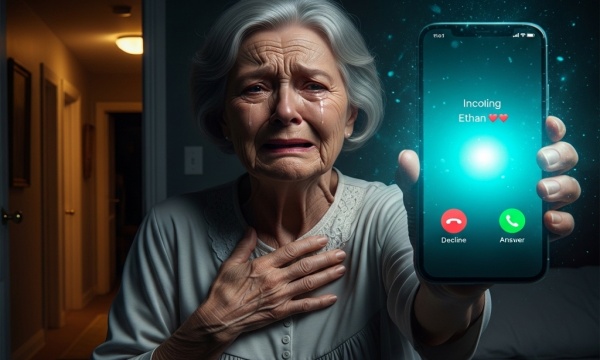
The phone call came at 3:07 AM—my son’s name glowing on the screen, impossible and terrifying. He had drowned two years ago in the Atlantic Ocean. They never found his body. But there was his voice, raspy and urgent: “Mom, I’m cold. Open the door.”… When the doorbell rang moments later, my daughter-in-law ran to the peephole and screamed words that made my blood run cold: “He’s back for revenge! Go away!” The door was empty, but my mind was racing….
Part 1: The Call That Should Have Been Impossible
At 3:07 in the morning, the sound of my phone shattered the silence.
It wasn’t just any ringtone. I had set that specific melody—”Somewhere Over the Rainbow”—for only one person, the only name that still made my throat close up when I tried to say it aloud: Ethan. My son.
I opened my eyes in the darkness of my bedroom and saw the blue glow of my iPhone on the nightstand. The screen was vibrating, or maybe it was my hand trembling as I reached for it.
“Ethan ❤️”
I felt my chest tighten like someone had wrapped steel bands around my ribs. I sat there in my king-sized bed, motionless, my mouth suddenly dry as desert sand. Ethan had died two years ago. I had organized the memorial service myself at St. Michael’s Episcopal Church in Portland, Maine—without a body, because the Atlantic Ocean doesn’t give back what it takes. I had clutched his framed photograph until I had no tears left to cry, until my daughter-in-law had to pry my fingers loose.
So why… why was his name there on my screen, calling me at three in the morning?

I answered with a shaking finger, as if the device might burn me.
“Hello?”
A second of crackling silence. And then, a voice—deep, hoarse, achingly familiar—that split my heart clean in two.
“Mom… open the door. I’m so cold out here.”
The air caught in my throat. That voice. I had heard that voice thousands of times: when he was seven and asked for hot chocolate after sledding, when he was sixteen and promised me he’d be careful driving in the snow, when he was twenty-eight and hugged me at his wedding like I was the one who needed protecting.
“Ethan?” I managed to whisper, and my own voice sounded like a stranger’s.
But the call cut off abruptly.
I held the phone pressed to my ear, hearing nothing but silence and the pounding of my own heartbeat. Cold sweat trickled down the back of my neck, sliding beneath my cotton nightgown. I got up without turning on the light and crossed the long hallway of my house—a four-bedroom colonial that was far too big for two women and a ghost.
I am Margaret Hartley, 64 years old, a widow for six years now, living in Cape Elizabeth, just outside Portland, Maine. After my son’s death, I thought I would spend my remaining years in quiet grief, with the echo of his footsteps haunting the hardwood floors. But that night, the silence was shattered.
I knocked on my daughter-in-law’s bedroom door, my knuckles rapping urgently against the wood.
“Vanessa! Vanessa, open up!”
The door flew open. Vanessa Crawford—my daughter-in-law—appeared with disheveled auburn hair and puffy eyes from interrupted sleep. She was wearing an expensive silk pajama set, the kind you buy at Nordstrom.
“What’s wrong, Margaret? It’s three in the morning.”
I grabbed her arm, my breath coming in short gasps.
“Ethan called me. He said… he said he’s at the door. That he’s cold.”
Vanessa’s face went pale, then her expression hardened.
“You had another nightmare. Go back to bed, Margaret. Please.”
And then the doorbell rang. Long. Insistent. The sound echoing through the house like a warning bell.
Vanessa froze, her eyes widening.
“No…” she murmured. “It can’t be.”
She ran down the stairs, her bare feet slapping against the wood. I followed her, gripping the banister for support. She pressed her eye to the peephole of our heavy oak front door.
And then she screamed with a voice I’d never heard from her before—raw, terrified.
“Don’t come back! Go away! He’s back… he’s back for revenge!”
I pushed past her and looked through the peephole myself.
There was nobody outside. Just our front porch with its wicker furniture and the motion-sensor light illuminating an empty space. The November wind rattled the bare branches of the maple tree in our yard.
I didn’t sleep that night.
Part 2: The Impossible Message
Three days later, my phone vibrated again during breakfast.
“Ethan ❤️”
I answered, my hands shaking so badly I nearly dropped the phone into my oatmeal.
“Mom, it’s me. I’m alive.” The voice was rushed, urgent. “I’ll explain everything later. Tomorrow, at nine o’clock in the morning, come alone to The Harbor Café on Commercial Street. And whatever you do… don’t tell Vanessa.”
The call ended before I could respond.
How could a son who had drowned, whose memorial service I had attended, whose life insurance policy had paid out $500,000… how could he be alive? And why did his own wife fear his return?
The truth wasn’t just going to resurrect a dead man. It was going to unmask a murderer.
Part 3: The Woman in My House
That afternoon, Vanessa returned from downtown Portland with shopping bags from L.L.Bean and a radiant smile that now looked sinister to me.
“Margaret, I bought you a beautiful scarf. It’s cashmere. Try it on.”
The forest-green fabric felt soft against my skin, but to me it looked like a noose. I wrapped it around my neck, forcing a smile.
“Thank you, dear. It’s lovely.”
When I went upstairs to my bedroom, I felt her gaze following me, suspicious. As if she could smell my secrets the way a predator smells fear.
The next morning I woke before dawn. I put on a simple gray cardigan and slacks, tied my silver hair back, and went downstairs trying to appear normal. Vanessa was in our granite-countered kitchen preparing a pot of herbal tea—her daily ritual for me.
“You’re up early, Margaret. I made your tea. It’ll help you relax.”
The scent of chamomile and lavender used to comfort me. Now it made my stomach turn. I picked up the ceramic mug, pretended to take a sip, and set it down.
“It’s too hot. I’ll let it cool.”
Vanessa smiled, but her shoulders tensed for just a fraction of a second. A tiny detail… like a wire pulled taut.
I lied smoothly: I said I had a book club meeting with Dorothy Simmons. I called an Uber. The entire fifteen-minute ride to the Old Port, I clutched my purse as if it contained my life.
The Harbor Café was tucked into a narrow brick building near the waterfront. Inside, it smelled of fresh-brewed coffee and blueberry muffins. I saw him in the back corner booth: a thin man with his back to me, facing a window overlooking the gray November harbor.
My heart stopped… and then it raced.
When he turned around, I recognized him even though he was gaunt, with deep purple circles under his eyes and a fresh scar cutting through his left eyebrow. But his eyes—those hazel eyes—were still my son’s.
“Mom…”
I threw myself into his arms across the table, knocking over a water glass. I cried like I hadn’t cried even at his memorial service. I touched his face, his arms, his warm skin: flesh and blood, not a ghost.
“Where have you been? Why… why did you do this to me?” I demanded between sobs, my voice breaking.
Ethan closed his eyes, as if swallowing broken glass.
“Forgive me. I… I couldn’t come back sooner. It wasn’t safe.”
He sat me down gently. He lowered his voice, glancing around the café to make sure no one was listening.
“Mom, I need you to answer something. What did Vanessa tell you about the night I ‘died’?”
I recounted what she had repeated to me for two years, the story I had memorized like a terrible prayer: a party on a chartered yacht off Peaks Island, too much champagne, “he jumped in to go swimming,” “I saw him go under,” “I screamed for help but the current was too strong,” “the Coast Guard searched for three days.” Every phrase burned my throat.
Ethan’s jaw clenched, a muscle jumping near his temple.
“It was all a lie.” He swallowed hard. “That night, I overheard her on the phone in the yacht’s cabin. She was talking to someone… saying it was about the life insurance policy… about you… about making it look like a sudden heart attack… that no one would suspect anything.”
I felt like the floor was tilting beneath me, like the café was spinning.
“Kill me?”
“Yes.” His voice trembled with suppressed rage. “I confronted her right there on the deck. She confessed that she owed money—gambling debts, over $200,000 to some dangerous people in Boston. She was being threatened. And when I told her I was going to divorce her and that I was going to protect you… she snapped. She pushed me over the railing.”
I covered my mouth with both hands, tasting salt from my tears. The coffee shop sounds became distant, as if life were happening behind thick glass.
“How… how did you survive?”
Ethan took a shuddering breath.
“The current dragged me toward the rocks near the shore. I hit my head on the railing going down, then again on the rocks. I lost consciousness. A lobsterman—Tom Morrison—found me washed up on the beach at dawn. I had no ID, no memory. I’d hit my head so hard I had retrograde amnesia.”
He paused, his hands shaking as he wrapped them around his coffee mug.
“Tom and his wife, Linda, took me in. I lived with them in their house in Harpswell for two years. I worked on their lobster boat. I went by the name ‘John’—they called me that because I was a John Doe. I was a completely different person. Until three weeks ago, when I saw a yacht go by that looked like the one from that night… and everything came flooding back. I remembered your face. Your voice. And I knew I had to come home.”
He stared at me with an intensity that made my chest ache.
“Mom, Vanessa is still trying to kill you. She needs your life insurance money—you’re worth $750,000. Don’t tell her anything. We need proof before we go to the police.”
He pulled out a small glass vial from his jacket pocket.
“Tonight, when she gives you the tea, smile and accept it. But don’t drink it. Pour a sample into this. We’re going to have it analyzed.”
Part 4: The Poison in Plain Sight
I returned home feeling like my beautiful colonial house was a cage filled with hidden traps. Vanessa greeted me at the door with her practiced smile.
“Did you have a nice time at book club, Margaret?”
“Yes, dear.” I lied without blinking, my voice steady. “We discussed ‘Where the Crawdads Sing.'”
That evening, when she brought me the cup of chamomile tea—the same ritual we’d maintained for two years—the aroma smelled like death itself.
“Here’s your tea, Margaret. I added a little honey, just how you like it.”
“Thank you, sweetheart.” I said “sweetheart” and the word tasted like poison on my tongue.
I pretended to take a sip, complimented the flavor, then excused myself “to get my reading glasses.” In the kitchen, with trembling hands, I poured a small amount into the vial Ethan had given me. Then I dumped the rest down the garbage disposal and ran the water hard, as if I could wash away the horror.
I repeated this ritual for three nights, collecting samples each time.
On the fourth day, Ethan texted me to meet him in the parking lot of a CVS pharmacy. He handed me a laboratory report from Maine Medical Center. In red letters, a word that stole my breath:
ARSENIC
“Low concentration, cumulative dosing. Consistent with chronic poisoning. Kidney and liver damage. Death within 6-8 months if continued.”
I bent over, gripping the car door—not from weakness, but from the crushing weight of betrayal.
Part 5: Gathering Evidence
We called Robert Chen, a retired Portland Police detective and an old friend of my late husband. Robert listened to our story in his home office, his expression growing darker with each detail. He didn’t hesitate.
“I’ll follow her. Give me a week.”
Seven days later, Robert came back with photographs: Vanessa meeting with a rough-looking man outside a bar in the Bayside neighborhood, handing him a thick envelope of cash, receiving a small package in return. And a recording—captured with a directional microphone—where Vanessa said with a coldness that still haunts my dreams:
“When I collect that old woman’s insurance money, this will all be over. Then I can pay off Marco and finally be free.”
We had proof of the attempted murder against me. But we were missing evidence for the other crime: the push from the yacht. “There was only the ocean,” I thought. But Ethan remembered something crucial.
“Jake… my best friend… he hired a drone to record the party. He’s into photography.”
We drove to Falmouth to visit Jake Sullivan. He searched through old files on external hard drives, his face contorted with guilt for not having checked the footage sooner.
“I’m so sorry, man. I should have looked at this two years ago. I just… I couldn’t bear to watch it after you ‘died.'”
After an hour of searching, a video file surfaced: an aerial shot of the yacht at sunset. The upper deck. Two figures arguing—a man and a woman. And then… my son’s body falling backward into the dark water, pushed by a woman in a red dress who stood there watching without calling for help, calmly adjusting her hair before turning and walking back to the party.
Jake put his hands over his mouth, his eyes filling with tears.
“Oh my God. It’s Vanessa. She just… she just watched him fall.”
I wept silently, my body shaking. It wasn’t just about justice anymore. It was confirmation that my grief had been manufactured, manipulated, used as a weapon.
Part 6: Justice
We went to the Portland Police Department the next morning. Detective Sarah Morrison reviewed the video, the arsenic lab reports, and the audio recording. Her face hardened with professional anger.
“We’ll proceed with an immediate arrest warrant for Vanessa Crawford for attempted murder of Margaret Hartley and for the attempted murder of Ethan Hartley.”
I arrived home before the police. I locked myself in my bedroom, trembling, while I listened to Vanessa downstairs, humming along to Spotify while painting her nails a deep crimson red—the color of fresh blood.
The doorbell rang forty-five minutes later. I heard Detective Morrison’s voice, firm and unwavering:
“Vanessa Crawford, you’re under arrest for two counts of attempted murder.”
Vanessa screamed like a cornered animal.
“This is insane! My husband is dead! Margaret is having delusions!”
I stepped to the top of the stairs. Two uniformed officers were holding her arms. Her mascara was running down her cheeks in black rivers. When she saw me, her eyes filled with pure hatred.
“You!” she shrieked. “You bitter old woman! You want to destroy me because you’re jealous!”
Detective Morrison held up her tablet. The drone video played on the screen—the argument, the push, the watching. The image destroyed her. Vanessa’s legs buckled.
And then Ethan stepped through the front door, alive and real.
Vanessa’s face went white as paper. She fainted.
For the first time in two years, I breathed without that crushing weight on my chest.
Part 7: Aftermath and Healing
The trial made headlines across Maine and even got picked up by national news. “The Dead Son Who Came Back Alive” became a sensational story for many, but for me it was closure—painful, necessary closure.
Vanessa pleaded guilty when the prosecutor presented the arsenic evidence, the audio recording, and the drone footage. She received twenty-five years in prison with no possibility of parole for fifteen years. And most importantly: she could never contact me or Ethan again.
My health took months to stabilize. Arsenic isn’t something you can flush out with tears alone. I underwent chelation therapy at Maine Medical Center, endured countless blood tests, and slowly—painfully slowly—my kidney and liver function improved.
But every morning, when I opened my eyes and smelled coffee brewing, I saw my son in the kitchen—alive, real, home—making coffee with the calloused hands of a lobsterman, and that was better medicine than anything the doctors could prescribe.
One Sunday in May, when the Maine coast was finally warm again, Ethan took me to Harpswell to meet Tom and Linda Morrison. I brought them a basket filled with homemade blueberry muffins, a handwritten card, and a “thank you” that could never be adequate for saving my son’s life.
Linda held my face in her weathered hands as if I were her own child.
“God brought him to our shore, Margaret. But you brought him back to life.”
We stood together on the rocky beach, watching the lobster boats bob in the harbor. Ethan took off his shoes and walked into the cold Atlantic water, letting the waves wash over his feet.
“I lost two years, Mom.”
I hugged him from behind, resting my cheek against his back.
“No, son. We got them back today.”
And there, with the salt wind on my face and the cry of seagulls overhead, I understood something I never thought I’d say after burying him without a body:
That love, sometimes, returns—even if it arrives at 3:07 in the morning, with an impossible phone call and the truth hidden in a cup of poisoned tea.
That miracles can happen on rocky Maine shores.
That mothers know their children’s voices, even from beyond death.
And that some bonds are stronger than the ocean that tried to take him from me.
Epilogue
Two years later, Ethan and I still live in the colonial house in Cape Elizabeth. He works with Tom on the lobster boat during the season and is studying to become a marine biologist. I volunteer at the Maine Medical Center, helping other families navigate medical crises.
We replaced all the mugs in the house. I drink my tea from a new set—bright yellow ceramic ones that Ethan bought me for Christmas, each one painted with a different lighthouse from the Maine coast.
Every night at 3:07 AM, my phone stays silent.
And that’s exactly how I like it.
