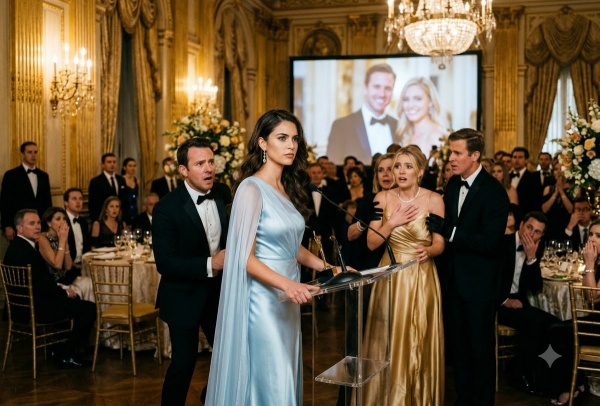
My husband emptied my jewelry safe and dressed his mistress in my dead mother’s diamonds for their engagement photos. My husband left me a note saying he had “borrowed” my mother’s diamonds and would return them on Monday. Hours later, I saw his mistress wearing them in their engagement photos—and Preston was smiling beside her…
Part 1: The Note Beside the Safe
The first thing I noticed was my mother’s jewelry box sitting crooked on the shelf.
It was a small thing, really. Preston had been moving things around our bedroom for months, leaving drawers half-open and setting his watch wherever he pleased, so a crooked box shouldn’t have stopped me in my tracks. But my mother’s box had a place, and for two years I had made sure it stayed there.
I set my purse down and opened the bedroom safe.
The velvet tray inside was empty.
For a moment, I simply stared at it, waiting for my mind to catch up with what my eyes had already seen. The pear-shaped diamond ring was gone, along with the matching earrings and the pendant my mother wore on every anniversary dinner I could remember. Even the thin gold chain she had tucked beneath the pendant was missing.
There was a piece of paper folded on the bottom shelf.
I recognized Preston’s handwriting before I unfolded it, the confident slant of a man who had signed checks and contracts without ever doubting he deserved the pen in his hand. I had loved that handwriting once, especially when it appeared on the backs of postcards from cities we planned to visit together. Now it was written on a torn sheet from the notepad beside his home office phone.
Eleanor,
I borrowed the diamonds for a few days. They’ll be back on Monday. Please don’t make this difficult.
Preston
I read the note three times, because the word borrowed was so absurd that I thought I must have misunderstood it.
My mother’s diamonds were not a serving dish he could take to a neighbor’s house. They were not a coat I had left hanging in a guest room, or a necklace I had forgotten I owned. They were the last things she had given me before she died, and Preston knew exactly what they meant.
I called him.
The phone rang until voicemail picked up, and I left no message. Then I called again, and again, until the line went straight to voicemail. Preston had always claimed his phone battery died when he was busy, although I had never once seen him forget to charge it before a golf outing.
I called his assistant, who told me he was in a meeting and couldn’t be disturbed.
“Please tell him it’s about my mother’s jewelry,” I said.
There was a pause on the other end of the line. “I’ll give him the message, Mrs. Whitmore.”
I hated how carefully she said my name. It sounded like she was looking at something she couldn’t tell me about.
I went downstairs and made a cup of tea I never drank. Outside the windows of our Charleston home, the live oaks were moving in the late-afternoon breeze, and someone on the street was walking a golden retriever in a red bandana. It was the kind of ordinary October day that made my own kitchen feel unreal.
I had just reached for my phone again when my sister called.
“Tell me you’re sitting down,” Anna said.
My stomach tightened. “What happened?”
“I was looking at a photographer’s page. Eleanor, I think you need to see something.”
A link appeared in our text thread. I opened it and saw a photograph of Preston standing beneath the white columns of a waterfront hotel, his hand resting on a woman’s waist. The woman was smiling up at him, one hand on his chest, her long dark hair falling over a cream-colored dress.
On her finger was my mother’s ring.
I knew its shape before I enlarged the image: the pear-shaped center stone, the narrow platinum band, the tiny diamond on either side. My mother used to turn the ring inward when she kneaded biscuit dough, and I had spent my childhood watching that pale stone flash as she worked. I knew the earrings too, even though one was partly hidden by the woman’s hair.
The caption read, A little preview of Preston and Julia’s engagement session. Congratulations to this beautiful couple!
For several seconds, I couldn’t feel my hands.
Preston and I had been married for eleven years. We had not separated, and neither of us had filed for divorce as far as I knew. Three nights earlier, he had asked me whether we should replace the outdoor furniture before Thanksgiving.
I looked at the woman again. I had met Julia Bennett twice, both times at charity events where Preston introduced her as a consultant who helped with his company’s marketing. She had been polite, carefully dressed, and young enough that I had noticed Preston suddenly laughing harder at jokes that weren’t funny.
“Ellie?” Anna said.
“I’m here.”
“Do you want me to come over?”
I looked at the empty safe, then at the photograph on my phone. My mother’s ring was on another woman’s hand, and my husband had called it borrowing. I thought about all the times I had watched my mother look for the right word when she was angry, as if choosing it carefully might keep the world from breaking.
“Yes,” I said. “Please come.”
While I waited, I took screenshots of the photographer’s post, including the account name, the caption, and the time displayed on my phone. I saved the link and emailed the images to myself, then photographed the empty safe and Preston’s note where I had found it. I didn’t know yet what any of those things would prove, but I knew I didn’t want to rely on my memory.
I also took out the blue folder my mother had given me when she made me promise to insure the jewelry. Inside were photographs, an old appraisal, and a laboratory report for the center diamond in the ring. She had labeled everything in her neat handwriting, with little arrows pointing to the documents she thought I might overlook.
At the bottom of the folder was a birthday card she had written when I turned thirty.
The most valuable things in a family aren’t always the things that sparkle, it said. But you’re allowed to love the sparkling things too.
I sat on the edge of my bed and cried with the card in my lap. I cried for the ring and the earrings and the fact that a stranger had worn my mother’s diamonds while posing with my husband. But underneath all of it was a deeper humiliation: Preston had expected me to read that note and wait quietly until Monday.
Anna arrived with takeout containers from the Italian place down the street and two bottles of sparkling water. She didn’t ask me to explain before she wrapped her arms around me. She knew our mother had worn those diamonds to Anna’s wedding and to my father’s funeral, and she knew why I couldn’t stop shaking.
“Have you spoken to him?” she asked.
“No. His assistant says he’s in a meeting.”
Anna looked at the photograph on my phone. “That doesn’t look like a meeting.”
I almost laughed, and the sound that came out of me surprised us both. It was sharp and tired, and it ended before it had the chance to become anything else. Anna opened one of the takeout containers and put a fork in my hand.
“You don’t have to eat much,” she said. “But you need something.”
At six forty-three, Preston finally called.
“Eleanor, I was going to explain,” he said before I could speak.
“Where are my mother’s diamonds?”
A silence followed, so brief I might have missed it if I hadn’t known him so well. Preston was deciding which version of the truth would cost him the least. I had watched him do it with clients, contractors, and once with a neighbor whose fence he had damaged while backing out of the driveway.
“They’re safe,” he said. “Julia needed jewelry for a photo shoot, and I knew you weren’t wearing them.”
“You mean your engagement photo shoot.”
Another silence. This one was longer.
“It isn’t what you think.”
“You’re standing next to her in a photograph labeled ‘engagement session.’ Which part am I misunderstanding?”
“Eleanor, lower your voice.”
I looked at Anna, who was sitting across from me with her hands clasped around her glass. She had heard enough to understand, but she didn’t interrupt. I was grateful for that, because I needed Preston to hear me clearly.
“Bring the jewelry home tonight,” I said.
“I can’t do that tonight.”
“Why not?”
“Because Julia has it, and she’s out with friends. I said it would be back Monday.”
It was Friday.
“You took my mother’s things without asking me, gave them to another woman, and now you’re telling me I have to wait three days?”
“I knew you’d react like this,” he said. “That’s why I left the note.”
For eleven years, I had mistaken Preston’s calm voice for steadiness. That evening, I heard it for what it was: a way to make every reasonable objection sound like a problem with the person raising it. He had anticipated my anger and treated that anticipation as permission.
“I want the jewelry returned,” I said. “And I want you to stop pretending you don’t know why.”
He exhaled. “We need to discuss our marriage, Eleanor. I didn’t want you finding out this way.”
“You mean you didn’t want me finding out before Monday?”
“That’s not fair.”
I ended the call.
Anna reached across the table and squeezed my hand. “You don’t have to solve everything tonight.”
“I know,” I said, though I had no idea what the next hour was supposed to look like. “But I want someone to tell me what I should do before he moves anything else.”
She gave me the name of a family-law attorney who had helped a friend through a difficult divorce. When I called the office, the receptionist said the attorney was unavailable until Monday, but offered to schedule a consultation. I booked the earliest appointment and wrote down the time.
Then I sent Preston one message: Do not sell, move, alter, or give away any of my mother’s jewelry. Please arrange its return.
His reply arrived almost immediately.
You’re making a scene over a few photographs.
I stared at the message until the screen went dark. A few photographs, I thought, and an empty safe, and an engagement announcement I had learned about from my sister. He could shrink any fact if the truth was inconvenient enough.
At nine o’clock, a new message appeared from a number I didn’t recognize.
My name is Julia. Preston says you’re upset about the jewelry. I’m sorry, but I think there’s something you should know.
Part 2: The Woman in the Photograph
I read Julia’s message to Anna, then set the phone face down on the table. My first instinct was to ignore it; I had no desire to hear a rehearsed apology from the woman wearing my mother’s ring. But she had the jewelry, and I wanted it back more than I wanted the satisfaction of silence.
I wrote, Where are the pieces?
Julia replied that the ring, earrings, and pendant were at her apartment. She said she had taken them off after the photo session and put them in a small leather travel case. She also said Preston had told her I had agreed to lend them.
I typed a response, deleted it, and tried again.
I never agreed. Please don’t give them to anyone until we can arrange a safe return.
Her answer came a minute later. I won’t. I’m sorry.
Anna offered to drive me to Julia’s apartment, but I didn’t want an argument in a building hallway or a struggle over a jewelry case. I suggested that Julia bring the pieces to a local jeweler the next morning, and she agreed. Anna knew the owner of a shop on King Street, a woman named Margaret Bell who had repaired our mother’s bracelet years earlier.
I barely slept. Every time I closed my eyes, I saw the photograph again: Preston’s hand at Julia’s waist, Julia’s smile, and my mother’s ring catching the afternoon light. I wondered whether Preston had stood beside her while the photographer adjusted her hand to make the diamond more visible.
By morning, the post was gone. I was glad I had saved it, although seeing the empty space on the photographer’s page made me feel as if someone had wiped fingerprints from a table. Anna reminded me that the screenshots were still on my phone and in my email.
Margaret let us into the shop before opening. The air smelled faintly of metal polish, and a small lamp glowed over the workbench at the back. I had expected to feel comforted there, but my heart was beating so hard that I could hear it in my ears.
Julia arrived five minutes late, carrying a brown leather case in both hands. She wore jeans, a navy sweater, and no makeup that I could see. Without the careful lighting of the engagement photographs, she looked less like a rival and more like a woman who had spent the night worrying about what she had done.
“I should have asked more questions,” she said as soon as she saw me.
“Why didn’t you?”
She looked down at the case. “Preston told me you’d been separated for months. He said you were still living in the house because you were waiting for the attorneys to finish the paperwork.”
“And you believed him?”
“Yes.” Her voice was quiet, but she didn’t look away. “I believed him because I wanted to.”
I appreciated the honesty more than I wanted to. It didn’t erase the photograph or the humiliation, and it didn’t make her innocent of every choice she had made. But I had spent the previous evening listening to Preston explain why nothing was his fault, and Julia’s answer was different.
She opened the case on Margaret’s counter.
The ring lay in the center, with the earrings and pendant tucked into separate compartments. I felt a rush of relief so strong that my knees nearly gave out. I had imagined Preston selling the jewelry overnight, hiding it, or persuading Julia to keep it until I agreed to whatever he wanted.
Margaret put on a pair of gloves and carefully lifted the ring. I handed her the folder containing my mother’s appraisal, photographs, and laboratory report. She studied the papers before reaching for the loupe around her neck.
Julia stood several feet away, her arms wrapped around herself. “I told Preston I was bringing it here,” she said. “He told me not to.”
“What did he say?”
“That you were being dramatic, and that he would handle it. I told him it wasn’t his decision.”
I wanted to ask whether he had called her dramatic too, but Margaret had gone very still.
She examined the ring from another angle, then adjusted the lamp. “Eleanor, when was the last time you had this inspected?”
“I had the prongs checked about a year ago,” I said. “I brought it to a jeweler near my studio.”
“Do you remember the shop?”
“Yes. Why?”
Margaret took a breath. “The mounting appears consistent with the photographs you brought, but I’m concerned about the center stone. I’d like to compare it with the report more carefully, and an independent gemological laboratory can give you a more definitive assessment.”
The relief I had felt moments earlier drained away.
“What kind of concern?”
“The report describes identifying characteristics and an inscription. I’m not seeing a match under this magnification, but I don’t want to reach a final conclusion from a quick look at the counter.”
Julia’s hand flew to her mouth. “Preston told me it was an antique diamond.”
Margaret examined the earrings next. One appeared consistent with the description in the appraisal, but the other raised questions. The pendant, she said, would also need a closer examination before she could give us a useful answer.
“Are you saying someone switched them?” I asked.
“I’m saying that some of the stones may not be the ones described in these documents. When it happened and who was responsible are separate questions.”
Her restraint frightened me more than a dramatic accusation would have. Margaret didn’t fill the silence with guesses, and I found myself wishing she would. A guess, even a terrible one, would have given my mind something to hold.
I called the attorney’s office and explained that there might be a problem with the jewelry. The receptionist confirmed my Monday appointment and suggested I keep the pieces and documents secure until the attorney could advise me. Margaret offered to prepare a written intake record and arrange for an independent examination if I chose to proceed.
I signed the intake form, listing the pieces I had brought and the questions I wanted answered. Margaret photographed each item in its current condition and gave me a copy of the receipt. I left the jewelry in her secured custody for the examination, feeling both relieved and strangely bereft.
Outside, Julia followed us onto the sidewalk.
“I need to tell you something else,” she said. “Preston gave me a ring of my own two weeks ago, but he said it was being resized. Yesterday he told me the photographer wanted something larger for the pictures.”
“Did you know it belonged to my mother?”
“He said it was a family ring and that you didn’t mind. I knew it was strange, but he kept saying you wanted everything to stay friendly.”
I thought about Preston’s note: Please don’t make this difficult. He had apparently given Julia a version of the same instruction, only dressed in kinder language. To each of us, he had presented the other woman as a detail he had already handled.
“Why did you contact me?” I asked.
“Because after I saw the photograph, I asked him why you hadn’t been told about the engagement. He got angry and said you would never have the nerve to leave him anyway.” She swallowed. “Then he told me to keep the jewelry until he worked things out.”
The words stung because they were so close to what I had feared. Preston hadn’t simply expected me to forgive him; he had counted on my staying in place while he arranged a future that excluded me. I wondered how many conversations about my life had happened while I was choosing flowers for our dining table and asking whether he wanted chicken for dinner.
Julia took her phone out of her bag. “I have messages from him about the jewelry and the photographs. I can share the ones that involve me, if they’re useful.”
“Please save them,” I said. “My attorney may want to speak with you.”
She nodded. “I’m not asking you to forgive me, Eleanor. I just don’t want to help him lie to you anymore.”
After she left, Anna and I walked toward the parking garage without speaking. A horse-drawn carriage passed at the end of the block, and a group of tourists stopped to take photographs of the old buildings. I had lived in Charleston long enough to know how beautiful the city looked to someone passing through, but that morning I couldn’t make myself see it.
The laboratory’s preliminary findings came several days later, after Margaret had sent the stones for examination with my authorization. The center stone in the ring was not the diamond described in my mother’s report. One earring stone also differed from the documented original; the other earring and the pendant appeared consistent with the records available.
I sat at my attorney’s desk while she read the report. Her name was Laura Simmons, and she had a habit of letting silence settle before she spoke. I had already learned that she was not the kind of lawyer who promised an outcome simply because a client was hurting.
“The photographs help establish that Preston and Julia had the jewelry at the photo session,” she said. “They don’t tell us when the stones changed, or who changed them.”
“Preston had access to the safe,” I said. “He knew the code.”
“That matters. So will any records showing when the pieces were last inspected, repaired, insured, or photographed.”
I told her about the jeweler near my studio. I had taken the ring there the previous fall because one prong felt loose, but I couldn’t remember whether I had watched the jeweler examine it. At the time, I had been more concerned about missing a delivery of roses than about whether the stone in my mother’s ring was still hers.
“Let’s get those records,” Laura said. “And don’t accuse anyone publicly while we’re sorting out the facts.”
I didn’t want to post anything. I wanted to go back to the day my mother gave me the ring and put it somewhere no one else could reach. Since I couldn’t do that, I signed the authorization for Laura to request the repair records.
That afternoon, Preston came home while Anna was helping me pack a bag. He stopped in the bedroom doorway and watched me fold sweaters into a suitcase. He looked tired, but he was wearing the same expensive watch he always wore when he wanted to appear in control.
“Julia told me you took the jewelry to a jeweler,” he said.
“Yes.”
“You didn’t need to do that.”
I turned toward him. “The center stone in my mother’s ring isn’t her diamond.”
His face changed so quickly that I almost missed it. His eyes moved to the blue folder on the dresser, then back to me. He recovered in a second, but I had seen enough to know the news was not landing the way it would on a surprised man.
“That’s ridiculous,” he said.
“Is it?”
“Maybe the jeweler made a mistake.”
“An independent laboratory examined it.”
He loosened his tie and sat on the edge of the bed. “Eleanor, you know how old that jewelry is. Your mother might have changed something years ago and forgotten to tell you.”
My mother had written the date she bought a new kitchen faucet inside the cabinet beneath the sink. She had kept receipts for shoes she no longer owned and labeled every Christmas ornament with the year it entered our family. If she had changed the diamond in her ring, there would have been a record, and there would have been a story.
“Did you take it?” I asked.
“No.”
“Did you know it had been replaced?”
“No.”
I watched him pick up the birthday card from the dresser. For one terrible second, I thought he might try to use my mother’s words to comfort me. Instead, he put it down again and said, “I think you should come home tonight so we can talk privately.”
“I am home.”
“You know what I mean.”
Yes, I did. He meant the house was his because he had paid most of the mortgage, the marriage was his because he had decided when it would end, and my mother’s ring was his to explain away. He meant I should send my sister home and make it easier for him to control the conversation.
“I’m staying with Anna for now,” I said. “Laura will be in touch.”
He stood. “You hired a lawyer already?”
“I did.”
His expression hardened. “You’re going to regret turning this into something ugly.”
“It became ugly before I found the note.”
After he left, I opened the bottom drawer of my dresser to pack the last of my things. Beneath a stack of scarves, I found an envelope I had forgotten was there. It held receipts from the year my mother died, when I had been too exhausted to put every paper in its proper place.
One receipt was from the jeweler who had checked the ring’s prongs. On the back, in my handwriting, were the words: Preston picked it up for me.
I remembered the day suddenly and clearly. I had been at the hospital with Anna, sorting through paperwork from our mother’s final stay, and Preston had offered to collect the ring so I wouldn’t have to make another trip. I had thanked him for being thoughtful.
The date on the receipt was nineteen months before the engagement photographs.
Part 3: What He Took While I Was Grieving
Laura was careful with the receipt.
“His picking up the ring gives us a point in the timeline,” she said. “It doesn’t establish that anything happened at the shop or while the ring was in his possession.”
I appreciated that she said it plainly. By then, my mind had begun filling every gap with an image of Preston at a jeweler’s counter, holding my mother’s ring and deciding what it was worth. I needed someone who would separate what I feared from what I could demonstrate.
The jeweler near my studio remembered the repair after checking his records. He had photographed the ring when it was brought in and had recorded the inscription on the center diamond as part of his intake process. His records showed that the ring had been collected by Preston, who had signed the pickup slip.
The inscription in the intake record matched the number in my mother’s laboratory report. Margaret explained that the record supported the conclusion that the documented diamond was in the ring when it arrived at the shop. It did not, by itself, show what happened between pickup and the day I opened the safe.
Preston denied taking the stone when Laura raised the issue through his attorney. His initial response suggested the jewelry might have been altered during the repair, but the jeweler’s records and photographs became part of the documents Laura asked both sides to preserve. She also told me I could make a report to the police and discuss the laboratory findings with my insurer, without treating an investigation as a guaranteed outcome.
I did both.
At the police station, I handed an officer copies of the note, the engagement photographs, the laboratory report, and the repair receipt. I explained what I knew and said clearly when I was uncertain. When the officer asked who had changed the stones, I said I didn’t know, even though Preston’s face in our bedroom kept returning to me.
“Do you want to take a break?” the officer asked.
“No,” I said. “I just want to make sure I’m not telling you more than I can prove.”
The insurer asked for similar records and explained that any claim would be reviewed under the policy’s terms. I didn’t know whether a loss would be covered or whether an original stone might be recovered. The process was slower and less dramatic than anything Preston would have called a scene.
While the requests and interviews continued, I tried to work.
I owned a floral design studio called Rowan & Stem, in a narrow brick building not far from Hampton Park. Most mornings I arrived before seven, opened the back door for deliveries, and trimmed stems while the coffee brewed. The work had always given me something physical and manageable to do with my hands.
That week, I ruined an arrangement for a rehearsal dinner by choosing flowers in colors the bride had specifically rejected. My assistant, Tessa, caught the mistake before we loaded the van. She quietly brought me the order sheet and asked whether I wanted her to remake it.
“I’m sorry,” I said.
“You don’t have to apologize for having a hard week.”
“I do have to apologize for putting orange ranunculus in a blush-and-white arrangement.”
That earned a small smile. Tessa took the flowers apart while I made fresh coffee, and we rebuilt the arrangement together. I was grateful she didn’t ask me for the whole story, because I had begun to dread watching people’s faces change when they heard it.
Preston called twice that afternoon. I let both calls go to voicemail, then listened to the messages after Laura told me I could preserve them. In the first, he asked whether we could meet for dinner; in the second, he said Julia had moved out of the apartment he had arranged for her and that I had “done enough damage.”
Julia had not told me she was leaving him. She sent me only the messages she had promised to preserve, along with the photographer’s contact information. In one text, Preston had written, Eleanor won’t care about the jewelry once she understands the settlement.
I read that sentence several times.
There had been no settlement offered to me. Preston had not even told me he wanted a divorce until I saw his engagement photographs. Yet he had already decided how much my silence would cost.
Two weeks later, Laura received a response from Preston’s attorney concerning the jewelry. It contained no admission of wrongdoing, but it stated that Preston had obtained a short-term business loan using personal property as collateral. The response did not identify every item involved, and Laura immediately requested further information through the appropriate legal process.
“A loan?” I asked.
“That’s what they’re saying. We need the records before we know whether it has anything to do with the diamonds.”
Preston owned a regional building-supply company that had expanded rapidly during our marriage. He loved to talk about growth, new contracts, and the people who underestimated him when he was starting out. What he rarely discussed at home were the loans, the overdue invoices, or the deals that didn’t work.
I remembered a winter evening shortly after my mother died. I had gone into his office looking for a charger and found him staring at a spreadsheet, his jaw clenched. When I asked if everything was all right, he closed the laptop and told me he had it under control.
At the time, I believed that meant there was nothing for me to worry about. Now I understood it might have meant he didn’t want me to ask. The difference was small enough to hide in a sentence and large enough to change eleven years of marriage.
The records eventually showed that the original center diamond had been sold through a dealer, not merely held as collateral. Documents associated with the transaction included the diamond’s identifying details and a seller representation concerning ownership. Laura explained that the records would need to be evaluated alongside everything else; a document could tell us what had been represented without proving every circumstance behind it.
The transaction date was seventeen months before the photo session.
My mother had been dead for less than a year.
I was sitting in Anna’s kitchen when Laura called with the news. My sister was cutting apples for her daughter’s lunch, and the sound of the knife against the board continued for several seconds after I stopped listening. I put the phone on speaker because I could not bear to hear the details alone.
“Can it be found?” Anna asked.
“We’re trying to trace it,” Laura said. “The dealer’s records indicate it was sold to another business. That doesn’t necessarily mean recovery will be simple, even if we locate it.”
I thanked her and ended the call. Anna set the knife down and came around the counter, but I shook my head when she reached for me. I needed a moment to understand why I was angry in a way I hadn’t been before.
The engagement photograph had been an insult I could point to. Preston had put my mother’s ring on Julia’s hand, smiled for a camera, and assumed I would tolerate it. But the sale had happened while I was grieving, when he was driving me to appointments and telling me I didn’t need to worry about anything.
I remembered one morning from that spring. I had woken up crying because I dreamed my mother was calling me from the kitchen, and Preston had brought me a cup of coffee without being asked. He had sat beside me and rubbed my back until I could breathe normally.
I had called him kind.
“Ellie,” Anna said softly, “you didn’t know.”
“I thanked him for picking up the ring.”
“You thanked your husband for doing something a husband should have been able to do.”
I stared at the apples on the cutting board. Our mother used to slice them the same way, leaving the skin on because she said the color made a lunchbox look cheerful. I had spent so much of my grief trying to preserve the small details of her life, never imagining that Preston was quietly converting one of them into cash.
That evening, I found an old voicemail from her on my phone.
“Hi, sweetheart,” she said, her voice bright and a little breathless. “I’m at the grocery store, and I can’t remember whether Anna’s little one likes the yellow cookies or the chocolate ones. Call me when you get a chance.”
It was an ordinary message, the kind I had once deleted without thinking. I listened to it three times, smiling at the way she said little one, then crying when the recording ended. The diamonds had been important because they were hers, but her voice reminded me that they had never contained all of her.
A few days later, Julia asked whether we could meet. I agreed to coffee at a busy café near my studio, partly because I wanted to hear what she knew and partly because I was tired of imagining her as a photograph. She arrived carrying a folder and ordered a tea she barely touched.
“I didn’t know about the diamond,” she said. “I know you have no reason to trust me, but I didn’t.”
“I believe you didn’t know.”
She looked surprised. I told her that belief didn’t mean I was comfortable with what had happened between her and Preston. She nodded without trying to defend herself.
“He told me he was waiting for you to accept a generous settlement,” she said. “He made it sound like the marriage had been over for a long time, but that you couldn’t accept it.”
“Did you ever ask me?”
“No. I should have.”
She opened the folder and showed me copies of messages and a receipt for the engagement session. The photographer had been paid by Preston’s company, something Laura would want to review along with the other records. Julia said she had already told the photographer not to delete any original files if someone properly requested them.
“I thought the worst thing I’d discover was that he lied to me about being separated,” Julia said. “Then he started asking me what I’d told you and whether I still had the messages.”
“What did you say?”
“That I wasn’t deleting anything.”
For the first time since seeing the photograph, I noticed how exhausted she looked. Preston’s lies had reached both of us, though not in the same way and not with the same history. I could acknowledge that without pretending we had shared the same marriage.
Before she left, Julia slid one more page across the table. It was a copy of a message Preston had sent her the night before the photo shoot. He had written: The ring will make the pictures. Eleanor never checks the safe, and she won’t do anything when she finds out.
I folded the page and put it in my bag.
He had been right about one thing: I hadn’t checked the safe often. I had believed the people in my home would leave my mother’s things where they belonged. I would not apologize for that trust, but I was finished allowing him to mistake it for helplessness.
Part 4: The Price of Getting It Back
The diamond was located in Atlanta.
Laura called on a rainy Thursday morning while I was sorting ribbon at the studio. A jeweler there had acquired a stone whose identifying details matched my mother’s report, after it had passed through another dealer. The jeweler had purchased it in good faith and had records of the transaction.
“Does that mean I can get it back?” I asked.
“It means we know where to start a conversation. Ownership and recovery can be complicated when an item has passed through other hands, and I don’t want to promise you an outcome.”
I sat down on a crate of flower buckets. For weeks I had pictured the diamond somewhere beyond reach, set into another ring or locked in a vault with no one aware of its history. Knowing where it was brought relief, but it also gave me a new fear: that I might see it again and still have no way to bring it home.
The Atlanta jeweler agreed to preserve the stone while the relevant parties discussed the matter. Laura communicated with the jeweler and the attorneys involved, and I provided the documents that supported my account. The police inquiry continued separately, and I answered additional questions when asked.
Preston’s attorney proposed a meeting to discuss the divorce and the disputed jewelry. Laura told me I didn’t have to agree to anything at that meeting and that we could leave if it became unproductive. I said yes because I wanted to hear Preston explain himself without a note, a voicemail, or Julia standing between us.
We met in a conference room with a long table and a view of the Cooper River. Preston arrived with his attorney and a leather folder, looking as polished as he had in the engagement photographs. When he saw me, he gave a small smile that might once have persuaded me he was relieved to see me.
“You look well,” he said.
“I’m here to discuss the jewelry and the divorce.”
His smile disappeared.
The first hour was mostly practical. Our attorneys discussed documents, accounts, and what information still needed to be exchanged. Laura had already warned me that a divorce settlement would require careful review of assets and obligations; it would not be decided by who gave the most satisfying speech at a conference table.
When the conversation turned to the diamond, Preston shifted in his chair.
“I intended to replace it,” he said.
The room went quiet. His attorney leaned toward him, but Preston raised a hand. He was looking at me, and for the first time in weeks he seemed to understand that I would not accept a vague explanation.
“You sold my mother’s diamond,” I said.
“I was dealing with a cash-flow problem. A major customer was late paying us, and I needed to cover payroll.”
“You told me the company was doing fine.”
“I didn’t want you to worry.”
“Then you replaced the stone and put the ring back in my safe.”
“I was going to fix it before you noticed.”
I thought of the month he had bought a new boat for company entertaining. I thought of the weekend in Savannah when he ordered a bottle of wine that cost more than my first apartment’s monthly rent. Perhaps the business had needed money, but he had made other choices too, and he had made them while letting me believe my mother’s ring was untouched.
“What about the earring?” I asked.
Preston glanced at his attorney. “That was part of the same situation.”
“You took two stones.”
“I needed more than the ring would bring.”
He said it as if the number of stones were a detail on an invoice. I wanted to ask whether he had held the earrings in his palm and chosen which one to sell, but I didn’t trust myself to hear the answer. Laura rested a hand near her notepad, close enough to remind me that I did not have to manage this conversation alone.
“Why give the jewelry to Julia?” I asked.
Preston rubbed his forehead. “She liked the ring. I thought you’d be willing to let her wear it for the pictures once we settled things.”
“You knew it wasn’t the original diamond.”
“Yes.”
“And you still took it from my safe.”
“I told you I was bringing it back.”
That was the moment I understood how little his confession had changed. He was admitting the sale, but he still expected me to measure his actions by his intentions. In his version, I should be grateful that he had planned to return a ring whose most precious part he had already sold.
“You didn’t borrow it, Preston,” I said. “You took it twice.”
His eyes filled, and for a moment I felt the old instinct to soften. We had been together for thirteen years, married for eleven, and I knew the difference between the tears he used to end an argument and the tears he couldn’t stop. These might have been real, but real regret did not give him the right to decide what happened next.
“I loved your mother,” he said.
“She loved you too.”
“I know.”
“She trusted you.”
That was all I said. I didn’t need to raise my voice, and I didn’t need him to agree with me. The expression on his face told me he understood the sentence, even if he still wanted to escape its meaning.
The meeting ended without a final agreement. Preston’s attorney asked for time to review the documents concerning the Atlanta jeweler, and Laura advised me not to sign anything that day. Outside the building, the rain had stopped, leaving the sidewalks shiny and the air smelling of wet leaves.
Anna was waiting in her car. She had offered to come into the meeting, but I had wanted to face Preston myself. When I got into the passenger seat, she handed me a paper bag containing a warm biscuit.
“You look like you need this,” she said.
“I probably need six.”
“There’s another one in the bag.”
I laughed, then cried with the biscuit in my hand. Anna drove us to the waterfront and parked where we could see the water moving beneath a gray sky. We sat there until I was ready to tell her what Preston had admitted.
The negotiations took months. The Atlanta jeweler had paid for the diamond and had no reason to surrender it simply because my story was heartbreaking. After discussions among the parties and their attorneys, an agreement was reached that allowed the stone to be returned in exchange for payment; Preston contributed to that resolution as part of a broader agreement.
I signed only after Laura explained the terms and I had time to review them. The agreement did not magically erase every dispute between us, and it did not dictate what authorities would do with their inquiry. It resolved the recovery of the center diamond and certain financial issues between Preston and me.
The missing earring stone was another matter.
The records traced it to a separate transaction, but the trail became less clear after that. Laura made inquiries, and I gave the investigator the information I had. Months later, there was still no confirmed location for the original stone.
“I’m sorry,” Margaret said when I told her.
“I keep thinking it must be somewhere.”
“It probably is.”
“But someone may be wearing it without knowing.”
Margaret nodded. “That can happen.”
I had imagined recovery as an ending: the diamonds would come home, and I would be able to close the box and feel whole again. Instead, one stone came back and one did not. I had to live with both the relief and the loss, without turning either into a lesson that made the other easier.
The divorce took longer than Preston had predicted. There were disclosures to review, property questions to negotiate, and days when I was tempted to accept less simply to stop hearing his name. Laura never told me what I should feel, but she did remind me to understand each decision before I made it.
One afternoon, Preston sent a letter to Anna’s house. It was written on the same heavy cream stationery he used for business correspondence, and the sight of his handwriting made my stomach tighten. I almost handed it straight to Laura without opening it.
Inside, he apologized for the affair and the jewelry. He wrote that he had been ashamed of the company’s financial problems and afraid I would think less of him. He also said he missed the life we had built.
I read those lines twice. I could believe he was ashamed, and I could believe he missed our life, but neither statement explained why he had let another woman wear my mother’s ring in engagement photographs. By then, the diamond had already been sold, the replacement had already been set, and I had already been kept in the dark for more than a year.
At the bottom of the page, he wrote, I never meant to hurt you.
I placed the letter in an envelope for Laura. For a long time, I had treated Preston’s intentions as more important than the consequences of his choices. I was finally learning that I didn’t have to keep doing that.
Part 5: What Remained
The morning Margaret called to say the diamond was ready, I almost let the call go to voicemail.
It was a bright day in early spring, and I was standing in the studio surrounded by buckets of tulips. I had spent months waiting for that call, yet the thought of holding the stone again made me unexpectedly nervous. I worried that it would look smaller than I remembered, or that it would look exactly the same and make me angry all over again.
Margaret met me at the counter with a small parcel and the examination documents. The loose diamond rested in a folded white paper, its shape familiar even before she lifted it under the light. She showed me the identifying details that corresponded with my mother’s report and explained what the laboratory had confirmed.
“It’s hers,” I said.
“It’s the diamond described in the records you brought.”
I smiled at the careful way she put it. Margaret had never promised more than she could know, and that steadiness had carried me through some of the hardest conversations of the past few months. I signed the paperwork acknowledging receipt and watched her place the stone in a secure container.
“What would you like to do with it?” she asked.
I had been asked that question by Anna, Laura, and the insurer, and I had given each of them a different answer. Some days I wanted the ring restored exactly as my mother had worn it. Other days I wanted to sell everything and never look at another piece of jewelry.
“Could we reset it later?” I asked.
“Of course. You don’t have to decide today.”
I took the diamond to a new safe-deposit box, along with the pendant and the earring stone that had remained consistent with my mother’s records. I kept copies of the reports in a separate place and gave Anna the information she would need if anything happened to me. It felt sensible rather than fearful, which was a distinction I had worked hard to recover.
The divorce was finalized that summer. The settlement reflected months of negotiation and the financial circumstances documented during the process, not the spectacular victory Preston had once assumed he could buy or I had briefly imagined I needed. I left with enough to make a stable life, my studio intact, and no desire to spend another year arguing over furniture.
The investigation into the jewelry had not produced a dramatic courtroom moment by then. I had provided my records and answered questions, and I understood that any further decisions belonged to the authorities handling the matter. Whatever happened there, I knew what Preston had admitted to me and what the documents showed.
Julia sent one final message after the divorce.
I hope you and your family are doing well. I’m sorry for the part I played, and I won’t contact you again unless there’s a reason you need me.
I read it while sitting on the back steps of the studio. I considered replying, but I didn’t know what to say that would be honest and useful. In the end, I saved the message and let it be her last one.
I heard through a mutual acquaintance that she had moved to another city. I didn’t ask where, and I didn’t ask whether she was dating anyone new. Her future was hers to build, just as mine was finally mine.
The house Preston and I had shared was sold as part of the settlement. On my last visit, I walked through the rooms after the movers had taken my belongings. Without our furniture, the bedroom looked smaller, and the safe on the wall seemed like an ordinary metal box.
I remembered the day Preston had installed it. He had said he wanted me to feel secure keeping my mother’s jewelry at home, and I had kissed him for thinking of it. For a moment, I was tempted to tell myself that every kindness in our marriage had been a lie.
But life is rarely that neat. There had been dinners when we made each other laugh, road trips with terrible music, and mornings when he brought me coffee because he knew how I liked it. Remembering those things did not excuse what he had done; it only meant I didn’t have to rewrite my entire life to justify leaving.
I closed the bedroom door and went downstairs.
On the kitchen counter, I found a small ceramic bowl I had forgotten to pack. My mother had made it in a pottery class, and it leaned slightly to one side because she had never quite mastered the wheel. She had laughed when she gave it to me and said it was perfect for holding keys, provided the keys didn’t mind being crooked.
I wrapped the bowl in a dish towel and carried it out myself. It was worth almost nothing to anyone else, and I would have been devastated to leave it behind. That felt like the simplest explanation of everything I had spent months trying to say.
By August, business at Rowan & Stem had picked up. Tessa and I hired another part-time assistant, and we painted the front room a soft green that made the shelves look brighter. I began taking on smaller community events again, the kind I had turned down when Preston insisted they weren’t worth the time.
One Saturday, Anna brought her daughter, Sophie, to help us prepare flowers for a neighborhood fundraiser. Sophie was eight and took her responsibilities seriously, although most of the ribbon she cut ended up in pieces too short to use. Tessa showed her how to tie a bow, and Sophie practiced until she had a lopsided one she considered acceptable.
“Grandma would have liked this place,” she told me.
“She would have tried to rearrange the shelves,” I said.
Sophie grinned. “And she would have brought cookies.”
“Definitely.”
My mother had loved the studio when it was little more than a rented room and a secondhand table. She used to arrive with a paper bag of pastries and sit in the corner while I worked, offering opinions about arrangements I hadn’t asked her to critique. If she liked something, she said so; if she didn’t, she usually said that too.
After Sophie went home, I found one of her bows on my desk. She had attached it to a note that read, For your new shop, even though it’s not new. I pinned it beside the calendar, where I could see it from the worktable.
That fall, I returned to Margaret’s shop with the center diamond and the original ring setting. I had decided I didn’t want the ring restored exactly as it had been. Too much had happened to it, and I wanted to choose how I would wear the stone rather than pretend nothing had changed.
Margaret showed me several designs, from elaborate settings to simple bands. I chose a low, secure setting that would let me wear the ring while working without catching it on every stem and piece of ribbon. We agreed that she would document the work and provide updated photographs when it was finished.
“What about the earrings?” she asked.
I had the remaining original stone, its setting, and the replacement that had come back from Julia’s case. The missing original had still not been located. I decided to keep the pieces as they were for the time being, rather than rush to make a matching pair.
When the ring was ready, I wore it to Sunday dinner at Anna’s house. Sophie noticed it before anyone else and asked whether it had belonged to Grandma. I told her the diamond had, and that the new setting was something I had chosen.
“Can I see?” she asked.
I held out my hand, and she leaned close enough that her hair brushed my wrist. “It looks like a little drop of water,” she said. Then she ran back to the kitchen to tell Anna, who came out drying her hands on a towel.
Our mother had once said the same thing. She told me the diamond looked like a drop of water on the day she let me try it on, when I was twelve and convinced that wearing her jewelry made me look grown-up. I hadn’t remembered that until Sophie said it.
At dinner, Anna asked whether wearing the ring felt strange.
“A little,” I said. “But not because of Preston.”
“What, then?”
“Because for so long I thought getting it back would make everything feel finished. It doesn’t.”
Anna nodded. “Maybe it doesn’t have to.”
She was right. The ring did not restore my marriage, return the missing earring stone, or give me another afternoon with my mother. It was one beautiful thing I had managed to bring home, and that was enough.
Later that evening, I helped Sophie clear the table. She carried the napkins while I gathered plates, and she told me a long story about a friend at school who had borrowed her favorite pencil without asking. I listened carefully, remembering how easy it was for adults to dismiss the small betrayals children brought to them.
“Did she give it back?” I asked.
“Yes, but she acted like I shouldn’t be mad.”
“What did you say?”
“I told her she has to ask next time.” Sophie set the napkins on the counter and looked up at me. “Was that okay?”
“It was more than okay.”
On my way home, I stopped at the studio to pick up an order form I needed for Monday. The street was quiet, and the shop windows reflected the warm light from inside. I unlocked the door, found the form, and paused beside the worktable.
My mother’s crooked ceramic bowl sat there now, holding keys, loose ribbon clips, and the occasional coin. Beside it was a photograph of her laughing at one of our first flower deliveries, her hair falling across her face as she tried to carry too many buckets at once. In the picture, her ring was visible, but it wasn’t the first thing I saw.
I switched off the lights and locked the door behind me. The diamond caught the last bit of light as I turned the key, and I thought of my mother slicing apples for a lunchbox, insisting that color mattered. Then I put my hand in my pocket and went home.
