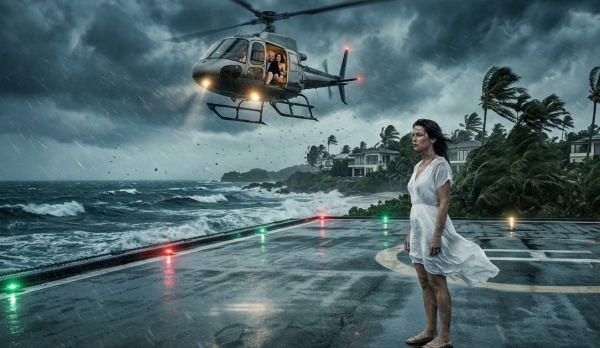
My Husband Took the Last Helicopter With His Mistress and Left Me on an Island Before the Hurricane
When the hurricane warning hit our private-island resort, everyone panicked—but my husband made his choice without hesitation. He climbed into the last helicopter with his mistress and left me standing on the landing pad as the storm closed in. He thought abandoning me would protect his future, his fortune, and the life he had been secretly building without me. What he didn’t know was that the island held one secret he had completely forgotten.
PART I — THE LAST HELICOPTER
When the hurricane warning reached our private-island resort, my husband took the last helicopter with his mistress and left me behind.
He did not look back.
That is the detail people always ask me about later, as if betrayal becomes easier to understand if there was one final glance of guilt. There was none. Preston Hale climbed into the helicopter with one hand on the doorframe and the other wrapped around Brielle Carter’s wrist, pulling her in beside him while the wind whipped salt spray across the helipad.
I stood twenty yards away in a rain jacket that was already soaked through, holding my small duffel bag and watching my marriage lift off into a sky the color of bruised steel.
The helicopter rose hard and fast, its blades chopping the air above Cayo Esperanza, the private island resort where Preston and I had come to celebrate our tenth wedding anniversary. The trip had been his idea. Five nights in a $4,800-a-night overwater villa, private chef dinner, sunset sailing, spa appointments, and “no work, no distractions,” he had promised.
Except Preston had brought a distraction with a spray tan, diamond tennis bracelet, and a passport he apparently knew how to pack in a hurry.
Her name was Brielle Carter, though when I first saw her at the resort bar two nights earlier, he introduced her as “a client’s brand consultant.”
I was forty-two years old. Old enough to know that when a husband says a woman in a silk beach cover-up is “a brand consultant,” he has either forgotten how lies work or never respected your intelligence in the first place.
My name is Meredith Hale, though before marrying Preston, I was Meredith Lane from Savannah, Georgia. I built my life carefully, the way people do when they grow up watching hurricanes take roofs, savings, and certainty from families who thought they had done everything right. My father owned a marina. My mother taught fifth grade. I learned early that water is beautiful until it decides otherwise.
Preston learned a different lesson growing up in Dallas.
He learned that money could make weather someone else’s problem.
By the time the hurricane warning came, he had already made three mistakes.
The first was underestimating the storm.
The second was underestimating me.
The third—and the one that would eventually threaten everything he believed was his—was forgetting what he had signed when he bought the island.
Yes.
Bought.
Not the entire island outright, technically, because ownership of Caribbean private islands is often wrapped in leases, development rights, local regulations, conservation easements, and agreements with governments people like Preston only skim before giving speeches about vision. But Cayo Esperanza Resort existed because of Hale Meridian Group, the hospitality investment company Preston had built with my inheritance, my legal contacts, and a story he liked to tell without mentioning either one.
What he had forgotten was that the island was not just a playground.
It was collateral.
And more importantly, it was held inside a trust structure that had my name in places he never bothered to revisit after the champagne toasts were over.
At 6:10 that morning, the resort manager, Anika James, knocked on the door of our villa.
Preston was not there.
I had woken alone at 5:30 to the sound of wind rattling the glass doors and my phone vibrating with weather alerts. Outside, the turquoise water that had looked like polished glass the day before was dark and restless. Palm fronds bent inland, and low clouds dragged across the horizon like smoke.
The alert on my phone read:
HURRICANE WARNING ISSUED FOR NORTHERN LEEWARD ISLANDS. CATEGORY 3 STORM EXPECTED TO STRENGTHEN. LIFE-THREATENING WINDS AND STORM SURGE POSSIBLE. SEEK SHELTER OR EVACUATE IF DIRECTED.
I called Preston immediately.
No answer.
I texted:
Where are you? Hurricane warning. Call me now.
Three dots appeared.
Disappeared.
Then nothing.
That small digital silence told me more than I wanted to know.
When Anika knocked, she was wearing resort khakis, a navy windbreaker, and the controlled expression of a person whose emergency training had just become real life.
“Mrs. Hale,” she said, “we’re initiating storm protocols. We need all guests to gather at the main lodge within thirty minutes. The aviation company is evaluating evacuation windows.”
“Where is my husband?”
Her hesitation was brief.
Too brief for anyone else to catch.
Long enough for me.
“I believe Mr. Hale is already at the lodge.”
“With Brielle Carter?”
Anika’s face did not change.
That was professionalism.
But her eyes flicked once toward the path.
“Yes, ma’am.”
The ma’am nearly undid me.
Not because it was rude. Because it was kind.
And kindness during humiliation can feel like someone touching a bruise.
I packed quickly.
Passport. Medication. Phone charger. Wallet. A light sweater. The resort welcome folder. A waterproof pouch my father had given me years ago that Preston used to mock as “your hurricane grandma kit.” Inside were copies of important documents, a small flashlight, cash, a power bank, and a laminated emergency contact card.
Preston had laughed when I packed it.
I had laughed too.
Women are often trained to make their preparedness look adorable so men do not feel accused by it.
By the time I reached the main lodge, the wind had become loud enough to enter your thoughts.
Guests clustered near the front desk: honeymooners from Chicago, a retired couple from Boston, a tech founder and his teenage sons, two influencers filming despite staff warnings, and several resort employees moving with radios clipped to their belts.
Preston stood near the bar with Brielle.
Not beside her.
Too close behind her.
His hand rested at the small of her back in that absent, possessive way men touch women they are used to touching when they think no one who matters is watching.
He saw me.
His hand dropped.
Brielle turned.
She was thirty-one, maybe thirty-two, with glossy dark hair and the smooth, expensive face of someone who had never been told no by a mirror. She wore white linen pants and a cropped sweater that looked impractical for survival but excellent for being photographed surviving.
“Meredith,” Preston said.
Not honey.
Not thank God.
Not I’m sorry.
My name, presented like a legal exhibit.
“We need to talk,” I said.
He looked toward the windows.
“Not now.”
“Now seems appropriate.”
Brielle shifted slightly behind him.
I looked at her.
“You can stop hiding. The storm has already arrived.”
Her cheeks colored, but she lifted her chin.
“I’m not hiding.”
“No,” I said. “You’re just vacationing with another woman’s husband during hurricane season.”
A few nearby guests went silent.
Preston’s jaw tightened.
“Meredith.”
There it was.
The warning tone.
In ten years of marriage, I had learned every shade of Preston’s voice. Public charm. Investor confidence. Bedroom tenderness. Boardroom impatience. And that tone—the one that meant I was expected to protect the Hale name even while he cut me with it.
Anika approached before he could say more.
“Mr. and Mrs. Hale, may I speak with you privately?”
She led us into a small office behind the reception desk. Brielle started to follow, but Anika stopped her with a polite hand.
“Guests are being briefed in the lodge.”
Brielle looked at Preston.
He looked annoyed but nodded.
Inside the office, Anika closed the door.
“The aviation company can take one more helicopter departure before winds exceed safety limits,” she said. “After that, no aircraft. The boat evacuation is already suspended because of the seas.”
“How many seats?” I asked.
“Four passenger seats. Two are needed for a guest with a medical condition and their spouse. That leaves two.”
Preston said immediately, “Meredith goes.”
For half a second, I almost believed my marriage still had a bone of honor.
Then Anika said, “Mr. Hale, the pilot was told you requested two seats for yourself and Ms. Carter.”
The room went still.
I looked at him.
Preston did not deny it.
He adjusted his watch.
“I was going to explain.”
I laughed once, not from humor.
“Were you?”
“She’s not prepared for this.”
I stared at him.
“She?”
“Brielle has severe anxiety. She can’t stay here through a Category 3.”
I waited for him to hear himself.
He did not.
“And I can?” I asked.
“You know storms. You grew up around them.”
There it was.
My childhood trauma, converted into logistical usefulness.
Anika’s face remained professionally blank, but something in her posture changed.
I turned to Preston.
“Your plan is to put your mistress on the last helicopter and leave your wife on the island?”
“Don’t use that word.”
“Mistress?”
His eyes sharpened.
“This is not the time for drama.”
“No, Preston. This is exactly when character stops being theoretical.”
He stepped closer and lowered his voice.
“You will be safe here. The resort has a hardened storm shelter, satellite communication, generators, supplies. You know that.”
“Then Brielle can be safe here too.”
“She can’t.”
“Why? Because she cries prettier?”
His face flushed.
“Enough.”
Anika interrupted.
“The pilot needs a manifest in five minutes.”
I looked at my husband of ten years.
A man whose company brochures used phrases like stewardship, resilience, and commitment. A man who gave speeches about community investment. A man who had once stood beside me at a hurricane relief fundraiser in Miami and said into a microphone that crisis revealed what people valued most.
At last, he was telling the truth.
“Go,” I said.
Preston blinked.
“What?”
“Take her.”
Anika looked at me.
Preston looked relieved too quickly.
“I’ll make this right when I get to St. Thomas,” he said.
That sentence was obscene.
Like he was rescheduling a lunch.
I stepped closer, lowering my voice so only he could hear.
“You are making it right now. Just not the way you think.”
For the first time that morning, uncertainty crossed his face.
But the pilot radioed from the helipad.
Time was up.
Preston left with Brielle.
At 7:02 a.m., I stood in the rain and watched the helicopter disappear into the storm bands.
At 7:06, Anika touched my arm.
“Mrs. Hale, we need to get inside.”
I nodded.
Behind us, the main lodge doors opened and staff ushered remaining guests toward the reinforced service corridor leading to the storm shelter. The island shuddered under a gust. Somewhere, metal clanged hard against metal.
I took one last look at the empty sky.
Preston thought he had made the choice that would protect his future.
He had actually made the first decision in years that finally exposed it.
PART II — THE ISLAND REMEMBERED MY NAME
Cayo Esperanza’s storm shelter was not glamorous.
That may sound obvious, but luxury resorts are designed to hide the machinery of survival. Guests see infinity pools, plunge tubs, white sand, and cocktails named after local birds. They do not see the reinforced concrete rooms behind service corridors, the diesel fuel storage, the satellite phones, the emergency pantry, the water purification system, or the staff who know exactly which doors must be sealed first.
I saw all of it.
Because eight years earlier, I had been the person who insisted the resort needed it.
Preston had called me dramatic then.
“We’re building for high-net-worth travelers,” he said in a Dallas conference room, clicking through architectural renderings. “They don’t want to think about disaster.”
I was thirty-four, newly married, and still foolish enough to believe being right would eventually make him grateful.
“They don’t have to think about it,” I said. “But we do.”
The developers wanted sleek minimalism.
I wanted hurricane shutters rated for extreme winds, elevated utility systems, backup satellite communications, and a shelter large enough for guests and staff. The budget fight lasted three months. Preston’s board grumbled about cost overruns. His father called me “overcautious.”
My father had died two years earlier after a long battle with heart disease, but I could still hear his voice.
Storms punish cheap decisions.
I fought until the safety requirements went into the operating agreement.
Preston later accepted praise for the “resilience-forward design.”
That was how our marriage worked.
I worried.
He dismissed.
I documented.
He performed.
When the shelter door sealed behind us that morning, the air changed.
The outside world became sound: wind striking walls, rain hammering vents, the distant groan of trees, the occasional impact of something torn loose and thrown. Inside, staff moved efficiently. Guests sat on cots or folding chairs, clutching phones with no signal and trying not to show fear.
Anika stood near a whiteboard, assigning tasks.
She had been resort manager for two years. Born in St. Croix, educated in Florida, trained in luxury hospitality but clearly built for command. She spoke calmly into a radio, checked guest counts, confirmed generator status, and made sure the kitchen team had moved water and shelf-stable food into the shelter.
When she finished, she came to me.
“Are you all right?”
“No.”
She nodded once.
“Fair answer.”
That made me laugh unexpectedly.
It came out sharp and brief, but it was real.
She gestured toward a small administrative room off the shelter.
“You may want privacy.”
I followed her inside.
The room had a desk, two chairs, metal filing cabinets, a first-aid kit, and a wall-mounted map of the island. Rain battered the exterior wall so loudly it sounded alive.
“I’m sorry,” Anika said.
“For the storm?”
“For what he did.”
That kindness again.
I looked at her carefully.
“How long have you known?”
She did not pretend not to understand.
“That he was involved with Ms. Carter? Since they arrived.”
I sat slowly.
“They arrived together?”
“No. You and Mr. Hale arrived on the charter plane. Ms. Carter arrived later by seaplane under a separate reservation. But she was assigned Villa Six after Mr. Hale’s office requested it.”
Villa Six was two paths away from ours.
Close enough to visit.
Far enough to deny.
“His office requested it?”
“Yes.”
“Who paid?”
Anika hesitated.
“Mrs. Hale—”
“Anika. My husband just abandoned me during a hurricane evacuation. Please do not insult me with guest privacy language unless your counsel is in the room.”
Her mouth tightened.
Then she said, “The reservation was billed to a corporate card under Hale Meridian Group.”
I closed my eyes.
Not because I was surprised.
Because there is a particular exhaustion in having your worst suspicion become administratively verified.
“How much?”
“I don’t know the total. Her villa, spa charges, boutique purchases, private dining, and seaplane transfer were all routed through corporate billing.”
Corporate billing.
Meaning investors.
Meaning accounting.
Meaning potentially marital assets, depending on structure.
Meaning Preston had not only humiliated me; he had made it traceable.
I opened my duffel and pulled out the waterproof pouch.
Inside was a folder I had packed out of habit, not prophecy.
Resort documents.
Insurance contacts.
Emergency protocols.
Copies of old trust paperwork.
A flash drive.
Anika glanced at it.
“You travel with files?”
“My father raised me near hurricanes and my husband raised my blood pressure. I believe in documentation.”
Her lips twitched.
I took out my phone.
No service.
Anika noticed.
“We have satellite internet for operations only. Limited bandwidth. Emergency use priority.”
“I need to contact my attorney.”
“That can be arranged if it concerns safety or legal exposure for the resort.”
“It concerns both.”
Anika considered me for one second.
Then she unlocked a cabinet and removed a satellite phone.
The first person I called was not Preston.
It was Jillian Morales, my attorney in Miami.
Jillian handled trust and business matters for my family after my father died. She also reviewed Hale Meridian’s early island acquisition documents before Preston gradually pushed her out of the conversation by saying she was “too conservative” and “not hospitality-focused.”
Jillian answered on the third ring.
“Meredith?”
“Preston left me on Cayo Esperanza during a hurricane evacuation and took Brielle Carter on the last helicopter.”
There was a pause.
Then she said, “I’m putting you on speaker in my office. Are you physically safe?”
“Yes. In the storm shelter.”
“Good. Say the first part again slowly.”
I did.
Jillian did not gasp.
Lawyers like Jillian do not gasp.
They sharpen.
“Was the evacuation ordered by resort management?”
“Yes.”
“Was he acting in any official capacity as principal of the resort ownership group?”
“He took one of the last available seats arranged through resort aviation.”
“Who did he displace?”
“Me.”
“Was Ms. Carter a registered guest?”
“Yes. On corporate billing.”
Another pause.
“Oh, Preston.”
The way she said it almost made me smile.
Not pity.
Professional anticipation.
“Jillian, I need you to pull the island trust documents.”
“I already know where they are.”
“Tell me what I’m remembering.”
“You are remembering that Cayo Esperanza Development Holdings is partly held through the Lane Family Coastal Resilience Trust. Your late father’s capital formed the initial secured tranche. You retained protective rights if the asset was mismanaged, if emergency obligations were breached, if funds were diverted, or if controlling executives created reputational or operational risk.”
My throat tightened.
“Preston always said those rights expired.”
“He always said many things. They did not expire. They became dormant unless triggered.”
Triggered.
A word that sounded almost too perfect.
“What triggers them?”
“Among other things: misuse of company resources for personal benefit, breach of safety obligations, conduct exposing the resort to major liability, and abandonment of fiduciary responsibilities during a declared emergency.”
Outside, something slammed into the building.
The lights flickered.
The generator caught.
Anika watched me from the doorway, expression unreadable.
I said, “He took the last helicopter.”
Jillian said, “Then he may have just activated every protective clause he spent eight years ignoring.”
I looked down at the map of Cayo Esperanza.
The island had not forgotten my name.
Preston had.
That was the difference.
“Preserve all records,” Jillian continued. “Guest manifests, communications, flight logs, billing, emergency protocols, corporate charges, staff statements, everything. Do not sign anything from Preston. Do not communicate emotionally in writing. If he calls, record notes immediately afterward. Are you with the manager?”
“Yes.”
“Put her on if she’s willing.”
I looked at Anika.
She stepped forward and took the phone.
For the next fifteen minutes, while the storm intensified outside, my attorney and the resort manager discussed document preservation, safety logs, guest counts, aviation manifests, and communications protocols. I listened in silence, feeling something cold and steady settle inside me.
Not revenge.
Not yet.
Revenge is emotional.
This was structure.
Preston had always relied on speed, charm, and confusion. He assumed that in a crisis, people would accept his version because his version usually arrived first and wearing a better suit.
But hurricanes slow everything.
They trap you with the truth.
By noon, the storm was fully over us.
The resort shook.
Water pushed over the lower beach paths. Cameras showed palm trees bent nearly horizontal. Staff reported flooding near the spa and damage to the dock. Guests cried quietly, prayed loudly, or sat stunned by the collapse of luxury into dependence.
I helped where I could.
Not heroically.
Practically.
I distributed water bottles. Comforted one of the Chicago honeymooners who was having a panic attack. Helped Anika organize medication needs. Sat with an elderly man whose wife needed oxygen support from a backup unit.
At some point, one of the influencers began filming herself crying near the emergency supplies.
Anika shut that down with such calm authority that I almost applauded.
“No guest or staff member is to be filmed without consent during an emergency,” she said. “Put the phone away.”
The girl did.
Around 2:00 p.m., the satellite phone rang.
Anika answered, then looked at me.
“It’s Mr. Hale.”
The room seemed to tilt.
I took the phone.
“Preston.”
His voice came through thin and broken by static.
“Meredith. Thank God. Are you safe?”
I almost admired the performance.
“Yes.”
“The pilot barely made it to St. Thomas. It was chaos. I’ve been trying to get through.”
“Have you?”
A pause.
“I know how this looks.”
“How generous of you.”
“Listen to me. I made a split-second decision.”
“No, you made a manifest.”
Silence.
Then irritation surfaced.
“I couldn’t leave Brielle. She was terrified.”
“You could leave your wife.”
“You were in the safest place available.”
“Then why didn’t you stay?”
Static hissed between us.
He lowered his voice.
“We will discuss this privately when you’re off the island.”
“No, Preston. We will discuss this with attorneys, insurers, investors, and possibly regulators.”
His tone changed.
“Meredith.”
There it was again.
The warning tone.
But warning tones work best on women still trying to keep the peace.
I was sitting inside a hurricane shelter because my husband evacuated his mistress with corporate resources and left me behind on an island partly secured by my family’s trust.
Peace had left on the helicopter.
“You need to be very careful,” he said.
I looked at Anika, who was writing notes with time stamps.
“I agree,” I said. “That is why everything is being preserved.”
He went quiet.
For the first time in years, Preston Hale did not know what story he was in.
PART III — AFTER THE EYE PASSED
The eye of the hurricane passed over Cayo Esperanza at 3:40 p.m.
People who have never experienced the eye think it must feel like relief.
It does not.
It feels like the storm is holding its breath.
For twenty-three minutes, the wind dropped to a strange, unnatural calm. Rain softened. The pressure in the shelter seemed to lift. Guests wanted to go outside, but staff kept everyone inside because the second half of the storm was coming, and Anika did not tolerate ignorance disguised as optimism.
During that eerie calm, I checked the logs.
Not because Anika needed help.
Because I needed facts.
The emergency aviation manifest showed four passenger names for the final helicopter:
Dr. Harold Ames
Linda Ames
Preston Hale
Brielle Carter
Next to Preston’s name was a notation:
Priority authorization confirmed by ownership office.
Ownership office.
That phrase would matter.
The flight had not simply taken available guests.
Someone had marked Preston and Brielle as priority.
I asked Anika who authorized it.
She checked the communication record.
“Request came from Mr. Hale’s executive assistant, Marcy Dugan, at 6:38 a.m., confirmed verbally by Mr. Hale at 6:51.”
“Was my name ever on the manifest?”
“Yes.”
She showed me the earlier version.
Meredith Hale had been listed in the fourth seat.
My name was crossed out.
Brielle’s typed beneath it.
There is humiliation, and then there is seeing your replacement entered into a system.
The second half of the storm hit harder from the opposite direction.
By evening, the satellite connection became intermittent. The generator held. Water entered one lower maintenance corridor but not the shelter. A guest vomited from fear. A staff member cut his hand securing a loose panel before sheltering; we cleaned and bandaged it.
I did not sleep.
I sat with my back against a concrete wall, listening to strangers breathe, cry, whisper, and survive.
At 1:15 a.m., my phone found one bar of emergency roaming for exactly long enough to download a burst of messages.
From Preston:
Please don’t turn this into something it isn’t.
I’m arranging extraction as soon as winds drop.
Brielle is shaken. Don’t punish her for my decision.
That one made me stare.
Do not punish her.
As if consequences were something I manufactured rather than something he had loaded onto the helicopter himself.
Then a message from Jillian:
Board notified. Emergency protective review initiated. Do not respond to P except through counsel unless safety issue. Proud of you. Stay alive first. Fight later.
Stay alive first.
Fight later.
Good advice for storms and marriages.
By dawn, Hurricane Iris had moved west.
Cayo Esperanza emerged battered but standing.
The dock was damaged. Several villas had roof and water intrusion. The beach had been rearranged by surge. The spa’s lower level was flooded. Dozens of palm trees were down, including one across the main path. But the lodge, shelter, communications room, generator building, and elevated utilities survived.
The systems I had fought for had worked.
Guests clapped when Anika announced the worst had passed.
I cried in the bathroom for three minutes.
Not because I was relieved.
Because after holding yourself upright through betrayal and a hurricane, the body eventually sends an invoice.
At 10:20 a.m., the first post-storm aircraft reached the island.
Not a luxury helicopter.
A government-coordinated rescue and assessment flight with limited seats for medical and priority evacuation.
Preston was not on it.
Neither was Brielle.
Anika spoke with officials, assessed guest needs, and prioritized the elderly couple, the injured staff member, and families with medical vulnerabilities. No one argued. Disaster has a way of clarifying who should go first when decent people are in charge.
I stayed.
By choice this time.
There were records to secure, staff statements to gather, and an island to stabilize.
Besides, I was done being cargo in Preston’s story.
The second extraction flight came late afternoon. I left on that one after Anika insisted there was nothing more I could do that day from the island.
As the helicopter lifted, I looked down at Cayo Esperanza.
From above, the island was both wounded and beautiful. White sand torn into new curves. Blue-green water clouded by churned-up sediment. Villas scattered like toys along the lagoon. The storm had not destroyed it, but it had stripped away the illusion that beauty meant safety.
That was true of my marriage too.
In St. Thomas, Preston waited inside a private aviation terminal with Brielle at his side.
He had changed clothes.
Of course he had.
Khaki pants, navy polo, loafers. Casual concern curated for witnesses. Brielle wore leggings and one of his sweatshirts, which felt so predictable it almost failed to hurt.
Preston came toward me.
“Meredith.”
I raised one hand.
“Do not touch me.”
He stopped.
People noticed.
Good.
Brielle looked pale. Without resort lighting and curated confidence, she seemed younger, less triumphant. Her eyes darted from me to Preston to the uniformed airport staff.
“I’m sorry,” she said.
I looked at her.
“Which part?”
Her mouth opened.
Closed.
Preston stepped in.
“She doesn’t deserve this.”
I laughed then.
Not loudly.
Just enough.
“That may be the most honest thing you’ve said. None of us deserved what you did.”
He lowered his voice.
“We need to talk privately.”
“No.”
“Meredith, there are business implications.”
“Yes.”
His eyes narrowed.
“What did you do?”
I adjusted the strap of my duffel.
“I survived the hurricane you abandoned me in. Everything after that is paperwork.”
His face changed.
He understood paperwork.
He feared it more than storms.
My attorney’s local contact, Caleb Ortiz, arrived ten minutes later with a car. He was a calm man in a linen blazer holding a folder and wearing the expression of someone who enjoyed watching arrogant men discover jurisdiction.
“Mrs. Hale,” he said, “Ms. Morales asked me to escort you to the hotel. We have a secure call scheduled with counsel at 7:00.”
Preston stepped forward.
“I’m her husband.”
Caleb looked at him politely.
“I’m aware.”
The silence afterward was magnificent.
At the hotel in St. Thomas—not The Adair, not one of Preston’s properties, not anywhere he controlled—I finally showered.
Salt, sweat, fear, and humiliation went down the drain.
I stood under hot water until my skin turned pink and my hands stopped shaking.
Then I put on clean clothes, sat at a desk overlooking the harbor, and joined a video call with Jillian, Caleb, and two members of the Lane Family Coastal Resilience Trust’s advisory board.
Jillian summarized the facts.
Unauthorized corporate expenditures for Brielle Carter’s travel and accommodations.
Possible misuse of resort emergency aviation.
Alteration of evacuation priority manifest.
Abandonment of spouse and co-beneficial interest holder during declared emergency.
Exposure of resort ownership group to liability and reputational harm.
Potential breach of fiduciary duties.
Possible violation of internal emergency protocols.
Possible marital misconduct relevant to divorce and property proceedings.
It sounded clinical.
It sounded devastating.
“Meredith,” Jillian said, “the trust has grounds to initiate protective control review. That could suspend Preston’s unilateral authority over the island asset pending investigation.”
“What does that mean in plain English?”
“It means he may no longer be able to sell, leverage, refinance, or direct operations at Cayo Esperanza without oversight. Depending on the findings, he could be removed from control over this asset entirely.”
I looked out at the harbor.
Boats rocked under a bruised sunset.
“What about the broader company?”
“That depends on how far the misuse extends.”
Caleb added, “And whether investors decide a man who left guests exposed to prioritize his girlfriend is a governance risk.”
Girlfriend.
The word landed differently than mistress.
Less dramatic.
More pathetic.
I asked, “Can he stop this?”
Jillian’s expression softened.
“He can cooperate. He cannot unmake the manifest.”
No.
He could not.
Preston had spent our marriage believing power meant choosing who mattered.
On Cayo Esperanza, he had made that choice in writing.
PART IV — THE PRICE OF A SEAT
The story broke publicly four days after the storm.
Not from me.
Not from Jillian.
From a travel industry journalist who got hold of evacuation details after several guests posted about being stranded at Cayo Esperanza. At first, the headline was about hurricane preparedness at luxury resorts. Then someone noticed the owner had evacuated with a woman who was not his wife.
By noon, the internet had learned Brielle’s name.
By two, someone found photos of her at Hale Meridian events.
By evening, the headline had sharpened:
Hospitality Executive Left Wife Behind During Hurricane Evacuation, Took Companion on Last Helicopter, Records Show
Records show.
Two words that make reputation consultants sweat.
Preston called me seventeen times.
I answered none.
His texts moved through the usual stages.
Concern.
Explanation.
Minimization.
Frustration.
Warning.
This is being distorted.
You know the shelter was safe.
I made a difficult decision under pressure.
Do not let Jillian weaponize this.
You are going to damage both of us.
Both of us.
Men like Preston love shared consequences after making unilateral choices.
Jillian handled formal communications.
A statement went out from the trust:
The Lane Family Coastal Resilience Trust is reviewing emergency governance and fiduciary issues related to Cayo Esperanza Resort following Hurricane Iris. Our priority remains guest safety, staff welfare, infrastructure recovery, and full compliance with applicable laws and obligations.
No mention of Preston.
No mention of Brielle.
That made it worse for him.
A direct accusation gives a man like Preston something to fight. A sober review gives everyone else permission to ask for documents.
Investors called.
Insurers called.
The resort’s lender called.
Local authorities requested a post-storm operational review, which was standard after a major weather event, but suddenly not routine for Preston.
The board of Hale Meridian Group scheduled an emergency meeting.
I did not attend as his wife.
I attended through counsel as trust representative and beneficiary.
That distinction mattered.
Preston entered the video meeting from his Dallas office wearing a suit and the strained expression of a man who had slept badly in expensive sheets. Brielle was nowhere visible. His general counsel sat beside him, looking like he had recently discovered ulcers.
The board chair, Elaine Strickland, did not waste time.
“Preston, did you authorize removing Meredith Hale from the final evacuation manifest and replacing her with Brielle Carter?”
Preston folded his hands.
“The situation was fluid.”
Elaine did not blink.
“That is not an answer.”
He inhaled.
“Yes, but—”
“Did Ms. Carter’s accommodations and travel route through corporate billing?”
“I was planning to reimburse—”
“Did they?”
“Yes.”
“Was Ms. Carter conducting business for Hale Meridian?”
Silence.
“No.”
“Was she a guest of the company?”
“She was my guest.”
Elaine’s face hardened.
“Apparently at company expense.”
Preston’s attorney stepped in, but the damage had already spoken.
Then Jillian presented the trust provisions.
Dormant protective rights.
Emergency governance triggers.
Misuse of assets.
Reputational and operational risk.
Fiduciary obligations tied to storm safety.
Preston stared at the screen as if seeing the documents for the first time.
Maybe he was.
That was the astonishing part.
He had built speeches around Cayo Esperanza. Hosted investor retreats there. Used drone footage of the island in pitch decks. Told magazines that the resort represented “a new model of resilient luxury.”
But he had not remembered who insisted on resilience.
He had not remembered whose father’s money secured the first phase after other financing faltered.
He had not remembered that my agreement to move those funds came with protective rights written by attorneys who trusted neither charm nor weather.
By the end of the meeting, Preston’s authority over Cayo Esperanza was temporarily suspended pending investigation.
An independent operations monitor was appointed.
An outside forensic accounting firm was retained.
All corporate spending tied to Brielle Carter was placed under review.
Emergency protocol compliance would be audited.
Preston remained CEO of Hale Meridian for the moment, but everyone in that virtual room could feel the floor shifting under him.
After the call, Jillian stayed on.
“How are you?”
I laughed softly.
“I don’t know.”
“That’s acceptable.”
“Did we win?”
“No.”
She removed her glasses.
“We opened the door to accountability. That is not the same as winning.”
She was right.
Because outside the legal and business consequences, there was still the marriage.
I flew back to Dallas two weeks after the hurricane.
Not to return to Preston.
To pack.
Our house in Highland Park looked unchanged when I walked in. Limestone exterior, manicured hedges, art Preston selected because an advisor told him it signaled seriousness. Inside, the air smelled faintly of cedar and chilled emptiness.
Preston was waiting in the living room.
I had told him through counsel that I was coming with my sister and a security professional to collect personal items. He came anyway.
He looked thinner.
Good.
Or bad.
I no longer knew what I wanted his suffering to mean.
“Meredith,” he said.
My sister Caroline stepped slightly in front of me.
She was five feet four inches tall and worked as a pediatric nurse, but in that moment she radiated enough violence to power a small city.
I touched her arm.
“It’s fine.”
Preston’s eyes were red.
“I made the worst mistake of my life.”
I looked around the room.
At the framed black-and-white photograph from our wedding.
At the bowl we bought in Santa Fe.
At the sofa where we had watched election returns, football games, and weather coverage of storms far away.
“One?” I asked.
He flinched.
“You’re right.”
I waited.
He seemed to realize I was not going to help him.
“I had an affair,” he said. “For seven months. Brielle was not a consultant. She was not business. I paid for things through the company because I thought I could clean it up later.”
“Why?”
The question was simple.
He looked almost confused by it.
“Because I was selfish.”
“That is a category. Not a reason.”
He sat slowly.
“I liked how she saw me. Or how she pretended to. No history. No criticism. No expectations. She thought I was brilliant.”
“I used to think you were brilliant.”
His face crumpled.
“I know.”
“No, Preston. You knew. That was the problem. My admiration became old furniture. Hers was new.”
He covered his face.
There was a time when his tears would have moved me immediately. I would have sat beside him, touched his back, translated his pain into repair work for myself. I would have mistaken his shame for change.
Not anymore.
“Why did you leave me?” I asked.
He lowered his hands.
“I thought if I left Brielle, she would expose everything.”
The room went very quiet.
That was the truth.
Not anxiety.
Not split-second pressure.
Not concern.
Calculation.
“You left me in a hurricane to protect yourself from your mistress?”
He closed his eyes.
“Yes.”
The word should have shattered me.
Instead, it clarified something so completely I almost felt calm.
“Thank you,” I said.
He looked up, startled.
“For finally telling the truth?”
“For making the divorce emotionally simple.”
He stood.
“Meredith, please.”
I stepped back.
“No.”
Just that.
No.
It is a small word, but if a woman has spent years cushioning a man’s consequences, it can feel like a foreign language.
I packed clothes, documents, jewelry that belonged to my mother, family photographs, and the watercolor of my father’s marina from my office wall. I left the anniversary albums. I left the china Preston’s mother chose. I left the bed.
Some things are not worth dividing because touching them costs too much.
I moved temporarily into Caroline’s guesthouse outside Austin, where her children asked only practical questions.
“Are you staying for pancakes?”
“Can we use your suitcase as a fort?”
“Did Uncle Preston do something dumb?”
Caroline nearly choked on coffee at that last one.
“Yes,” I said. “Very dumb.”
Children appreciate clarity.
The divorce filing came in Texas, with business and trust actions proceeding where appropriate through separate counsel and jurisdictions. I will not pretend the process was quick or clean. Wealth makes divorce more complicated, not less. Every asset has a lawyer. Every lie has a spreadsheet. Every apology arrives with concern about valuation dates.
Forensic accounting found more than Brielle.
Not other women, at least not documented in the same way.
But improper corporate expenses, personal travel masked as site visits, gifts, villa charges, luxury purchases, and “consulting” payments with descriptions so vague they might as well have said bad judgment.
Brielle cooperated eventually.
Not out of remorse.
Out of self-preservation.
She produced messages showing Preston had promised her he was “unwinding” his marriage and would “make sure she was protected” if things became public. She also produced the message he sent her from the lodge before the helicopter:
Get to the pad. I have your seat handled.
Your seat.
Not a seat.
Your seat.
That message became important.
Preston’s attorneys tried to argue that evacuation decisions were chaotic, made under stress, and not evidence of governance failure.
The records disagreed.
Records are stubborn.
The island’s emergency protocols required vulnerable guests and designated essential decision-makers to be prioritized according to documented criteria. Preston had overridden the process to move Brielle. He had also removed himself, despite his role in ownership, while leaving operations staff to manage the crisis without executive support.
Anika’s notes were meticulous.
I later sent her a handwritten letter and a bonus through the approved employee relief fund, not directly, because I knew enough not to create problems for her.
She wrote back one line:
Storms reveal the foundation.
I framed it.
PART V — WHAT THE STORM LEFT BEHIND
One year after Hurricane Iris, I returned to Cayo Esperanza.
Not as Preston’s wife.
Not as a guest.
As chair of the newly restructured oversight committee representing the Lane Family Coastal Resilience Trust’s interest in the island.
Preston no longer controlled it.
After months of review, negotiations, investor pressure, and legal maneuvering, he agreed to step away from operational authority over the resort. Hale Meridian retained a reduced financial stake, but the island moved under independent management with trust protections permanently active.
The public version called it “a governance restructuring following Hurricane Iris.”
Beautiful phrase.
Almost peaceful.
The private version was simpler: Preston lost the island because he forgot who had built the parts of it that survived.
He also lost me.
Our divorce finalized sixteen months after the storm.
I kept my separate family assets, recovered amounts tied to misused marital and trust-linked funds, and received a settlement that Preston resented but signed because discovery had become more dangerous to him than fairness.
He and Brielle did not last.
No one was surprised.
A woman who watches a man abandon his wife in a hurricane eventually has to wonder what kind of weather he would leave her in.
She posted cryptic quotes for a while about betrayal, narcissists, and “learning my worth.” I did not follow her. People sent screenshots until I asked them to stop. I had spent enough of my life receiving evidence of Preston’s failures.
When I stepped off the boat onto Cayo Esperanza, the rebuilt dock smelled of fresh wood and salt.
The island looked different.
Not less beautiful.
More honest.
The lower spa had been redesigned above the updated flood line. Emergency signage had been improved. Staff housing had new storm shutters and backup power. Guest briefings now included real evacuation and shelter information, not just sunset cruise schedules. The storm shelter had been expanded and renamed the Lane Resilience Center after my father.
I cried when I saw the plaque.
In honor of Thomas Lane, who believed preparation was an act of care.
For years, Preston had treated my caution as a personality flaw.
Now it was carved into the wall of the building that saved his guests.
Anika met me at the entrance.
Still calm.
Still direct.
Still the person I would trust before any CEO in a tailored shirt.
“Welcome back, Mrs. Lane,” she said.
I had taken back my name after the divorce.
Not because Hale was cursed.
Because Lane was mine.
“Meredith,” I corrected gently.
She smiled.
“Welcome back, Meredith.”
We toured the property together.
Repairs were nearly complete. Occupancy had returned slowly but steadily. The resort had changed its marketing language from “exclusive escape” to “responsible luxury,” which made me laugh because hospitality people can rebrand anything, even accountability.
But the changes were real.
Staff emergency training improved.
Local partnerships strengthened.
A portion of annual profits now funded hurricane preparedness programs for nearby island communities.
That last part mattered most to me.
My father used to say rich people discover community after the bridge washes out. I wanted the bridge built before then.
That evening, Anika and I stood on the beach at sunset.
The water was calm again, almost impossibly blue.
“Do you hate him?” she asked.
I appreciated the directness.
“No.”
That surprised me too.
“I did,” I admitted. “For a while. Then I realized hate kept me checking the sky for his helicopter.”
Anika nodded.
“And now?”
“Now I hope he becomes someone who cannot hurt people the same way. But I do not need to witness it.”
She looked out at the water.
“That sounds like freedom.”
“It sounds like therapy and expensive lawyers.”
She laughed.
“Also freedom.”
I stayed in Villa Four that night.
Not the one Preston and I had shared.
Never that one.
The resort had offered me the owner’s villa, but I chose a smaller bungalow near the ridge, where you could hear wind moving through sea grapes and waves striking rock below.
At 2:00 a.m., I woke to rain.
For one second, my body remembered the storm.
The shelter.
The manifest.
The helicopter lifting away.
Then I breathed.
The rain was soft.
Ordinary.
A tropical shower passing through.
I got out of bed, wrapped myself in a robe, and stepped onto the covered deck. The air smelled of wet leaves and salt. Far out over the water, lightning flickered silently inside a distant cloud.
Weather.
Not enemy.
Not metaphor.
Just weather.
That is something healing teaches you eventually.
Not every storm is the one that broke you.
The next morning, I visited the Lane Resilience Center alone.
The room had been transformed since the hurricane. Fresh paint. Better ventilation. More supplies. Cots stored neatly. Water systems labeled. Emergency communications equipment upgraded. A wall cabinet held laminated protocols in English and Spanish.
I stood where I had sat during the worst of Iris.
Where I had taken Preston’s call.
Where I had first understood that the island’s legal foundation remembered me even when my husband did not.
I thought about the woman I had been then.
Soaked.
Humiliated.
Angry.
Still expecting some part of Preston to return for me emotionally if not physically.
I wanted to tell her something.
Not that everything would be fine.
That is too cheap.
I wanted to tell her that abandonment can become evidence.
That the thing meant to prove you were disposable can become the document that frees you.
That sometimes the last seat someone refuses you becomes the first seat you take at the table where decisions are made.
Before leaving, I placed my hand on the wall beneath my father’s plaque.
“Storms punish cheap decisions,” I whispered.
Then I smiled.
“They also reward good foundations.”
On the flight home to Austin, I did not think much about Preston.
That felt like the final miracle.
For months, he had occupied every room in my mind: what he did, why he did it, what he owed, what he lost, what he might try next. Divorce can make another person feel like both injury and homework.
But somewhere between the island and the mainland, I realized I was thinking about dinner.
About whether Caroline’s kids would want tacos.
About the grant proposal for coastal preparedness I needed to review.
About repainting my bedroom.
About buying a house with a porch.
Small thoughts.
Living thoughts.
Not survival thoughts.
Six months later, I bought that house.
Not in Dallas.
Not in Savannah.
In Charleston, close enough to the water to smell salt on humid mornings but high enough above the flood maps to satisfy my father’s ghost. It had old pine floors, a blue front door, and storm shutters that actually worked.
The first time a tropical storm watch appeared on the news after I moved in, friends texted nervously.
I checked my supplies.
Charged my power banks.
Reviewed the forecast.
Then I made tea.
Preparedness no longer felt like fear.
It felt like self-respect.
People sometimes ask if I regret letting Preston take the helicopter.
The answer is complicated.
I did not “let” him in the way people mean. He chose. The system allowed it because power often moves fastest in confusion. I survived because staff did their jobs, infrastructure held, and I had prepared for emergencies long before one arrived wearing my husband’s face.
But if they mean do I regret not begging him to stay?
No.
Begging would not have made him honorable.
It would only have made me smaller in the memory.
Preston thought taking that helicopter would protect his future.
He thought he was choosing the woman who made him feel powerful over the woman who knew exactly how much of his power had been borrowed, structured, guaranteed, and signed.
He thought the island was his.
That was the most shocking part.
He had forgotten that Cayo Esperanza was built on my father’s money, my insistence, my documents, my safety clauses, and my name hidden in the foundation like rebar inside concrete.
You do not see rebar when the building is beautiful.
You learn whether it exists when the storm hits.
The helicopter lifted away with my husband and his mistress inside.
The world he believed was his lifted with it.
But the island stayed.
So did I.
And when the winds finally stopped, everything still standing remembered who had built it strong enough to survive.
