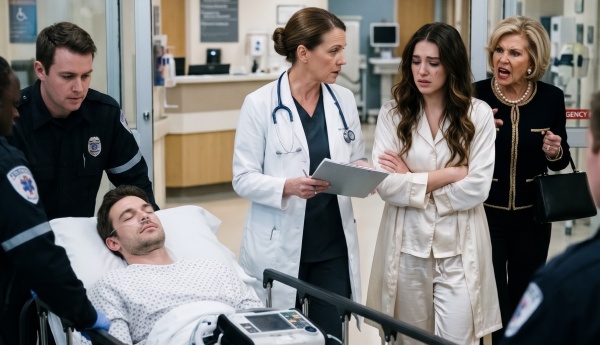
At 3 a.m., I got a call from the emergency room saying my husband had been found unconscious in another woman’s apartment. By 3:30, his mother was standing under the hospital lights, demanding that I sign surgical consent before I “killed” her son with questions. Everyone thought I was delaying care out of shock and humiliation, but his medical chart showed numbers that made no sense for a healthy man. And the woman sitting across the ER looked less afraid of being exposed as his affair partner than of what had really happened before the ambulance arrived.
PART I — THE CALL FROM THE EMERGENCY ROOM
At three in the morning, my husband collapsed inside another woman’s apartment, and by three-thirty his mother was demanding that I sign surgical consent before I killed him.
That was exactly how she said it.
“If you keep asking questions, Hannah, you are going to kill my son.”
Her voice cracked on the last word, not with grief alone, but with accusation. She stood in the fluorescent glare of the emergency department at Northwestern Memorial Hospital in Chicago, wrapped in a camel coat over silk pajamas, her silver hair pinned perfectly despite the hour. Even in crisis, Eleanor Whitcomb looked like a woman who expected the room to arrange itself around her.
I stood across from her in leggings, an oversized sweatshirt, and sneakers I had put on without socks.
In my right hand was a clipboard.
On it were consent forms for a procedure the surgeon said might be necessary if my husband’s condition deteriorated. In my left hand was the paper cup of coffee I had not taken a single sip from since a nurse handed it to me twenty minutes earlier.
Behind the double doors, my husband, Andrew Whitcomb, was unconscious.
Thirty-nine years old.
Senior partner at a private equity firm.
Beloved son.
Polished husband.
And apparently the kind of man who collapsed half-dressed in another woman’s apartment while his wife slept at home across town.
The woman’s name was Mara Bell.
I had learned that from the police officer who met me at the emergency department entrance.
Not from Andrew.
Not from his mother.
Not from a friend gently preparing me for humiliation.
From an officer with tired eyes who said, “Ma’am, your husband was transported from an apartment in River North. The tenant is here as well. We may need to ask you some questions later.”
Then he paused.
The pause told me everything before the words did.
“The tenant is a woman named Mara Bell.”
My name is Hannah Whitcomb, though for most of my adult life I was simply Hannah Ellis.
I was thirty-seven years old, an attorney by training, though I had left corporate litigation four years earlier to run compliance for a healthcare nonprofit. That detail matters because people often mistake calm for confusion. They also mistake a woman asking precise questions during an emergency for a woman delaying care out of emotion.
I was not calm because I felt nothing.
I was calm because panic is a poor reader of documents.
And that morning, the numbers on Andrew’s medical chart told me there was more to his condition than anyone had explained.
The phone rang at 3:12 a.m.
At first, I thought it was my alarm.
The sound dragged me out of sleep so violently that I knocked my water glass off the nightstand. It hit the rug, rolled under the bed, and kept glugging water into the darkness while I fumbled for my phone.
The screen said Unknown Caller.
I almost ignored it.
Then some instinct, maybe the old litigation instinct, maybe the wife instinct, made me answer.
“Is this Hannah Whitcomb?” a woman asked.
“Yes.”
“This is Northwestern Memorial Hospital. Your husband, Andrew Whitcomb, has been brought into the emergency department. You are listed as his emergency contact.”
The room tilted.
“What happened?”
“He experienced a medical emergency. He is being evaluated now. Are you able to come to the hospital?”
“Is he conscious?”
There was a slight pause.
“He is currently not able to speak with you.”
That is how hospitals say things when they cannot or will not say more over the phone.
I was dressed in four minutes.
On the ride downtown, I called Andrew three times even though I knew he would not answer. Then I called his mother, because if I did not and she found out later, she would make my failure part of the family record for the next decade.
Eleanor answered on the first ring.
“Hannah?”
“Andrew is at Northwestern. I’m on my way.”
There was no groggy confusion in her voice.
No, “What do you mean?”
No, “I just woke up.”
Only a hard inhale.
“What happened?”
“I don’t know yet.”
“I’m coming.”
She hung up before I could ask why she sounded as if she had been waiting for the call.
The driver dropped me at the emergency entrance at 3:28 a.m.
Chicago was cold in that sharp February way that makes every breath feel metallic. Snow from the previous day had hardened along the curb in gray ridges. Ambulance lights pulsed red against the glass doors.
Inside, the emergency department was a world of controlled urgency.
Monitors beeped.
Phones rang.
Nurses moved fast but not frantically.
A man in a puffer jacket slept upright near the vending machines with his mouth open.
A young woman cried quietly into her sleeve while an older man rubbed her back.
I gave my name at the desk.
The receptionist’s expression shifted when she saw the screen.
“Someone will be with you shortly, Mrs. Whitcomb.”
Shortly meant two minutes.
A nurse named Celeste came out, kind eyes above a surgical mask.
“Your husband is in critical care bay four. The physicians are working on him. Before we go back, I need to confirm some information.”
“What happened?”
“He was brought in by ambulance after collapsing at a private residence. He had altered mental status and low blood pressure on arrival. He’s being stabilized.”
“Was there trauma?”
“Not obvious external trauma. The doctor will explain.”
“Is he breathing on his own?”
“With support.”
“With support meaning oxygen? Intubation?”
Celeste studied me more closely.
“You have medical background?”
“Legal. Healthcare compliance. Not clinical.”
“He is intubated.”
The words went through me like cold water.
Intubated.
Andrew, who complained about seasonal allergies as if they were constitutional violations.
Andrew, who ran five miles along the lakefront three mornings a week.
Andrew, who had kissed my forehead at 10:15 the previous night and told me he had to go back to the office because a deal was falling apart.
I gripped the strap of my purse.
“Take me to him.”
Before she could answer, Eleanor entered the emergency department like a weather system.
Her driver must have broken several traffic laws.
“Hannah.”
She did not hug me.
She took my shoulders in both hands and looked at my face, as if searching for what I knew.
“What did they say?”
“He’s intubated.”
Her eyes closed briefly.
Then she looked at the nurse.
“I am his mother.”
Celeste nodded politely.
“Mrs. Whitcomb is listed as next of kin and healthcare proxy.”
Eleanor’s mouth tightened.
I had forgotten that detail for years because it had never mattered.
Andrew had signed healthcare power of attorney documents shortly after we married, mostly because I insisted we both do complete estate planning like responsible adults. He had joked that I was trying to make romance billable. I had laughed and filed the originals in our home safe.
Now those forms meant something.
Eleanor knew it too.
The doctor came out at 3:41.
Dr. Priya Shah, emergency medicine attending, early forties, composed and direct.
“Mrs. Whitcomb?”
“Yes.”
“Your husband is critically ill. He arrived with severely low blood pressure, abnormal heart rhythm, respiratory distress, and altered consciousness. We intubated him to protect his airway and support breathing. We are giving fluids, medications to support blood pressure, and running labs and imaging.”
“What do you think caused it?”
“We are still evaluating. Possibilities include severe infection, cardiac event, toxic ingestion, endocrine crisis, and other causes. We need more data.”
Eleanor cut in.
“He needs surgery?”
Dr. Shah turned to her.
“At this moment, surgery is not confirmed. However, imaging and lab results may indicate a need for urgent intervention. We have a surgical consult involved because of abdominal findings and instability.”
“What abdominal findings?” I asked.
Dr. Shah looked back at me.
“He has abdominal tenderness on exam, abnormal lactate, low blood pressure, and some lab values we are concerned about. We’re obtaining CT imaging.”
“Can I see the labs?”
Eleanor snapped, “Hannah.”
Dr. Shah did not flinch.
“We can review them. But I want to be clear: if he deteriorates, decisions may need to be made quickly.”
“I understand.”
That was when a surgical resident appeared with consent forms.
Not because surgery was happening that second.
Because hospitals prepare while possibilities narrow.
He explained potential exploratory surgery if imaging suggested internal bleeding, bowel ischemia, perforation, or another life-threatening abdominal process. He spoke quickly but appropriately. Risks. Benefits. Alternatives. Emergency exceptions if delay threatened life.
Then he handed me the clipboard.
Eleanor leaned toward me.
“Sign it.”
I looked at the form.
Then through the glass panel toward the bay where Andrew lay surrounded by machines.
Then at Dr. Shah.
“I need to understand what you know so far.”
Eleanor’s face hardened.
“This is not a deposition.”
“No,” I said. “It is my husband.”
“Then act like it.”
That was when Dr. Shah stepped between us, professionally but firmly.
“Mrs. Whitcomb is permitted to ask questions. We will answer as efficiently as possible.”
Eleanor’s eyes flashed.
“You do not know this family.”
Dr. Shah’s expression did not change.
“I know this patient is unstable. I know his legal decision-maker is his wife. And I know raised voices do not help him.”
For one strange second, I wanted to hug her.
Instead, I set the clipboard on the counter and asked to see the chart.
The first numbers made my pulse quicken.
Low blood pressure.
High lactate.
Abnormal electrolytes.
Elevated white count.
Acute kidney injury.
Low glucose on EMS arrival, corrected.
Cardiac rhythm disturbance.
Toxicology pending.
Then I saw one value repeated in the EMS note.
His blood sugar had been dangerously low in the apartment.
Andrew was not diabetic.
He did not use insulin.
He had no prescription for blood sugar medication.
I read the note again.
Found unresponsive at private residence.
Diaphoretic.
Confused before loss of consciousness, per witness.
Blood glucose 34 mg/dL on EMS arrival.
Given dextrose.
Partial improvement, then declined.
I looked up.
“Why was his glucose that low?”
Dr. Shah’s eyes sharpened slightly.
“We are investigating.”
“Could alcohol cause it?”
“In some contexts, yes. But we do not assume. We’re checking insulin, C-peptide, sulfonylurea screen, tox labs, liver function, infection markers, and other studies.”
Eleanor grabbed my arm.
“Stop.”
I looked down at her hand.
She released me.
“You are wasting time.”
“No,” I said quietly. “I am asking why my healthy, non-diabetic husband collapsed with severe hypoglycemia in another woman’s apartment.”
The words hung there.
Another woman’s apartment.
Eleanor’s face changed.
Not shock.
Fear.
That was the first moment I realized she knew more than she had said.
Across the emergency department, near a row of plastic chairs by the wall, sat a woman in a long beige cardigan and black boots.
She was maybe early thirties.
Dark blond hair pulled into a low ponytail.
No coat.
No purse.
Her hands were wrapped around a paper cup she was not drinking from.
A uniformed officer stood nearby.
She looked at me once and immediately looked away.
That had to be Mara Bell.
And she looked terrified.
Not embarrassed.
Not guilty in the simple way of a woman caught having an affair with someone’s husband.
Terrified.
Of something far worse than our discovering the affair.
PART II — THE WOMAN ACROSS THE ROOM
I had imagined Andrew cheating before.
That sounds strange, but I think most married people with enough disappointments privately rehearse disasters. Not because we want them. Because fear likes preparation.
In my imagination, the other woman was always polished.
Someone from his firm.
Someone who laughed at finance jokes and wore heels that cost more than my first apartment’s monthly rent.
Someone who called him brilliant in a tone I had not used since year four of our marriage.
Mara Bell was not that woman.
At least, not at 4:00 in the morning under hospital lights.
She looked like someone who had left her apartment in a panic. No makeup. Sweater buttoned wrong. One sock visible above one boot but not the other. Her face was pale, and there was a faint bruise-colored shadow beneath one eye that may have been exhaustion or something else.
When our eyes met again, she flinched.
Not theatrically.
Reflexively.
Eleanor saw me looking.
“Don’t,” she said.
I turned to her.
“Don’t what?”
“Not now.”
“Do you know her?”
Her lips pressed into a thin line.
“Hannah, Andrew may be dying.”
“And he may be dying because of something that happened in her apartment.”
A nurse approached then and asked me to come back briefly.
The critical care bay was warmer than the hallway and smelled like antiseptic, plastic tubing, and fear. Andrew lay on the bed with monitors attached to his chest, an IV line in each arm, another line being placed, a ventilator tube secured at his mouth. His hair, always carefully styled, was flattened on one side.
He looked younger unconscious.
Or maybe just stripped of performance.
His wedding ring was gone.
That detail hit me harder than I expected.
Not because I had still believed in the symbol, but because its absence made the night feel organized. He had not stumbled into Mara’s apartment by accident. He had removed the evidence of me before entering.
I stood beside the bed.
“Andrew,” I said.
Nothing.
The ventilator hissed.
His hand was cool when I touched it.
For seven years, that hand had reached for mine at parties, rested on my back in elevators, signed anniversary cards, scrolled through emails during dinners, and once held my hair back when I had food poisoning in Napa.
Now it lay motionless under hospital tape.
I felt rage.
Then grief.
Then rage again.
Dr. Shah came in with more updates.
The CT was still pending. His blood pressure remained unstable but was responding somewhat to medication. Additional labs were in process. Toxicology would take time.
“Could this be intentional?” I asked.
She paused just enough.
“We do not have enough information.”
“That is not a no.”
“It is not a no.”
“Would the hospital notify police if there were concern for poisoning or foul play?”
“There is already law enforcement involvement because of the circumstances of the 911 call and his condition. We document findings and cooperate as required.”
I nodded.
Healthcare language is careful because careful language survives courtrooms.
Before I left the bay, a nurse handed me a clear plastic belongings bag.
“Items transported with him.”
Inside were Andrew’s wallet, phone, watch, belt, dress shirt cut open by paramedics, and a small black velvet box.
My stomach tightened.
I opened the bag enough to look.
Not a ring box.
A necklace.
A thin gold chain with a small emerald pendant.
Not mine.
I closed the bag.
When I returned to the hall, Eleanor was speaking to a surgeon in a low urgent voice. Her posture was rigid. She saw the belongings bag in my hand and stopped mid-sentence.
“Give me that.”
“No.”
“Hannah.”
“I said no.”
“That contains family property.”
“It contains my husband’s property, transported with him during a medical emergency. I’m his spouse.”
Her eyes moved to the black box inside the bag.
There it was again.
Fear.
“Did you know about Mara?” I asked.
“This is not the time.”
“You keep saying that.”
“Because it is true.”
“No. Because timing is the last thing you can control.”
Her face flushed.
“You have always enjoyed making yourself sound reasonable.”
“I have had practice around this family.”
That landed.
Eleanor looked away first.
Andrew and I met at a charity auction for literacy programs in Chicago. I was there because my nonprofit had partnered with the event; he was there because Whitcomb Capital had bought a table. He bid $18,000 on a signed first edition he did not want because I mentioned the library program needed another tutoring van.
That was how Andrew operated.
Large gestures.
Public generosity.
Private deficits.
When we dated, he was attentive in ways that felt rare. He sent car service when I worked late. He remembered obscure details. He asked about cases I was working on when I was still in litigation and actually listened to the answer, or seemed to.
His family was old Chicago money.
Not billionaire old, but close enough that no one checked menu prices. Eleanor belonged to committees with names like “Friends of the Art Institute” and “Women for Civic Stewardship.” His late father had built an investment firm that Andrew inherited in prestige if not full ownership.
I was the daughter of a public school teacher from Evanston and a contractor who fixed other people’s kitchens until his knees gave out.
Eleanor never said I was beneath them.
She was too well bred for direct cruelty.
Instead, she said things like, “Hannah is so refreshingly practical,” and “It must be grounding for Andrew to be with someone outside our usual circle.”
Outside our usual circle.
That was the circle I spent seven years entering but never belonging to.
Andrew loved that I was competent. He loved that I could speak to donors, lawyers, doctors, investors, and difficult relatives without losing my balance. He loved that I remembered deadlines, organized holidays, read contracts, managed household staff schedules, and made his life appear seamless.
At some point, competence became expectation.
At some point, expectation became invisibility.
Still, I did not think he was having an affair until six months before the hospital call.
The signs were ordinary.
Too ordinary.
A second phone he said was for secure client communication.
Late nights that smelled like shampoo I did not use.
A credit card charge at a restaurant in Fulton Market on a night he claimed to be flying back from New York.
New passwords.
New irritation.
New tenderness after unexplained absences.
I asked once.
He smiled sadly, which was Andrew’s most manipulative expression.
“Hannah, are we really there?”
That question made me the accuser, not him the liar.
So I stopped asking.
But I did not stop noticing.
Three weeks before the collapse, I met with a divorce attorney named Laura Medina.
Not to file immediately.
To understand.
Laura’s office was on LaSalle Street, with a view of buildings full of people billing six-minute increments. She was practical, direct, and not impressed by the Whitcomb name, which made me like her immediately.
“Do you have proof of an affair?” she asked.
“No.”
“Do you need proof emotionally or legally?”
“What’s the difference?”
“Legally, Illinois is no-fault for divorce. You do not need to prove adultery to get divorced. Financial misconduct can matter if marital assets were spent improperly. Emotionally, people often want proof because leaving uncertainty feels harder than leaving betrayal.”
That sentence sat with me.
I began collecting documents.
Bank statements.
Credit card records.
Estate planning paperwork.
Healthcare proxy forms.
Insurance information.
Copies of Andrew’s medication list, which was short: allergy pills, occasional sleep medication, cholesterol medication he rarely admitted needing.
No diabetes medication.
No insulin.
No sulfonylureas.
Nothing that should have produced a blood sugar of 34.
I did not know then that this detail would matter at 4:00 in the morning under hospital lights.
Back in the emergency department, Mara stood suddenly.
The officer near her placed a hand slightly out, not touching her but signaling stay.
She said something I could not hear.
Then she looked at me.
This time she held my gaze.
Her lips trembled.
I walked toward her before Eleanor could stop me.
The officer stepped in.
“Ma’am, please give us a moment.”
“I’m his wife.”
“I understand.”
Mara spoke past him.
“I didn’t know he was married.”
The sentence was ridiculous.
Maybe true.
Maybe not.
Not the point.
I looked at her bare left hand.
She looked down as if ashamed of not having proof of her innocence.
“He told me he was separated,” she said.
Of course he did.
They always do, those men who want the privileges of marriage and the freedoms of bachelorhood.
Before I could answer, she added, “But that’s not why you need to listen to me.”
The officer turned.
“Mara.”
She ignored him.
“He said if anything happened, I should call his mother first. Not 911.”
Eleanor appeared beside me.
“That is a lie.”
Mara recoiled at the sound of her voice.
Not from guilt.
From recognition.
“You,” I said quietly to Eleanor. “You knew her.”
Eleanor looked at the officer.
“This woman is clearly unstable.”
Mara’s face crumpled.
“I called 911 anyway,” she whispered. “He was turning gray.”
I felt cold move through me.
“What happened in your apartment?”
Mara’s eyes filled.
“He drank tea.”
The officer said her name again, firmer.
She stopped.
But not before I saw Eleanor’s face.
For half a second, Andrew’s mother looked not afraid of losing her son.
She looked afraid of what her son had done.
PART III — THE NUMBERS THAT DID NOT LIE
By 5:15 a.m., the emergency department had become a maze of partial truths.
Andrew’s CT scan did not show the catastrophic abdominal event the surgical team had feared. No obvious internal bleeding. No perforation. No immediate surgical target. Surgery moved from urgent possibility to watchful readiness.
Eleanor treated that like proof that I had nearly killed him by asking questions.
I treated it like proof that asking questions had not harmed him and may have prevented unnecessary consent under panic.
Dr. Shah updated me in a family consultation room with blue vinyl chairs and a box of tissues placed too deliberately on the table.
“His condition remains serious,” she said. “But we are narrowing the differential. His blood pressure is improving with support. We are concerned about severe hypoglycemia with possible toxic or medication-related cause, among other possibilities.”
“Medication-related meaning someone gave him something?”
“Meaning he may have ingested or been exposed to a substance that lowered blood sugar. We do not yet know whether accidental, intentional, prescribed, or otherwise.”
“Could he have taken something recreational?”
“We are testing broadly.”
I nodded.
“What about tea?”
Her expression did not change, but her pen stopped moving.
“Why do you ask?”
“Mara said he drank tea.”
“Do you know what kind?”
“No.”
“We will inform the team.”
I looked down at my hands.
My wedding ring caught the fluorescent light.
“Was he conscious when EMS arrived?”
“Altered. The report says he was confused, sweating, agitated, then became less responsive.”
“What did he say?”
Dr. Shah hesitated.
“EMS notes can be imperfect in an emergency.”
“I understand.”
“He reportedly said, ‘Don’t call her.’ It is unclear who he meant.”
I almost laughed.
Not because it was funny.
Because even while collapsing, Andrew’s instinct had been concealment.
Don’t call her.
Me?
His mother?
Mara?
Which woman was he trying to keep out of the room as his body failed him?
A detective arrived around dawn.
Detective Luis Ortega, Chicago Police Department, calm, middle-aged, with a notebook that had seen worse stories than mine. He asked me to step into another consultation room. Laura Medina, my divorce attorney, was not a criminal attorney, but I texted her anyway. To her credit, she responded at 5:42 a.m.
Do not obstruct medical care. Cooperate factually. Do not speculate. If police ask about you as a suspect or request a formal statement beyond basic facts, ask for counsel. Preserve everything.
I almost smiled.
Lawyers are love letters from reality.
Detective Ortega began gently.
“Mrs. Whitcomb, I know this is a difficult morning.”
“Yes.”
“I need to ask some questions about your husband’s health, medications, habits, and relationships.”
“I’ll answer what I can.”
“Was your husband diabetic?”
“No.”
“Any history of low blood sugar?”
“No.”
“Does he use insulin or diabetes medications for weight loss or any other purpose?”
“Not to my knowledge.”
“Any substance use?”
“He drank socially. Sometimes more than he admitted. I don’t know about drugs.”
“Any mental health concerns? Self-harm statements?”
“No.”
“Marital issues?”
I looked at him.
“My husband was found in another woman’s apartment at three in the morning.”
He nodded once.
“Understood.”
“That is not an answer?”
“It is an answer. Was divorce being discussed?”
“Not with him yet. I consulted an attorney.”
“When?”
“Three weeks ago.”
“Did he know?”
“I don’t think so.”
Detective Ortega wrote that down.
It felt ugly seeing truth become notes.
He asked where I had been that night.
“At home. Asleep until the hospital called.”
“Anyone with you?”
“No.”
“Security system? Doorbell camera?”
“Yes.”
“We may request footage showing when you were home.”
“I’ll provide it through counsel.”
He accepted that without offense.
That made me trust him a little.
Then I asked, “Is Mara a suspect?”
He looked at me for a long moment.
“We are gathering information.”
“Is Eleanor?”
His pen paused.
“What makes you ask?”
“My mother-in-law knew something before I arrived. She was not surprised enough. Mara said Andrew told her to call his mother before 911 if anything happened. Eleanor also reacted when I mentioned his glucose.”
Detective Ortega’s expression remained neutral.
“Do you believe Mrs. Whitcomb—Eleanor—had access to medications?”
“Eleanor has access to everything. That’s how she lives.”
He wrote again.
I realized then I had entered a story larger than adultery.
That should have frightened me.
It did.
But it also steadied me.
Affairs are fog.
Numbers are not.
Andrew’s glucose had been 34.
His labs were abnormal in ways that suggested more than embarrassment.
His mother was hiding something.
His mistress was terrified.
And I was done accepting family mythology as explanation.
At 6:30 a.m., Mara agreed to speak with me only if Detective Ortega was present. He allowed a brief conversation in a small room near the social worker’s office. Eleanor objected loudly in the hallway until hospital security suggested she return to the waiting area.
Mara sat across from me with both hands wrapped around herself.
Up close, she looked younger.
“Did you know he was married?” I asked.
She swallowed.
“He said the divorce was almost final.”
“There was no divorce filed.”
“I know that now.”
“How long?”
“Four months.”
The number landed without surprise.
Four months explained the restaurant charge, the second phone, the new irritation.
“Where did you meet?”
“At a donor event. I work in arts administration. He funded a program.”
Of course.
Andrew loved being admired near a podium.
Mara looked at Detective Ortega.
“Can I tell her about the calls?”
He nodded.
“If you keep it factual.”
She turned back to me.
“Andrew said his mother could never know about me. Then later he said she did know and was handling things. Then he got weird last week. He said if he ever got sick around me, I should call Eleanor before anyone else because there were family medical issues that could be misunderstood.”
“Family medical issues?”
“He said he had a rare condition. Something metabolic.”
“He doesn’t.”
“I didn’t know.”
“What happened tonight?”
She closed her eyes.
“He came over around midnight. He was upset. Said he had a fight with his mother. He brought a bottle of wine, but he barely drank. Around two, he made tea in my kitchen. He carried a little tin in his coat pocket. Said it helped him sleep.”
“His own tea?”
“Yes.”
“What kind?”
“I don’t know. Loose tea. Bitter smell. He added honey.”
“Did you drink it?”
“No. I hate tea.”
That tiny ordinary sentence nearly undid me.
She hated tea.
A preference may have saved her life.
“What happened after?”
“He started sweating. He said he felt weird. Then he got confused and angry. He told me not to call anyone. Then he collapsed. I called Eleanor because he had said to, and she told me to wait ten minutes.”
My body went still.
“She what?”
Mara began crying.
“She said he was dramatic. She said he had episodes. She said not to create a scandal. But he wasn’t breathing right, so I called 911.”
Detective Ortega wrote quickly.
“Did you preserve the tea tin?” he asked.
Mara nodded.
“The officers took it from my apartment.”
I looked at him.
Tea tin.
Hypoglycemia.
Andrew carrying it himself.
Eleanor saying wait.
This was not the story I thought I had entered.
“Why are you scared?” I asked Mara.
She looked at the detective, then back at me.
“Because Andrew told me last week that if his wife ever found out, his mother would ruin me. But after tonight, I think he was scared of her too.”
PART IV — THE FAMILY CONDITION
Andrew was moved to the ICU just after 8 a.m.
He was still intubated, still sedated, still critically ill but more stable than when he arrived. The ICU waiting room was quieter than the emergency department, with softer chairs and heavier fear. Families spoke in whispers, as if volume could disturb fate.
Eleanor sat near the window, phone in hand, issuing orders.
Not requests.
Orders.
To Andrew’s assistant.
To the family office.
To someone named Charles, likely their longtime attorney.
When I entered, she ended the call.
“You have made this much worse.”
I sat across from her.
“Andrew made this much worse.”
Her mouth tightened.
“You do not know what you are talking about.”
“Then explain it.”
She looked away.
For the first time since I had known her, Eleanor Whitcomb seemed old.
Not elegant old.
Tired old.
Cornered old.
“He has struggled for years,” she said finally.
“With what?”
“Pressure.”
“That is not a diagnosis.”
“He has always had difficulty managing expectations.”
“That is not a diagnosis either.”
Her hand trembled slightly as she adjusted her bracelet.
“When Andrew was in college, there was an incident.”
I waited.
She hated that I did not fill the silence.
“He became involved with a young woman. It ended badly. She made accusations.”
“What kind?”
“Unfair ones.”
I leaned forward.
“What kind?”
Eleanor’s eyes flashed.
“She said he manipulated her. That he promised marriage. That he pressured her to keep quiet after she became pregnant.”
The air changed.
I felt it leave the room.
“What happened?”
“There was no child.”
“That does not answer the question.”
“She miscarried.”
The word landed heavily.
“Did Andrew know?”
“Of course.”
“Did he cause—”
“No,” Eleanor snapped. “No. Do not be grotesque.”
I sat back.
“What does this have to do with tonight?”
“After that, he became reckless. Drinking. Pills. Women. His father cleaned up more than you know. When his father died, I handled it.”
“Handled what?”
“Everything necessary.”
There it was.
The Whitcomb family motto in two words.
Everything necessary.
I thought about Mara saying Andrew’s mother would ruin her. I thought about Andrew telling her to call Eleanor first if anything happened. I thought about the ring missing from his finger and the emerald necklace in his belongings bag.
“Did he have a condition?” I asked.
“A tendency toward chaos.”
“Eleanor.”
She looked at me with raw dislike.
“You think you are the first woman to discover Andrew disappoints people?”
The cruelty of it almost stole my breath.
“No,” I said. “I think I may be the first one with legal authority over his medical decisions while the doctors investigate why he nearly died.”
She went quiet.
Then she said, “Sign whatever they put in front of you. Keep him alive. That is your role now.”
“My role?”
“Yes.”
I stood.
“My role is not to protect the Whitcomb name. My role is to make informed decisions for my husband’s care based on medical facts, not family panic.”
Her expression hardened.
“And after he wakes up?”
“If he wakes up, he can explain why he was carrying tea that may have almost killed him.”
She flinched.
So she knew about the tea.
Before I could push further, Dr. Shah arrived with an ICU physician, Dr. Marcus Bellamy. They asked to speak privately. Eleanor insisted on joining. I allowed it because whatever was coming, I wanted witnesses.
Dr. Bellamy was direct.
“Some of Mr. Whitcomb’s tests suggest inappropriate insulin activity. We are still waiting on confirmatory labs, but the pattern raises concern that his blood sugar was driven down by either insulin or an insulin-stimulating medication.”
“Could that be accidental?” I asked.
“Potentially, but in a non-diabetic patient, it would be unusual. We are investigating possible exposure.”
Eleanor looked at the floor.
I saw it.
Dr. Bellamy continued.
“The police have collected items from the scene. Toxicology and specialized tests may take time. Right now, treatment is supportive: maintaining blood sugar, monitoring organs, treating complications, and watching for recurrence.”
“Will he survive?”
“We are cautiously more optimistic than we were on arrival, but he remains critically ill.”
I nodded.
“Thank you.”
Eleanor waited until the doctors left.
Then she whispered, “He promised me he stopped.”
I turned slowly.
“Stopped what?”
Her eyes filled.
Not with innocence.
With defeat.
“Using medications to control his weight. Energy. Sleep. Whatever nonsense men in his industry pass around when they decide being tired is weakness.”
“Diabetes medications?”
“I don’t know all the names.”
“Eleanor.”
“I found pens once. In his apartment before he married you. He said they were from a concierge doctor. I made him stop.”
Made him.
As if Andrew were a teenager caught with cigarettes.
“Why didn’t you tell me?”
“Because you would have left.”
I stared at her.
The honesty was so naked it was almost refreshing.
“Yes,” I said. “I might have made different choices if I knew my husband had a history of secret drug misuse and medical crises.”
“You loved him.”
“I loved a version of him you helped edit.”
She recoiled.
Good.
My phone buzzed.
Laura Medina.
Call me when you can. Important.
I stepped into the hallway and called.
Laura answered immediately.
“I pulled the public records you asked about after your text. There is something odd.”
“What?”
“Andrew transferred a substantial amount of marital funds into a private account over the last six months. At least $480,000. Some payments to a concierge medical practice, some to a consulting company tied to a Mara Bell, some to cash equivalents.”
My back pressed against the wall.
“Mara’s consulting company?”
“Yes. But before you assume affair payments only, there are also payments to a crisis management firm and a private investigator.”
“Investigating whom?”
“I don’t know yet.”
I looked through the ICU glass at Eleanor.
She was sitting perfectly still now.
Like a statue waiting for history to choose an angle.
“Laura,” I said quietly, “I think Andrew may have been afraid of his mother.”
“That sentence needs context.”
“I know.”
“Preserve everything. Do not let Eleanor take his belongings. Do not sign financial documents. Medical consent only after physician explanation. And Hannah?”
“Yes?”
“If Andrew wakes up, do not have a private emotional confrontation in the ICU. There may be criminal and financial issues now.”
I almost laughed again.
My marriage had become a place where that advice made sense.
When I returned, Detective Ortega was waiting.
“We obtained the tea tin,” he said. “Preliminary field information is limited, but there may be crushed tablets mixed with loose tea. Lab confirmation will take time.”
“Tablets of what?”
“We do not know yet.”
“Did Andrew mix them himself?”
“We do not know.”
“Did Mara?”
“We do not know.”
“Did Eleanor?”
He looked at me carefully.
“We are asking everyone questions.”
At that moment, Mara stepped out of the elevator with an attorney beside her.
Her eyes found mine.
She looked terrified still.
But now there was something else in her face.
Decision.
She walked toward Detective Ortega.
“I remembered something,” she said.
Her attorney placed a hand lightly on her arm but did not stop her.
Mara swallowed.
“Andrew said his mother found out he was going to tell Hannah everything.”
Eleanor stood from her chair.
“That is enough.”
Mara flinched but continued.
“He said he was tired of lying. He said there were accounts, doctors, women, all of it. He said if he disappeared or got sick, not to believe the first story his mother told.”
Eleanor’s voice was ice.
“This woman is trying to save herself.”
Mara looked at me, tears running down her face.
“Maybe. But I’m also telling the truth.”
I believed her.
Not because she was innocent.
Because she was afraid in the right direction.
PART V — WHEN HE WOKE UP
Andrew woke up thirty-six hours later.
Not fully.
Not dramatically.
There was no movie scene where he opened his eyes, confessed everything, and solved the mystery before the next commercial break.
He surfaced slowly, fighting the ventilator, confused, restrained for safety, surrounded by nurses who spoke to him like he was a person returning from underwater.
By then, the confirmatory labs had begun to clarify the medical picture. The team believed he had been exposed to medication capable of driving dangerous hypoglycemia. The exact route and intent were still under investigation. His organs had taken a hit, but he was improving.
Police had collected the tea tin.
Mara had provided her phone.
I had provided our home security footage showing I had been home all night.
Laura had started formal steps to preserve financial records.
Eleanor had hired counsel.
That last part told me more than any denial.
When Andrew was extubated, the first word he rasped was not my name.
It was, “Mom?”
The nurse told him not to talk.
He did anyway.
“Where’s Mom?”
I stood near the doorway, arms folded.
His eyes found me.
For a moment, he looked relieved.
Then afraid.
“Hannah.”
I walked closer.
The nurse warned me he needed rest.
“I know,” I said. “I’ll be brief.”
His voice was wrecked.
“I’m sorry.”
“For which part?”
His eyes closed.
Even near death, accountability exhausted him.
“All of it.”
“That is not specific enough anymore.”
A tear slipped from the corner of his eye into his hairline.
“I was going to tell you.”
“When?”
“That morning. I was going to come home.”
“From Mara’s apartment?”
He flinched.
“I know.”
“No, Andrew. You do not know what I know.”
His eyes opened again.
I kept my voice quiet.
“Your glucose was dangerously low. There were crushed tablets in your tea tin. Your mother told Mara to wait before calling 911. You moved nearly half a million dollars. You paid doctors, Mara’s company, a crisis firm, and a private investigator. Your mother says you had a history with secret medications. Mara says you were afraid.”
Machines hummed around us.
Andrew looked toward the doorway.
“She’ll ruin me,” he whispered.
“Who?”
He did not answer.
“Andrew.”
His breathing quickened.
A nurse stepped forward.
“That’s enough for now.”
I stepped back.
He grabbed weakly at the sheet.
“My mother doesn’t know how to stop.”
That was all he said before the nurse ended the conversation.
It was enough.
Not legally enough.
Not morally complete.
But enough to confirm that the center of gravity had shifted.
For years, I had thought Eleanor controlled the family because she was proud.
Now I understood she controlled it because control was how the family avoided collapse.
Andrew had affairs.
Andrew used substances and concierge medical shortcuts.
Andrew moved money.
Andrew lied.
Eleanor covered, threatened, paid, arranged, smoothed, erased.
The question was whether the tea tin was Andrew’s reckless self-dosing, someone else’s manipulation, or some terrible mixture of both.
The investigation continued for months.
The final legal truth was complicated, as real legal truths often are.
The tablets found in the tea mixture were consistent with a medication that could lower blood sugar. Evidence suggested Andrew had obtained similar medications through improper channels before. But there were also communications showing Eleanor knew about his use, had pressured him not to disclose certain issues to me, and had contacted Mara during the emergency in a way that delayed calling 911 by several minutes.
Could prosecutors prove Eleanor tried to harm him?
No.
Could they prove Mara did?
No.
Could they prove Andrew had knowingly carried and consumed a dangerous mixture without medical supervision?
That became the most supported conclusion.
But the moral truth was larger than the charging decision.
Andrew nearly died because he lived inside a structure of lies so elaborate that even his medical crisis had a public relations plan.
He had told Mara to call his mother before 911 because scandal frightened him more than danger.
Eleanor had told Mara to wait because reputation still outranked urgency in her mind.
And I had been summoned at 3:30 a.m. to sign consent forms as if wifehood meant silent authorization after everyone else made the mess.
I filed for divorce six weeks later.
Illinois law did not require me to prove adultery, poisoning, or family dysfunction. Irreconcilable differences was enough. But the financial disclosures became fierce. Laura uncovered payments, hidden accounts, improper transfers, gifts, consulting arrangements, and reimbursements disguised badly enough to insult everyone involved.
Mara cooperated through her attorney.
She returned the emerald necklace.
Not to me.
To Andrew’s attorney.
I did not want it.
She also provided documentation showing some payments to her company were legitimate project fees and others were personal support Andrew had mislabeled. That mattered in the divorce accounting. It also mattered to her professional reputation, which Eleanor had indeed tried to damage quietly.
I never liked Mara.
I did not need to.
She was not my friend, not my ally in the sentimental sense, and not innocent of participating in betrayal. But she called 911 when Eleanor told her to wait. That fact remained fixed in my mind.
Sometimes people do the right thing late.
Late still matters.
Andrew survived.
Physically, at least.
He entered a treatment program after discharge, partly because his doctors insisted, partly because his attorneys understood how bad everything looked, and maybe partly because he finally scared himself. He sent me letters from treatment. Long ones. Apologies. Explanations. Memories. Regrets.
I read the first two.
Then I asked Laura to tell him to stop sending them directly.
Not because they were meaningless.
Because they were not enough.
A confession is not repair.
An apology is not safety.
A near-death experience is not a personality transplant.
Eleanor called me once.
From a number I did not recognize.
“Hannah,” she said.
I almost hung up.
“You have done enough damage,” she continued.
That made me laugh.
Not politely.
Fully.
A startled, exhausted laugh that seemed to offend her more than any insult.
“Eleanor,” I said, “your son collapsed in another woman’s apartment with dangerous drugs in his system after telling her to call you instead of 911. I am not the architect of this family’s damage. I am just no longer helping you wallpaper over it.”
She was silent.
Then she said, “You will regret making enemies of us.”
“No,” I said. “I regret mistaking your approval for belonging.”
I hung up.
That was the last time we spoke.
The divorce finalized eleven months after the hospital call.
I kept my separate retirement accounts, received my share of marital assets after forensic accounting, and recovered amounts tied to improper spending where the law allowed. We sold the Lincoln Park house because neither of us wanted the other to have it, which was perhaps the last honest thing we agreed on.
Andrew’s firm placed him on extended leave, then quietly bought out part of his interest.
The official language was health-related transition.
Rich people have beautiful phrases for consequences.
I moved to a condo in Evanston, three blocks from the lake and ten minutes from my mother’s house. It had old floors, drafty windows, and a kitchen that did not need to impress anyone. For months, I slept with my phone on silent just because I could.
The strangest part was not the divorce.
It was the peace.
Not happiness at first.
Peace.
No Eleanor.
No Andrew crisis hidden behind charm.
No family dinners where the wine was older than my career and everyone pretended cruelty became sophistication if spoken softly.
No waiting for the next secret to knock at 3 a.m.
One year after the hospital call, I returned to Northwestern for a routine board meeting connected to my nonprofit work. I walked past the emergency entrance and stopped.
Snow was falling again.
Ambulances idled near the curb.
People hurried through the doors carrying fear in all its forms.
For a moment, I remembered standing there in leggings without socks, holding a clipboard while my mother-in-law accused me of killing a man I had not yet realized had been slowly destroying our marriage for years.
I thought about the numbers on his chart.
Glucose 34.
Lactate high.
Pressure low.
Evidence, in its bluntest form.
The body telling the truth when people refused to.
That morning taught me something I have never forgotten.
Betrayal is not always discovered through lipstick on a collar or a text message left open. Sometimes it arrives as a lab value. Sometimes as a missing wedding ring in a belongings bag. Sometimes as a mistress too frightened to keep lying. Sometimes as a mother-in-law who says “family” when she means “cover-up.”
Everyone thought I was wasting precious time by asking questions.
But questions did not endanger Andrew.
Secrets did.
The affair was painful.
Humiliating.
Predictable in the way powerful men’s appetites often become predictable.
But it was not the worst part.
The worst part was realizing that Andrew had built an entire emergency plan around excluding the truth. He had trained Mara to call his mother instead of help. Eleanor had trained everyone to protect the name before the person. And for years, I had mistaken being kept outside the ugliest rooms for being spared.
I was not being spared.
I was being managed.
Not anymore.
Now, when my phone rings at night, my heart still jumps.
Trauma has muscle memory.
But then I breathe, look around my quiet bedroom, and remember: no one in my home is hiding a second life behind my competence. No one gets to hand me a clipboard and demand silence disguised as loyalty. No one gets to make me responsible for saving a man from consequences he helped create.
At three in the morning, Andrew collapsed in another woman’s apartment.
By three-thirty, his mother demanded I sign before I killed him.
But by sunrise, the truth had already begun doing what truth does best.
It moved through the chart.
Through the labs.
Through the tea tin.
Through the terrified woman across the emergency department.
Through the questions they wanted me too ashamed to ask.
And once it started moving, not even the Whitcomb name could stop it.
